


 Скачать презентацию Focus Area Meteorology What Scott promised The CRs
b4f9d59d71b105bbb7fb07e3f4a49c32.ppt
- Количество слайдов: 31
 Focus Area: Meteorology “What Scott promised” The CRs from MET AIRM Review Forum – 12 -Sept-2011 Dennis HART, DSR/CMN/IM The European Organisation for the Safety of Air Navigation
 The CRs discussed in the MET domain • • AIRM Rulebook adherence ICAO Annex 3 adherence Volcanic Ash Representation OGC Test. Bed observations Namespaces ISO/OGC Observation & Measurement model v 2 adherence Extension points
 The CRs that survived (partly) • • AIRM Rulebook adherence ICAO Annex 3 adherence Volcanic Ash Representation OGC Test. Bed observations Namespaces ISO/OGC Observation & Measurement model v 2 adherence Extension points
 Focus Area: Meteorology “Lean and Mean” WXXM from AIRM Review Forum – 12 -Sept-2011 Dennis HART & Hubert LEPORI, DSR/CMN/IM The European Organisation for the Safety of Air Navigation
 Global Interoperability • Global consensus: • User requirements for MET could differ around the globe • MET provision capability could differ around the globe • MET Information exchange needs to be standardised
 Global Interoperability • SESAR AIRM version 1. 1. 1 --- MET IM, LDM, XML schema v 1. 1 • MET contribution to SESAR ATM Information Exchange • ‘AIRM’ centric • WXCM/WXXS version 1. 1. 3 • Global draft specification for MET information exchange • Baseline for ICAO & WMO adoption • Data domain centric • Notion of ATM Information Exchange/Management under development • FAA Next. Gen moving fast • ICAO – WMO Will probably take slightly longer
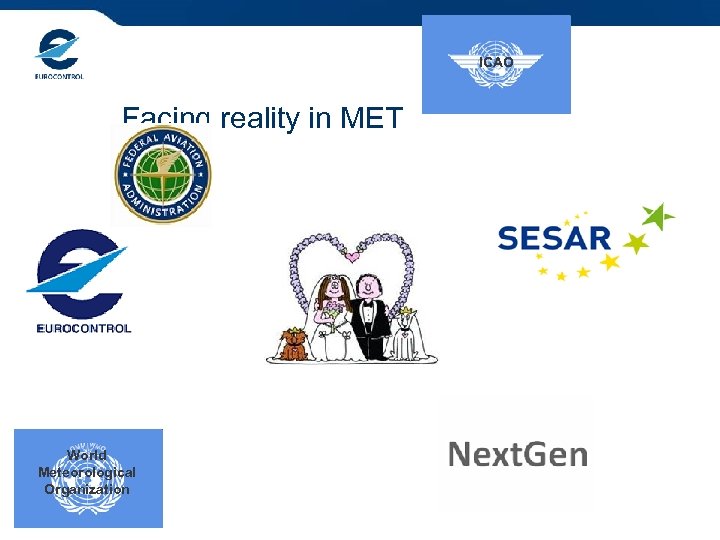 ICAO Facing reality in MET World Meteorological Organization
 ‘lean and mean’ WXXM from AIRM • Developing the AIRM whilst assuring global interoperability for the coming years • AIRM WXXM • Pragmatic • Automated (preferably) • SESAR centric • Designated task in P 08. 01. 06 • Question raised: Can we have a WXXM derived from the AIRM CLDM v. v. ?
 This image can only be used for AIS AGORA Promotion. The reproduction of the individual logos and their use requires the permission of the respective owner
 Solution Sets, the options
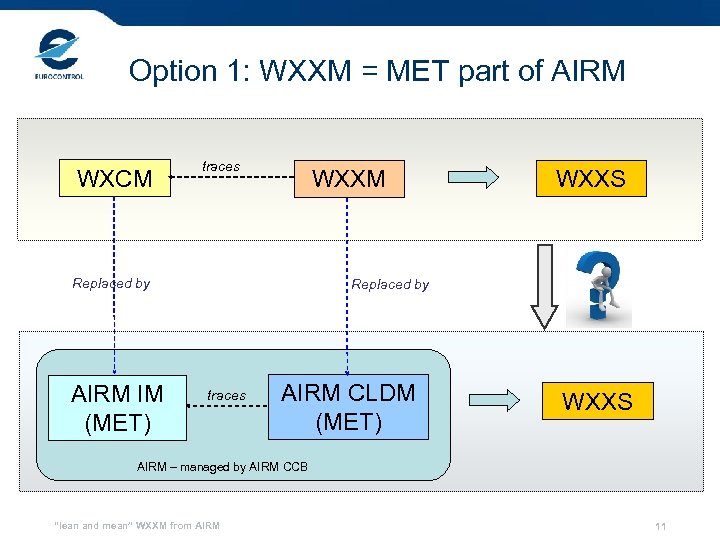 Option 1: WXXM = MET part of AIRM WXCM traces WXXM Replaced by AIRM IM (MET) WXXS Replaced by traces AIRM CLDM (MET) WXXS AIRM – managed by AIRM CCB “lean and mean” WXXM from AIRM 11
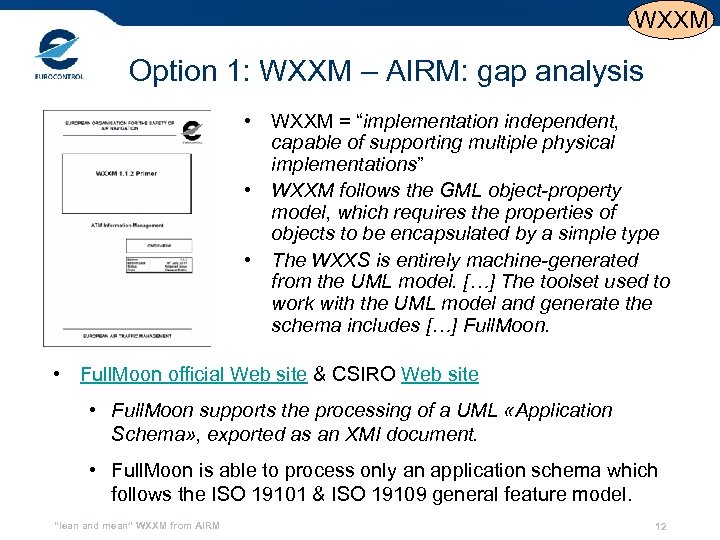 WXXM Option 1: WXXM – AIRM: gap analysis • WXXM = “implementation independent, capable of supporting multiple physical implementations” • WXXM follows the GML object-property model, which requires the properties of objects to be encapsulated by a simple type • The WXXS is entirely machine-generated from the UML model. […] The toolset used to work with the UML model and generate the schema includes […] Full. Moon. • Full. Moon official Web site & CSIRO Web site • Full. Moon supports the processing of a UML «Application Schema» , exported as an XMI document. • Full. Moon is able to process only an application schema which follows the ISO 19101 & ISO 19109 general feature model. “lean and mean” WXXM from AIRM 12
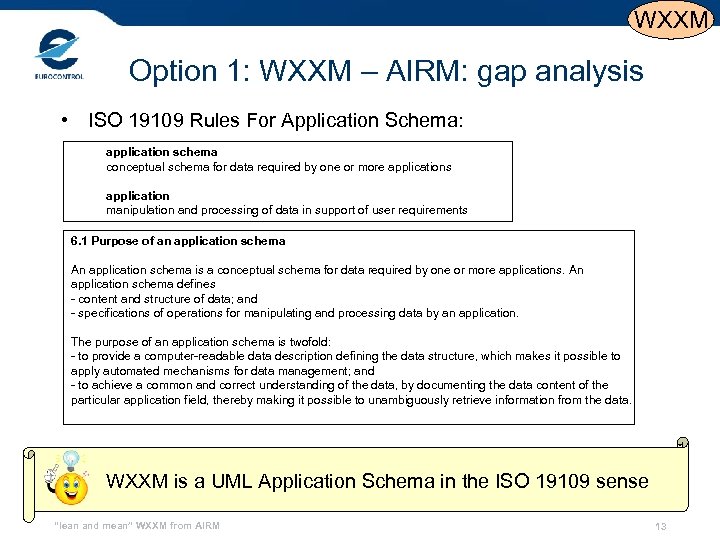 WXXM Option 1: WXXM – AIRM: gap analysis • ISO 19109 Rules For Application Schema: application schema conceptual schema for data required by one or more applications application manipulation and processing of data in support of user requirements 6. 1 Purpose of an application schema An application schema is a conceptual schema for data required by one or more applications. An application schema defines - content and structure of data; and - specifications of operations for manipulating and processing data by an application. The purpose of an application schema is twofold: - to provide a computer-readable data description defining the data structure, which makes it possible to apply automated mechanisms for data management; and - to achieve a common and correct understanding of the data, by documenting the data content of the particular application field, thereby making it possible to unambiguously retrieve information from the data. WXXM is a UML Application Schema in the ISO 19109 sense “lean and mean” WXXM from AIRM 13
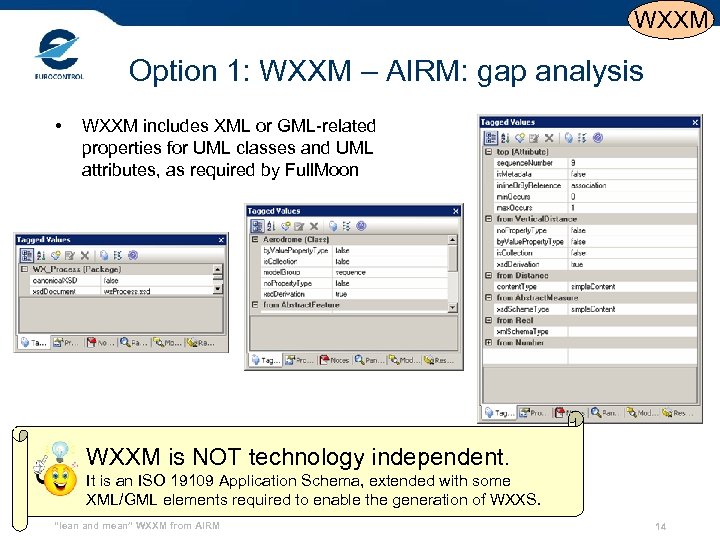 WXXM Option 1: WXXM – AIRM: gap analysis • WXXM includes XML or GML-related properties for UML classes and UML attributes, as required by Full. Moon WXXM is NOT technology independent. It is an ISO 19109 Application Schema, extended with some XML/GML elements required to enable the generation of WXXS. “lean and mean” WXXM from AIRM 14
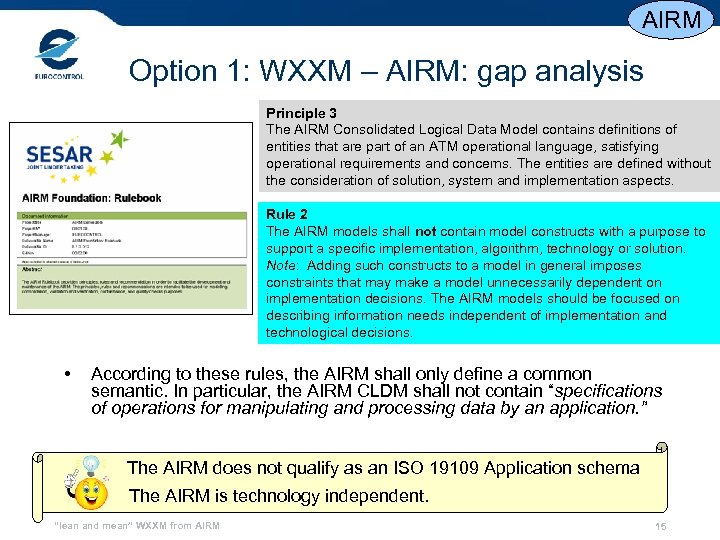 AIRM Option 1: WXXM – AIRM: gap analysis Principle 3 The AIRM Consolidated Logical Data Model contains definitions of entities that are part of an ATM operational language, satisfying operational requirements and concerns. The entities are defined without the consideration of solution, system and implementation aspects. Rule 2 The AIRM models shall not contain model constructs with a purpose to support a specific implementation, algorithm, technology or solution. Note: Adding such constructs to a model in general imposes constraints that may make a model unnecessarily dependent on implementation decisions. The AIRM models should be focused on describing information needs independent of implementation and technological decisions. • According to these rules, the AIRM shall only define a common semantic. In particular, the AIRM CLDM shall not contain “specifications of operations for manipulating and processing data by an application. ” The AIRM does not qualify as an ISO 19109 Application schema The AIRM is technology independent. “lean and mean” WXXM from AIRM 15
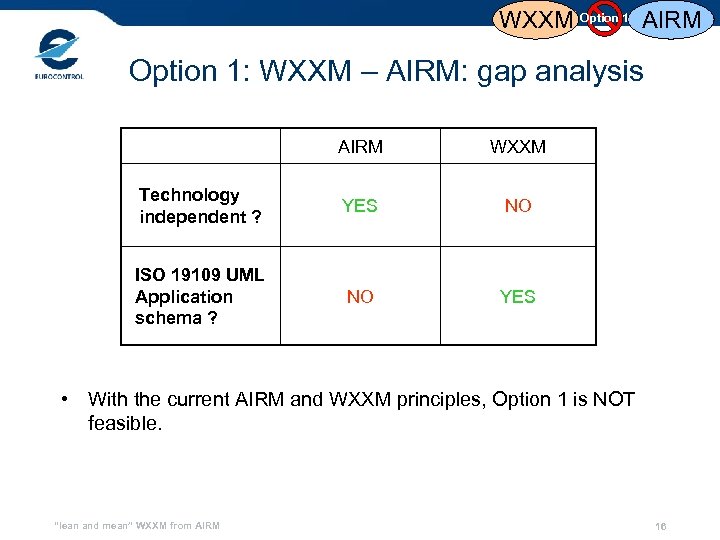 WXXM Option 1 AIRM Option 1: WXXM – AIRM: gap analysis AIRM WXXM Technology independent ? YES NO ISO 19109 UML Application schema ? NO YES • With the current AIRM and WXXM principles, Option 1 is NOT feasible. “lean and mean” WXXM from AIRM 16
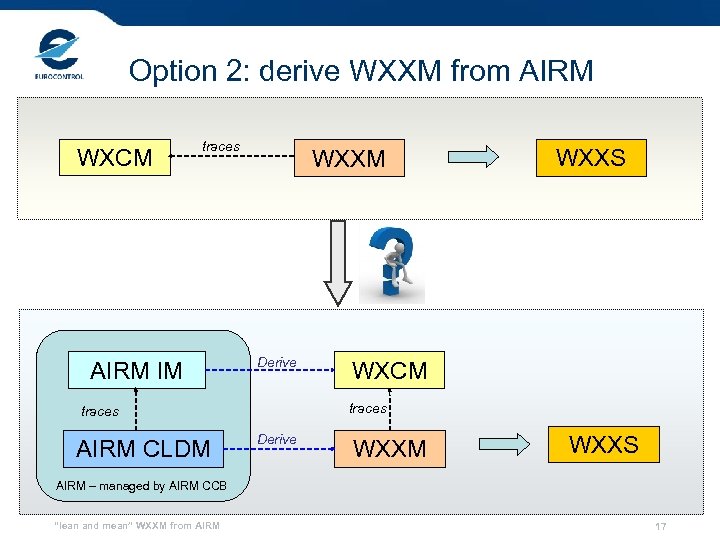 Option 2: derive WXXM from AIRM WXCM traces AIRM IM WXXM Derive WXCM traces AIRM CLDM WXXS Derive WXXM WXXS AIRM – managed by AIRM CCB “lean and mean” WXXM from AIRM 17
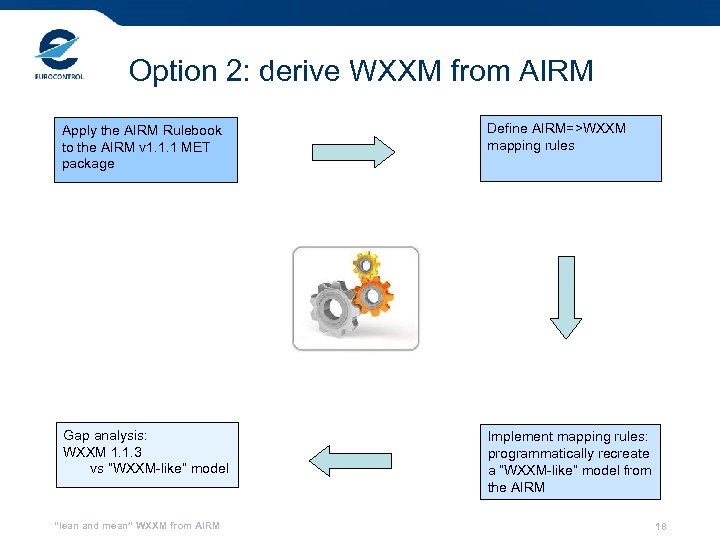 Option 2: derive WXXM from AIRM Apply the AIRM Rulebook to the AIRM v 1. 1. 1 MET package Define AIRM=>WXXM mapping rules Gap analysis: WXXM 1. 1. 3 vs “WXXM-like” model Implement mapping rules: programmatically recreate a “WXXM-like” model from the AIRM “lean and mean” WXXM from AIRM 18
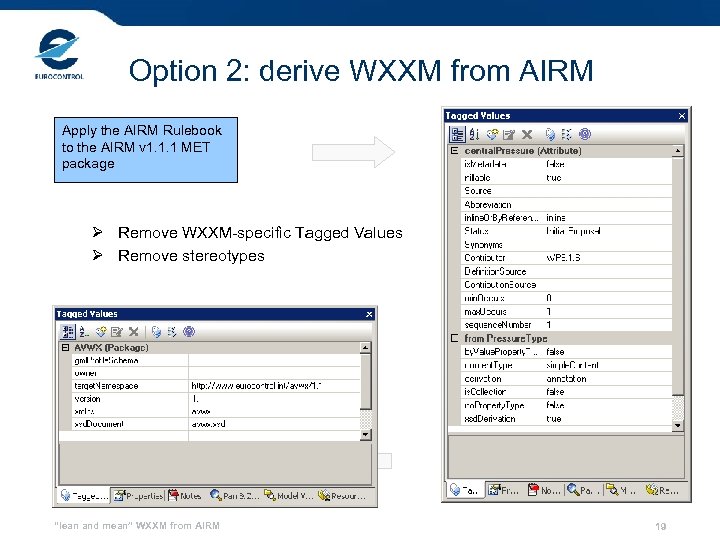 Option 2: derive WXXM from AIRM Apply the AIRM Rulebook to the AIRM v 1. 1. 1 MET package Define AIRM=>WXXM mapping rules Ø Remove WXXM-specific Tagged Values Ø Remove stereotypes Gap analysis: WXXM 1. 1. 3 vs “WXXM-like” model “lean and mean” WXXM from AIRM Implement mapping rules: programmatically recreate a “WXXM-like” model from the AIRM 19
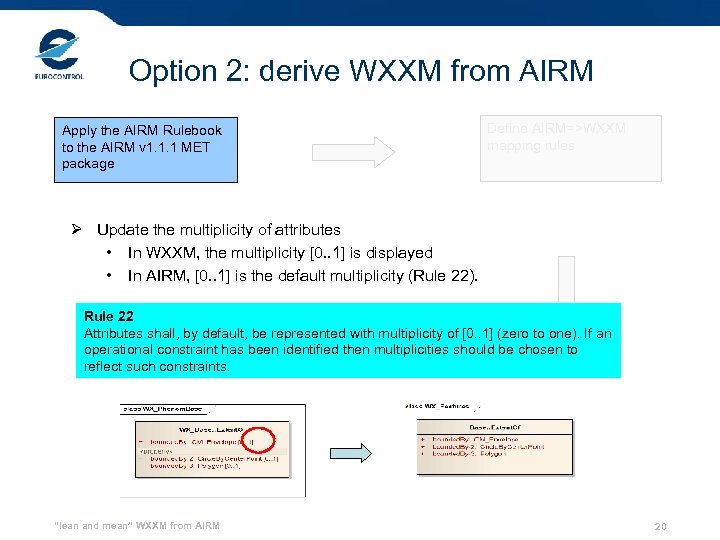 Option 2: derive WXXM from AIRM Apply the AIRM Rulebook to the AIRM v 1. 1. 1 MET package Define AIRM=>WXXM mapping rules Ø Update the multiplicity of attributes • In WXXM, the multiplicity [0. . 1] is displayed • In AIRM, [0. . 1] is the default multiplicity (Rule 22). Rule 22 Attributes shall, by default, be represented with multiplicity of [0. . 1] (zero to one). If an operational constraint has been identified then multiplicities should be chosen to reflect such constraints. Gap analysis: WXXM 1. 1. 3 vs “WXXM-like” model “lean and mean” WXXM from AIRM Implement mapping rules: programmatically recreate a “WXXM-like” model from the AIRM 20
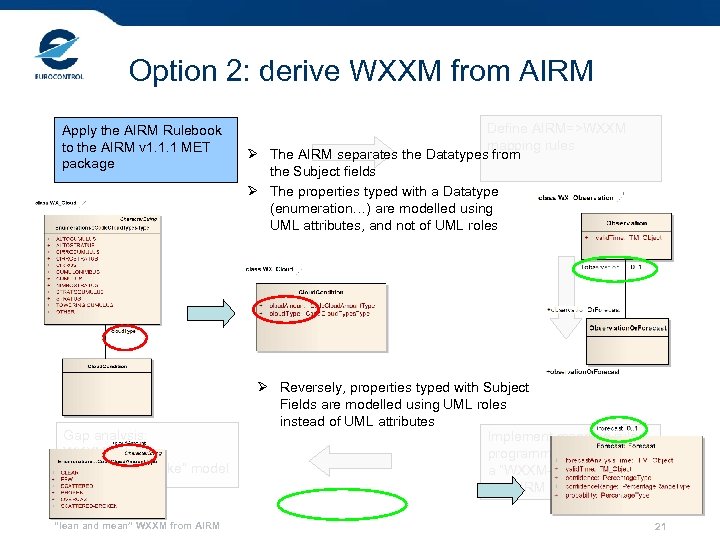 Option 2: derive WXXM from AIRM Apply the AIRM Rulebook to the AIRM v 1. 1. 1 MET package Gap analysis: WXXM 1. 1. 3 vs “WXXM-like” model “lean and mean” WXXM from AIRM Define AIRM=>WXXM mapping rules Ø The AIRM separates the Datatypes from the Subject fields Ø The properties typed with a Datatype (enumeration…) are modelled using UML attributes, and not of UML roles Ø Reversely, properties typed with Subject Fields are modelled using UML roles instead of UML attributes Implement mapping rules: programmatically recreate a “WXXM-like” model from the AIRM 21
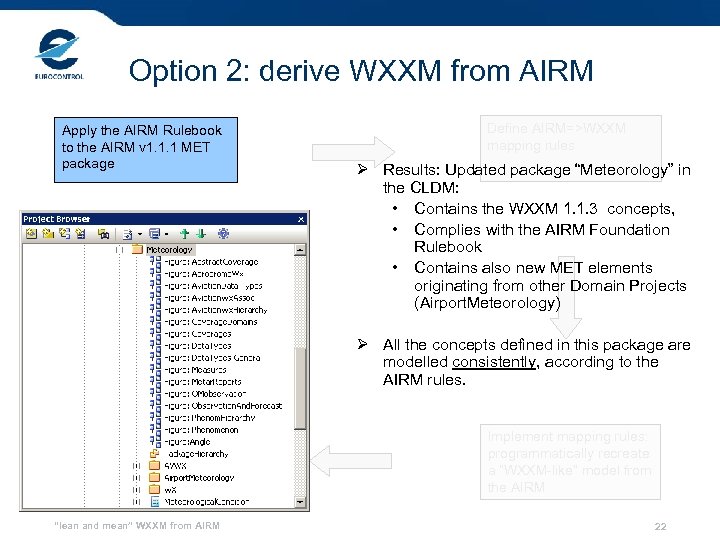 Option 2: derive WXXM from AIRM Apply the AIRM Rulebook to the AIRM v 1. 1. 1 MET package Define AIRM=>WXXM mapping rules Ø Results: Updated package “Meteorology” in the CLDM: • Contains the WXXM 1. 1. 3 concepts, • Complies with the AIRM Foundation Rulebook • Contains also new MET elements originating from other Domain Projects (Airport. Meteorology) Ø All the concepts defined in this package are modelled consistently, according to the AIRM rules. Gap analysis: WXXM 1. 1. 3 vs “WXXM-like” model “lean and mean” WXXM from AIRM Implement mapping rules: programmatically recreate a “WXXM-like” model from the AIRM 22
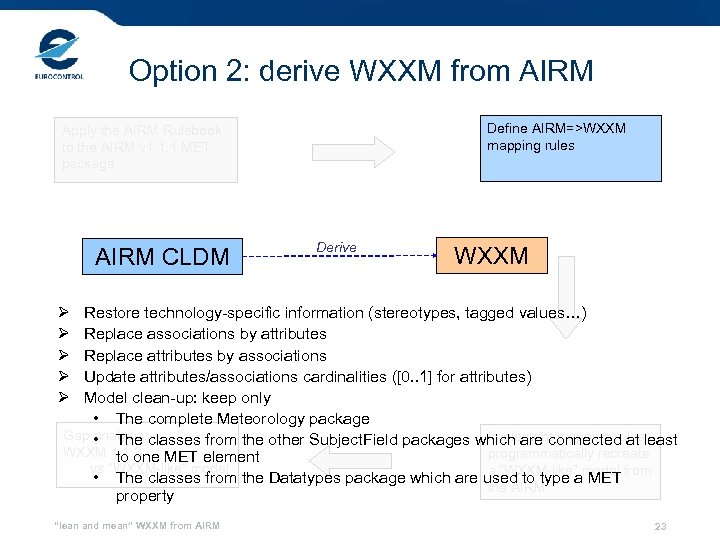 Option 2: derive WXXM from AIRM Define AIRM=>WXXM mapping rules Apply the AIRM Rulebook to the AIRM v 1. 1. 1 MET package AIRM CLDM Derive WXXM Ø Ø Ø Restore technology-specific information (stereotypes, tagged values…) Replace associations by attributes Replace attributes by associations Update attributes/associations cardinalities ([0. . 1] for attributes) Model clean-up: keep only • The complete Meteorology package Gap • The classes from the other Subject. Field packages which are connected at least analysis: Implement mapping rules: WXXM 1. 1. 3 programmatically recreate to one MET element vs “WXXM-like” model a “WXXM-like” model from • The classes from the Datatypes package which are used to type a MET the AIRM property “lean and mean” WXXM from AIRM 23
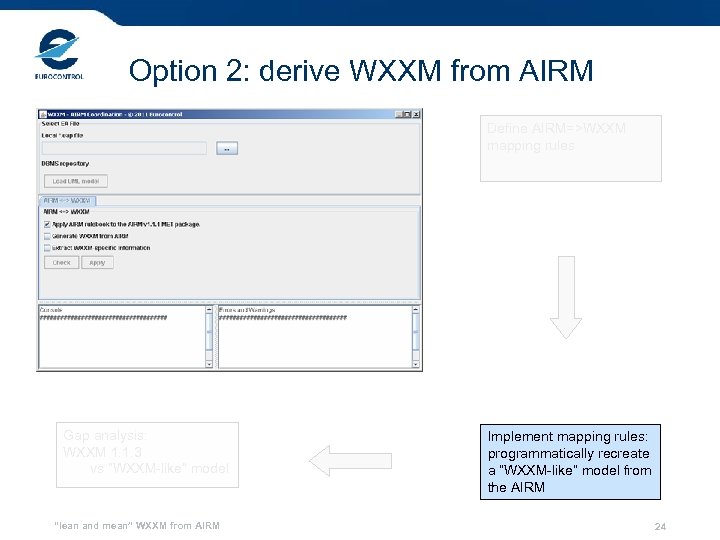 Option 2: derive WXXM from AIRM Apply the AIRM Rulebook to the AIRM v 1. 1. 1 MET package Define AIRM=>WXXM mapping rules Gap analysis: WXXM 1. 1. 3 vs “WXXM-like” model Implement mapping rules: programmatically recreate a “WXXM-like” model from the AIRM “lean and mean” WXXM from AIRM 24
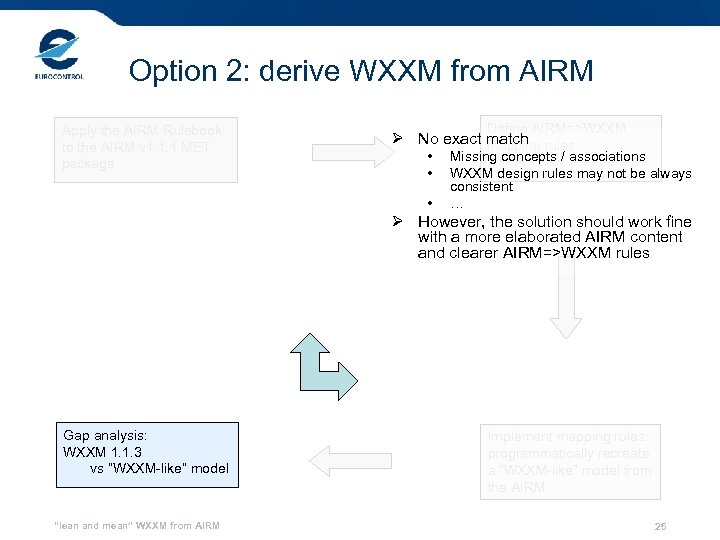 Option 2: derive WXXM from AIRM Apply the AIRM Rulebook to the AIRM v 1. 1. 1 MET package Define AIRM=>WXXM Ø No exact match rules mapping • • • Missing concepts / associations WXXM design rules may not be always consistent … Ø However, the solution should work fine with a more elaborated AIRM content and clearer AIRM=>WXXM rules Gap analysis: WXXM 1. 1. 3 vs “WXXM-like” model “lean and mean” WXXM from AIRM Implement mapping rules: programmatically recreate a “WXXM-like” model from the AIRM 25
 Option 2: derive WXXM from AIRM • Option 2 is feasible, provided the right mapping rules are specified • Option 2 does not question the AIRM foundation rules nor the key WXXM principles • The mapping can be (partially) automated • WXXM can become an “AIRM-compliant” ISO 19109 Application Schema for Aviation Meteorology “lean and mean” WXXM from AIRM 26
 Looking now at the bigger picture… • Let’s take a step back and look at the subject from a broader perspective ! • We are trying to map a subset of AIRM concepts into an ISO 19109 Application Schema and subsequent physical model • This is NOT specific to the MET Domain ! “lean and mean” WXXM from AIRM 27
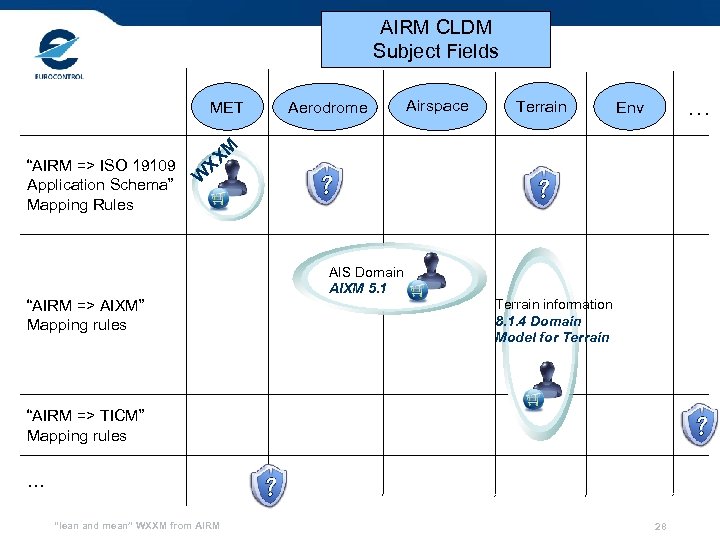 AIRM CLDM Subject Fields MET “AIRM => ISO 19109 Application Schema” Mapping Rules W Aerodrome Airspace Terrain … Env XM X “AIRM => AIXM” Mapping rules AIS Domain AIXM 5. 1 Terrain information 8. 1. 4 Domain Model for Terrain “AIRM => TICM” Mapping rules … “lean and mean” WXXM from AIRM 28
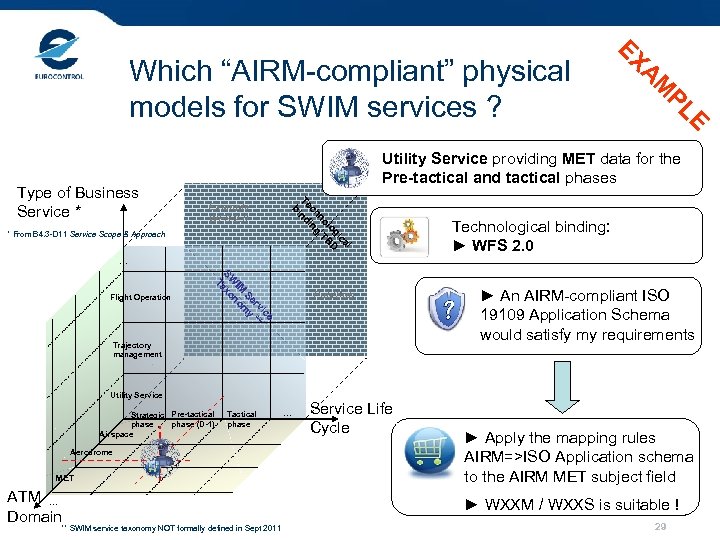 A M E PL Utility Service providing MET data for the Pre-tactical and tactical phases Example: WFS 2. 0 * From B 4. 3 -D 11 Service Scope & Approach l ca gi lo BD no T ch ing Te ind b Type of Business Service * EX Which “AIRM-compliant” physical models for SWIM services ? Technological binding: ► WFS 2. 0 … e ic rv ** Se my IM no SW axo T Flight Operation Pub/Sub … Trajectory management Utility Service Strategic Pre-tactical phase (D-1) phase Airspace Tactical phase Aerodrome MET ATM … Domain and mean” WXXM from AIRM “lean ** SWIM service taxonomy NOT formally defined in Sept 2011 … Service Life Cycle ► An AIRM-compliant ISO 19109 Application Schema would satisfy my requirements ► Apply the mapping rules AIRM=>ISO Application schema to the AIRM MET subject field ► WXXM / WXXS is suitable ! 29
 Conclusion • The AIRM defines the shared ATM concepts & the AIRM governance is now up and running • WP B is moving forward with regards to the definition of the SWIM Service taxonomy • Some 8. 1. x projects have started to map subsets of the AIRM CLDM into other models that enable the generation of ad-hoc physical models • Time to close the loop and prototype the services ! “lean and mean” WXXM from AIRM 30
 “lean and mean” WXXM from AIRM 31