 Скачать презентацию FNR 407 Forest Economics William L Bill Hoover
803a5aa2bb0af00ee961316ef8d1fb84.ppt
- Количество слайдов: 13



FNR 407 Forest Economics William L. (Bill) Hoover Professor of Forestry 494 -3580 743 -4120 whoover@purdue. edu
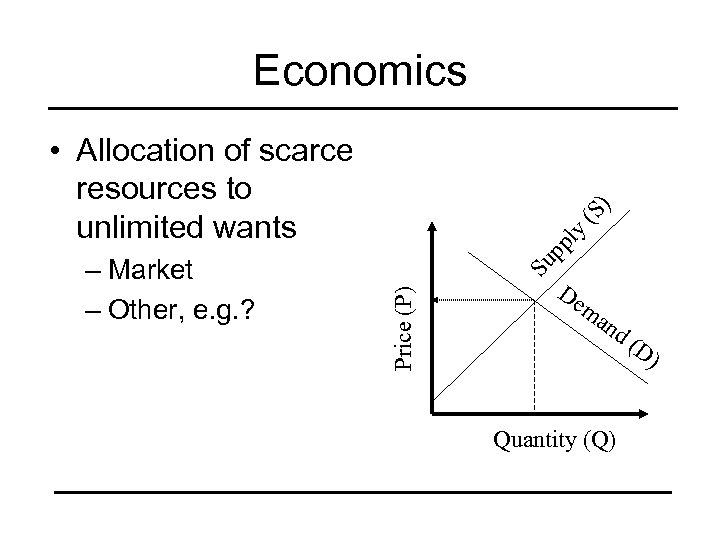
Economics y pp l Su Price (P) – Market – Other, e. g. ? (S ) • Allocation of scarce resources to unlimited wants De ma nd (D ) Quantity (Q)
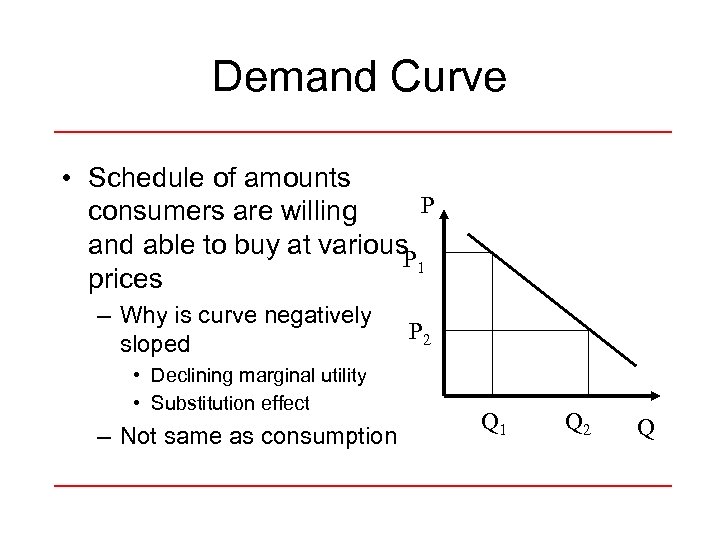
Demand Curve • Schedule of amounts P consumers are willing and able to buy at various. P 1 prices – Why is curve negatively sloped • Declining marginal utility • Substitution effect – Not same as consumption P 2 Q 1 Q 2 Q
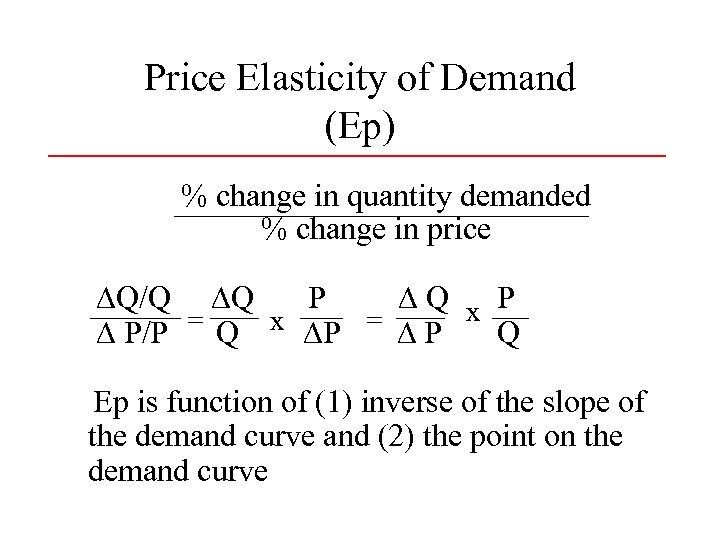
Price Elasticity of Demand (Ep) % change in quantity demanded % change in price ∆Q/Q ∆Q P ∆Q x P ∆ P/P = Q x ∆P = ∆ P Q Ep is function of (1) inverse of the slope of the demand curve and (2) the point on the demand curve
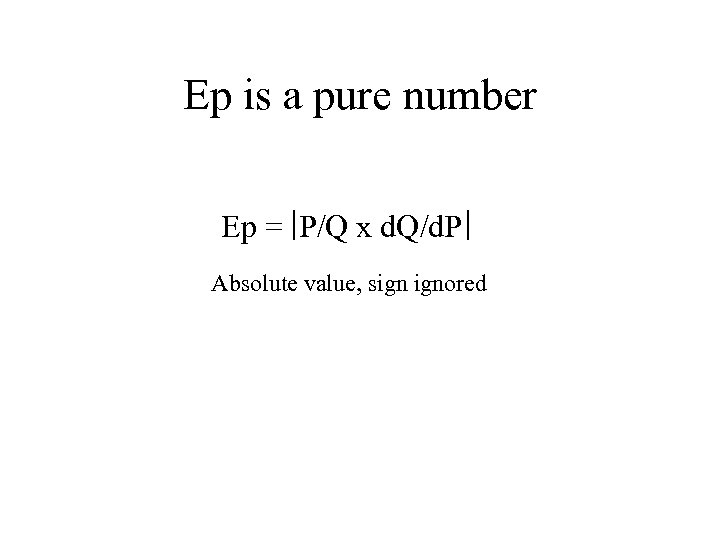
Ep is a pure number Ep = P/Q x d. Q/d. P Absolute value, sign ignored
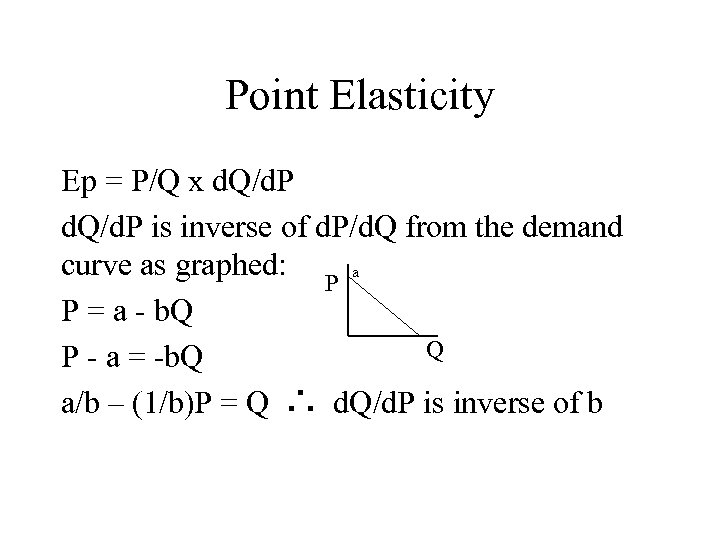
Point Elasticity Ep = P/Q x d. Q/d. P is inverse of d. P/d. Q from the demand curve as graphed: P a P = a - b. Q Q P - a = -b. Q a/b – (1/b)P = Q ∴ d. Q/d. P is inverse of b
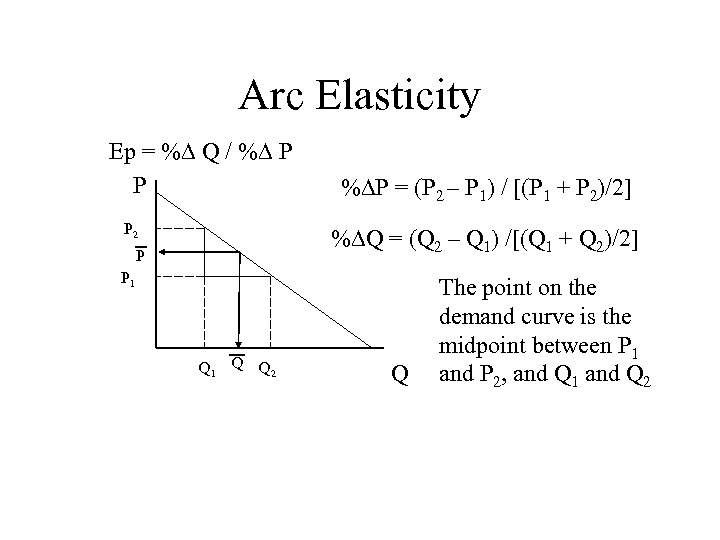
Arc Elasticity Ep = %∆ Q / %∆ P P P 2 %∆P = (P 2 – P 1) / [(P 1 + P 2)/2] %∆Q = (Q 2 – Q 1) /[(Q 1 + Q 2)/2] P P 1 Q Q 2 Q The point on the demand curve is the midpoint between P 1 and P 2, and Q 1 and Q 2
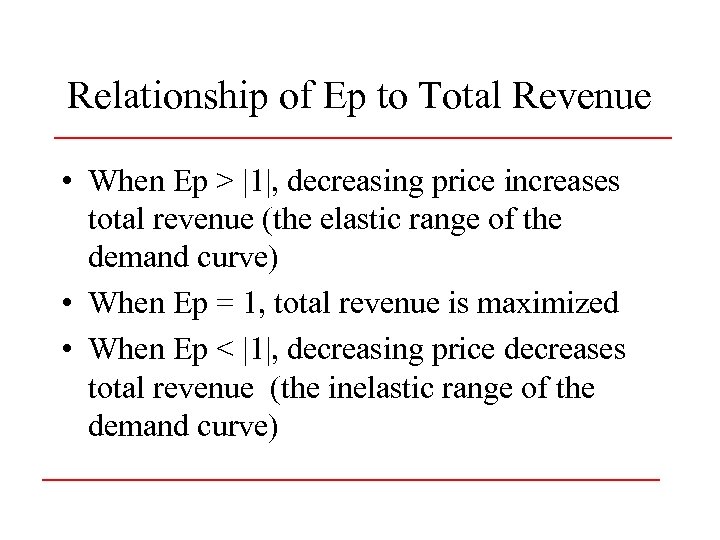
Relationship of Ep to Total Revenue • When Ep > |1|, decreasing price increases total revenue (the elastic range of the demand curve) • When Ep = 1, total revenue is maximized • When Ep < |1|, decreasing price decreases total revenue (the inelastic range of the demand curve)
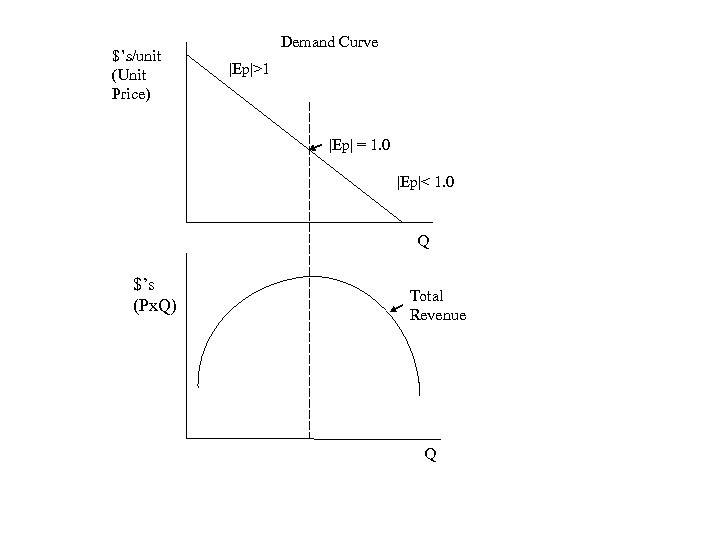
$’s/unit (Unit Price) Demand Curve |Ep|>1 |Ep| = 1. 0 |Ep|< 1. 0 Q $’s (Px. Q) Total Revenue Q
Marginality • Given the function Y = f(X), – Marginal change is change in Y per unit change in X – ∆Y/ ∆X, or – d. Y/d. X (first derivative of Y with respect to X • Example – Y ≡ yield, X ≡ year – d. Y/d. X = current annual increment – Y/X = mean annual increment
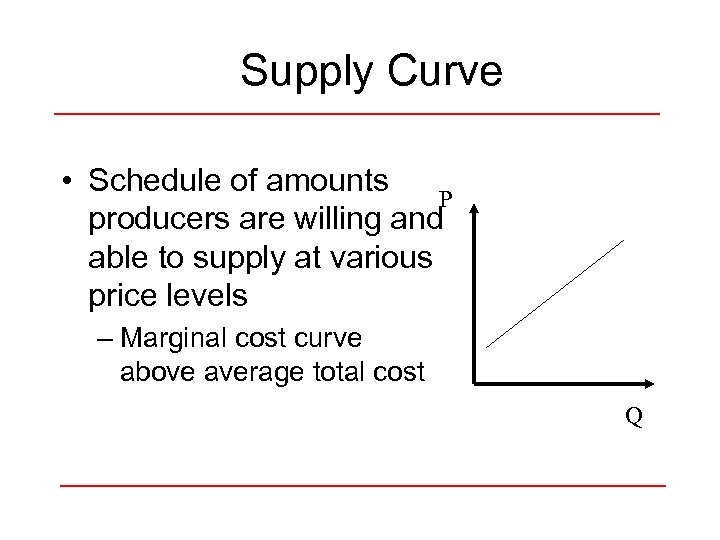
Supply Curve • Schedule of amounts P producers are willing and able to supply at various price levels – Marginal cost curve above average total cost Q
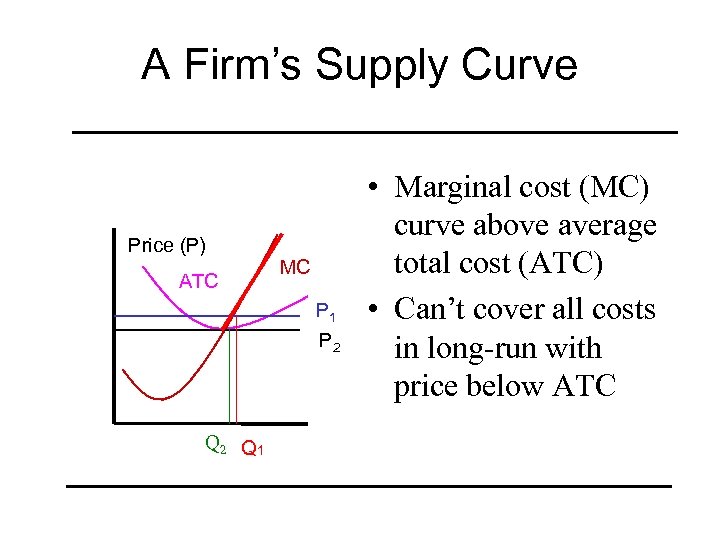
A Firm’s Supply Curve Price (P) ATC MC P 1 P 2 Q 1 • Marginal cost (MC) curve above average total cost (ATC) • Can’t cover all costs in long-run with price below ATC
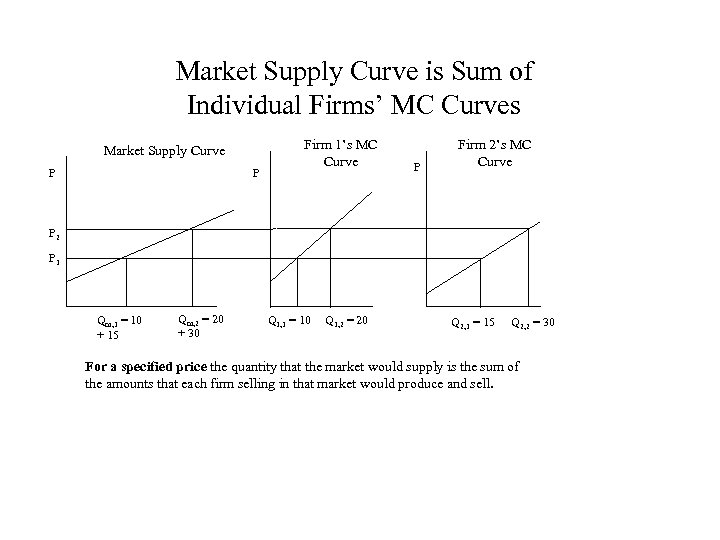
Market Supply Curve is Sum of Individual Firms’ MC Curves Market Supply Curve P P Firm 1’s MC Curve P Firm 2’s MC Curve P 2 P 1 Qm, 1 = 10 + 15 Qm, 2 = 20 + 30 Q 1, 1 = 10 Q 1, 2 = 20 Q 2, 1 = 15 Q 2, 2 = 30 For a specified price the quantity that the market would supply is the sum of the amounts that each firm selling in that market would produce and sell.
Скачать презентацию FNR 407 Forest Economics William L Bill Hoover
803a5aa2bb0af00ee961316ef8d1fb84.ppt