


 Скачать презентацию Fluxion The Compara GRID Data Integration Architecture Matthew
761634a0aa3bde33a8dbf64ca47c103a.ppt
- Количество слайдов: 20
 Fluxion: The Compara. GRID Data Integration Architecture Matthew Pocock, Tony Burdett, Rob Davey, Andrew Gibson, Trevor Paterson Bio. Models 2007
 The Collaboration “Developing a GRID-based system for integrating and exploring data from comparative genomics, to discover biological knowledge that can not be discovered from any one source” ● Collaborative BBSRC project – ● 5 sites across the UK 3/19/2018 http: //3/19/2018 www. comparagrid. org 3/1 9/2018 Bio. Models 2007
 Fluxion ● ● ● Our data-integration platform Must support comparative genomics We would like it to be broadly re-useable Bio. Models 2007
 Motivations ● Data and “knowledge” about genomics is in many databases – – ● ● ● General Species-specific Process-specific … Then there’s all the things we use to interpret genomics No unified schema / format / formalisation No common location But ● We are pretty sure that useful stuff is waiting to be uncovered by joining these together Bio. Models 2007
 Same problem everywhere ● These issues are common among all of us – – ● Genomics Pathways/modelling Buying a house … Want to minimise how much of the process is performed by people So ● Need to describe what we want formally ● Tools to work with these descriptions Bio. Models 2007
 Target users? ● ● ● Want wide adoption Provide maximal choice about real-life deployment Hide all details from end-user Standard deployable stack with minimal effort Allow 3 rd parties to publish different views of raw data sources Different views for different communities Bio. Models 2007
 Tech Choices ● ● ● Java 5 Haskell Web services – – ● SOAP / WSDL XFire – – Protégé 4 Wonderweb OWL API OWL-DL Bio. Models 2007
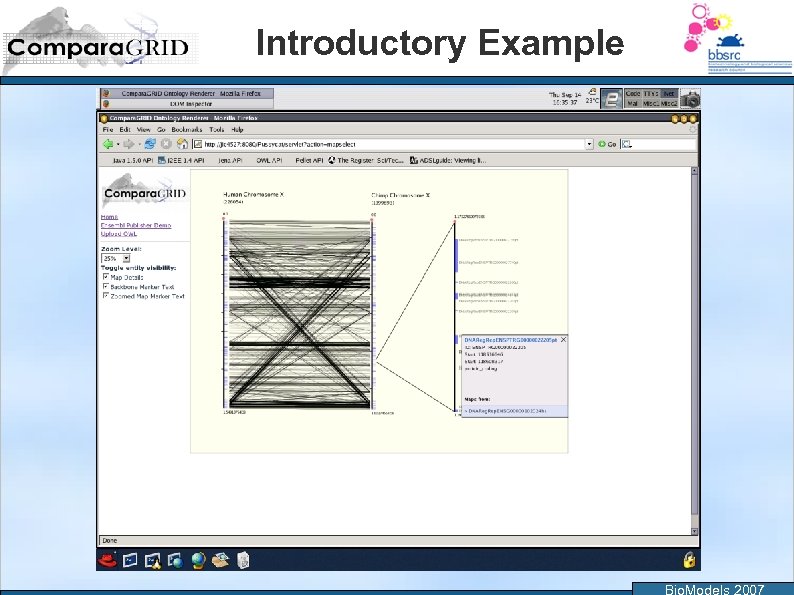 Introductory Example Bio. Models 2007
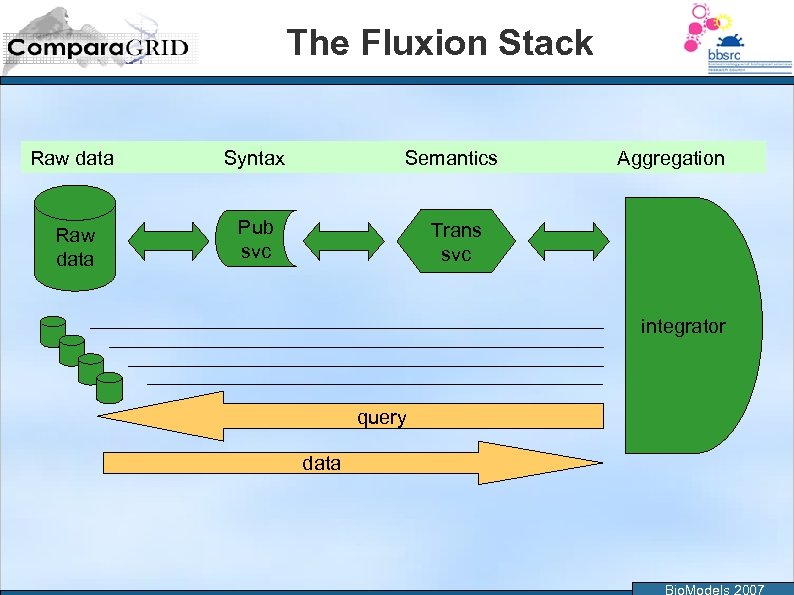 The Fluxion Stack Raw data Syntax Semantics Raw data Pub svc Aggregation Trans svc integrator query data Bio. Models 2007
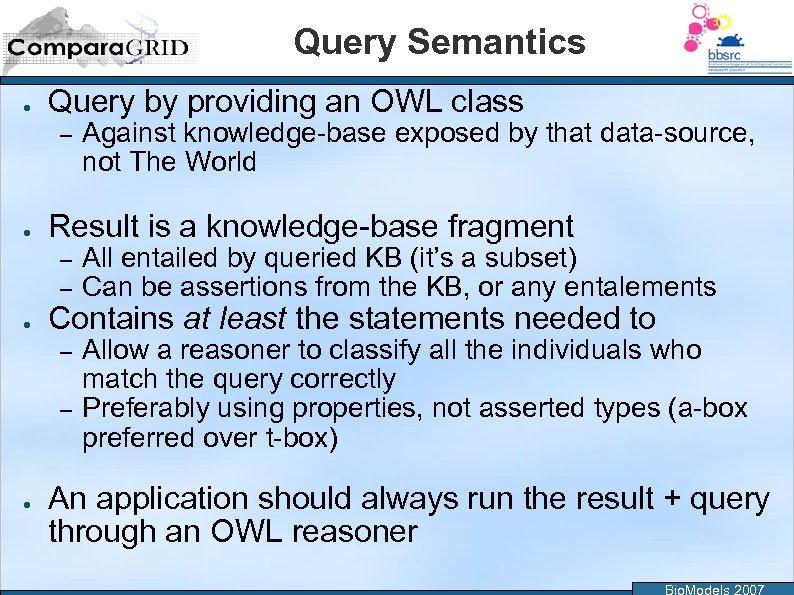 Query Semantics ● Query by providing an OWL class – ● Against knowledge-base exposed by that data-source, not The World Result is a knowledge-base fragment – – – ● All entailed by queried KB (it’s a subset) Can be assertions from the KB, or any entalements Allow a reasoner to classify all the individuals who match the query correctly Preferably using properties, not asserted types (a-box preferred over t-box) Contains at least the statements needed to – ● An application should always run the result + query through an OWL reasoner Bio. Models 2007
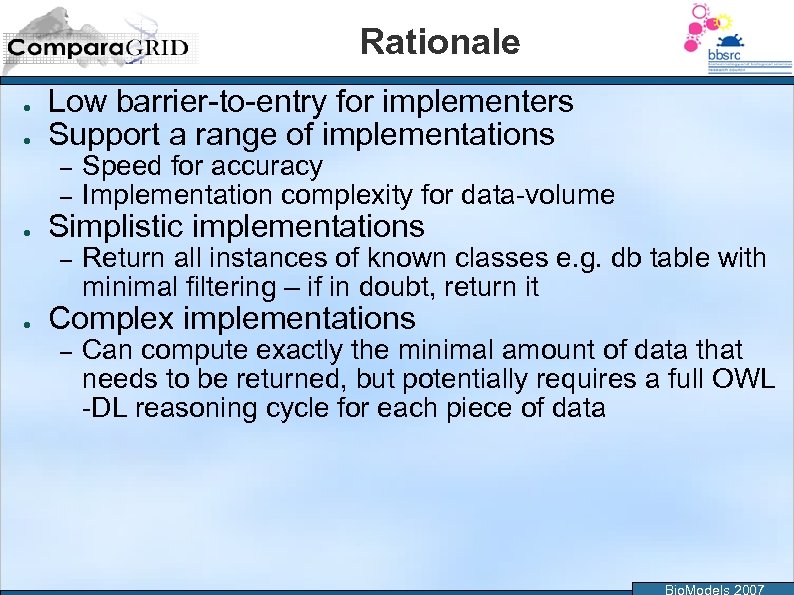 Rationale ● ● Low barrier-to-entry for implementers Support a range of implementations – – – ● ● Speed for accuracy Implementation complexity for data-volume Return all instances of known classes e. g. db table with minimal filtering – if in doubt, return it Simplistic implementations Complex implementations – Can compute exactly the minimal amount of data that needs to be returned, but potentially requires a full OWL -DL reasoning cycle for each piece of data Bio. Models 2007
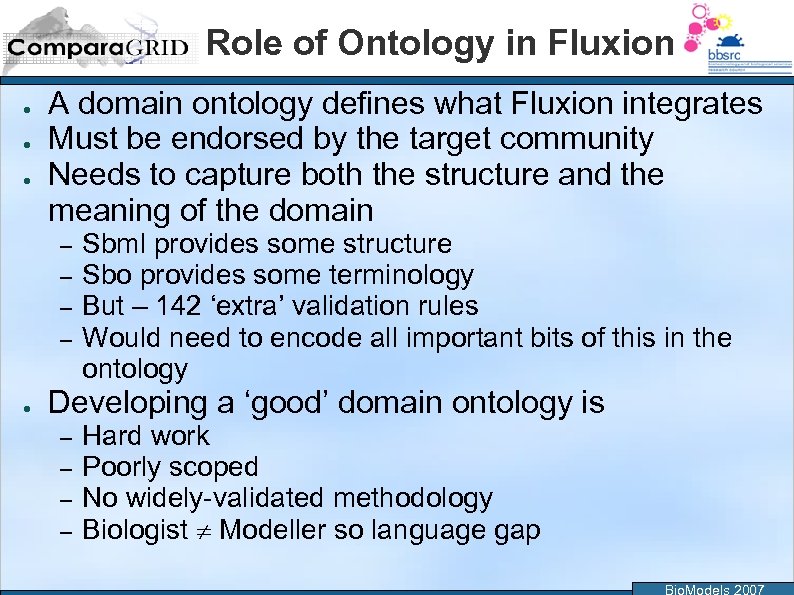 Role of Ontology in Fluxion ● ● ● A domain ontology defines what Fluxion integrates Must be endorsed by the target community Needs to capture both the structure and the meaning of the domain – – ● Sbml provides some structure Sbo provides some terminology But – 142 ‘extra’ validation rules Would need to encode all important bits of this in the ontology Developing a ‘good’ domain ontology is – – Hard work Poorly scoped No widely-validated methodology Biologist Modeller so language gap Bio. Models 2007
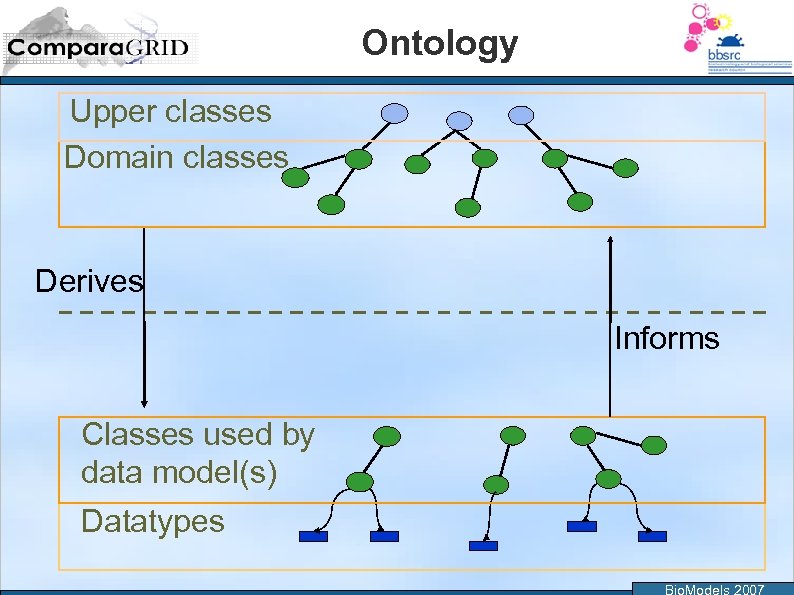 Ontology Upper classes Domain classes Derives Informs Classes used by data model(s) Datatypes Bio. Models 2007
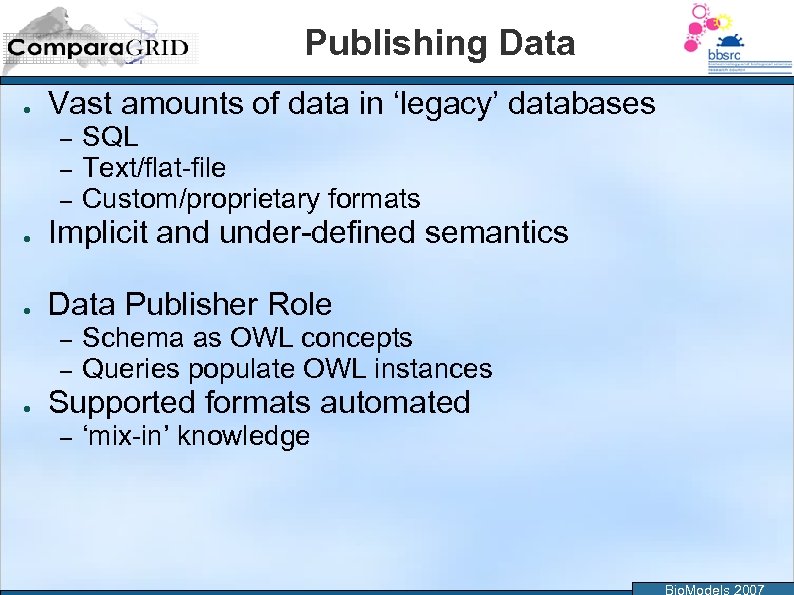 Publishing Data ● Vast amounts of data in ‘legacy’ databases – – – SQL Text/flat-file Custom/proprietary formats ● Implicit and under-defined semantics ● Data Publisher Role – – ● Schema as OWL concepts Queries populate OWL instances Supported formats automated – ‘mix-in’ knowledge Bio. Models 2007
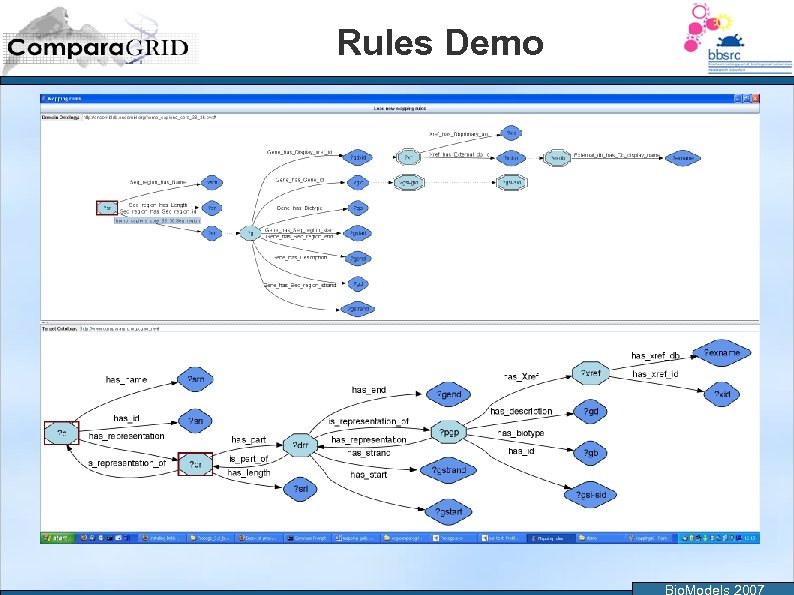
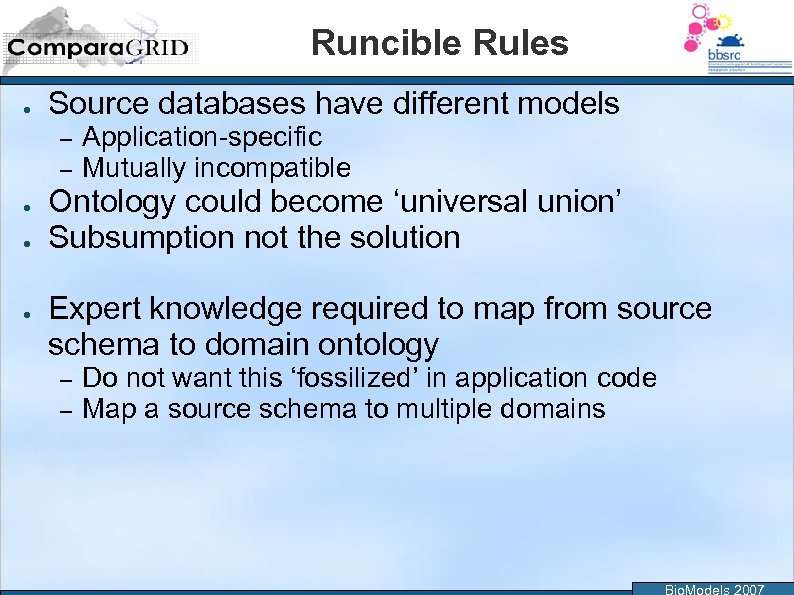 Runcible Rules ● Source databases have different models – – ● ● ● Application-specific Mutually incompatible Ontology could become ‘universal union’ Subsumption not the solution Expert knowledge required to map from source schema to domain ontology – – Do not want this ‘fossilized’ in application code Map a source schema to multiple domains Bio. Models 2007
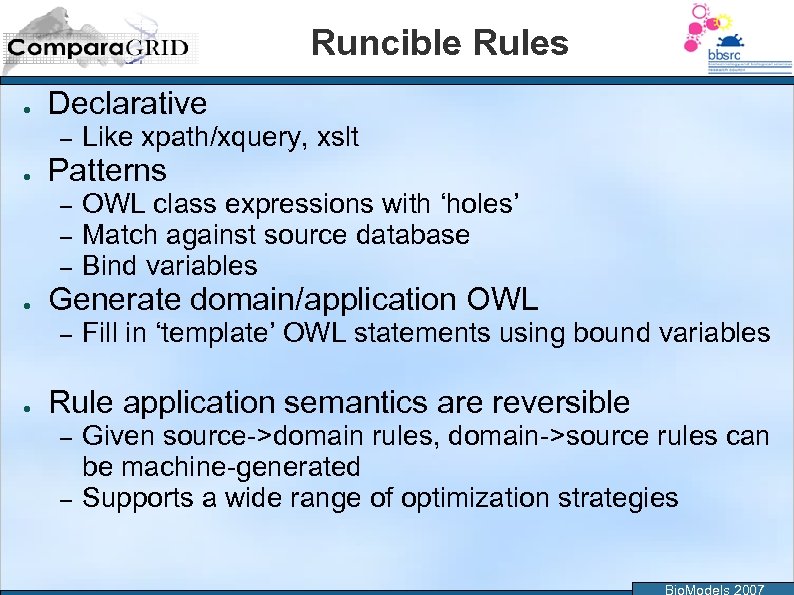 Runcible Rules ● Declarative – ● Patterns – – – ● OWL class expressions with ‘holes’ Match against source database Bind variables Generate domain/application OWL – ● Like xpath/xquery, xslt Fill in ‘template’ OWL statements using bound variables Rule application semantics are reversible – – Given source->domain rules, domain->source rules can be machine-generated Supports a wide range of optimization strategies Bio. Models 2007
 Rules Demo Bio. Models 2007
 Where Are We? ● Did first live demos in Oct, Nov – – ● ● ● Held together by string Got 1 week to make them work for everyone Web services work as of Xmas Automated publishing of SQL -> OWL works now Data protection rules work for expert user Browser has been working since ISMB, but constantly improves Protégé plugins need re-writing for Protégé 4 Will be available to download (alpha users) once our ISMB paper is in Bio. Models 2007
 Acknowledgements • Newcastle – – – – Anil Wipat Darren Wilkinson Richard Boys Matthew Pocock Madhu Bhattacharjee Dan Swan Phil Lord • EBI – Peter Rice – Tony Burdett • Manchester – Robert Stevens – Andrew Gibson • Roslin – Andy Law – Trevor Patterson • John Innes Centre – Jo Dicks – Rob Davey 3/19/2018 http: //deanmoor. ncl. ac. uk/blogs 3/19/2018 http: //deanmoor. ncl. ac. uk/websvn 3/19/2018 http: //www. comparagrid. org 3/19/2018 mailto: comparagrid@lists. bbsrc. ac. uk Bio. Models 2007