


 Скачать презентацию Fluid Earth 2 Launch Meeting Fluid Earth 2
efd23219571b7d879d9e4b9074aecf4e.ppt
- Количество слайдов: 16
 Fluid. Earth 2 Launch Meeting Fluid. Earth 2: Motivations and Opportunities HR Wallingford, 18 th April 2013 Ian. Townend
 Open. MI Motivations To provide a mechanism for physical and socio-economic models to be linked to each other, other data sources and tools at runtime. To enable the linking of models for different: • Domains and environments ‐ hydraulics, hydrology, ecology, water quality, economics, etc ‐ atmospheric, freshwater, marine, terrestrial, urban, rural, etc • Modelling concepts (deterministic, stochastic etc. ); • Dimensionality (0, 1, 2, 3 D); • Scales (e. g. a regional climate model to a catchment runoff model); • Temporal resolutions (e. g. hourly to monthly or even annual); • Spatial representations (e. g. networks, grids, polygons); • Projections, units and categorizations; That link to: • Other data sources (e. g. databases, user interfaces, instruments); • Models running on different platforms (e. g. Windows, Unix and Linux) • Models run on different computers. Page 2 © HR Wallingford 2011
 “We are therefore seeking to explore better ways of : • identifying and managing new knowledge; • developing a dialogue between key academic partners; • providing the tools needed to reduce duplication of effort within the research community; • making the task of translating research into applications easier; and • increasing the commercial potential of research outputs by creating the necessary critical mass This proposal sets out the basis for a collaborative initiative between the academic community and users to promote the development of a common platform to be used by academics for teaching and research, with a clear path for industry take-up. ” Proposal for a Shared Development Platform to support Research in the Water Environment HR Wallingford, 2007 Page 3 © HR Wallingford 2011
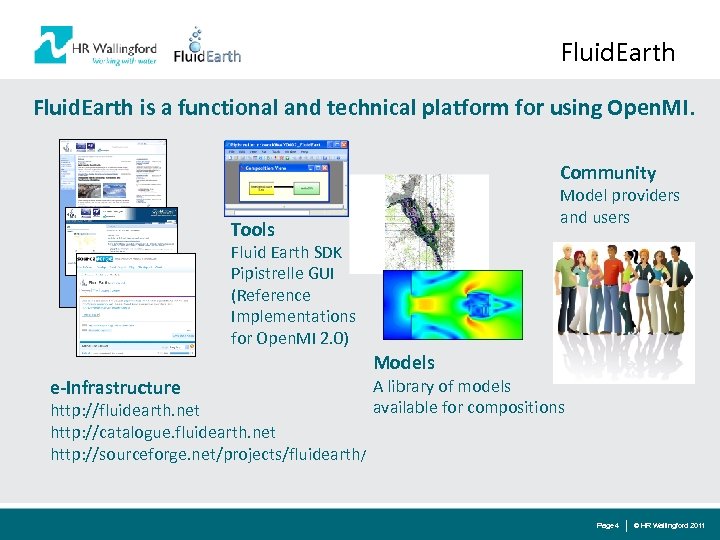 Fluid. Earth is a functional and technical platform for using Open. MI. Community Model providers and users Tools Fluid Earth SDK Pipistrelle GUI (Reference Implementations for Open. MI 2. 0) Models e-Infrastructure http: //fluidearth. net http: //catalogue. fluidearth. net http: //sourceforge. net/projects/fluidearth/ A library of models available for compositions Page 4 © HR Wallingford 2011
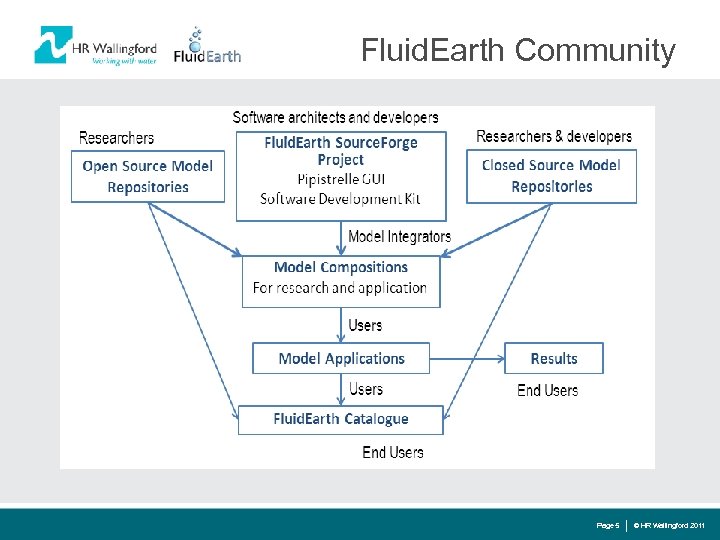 Fluid. Earth Community Page 5 © HR Wallingford 2011
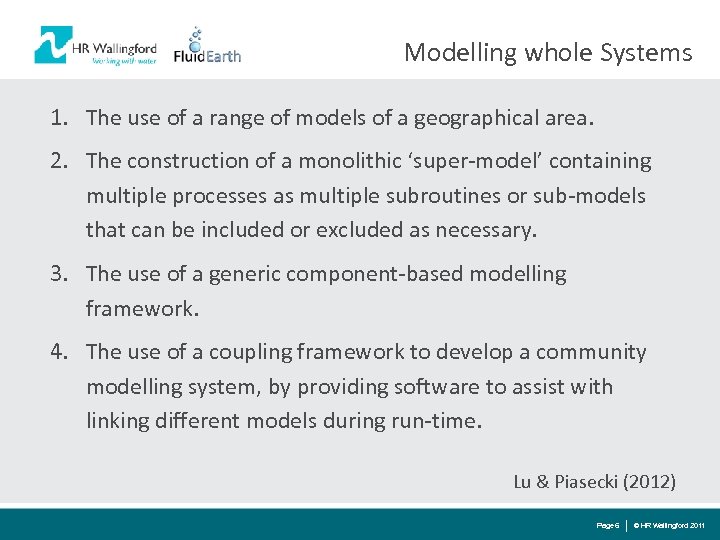 Modelling whole Systems 1. The use of a range of models of a geographical area. 2. The construction of a monolithic ‘super‐model’ containing multiple processes as multiple subroutines or sub‐models that can be included or excluded as necessary. 3. The use of a generic component‐based modelling framework. 4. The use of a coupling framework to develop a community modelling system, by providing software to assist with linking different models during run‐time. Lu & Piasecki (2012) Page 6 © HR Wallingford 2011
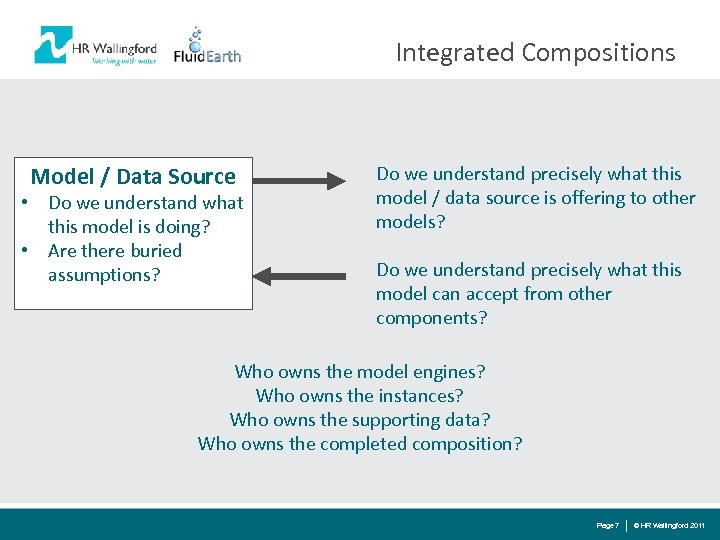 Integrated Compositions Model / Data Source • Do we understand what this model is doing? • Are there buried assumptions? Do we understand precisely what this model / data source is offering to other models? Do we understand precisely what this model can accept from other components? Who owns the model engines? Who owns the instances? Who owns the supporting data? Who owns the completed composition? Page 7 © HR Wallingford 2011
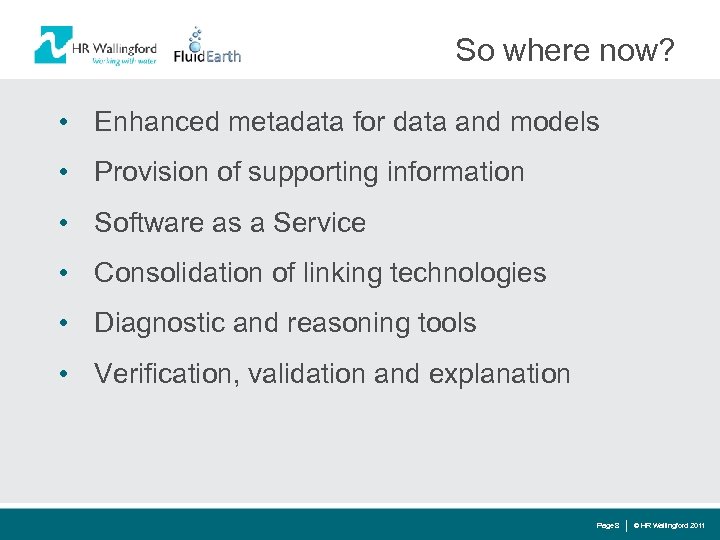 So where now? • Enhanced metadata for data and models • Provision of supporting information • Software as a Service • Consolidation of linking technologies • Diagnostic and reasoning tools • Verification, validation and explanation Page 8 © HR Wallingford 2011
 Enhanced metadata > First step is routine tagging of information > Need to improve: § Standards of model and data documentation § Management of codes (version control, automated testing, etc) Page 9 © HR Wallingford 2011
 Supporting information > Manageable within an organisation § Not dissimilar to distributed databases § Still need protocols and standards > Harvesting externally is a much bigger challenge § Existence, ownership and quality of both data and models § Input/output protocols, understanding of what is being solved, implicit assumptions, etc > Advanced filtering tools to protect from data overload Page 10 © HR Wallingford 2011
 Establish models as services > Cloud, Grid and emerging standards enabling rapid progress > Technology is ahead of “user” community (or even existence of a community) Page 11 © HR Wallingford 2011
 Linking technologies Automate search, discovery and linking > Impossible without established communities > Will need agreed standards > Logical progression from initiatives like the Fluid. Earth Catalogue Page 12 © HR Wallingford 2011
 Diagnostic + reasoning tools > Diagnostics § Assumption testing: may need to develop explicit reporting? § Investigate model interactions and exchanges > Analysis § Tools to support multi-model interpretation, sensitivity and uncertainty analysis > Synthesis § § § Merging data and model information Identifying the consistent AND the inconsistent Weighing the balance of the two Page 13 © HR Wallingford 2011
 Verification & explanation Published verification and validation tests > measures of model skill Handling and communicating outputs > public scepticism about models results > increased complexity can confuse, obfuscate, or mislead > audit trail needs to be consistently documented > tools needed to drill down from high level outputs to supporting information, models, and data Page 14 © HR Wallingford 2011
 Conclusions These advances should > Deliver the next steps in integrated modelling § Interoperable modelling § Modelling and data integration § Modelling as a service > Deliver improved reasoning capabilities > BUT will require a community to develop that is willing to share existing resources These are our thoughts. Today we want you to help us shape the way forward Page 15 © HR Wallingford 2011
 www. hrwallingford. com HR Wallingford Howbery Park, Wallingford, Oxfordshire OX 10 8 BA, United Kingdom tel +44 (0)1491 835381 fax +44 (0)1491 832233 email info@hrwallingford. com