


 Скачать презентацию Flourishing within to real happiness 1 Why
Flourishing within.ppt
- Количество слайдов: 36
 Flourishing within to real happiness 1
 Why ? • Some wiser, gentler <-> hard-hearted to other • Exper. +radiating joy <-> anxious, fearful • Cope with suffering <-> fall apart under suffer self-interest < well-being of total situation Nelson Mandela, Marten Luther King, Mother Theresa, Thich Nhat Hanh, Etty Hillesum, … 2
 Moments of real happiness • World sometimes seems to open itself totally present and accessable to us • But we open us to field of our experience : -we are totally present and accessable -we are free from restraint and defence -we are beyond hope and fear --- joy of life comes by joy around us compassion by suffering that we see 3
 Open field of experience • Tells us about our mind, existence : • unconditional openess (also to our anxiety, moments of closedness, and accepting it) makes it visible and frees our mind of defence and blindness to whatever exists • our happiness can handle in a healthy way both good luck ànd bad luck • Your moments of real happiness ? (groups) 4
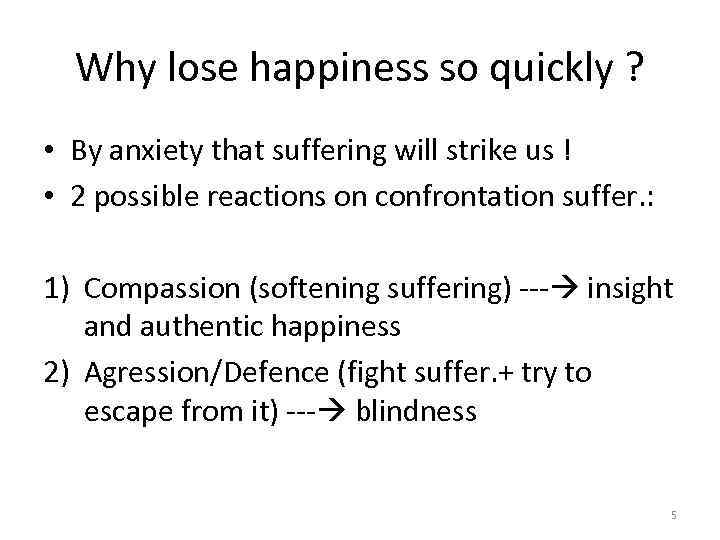 Why lose happiness so quickly ? • By anxiety that suffering will strike us ! • 2 possible reactions on confrontation suffer. : 1) Compassion (softening suffering) --- insight and authentic happiness 2) Agression/Defence (fight suffer. + try to escape from it) --- blindness 5
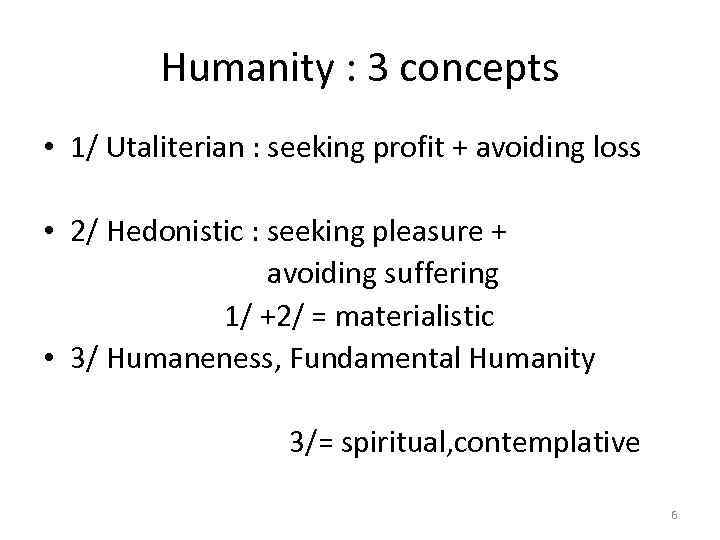 Humanity : 3 concepts • 1/ Utaliterian : seeking profit + avoiding loss • 2/ Hedonistic : seeking pleasure + avoiding suffering 1/ +2/ = materialistic • 3/ Humaneness, Fundamental Humanity 3/= spiritual, contemplative 6
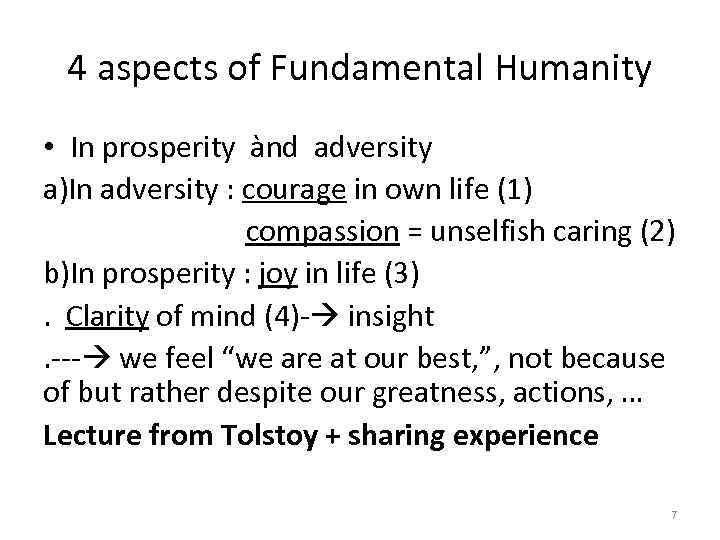 4 aspects of Fundamental Humanity • In prosperity ànd adversity a)In adversity : courage in own life (1) compassion = unselfish caring (2) b)In prosperity : joy in life (3). Clarity of mind (4)- insight. --- we feel “we are at our best, ”, not because of but rather despite our greatness, actions, … Lecture from Tolstoy + sharing experience 7
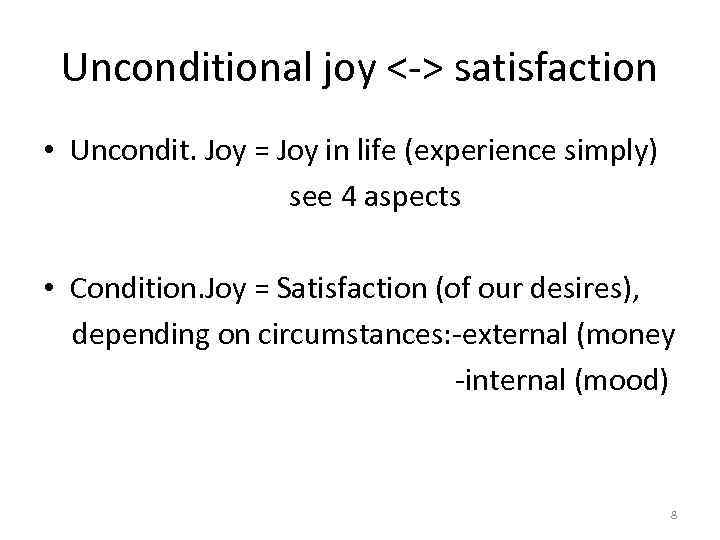 Unconditional joy <-> satisfaction • Uncondit. Joy = Joy in life (experience simply) see 4 aspects • Condition. Joy = Satisfaction (of our desires), depending on circumstances: -external (money -internal (mood) 8
 Compassion, courage, clarity=uncond. • Compass. : not because of duty but we cannot do otherwise • Courage : is not toughness, perseverence, … • Clarity : is not something vaghe is more than having good information knowledge, presence of mind for own interests 9
 Way to Happiness : 2 tips > =“ is more efficient than” • Giving H. > Searching for H. • Clearing inner obstacles to H. > Cultivating H. 10
 Exploring own unenlightened aspects • Discovering moments of ‘wake up’ to our self-deception or illusions (Milarepa) • Reflection and sharing 11
 4 Ego’s • 1) Grammatical : referring to 1 st person sing. • 2) Materialistic : utalitarian and hedonistic • 3) Psycho-(therapeutic) : ego has to be cared, strenghtened, educated, cured if necessary, to become a healthy and respected person . 4) Spiritual : egocentric + egotistic mentality (state of mind) has to be transcended, while 2) and 3) make us anxious and contricted and chokes a Fundamental Humanity Lecture from : Bible (Gal. 2, 2) Rilke Sartre 12
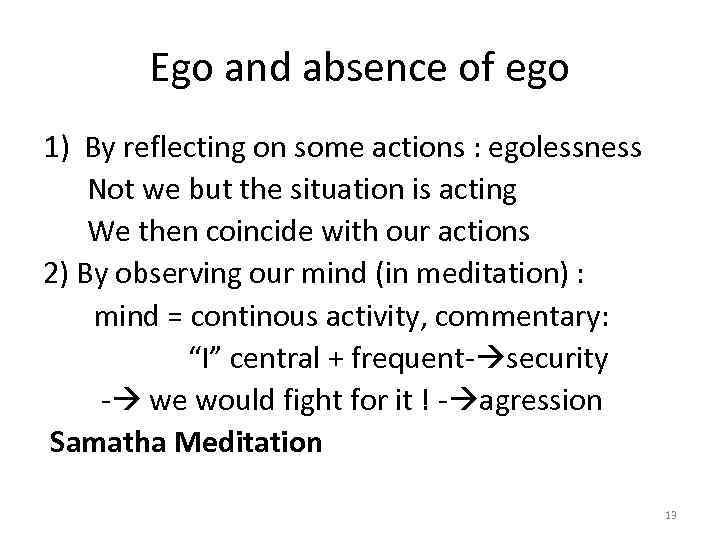 Ego and absence of ego 1) By reflecting on some actions : egolessness Not we but the situation is acting We then coincide with our actions 2) By observing our mind (in meditation) : mind = continous activity, commentary: “I” central + frequent- security - we would fight for it ! - agression Samatha Meditation 13
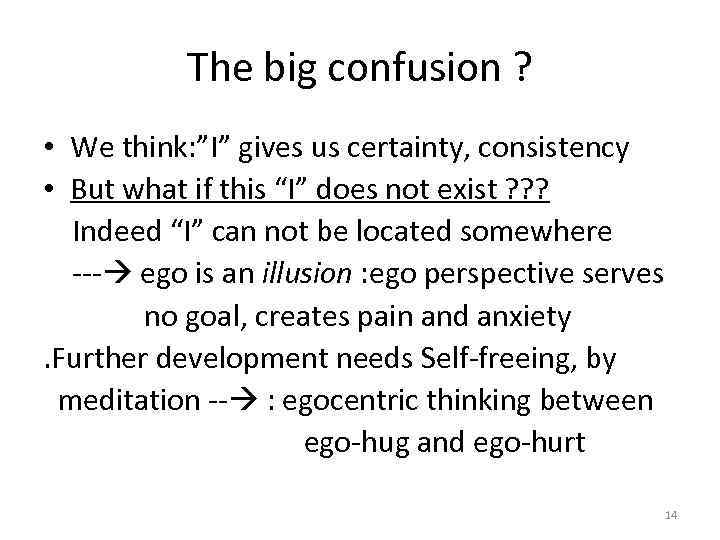 The big confusion ? • We think: ”I” gives us certainty, consistency • But what if this “I” does not exist ? ? ? Indeed “I” can not be located somewhere --- ego is an illusion : ego perspective serves no goal, creates pain and anxiety. Further development needs Self-freeing, by meditation -- : egocentric thinking between ego-hug and ego-hurt 14
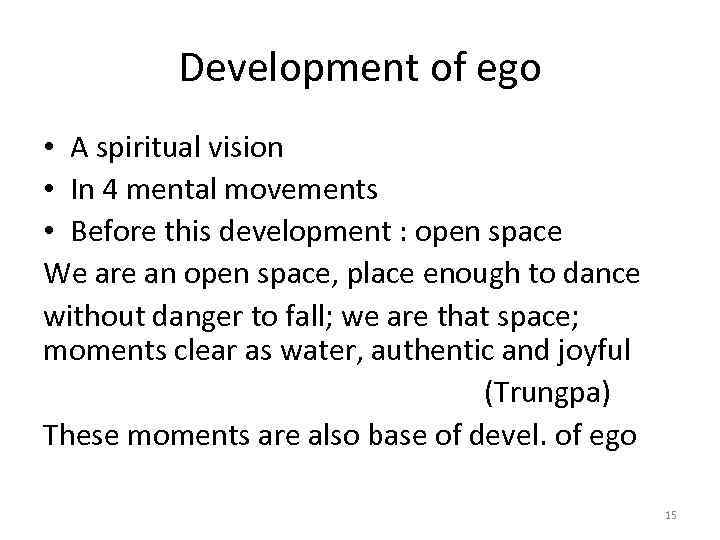 Development of ego • A spiritual vision • In 4 mental movements • Before this development : open space We are an open space, place enough to dance without danger to fall; we are that space; moments clear as water, authentic and joyful (Trungpa) These moments are also base of devel. of ego 15
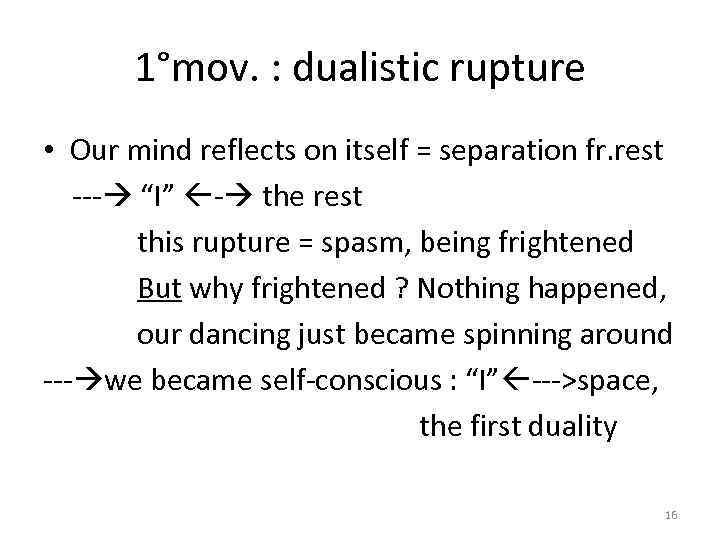 1°mov. : dualistic rupture • Our mind reflects on itself = separation fr. rest --- “I” - the rest this rupture = spasm, being frightened But why frightened ? Nothing happened, our dancing just became spinning around --- we became self-conscious : “I” --->space, the first duality 16
 . • Now we fear to lose control, BUT : 1. we never had real control 2. we never will have real control 3. We never need real control - this ego is not fundament of our existence this ego creates anxiety has no confidence in totaly open space And so we are seaking grasp and support 17
 2°mov. : ego-identification. This grasp can not be found and becomes an endless project=to be someone + proof ourselv. . With time attemps themself become our grasp!. we identify ours. with fhenomena calling it “I” --- this called “I” is fluctuating : as our body, or feeling, or emotions, … : it expands or shrinks, according the situation 18
 3°mov. : decoration of the naked ego • By making stream of thoughts about ourselves and the world. • We decorate ourselves with all kind of ideas, correct ones, foolish ones, joyful ones, … • This self-image construction is the story of, about and for ourselves, an inner administration about who and how we are; a seemingly quite stable construction : a certain strcture and security, a feeling of overview 19
 4°mov. : identification with the selfimage ! Now we are who we think that we are !. 4 movements happen each moment together, a quick and non remarked mental movement. 4 mov. can become visible in meditation. ego is not a thing (against our first impression) ego is a mental activity and suggests to be permanent (but far away from ‘open space’), and is very vulnerable (selfconcept = I) Sharing of our vulnerabilities/irritability 20
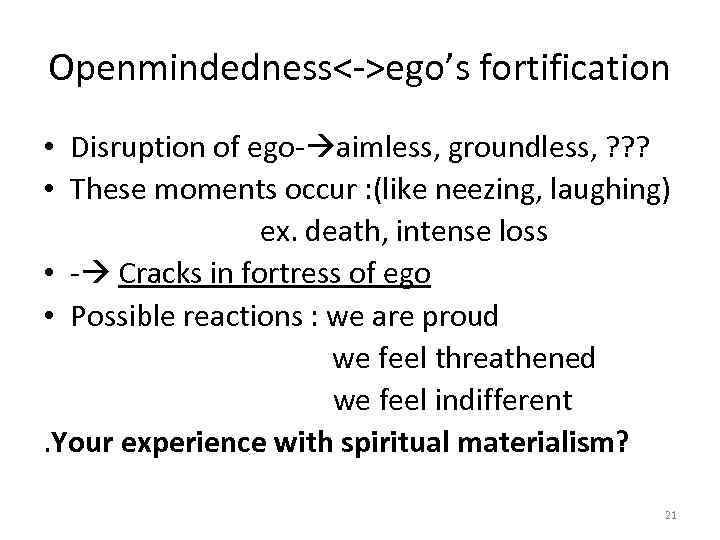 Openmindedness<->ego’s fortification • Disruption of ego- aimless, groundless, ? ? ? • These moments occur : (like neezing, laughing) ex. death, intense loss • - Cracks in fortress of ego • Possible reactions : we are proud we feel threathened we feel indifferent. Your experience with spiritual materialism? 21
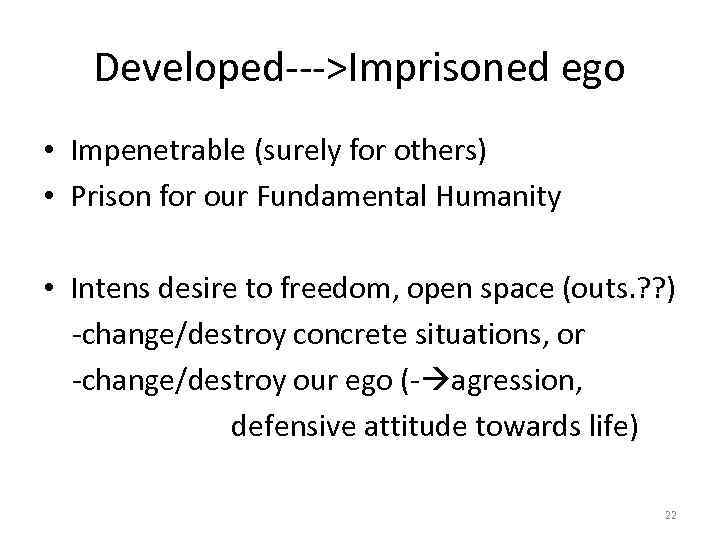 Developed--->Imprisoned ego • Impenetrable (surely for others) • Prison for our Fundamental Humanity • Intens desire to freedom, open space (outs. ? ? ) -change/destroy concrete situations, or -change/destroy our ego (- agression, defensive attitude towards life) 22
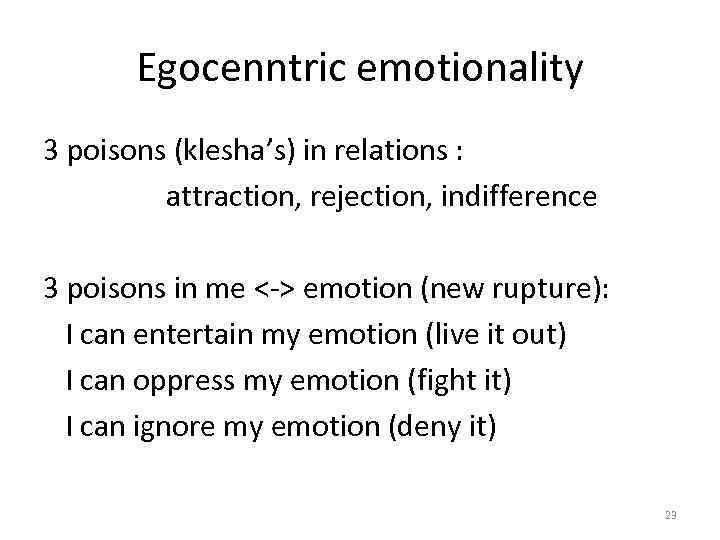 Egocenntric emotionality 3 poisons (klesha’s) in relations : attraction, rejection, indifference 3 poisons in me <-> emotion (new rupture): I can entertain my emotion (live it out) I can oppress my emotion (fight it) I can ignore my emotion (deny it) 23
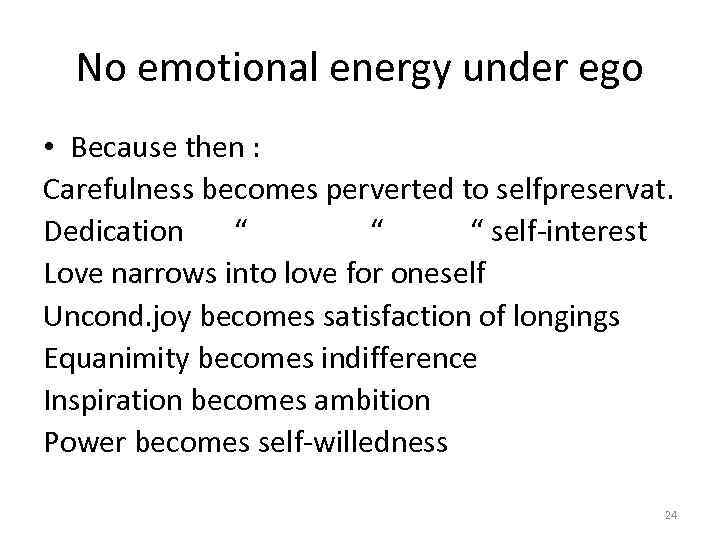 No emotional energy under ego • Because then : Carefulness becomes perverted to selfpreservat. Dedication “ “ “ self-interest Love narrows into love for oneself Uncond. joy becomes satisfaction of longings Equanimity becomes indifference Inspiration becomes ambition Power becomes self-willedness 24
 Disciplines of Mindfulness • Mind = as a wild horse; absent mindedness • Focal point = anchor (concentration, alertness) breathing, object, mantra, … • Sitting, walking, running, working • --- we become more attentive, allert • = preparation on Discipline of Insight • Name : Shamatha (peace, stability) 25
 3 Effects of Mindfulness • 1) peace, stabilitas • 2) simplicity : no thoughts about thoughts “poor in spirit” (Matth. 5. 3) you are the technique(non-dual) • 3 Purity of heart : breaking free of our egocentric emotions, our passions (Matth. 5. 8) 26
 Liberation • from play of hopes and fears to openmindedn: • a) wakeful thoughtlessnes (initally) • b) absense of captivity by our thoughts : - not resisting thoughts - not losing ourselves in thoughts =foundation for the Disciplines of Insight 27
 Disciplines of Insight • “formless meditation”(no concepts, no images) • = nonconceptual, perceptual knowledge • Same technique as Mindfulness, BUT openmindedness is not a goal here, but a means to distinguish between illusion and reality. Based on mental relaxation, not certain effort (ego fears open mindedness, that is egolessn. ) (stick in river) 28
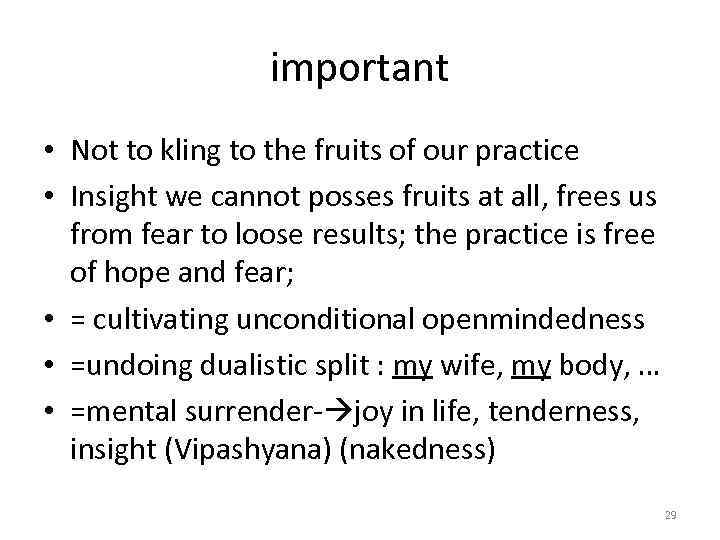 important • Not to kling to the fruits of our practice • Insight we cannot posses fruits at all, frees us from fear to loose results; the practice is free of hope and fear; • = cultivating unconditional openmindedness • =undoing dualistic split : my wife, my body, … • =mental surrender- joy in life, tenderness, insight (Vipashyana) (nakedness) 29
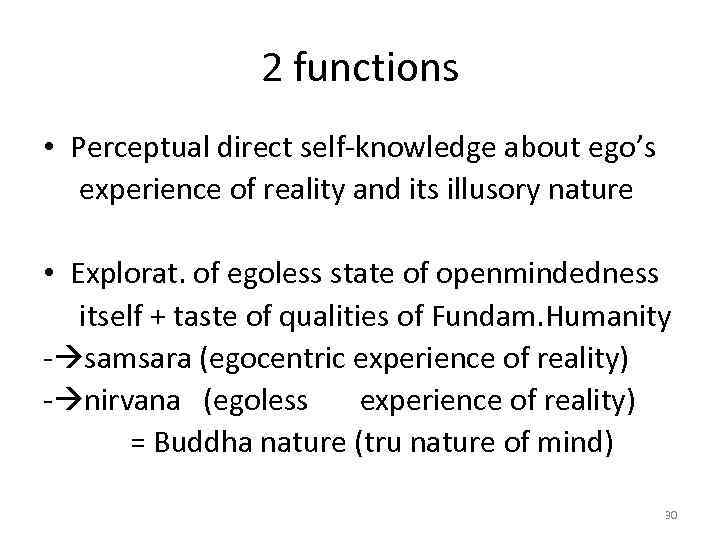 2 functions • Perceptual direct self-knowledge about ego’s experience of reality and its illusory nature • Explorat. of egoless state of openmindedness itself + taste of qualities of Fundam. Humanity - samsara (egocentric experience of reality) - nirvana (egoless experience of reality) = Buddha nature (tru nature of mind) 30
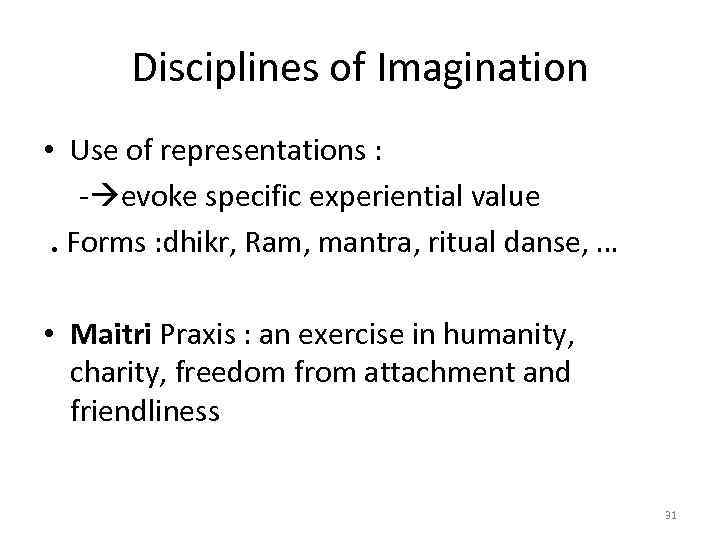 Disciplines of Imagination • Use of representations : - evoke specific experiential value. Forms : dhikr, Ram, mantra, ritual danse, … • Maitri Praxis : an exercise in humanity, charity, freedom from attachment and friendliness 31
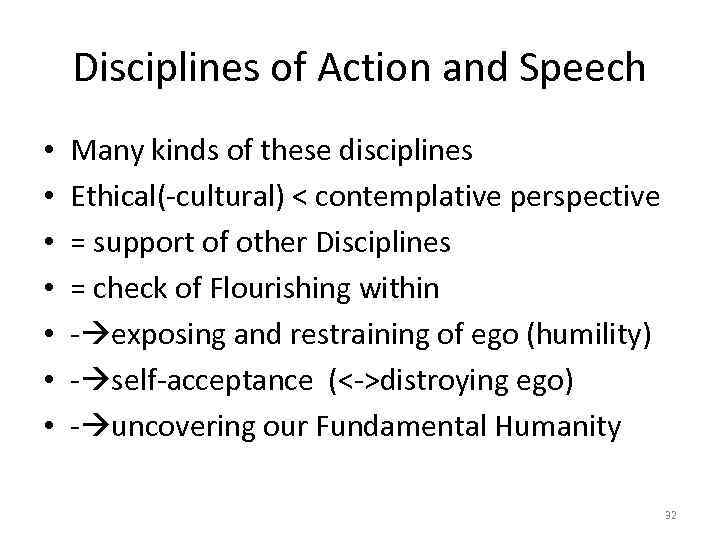 Disciplines of Action and Speech • • Many kinds of these disciplines Ethical(-cultural) < contemplative perspective = support of other Disciplines = check of Flourishing within - exposing and restraining of ego (humility) - self-acceptance (<->distroying ego) - uncovering our Fundamental Humanity 32
 Examples and Significance • Stabilitas loci : // mental stability • Obedience : ego - egolessness • Silence : makes visible need of profiling ourselv we know…for having been silent together • Generosity : (re)discover fundamental wealth • Speaking the truth : lies protect and exalt the fortification of our ego 33
 Guidance • Unconditional trust ? (Marpa, Jesus) • External and internal stability • Internal st. : honesty to our innermost feelings self-acceptance discernment (diakrisi/prajna) trust/faith (pistis) • --- We can tackle our jealousy rather than the object of our jealousy 34
 Akèdia • Akèdia = despair (without care) • = complete openness, but not yet rerecognized as such • - internal stab--->stabil. within=hidden stabil. Magister exterior = magister interior 35
 Bibliography • Han F. de Wit, The Spiritual Path. An Introduction to the Psychology of the Spiritual Traditions, Duquesne University Press, 1999. • Han F. De Wit, De verborgen Bloei. Over de Psychologische achtergronden van spiritualiteit, Kampen, 2010. 36