

Flourishing within to real happiness 1 Why ?

 Скачать презентацию Flourishing within to real happiness 1 Why ?
22760-flourishing_within.ppt
- Количество слайдов: 36
Flourishing within to real happiness 1
Why ? Some wiser, gentler <-> hard-hearted to other Exper.+radiating joy <-> anxious, fearful Cope with suffering <-> fall apart under suffer self-interest < well-being of total situation Nelson Mandela, Marten Luther King, Mother Theresa, Thich Nhat Hanh, Etty Hillesum, … 2
Moments of real happiness World sometimes seems to open itself totally present and accessable to us But we open us to field of our experience : -we are totally present and accessable -we are free from restraint and defence -we are beyond hope and fear ---joy of life comes by joy around us compassion by suffering that we see 3
Open field of experience Tells us about our mind, existence : unconditional openess (also to our anxiety, moments of closedness, and accepting it) makes it visible and frees our mind of defence and blindness to whatever exists our happiness can handle in a healthy way both good luck ànd bad luck Your moments of real happiness ? (groups) 4
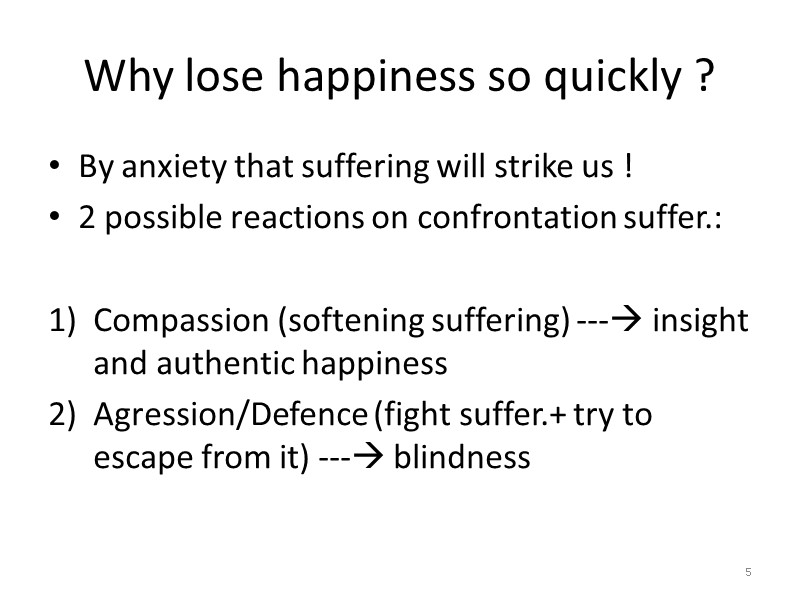
Why lose happiness so quickly ? By anxiety that suffering will strike us ! 2 possible reactions on confrontation suffer.: Compassion (softening suffering) --- insight and authentic happiness Agression/Defence (fight suffer.+ try to escape from it) --- blindness 5
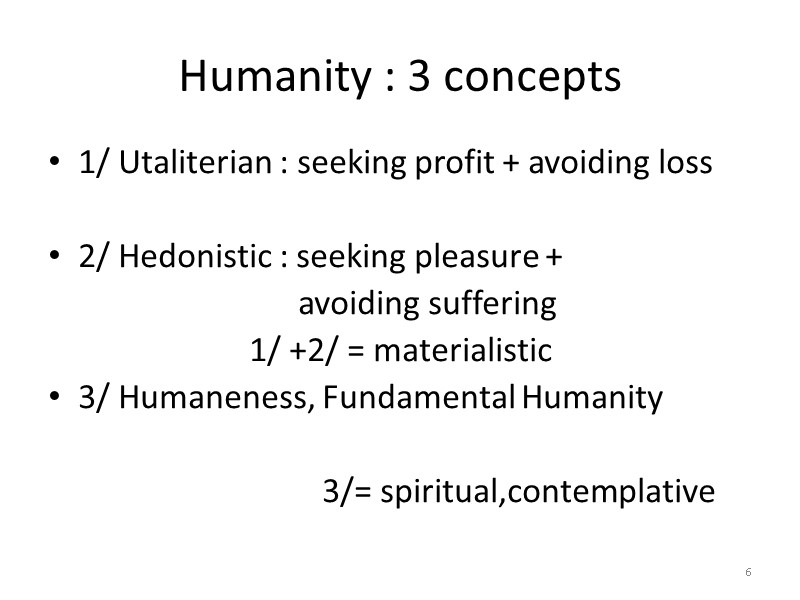
Humanity : 3 concepts 1/ Utaliterian : seeking profit + avoiding loss 2/ Hedonistic : seeking pleasure + avoiding suffering 1/ +2/ = materialistic 3/ Humaneness, Fundamental Humanity 3/= spiritual,contemplative 6
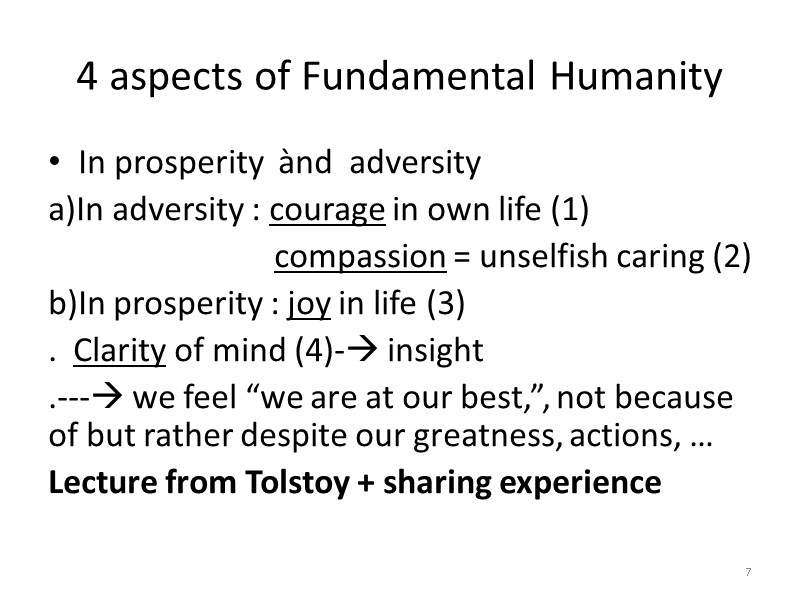
4 aspects of Fundamental Humanity In prosperity ànd adversity a)In adversity : courage in own life (1) compassion = unselfish caring (2) b)In prosperity : joy in life (3) . Clarity of mind (4)- insight .--- we feel “we are at our best,”, not because of but rather despite our greatness, actions, … Lecture from Tolstoy + sharing experience 7
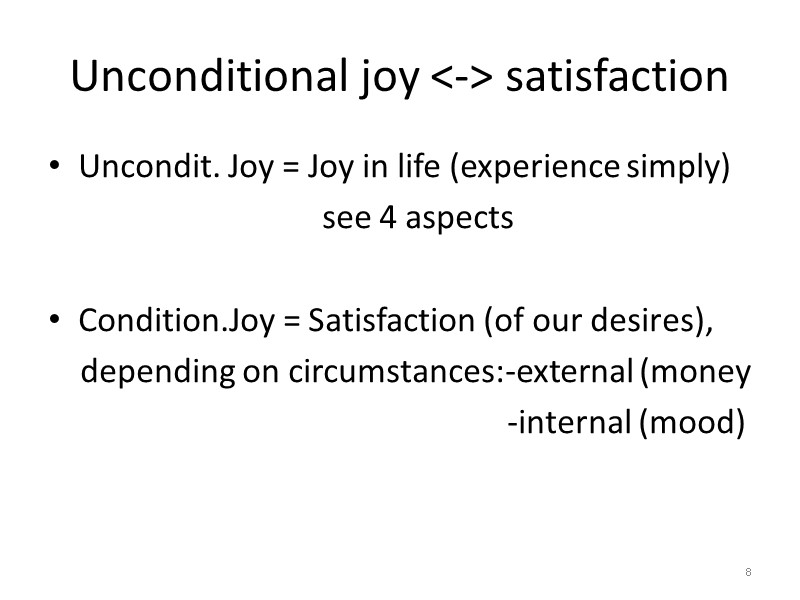
Unconditional joy <-> satisfaction Uncondit. Joy = Joy in life (experience simply) see 4 aspects Condition.Joy = Satisfaction (of our desires), depending on circumstances:-external (money -internal (mood) 8
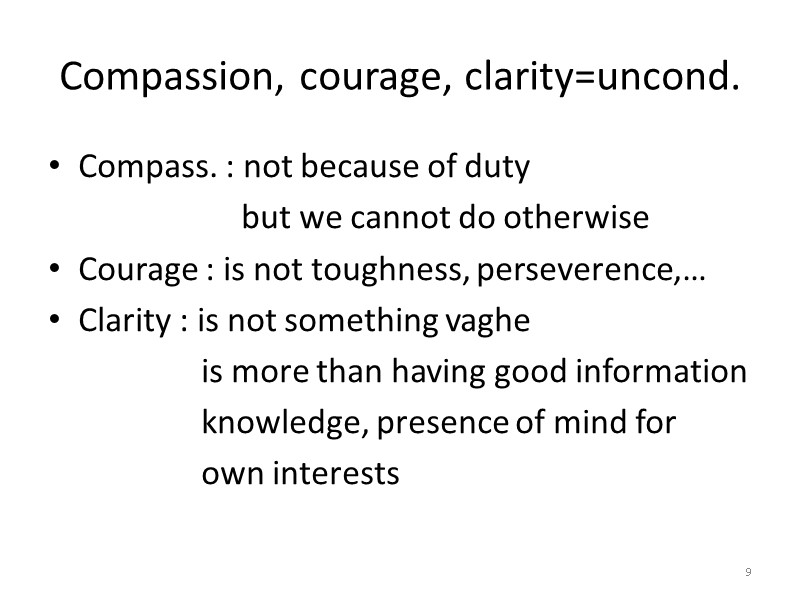
Compassion, courage, clarity=uncond. Compass. : not because of duty but we cannot do otherwise Courage : is not toughness, perseverence,… Clarity : is not something vaghe is more than having good information knowledge, presence of mind for own interests 9
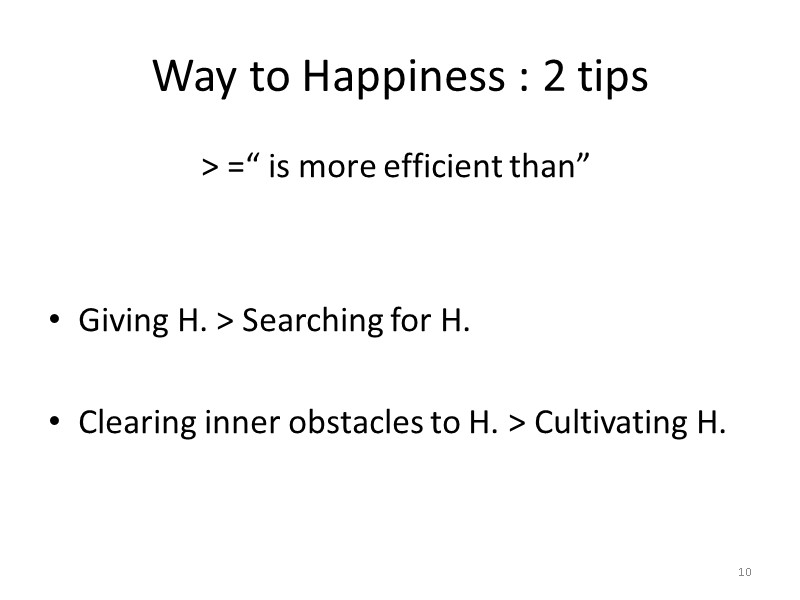
Way to Happiness : 2 tips > =“ is more efficient than” Giving H. > Searching for H. Clearing inner obstacles to H. > Cultivating H. 10
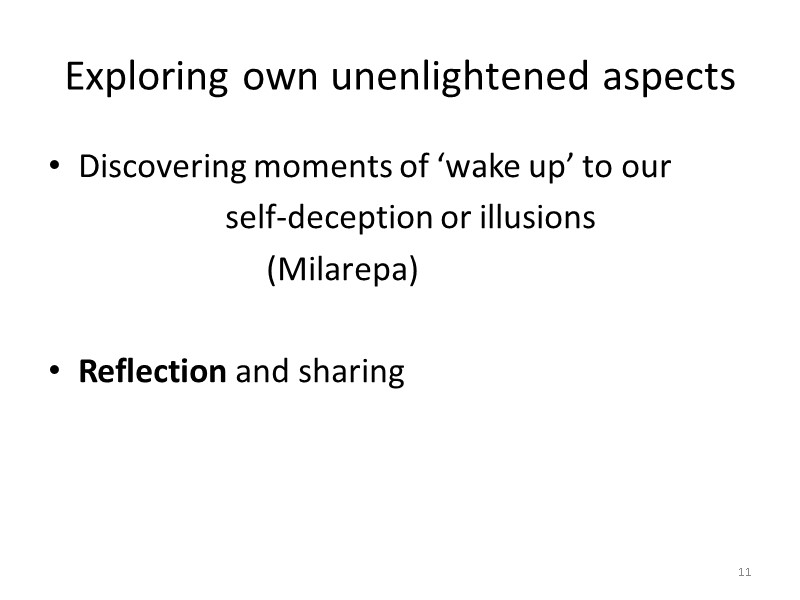
Exploring own unenlightened aspects Discovering moments of ‘wake up’ to our self-deception or illusions (Milarepa) Reflection and sharing 11
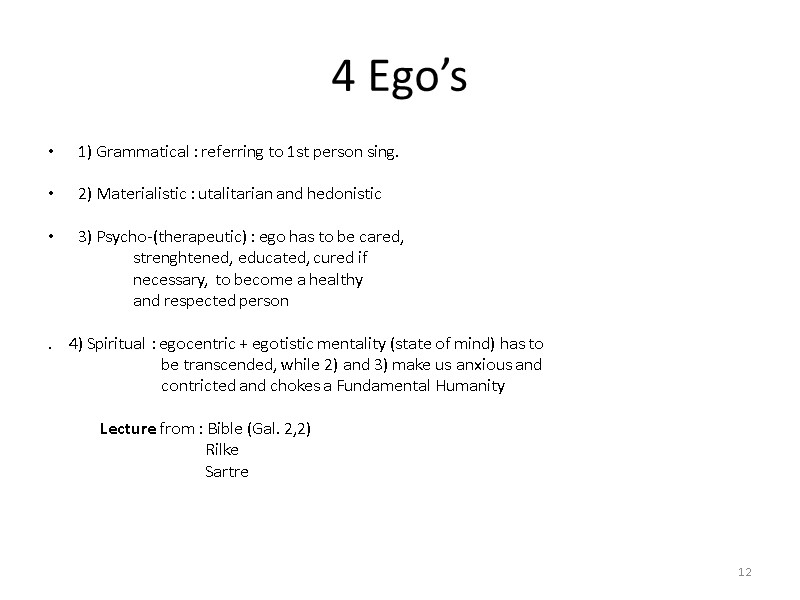
4 Ego’s 1) Grammatical : referring to 1st person sing. 2) Materialistic : utalitarian and hedonistic 3) Psycho-(therapeutic) : ego has to be cared, strenghtened, educated, cured if necessary, to become a healthy and respected person . 4) Spiritual : egocentric + egotistic mentality (state of mind) has to be transcended, while 2) and 3) make us anxious and contricted and chokes a Fundamental Humanity Lecture from : Bible (Gal. 2,2) Rilke Sartre 12
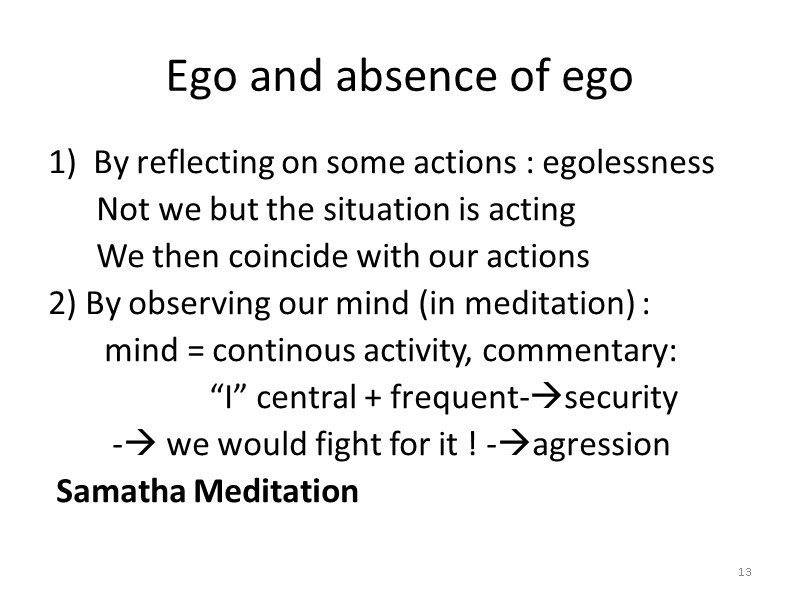
Ego and absence of ego By reflecting on some actions : egolessness Not we but the situation is acting We then coincide with our actions 2) By observing our mind (in meditation) : mind = continous activity, commentary: “I” central + frequent-security - we would fight for it ! -agression Samatha Meditation 13
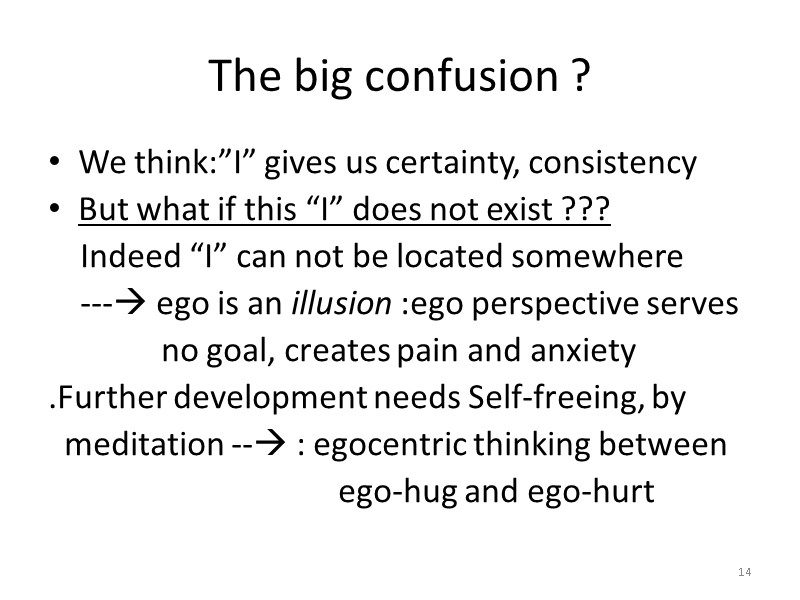
The big confusion ? We think:”I” gives us certainty, consistency But what if this “I” does not exist ??? Indeed “I” can not be located somewhere --- ego is an illusion :ego perspective serves no goal, creates pain and anxiety .Further development needs Self-freeing, by meditation -- : egocentric thinking between ego-hug and ego-hurt 14
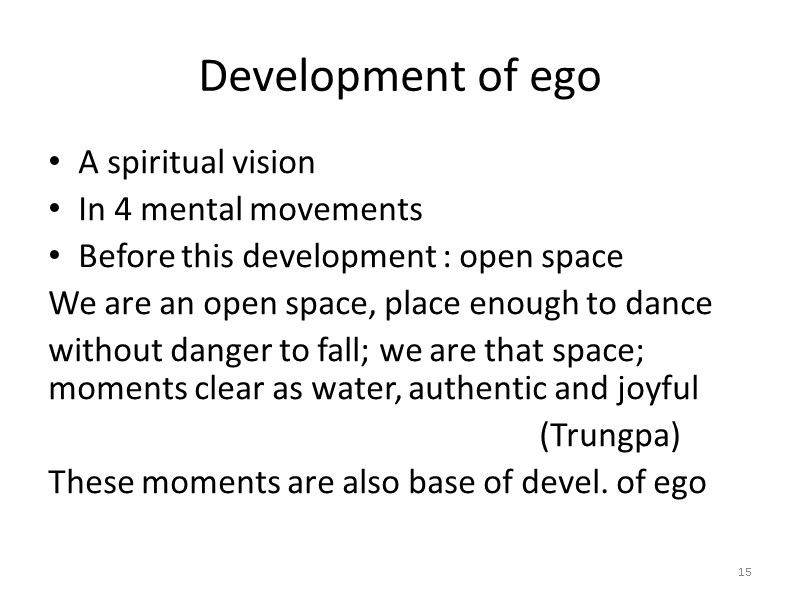
Development of ego A spiritual vision In 4 mental movements Before this development : open space We are an open space, place enough to dance without danger to fall; we are that space; moments clear as water, authentic and joyful (Trungpa) These moments are also base of devel. of ego 15
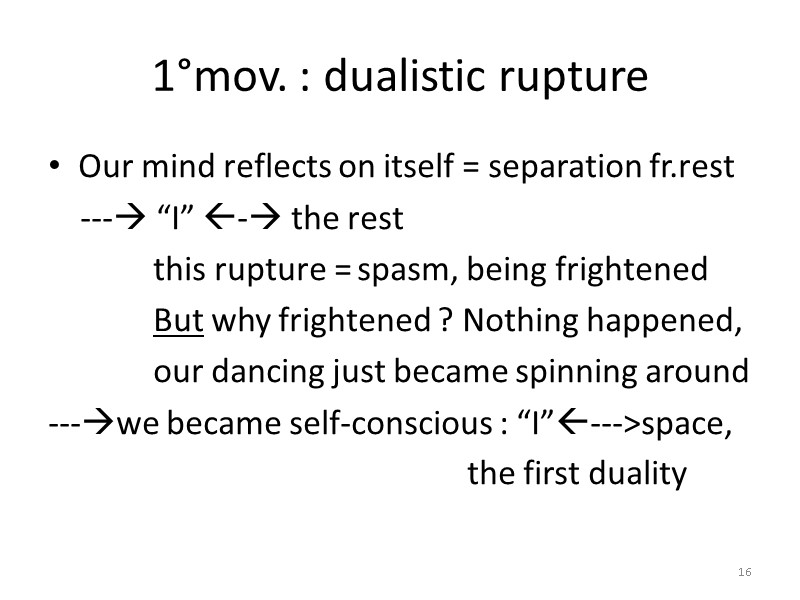
1°mov. : dualistic rupture Our mind reflects on itself = separation fr.rest --- “I” - the rest this rupture = spasm, being frightened But why frightened ? Nothing happened, our dancing just became spinning around ---we became self-conscious : “I”--->space, the first duality 16
. Now we fear to lose control, BUT : we never had real control we never will have real control We never need real control -this ego is not fundament of our existence this ego creates anxiety anxiety has no confidence in totaly open space And so we are seaking grasp and support 17
2°mov.: ego-identification . This grasp can not be found and becomes an endless project=to be someone + proof ourselv. . With time attemps themself become our grasp! .we identify ours. with fhenomena calling it “I” ---this called “I” is fluctuating : as our body, or feeling, or emotions, … : it expands or shrinks, according the situation 18
3°mov.: decoration of the naked ego By making stream of thoughts about ourselves and the world. We decorate ourselves with all kind of ideas, correct ones, foolish ones, joyful ones, … This self-image construction is the story of, about and for ourselves, an inner administration about who and how we are; a seemingly quite stable construction : a certain strcture and security, a feeling of overview 19
4°mov.: identification with the self-image ! Now we are who we think that we are ! .4 movements happen each moment together, a quick and non remarked mental movement . 4 mov. can become visible in meditation . ego is not a thing (against our first impression) ego is a mental activity and suggests to be permanent (but far away from ‘open space’), and is very vulnerable (selfconcept = I) Sharing of our vulnerabilities/irritability 20
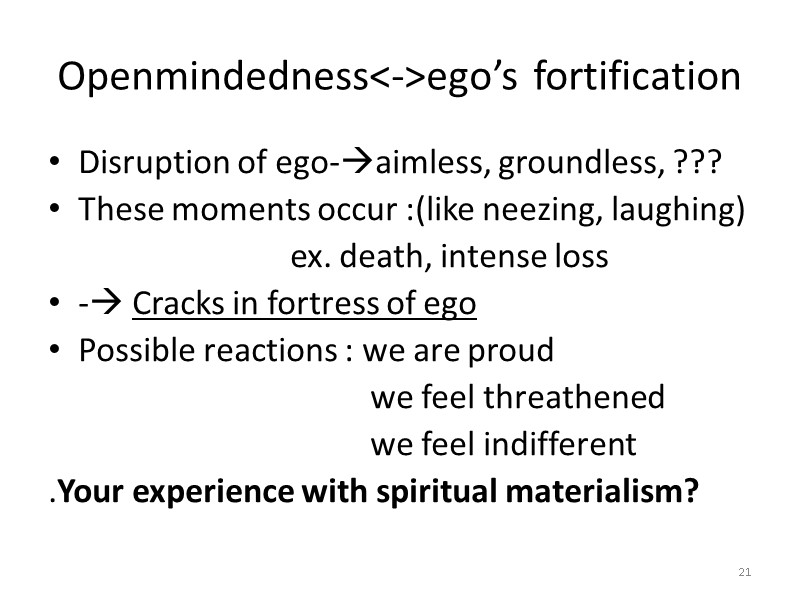
Openmindedness<->ego’s fortification Disruption of ego-aimless, groundless, ??? These moments occur :(like neezing, laughing) ex. death, intense loss - Cracks in fortress of ego Possible reactions : we are proud we feel threathened we feel indifferent .Your experience with spiritual materialism? 21
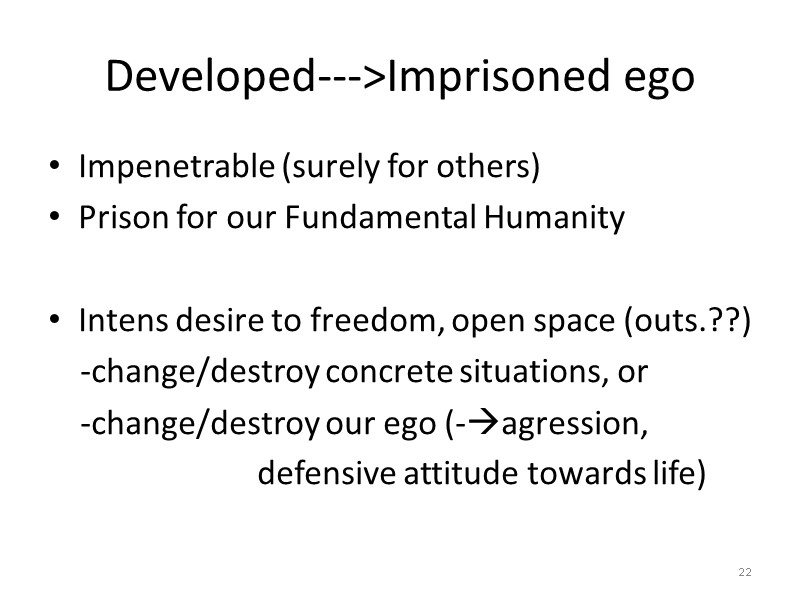
Developed--->Imprisoned ego Impenetrable (surely for others) Prison for our Fundamental Humanity Intens desire to freedom, open space (outs.??) -change/destroy concrete situations, or -change/destroy our ego (-agression, defensive attitude towards life) 22
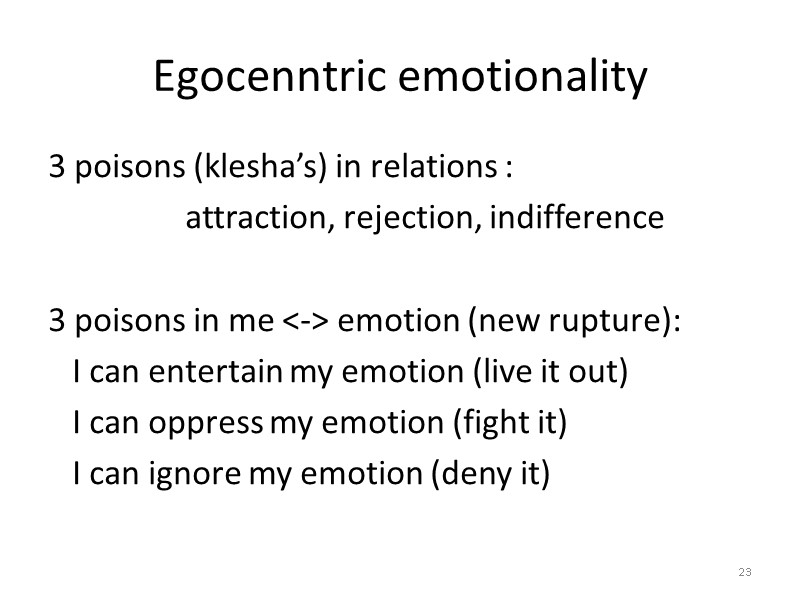
Egocenntric emotionality 3 poisons (klesha’s) in relations : attraction, rejection, indifference 3 poisons in me <-> emotion (new rupture): I can entertain my emotion (live it out) I can oppress my emotion (fight it) I can ignore my emotion (deny it) 23
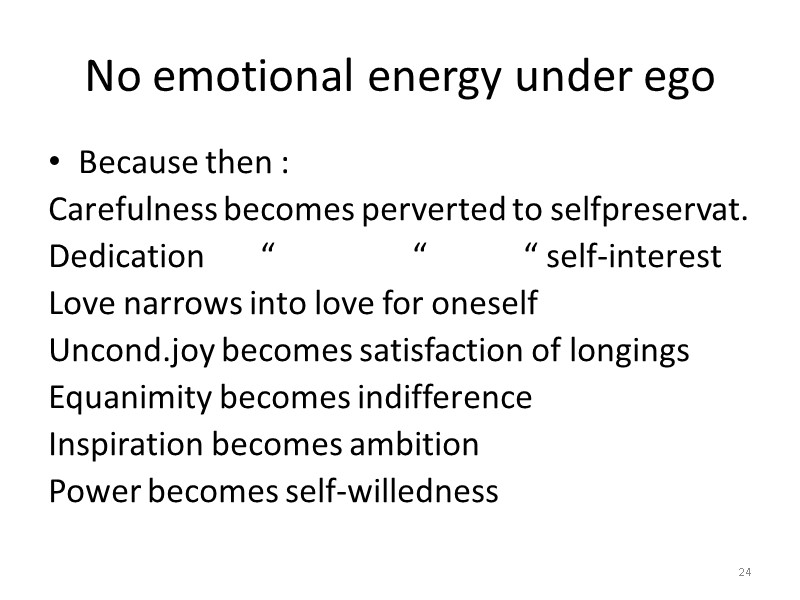
No emotional energy under ego Because then : Carefulness becomes perverted to selfpreservat. Dedication “ “ “ self-interest Love narrows into love for oneself Uncond.joy becomes satisfaction of longings Equanimity becomes indifference Inspiration becomes ambition Power becomes self-willedness 24
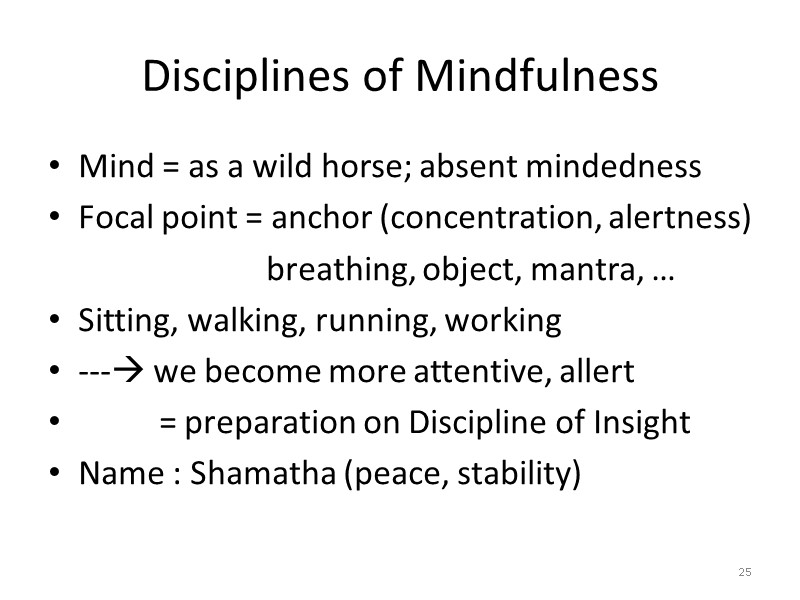
Disciplines of Mindfulness Mind = as a wild horse; absent mindedness Focal point = anchor (concentration, alertness) breathing, object, mantra, … Sitting, walking, running, working --- we become more attentive, allert = preparation on Discipline of Insight Name : Shamatha (peace, stability) 25
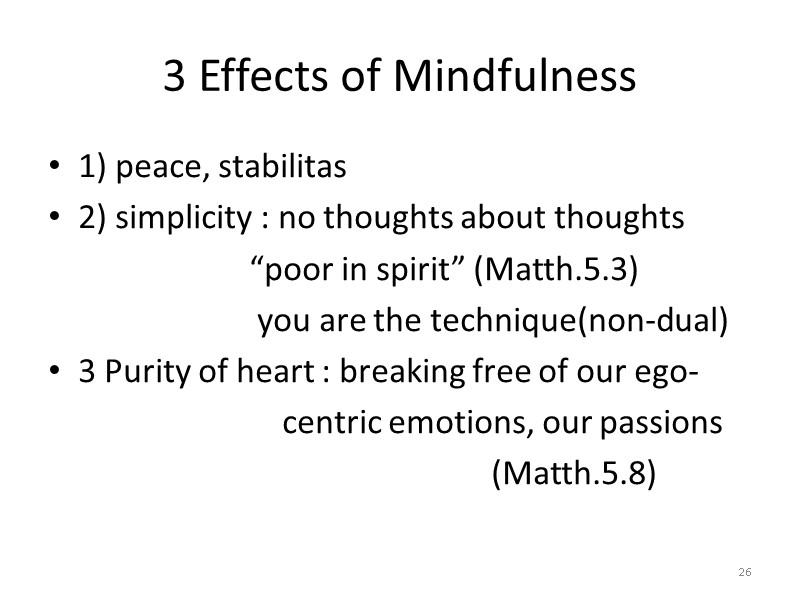
3 Effects of Mindfulness 1) peace, stabilitas 2) simplicity : no thoughts about thoughts “poor in spirit” (Matth.5.3) you are the technique(non-dual) 3 Purity of heart : breaking free of our ego- centric emotions, our passions (Matth.5.8) 26
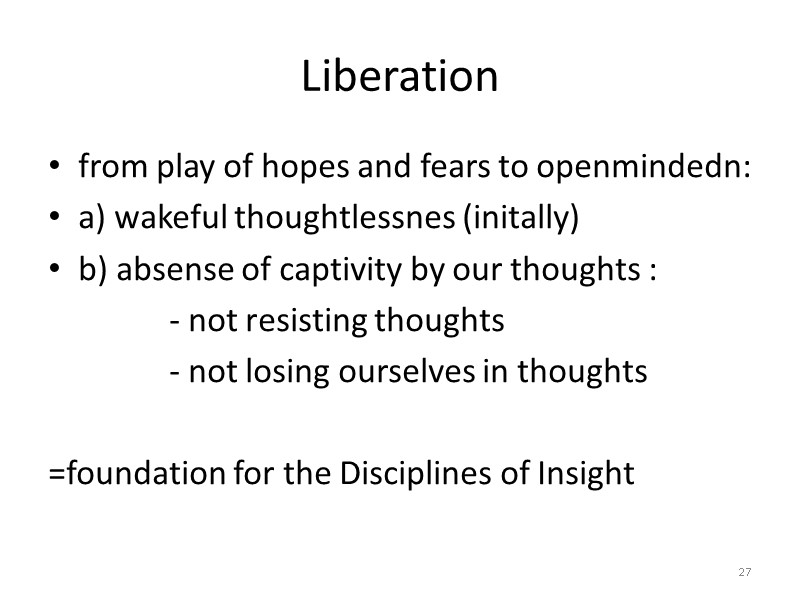
Liberation from play of hopes and fears to openmindedn: a) wakeful thoughtlessnes (initally) b) absense of captivity by our thoughts : - not resisting thoughts - not losing ourselves in thoughts =foundation for the Disciplines of Insight 27
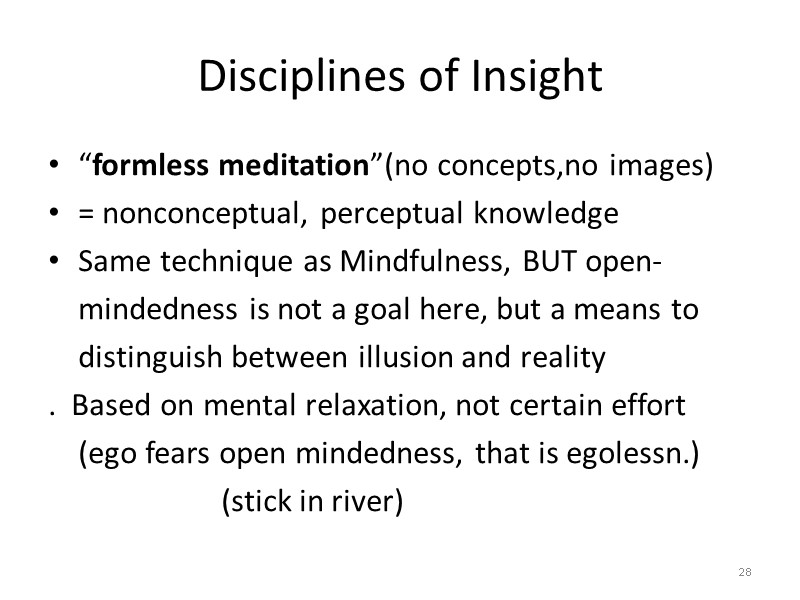
Disciplines of Insight “formless meditation”(no concepts,no images) = nonconceptual, perceptual knowledge Same technique as Mindfulness, BUT open- mindedness is not a goal here, but a means to distinguish between illusion and reality . Based on mental relaxation, not certain effort (ego fears open mindedness, that is egolessn.) (stick in river) 28
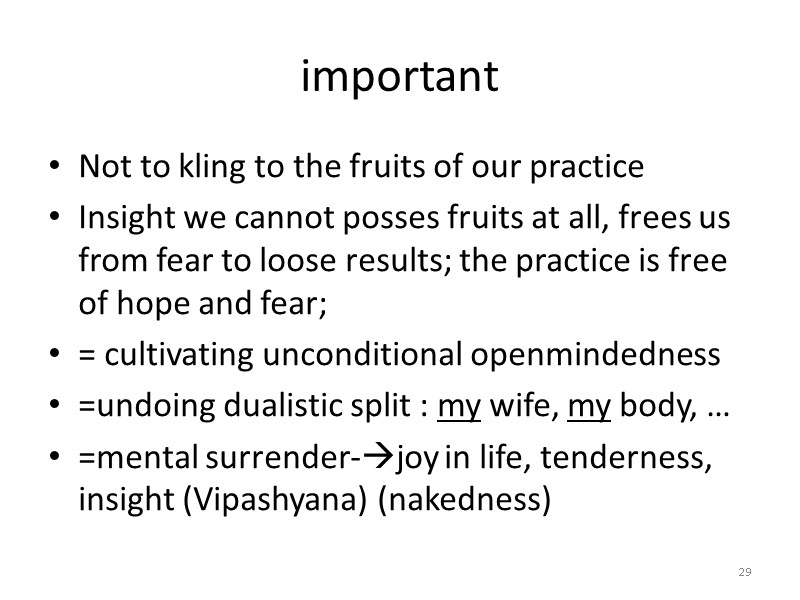
important Not to kling to the fruits of our practice Insight we cannot posses fruits at all, frees us from fear to loose results; the practice is free of hope and fear; = cultivating unconditional openmindedness =undoing dualistic split : my wife, my body, … =mental surrender-joy in life, tenderness, insight (Vipashyana) (nakedness) 29
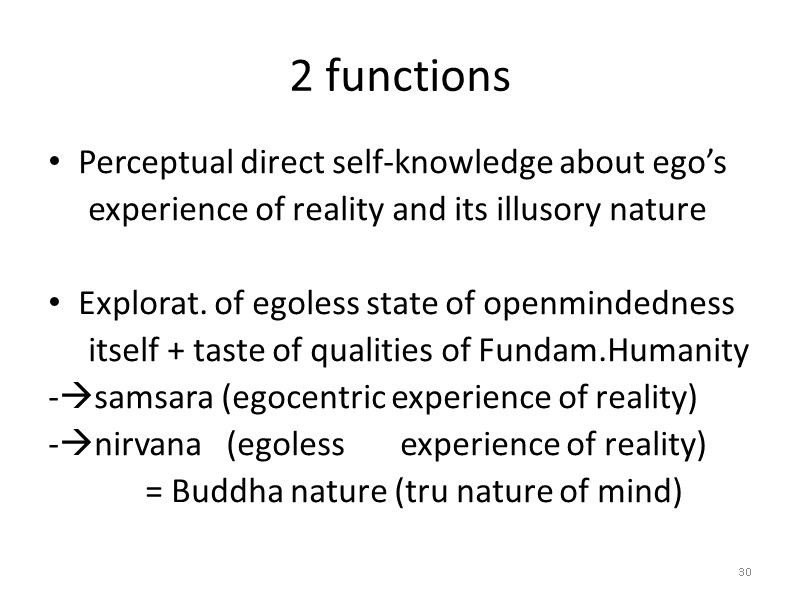
2 functions Perceptual direct self-knowledge about ego’s experience of reality and its illusory nature Explorat. of egoless state of openmindedness itself + taste of qualities of Fundam.Humanity -samsara (egocentric experience of reality) -nirvana (egoless experience of reality) = Buddha nature (tru nature of mind) 30
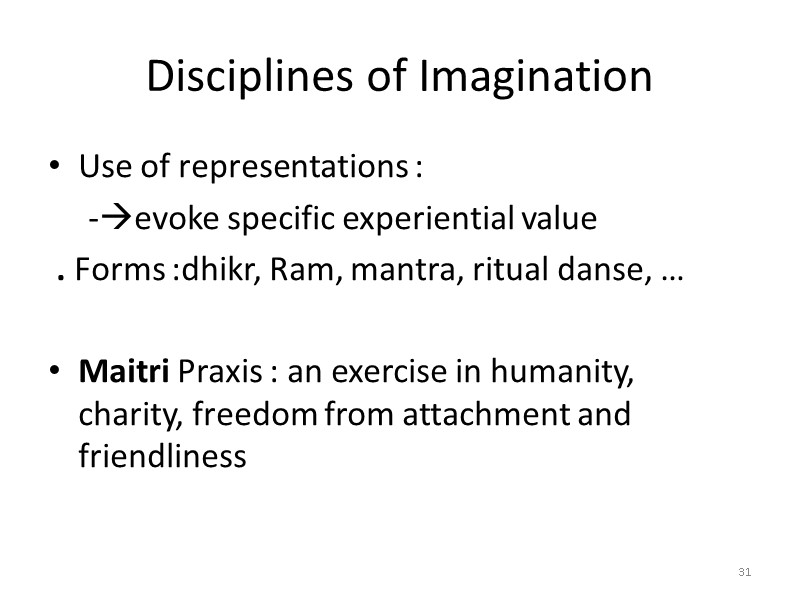
Disciplines of Imagination Use of representations : -evoke specific experiential value . Forms :dhikr, Ram, mantra, ritual danse, … Maitri Praxis : an exercise in humanity, charity, freedom from attachment and friendliness 31
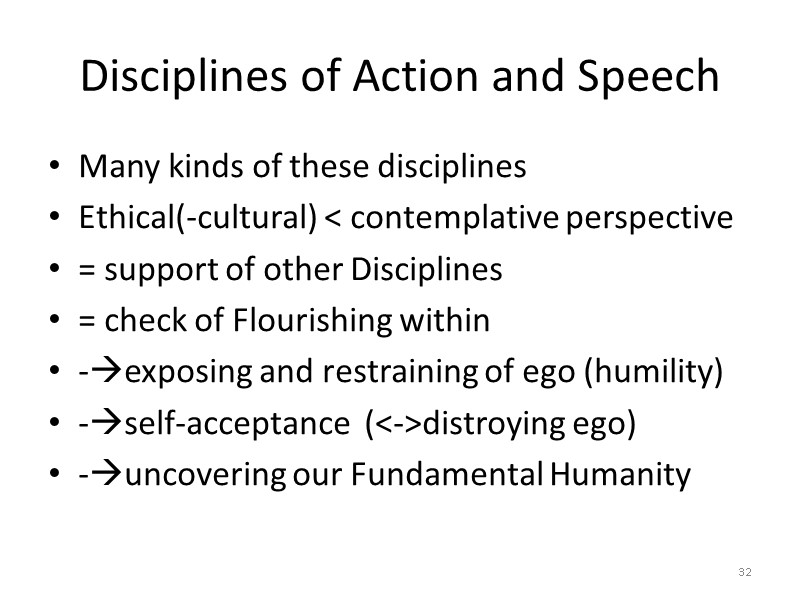
Disciplines of Action and Speech Many kinds of these disciplines Ethical(-cultural) < contemplative perspective = support of other Disciplines = check of Flourishing within -exposing and restraining of ego (humility) -self-acceptance (<->distroying ego) -uncovering our Fundamental Humanity 32
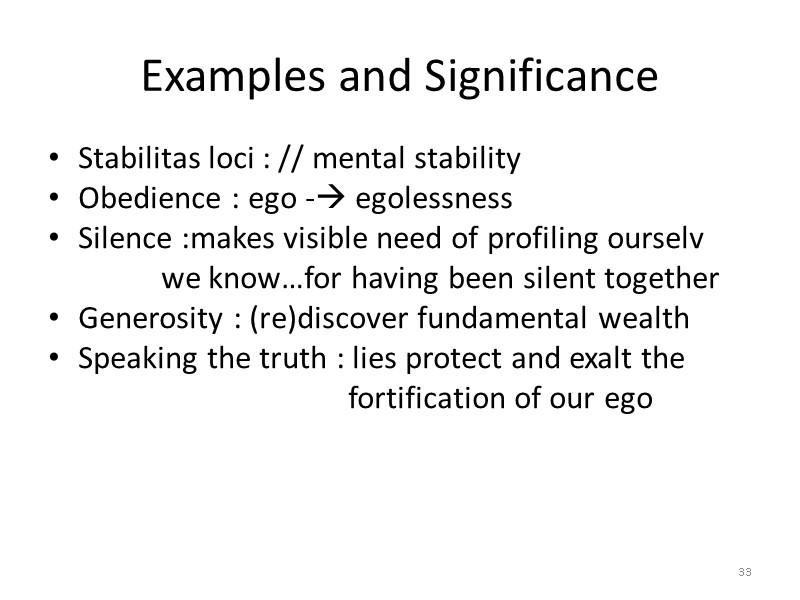
Examples and Significance Stabilitas loci : // mental stability Obedience : ego - egolessness Silence :makes visible need of profiling ourselv we know…for having been silent together Generosity : (re)discover fundamental wealth Speaking the truth : lies protect and exalt the fortification of our ego 33
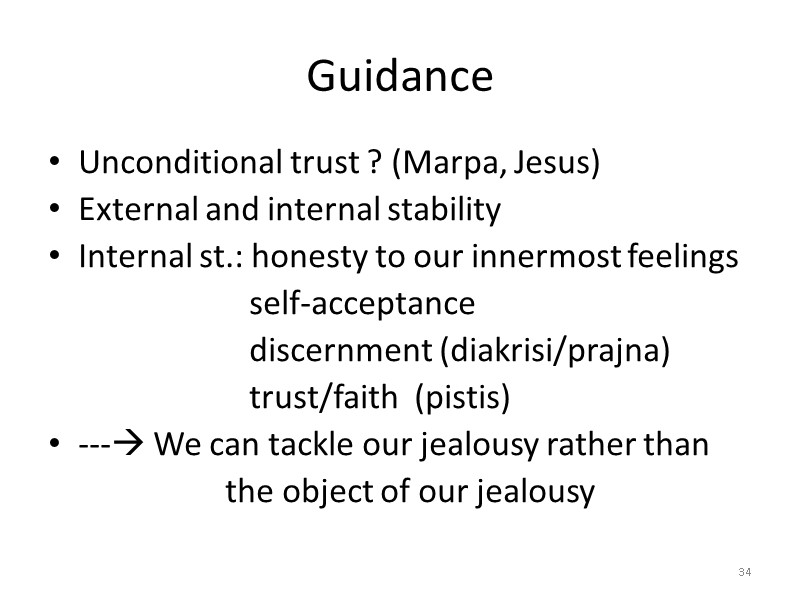
Guidance Unconditional trust ? (Marpa, Jesus) External and internal stability Internal st.: honesty to our innermost feelings self-acceptance discernment (diakrisi/prajna) trust/faith (pistis) --- We can tackle our jealousy rather than the object of our jealousy 34
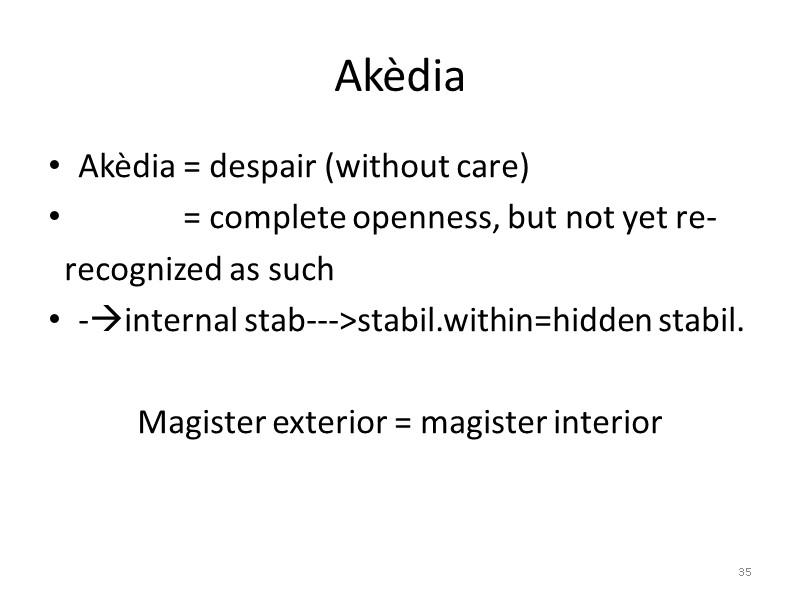
Akèdia Akèdia = despair (without care) = complete openness, but not yet re- recognized as such -internal stab--->stabil.within=hidden stabil. Magister exterior = magister interior 35
Bibliography Han F. de Wit, The Spiritual Path. An Introduction to the Psychology of the Spiritual Traditions, Duquesne University Press, 1999. Han F. De Wit,De verborgen Bloei. Over de Psychologische achtergronden van spiritualiteit, Kampen, 2010. 36