 Скачать презентацию Florida Atlantic University Environmental Health and Safety Building
845278ae7a61f7f99a7706dc580de421.ppt
- Количество слайдов: 70



Florida Atlantic University Environmental Health and Safety Building Safety Personnel Program
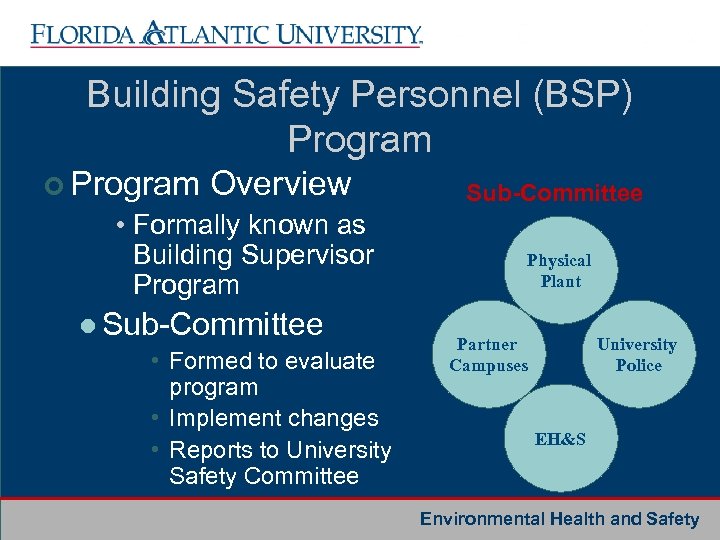
Building Safety Personnel (BSP) Program ¢ Program Overview • Formally known as Building Supervisor Program l Sub-Committee • Formed to evaluate program • Implement changes • Reports to University Safety Committee Sub-Committee Physical Plant Partner Campuses University Police EH&S Environmental Health and Safety
EMERGENCY MGMT- OVERVIEW ¢ Emergency Operations Plan (EOP) – PREPAREDNESS, RESPONSE, RECOVERY l l l Follow NIMS/ICS model for handling emergencies Includes Emergency Operations Center (EOC) Includes Annexes: Hazard Specific • Fire, Hurricane, Hostile Intruder l ¢ Occupant Emergency Plans Continuity of Operations (COOP) – RECOVERY l Mission Essential Functions (MEFs) • 12 hour/30 day rule – MEFs need to be continued within 12 hours of being suspended and for up to 30 days if primary facilities are rendered inoperable. Environmental Health and Safety
BSP Program Occupant Emergency Plans = BSP Program! ¢ Addresses responses to emergency events: Shelter in Place l Evacuation l Other l ¢ University-wide program Environmental Health and Safety
HAZARDS Types: ¢ Natural: • Severe weather: Tornadoes, Lightning, Hurricanes • Flooding • Wild Fires ¢ Man-Made: • Fires, Hostile Intruder, Civil Disturbances, Explosions • Technological: Cyber-Terrorism Environmental Health and Safety
RISKS OF HAZARDS ¢ Impact on human life: injury, illness, death. ¢ Impact on the organization: property damage, reduced ability to continue academic, research, business functions. ¢ Impact on the environment: spills, contamination ¢ Occupational issues: unsafe work environment Environmental Health and Safety
BSP Program – 3 Groups Group 1 ¢ Building Safety Administrator Planning; COOP/Emergency • Determined from the occupancy of the building in question, for example, • Majority of building occupants are part of programs under their purview • They are the highest ranking individual stationed in the building • Not required to be stationed in the building they oversee Environmental Health and Safety
Key Points for Administrators ¢ ¢ Be familiar with emergency plans, be involved in the review process Be involved in the appointment process of personnel within the buildings they oversee Communicate any University policy or Functional Unit plan changes to all Safety Supervisors under their purview as well as other Functional Units Support and help Safety Supervisors with compliance issues regarding building occupants and act as a liaison for other units Environmental Health and Safety
Key Points ¢ ¢ Ensure that Safety Supervisors have necessary clearance for duties (e. g. Tier 2 Essential Personnel cards) Ensure that this role is accommodated for given the other day-to-day roles and responsibilities that Groups 2 and 3 assume l Support Program components: • • Training Planning Leadership Time Be knowledgeable of the program! Environmental Health and Safety
BSP Program – 3 Groups Group 2 ¢ Building Safety Supervisor Planning and Implementation • Determined from the occupancy of the building in question, for example, • Majority of building occupants are part of programs they are familiar with • Familiarity with building layout and occupants • Stationed in the building they oversee or assigned to clusters of buildings that they are stationed in immediate proximity to. MAIN contact for first responders, EH&S and others for the building Environmental Health and Safety
Key Points for Safety Supervisors ¢ ¢ ¢ Be familiar with emergency plans, be involved in the review process Be involved in the appointment process of personnel within the building Acquire knowledge of the assigned building: • Locations of exits, fume hoods, hazardous material areas, mechanical rooms, safety equipment; fire extinguishers, fire alarm panels, control and shut-off valves emergency phones as well as areas of rescue. ¢ Accompany, when warranted, the State Fire Marshall during building inspections. Environmental Health and Safety
Key Points for Safety Supervisors ¢ ¢ ¢ Report any unsafe conditions to EH&S or University Police. Know how to identify individuals requiring assistance and inform emergency responders of their location during an emergency. Include general idea of condition (wheelchair bound, injured, etc) Prepare a checklist of tasks to be performed by the Building Safety Representatives. Communicate plan changes to all Building Safety Representatives. Participate in meetings/updates. Environmental Health and Safety
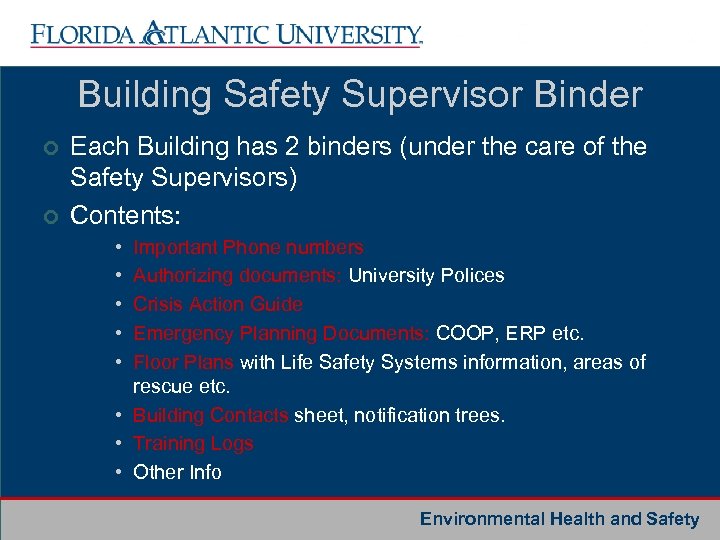
Building Safety Supervisor Binder ¢ ¢ Each Building has 2 binders (under the care of the Safety Supervisors) Contents: • • • Important Phone numbers Authorizing documents: University Polices Crisis Action Guide Emergency Planning Documents: COOP, ERP etc. Floor Plans with Life Safety Systems information, areas of rescue etc. • Building Contacts sheet, notification trees. • Training Logs • Other Info Environmental Health and Safety
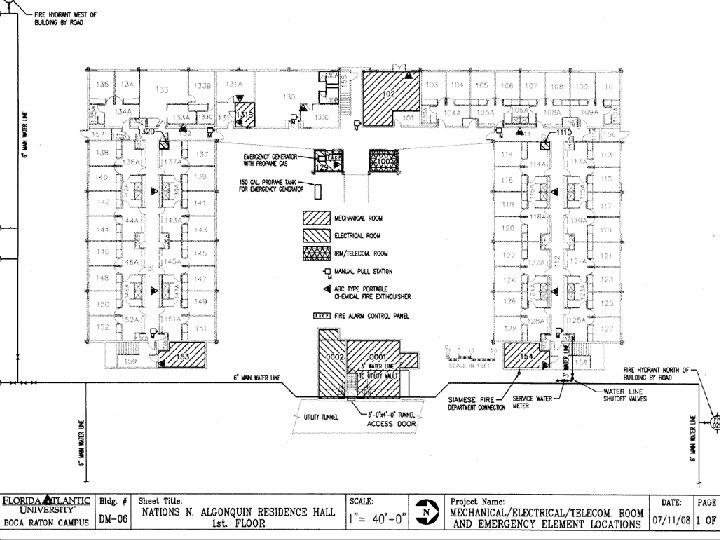
FLOOR PLANS ¢ ¢ ¢ Effort within the Division of Facilities to provide marked floor plans. Surveys conducted university-wide Floor Plans will be provided with the following indicated: • • • Life safety systems; fire alarm panels, extinguishers, AED Shut off valves: water, gas Locations of mechanical and electrical rooms Location of emergency generators Location of chemical, biological, radiological labs Ground floor: fire hydrants, main shut offs, etc. Environmental Health and Safety
BSP Program – 3 Groups Group 3 ¢ Building Safety Representative Implementation • Determined from the occupancy of the building in question, for example, • Majority of building occupants are part of college or division = floor rep. • Different programs within building = departmental/unit rep. • Stationed in the building they oversee Environmental Health and Safety
Building Safety Representative ¢ Qualifications: Representatives must be 12 -month employees with a good understanding of the facilities and programs within their assigned department or unit. The ideal candidate has an eye for detail, is willing to follow direction, and has a calm demeanor in a crisis. ¢ Training: Emergency Evacuation Sheltering in Place Severe Weather Other Environmental Health and Safety
Building Safety Representative Duties: • Participates in an annual or semi-annual update meeting. • Understands the evacuation plan for the building. • Assures that it is posted conspicuously throughout the department or unit. • Maintains a departmental or unit emergency contact list. • Pays attention to and reports safety or maintenance issues. Environmental Health and Safety
Alternates ¢ ¢ The Building Safety Supervisor is the only group to have an alternate. Role: l l An alternate will follow the same job description and guidelines Assume the duties of the position • if the appointed person is not available, • if the appointed position is vacated without replacement or • if the appointed replacement is undergoing or has yet to undergo required training. Environmental Health and Safety
BSP Database ¢ ¢ Used for personnel and training tracking Can perform queries and print reports for example: • Building Safety Personnel by Campus and Building • Building Safety Personnel by Name ¢ At this time, maintained by EH&S, however • Will be hosted on the Emergency Planning and Response website • Access will be given to Safety Supervisors to: • Update quarterly or when a change in personnel occurs • Review for accuracy ¢ Can export information for call out and text messaging alerting Environmental Health and Safety
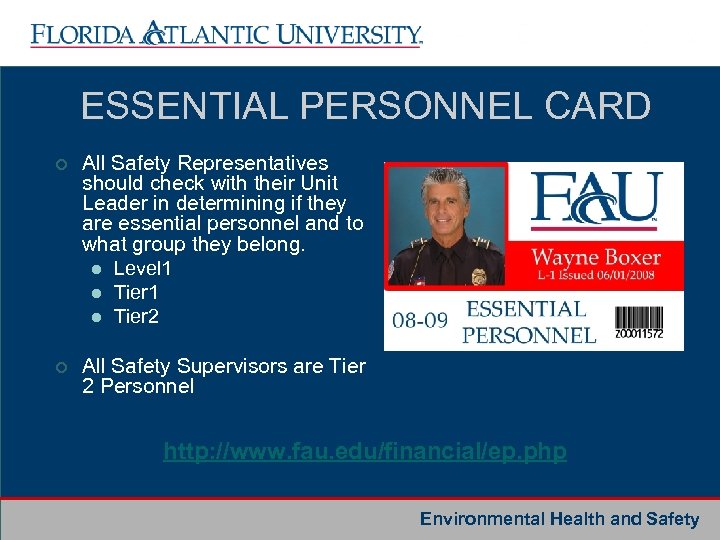
ESSENTIAL PERSONNEL CARD ¢ All Safety Representatives should check with their Unit Leader in determining if they are essential personnel and to what group they belong. l Level 1 l Tier 2 ¢ All Safety Supervisors are Tier 2 Personnel http: //www. fau. edu/financial/ep. php Environmental Health and Safety
CRISIS ACTION GUIDE A University community safety guide. ¢ Building Safety Personnel procedures are tailored from these. ¢ Addresses a variety of events. ¢ Should be disseminated to all. ¢ Located: ¢ l http: //www. fau. edu/admin/Emergency. Information. php KNOW IT!! Environmental Health and Safety
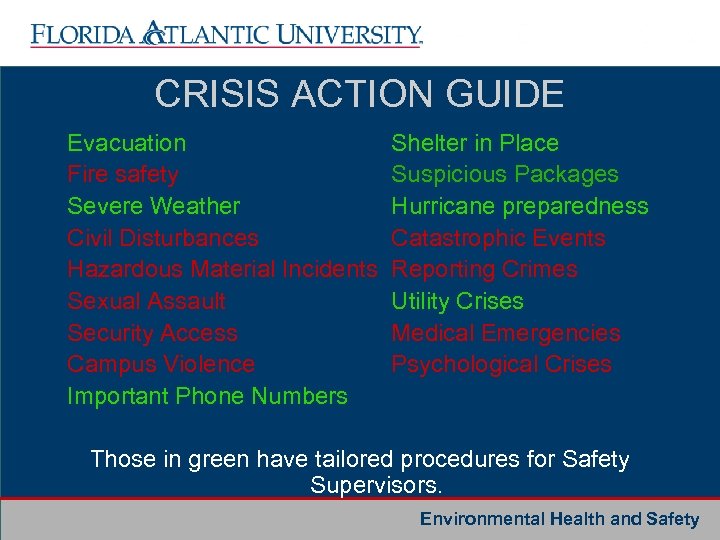
CRISIS ACTION GUIDE Evacuation Fire safety Severe Weather Civil Disturbances Hazardous Material Incidents Sexual Assault Security Access Campus Violence Important Phone Numbers Shelter in Place Suspicious Packages Hurricane preparedness Catastrophic Events Reporting Crimes Utility Crises Medical Emergencies Psychological Crises Those in green have tailored procedures for Safety Supervisors. Environmental Health and Safety
TRAINING ¢ Onsite training for Safety Reps: l Evacuation l Shelter in place l Utility Issues – planned/unplanned l Hurricane preparedness and recovery l Other information: • • • Card Access and Essential Personnel Program FAU Alert Hazard Communications Blood borne pathogens Suspicious packages Environmental Health and Safety
EMERGENCY EVACUATION Environmental Health and Safety
EVACUATION INFORMATION ¢ Should be displayed in a visible location in the building for a quick reference in case of an emergency ¢ This information includes: • Evacuation routes • Evacuation guidelines • Emergency telephone numbers ¢ Plan escape procedure and escape routes • Know the locations of the two closest exits and be familiar with the path that leads to the outside Environmental Health and Safety
EVACUATION PLAN ¢ What is it? : • It is floor plan with exit routes marked. ¢ Who develops it? • It is prepared by a qualified architect. ¢ Where can it be found? • It is posted or mounted in a hallway or close to an exit door or elevator. Environmental Health and Safety
EVACUATION PLAN ¢ Routes ¢ Assembly Areas ¢ Procedures Environmental Health and Safety
PRIMARY AND SECONDARY ESCAPE ROUTES Primary Route: The one that is closest to you ¢ Secondary Route: the one that is further away. ¢ l Sometimes routes cannot be used due to the emergency event at hand: • The emergency event or threat is occurring in or near the route. Environmental Health and Safety
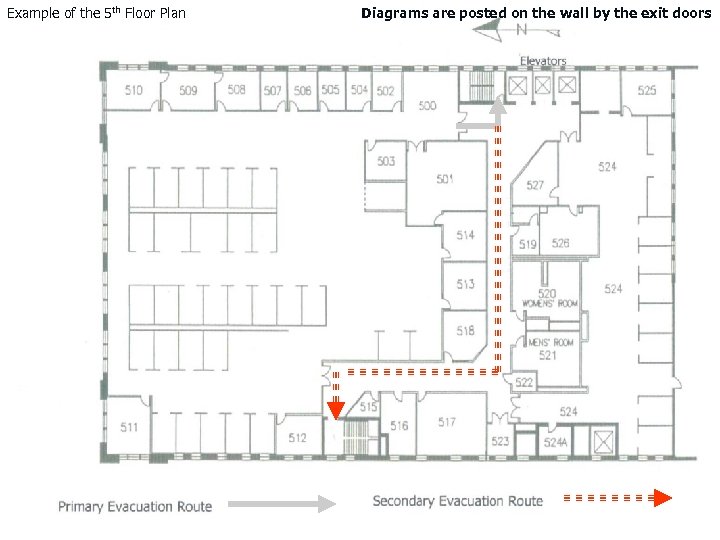
Example of the 5 th Floor Plan Diagrams are posted on the wall by the exit doors Environmental Health and Safety
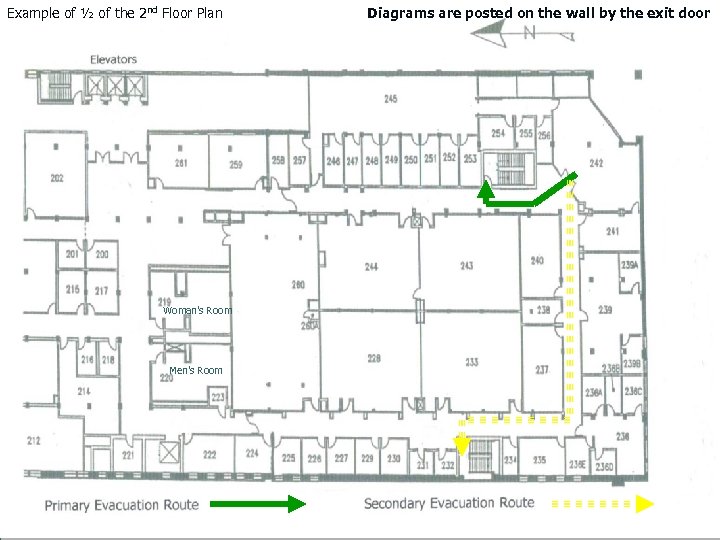
Example of ½ of the 2 nd Floor Plan Diagrams are posted on the wall by the exit door Woman's Room Men’s Room Environmental Health and Safety
ASSEMBLY AREA ¢ Know your assembly area outside the building • Building Evacuation Points: Boca Raton Campus Davie Campus Ft. Lauderdale Campus Jupiter Campus Sea. Tech Campus Treasure Coast Campus Environmental Health and Safety
WHEN TO EVACUATE l l l l If fire alarm is sounding and visual signals activated Fire Smoke Bomb threat Hazardous material spill (large or vapors) Rapidly deteriorating safety conditions Other incidents where evacuating is needed (if in doubt, call University Police) Easiest way to notify building occupants of need to evacuate is to activate the fire alarm, if not already activated Environmental Health and Safety
WHEN NOT TO EVACUATE ¢ When fire alarm is not sounding or visual signals inactive and: l l l ¢ No evidence of rapidly deteriorating safety conditions e. g. fire, smoke, bomb threat, spill. Localized hazard conditions (not spreading) Hostile Intruder/s (when occupants cannot safely do so) INSTEAD: • Without compromising your safety, make an effort to get to the area of the emergency or get an explanation from a reliable source about the nature of the emergency. • Notify University Police and Environmental Health and Safety and Building Safety Supervisor and alternate Environmental Health and Safety
INDIVIDUALS REQUIRING ASSISTANCE ¢ Individuals requiring assistance should go to their area of refuge and request assistance from others. Able-bodied persons should assist in the evacuation of individuals who require assistance. ¢ The assistance may be in the form of the following: • Be familiar with the people requiring assistance who are routinely in your work area. • Inform hearing impaired people that they have to evacuate. • Assist visually impaired people to an exit stairway. • Inform emergency personnel of the location of people inside the building who need help evacuating. • In the extreme case that you must physically evacuate a person, ask how to safely carry/assist them. Environmental Health and Safety
A TYPICAL FIRE SCENARIO ¢ From the time a fire starts, smoke detectors may operate within 1 minute. ¢ Room temperatures at the ceiling when flashover occurs can reach 1, 400 degrees. ¢ Flashover can occur within 4 minutes from the time a fire starts. ¢ From the time a fire starts, you generally will have less than 5 minutes to get out alive. Environmental Health and Safety
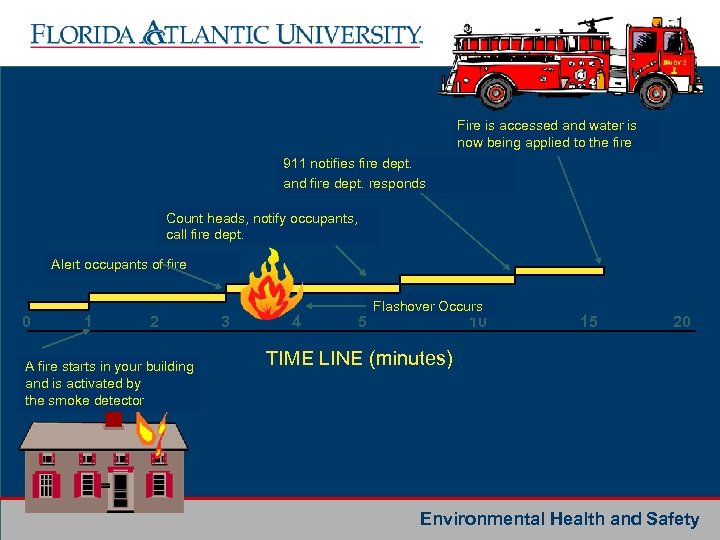
Fire is accessed and water is now being applied to the fire 911 notifies fire dept. and fire dept. responds Count heads, notify occupants, call fire dept. Alert occupants of fire 0 1 2 A fire starts in your building and is activated by the smoke detector 3 4 5 Flashover Occurs 10 15 20 TIME LINE (minutes) Environmental Health and Safety
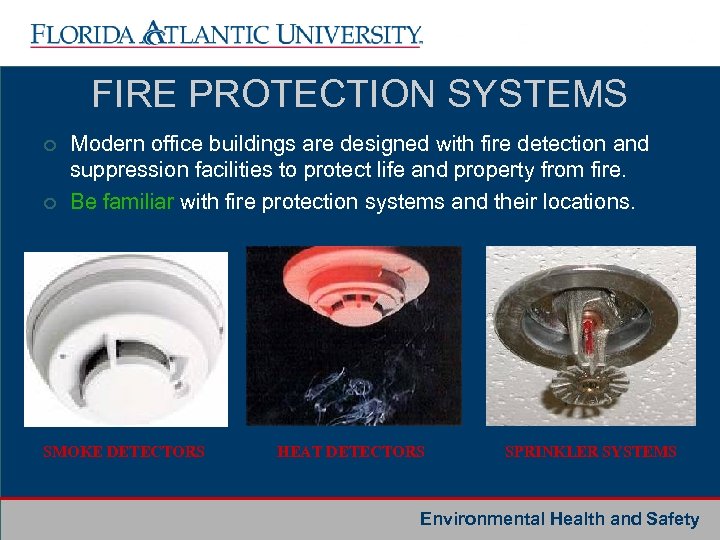
FIRE PROTECTION SYSTEMS ¢ ¢ Modern office buildings are designed with fire detection and suppression facilities to protect life and property from fire. Be familiar with fire protection systems and their locations. SMOKE DETECTORS HEAT DETECTORS SPRINKLER SYSTEMS Environmental Health and Safety
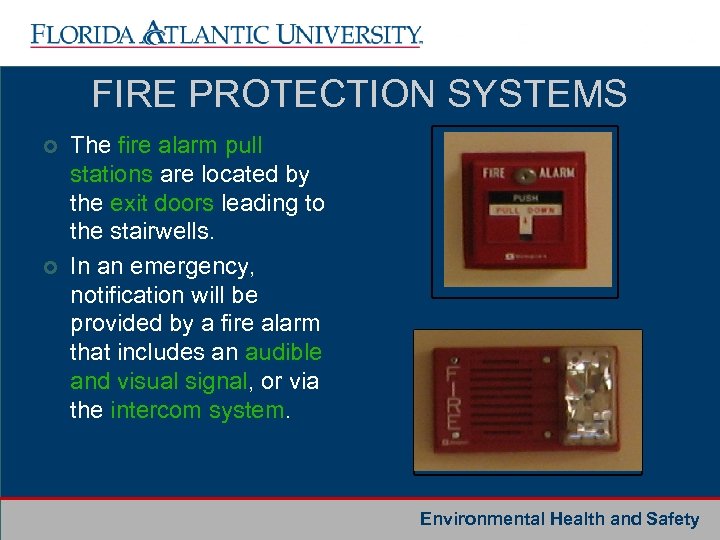
FIRE PROTECTION SYSTEMS ¢ ¢ The fire alarm pull stations are located by the exit doors leading to the stairwells. In an emergency, notification will be provided by a fire alarm that includes an audible and visual signal, or via the intercom system. Environmental Health and Safety
DUTIES RELATED TO SAFETY REPRESENTATIVES ¢ Maintain a list of staff in the department, including those who may need assistance. ¢ Order people to evacuate and ensure common areas closest to your occupied spaces are cleared (restrooms, break rooms, etc) ¢ Direct people to assigned areas – assembly areas and areas of rescue and take head count Environmental Health and Safety
DUTIES RELATED TO SAFETY REPRESENTATIVES ¢ Assist emergency responders and safety supervisors regarding location of individuals requiring assistance and department contents or operations. Keep evacuation procedures up to date and available ¢ Complete duties assigned to you by Safety Supervisor and give update ¢ Environmental Health and Safety
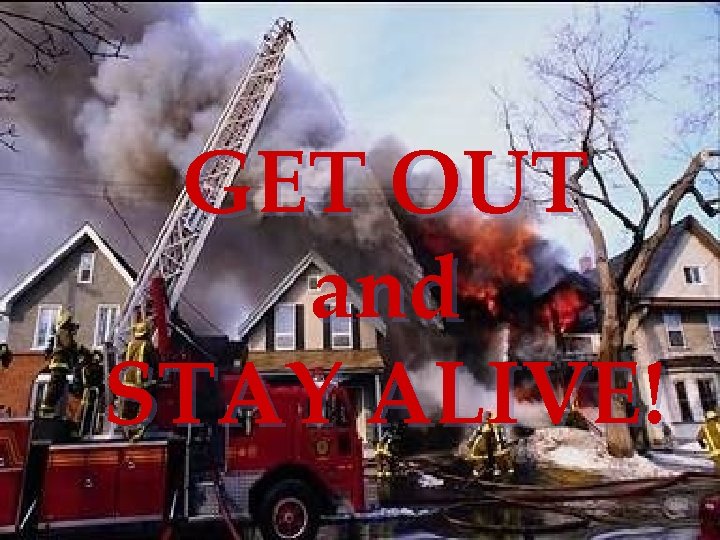
GET OUT and STAY ALIVE! Environmental Health and Safety
SHELTER IN PLACE Environmental Health and Safety
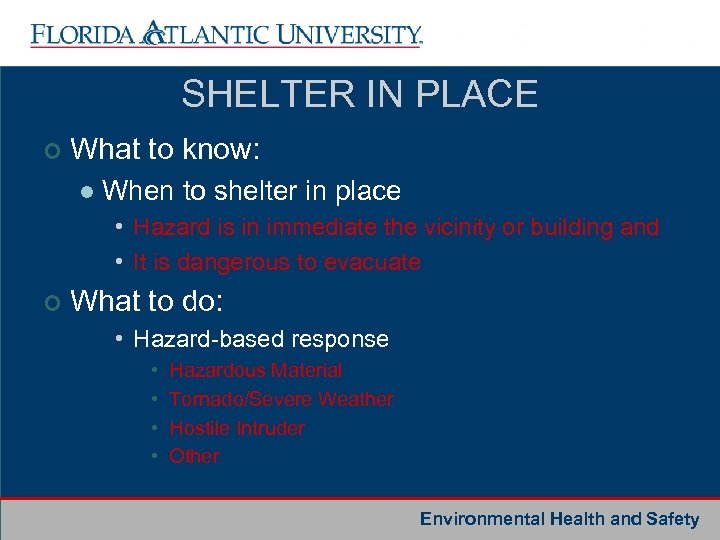
SHELTER IN PLACE ¢ What to know: l When to shelter in place • Hazard is in immediate the vicinity or building and • It is dangerous to evacuate ¢ What to do: • Hazard-based response • • Hazardous Material Tornado/Severe Weather Hostile Intruder Other Environmental Health and Safety
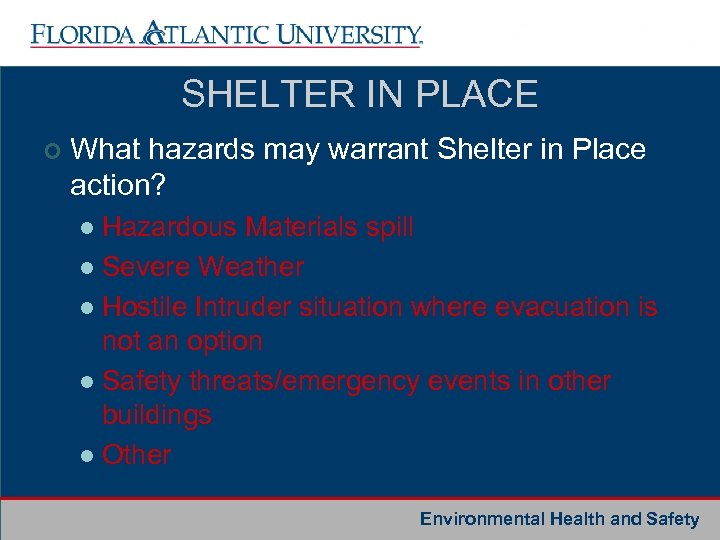
SHELTER IN PLACE ¢ What hazards may warrant Shelter in Place action? Hazardous Materials spill l Severe Weather l Hostile Intruder situation where evacuation is not an option l Safety threats/emergency events in other buildings l Other l Environmental Health and Safety
INDIVIDUALS REQUIRING ASSISTANCE ¢ Individuals requiring assistance should go to their area of refuge and request assistance from others. Able-bodied persons should assist in the sheltering in place of individuals who require assistance. ¢ The assistance may be in the form of the following: • Be familiar with the people requiring assistance who are routinely in your work area. • Inform hearing impaired people that they have to shelter in place. • Assist visually impaired people to an appropriate shelter-in-place area. • Inform emergency personnel of the location of people inside the building who are sheltering in place. • Ask how to safely carry/assist them in the extreme case that you must physically move a person to an area better suited to sheltering in place, Environmental Health and Safety
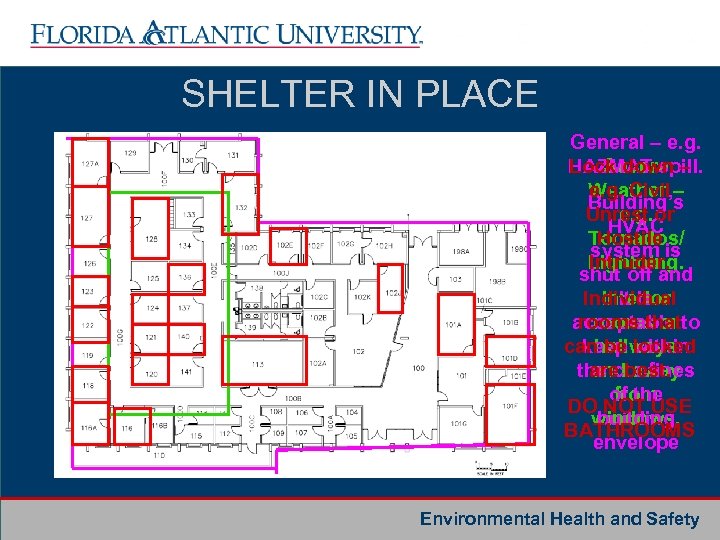
SHELTER IN PLACE General – e. g. HAZMAT spill. Lock down – Severe Weather – e. g. Civil Building’s Unrest or e. g. HVAC Tornados/ Hostile system is Lightning. Intruder. shut off and Individual Interior it is acceptable to rooms that rooms or canhallways keep within be locked the confines are best. and away of the from DO NOT USE windows. building BATHROOMS envelope Environmental Health and Safety
DUTIES RELATED TO SAFETY REPRESENTATIVES ¢ Maintain a list of staff in the building, including those who may need assistance ¢ Order people to shelter in place and ensure those in common areas closest to your occupied spaces are informed (restrooms, break rooms, etc) ¢ Direct people to appropriate areas to shelter depending on emergency (general, severe weather or lockdown) Environmental Health and Safety
DUTIES RELATED TO BUILDING SAFETY REPRESENTATIVES ¢ Assist emergency responders and Safety Supervisors regarding location of individuals requiring assistance and department contents or operations. Keep sheltering in place procedures up to date and available ¢ Complete duties assigned to you by the Safety Supervisors and give updates ¢ Environmental Health and Safety
CARD ACCESS AND LOCKS ¢ ¢ ¢ Should the event necessitate a building lock down, those buildings with card access will be instantly secured. This can be done from within the University Police dispatch center. Officers will also respond and verify there are no standing open or propped doors. Safety supervisors and representatives may be contacted to assist if available. Only building occupants who possess essential personal cards will be able to gain access, until such a time normal operations can resume. Environmental Health and Safety
HURRICANES l Storm Terms • Tropical Depression: <38 mph • Tropical Storm: 39 mph – 73 mph • Hurricane: >73 mph l Watch vs Warning • Watch: storm conditions within 36 hours • Warning: storm conditions within 24 hours l Intensity categories: Saffir-Simpson Scale • • • Cat 1: 74 mph – 95 mph Cat 2: 96 mph – 110 mph Cat 3: 111 mph – 130 mph Cat 4: 131 mph – 155 mph Cat 5: > 155 mph Environmental Health and Safety
HURRICANE DUTIES ¢ Pre-season (threat): • Update plans and procedures and inform unit • Photograph facilities: offices, labs etc • Print hurricane guidelines card and perform assessment ¢ Pre-event: • Print damage assessment forms • Assign duties to staff: • Secure offices, labs, equipment • Advise staff to take personal items home ¢ Post-event: • Record and report damages for repair and reimbursement Environmental Health and Safety
UTILITY ISSUES ¢ What to know: Types of Utilities in your area (gas, propane, plumbing, electrical) l Leak vs. outage l ¢ What to do: (dependant on degree or severity) Utility outage l Utility leak/break l Notification (University Police or campus security then Work Control) l Environmental Health and Safety
SUSPICIOUS PACKAGES ¢ What to know: l ¢ Any item out of place and considered unusual should be treated with caution until identification can be made. What to do: l l Do not handle suspicious items, secure the area and notify the University Police. If you make contact with any suspicious material (powder or fluid) immediately secure the area, rinse hands and other contact areas with soap and water and notify the police department. Environmental Health and Safety
HAZARD COMMUNICATION ¢ What is it? • Information about hazardous materials and associated protective measures. ¢ Why is it needed? • To protect employees handling materials from exposure. ¢ How is this done? • Through plans, labeling, Material Safety Data Sheets, inventories, and training. ¢ Why might I need to know about this? l l The building ay house hazardous materials in teaching/research labs, mechanical shops, janitorial supply areas, pipelines. You may be a source of information for first responders and building safety supervisors. Environmental Health and Safety
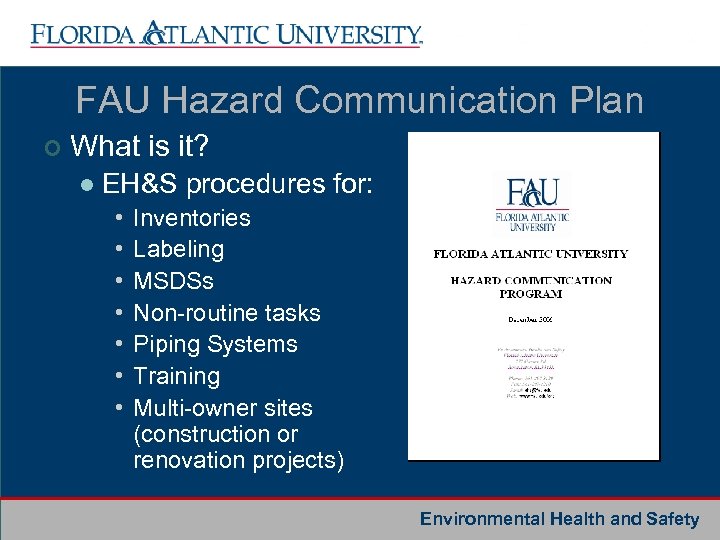
FAU Hazard Communication Plan ¢ What is it? l EH&S procedures for: • • Inventories Labeling MSDSs Non-routine tasks Piping Systems Training Multi-owner sites (construction or renovation projects) Environmental Health and Safety
Routes ¢ Entry to Body: • • ¢ Inhalation – (breathing) Ingestion – (eating) Absorption through the skin Injection – (needles, glass, metal) Exposure to Building Occupants: • Spills – surfaces such as floors, walls, equipment. • Aerosolization – dispersal of material through the air or throughout building via HVAC system. • Breaks in pipes or lines. Environmental Health and Safety
Hazard Information ¢ Labels: l Types: • ANSI (American National Standards Institute) • NFPA (National Fire Protection Agency) • HMIG (Hazardous Materials Identification Guide) • DOT (Department of Transportation) ¢ MSDS • What they are • Where to find them Environmental Health and Safety
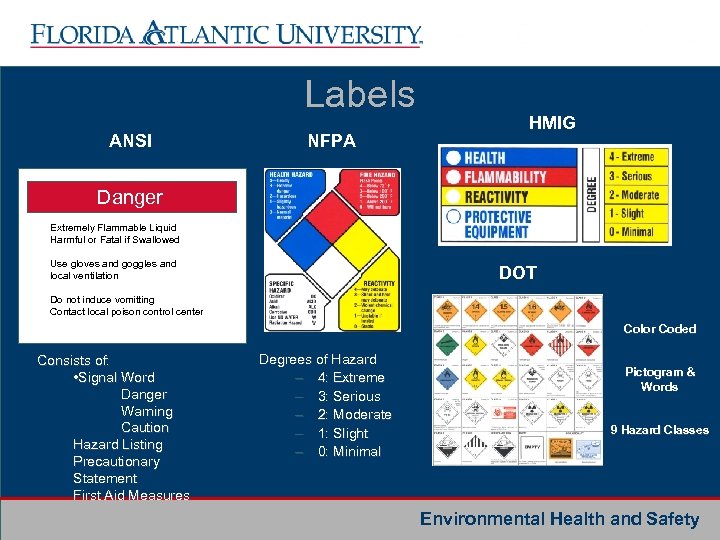
Labels ANSI NFPA HMIG Danger Extremely Flammable Liquid Harmful or Fatal if Swallowed Use gloves and goggles and local ventilation DOT Do not induce vomitting Contact local poison control center Color Coded Consists of: • Signal Word Danger Warning Caution Hazard Listing Precautionary Statement First Aid Measures Degrees of Hazard – 4: Extreme – 3: Serious – 2: Moderate – 1: Slight – 0: Minimal Pictogram & Words 9 Hazard Classes Environmental Health and Safety
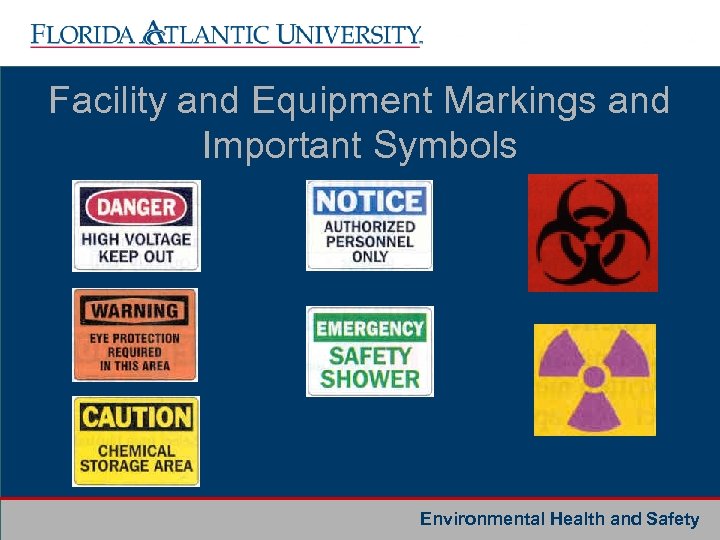
Facility and Equipment Markings and Important Symbols Environmental Health and Safety
BLOODBORNE PATHOGENS ¢ What are they? • Microorganisms and viruses in blood and body fluids that can cause disease in humans. Includes bloodborne diseases such as HIV, Hepatitis B, C, and D, syphilis, malaria. ¢ Why do I need to know about this? • There may be an emergency in the building involving blood • The building you work may house BBP or OPIM in: • Teaching/research labs • In an emergency event: • You are a source of information for first responders and safety supervisors. Environmental Health and Safety
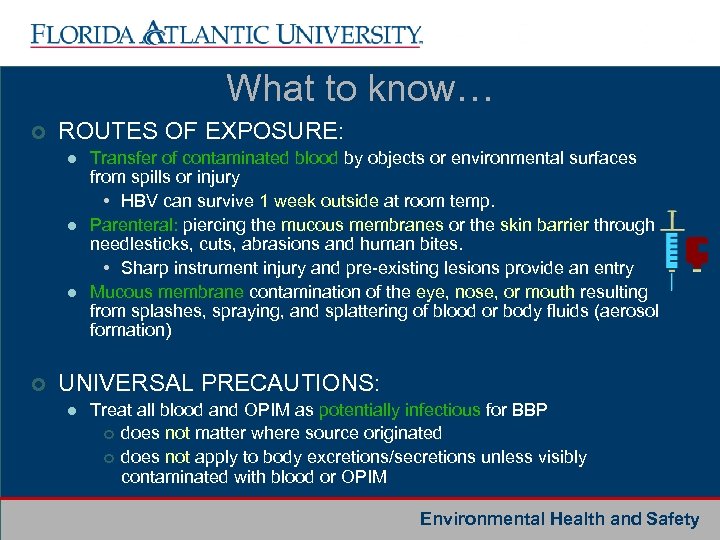
What to know… ¢ ROUTES OF EXPOSURE: l l l ¢ Transfer of contaminated blood by objects or environmental surfaces from spills or injury • HBV can survive 1 week outside at room temp. Parenteral: piercing the mucous membranes or the skin barrier through needlesticks, cuts, abrasions and human bites. • Sharp instrument injury and pre-existing lesions provide an entry Mucous membrane contamination of the eye, nose, or mouth resulting from splashes, spraying, and splattering of blood or body fluids (aerosol formation) UNIVERSAL PRECAUTIONS: l Treat all blood and OPIM as potentially infectious for BBP ¢ does not matter where source originated ¢ does not apply to body excretions/secretions unless visibly contaminated with blood or OPIM Environmental Health and Safety
BBP Standard ¢ The standard outlines policy and procedures to protect workers that includes: l l l Exposure determination: employees with reasonably anticipated contact with BBP in their job classification and procedures Initial and annual training Engineering controls and safe work practices Immunization and post exposure procedures Hazard communication, proper waste disposal, exposure control plan For those who do not work with BBP or OPIM, if you are exposed the post exposure procedures aspect of the standard would apply. Environmental Health and Safety
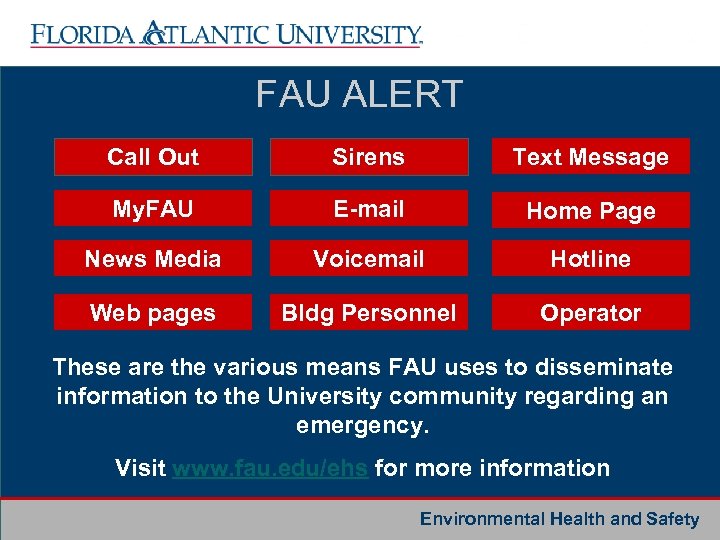
FAU ALERT Call Out Sirens Text Message My. FAU E-mail Home Page News Media Voicemail Hotline Web pages Bldg Personnel Operator These are the various means FAU uses to disseminate information to the University community regarding an emergency. Visit www. fau. edu/ehs for more information Environmental Health and Safety
Key Points… ¢ ¢ Report any unsafe conditions to EH&S or University Police and then the Safety Supervisor or alternate. Know how to identify individuals requiring assistance and inform emergency responders and safety supervisors of their location during an emergency. Include general idea of condition (wheelchair bound, injured, etc) Always keep University Police and Safety Supervisors informed Ensure that your Shelter-In-Place and Evacuation plans are up-to-date and communicated to those whom you will direct (department/floor/etc. ) Environmental Health and Safety
Key Points… Ensure that common areas assigned to you (restrooms, break rooms, classrooms, hallways, etc. ) are checked and cleared or occupants of these areas are clearly informed as to what action to take. ¢ Communicate changes and issues related to the building and emergency planning to your department leadership and Safety Supervisor ¢ Distribute the Crisis Action Guide to all ¢ Environmental Health and Safety
Importance of having BSP Program ¢ ¢ ¢ Help first responders through first-hand knowledge of the building and contents. Information dissemination within the building as quickly as possible to avoid health or safety issues. Help those in need in an emergency event or threat e. g. individuals with disabilities. All leading to reduced injury and property damage. Environmental Health and Safety
Important! ¢ BSP Program (Building Safety Personnel): l ¢ Crisis Action Guide: l ¢ http: //www. fau. edu/admin/Emergency. Information. php Card Access l ¢ http: //www. fau. edu/facilities/ehs/safety/Emergency. Planning. php http: //www. fau. edu/police/cardaccess. php Fire Safety: l http: //www. fau. edu/facilities/ehs/safety/fire-safetyprogram. php Environmental Health and Safety
Important! ¢ Evacuation Assembly Areas: • Boca Raton: http: //www. fau. edu/facilities/ehs/info/Bldg. Evac. Points. Boca. doc • Davie: http: //www. fau. edu/facilities/ehs/info/Bldg. Evac. Points. Davie. doc • Fort Lauderdale: http: //www. fau. edu/facilities/ehs/info/Bldg. Evac. Points-FLL. doc • Jupiter: http: //www. fau. edu/facilities/ehs/info/Bldg. Evac. Points. JDM. doc • Sea Tech: http: //www. fau. edu/facilities/ehs/info/Bldg. Evac. Points-ST. doc • Treasure Coast: http: //www. fau. edu/facilities/ehs/info/Bldg. Evac. Points-TC. doc Environmental Health and Safety
Important! ¢ Hurricane Information (FAU Hurricane Info): l ¢ Utilities: l ¢ http: //www. fau. edu/facilities/pp/ Chemical Safety & MSDS: l ¢ http: //www. fau. edu/facilities/ehs/safety/Emergen cy-Planning. php http: //www. fau. edu/facilities/ehs/info/MSDS. php Biological Safety incl. BBP: l http: //www. fau. edu/facilities/ehs/safety/biological -safety-programs. php Environmental Health and Safety
Thank you for your participation! l Questions? • Call (561) 297 -2889 or e-mail ssookhoo@fau. edu l If no questions – click here to let us know that you have completed this training. Environmental Health and Safety
Скачать презентацию Florida Atlantic University Environmental Health and Safety Building
845278ae7a61f7f99a7706dc580de421.ppt