Скачать презентацию Floods Paleofloods and Drought Insights from the Upper
9644c155f837ed3af4fb3a5c4e09e899.ppt
- Количество слайдов: 51
 Floods, Paleofloods, and Drought: Insights from the Upper Tails Katie Hirschboeck Laboratory of Tree-Ring Research University of Arizona CLIVAR/PAGES/IPCC Drought Implications Workshop November 2003
 Paleofloods -Direct Physical Evidence of Extreme Hydrological Events
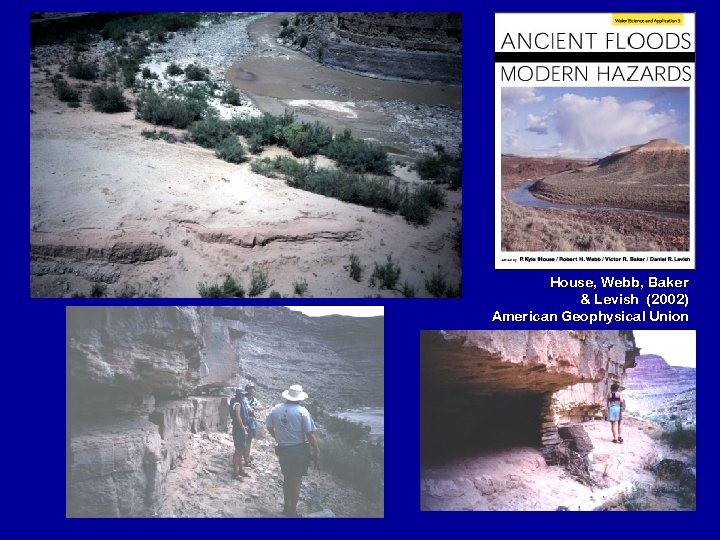 House, Webb, Baker & Levish (2002) American Geophysical Union
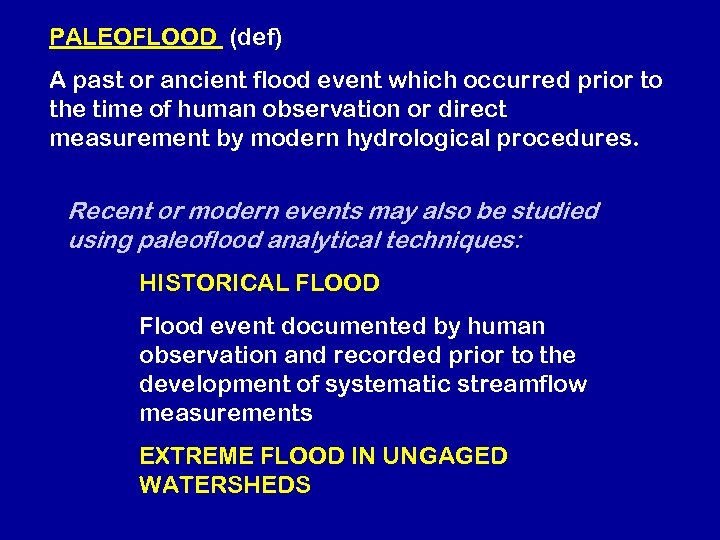 PALEOFLOOD (def) A past or ancient flood event which occurred prior to the time of human observation or direct measurement by modern hydrological procedures. Recent or modern events may also be studied using paleoflood analytical techniques: HISTORICAL FLOOD Flood event documented by human observation and recorded prior to the development of systematic streamflow measurements EXTREME FLOOD IN UNGAGED WATERSHEDS
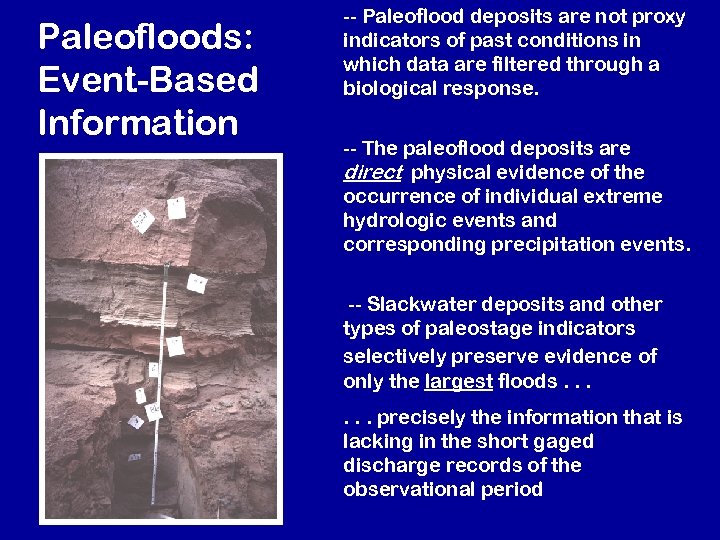 Paleofloods: Event-Based Information -- Paleoflood deposits are not proxy indicators of past conditions in which data are filtered through a biological response. -- The paleoflood deposits are direct physical evidence of the occurrence of individual extreme hydrologic events and corresponding precipitation events. -- Slackwater deposits and other types of paleostage indicators selectively preserve evidence of only the largest floods. . . precisely the information that is lacking in the short gaged discharge records of the observational period
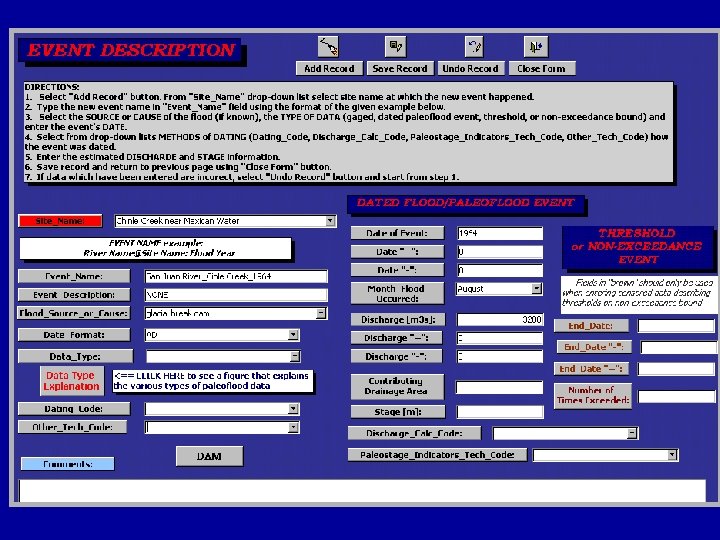
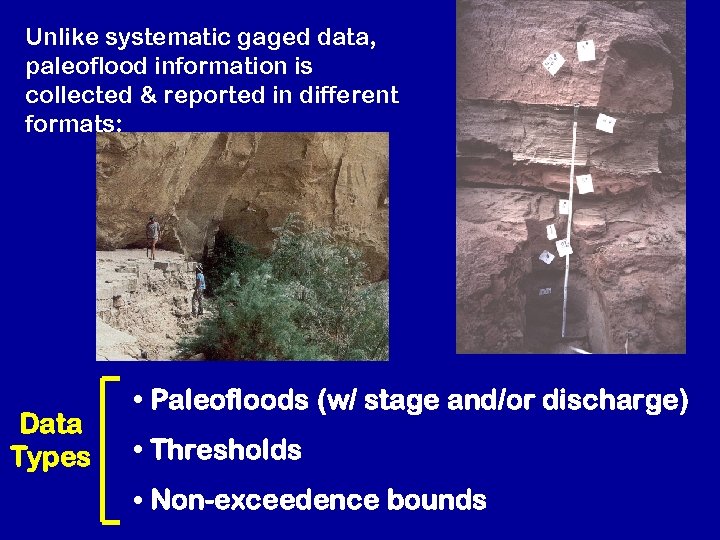 Unlike systematic gaged data, paleoflood information is collected & reported in different formats: Data Types • Paleofloods (w/ stage and/or discharge) • Thresholds • Non-exceedence bounds
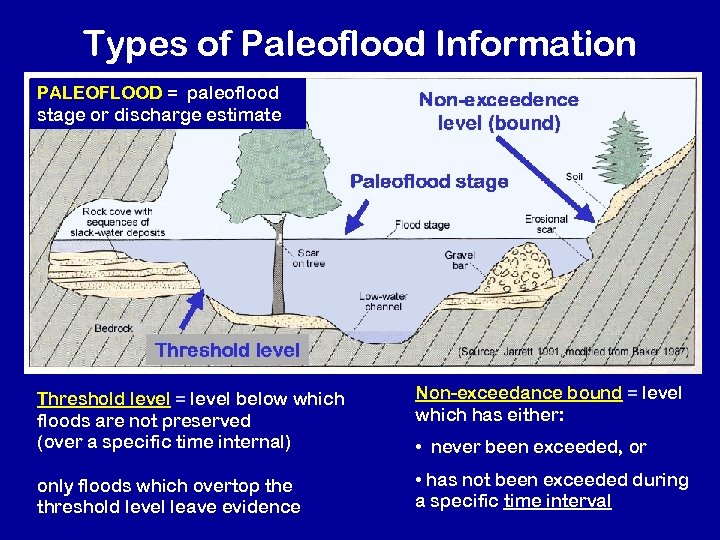 Types of Paleoflood Information PALEOFLOOD = paleoflood stage or discharge estimate Threshold level = level below which floods are not preserved (over a specific time internal) Non-exceedance bound = level which has either: only floods which overtop the threshold level leave evidence • has not been exceeded during a specific time interval • never been exceeded, or
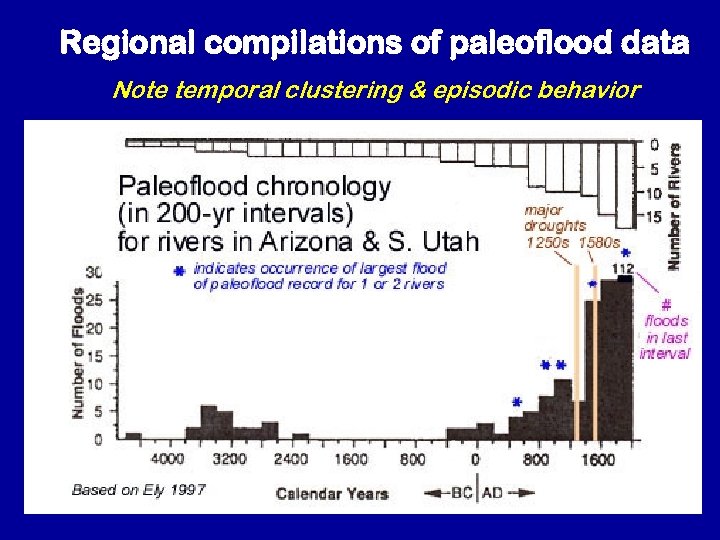 Regional compilations of paleoflood data Note temporal clustering & episodic behavior
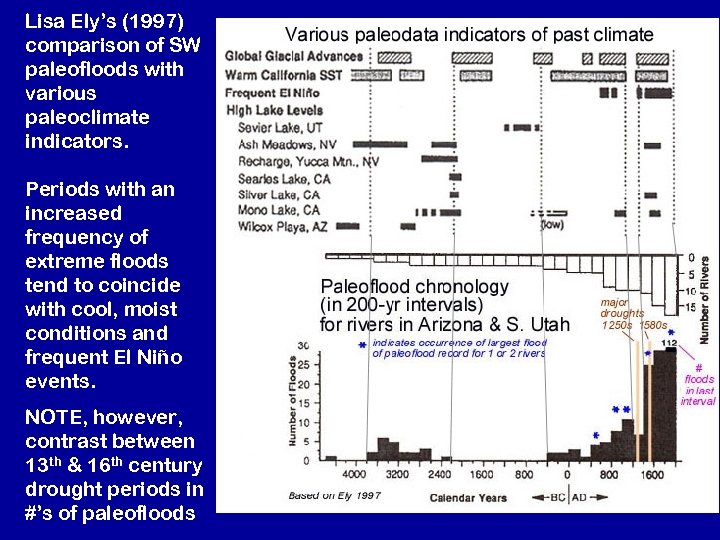 Lisa Ely’s (1997) comparison of SW paleofloods with various paleoclimate indicators. Periods with an increased frequency of extreme floods tend to coincide with cool, moist conditions and frequent El Niño events. NOTE, however, contrast between 13 th & 16 th century drought periods in #’s of paleofloods
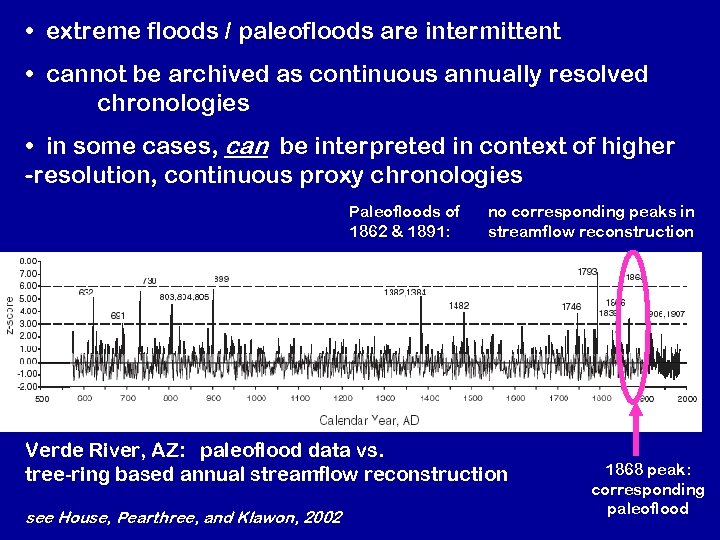 • extreme floods / paleofloods are intermittent • cannot be archived as continuous annually resolved chronologies • in some cases, can be interpreted in context of higher -resolution, continuous proxy chronologies Paleofloods of 1862 & 1891: no corresponding peaks in streamflow reconstruction Verde River, AZ: paleoflood data vs. tree-ring based annual streamflow reconstruction see House, Pearthree, and Klawon, 2002 1868 peak: corresponding paleoflood
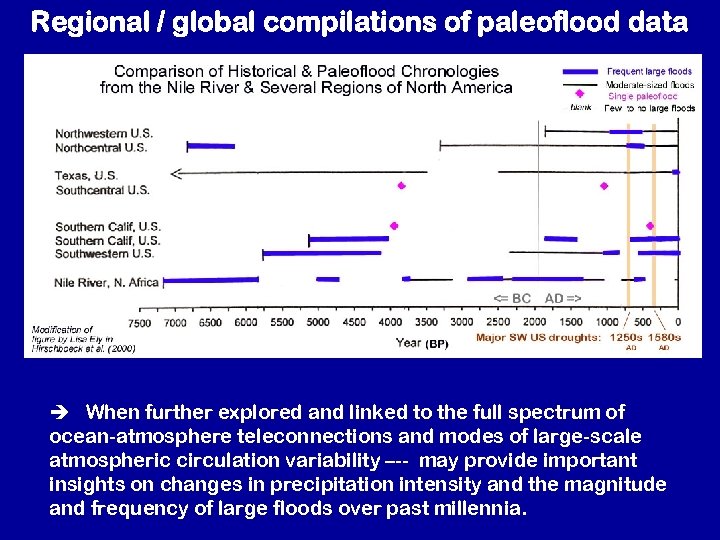 Regional / global compilations of paleoflood data When further explored and linked to the full spectrum of ocean-atmosphere teleconnections and modes of large-scale atmospheric circulation variability –-- may provide important insights on changes in precipitation intensity and the magnitude and frequency of large floods over past millennia.
 Five Insights from the Upper Tails of Flood Distributions
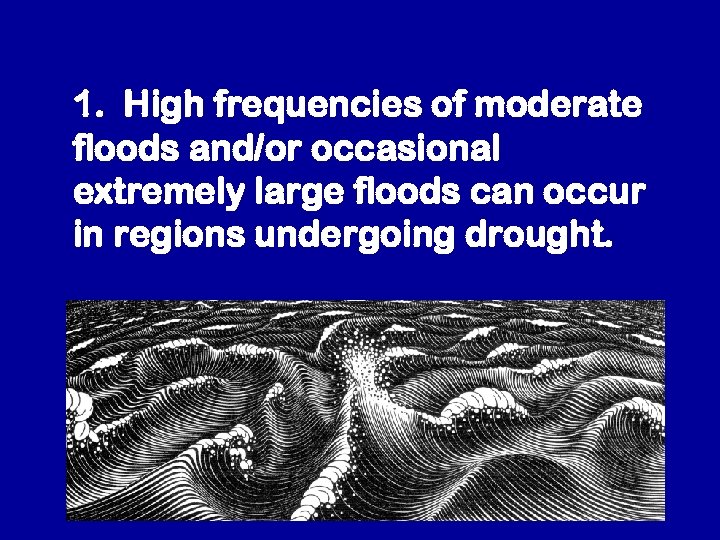 1. High frequencies of moderate floods and/or occasional extremely large floods can occur in regions undergoing drought.
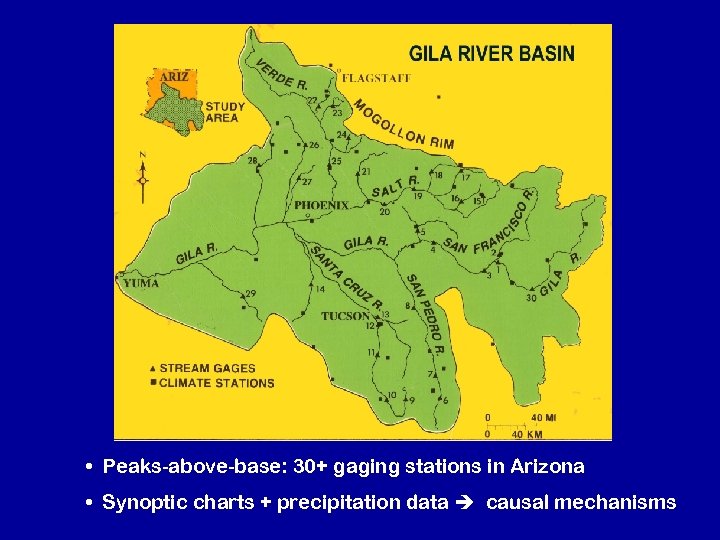 • Peaks-above-base: 30+ gaging stations in Arizona • Synoptic charts + precipitation data causal mechanisms
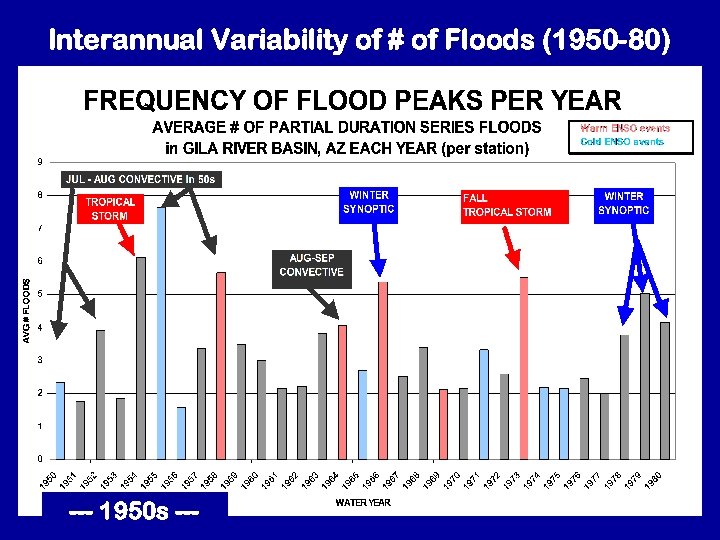 Interannual Variability of # of Floods (1950 -80) --- 1950 s ---
 IMPLICATIONS Systematic examinations of the gaged flood record in other regions undergoing drought are needed to explore the hydroclimatic conditions for concurrent flood and drought episodes.
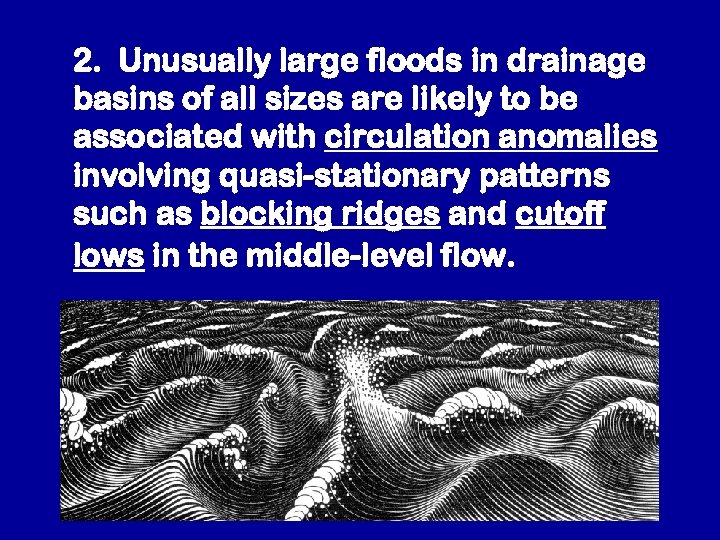 2. Unusually large floods in drainage basins of all sizes are likely to be associated with circulation anomalies involving quasi-stationary patterns such as blocking ridges and cutoff lows in the middle-level flow.
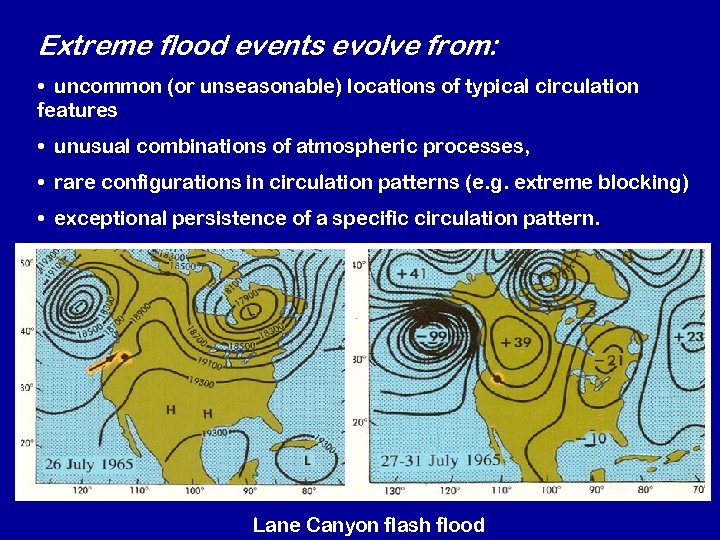 Extreme flood events evolve from: • uncommon (or unseasonable) locations of typical circulation features • unusual combinations of atmospheric processes, • rare configurations in circulation patterns (e. g. extreme blocking) • exceptional persistence of a specific circulation pattern. Lane Canyon flash flood
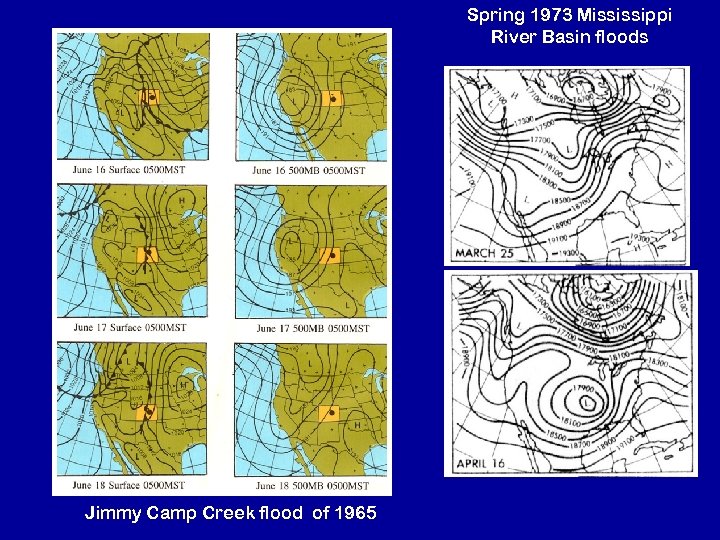 Spring 1973 Mississippi River Basin floods Jimmy Camp Creek flood of 1965
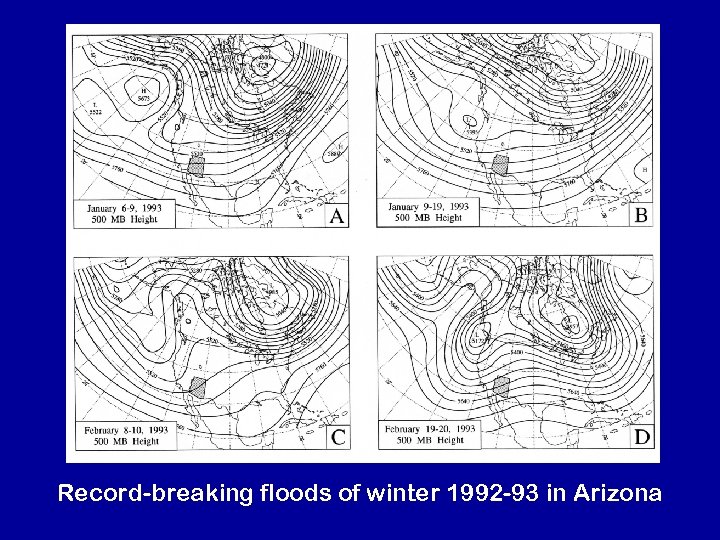 Record-breaking floods of winter 1992 -93 in Arizona
 IMPLICATIONS (1) Since the characteristic drought circulation pattern in the United States is a strong middle- and upper-level ridge (and occasional blocking high). . . it should not be surprising that extreme flooding and persistent drought occasionally coincide, at least in adjacent regions.
 IMPLICATIONS (2) Shifts in storm track locations and other anomalous circulation behavior are clearly linked to unusual flood and drought behavior. They are likely to be the factors most directly responsible for projected increases in hydrologic extremes under a changing climate.
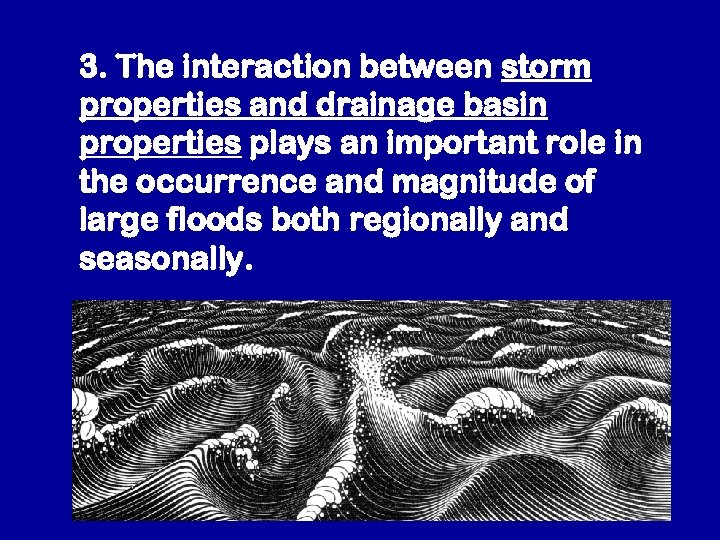 3. The interaction between storm properties and drainage basin properties plays an important role in the occurrence and magnitude of large floods both regionally and seasonally.
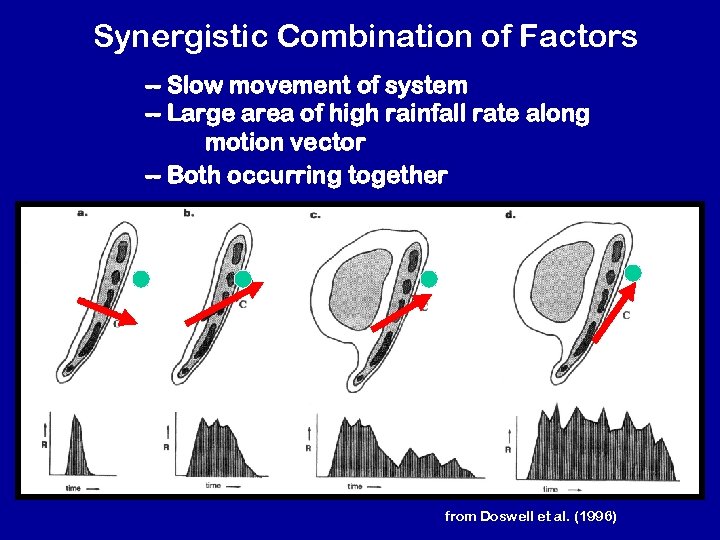 Synergistic Combination of Factors -- Slow movement of system -- Large area of high rainfall rate along motion vector -- Both occurring together from Doswell et al. (1996)
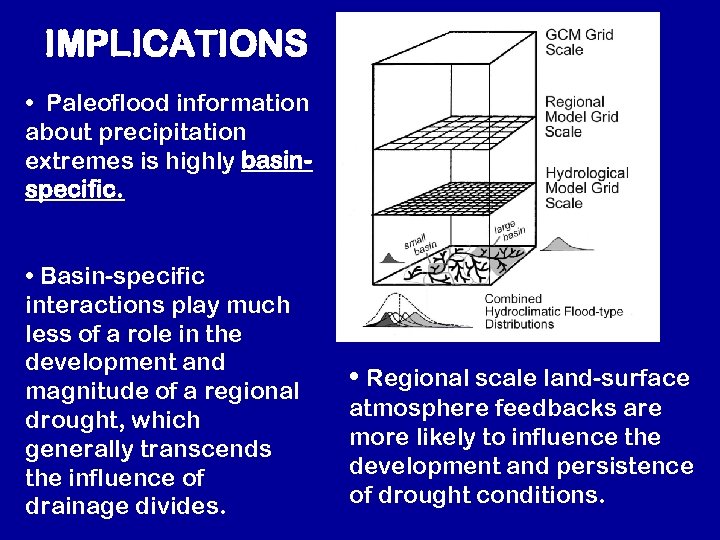 IMPLICATIONS • Paleoflood information about precipitation extremes is highly basinspecific. • Basin-specific interactions play much less of a role in the development and magnitude of a regional drought, which generally transcends the influence of drainage divides. • Regional scale land-surface atmosphere feedbacks are more likely to influence the development and persistence of drought conditions.
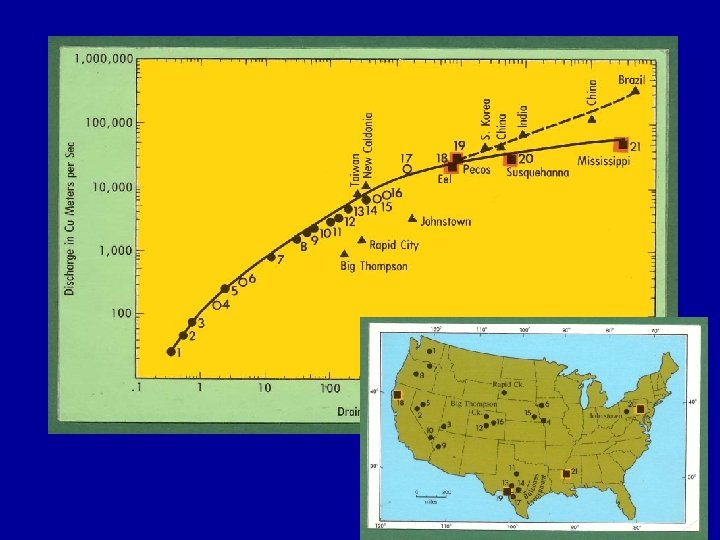
 4. Compilations of paleoflood records combined with gaged records suggest there is a natural, upper physical limit to the magnitude of floods in a given region.
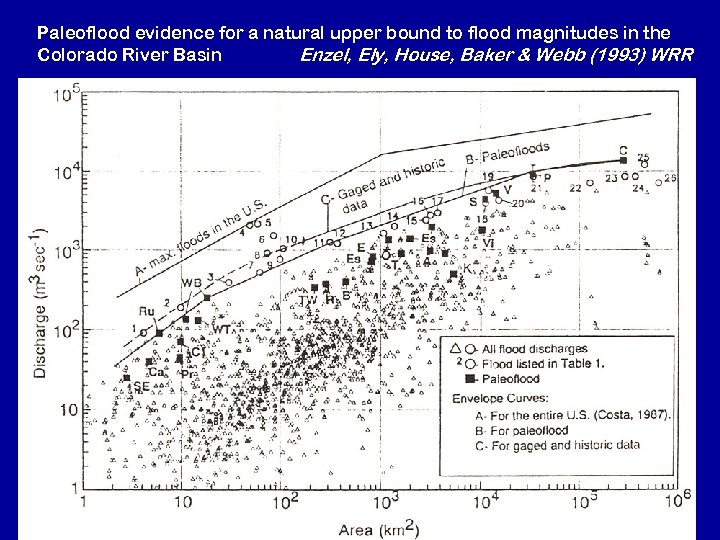 Paleoflood evidence for a natural upper bound to flood magnitudes in the Colorado River Basin Enzel, Ely, House, Baker & Webb (1993) WRR
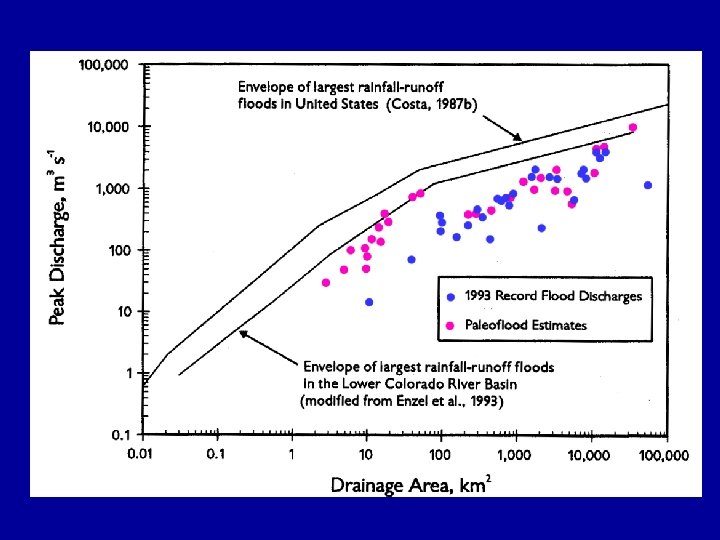
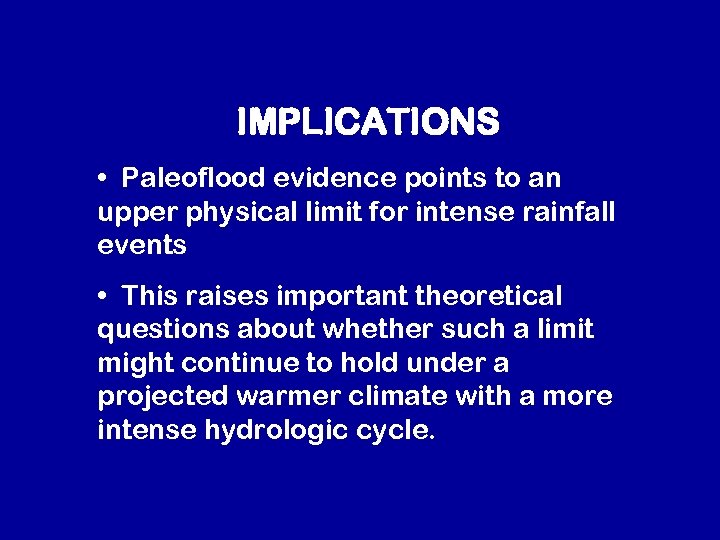 IMPLICATIONS • Paleoflood evidence points to an upper physical limit for intense rainfall events • This raises important theoretical questions about whether such a limit might continue to hold under a projected warmer climate with a more intense hydrologic cycle.
 5. The identification of hydroclimatically defined mixed distributions in flood records suggests that in regions where floods are produced by several types of meteorological events, different storm types may exhibit unique probability distributions.
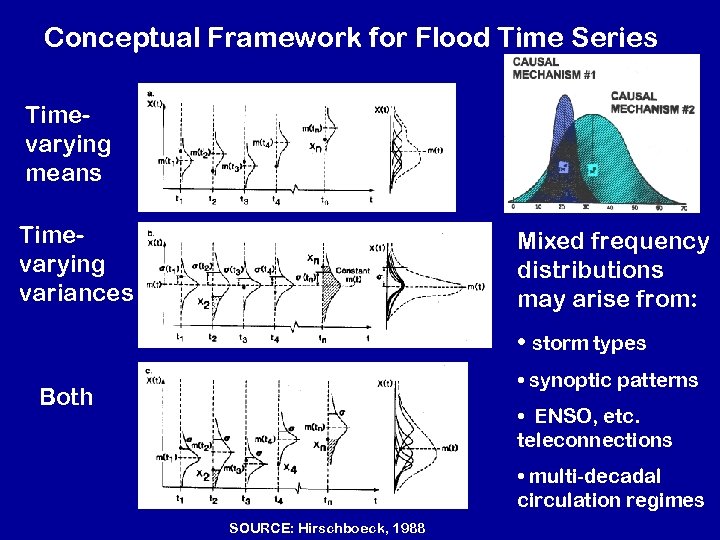 Conceptual Framework for Flood Time Series Timevarying means Timevarying variances Mixed frequency distributions may arise from: • storm types • synoptic patterns Both • ENSO, etc. teleconnections • multi-decadal circulation regimes SOURCE: Hirschboeck, 1988
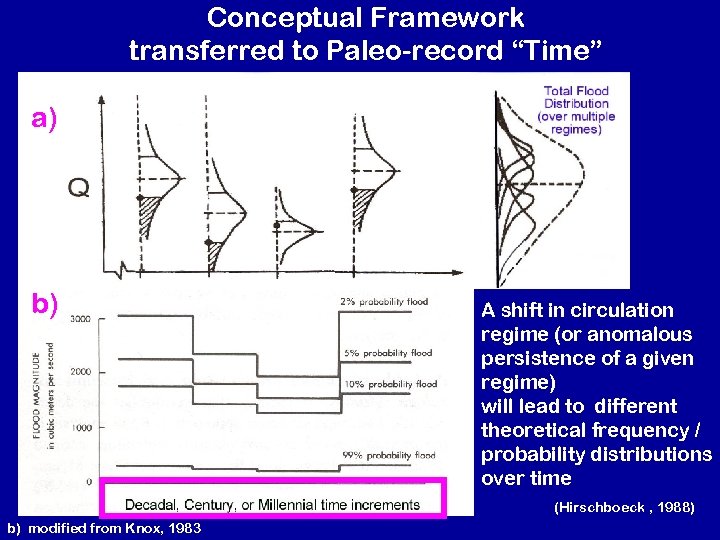 Conceptual Framework transferred to Paleo-record “Time” a) b) A shift in circulation regime (or anomalous persistence of a given regime) will lead to different theoretical frequency / probability distributions over time (Hirschboeck , 1988) b) modified from Knox, 1983
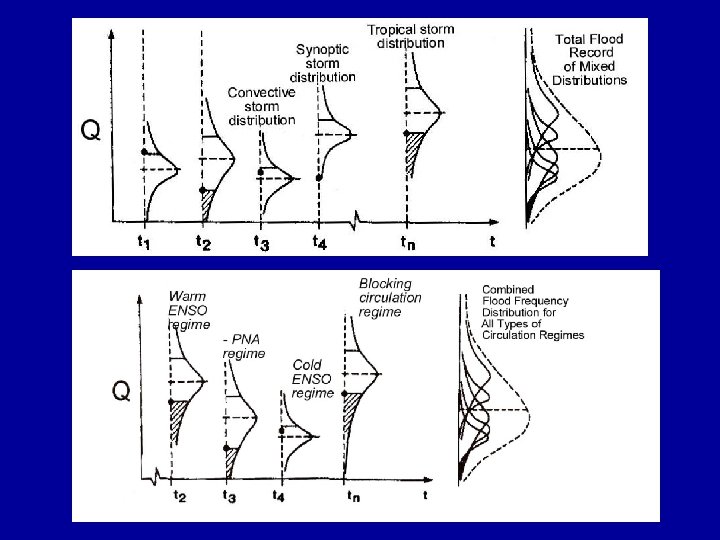
 IMPLICATIONS For floods or paleofloods, climatic changes can be conceptualized as time-varying atmospheric circulation regimes that generate a mix of shifting streamflow probability distributions over time. This conceptual framework – -- in tandem with the framework proposed by Trenberth (1998, 1999) – provides an opportunity to evaluate streamflow-based hydrologic extremes under a changing climate from complementary perspectives.
 CLOSING COMMENT
 • In the largest and most extreme floods studied, PERSISTENCE was always a factor • Persistence of INGREDIENTS (e. g. , deep moist convection environment) most important at small scales (flash floods) • Persistence of PATTERN most important at larger scales (basin-wide / regional floods)
 • Persistence bridges meteorological and climatological time scales • Persistence = underlying factor in atmosphere / basin synergy. . . AND DROUGHT!!!!
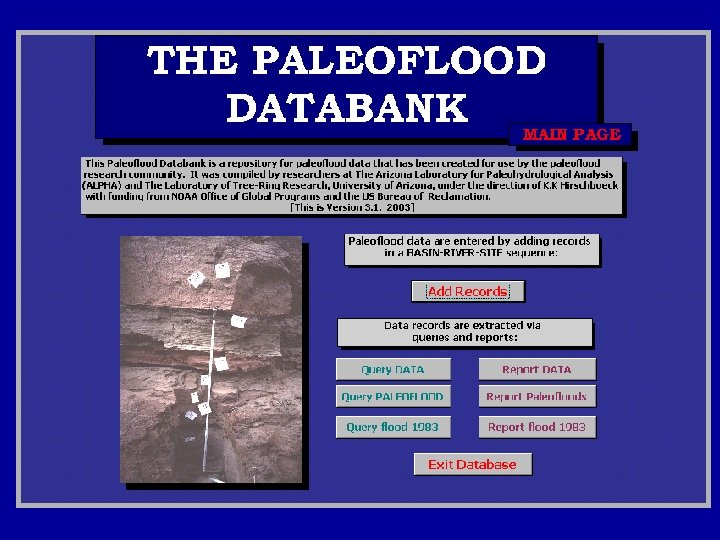
 This Paleoflood Databank is a repository for paleoflood data that has been created for use by the paleoflood research community. It was compiled by researchers at The Arizona Laboratory for Paleohydrological Analysis (ALPHA) and The Laboratory of Tree-Ring Research, University of Arizona, under the direction of K. K Hirschboeck with funding from NOAA Office of Global Programs and the US Bureau of Reclamation. [This is Version 3. 1. 2003]
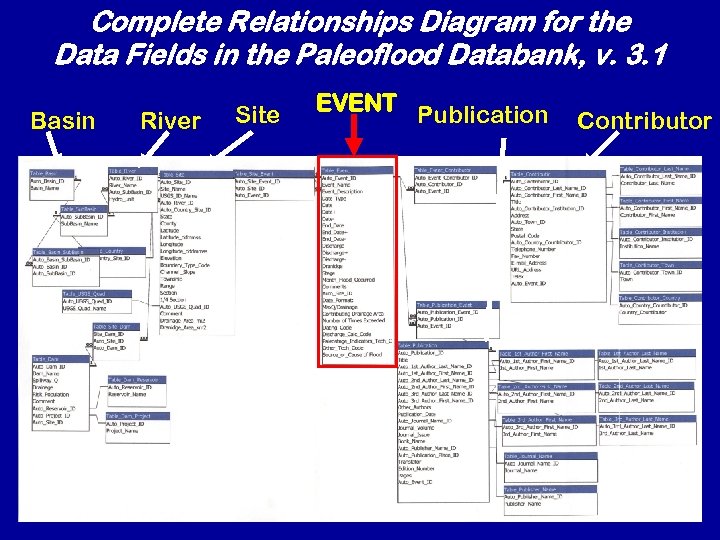 Complete Relationships Diagram for the Data Fields in the Paleoflood Databank, v. 3. 1 Basin River Site EVENT Publication Contributor
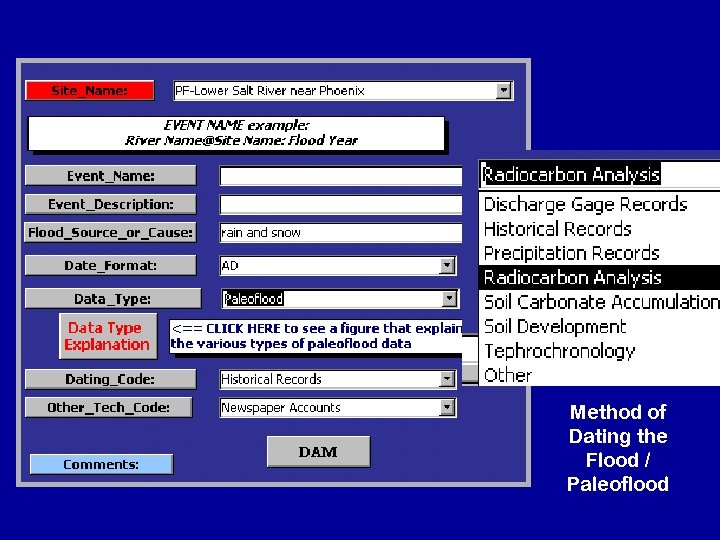 Method of Dating the Flood / Paleoflood
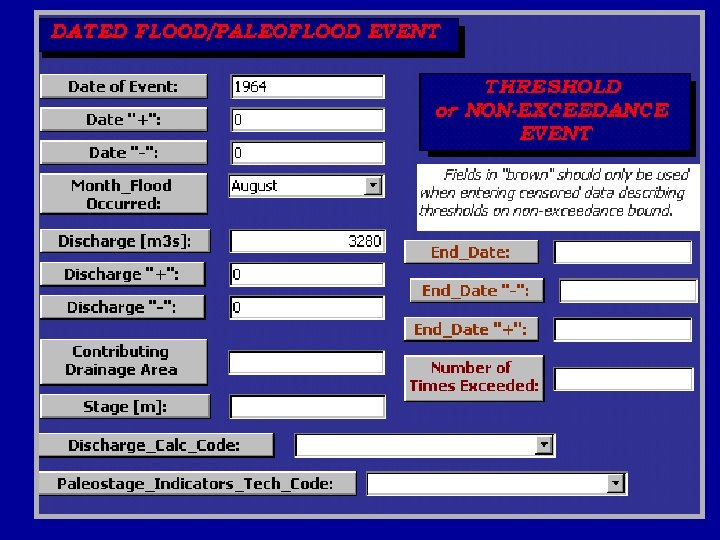
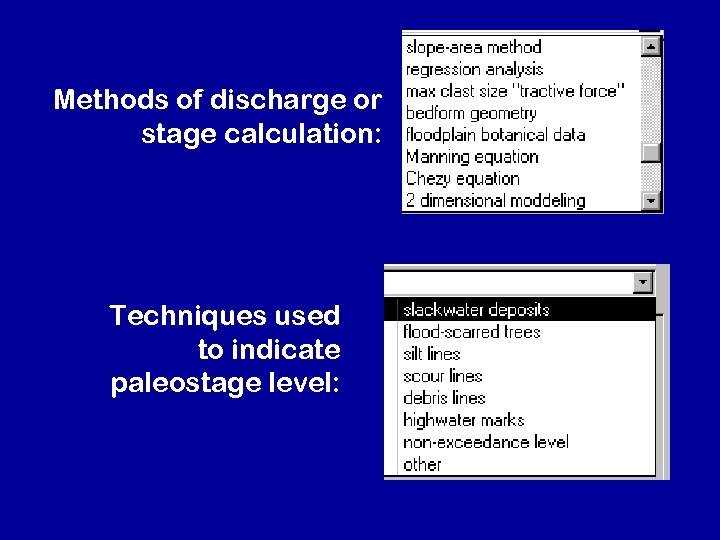 Methods of discharge or stage calculation: Techniques used to indicate paleostage level:
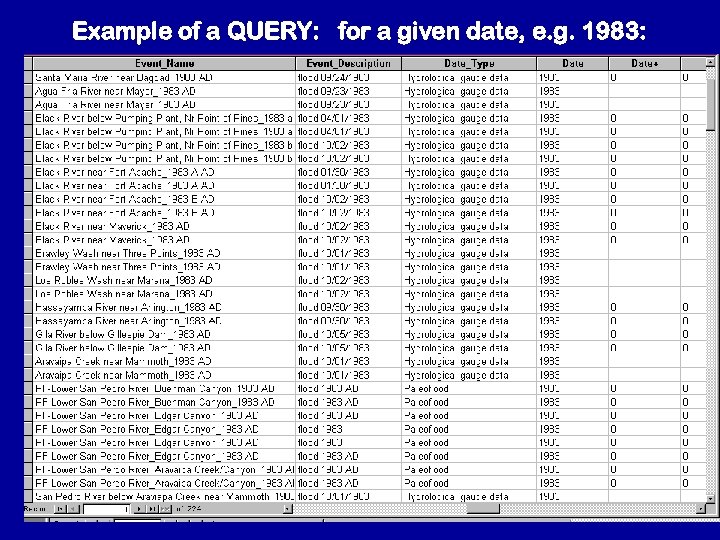 Example of a QUERY: for a given date, e. g. 1983:
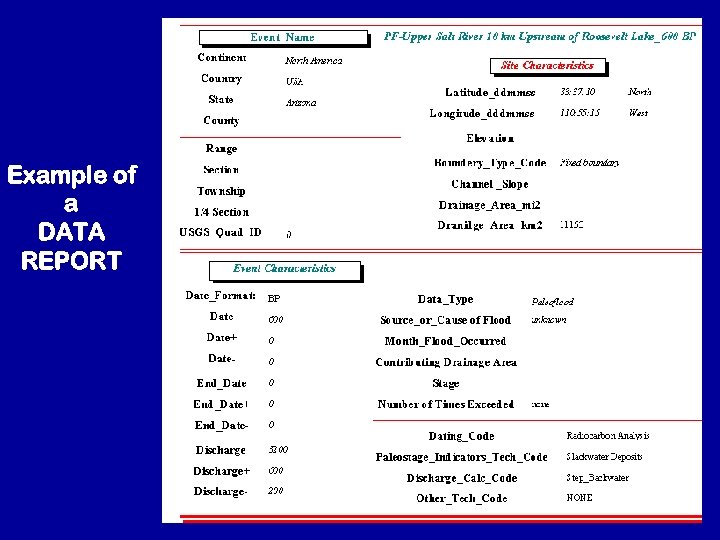 Example of a DATA REPORT
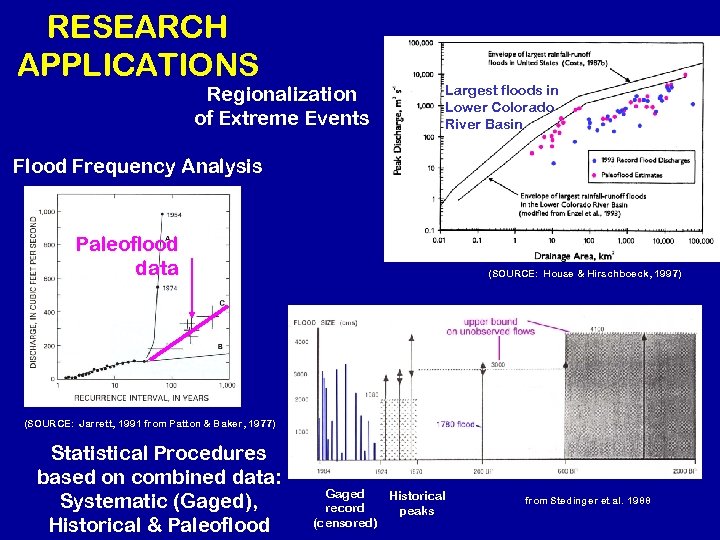 RESEARCH APPLICATIONS Largest floods in Lower Colorado River Basin Regionalization of Extreme Events Flood Frequency Analysis Paleoflood data (SOURCE: House & Hirschboeck, 1997) (SOURCE: Jarrett, 1991 from Patton & Baker, 1977) Statistical Procedures based on combined data: Systematic (Gaged), Historical & Paleoflood Gaged record (censored) Historical peaks from Stedinger et al. 1988