 Скачать презентацию Flexible Exchange Rates CHAPTER 14 Reinert Windows on the
636001bb41cea7d135621e9ee6937900.ppt
- Количество слайдов: 26



Flexible Exchange Rates CHAPTER 14 Reinert/Windows on the World Economy, 2005
Introduction n n Forces of supply and demand in currency markets determine exchange rate An example of a flexible or floating exchange rate regime § Canadian dollar began the 1990 s at 1. 651 per US dollar § By 1998, it was trading at 2. 155 per US dollar • A fall from 61 US cents to 46 US cents n What makes a flexible exchange rate move one way or another? § This chapter develops a model of how the nominal exchange rate is determined in currency markets • Will consider a trade-based model ¨ ¨ Nominal exchange rate is determined by currency transactions arising from imports and exports Will extend model to account for exchange of assets Reinert/Windows on the World Economy, 2005 2
A Trade-Based Model n n Part of fundamental accounting equations § Foreign Savings = Trade Deficit Rewrite this relationship using symbols § SF (foreign savings) = Z (imports) - E (exports) or SF = (Z - E) Use Mexico as home country and United States as foreign country SF is foreign savings § Savings supplied by US residents who buy Mexican assets § SF is a demand for pesos (supply of dollars) by US • Demand is invariant with respect to value of peso • Gives us the perfectly inelastic demand for pesos curve Reinert/Windows on the World Economy, 2005 3
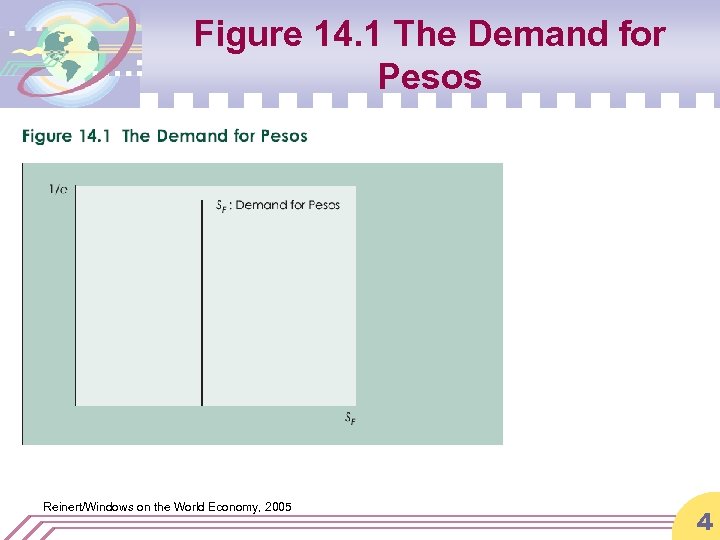
Figure 14. 1 The Demand for Pesos Reinert/Windows on the World Economy, 2005 4
A Trade-Based Model n Z - E is the trade deficit § Net demand for US goods by Mexico § A supply of pesos (demand for dollars) by Mexico Z has a positive relationship to value of peso n E has a negative relationship to value of peso n § Thus Z-E has a positive relationship to value of peso Reinert/Windows on the World Economy, 2005 5
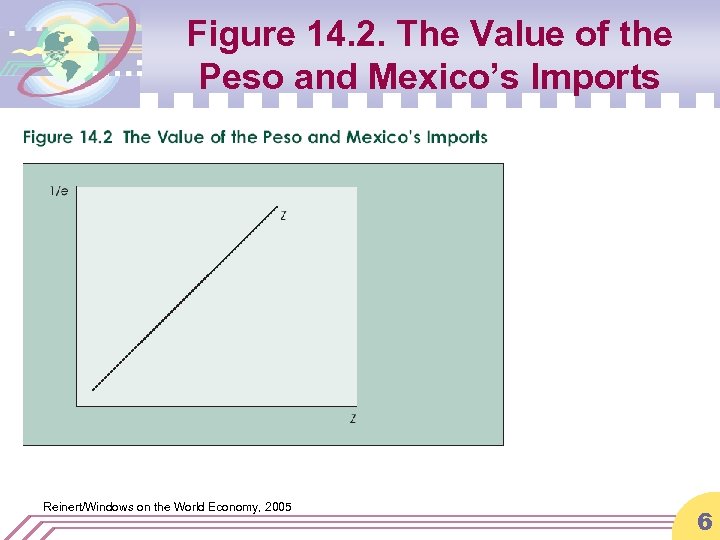
Figure 14. 2. The Value of the Peso and Mexico’s Imports Reinert/Windows on the World Economy, 2005 6
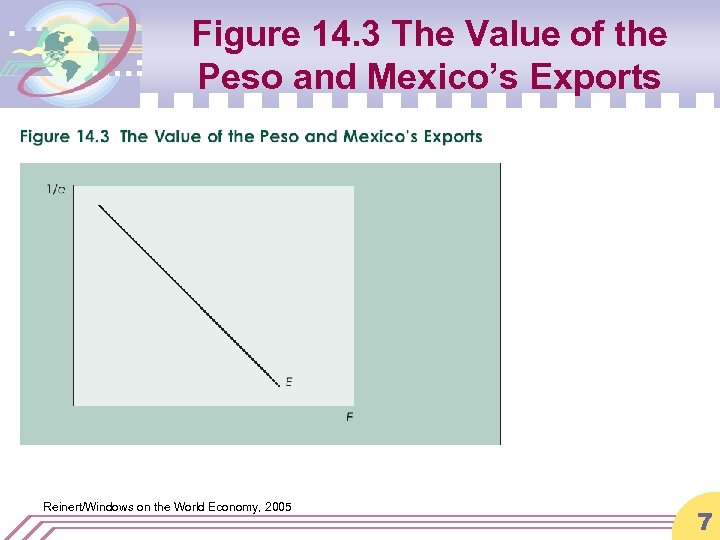
Figure 14. 3 The Value of the Peso and Mexico’s Exports Reinert/Windows on the World Economy, 2005 7
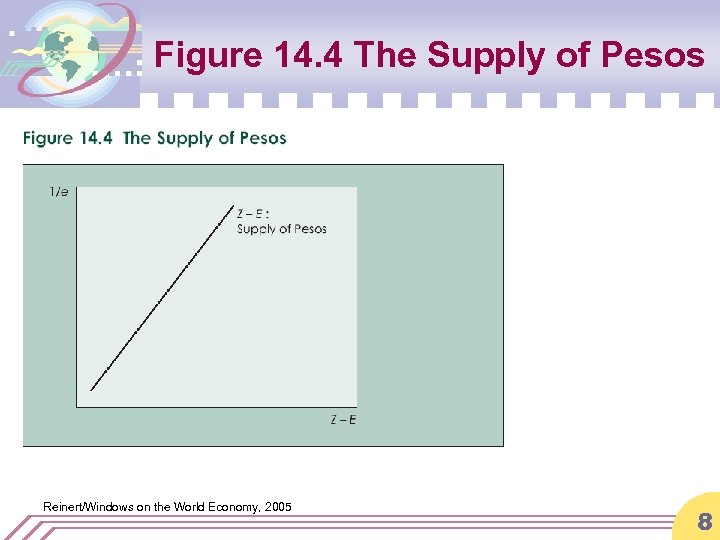
Figure 14. 4 The Supply of Pesos Reinert/Windows on the World Economy, 2005 8
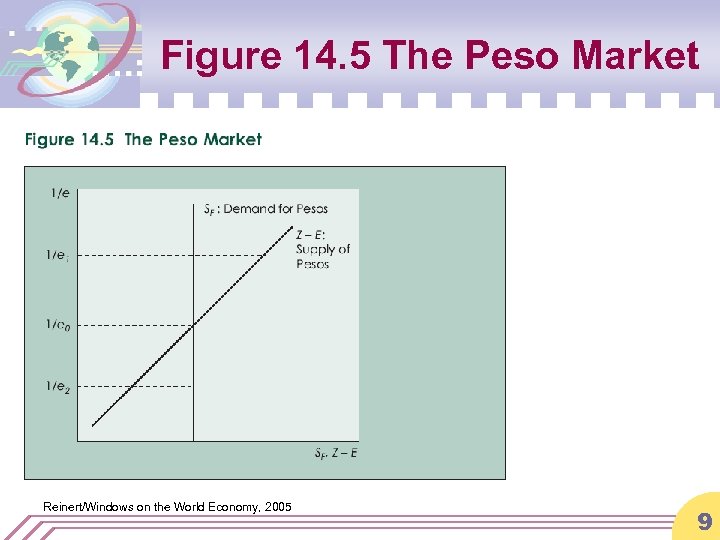
Figure 14. 5 The Peso Market Reinert/Windows on the World Economy, 2005 9
A Trade-Based Model n We are considering the case of a flexible exchange rate regime § e can vary in response to excess supply of or excess demand for pesos § Increase in e or a fall in value of peso • Depreciation of peso § Decrease in e or a rise in value of peso • Appreciation of peso Reinert/Windows on the World Economy, 2005 10
A Trade-Based Model n Consider three alternative values of the peso § 1 ÷ e 1—supply of pesos exceeds demand for pesos • Reduces value of peso ¨ Trade deficit falls—brings the supply and demand of pesos into equality § 1 ÷ e 2—demand for pesos exceeds the supply of pesos • Increases value of peso ¨ As peso appreciates, trade deficit rises—brings supply and demand of pesos into equality § 1 ÷ e 0—demand for and supply of pesos are exactly the same • Represents equilibrium value of peso, and e 0 is the equilibrium nominal exchange rate n Model is trade-based in the sense that only trade flows respond to a change in value of peso Reinert/Windows on the World Economy, 2005 11
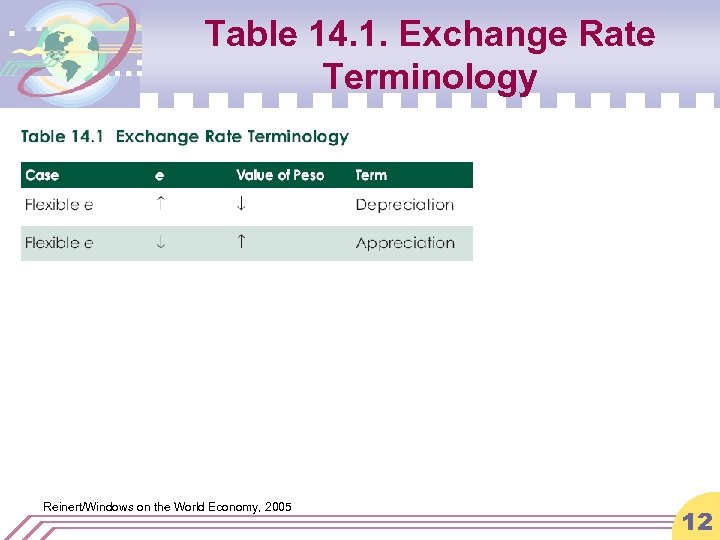
Table 14. 1. Exchange Rate Terminology Reinert/Windows on the World Economy, 2005 12
An Assets-Based Model n Views foreign currency transactions as arising from the buying and selling of foreign-currencydenominated assets, rather than from trade flows § Focuses on foreign savings rather than on trade deficit in the SF = Z - E relationship n Pretend you are a Mexican investor, deciding upon the allocation of your wealth portfolio between two assets § A peso-denominated asset § A dollar-denominated asset • For simplicity, assume both assets to be open-ended mutual funds with fixed domestic-currency prices ¨ You will allocate your portfolio with an eye to rates of return of alternative assets Reinert/Windows on the World Economy, 2005 13
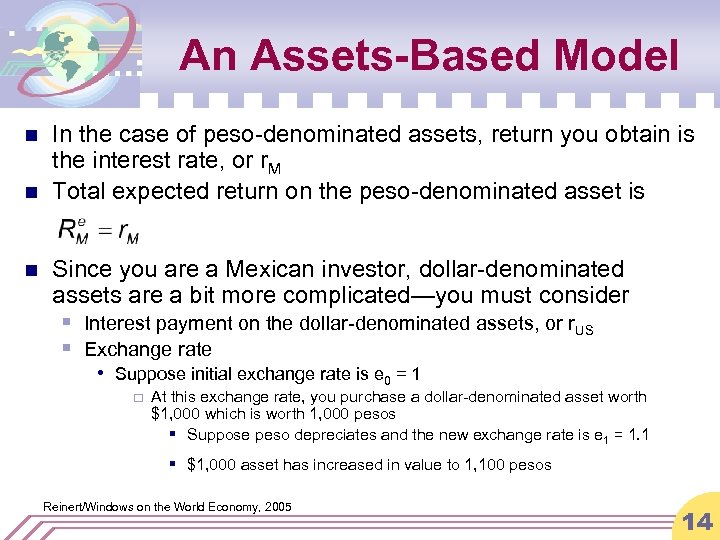
An Assets-Based Model n n n In the case of peso-denominated assets, return you obtain is the interest rate, or r. M Total expected return on the peso-denominated asset is Since you are a Mexican investor, dollar-denominated assets are a bit more complicated—you must consider § Interest payment on the dollar-denominated assets, or r. US § Exchange rate • Suppose initial exchange rate is e 0 = 1 ¨ At this exchange rate, you purchase a dollar-denominated asset worth $1, 000 which is worth 1, 000 pesos § Suppose peso depreciates and the new exchange rate is e 1 = 1. 1 § $1, 000 asset has increased in value to 1, 100 pesos Reinert/Windows on the World Economy, 2005 14
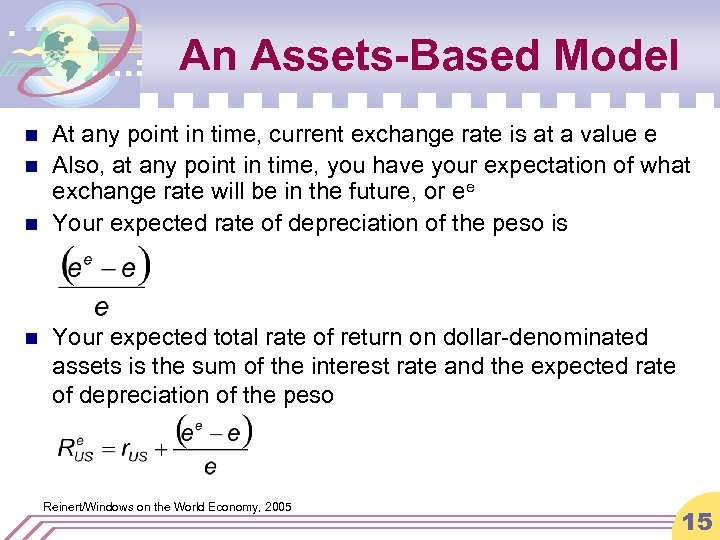
An Assets-Based Model n n At any point in time, current exchange rate is at a value e Also, at any point in time, you have your expectation of what exchange rate will be in the future, or ee Your expected rate of depreciation of the peso is Your expected total rate of return on dollar-denominated assets is the sum of the interest rate and the expected rate of depreciation of the peso Reinert/Windows on the World Economy, 2005 15
An Assets-Based Model— Portfolio Allocation n How will you allocate your portfolio between these two asset types? Possibilities include § If expected total rate of return on peso-denominated assets exceeds expected total rate of return on dollar-denominated assets • Since peso-denominated assets offer a higher expected rate of return, reallocate your portfolio towards these assets, selling dollars and buying pesos § If expected total rate of return on dollar-denominated assets exceeds expected total rate of return on peso-denominated assets • Reallocate your portfolio towards dollar-denominated assets, buying dollars and selling pesos § If expected total rate of return on dollar-denominated assets equals expected total rate of return on peso-denominated assets • No reason or incentive to reallocate your portfolio Reinert/Windows on the World Economy, 2005 16
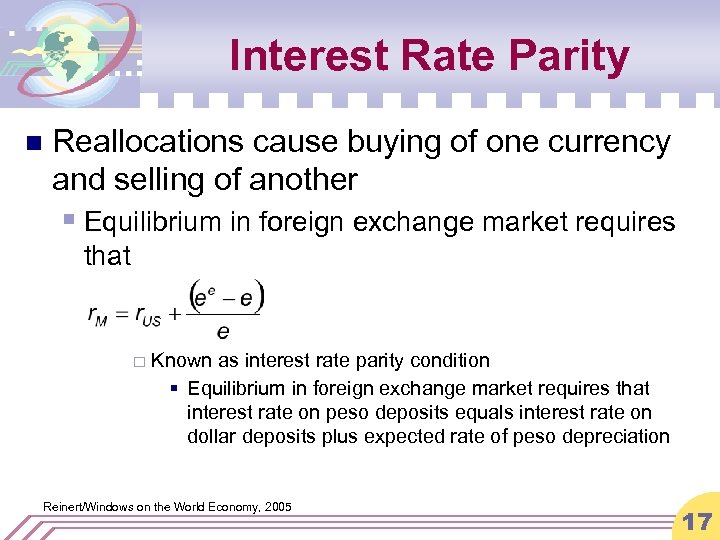
Interest Rate Parity n Reallocations cause buying of one currency and selling of another § Equilibrium in foreign exchange market requires that ¨ Known as interest rate parity condition § Equilibrium in foreign exchange market requires that interest rate on peso deposits equals interest rate on dollar deposits plus expected rate of peso depreciation Reinert/Windows on the World Economy, 2005 17
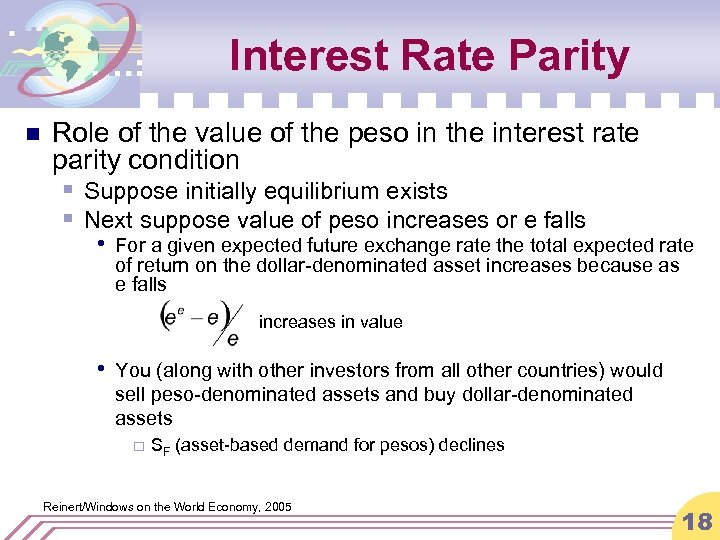
Interest Rate Parity n Role of the value of the peso in the interest rate parity condition § Suppose initially equilibrium exists § Next suppose value of peso increases or e falls • For a given expected future exchange rate the total expected rate of return on the dollar-denominated asset increases because as e falls increases in value • You (along with other investors from all other countries) would sell peso-denominated assets and buy dollar-denominated assets ¨ SF (asset-based demand for pesos) declines Reinert/Windows on the World Economy, 2005 18
Interest Rate Parity n To understand adjustment process, consider three alternative values of the peso § At 1/e 1 supply of pesos exceeds demand for pesos resulting in a fall in value of peso • Trade deficit falls as Z decreases and E increases—decreases • supply of pesos Foreign saving rises ¨ Expected total rate of return on dollar-denominated assets falls § Investors move into peso-denominated assets—increases demand for pesos • Both of these changes bring the peso market towards equilibrium Reinert/Windows on the World Economy, 2005 19
Interest Rate Parity § At 1/e 2 demand for pesos exceeds supply of pesos leading to a rise in value of peso • Trade deficit rises as Z increases and E decreases— • increases supply of pesos Foreign savings falls ¨ Expected total rate of return on dollar-denominated assets rises § Investors move out of peso-denominated assets into dollar-denominated assets—decreases demand for pesos § At e 0 demand for and supply of pesos are equal —peso market is in equilibrium Reinert/Windows on the World Economy, 2005 20
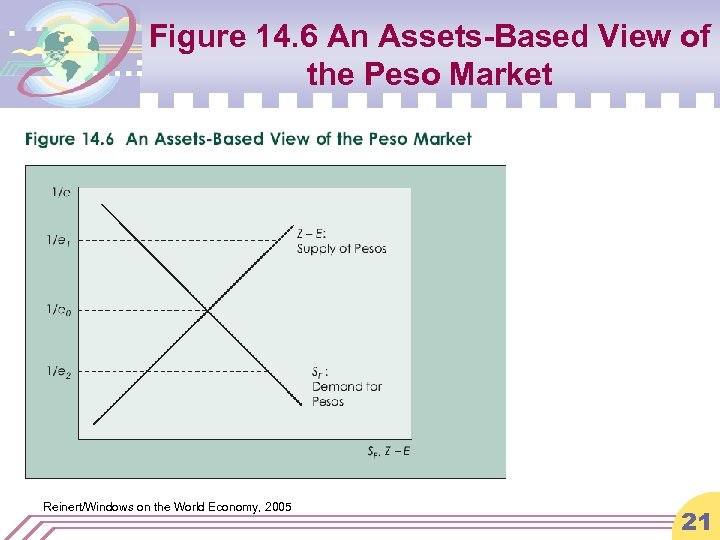
Figure 14. 6 An Assets-Based View of the Peso Market Reinert/Windows on the World Economy, 2005 21
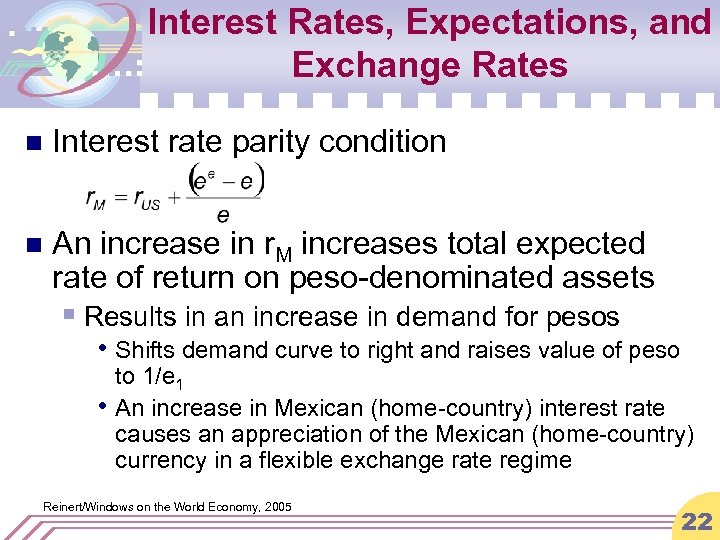
Interest Rates, Expectations, and Exchange Rates n Interest rate parity condition n An increase in r. M increases total expected rate of return on peso-denominated assets § Results in an increase in demand for pesos • Shifts demand curve to right and raises value of peso • to 1/e 1 An increase in Mexican (home-country) interest rate causes an appreciation of the Mexican (home-country) currency in a flexible exchange rate regime Reinert/Windows on the World Economy, 2005 22
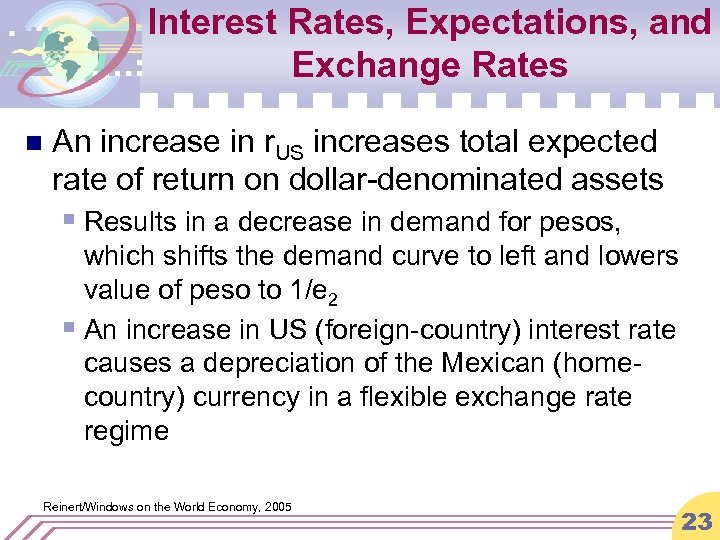
Interest Rates, Expectations, and Exchange Rates n An increase in r. US increases total expected rate of return on dollar-denominated assets § Results in a decrease in demand for pesos, which shifts the demand curve to left and lowers value of peso to 1/e 2 § An increase in US (foreign-country) interest rate causes a depreciation of the Mexican (homecountry) currency in a flexible exchange rate regime Reinert/Windows on the World Economy, 2005 23
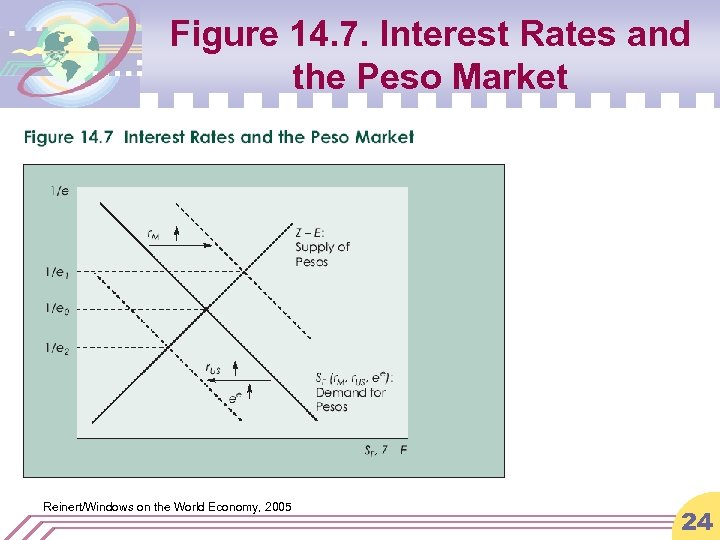
Figure 14. 7. Interest Rates and the Peso Market Reinert/Windows on the World Economy, 2005 24
Interest Rates, Expectations, and Exchange Rates n Interest rate parity condition involves expectations about future exchange rates § Expectations are formed in the minds of investors and are § subjective Suppose, for example, expected future exchange rate, ee, were to increase in the minds of investors • Would increase total expected rate of return on dollardenominated assets ¨ Results in a decreased demand for pesos § Shifts demand curve to left which lowers value of peso to 1/e 2 § An increase in expected future exchange rate for Mexico’s (home-country’s) currency causes a depreciation of Mexico’s (home-country’s) currency in a flexible exchange rate regime Reinert/Windows on the World Economy, 2005 25
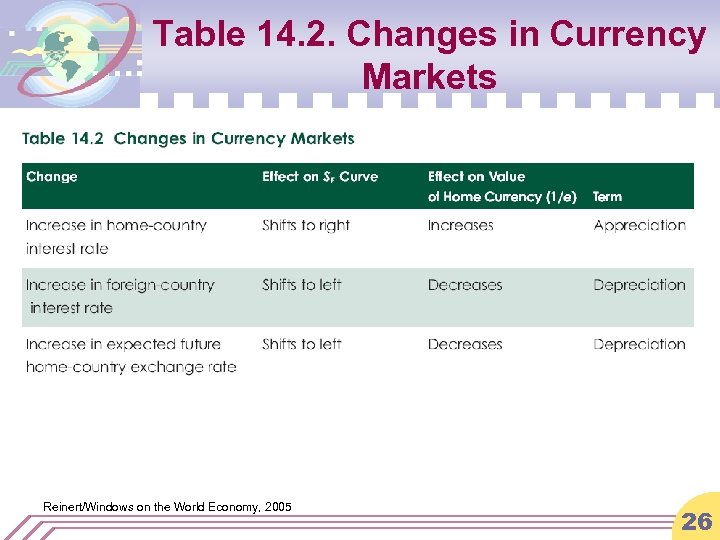
Table 14. 2. Changes in Currency Markets Reinert/Windows on the World Economy, 2005 26
Скачать презентацию Flexible Exchange Rates CHAPTER 14 Reinert Windows on the
636001bb41cea7d135621e9ee6937900.ppt