


 Скачать презентацию Flex Ray and Automotive Networking Future Chris Quigley
0bc72bb4d2c4f7741ef7ce343ff26732.ppt
- Количество слайдов: 36
 Flex. Ray and Automotive Networking Future Chris Quigley Warwick Control Technologies
 Presentation Overview High Speed and High Integrity Networking Why Flex. Ray? CAN Problems Time Triggered Network Principles Time Triggered Protocol Candidates Flex. Ray protocol and Applications: BMW, Audi, SAPECS Other Emerging Protocols and Standards Summary 2
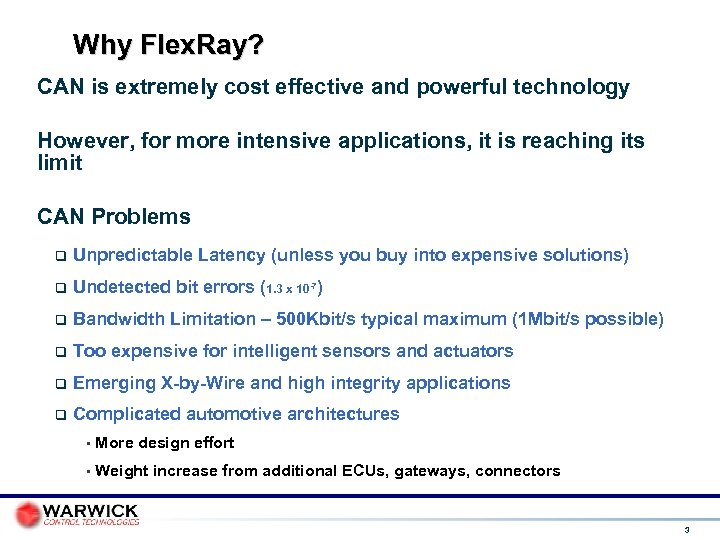 Why Flex. Ray? CAN is extremely cost effective and powerful technology However, for more intensive applications, it is reaching its limit CAN Problems Unpredictable Latency (unless you buy into expensive solutions) Undetected bit errors (1. 3 x 10 -7) Bandwidth Limitation – 500 Kbit/s typical maximum (1 Mbit/s possible) Too expensive for intelligent sensors and actuators Emerging X-by-Wire and high integrity applications Complicated automotive architectures • More design effort • Weight increase from additional ECUs, gateways, connectors 3
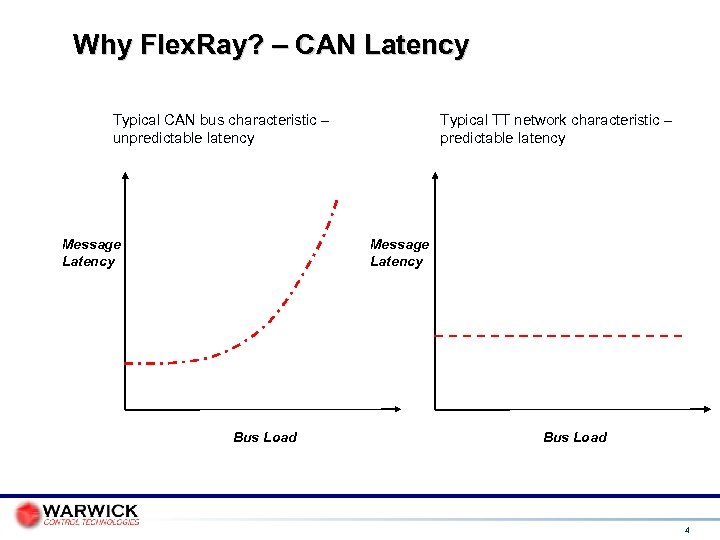 Why Flex. Ray? – CAN Latency Typical CAN bus characteristic – unpredictable latency Message Latency Typical TT network characteristic – predictable latency Message Latency Bus Load 4
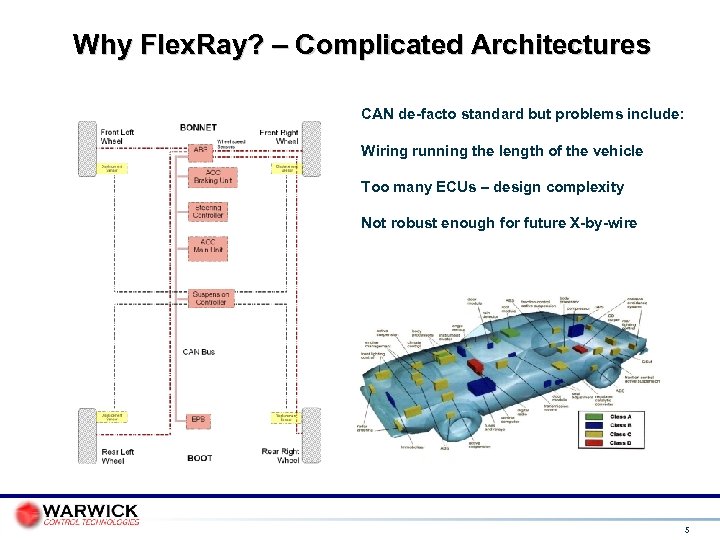 Why Flex. Ray? – Complicated Architectures CAN de-facto standard but problems include: Wiring running the length of the vehicle Too many ECUs – design complexity Not robust enough for future X-by-wire 5
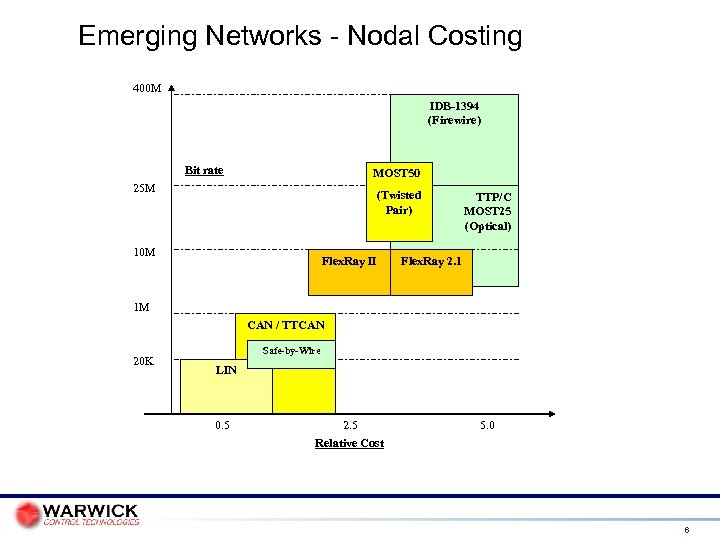 Emerging Networks - Nodal Costing 400 M IDB-1394 (Firewire) Bit rate MOST 50 25 M (Twisted Pair) 10 M Flex. Ray II TTP/C MOST 25 (Optical) Flex. Ray 2. 1 1 M CAN / TTCAN 20 K Safe-by-Wire LIN 0. 5 2. 5 5. 0 Relative Cost 6
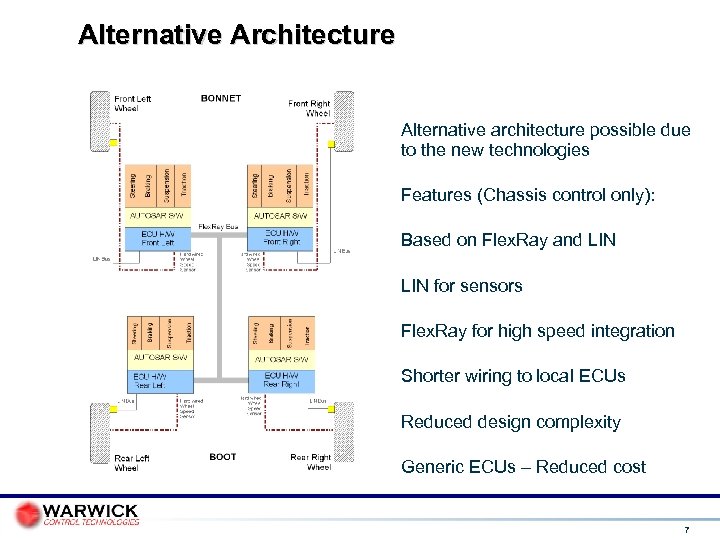 Alternative Architecture Alternative architecture possible due to the new technologies Features (Chassis control only): Based on Flex. Ray and LIN for sensors Flex. Ray for high speed integration Shorter wiring to local ECUs Reduced design complexity Generic ECUs – Reduced cost 7
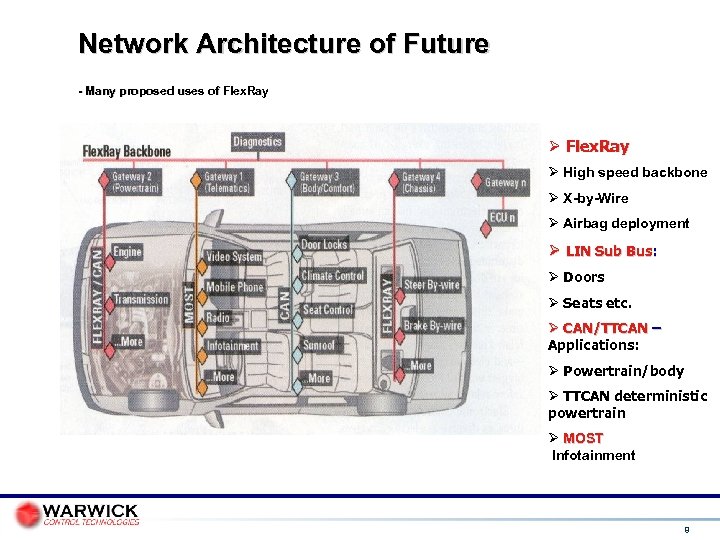 Network Architecture of Future - Many proposed uses of Flex. Ray High speed backbone X-by-Wire Airbag deployment LIN Sub Bus: Doors Seats etc. CAN/TTCAN – Applications: Powertrain/body TTCAN deterministic powertrain MOST Infotainment 8
 Time Triggered Network Principles Communication based on Slots or Windows of time Determinism Message transmission time known Schedule defined by a Matrix m Windows x n Cycles Message Scheduling Techniques: TDMA Mini-slotting 9
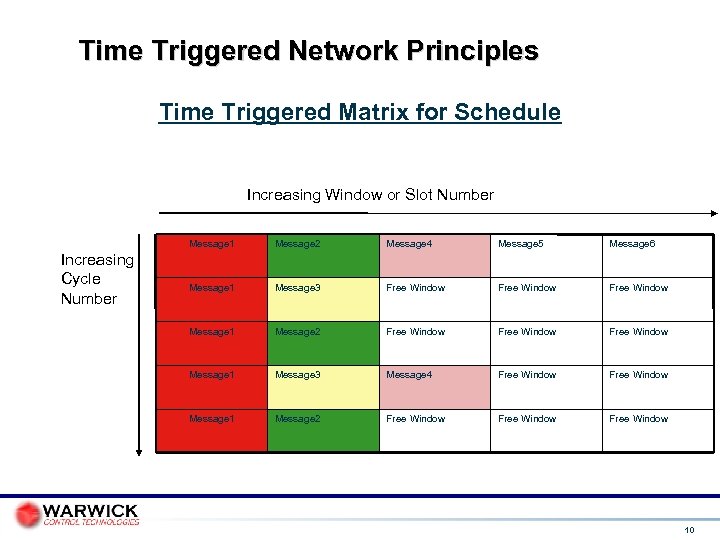 Time Triggered Network Principles Time Triggered Matrix for Schedule Increasing Window or Slot Number Message 1 Increasing Cycle Number Message 2 Message 4 Message 5 Message 6 Message 1 Message 3 Free Window Message 1 Message 2 Free Window Message 1 Message 3 Message 4 Free Window Message 1 Message 2 Free Window 10
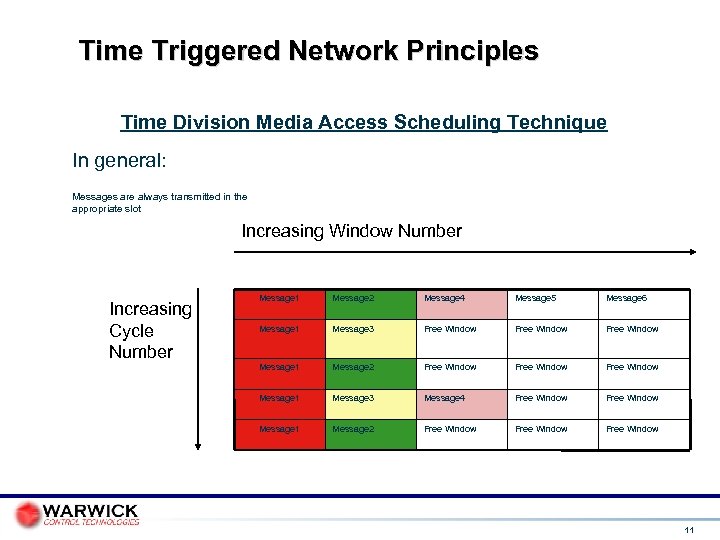 Time Triggered Network Principles Time Division Media Access Scheduling Technique In general: Messages are always transmitted in the appropriate slot Increasing Window Number Increasing Cycle Number Message 1 Message 2 Message 4 Message 5 Message 6 Message 1 Message 3 Free Window Message 1 Message 2 Free Window Message 1 Message 3 Message 4 Free Window Message 1 Message 2 Free Window 11
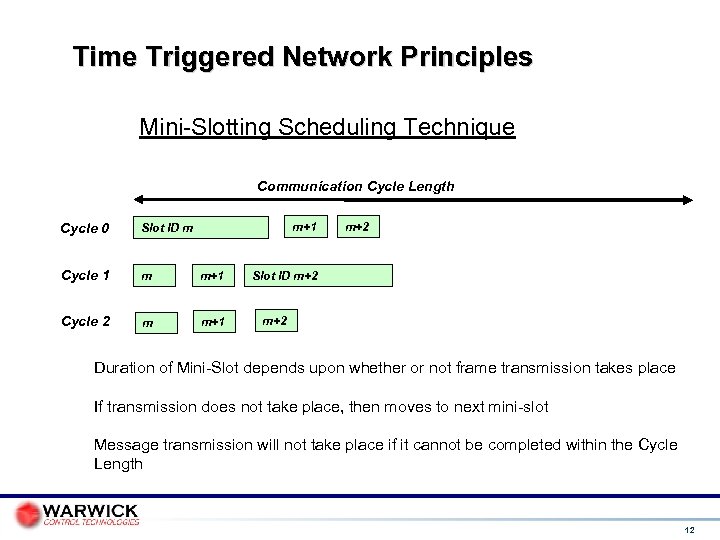 Time Triggered Network Principles Mini-Slotting Scheduling Technique Communication Cycle Length m+1 Cycle 0 Slot ID m Cycle 1 m m+1 Cycle 2 m m+1 m+2 Slot ID m+2 Duration of Mini-Slot depends upon whether or not frame transmission takes place If transmission does not take place, then moves to next mini-slot Message transmission will not take place if it cannot be completed within the Cycle Length 12
 Time Triggered Protocol Candidates that were considered include: Time Triggered CAN Byteflight TTP Flex. Ray 13
 Time Triggered CAN (TTCAN) TDMA message scheduling techniques and Arbitration Windows 1 Mbit/s Single channel Twisted Pair CAN Physical layer No commercial examples 14
 Byteflight Mini-slotting message scheduling technique 10 Mbit/s Single channel 8 bytes of data payload BMW 7 -Series (2001) – only production example Airbag deployment, seatbelt restraint Throttle and shift-by-wire 15
 Time Triggered Protocol (TTP) TDMA message scheduling technique 25 Mbit/s and beyond Dual channel for redundancy or faster transfer 244 byte data payload No automotive commercial examples Commercial examples: Boeing 787 flight controls Off highway drive-by-wire 16
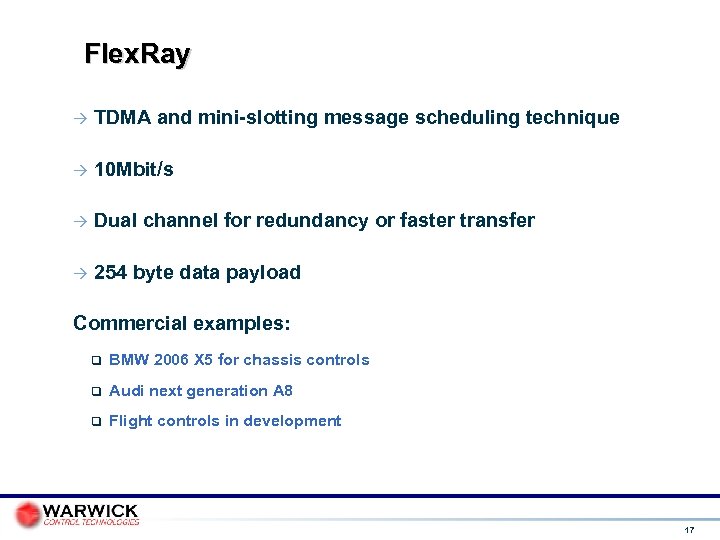 Flex. Ray TDMA and mini-slotting message scheduling technique 10 Mbit/s Dual channel for redundancy or faster transfer 254 byte data payload Commercial examples: BMW 2006 X 5 for chassis controls Audi next generation A 8 Flight controls in development 17
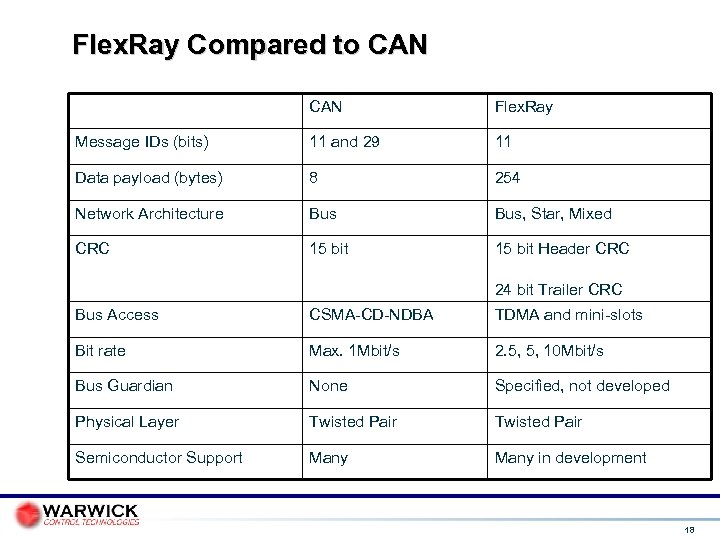 Flex. Ray Compared to CAN Flex. Ray Message IDs (bits) 11 and 29 11 Data payload (bytes) 8 254 Network Architecture Bus, Star, Mixed CRC 15 bit Header CRC 24 bit Trailer CRC Bus Access CSMA-CD-NDBA TDMA and mini-slots Bit rate Max. 1 Mbit/s 2. 5, 5, 10 Mbit/s Bus Guardian None Specified, not developed Physical Layer Twisted Pair Semiconductor Support Many in development 18
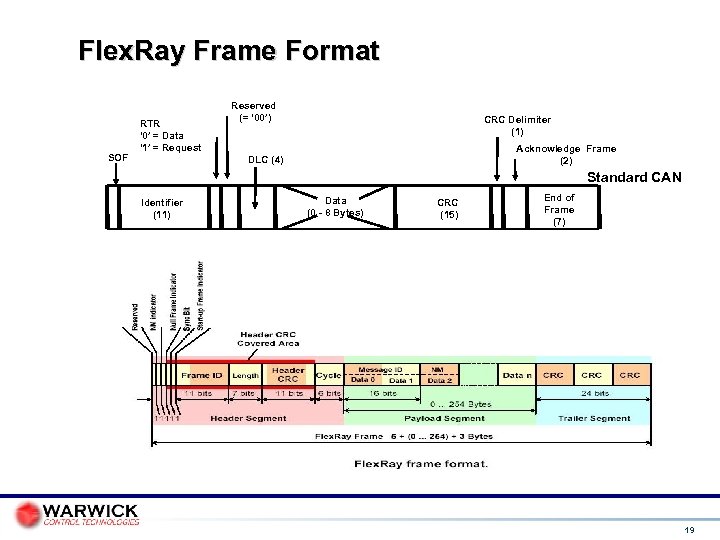 Flex. Ray Frame Format SOF RTR ‘ 0’ = Data ‘ 1’ = Request Reserved (= ‘ 00’) CRC Delimiter (1) Acknowledge Frame (2) DLC (4) Standard CAN Identifier (11) Data (0 - 8 Bytes) CRC (15) End of Frame (7) 19
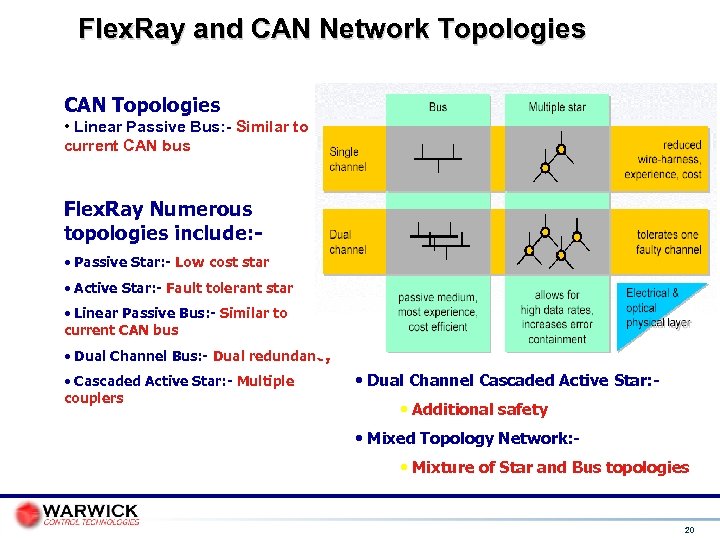 Flex. Ray and CAN Network Topologies CAN Topologies • Linear Passive Bus: - Similar to current CAN bus Flex. Ray Numerous topologies include: • Passive Star: - Low cost star • Active Star: - Fault tolerant star • Linear Passive Bus: - Similar to current CAN bus • Dual Channel Bus: - Dual redundancy • Cascaded Active Star: - Multiple couplers • Dual Channel Cascaded Active Star: • Additional safety • Mixed Topology Network: • Mixture of Star and Bus topologies 20
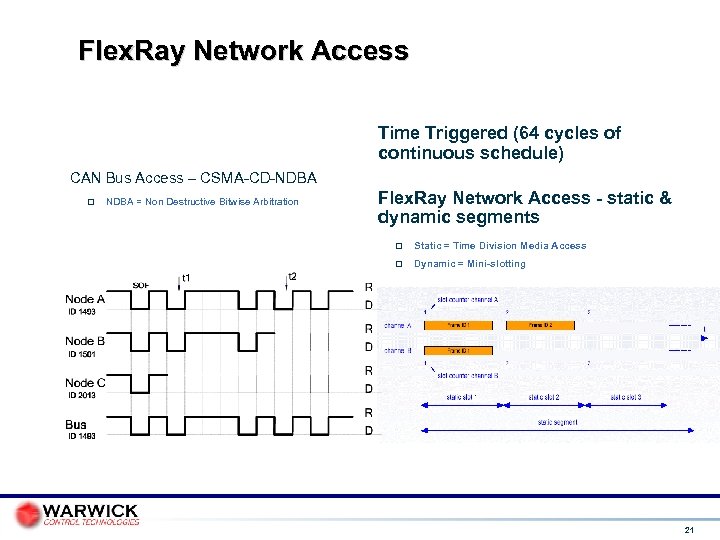 Flex. Ray Network Access Time Triggered (64 cycles of continuous schedule) CAN Bus Access – CSMA-CD-NDBA = Non Destructive Bitwise Arbitration Flex. Ray Network Access - static & dynamic segments Static = Time Division Media Access Dynamic = Mini-slotting 21
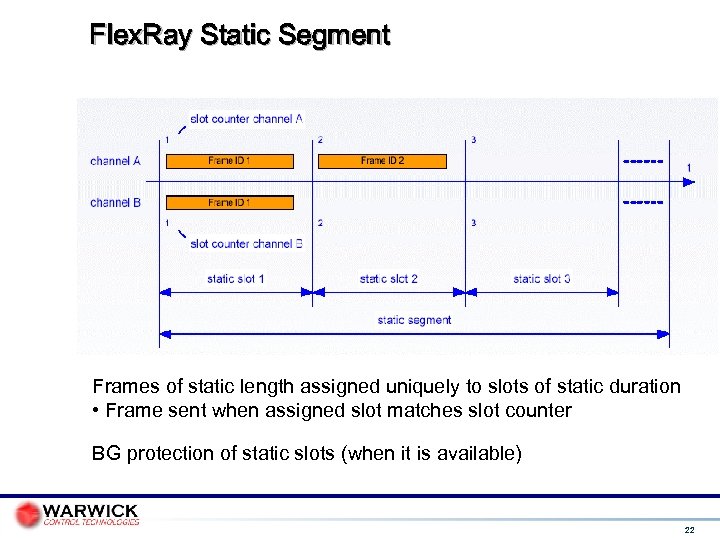 Flex. Ray Static Segment Frames of static length assigned uniquely to slots of static duration • Frame sent when assigned slot matches slot counter BG protection of static slots (when it is available) 22
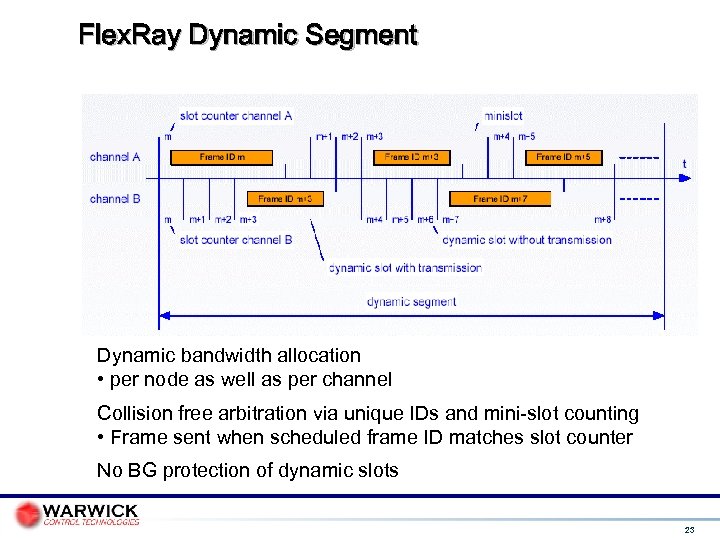 Flex. Ray Dynamic Segment Dynamic bandwidth allocation • per node as well as per channel Collision free arbitration via unique IDs and mini-slot counting • Frame sent when scheduled frame ID matches slot counter No BG protection of dynamic slots 23
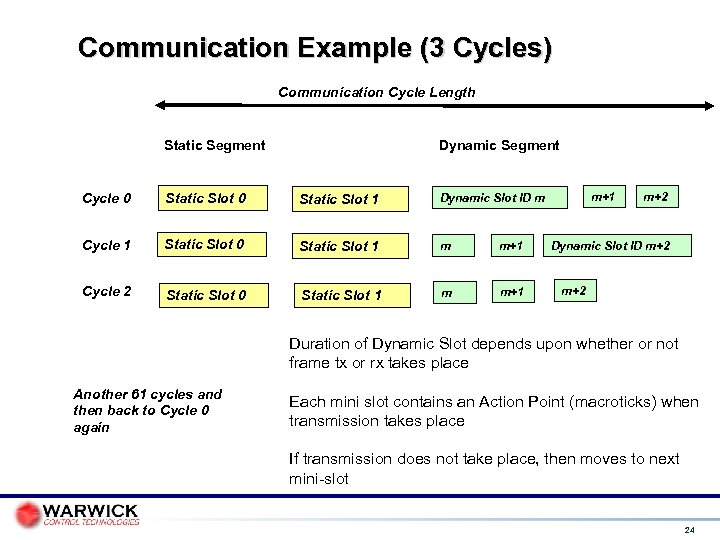 Communication Example (3 Cycles) Communication Cycle Length Static Segment Dynamic Segment Cycle 0 Static Slot 1 Cycle 1 Static Slot 0 Static Slot 1 m m+1 Cycle 2 Static Slot 0 Static Slot 1 m m+1 Dynamic Slot ID m m+2 Dynamic Slot ID m+2 Duration of Dynamic Slot depends upon whether or not frame tx or rx takes place Another 61 cycles and then back to Cycle 0 again Each mini slot contains an Action Point (macroticks) when transmission takes place If transmission does not take place, then moves to next mini-slot 24
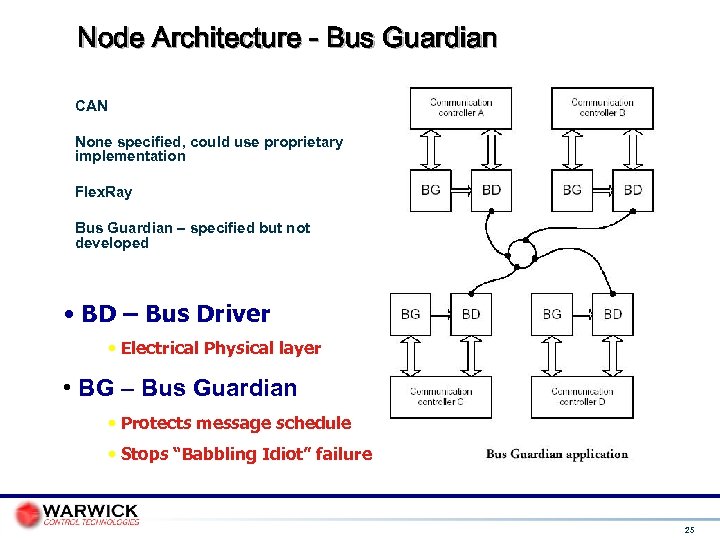 Node Architecture - Bus Guardian CAN None specified, could use proprietary implementation Flex. Ray Bus Guardian – specified but not developed • BD – Bus Driver • Electrical Physical layer • BG – Bus Guardian • Protects message schedule • Stops “Babbling Idiot” failure 25
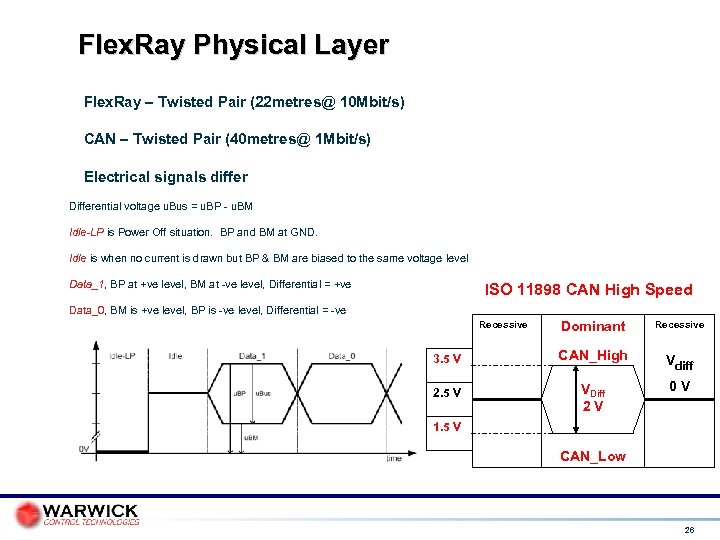 Flex. Ray Physical Layer Flex. Ray – Twisted Pair (22 metres@ 10 Mbit/s) CAN – Twisted Pair (40 metres@ 1 Mbit/s) Electrical signals differ Differential voltage u. Bus = u. BP - u. BM Idle-LP is Power Off situation. BP and BM at GND. Idle is when no current is drawn but BP & BM are biased to the same voltage level Data_1, BP at +ve level, BM at -ve level, Differential = +ve ISO 11898 CAN High Speed Data_0, BM is +ve level, BP is -ve level, Differential = -ve Recessive Dominant Recessive 3. 5 V CAN_High Vdiff 2. 5 V VDiff 2 V 0 V 1. 5 V CAN_Low 26
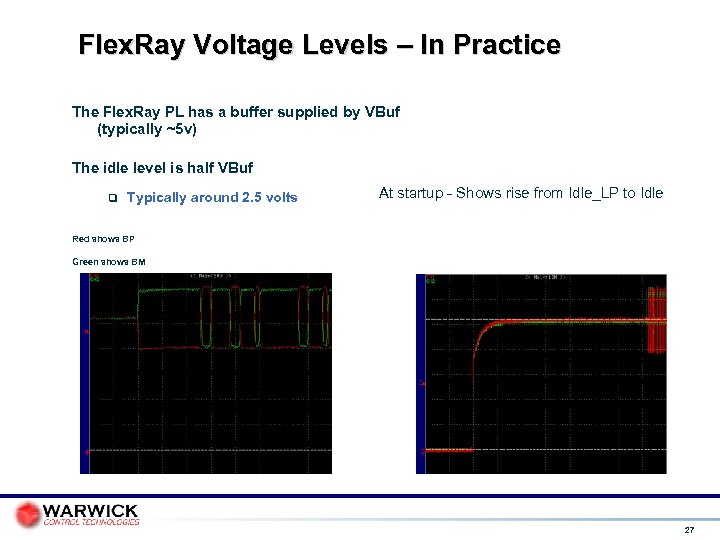 Flex. Ray Voltage Levels – In Practice The Flex. Ray PL has a buffer supplied by VBuf (typically ~5 v) The idle level is half VBuf Typically around 2. 5 volts At startup - Shows rise from Idle_LP to Idle Red shows BP Green shows BM 27
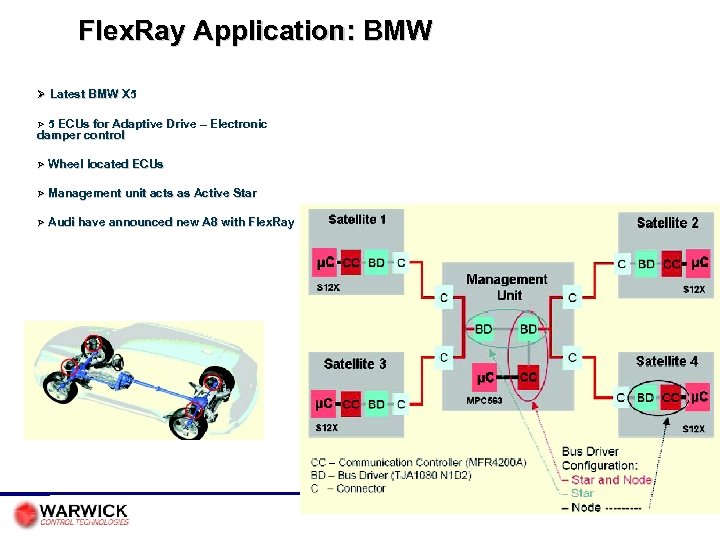 Flex. Ray Application: BMW Latest BMW X 5 5 ECUs for Adaptive Drive – Electronic damper control Wheel located ECUs Management unit acts as Active Star Audi have announced new A 8 with Flex. Ray
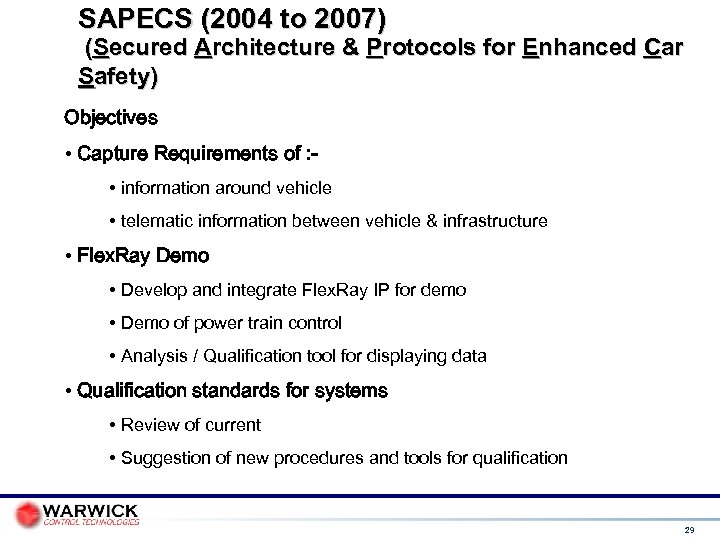 SAPECS (2004 to 2007) (Secured Architecture & Protocols for Enhanced Car Safety) Objectives • Capture Requirements of : • information around vehicle • telematic information between vehicle & infrastructure • Flex. Ray Demo • Develop and integrate Flex. Ray IP for demo • Demo of power train control • Analysis / Qualification tool for displaying data • Qualification standards for systems • Review of current • Suggestion of new procedures and tools for qualification 29
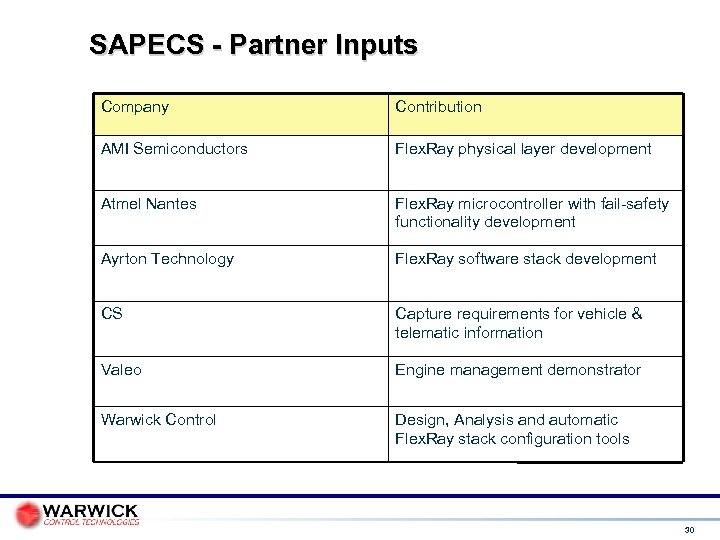 SAPECS - Partner Inputs Company Contribution AMI Semiconductors Flex. Ray physical layer development Atmel Nantes Flex. Ray microcontroller with fail-safety functionality development Ayrton Technology Flex. Ray software stack development CS Capture requirements for vehicle & telematic information Valeo Engine management demonstrator Warwick Control Design, Analysis and automatic Flex. Ray stack configuration tools 30
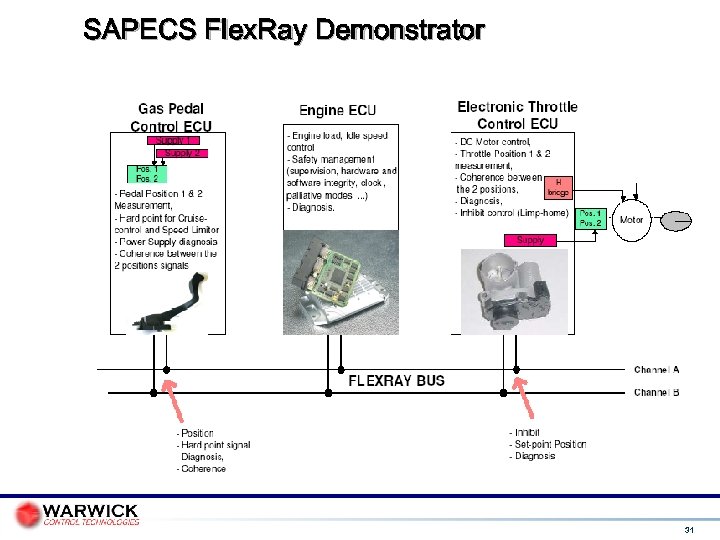 SAPECS Flex. Ray Demonstrator 31
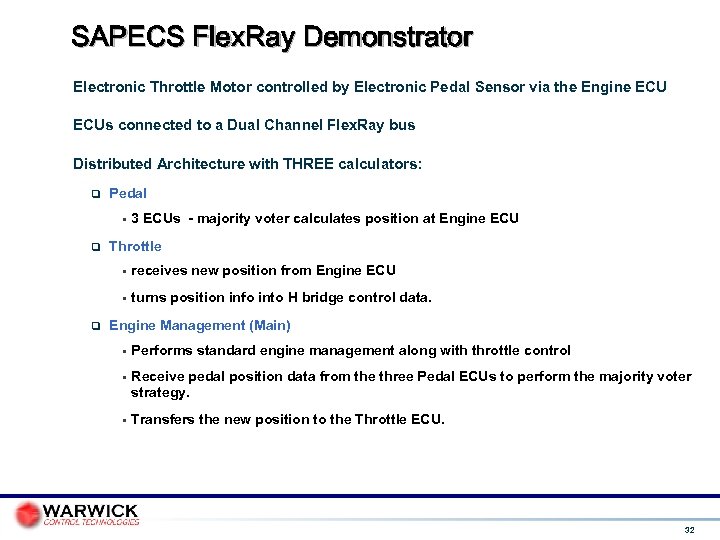 SAPECS Flex. Ray Demonstrator Electronic Throttle Motor controlled by Electronic Pedal Sensor via the Engine ECUs connected to a Dual Channel Flex. Ray bus Distributed Architecture with THREE calculators: Pedal • 3 ECUs - majority voter calculates position at Engine ECU Throttle • receives new position from Engine ECU • turns position info into H bridge control data. Engine Management (Main) • Performs standard engine management along with throttle control • Receive pedal position data from the three Pedal ECUs to perform the majority voter strategy. • Transfers the new position to the Throttle ECU. 32
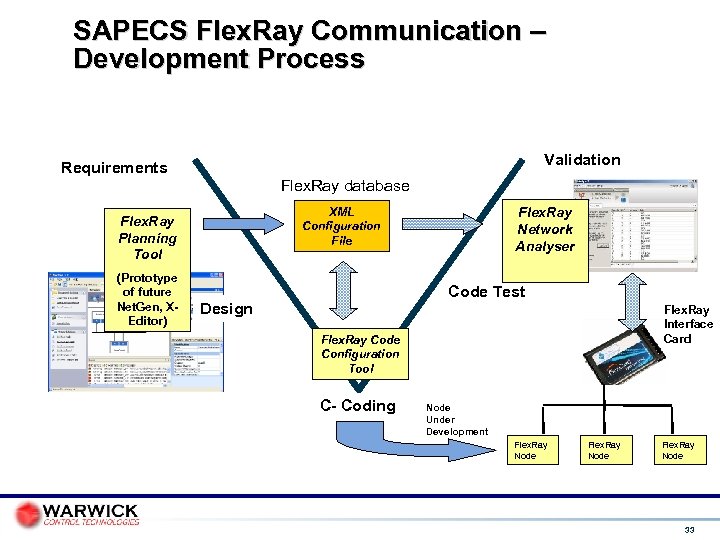 SAPECS Flex. Ray Communication – Development Process Validation Requirements Flex. Ray database (Prototype of future Net. Gen, XEditor) Flex. Ray Network Analyser XML Configuration File Flex. Ray Planning Tool Code Test Design Flex. Ray Interface Card Flex. Ray Code Configuration Tool C- Coding Node Under Development Flex. Ray Node 33
 Other Emerging Network Technologies Safe-by-Wire Plus consortium formed in February 2004 Automotive safety bus for occupant safety applications (e. g. airbag deployment and seat belt restraint) Safe-by-Wire Plus has variable bus speeds of 20, 40, 80 or 160 kbps Expected to have a similar nodal cost comparable to CAN The application of the Safe-by-Wire protocol is narrow and therefore is not suitable for general network service 34
 Emerging Standards Network data exchange: CANdb Vector proprietary LDF (LIN Description Files) Open standard LIN only FIBEX New open ASAM standard CAN, LIN, MOST, Flex. Ray For diagnostics/analysis tools AUTOSAR (CAN, LIN, MOST, Flex. Ray) For ECU designers 35
 Summary and Outlook CAN original aim: reduction wiring harness complexity, size and weight However, successful adoption has allowed integration of many more ECUs Led to more wiring, more CAN buses, more gateways etc. Flex. Ray off-the-shelf technology available for applications in which CAN performance has limitations and has been compared with CAN Flex. Ray implemented in the BMW X 5 plus numerous other emerging applications Likely to become de-facto standard for X-by-Wire and future high speed networking Protocol features likely to evolve further Danger is that Flex. Ray will allow the growth in vehicle electronics to explode Extremely complex when compared to CAN!!!! 36