


 Скачать презентацию Flecainide Therapy Reduces Exercise-Induced Ventricular Arrhythmias in Patients
712f83da49574e6d35ac09fdfc22ea48.ppt
- Количество слайдов: 16
 Flecainide Therapy Reduces Exercise-Induced Ventricular Arrhythmias in Patients With Catecholaminergic Polymorphic Ventricular Tachycardia Christian van der Werf, MD, Prince J. Kannankeril, MD, MSCI, Frederic Sacher, MD, Andrew D. Krahn, MD, Sami Viskin, MD, Antoine Leenhardt, MD, Wataru Shimizu, MD, Ph. D, Naokata Sumitomo, MD, Frank A. Fish, MD, Zahurul A. Bhuiyan, MD, Ph. D, Albert R. Willems, MD, Ph. D, Maurits J. van der Veen, MD, Ph. D, Hiroshi Watanabe, MD, Ph. D, FESC, Julien Laborderie, MD, Michel Haïssaguerre, MD, Björn C. Knollmann, MD, Ph. D, Arthur A. M. Wilde, MD, Ph. D Amsterdam and Ede, the Netherlands; Nashville, Tennessee; Bordeaux and Paris, France; London, Canada; Tel Aviv, Israel; and Suita, Tokyo and Niigata, Japan
 Catecholaminergic polymorphic ventricular tachycardia (CPVT) Ø Malignant inherited arrhythmia syndrome characterized by physical/emotional stressinduced polymorphic ventricular tachycardia (VT) in structurally normal hearts Ø Mutations in Ry. R 2 (~60%) or CASQ 2 (~2%) J Am Coll Cardiol 2011; 57: 2244 -54
 Conventional therapy in CPVT Ø First-line therapy: β-blocker Ø 8 -year (near-)fatal event rate: 11%1 Ø Alternatives: Ø Ca 2+-channel blocker Ø Not effective in all patients Ø Left cardiac sympathetic denervation Ø Effective, but requires surgery, not universally available, and only tested in small cohorts Ø Implantable cardioverter-defibrillator Ø Potentially harmful effect in CPVT patients 1 Hayashi et al. Circulation 2009
 Flecainide in CPVT Ø Flecainide directly targets the molecular defect in CPVT ØBlocks the Ry. R 2 channel ØPrevents Ry. R 2 -mediated premature Ca 2+ release ØSuppresses triggered beats (INa block) Ø Flecainide was effective in 2 highly symptomatic CPVT patients Watanabe et al. Nat Med 2009
 Participants and study design Ø Retrospective chart review of every CPVT patient started on flecainide before December 2009 at eight centers worldwide Ø Decisions on flecainide dose made by treating cardiologist Ø All patients positive for RYR 2 or CASQ 2 mutation
 Primary outcome measures Ø Ventricular arrhythmias during exercise testing Ø Ventricular arrhythmia score I. III. IV. None / isolated ventricular premature beats (VPB) Bigeminal VPBs and/or frequent VPBs (>10/min) Couplet Non-sustained VT Ø Sinus rate at onset of ventricular arrhythmias Ø Max number of VPBs during worst 10 seconds Ø Stable β-blocker dose Ø Baseline vs. first exercise test on stable flecainide dose J Am Coll Cardiol 2011; 57: 2244 -54
 Secondary outcome measures Ø Incidence of cardiac events Ø Side effects Ø Proarrhythmic effects J Am Coll Cardiol 2011; 57: 2244 -54
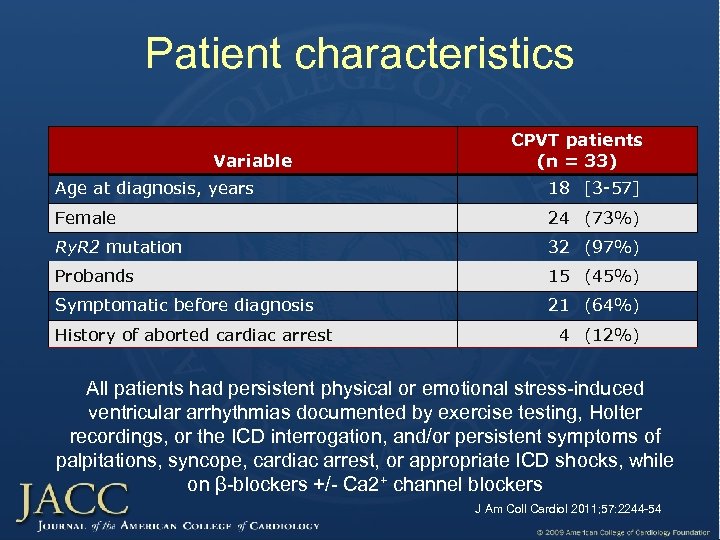 Patient characteristics Variable CPVT patients (n = 33) Age at diagnosis, years 18 [3 -57] Female 24 (73%) Ry. R 2 mutation 32 (97%) Probands 15 (45%) Symptomatic before diagnosis 21 (64%) History of aborted cardiac arrest 4 (12%) All patients had persistent physical or emotional stress-induced ventricular arrhythmias documented by exercise testing, Holter recordings, or the ICD interrogation, and/or persistent symptoms of palpitations, syncope, cardiac arrest, or appropriate ICD shocks, while on β-blockers +/- Ca 2+ channel blockers J Am Coll Cardiol 2011; 57: 2244 -54
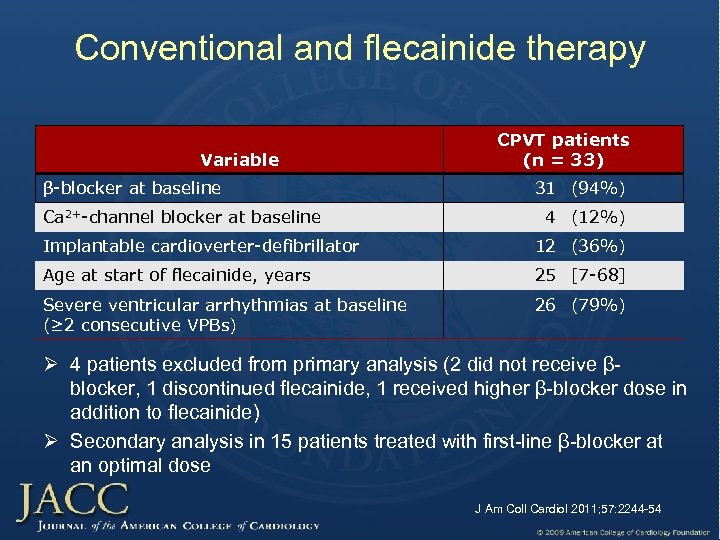 Conventional and flecainide therapy Variable β-blocker at baseline Ca 2+-channel blocker at baseline CPVT patients (n = 33) 31 (94%) 4 (12%) Implantable cardioverter-defibrillator 12 (36%) Age at start of flecainide, years 25 [7 -68] Severe ventricular arrhythmias at baseline (≥ 2 consecutive VPBs) 26 (79%) Ø 4 patients excluded from primary analysis (2 did not receive βblocker, 1 discontinued flecainide, 1 received higher β-blocker dose in addition to flecainide) Ø Secondary analysis in 15 patients treated with first-line β-blocker at an optimal dose J Am Coll Cardiol 2011; 57: 2244 -54
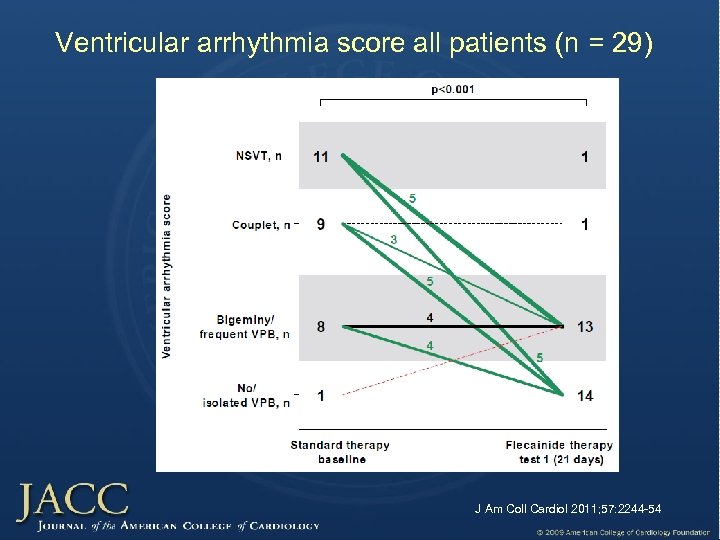 Ventricular arrhythmia score all patients (n = 29) J Am Coll Cardiol 2011; 57: 2244 -54
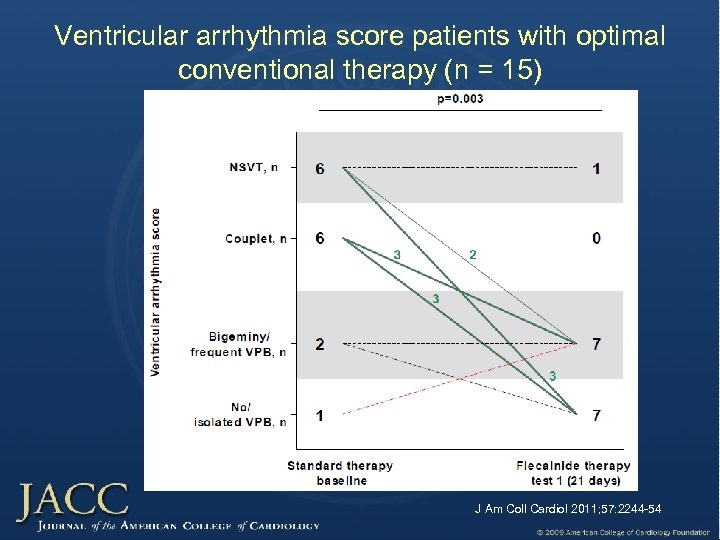 Ventricular arrhythmia score patients with optimal conventional therapy (n = 15) J Am Coll Cardiol 2011; 57: 2244 -54
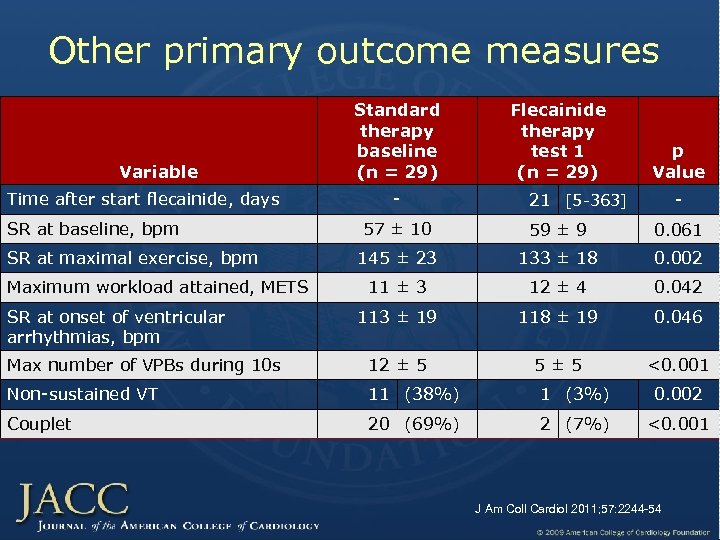 Other primary outcome measures Variable Time after start flecainide, days SR at baseline, bpm Standard therapy baseline (n = 29) - Flecainide therapy test 1 (n = 29) p Value 21 [5 -363] - 57 ± 10 59 ± 9 0. 061 145 ± 23 133 ± 18 0. 002 11 ± 3 12 ± 4 0. 042 113 ± 19 118 ± 19 0. 046 Max number of VPBs during 10 s 12 ± 5 5± 5 <0. 001 Non-sustained VT 11 (38%) 1 (3%) 0. 002 Couplet 20 (69%) 2 (7%) <0. 001 SR at maximal exercise, bpm Maximum workload attained, METS SR at onset of ventricular arrhythmias, bpm J Am Coll Cardiol 2011; 57: 2244 -54
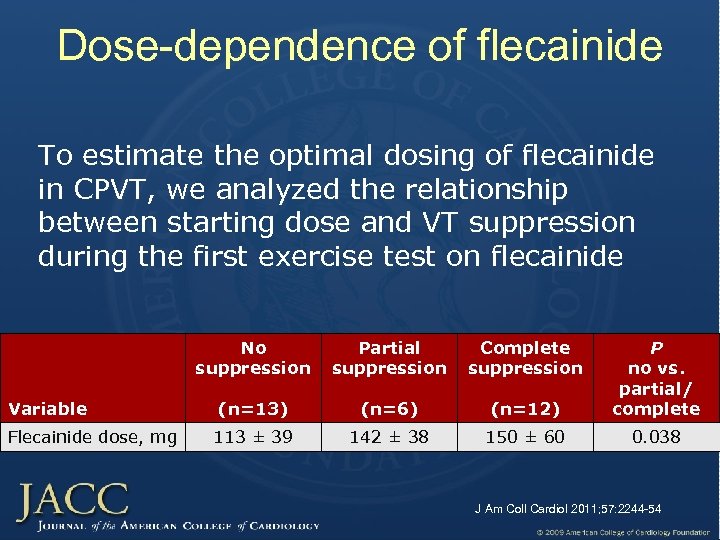 Dose-dependence of flecainide To estimate the optimal dosing of flecainide in CPVT, we analyzed the relationship between starting dose and VT suppression during the first exercise test on flecainide No suppression Variable Flecainide dose, mg Partial suppression Complete suppression (n=13) (n=6) (n=12) P no vs. partial/ complete 113 ± 39 142 ± 38 150 ± 60 0. 038 J Am Coll Cardiol 2011; 57: 2244 -54
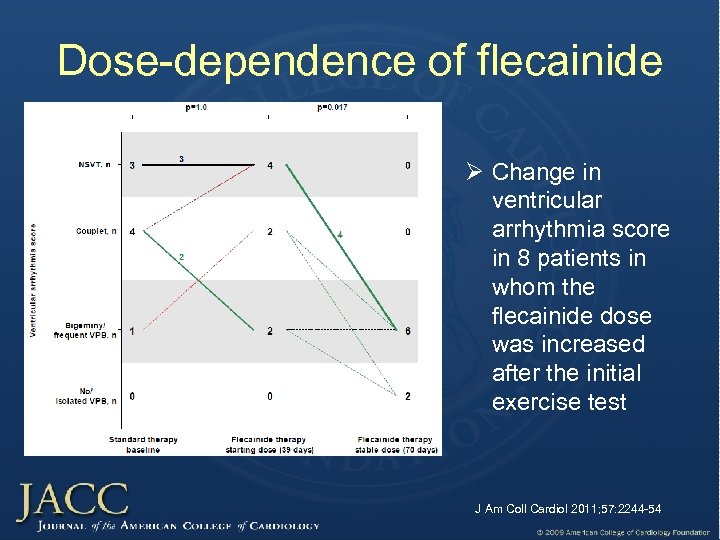 Dose-dependence of flecainide Ø Change in ventricular arrhythmia score in 8 patients in whom the flecainide dose was increased after the initial exercise test J Am Coll Cardiol 2011; 57: 2244 -54
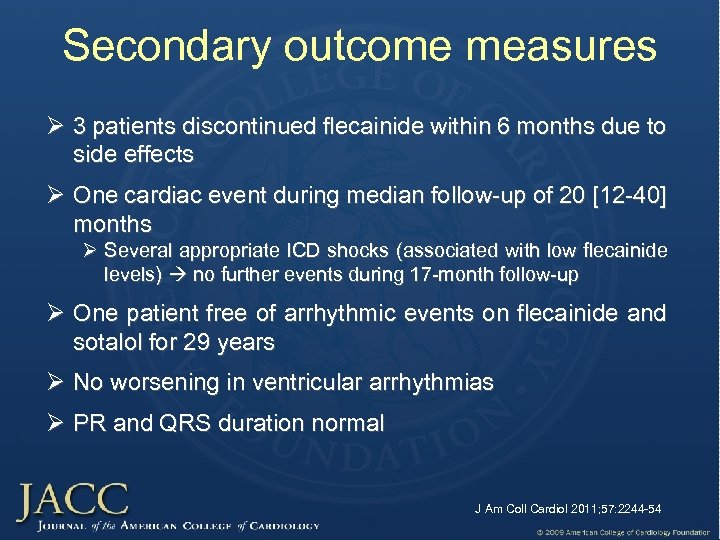 Secondary outcome measures Ø 3 patients discontinued flecainide within 6 months due to side effects Ø One cardiac event during median follow-up of 20 [12 -40] months Ø Several appropriate ICD shocks (associated with low flecainide levels) no further events during 17 -month follow-up Ø One patient free of arrhythmic events on flecainide and sotalol for 29 years Ø No worsening in ventricular arrhythmias Ø PR and QRS duration normal J Am Coll Cardiol 2011; 57: 2244 -54
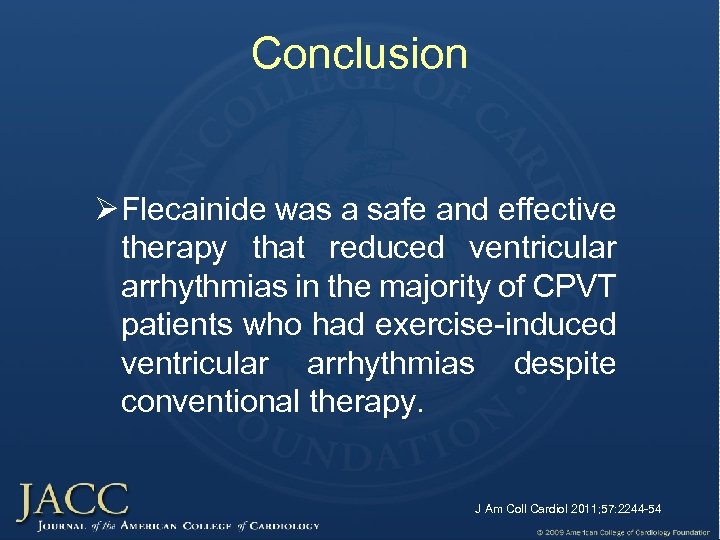 Conclusion Ø Flecainide was a safe and effective therapy that reduced ventricular arrhythmias in the majority of CPVT patients who had exercise-induced ventricular arrhythmias despite conventional therapy. J Am Coll Cardiol 2011; 57: 2244 -54