


 Скачать презентацию Flavouring Particles Shi quianli Gesine Wächter SLS Advanced
94ac0b0d3bdc5422d510086e98815936.ppt
- Количество слайдов: 36
 Flavouring Particles Shi quianli, Gesine Wächter SLS Advanced Translation, 22/1/2013
 • Ich habe keine Zeit. • Ich habe einfach keine Zeit. • Du spielst gut. • Du spielst aber gut! ====>> • Gib mir bitte die Karte! • Gib mir bitte mal die Karte!
 outline 1. Definition 2. Function 3. Differences German - English 4. List of Flavouring Particles 5. Examples 6. Sources
 1 Definition Flavouring (modal) particles (Abtönungs-, Modalpartikel) • are words which express the speaker‘s attitude to what is being said, e. g. : aber, doch, ja, mal, schon • alter the tone of what is being said, cannot always be translated word by word into English • difficulty: each particle can have several functions and meanings in German, thus needs to be translated in different ways into English
 1 Defintion • no full agreement as to which words can be classified as flavouring particles • similar function as adverbs of attitude, e. g. (un -) fortunately, (un-) luckily, obviously • can‘t be negated, are less independent • can‘t occur in first position of a main clause, before the main verb • usually relate to clause or sentence as a whole
 2 Function Flavouring particles can: • appeal for agreement • express surprise or annoyance • tone down a blunt question or statement • sound reassuring • make the speaker (foreign language learners) sound more natural
 3 Differences German English German: • far richer repertoire of flavouring particles • much more extensive use of downtoners English: • other ways of expressing speaker‘s attitude such as question tags, adverbs, intonation, and cleft sentences
 Little Exercise
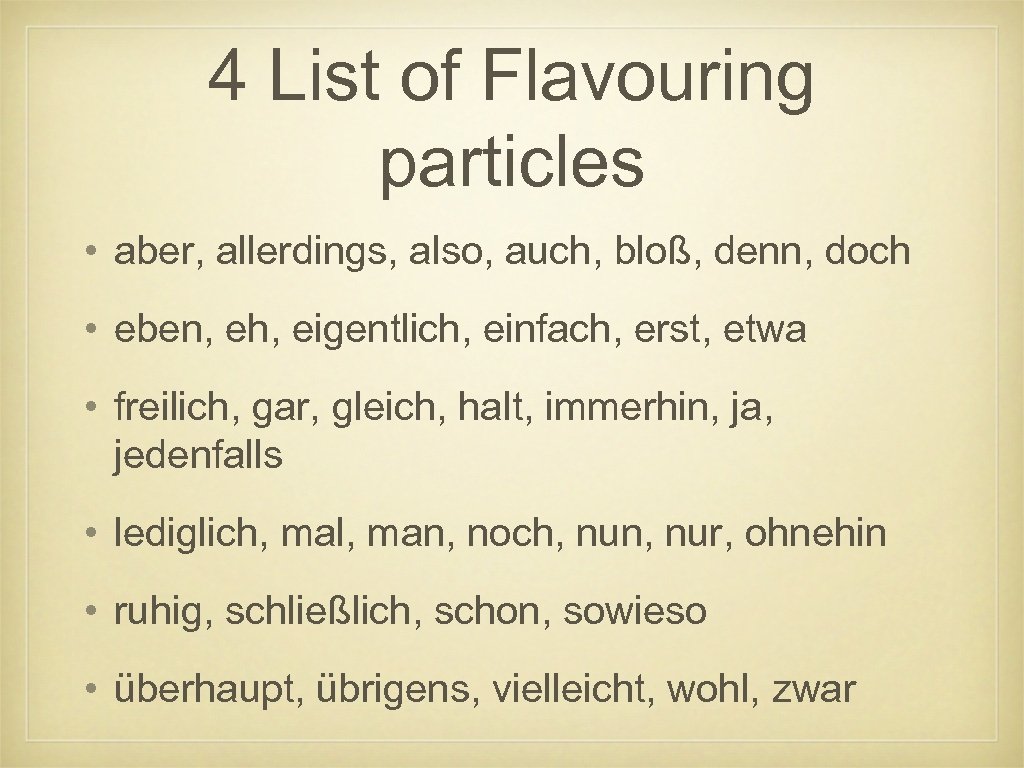 4 List of Flavouring particles • aber, allerdings, also, auch, bloß, denn, doch • eben, eh, eigentlich, einfach, erst, etwa • freilich, gar, gleich, halt, immerhin, ja, jedenfalls • lediglich, mal, man, noch, nun, nur, ohnehin • ruhig, schließlich, schon, sowieso • überhaupt, übrigens, vielleicht, wohl, zwar
 5 Examples
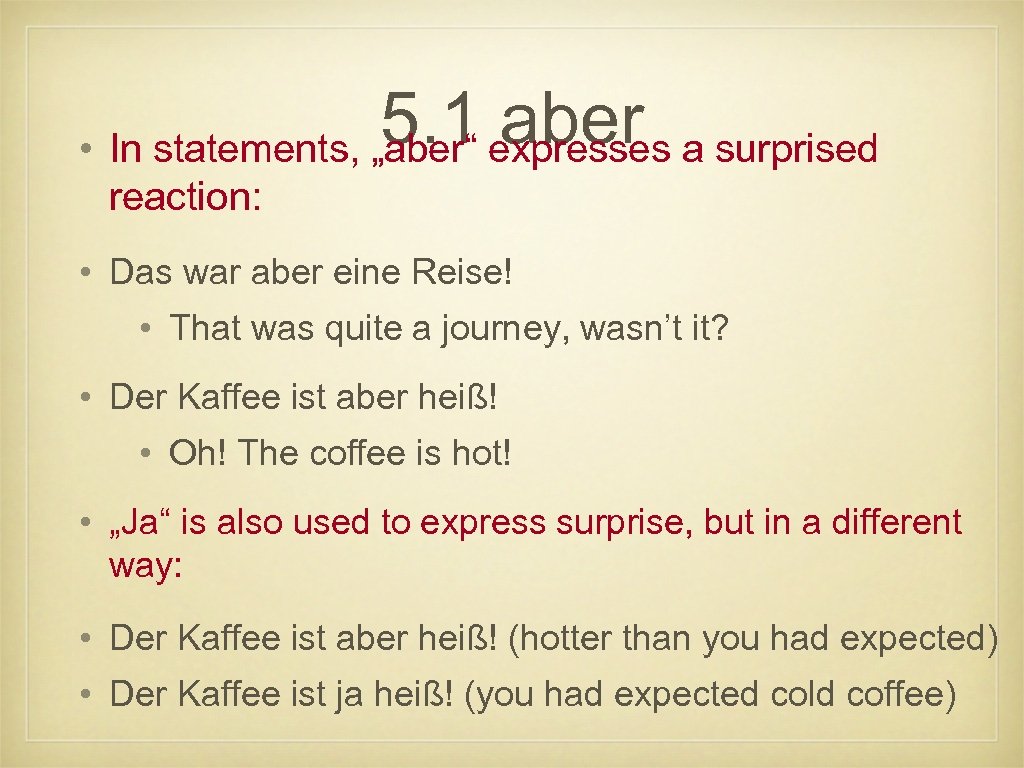 5. 1 expresses a surprised aber • In statements, „aber“ reaction: • Das war aber eine Reise! • That was quite a journey, wasn’t it? • Der Kaffee ist aber heiß! • Oh! The coffee is hot! • „Ja“ is also used to express surprise, but in a different way: • Der Kaffee ist aber heiß! (hotter than you had expected) • Der Kaffee ist ja heiß! (you had expected cold coffee)
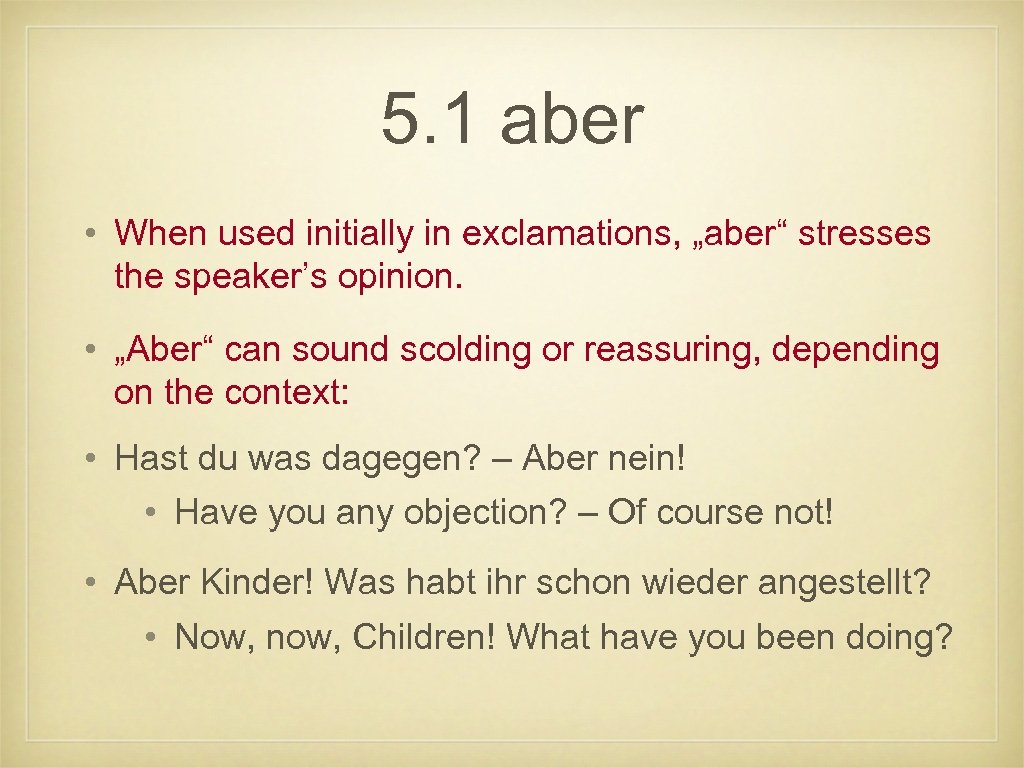 5. 1 aber • When used initially in exclamations, „aber“ stresses the speaker’s opinion. • „Aber“ can sound scolding or reassuring, depending on the context: • Hast du was dagegen? – Aber nein! • Have you any objection? – Of course not! • Aber Kinder! Was habt ihr schon wieder angestellt? • Now, now, Children! What have you been doing?
 5. 2 auch • It can be used to correct a false impression, often used with „ja“: • John sieht heute schlecht aus. • John is not looking well today. • Er ist ja auch lange krank gewesen. • Well, he‘s been ill for a long time.
 5. 2 auch • In yes/ no questions, „auch“ asks for confirmation of something which the speaker thinks should be taken for granted; English equivalent often tag question: • Kann ich mich auch drauf verlassen? • I can rely on that, can‘t I?
 5. 3 doch • In statements, „doch“ indicates disagreement with what has been said: • Gestern hat es doch geschneit. • All the same, it did snow yesterday. • If it is unstressed, it appeals politely for agreement or confirmation: • Du hast doch gesagt, dass du kommst. • You did say you were coming, didn’t you?
 5. 3 doch • In commands, the force of „doch“ depends a lot on the context: • Mach doch nicht (immer) so ein Gesicht! • Don’t keep making faces like that! • Lassen Sie mich doch (mal) das Foto sehen! • Why don’t you just let me see the photograph?
 5. 3 doch • In w-questions, „doch“ asks for confirmation of an answer or the repetition of information: • Wie heißt doch euer Hund? • What did you say your dog is called? • Wer war das doch? • Who was that again?
 5. 3 doch • In exclamations, „doch“ emphasizes the speaker’s surprise: • Wie winzig doch alles von hier oben aussieht! • But how tiny everything looks from up here! • Du bist doch kein kleines Kind mehr! • You are not a baby any more, you know!
 5. 3 doch • In wishes expressed with Konjunktiv Ⅱ, „doch“ emphasizes the urgency of the wish: • Wäre ich doch zu Hause geblieben! • If only I‘d just stayed at home! • Wenn er doch jetzt käme! • If only he would come now!
 5. 4 eh (sowieso, ohnehin) • Equivalent to English “anyway“ or “in any case: “ • Er ist eh ein schlauer Kerl. • He‘s a smart guy anyway. • Wenn ich arbeite, brauche ich eh immer mehr zum Essen. • When I‘m working, I need more to eat anyway. • Ich habe eh gesagt, dass ich die Idee nicht mochte. • I told you that I did not like the idea in the first place.
 5. 5 halt/ eben • As a modal particle, „eben“ typically expresses a confirmation that something is the case. • In statements, it emphasizes an inescapable conclusion: • Das ist eben so. • That’s how it is. • Ich kann ihn nicht überreden. Er ist eben hartnäckig. • I can’t convince him. He’s just obstinate.
 5. 5 halt/ eben • In commands, „eben“ emphasizes that there is no real alternative: • (Dann) bleib eben im Zug sitzen! • Well, just stay in the train then!
 5. 5 halt/ eben • „Halt“ is an alternative to „eben“ in some senses. It was originally characteristic of south German speech, but its use has recently become more widespread. • Da kann man halt nichts machen. • There’s just nothing to be done.
 5. 6 ja • By using „ja, “ the speaker insists that what s/he is saying is correct; “do-“ form or cleft sentence: • Wir haben ja gestern davon gesprochen. • We did talk about that yesterday (you know). • Hier im Gebirge ist es ja im Frühjahr am schönsten. • It‘s in spring when it‘s nicest here in the mountains.
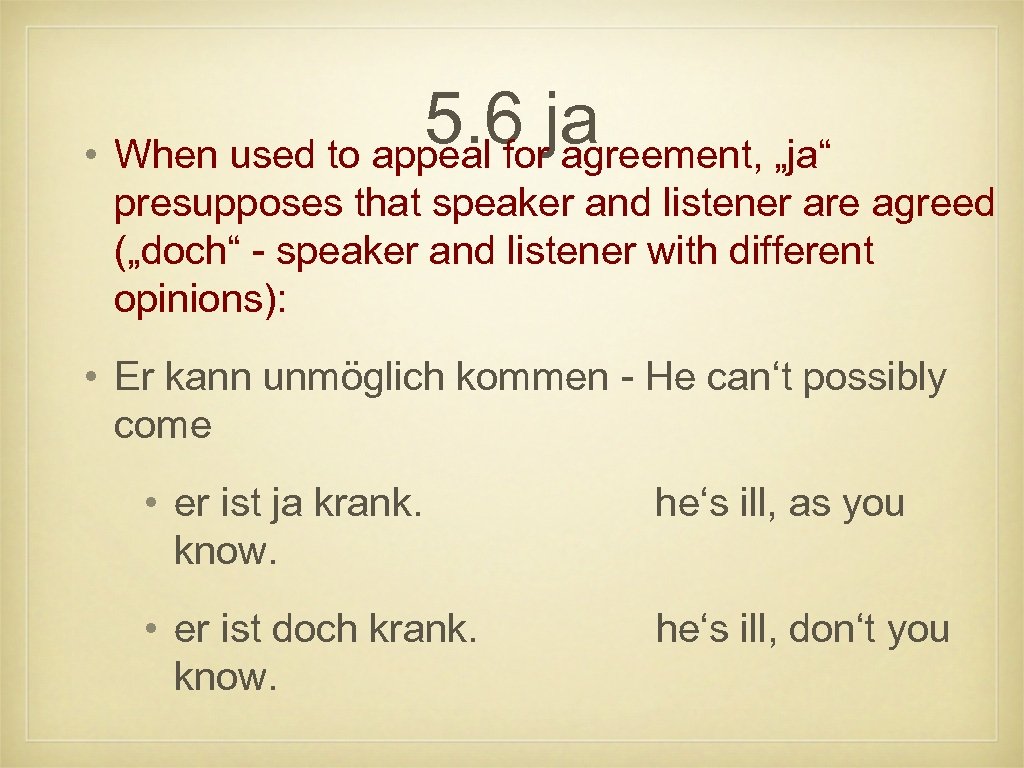 5. 6 ja • When used to appeal for agreement, „ja“ presupposes that speaker and listener are agreed („doch“ - speaker and listener with different opinions): • Er kann unmöglich kommen - He can‘t possibly come • er ist ja krank. know. he‘s ill, as you • er ist doch krank. know. he‘s ill, don‘t you
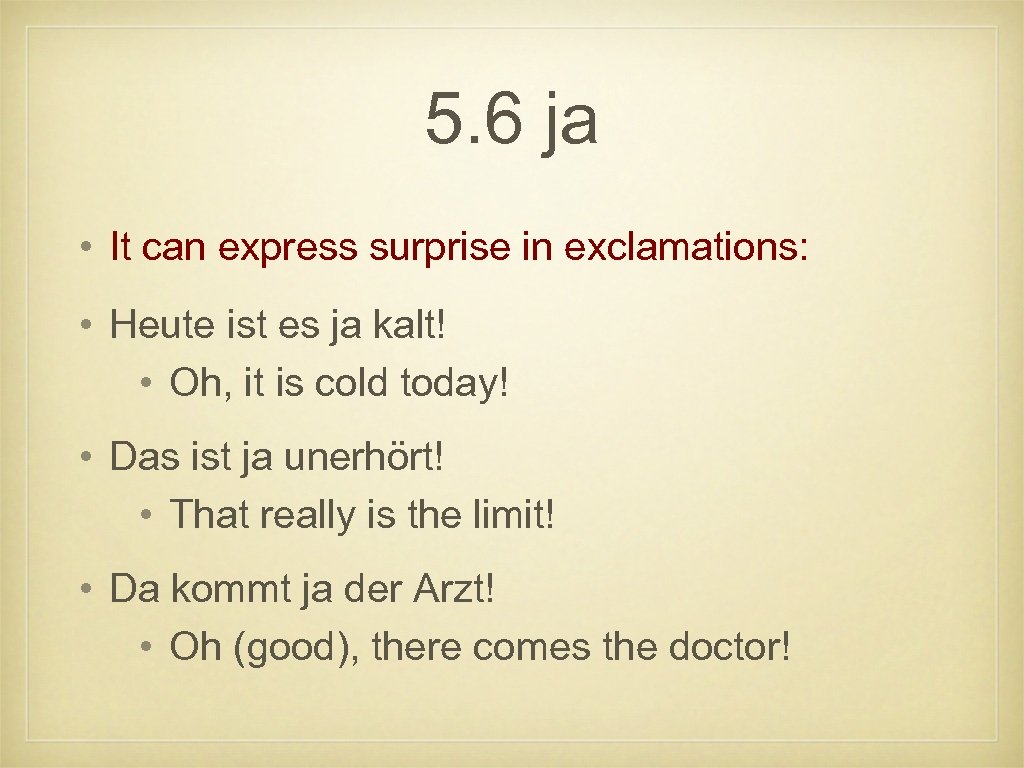 5. 6 ja • It can express surprise in exclamations: • Heute ist es ja kalt! • Oh, it is cold today! • Das ist ja unerhört! • That really is the limit! • Da kommt ja der Arzt! • Oh (good), there comes the doctor!
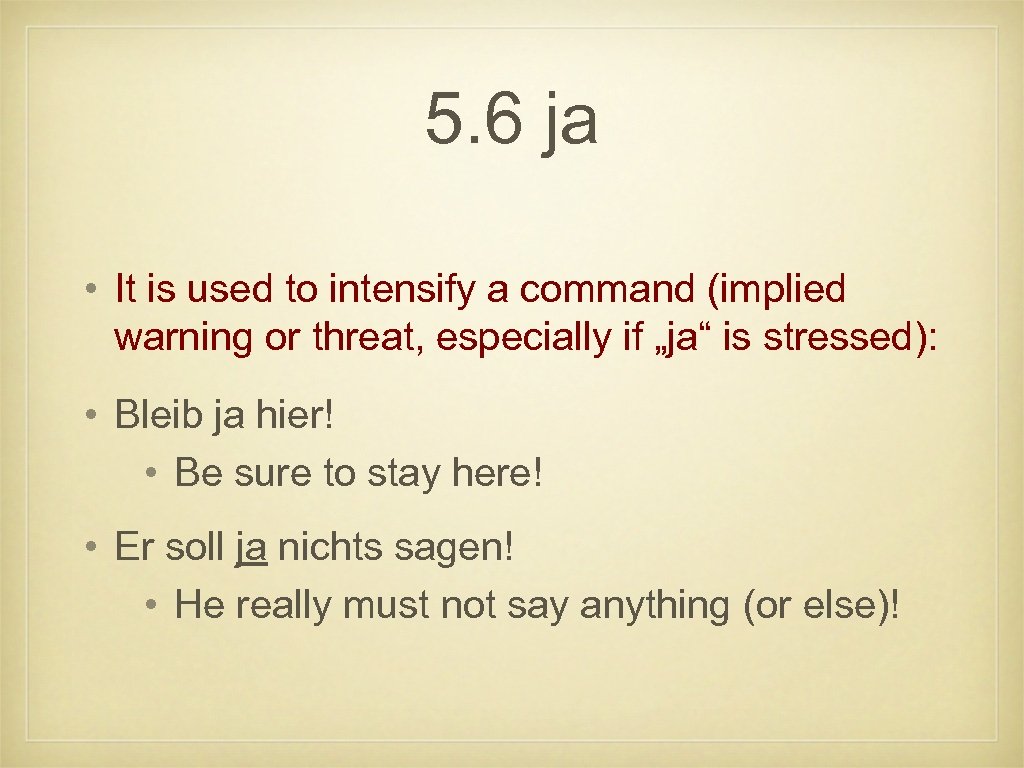 5. 6 ja • It is used to intensify a command (implied warning or threat, especially if „ja“ is stressed): • Bleib ja hier! • Be sure to stay here! • Er soll ja nichts sagen! • He really must not say anything (or else)!
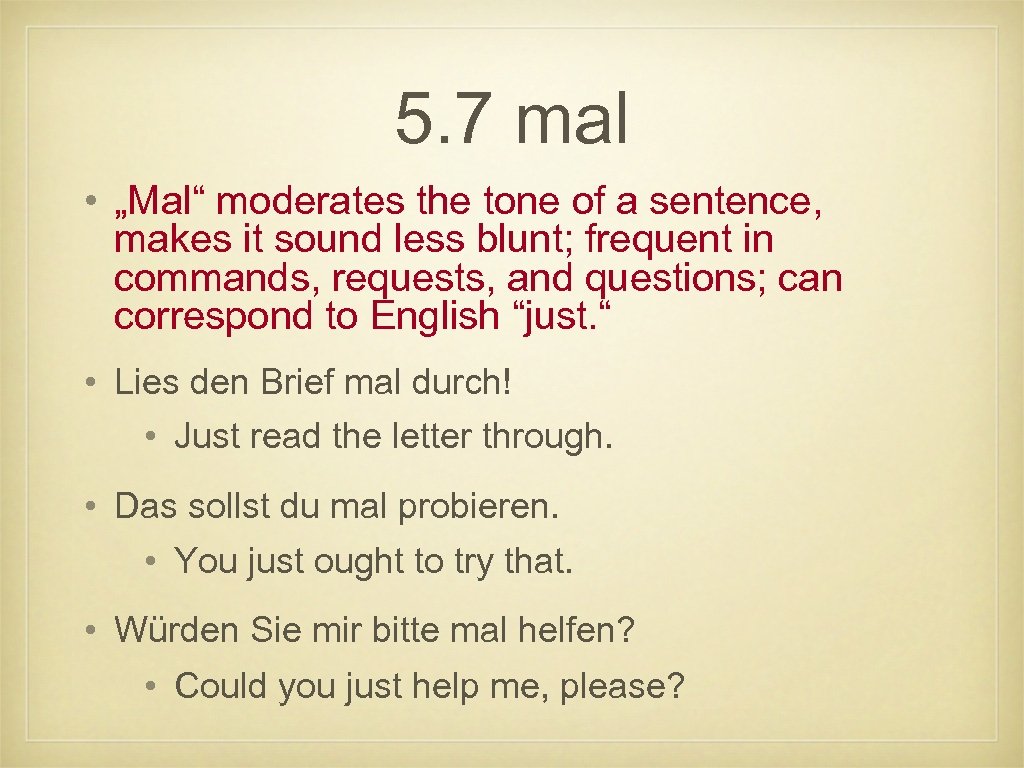 5. 7 mal • „Mal“ moderates the tone of a sentence, makes it sound less blunt; frequent in commands, requests, and questions; can correspond to English “just. “ • Lies den Brief mal durch! • Just read the letter through. • Das sollst du mal probieren. • You just ought to try that. • Würden Sie mir bitte mal helfen? • Could you just help me, please?
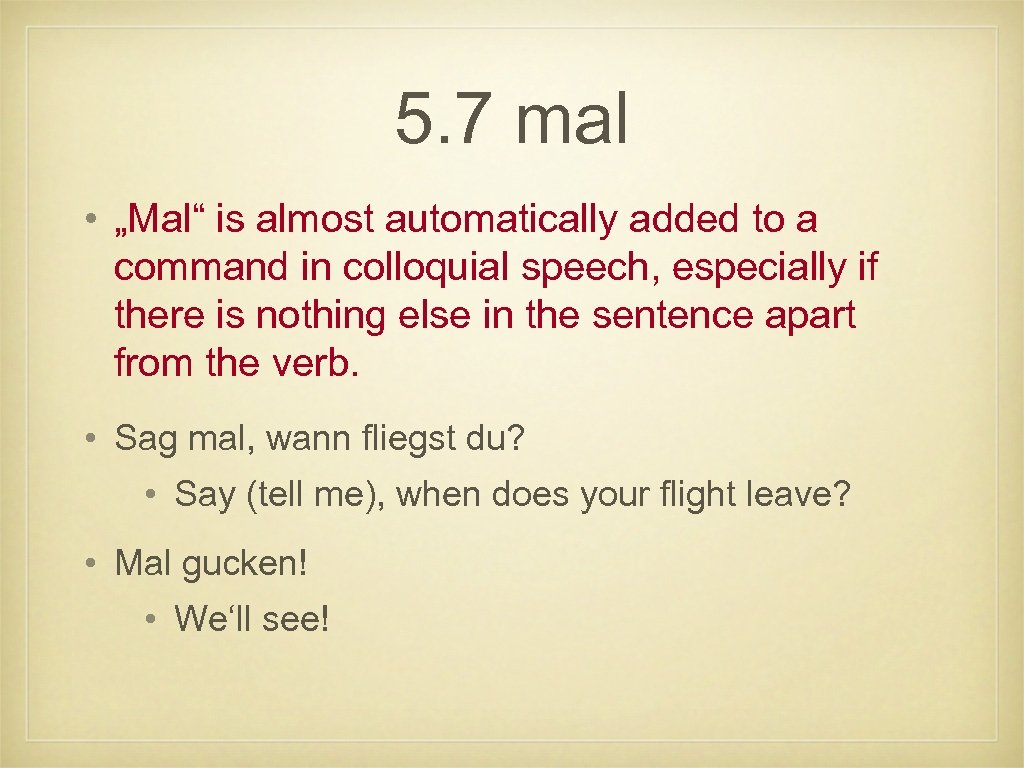 5. 7 mal • „Mal“ is almost automatically added to a command in colloquial speech, especially if there is nothing else in the sentence apart from the verb. • Sag mal, wann fliegst du? • Say (tell me), when does your flight leave? • Mal gucken! • We‘ll see!
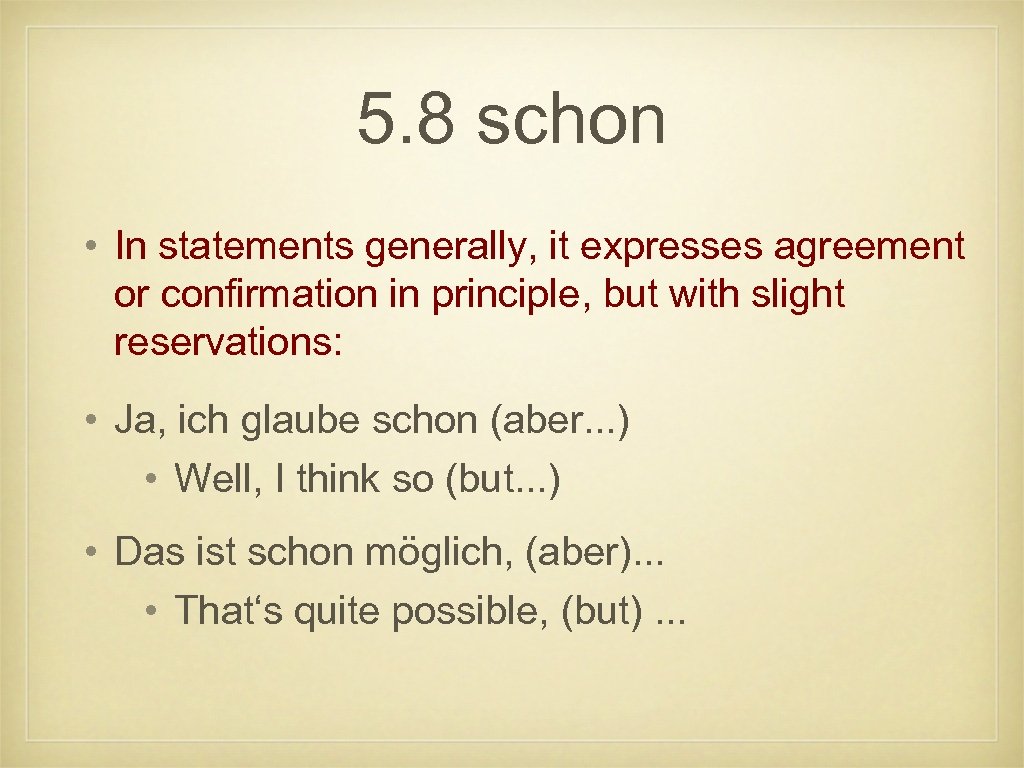 5. 8 schon • In statements generally, it expresses agreement or confirmation in principle, but with slight reservations: • Ja, ich glaube schon (aber. . . ) • Well, I think so (but. . . ) • Das ist schon möglich, (aber). . . • That‘s quite possible, (but). . .
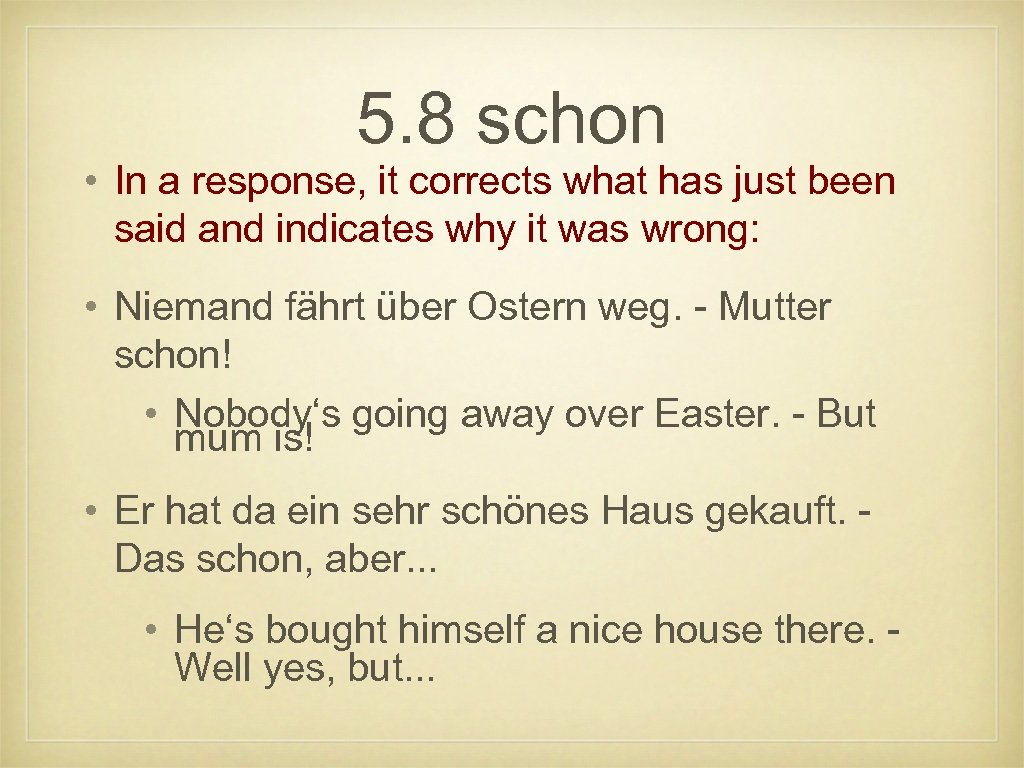 5. 8 schon • In a response, it corrects what has just been said and indicates why it was wrong: • Niemand fährt über Ostern weg. - Mutter schon! • Nobody‘s going away over Easter. - But mum is! • Er hat da ein sehr schönes Haus gekauft. Das schon, aber. . . • He‘s bought himself a nice house there. Well yes, but. . .
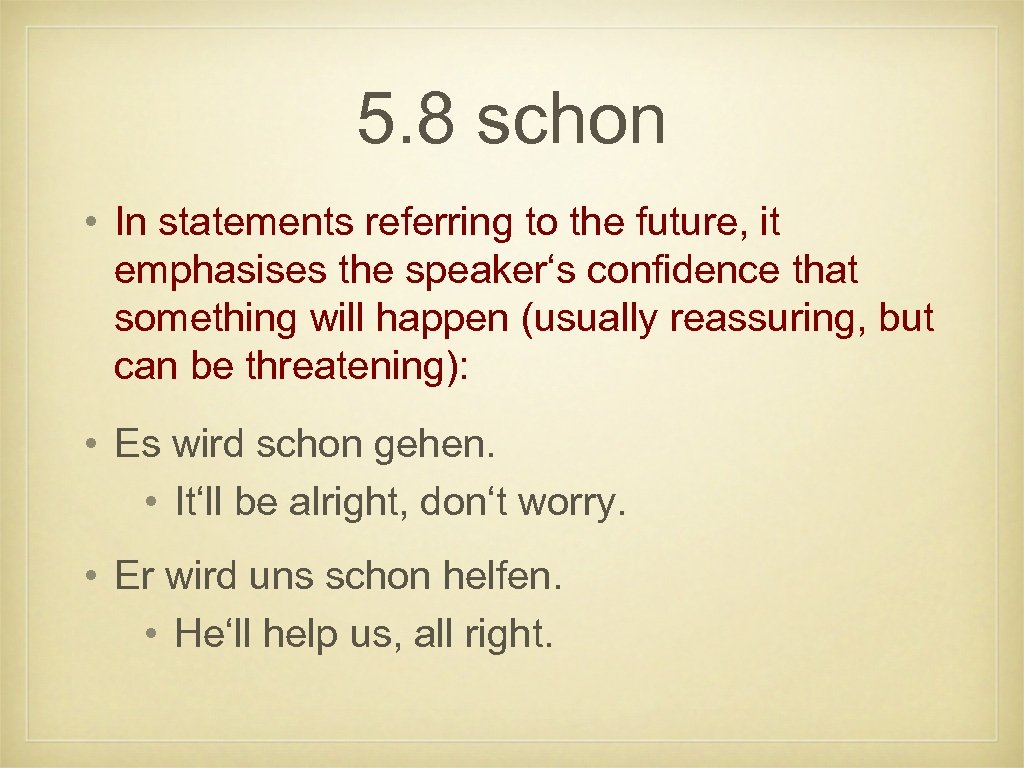 5. 8 schon • In statements referring to the future, it emphasises the speaker‘s confidence that something will happen (usually reassuring, but can be threatening): • Es wird schon gehen. • It‘ll be alright, don‘t worry. • Er wird uns schon helfen. • He‘ll help us, all right.
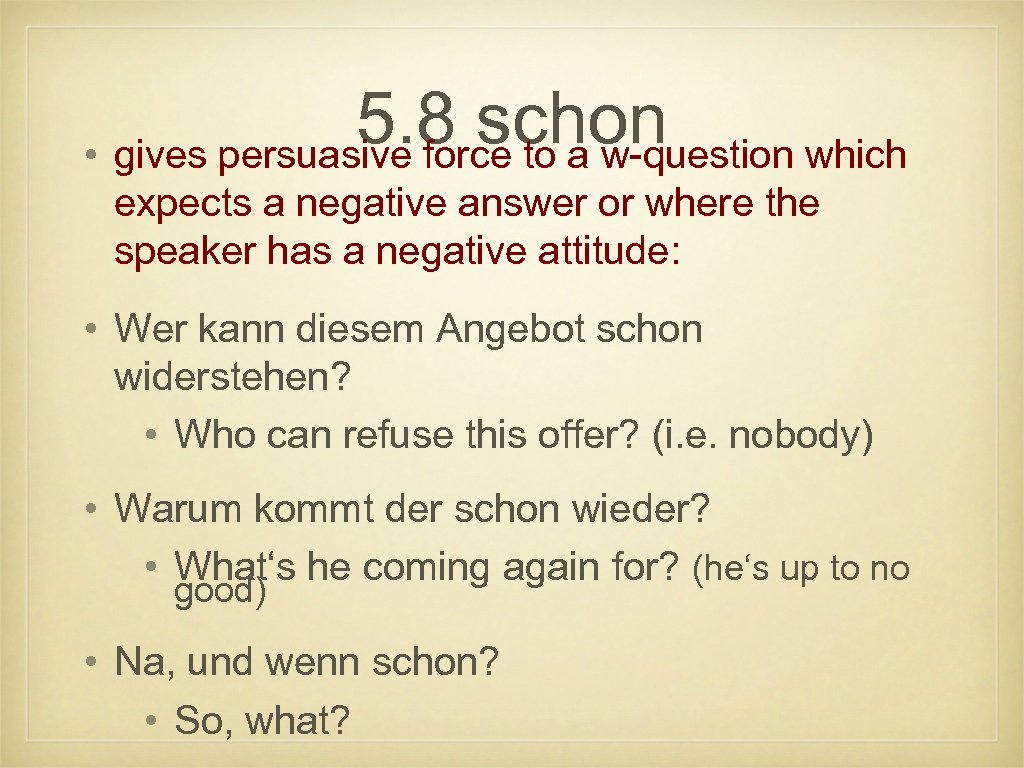 5. 8 schon • gives persuasive force to a w-question which expects a negative answer or where the speaker has a negative attitude: • Wer kann diesem Angebot schon widerstehen? • Who can refuse this offer? (i. e. nobody) • Warum kommt der schon wieder? • What‘s he coming again for? (he‘s up to no good) • Na, und wenn schon? • So, what?
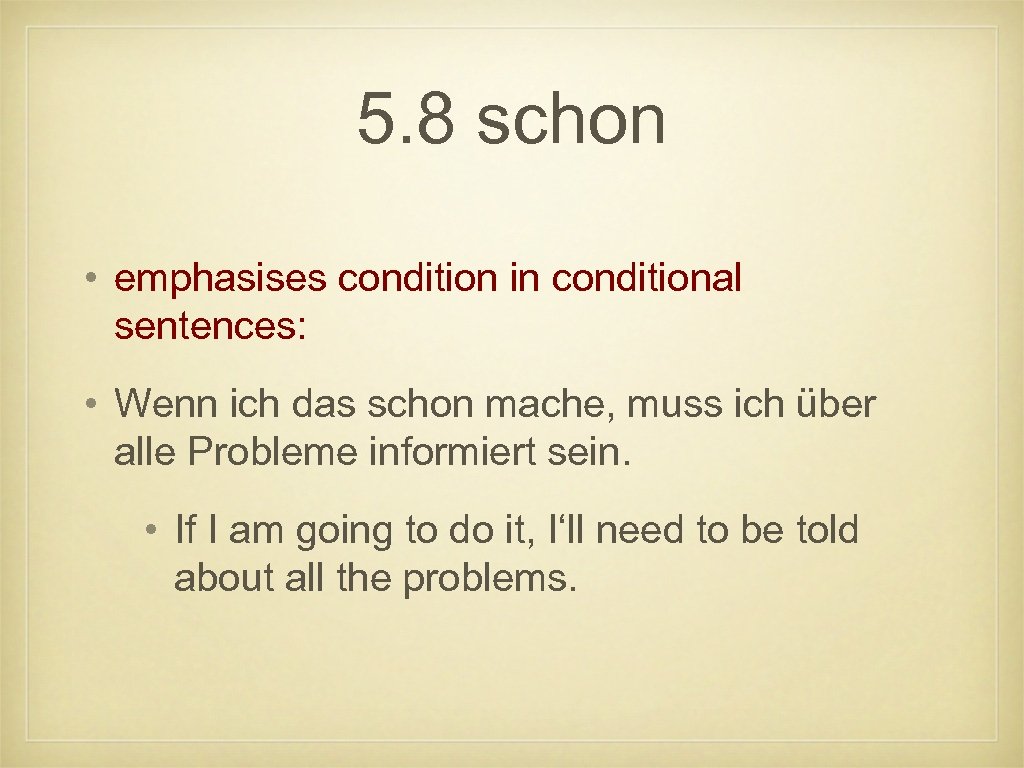 5. 8 schon • emphasises condition in conditional sentences: • Wenn ich das schon mache, muss ich über alle Probleme informiert sein. • If I am going to do it, I‘ll need to be told about all the problems.
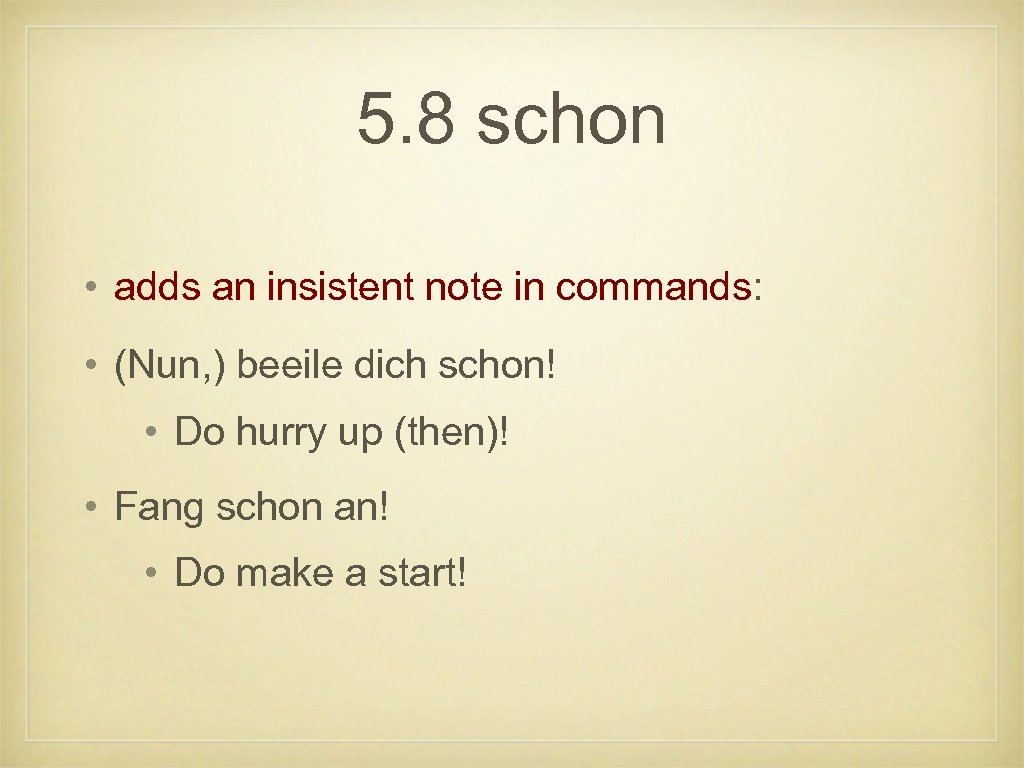 5. 8 schon • adds an insistent note in commands: • (Nun, ) beeile dich schon! • Do hurry up (then)! • Fang schon an! • Do make a start!
 6 Sources • Durrell, Martin. Hammer's German Grammar and Usage. New York: Mc. Graw. Hill, 2002. • Liu, Fang. Die deutschen Modalpartikeln. Beijing: FLTRP, 1986. • Dudenredaktion. Der DUDEN 4: Grammatik der deutschen Gegenwartssprache. Mannheim: Dudenverlag, 1966/1973/1995. • Shao, Ming. A Contrastive Analysis between German and Chinese Modal Particle. Journal of PLA University of Foreign Languages, 2010 -11 -6(33). • Bross, Fabian. German modal particles and the common ground. In: Helikon. A Multidisciplinary Online Journal, 2. 182 -209. • http: //coerll. utexas. edu/gg/gr/mis_04. html • http: //emp. byui. edu/HADERLIEB/flavoring. htm