 Скачать презентацию FLASH Bunch-Resolved Longitudinal Diagnostics Christopher Gerth DESY On
ca21d02e868864058f5ca1919066287f.ppt
- Количество слайдов: 34



FLASH Bunch-Resolved Longitudinal Diagnostics Christopher Gerth (DESY) On behalf of WP 18 and many others … Workshop on Linac Operation with Long Bunch Trains 22 -24 February 2010 Free-Electron Laser in Hamburg
FLASH Introduction Free-Electron Laser in Hamburg > Set-up of the machine = find operating points a) old settings: save&restore b) predicted operating points from simulations Diagnostics: magnets => orbit, matching => transverse diagnostics (BPM, OTR, BLM, …) modules => energy, bunch compression => longitudinal diagnostics => coarse diagnostics needed with large dynamic range (talk after lunch) > Stable operation of the machine = lock operating points a) single-bunch resolution b) feedback capability => high-resolution diagnostics needed (this talk) Christopher Gerth | 9 m. A Workshop | 23 -Feb-2010
Outline FLASH Free-Electron Laser in Hamburg > Bunch Arrival Monitor (BAM) > Energy Beam Position Monitor (EBPM) > Pyroelectric Detector (Pyro) > Synchrotron Radiation Monitor (SRM) > Outlook Christopher Gerth | 9 m. A Workshop | 23 -Feb-2010
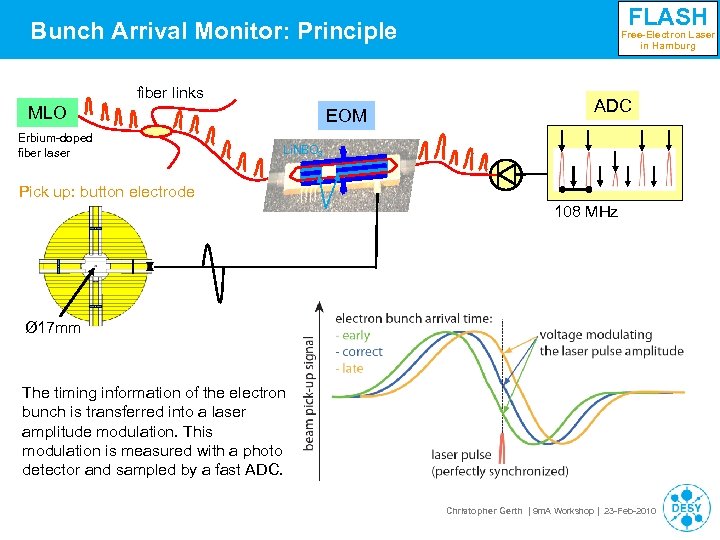
FLASH Bunch Arrival Monitor: Principle fiber links MLO Erbium-doped fiber laser EOM Free-Electron Laser in Hamburg ADC Li. NBO 3 Pick up: button electrode 108 MHz Ø 17 mm The timing information of the electron bunch is transferred into a laser amplitude modulation. This modulation is measured with a photo detector and sampled by a fast ADC. Christopher Gerth | 9 m. A Workshop | 23 -Feb-2010
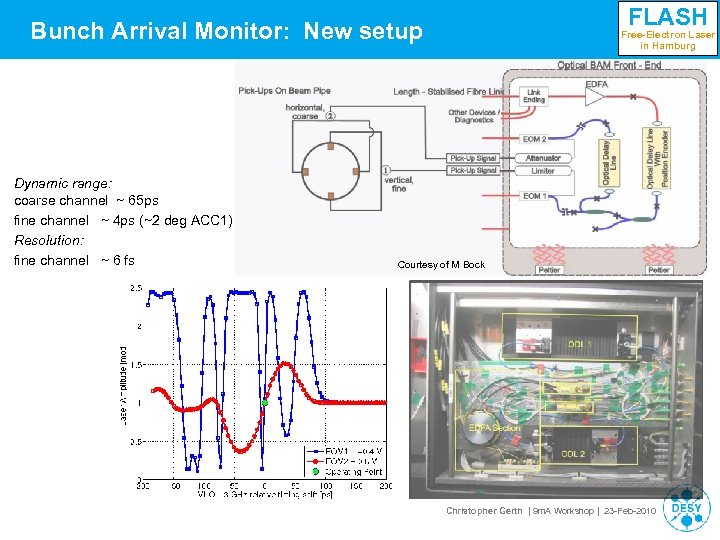
FLASH Bunch Arrival Monitor: New setup Dynamic range: coarse channel ~ 65 ps fine channel ~ 4 ps (~2 deg ACC 1) Resolution: fine channel ~ 6 fs Free-Electron Laser in Hamburg Courtesy of M Bock Christopher Gerth | 9 m. A Workshop | 23 -Feb-2010
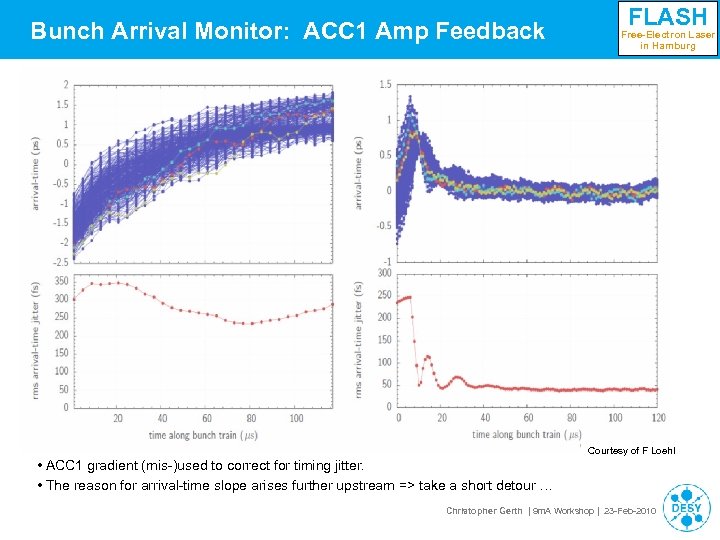
Bunch Arrival Monitor: ACC 1 Amp Feedback FLASH Free-Electron Laser in Hamburg Courtesy of F Loehl • ACC 1 gradient (mis-)used to correct for timing jitter. • The reason for arrival-time slope arises further upstream => take a short detour … Christopher Gerth | 9 m. A Workshop | 23 -Feb-2010
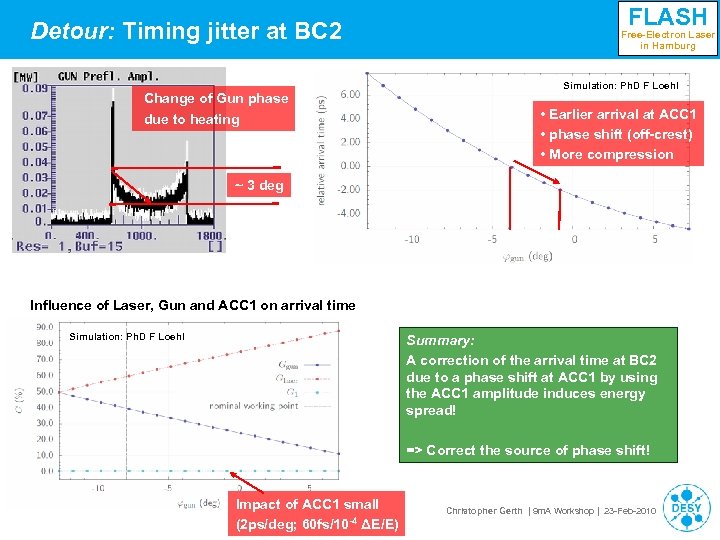
Detour: Timing jitter at BC 2 Change of Gun phase due to heating FLASH Free-Electron Laser in Hamburg Simulation: Ph. D F Loehl • Earlier arrival at ACC 1 • phase shift (off-crest) • More compression ~ 3 deg Influence of Laser, Gun and ACC 1 on arrival time Simulation: Ph. D F Loehl Summary: A correction of the arrival time at BC 2 due to a phase shift at ACC 1 by using the ACC 1 amplitude induces energy spread! => Correct the source of phase shift! Impact of ACC 1 small (2 ps/deg; 60 fs/10 -4 ΔE/E) Christopher Gerth | 9 m. A Workshop | 23 -Feb-2010
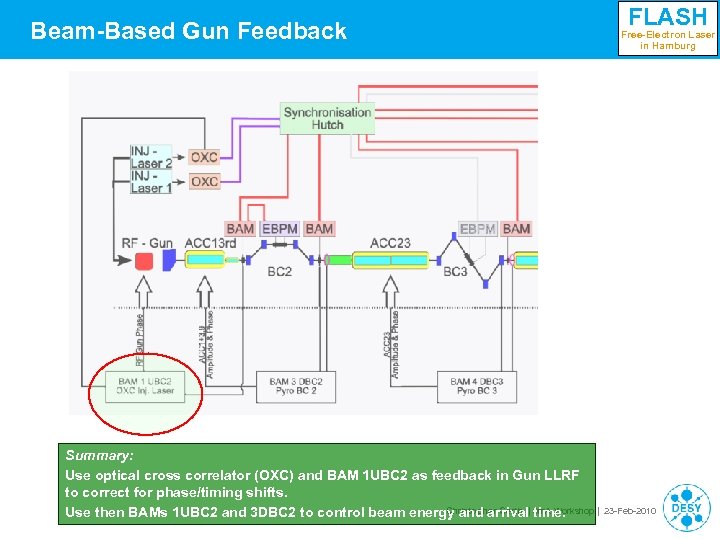
Beam-Based Gun Feedback Summary: Use optical cross correlator (OXC) and BAM 1 UBC 2 as feedback in Gun LLRF to correct for phase/timing shifts. Christopher Gerth time. Use then BAMs 1 UBC 2 and 3 DBC 2 to control beam energy and arrival| 9 m. A Workshop | FLASH Free-Electron Laser in Hamburg 23 -Feb-2010
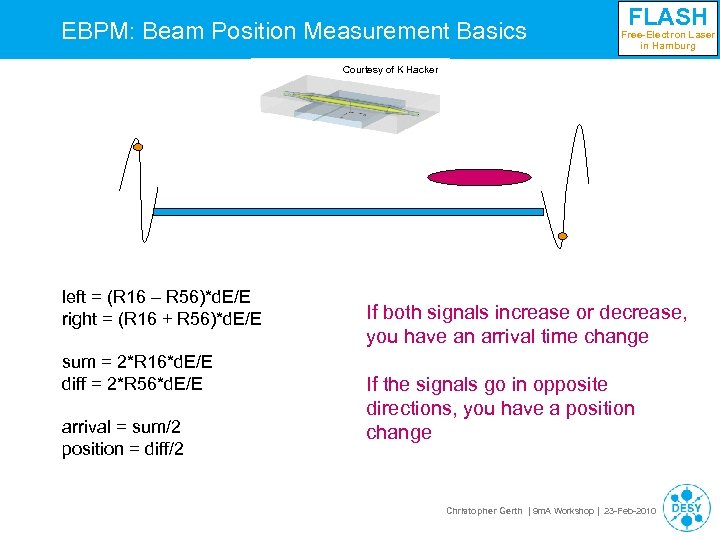
EBPM: Beam Position Measurement Basics FLASH Free-Electron Laser in Hamburg Courtesy of K Hacker left = (R 16 – R 56)*d. E/E right = (R 16 + R 56)*d. E/E sum = 2*R 16*d. E/E diff = 2*R 56*d. E/E arrival = sum/2 position = diff/2 If both signals increase or decrease, you have an arrival time change If the signals go in opposite directions, you have a position change Christopher Gerth | 9 m. A Workshop | 23 -Feb-2010
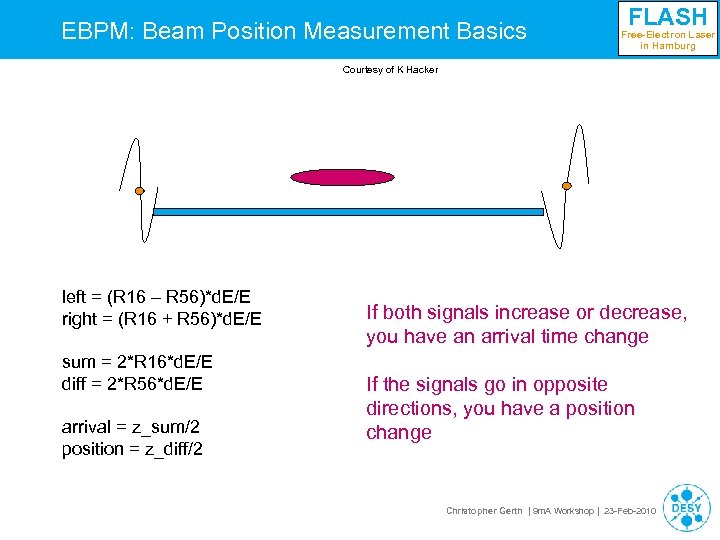
EBPM: Beam Position Measurement Basics FLASH Free-Electron Laser in Hamburg Courtesy of K Hacker left = (R 16 – R 56)*d. E/E right = (R 16 + R 56)*d. E/E sum = 2*R 16*d. E/E diff = 2*R 56*d. E/E arrival = z_sum/2 position = z_diff/2 If both signals increase or decrease, you have an arrival time change If the signals go in opposite directions, you have a position change Christopher Gerth | 9 m. A Workshop | 23 -Feb-2010
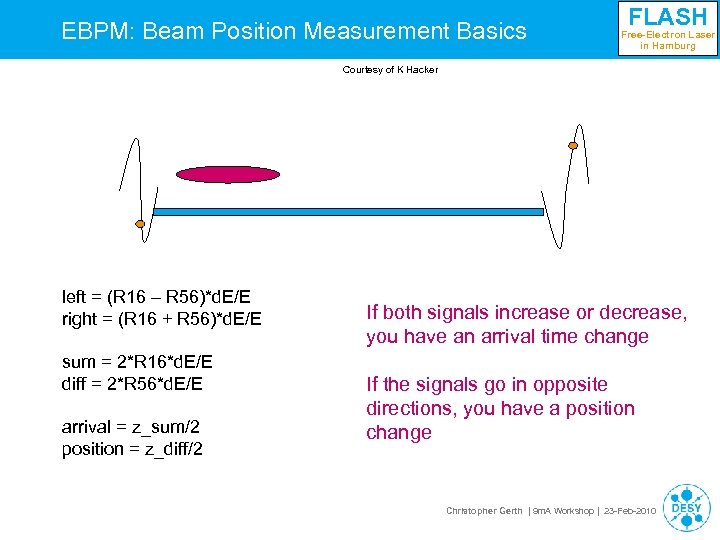
EBPM: Beam Position Measurement Basics FLASH Free-Electron Laser in Hamburg Courtesy of K Hacker left = (R 16 – R 56)*d. E/E right = (R 16 + R 56)*d. E/E sum = 2*R 16*d. E/E diff = 2*R 56*d. E/E arrival = z_sum/2 position = z_diff/2 If both signals increase or decrease, you have an arrival time change If the signals go in opposite directions, you have a position change Christopher Gerth | 9 m. A Workshop | 23 -Feb-2010
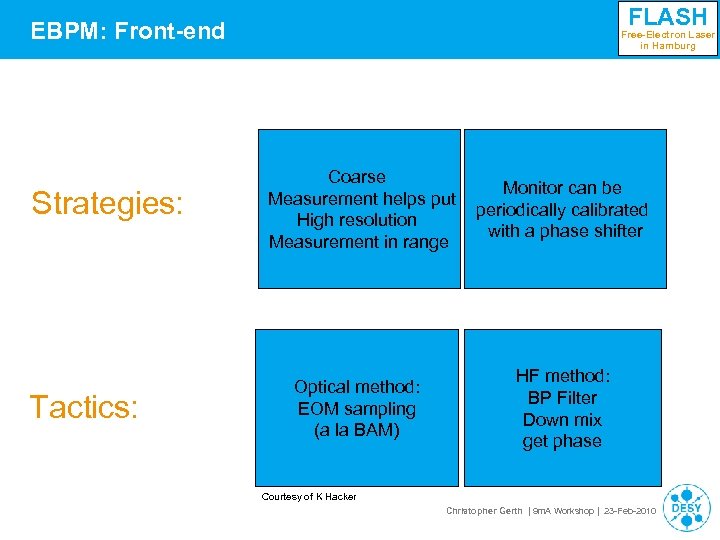
FLASH EBPM: Front-end Strategies: Tactics: Free-Electron Laser in Hamburg Coarse Measurement helps put High resolution Measurement in range Monitor can be periodically calibrated with a phase shifter Optical method: EOM sampling (a la BAM) HF method: BP Filter Down mix get phase Courtesy of K Hacker Christopher Gerth | 9 m. A Workshop | 23 -Feb-2010
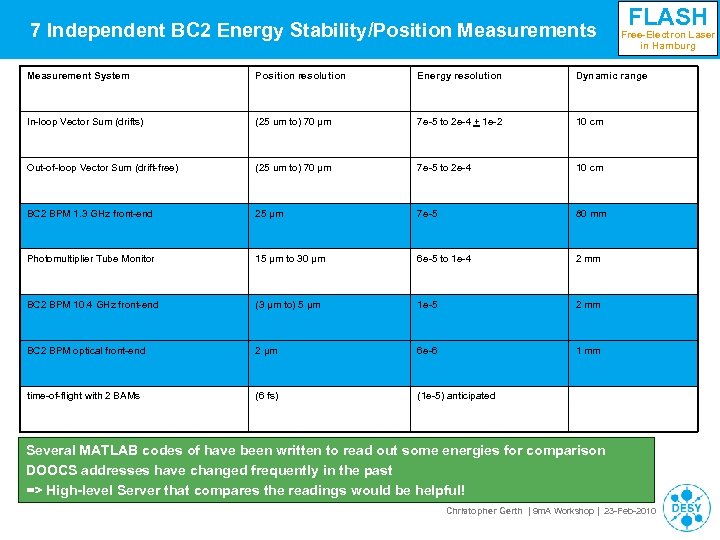
7 Independent BC 2 Energy Stability/Position Measurements FLASH Free-Electron Laser in Hamburg Measurement System Position resolution Energy resolution Dynamic range In-loop Vector Sum (drifts) (25 um to) 70 μm 7 e-5 to 2 e-4 + 1 e-2 10 cm Out-of-loop Vector Sum (drift-free) (25 um to) 70 μm 7 e-5 to 2 e-4 10 cm BC 2 BPM 1. 3 GHz front-end 25 μm 7 e-5 80 mm Photomultiplier Tube Monitor 15 μm to 30 μm 6 e-5 to 1 e-4 2 mm BC 2 BPM 10. 4 GHz front-end (3 μm to) 5 μm 1 e-5 2 mm BC 2 BPM optical front-end 2 μm 6 e-6 1 mm time-of-flight with 2 BAMs (6 fs) (1 e-5) anticipated Several MATLAB codes of have been written to read out some energies for comparison DOOCS addresses have changed frequently in the past => High-level Server that compares the readings would be helpful! Christopher Gerth | 9 m. A Workshop | 23 -Feb-2010
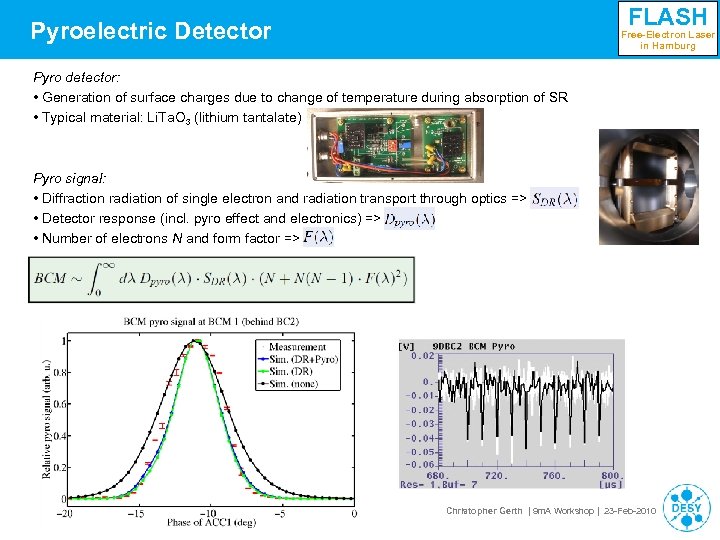
FLASH Pyroelectric Detector Free-Electron Laser in Hamburg Pyro detector: • Generation of surface charges due to change of temperature during absorption of SR • Typical material: Li. Ta. O 3 (lithium tantalate) Pyro signal: • Diffraction radiation of single electron and radiation transport through optics => • Detector response (incl. pyro effect and electronics) => • Number of electrons N and form factor => Christopher Gerth | 9 m. A Workshop | 23 -Feb-2010
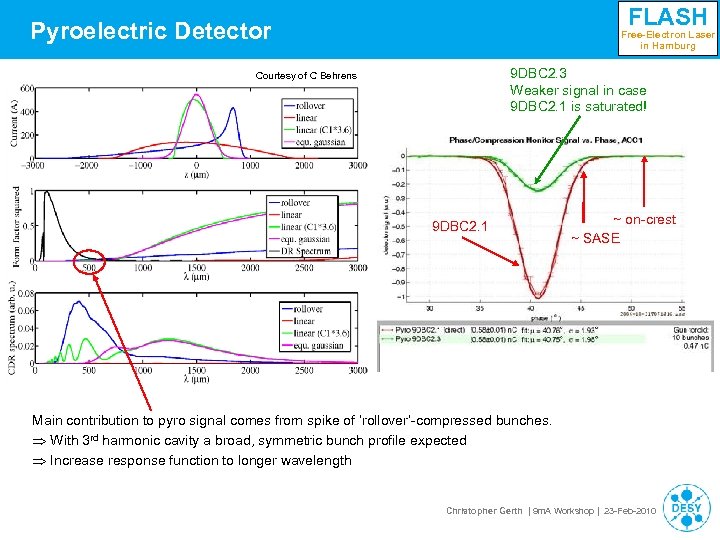
FLASH Pyroelectric Detector Free-Electron Laser in Hamburg 9 DBC 2. 3 Weaker signal in case 9 DBC 2. 1 is saturated! Courtesy of C Behrens 9 DBC 2. 1 ~ on-crest ~ SASE Main contribution to pyro signal comes from spike of ‘rollover’-compressed bunches. Þ With 3 rd harmonic cavity a broad, symmetric bunch profile expected Þ Increase response function to longer wavelength Christopher Gerth | 9 m. A Workshop | 23 -Feb-2010
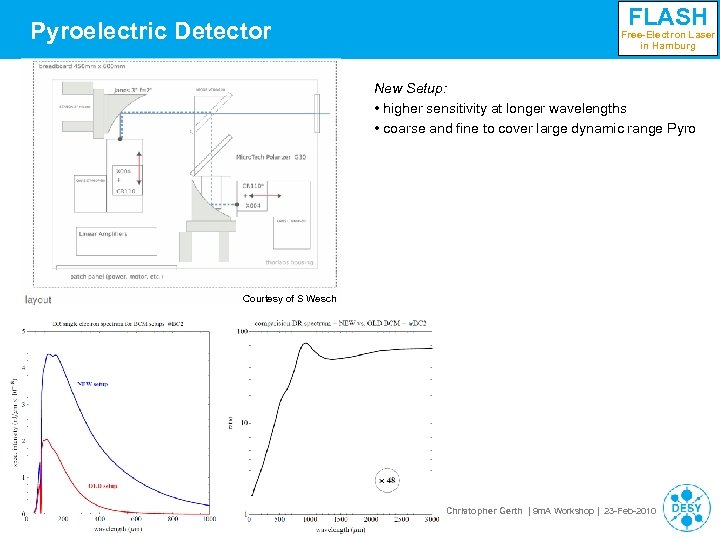
Pyroelectric Detector FLASH Free-Electron Laser in Hamburg New Setup: • higher sensitivity at longer wavelengths • coarse and fine to cover large dynamic range Pyro Courtesy of S Wesch Christopher Gerth | 9 m. A Workshop | 23 -Feb-2010
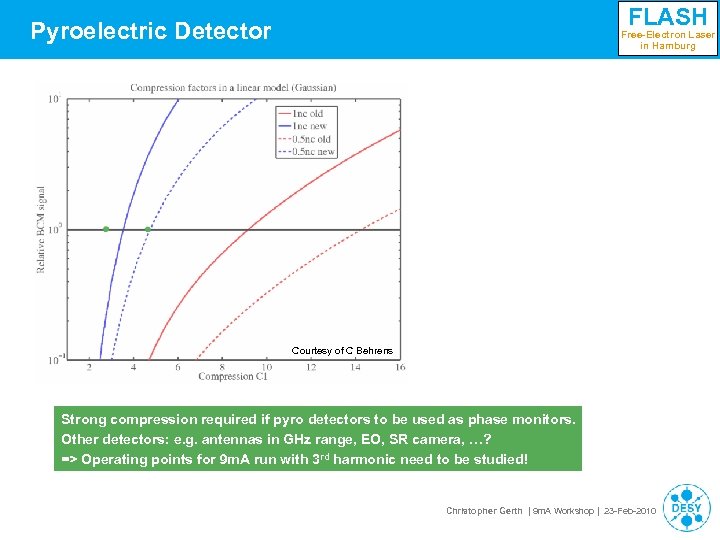
FLASH Pyroelectric Detector Free-Electron Laser in Hamburg Courtesy of C Behrens Strong compression required if pyro detectors to be used as phase monitors. Other detectors: e. g. antennas in GHz range, EO, SR camera, …? => Operating points for 9 m. A run with 3 rd harmonic need to be studied! Christopher Gerth | 9 m. A Workshop | 23 -Feb-2010
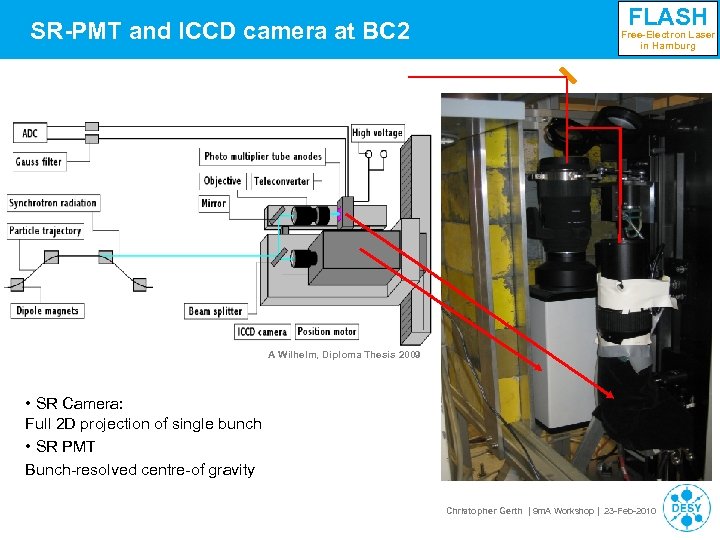
SR-PMT and ICCD camera at BC 2 FLASH Free-Electron Laser in Hamburg A Wilhelm, Diploma Thesis 2009 • SR Camera: Full 2 D projection of single bunch • SR PMT Bunch-resolved centre-of gravity Christopher Gerth | 9 m. A Workshop | 23 -Feb-2010
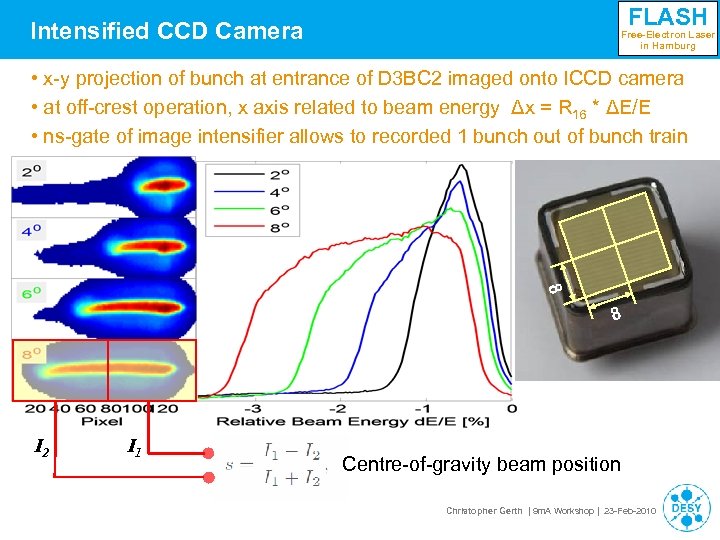
FLASH Intensified CCD Camera Free-Electron Laser in Hamburg • x-y projection of bunch at entrance of D 3 BC 2 imaged onto ICCD camera • at off-crest operation, x axis related to beam energy Δx = R 16 * ΔE/E • ns-gate of image intensifier allows to recorded 1 bunch out of bunch train 8 8 I 2 I 1 Centre-of-gravity beam position Christopher Gerth | 9 m. A Workshop | 23 -Feb-2010
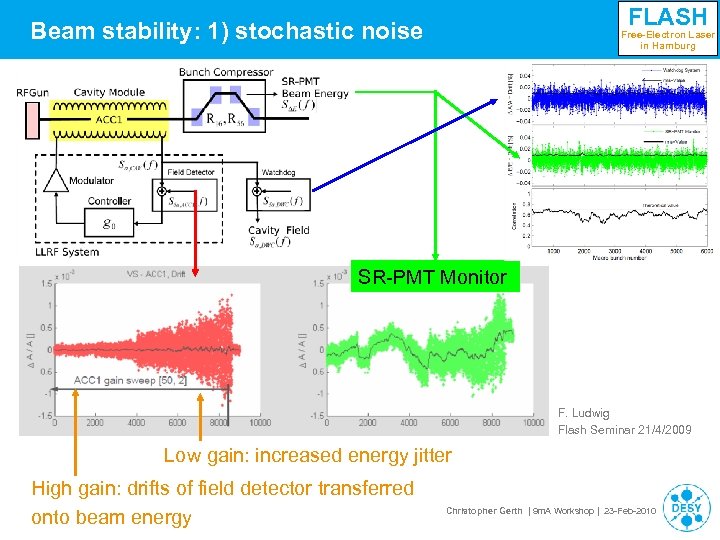
FLASH Beam stability: 1) stochastic noise Free-Electron Laser in Hamburg SR-PMT Monitor F. Ludwig Flash Seminar 21/4/2009 Low gain: increased energy jitter High gain: drifts of field detector transferred onto beam energy Christopher Gerth | 9 m. A Workshop | 23 -Feb-2010
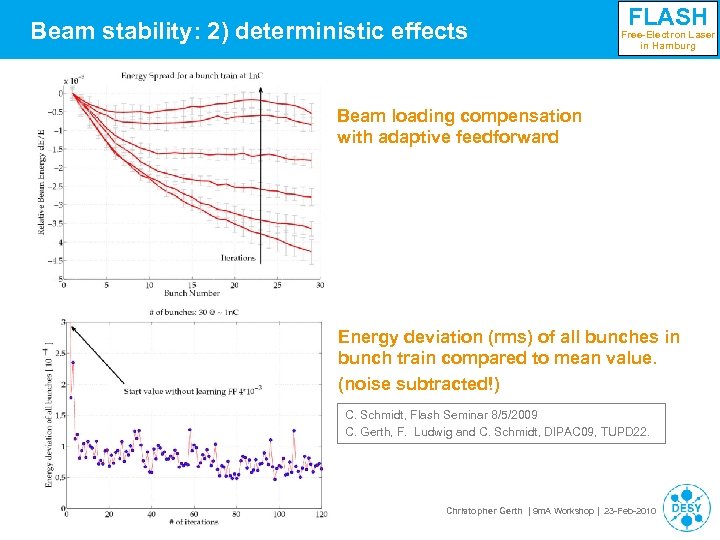
Beam stability: 2) deterministic effects FLASH Free-Electron Laser in Hamburg Beam loading compensation with adaptive feedforward Energy deviation (rms) of all bunches in bunch train compared to mean value. (noise subtracted!) C. Schmidt, Flash Seminar 8/5/2009 C. Gerth, F. Ludwig and C. Schmidt, DIPAC 09, TUPD 22. Christopher Gerth | 9 m. A Workshop | 23 -Feb-2010
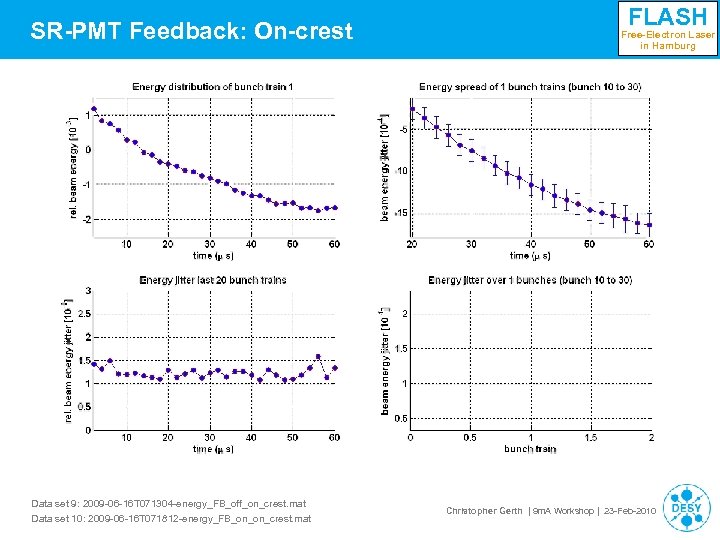
SR-PMT Feedback: On-crest Data set 9: 2009 -06 -16 T 071304 -energy_FB_off_on_crest. mat Data set 10: 2009 -06 -16 T 071812 -energy_FB_on_on_crest. mat FLASH Free-Electron Laser in Hamburg Christopher Gerth | 9 m. A Workshop | 23 -Feb-2010
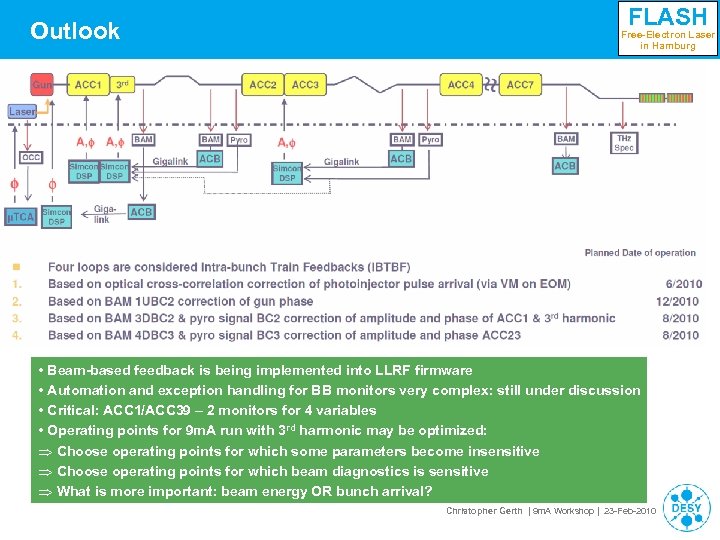
Outlook FLASH Free-Electron Laser in Hamburg • Beam-based feedback is being implemented into LLRF firmware • Automation and exception handling for BB monitors very complex: still under discussion • Critical: ACC 1/ACC 39 – 2 monitors for 4 variables • Operating points for 9 m. A run with 3 rd harmonic may be optimized: Þ Choose operating points for which some parameters become insensitive Þ Choose operating points for which beam diagnostics is sensitive Þ What is more important: beam energy OR bunch arrival? Christopher Gerth | 9 m. A Workshop | 23 -Feb-2010
Backup slides …. FLASH Free-Electron Laser in Hamburg Christopher Gerth | 9 m. A Workshop | 23 -Feb-2010
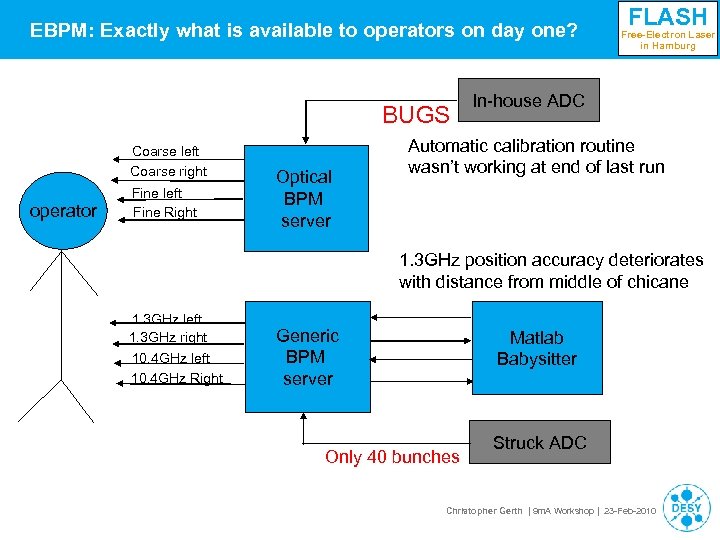
EBPM: Exactly what is available to operators on day one? BUGS Coarse left Coarse right operator Fine left Fine Right Optical BPM server FLASH Free-Electron Laser in Hamburg In-house ADC Automatic calibration routine wasn’t working at end of last run 1. 3 GHz position accuracy deteriorates with distance from middle of chicane 1. 3 GHz left 1. 3 GHz right 10. 4 GHz left 10. 4 GHz Right Generic BPM server Matlab Babysitter Only 40 bunches Struck ADC Christopher Gerth | 9 m. A Workshop | 23 -Feb-2010
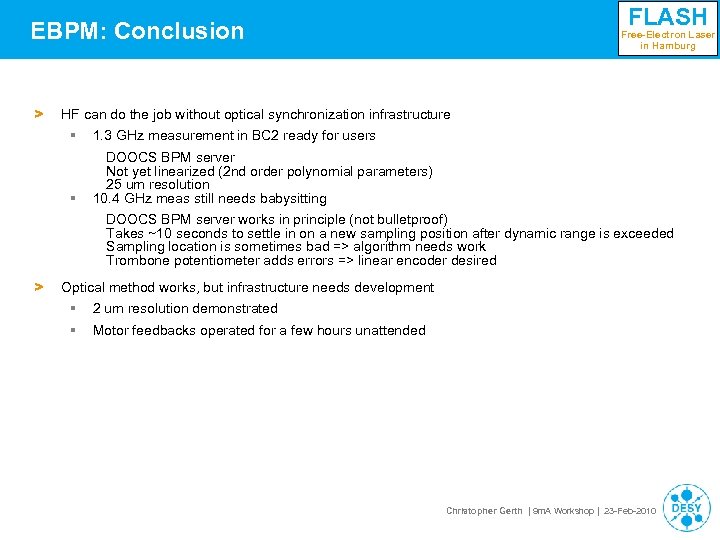
FLASH EBPM: Conclusion > Free-Electron Laser in Hamburg HF can do the job without optical synchronization infrastructure § 1. 3 GHz measurement in BC 2 ready for users § DOOCS BPM server Not yet linearized (2 nd order polynomial parameters) 25 um resolution 10. 4 GHz meas still needs babysitting DOOCS BPM server works in principle (not bulletproof) Takes ~10 seconds to settle in on a new sampling position after dynamic range is exceeded Sampling location is sometimes bad => algorithm needs work Trombone potentiometer adds errors => linear encoder desired > Optical method works, but infrastructure needs development § 2 um resolution demonstrated § Motor feedbacks operated for a few hours unattended Christopher Gerth | 9 m. A Workshop | 23 -Feb-2010
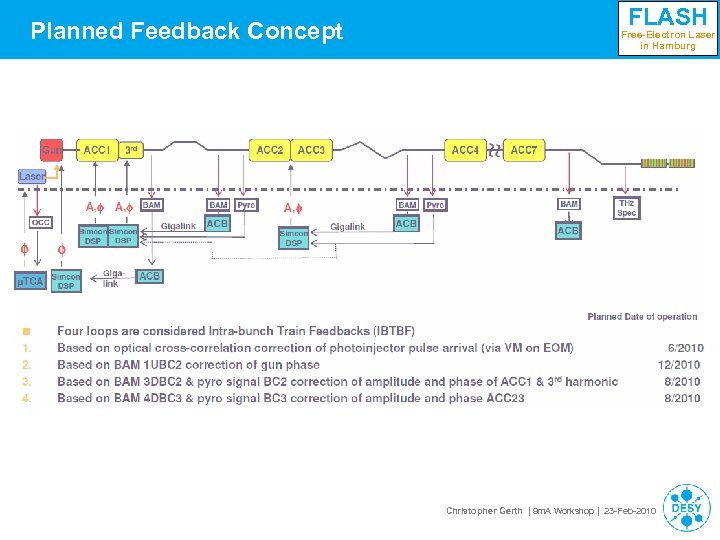
Planned Feedback Concept FLASH Free-Electron Laser in Hamburg Christopher Gerth | 9 m. A Workshop | 23 -Feb-2010
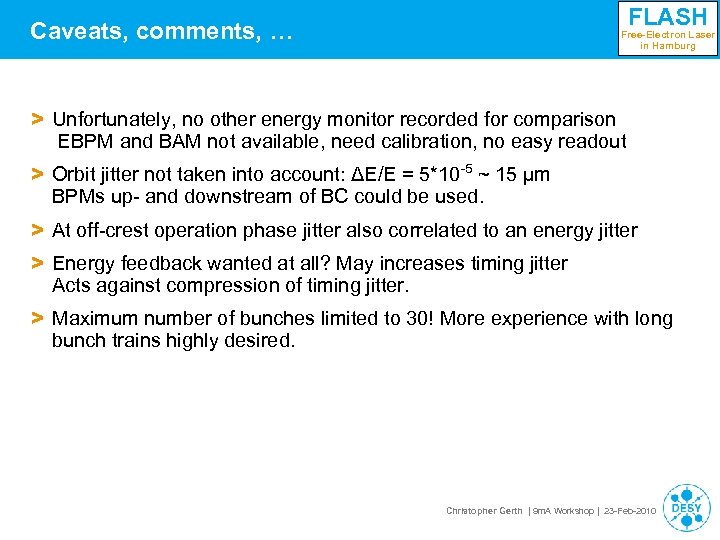
FLASH Caveats, comments, … Free-Electron Laser in Hamburg > Unfortunately, no other energy monitor recorded for comparison EBPM and BAM not available, need calibration, no easy readout > Orbit jitter not taken into account: ΔE/E = 5*10 -5 ~ 15 µm BPMs up- and downstream of BC could be used. > At off-crest operation phase jitter also correlated to an energy jitter > Energy feedback wanted at all? May increases timing jitter Acts against compression of timing jitter. > Maximum number of bunches limited to 30! More experience with long bunch trains highly desired. Christopher Gerth | 9 m. A Workshop | 23 -Feb-2010
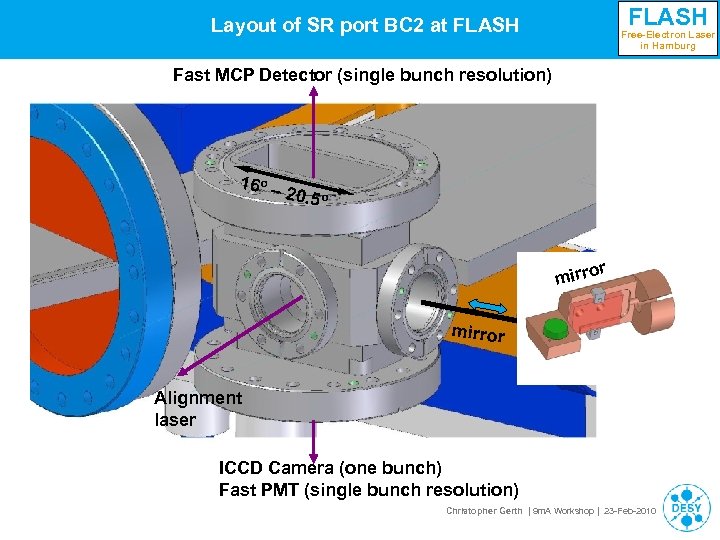
FLASH Layout of SR port BC 2 at FLASH Free-Electron Laser in Hamburg Fast MCP Detector (single bunch resolution) 16 o – 20. 5 o r mirror Alignment laser ICCD Camera (one bunch) Fast PMT (single bunch resolution) Christopher Gerth | 9 m. A Workshop | 23 -Feb-2010
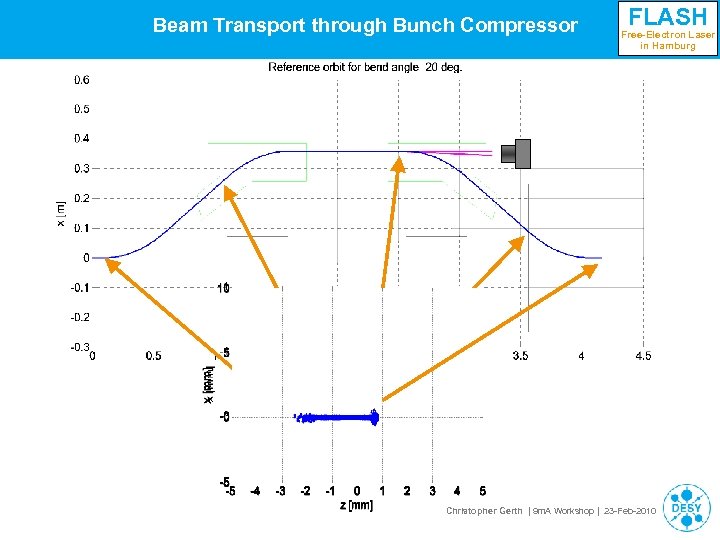
Beam Transport through Bunch Compressor FLASH Free-Electron Laser in Hamburg Christopher Gerth | 9 m. A Workshop | 23 -Feb-2010
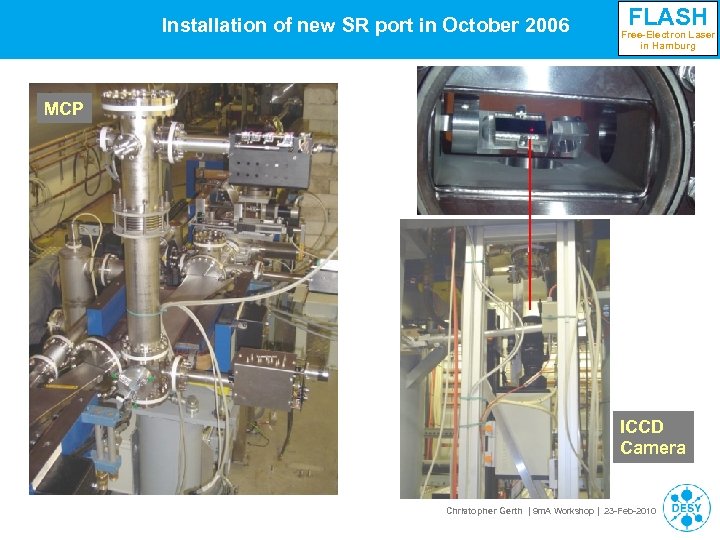
Installation of new SR port in October 2006 FLASH Free-Electron Laser in Hamburg MCP ICCD Camera Christopher Gerth | 9 m. A Workshop | 23 -Feb-2010
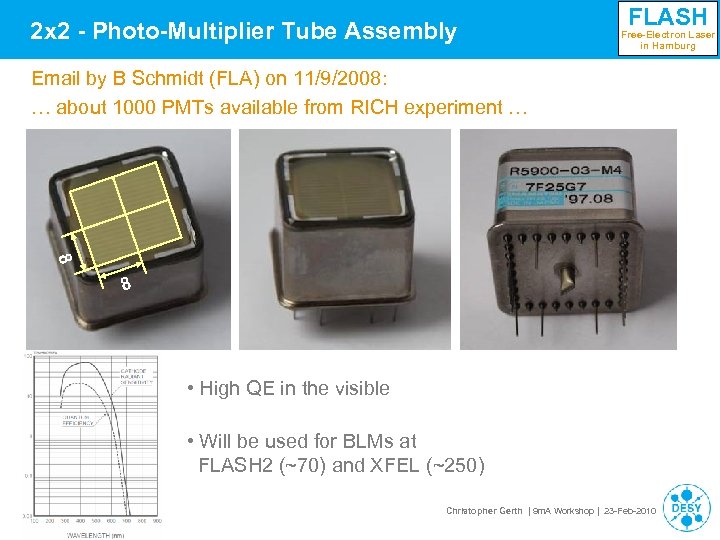
2 x 2 - Photo-Multiplier Tube Assembly FLASH Free-Electron Laser in Hamburg Email by B Schmidt (FLA) on 11/9/2008: … about 1000 PMTs available from RICH experiment … 8 8 • High QE in the visible • Will be used for BLMs at FLASH 2 (~70) and XFEL (~250) Christopher Gerth | 9 m. A Workshop | 23 -Feb-2010
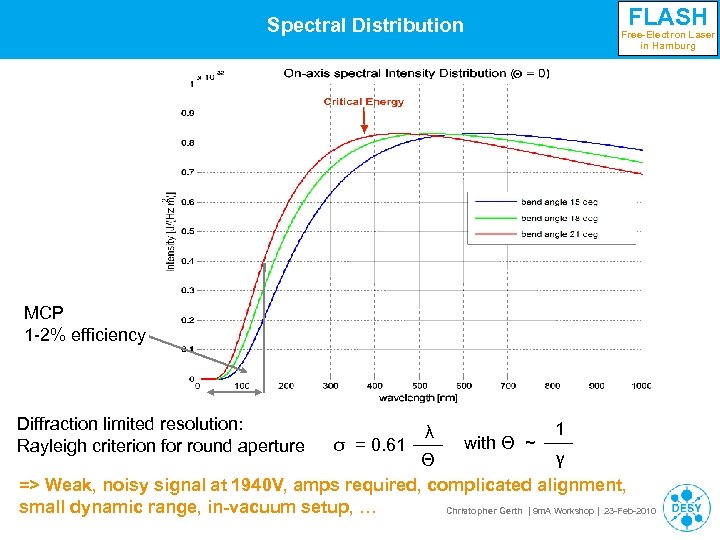
FLASH Spectral Distribution Free-Electron Laser in Hamburg MCP 1 -2% efficiency Diffraction limited resolution: Rayleigh criterion for round aperture σ = 0. 61 λ with Θ ~ 1 γ Θ => Weak, noisy signal at 1940 V, amps required, complicated alignment, small dynamic range, in-vacuum setup, … Christopher Gerth | 9 m. A Workshop | 23 -Feb-2010
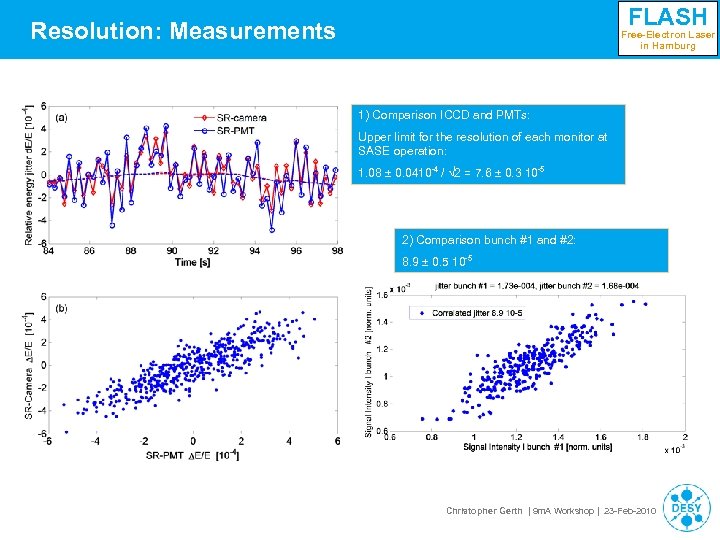
FLASH Resolution: Measurements Free-Electron Laser in Hamburg 1) Comparison ICCD and PMTs: Upper limit for the resolution of each monitor at SASE operation: 1. 08 ± 0. 0410 -4 / √ 2 = 7. 6 ± 0. 3 10 -5 2) Comparison bunch #1 and #2: 8. 9 ± 0. 5 10 -5 Christopher Gerth | 9 m. A Workshop | 23 -Feb-2010
Скачать презентацию FLASH Bunch-Resolved Longitudinal Diagnostics Christopher Gerth DESY On
ca21d02e868864058f5ca1919066287f.ppt