 Скачать презентацию Fixed Income Basics October 18 2010 Laura Tarbox
e8c64e4b363931166eb9b8fd060beb9f.ppt
- Количество слайдов: 40



Fixed Income Basics October 18, 2010 Laura Tarbox, CFP (949) 721 -2330 laura@tarboxgroup. com www. tarboxgroup. com
Fixed Income n n n What is fixed income? Benefits Risks Types of bonds Buying and selling Individual bonds vs. mutual funds
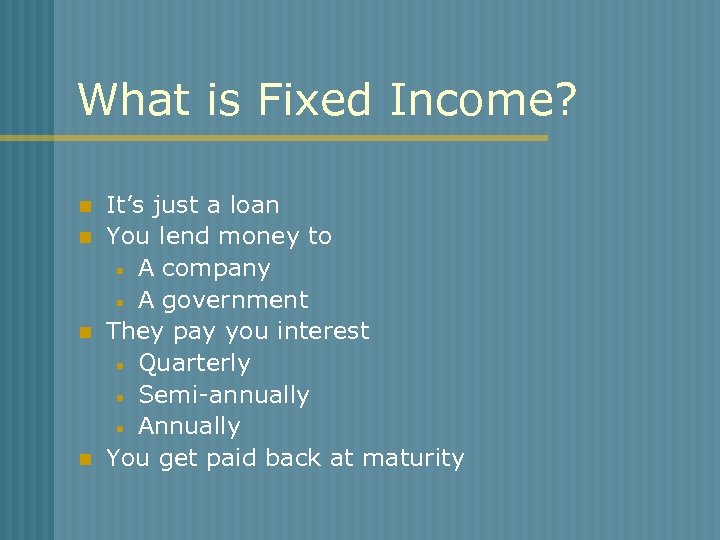
What is Fixed Income? n n It’s just a loan You lend money to • A company • A government They pay you interest • Quarterly • Semi-annually • Annually You get paid back at maturity
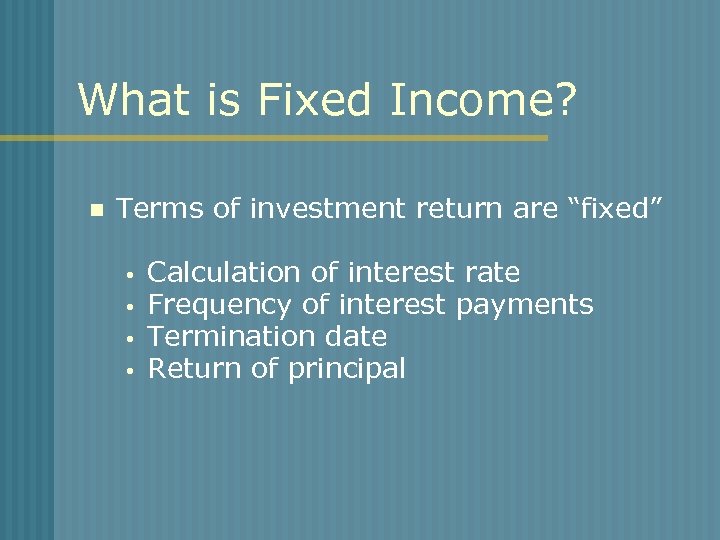
What is Fixed Income? n Terms of investment return are “fixed” Calculation of interest rate Frequency of interest payments Termination date Return of principal
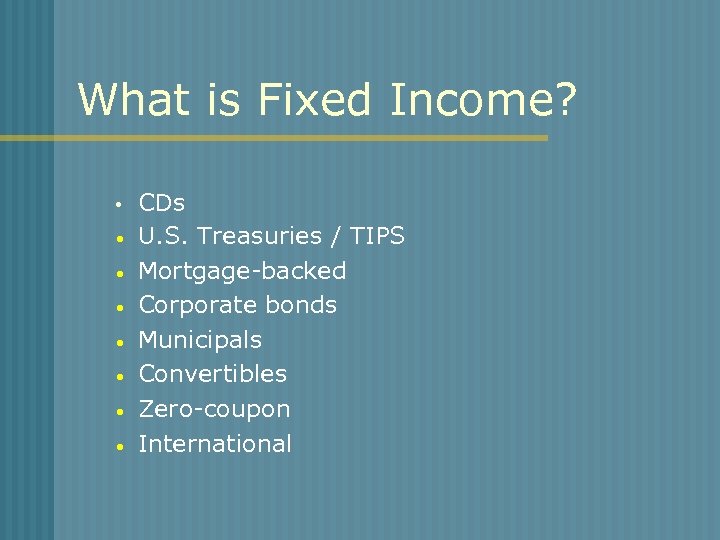
What is Fixed Income? • • CDs U. S. Treasuries / TIPS Mortgage-backed Corporate bonds Municipals Convertibles Zero-coupon International
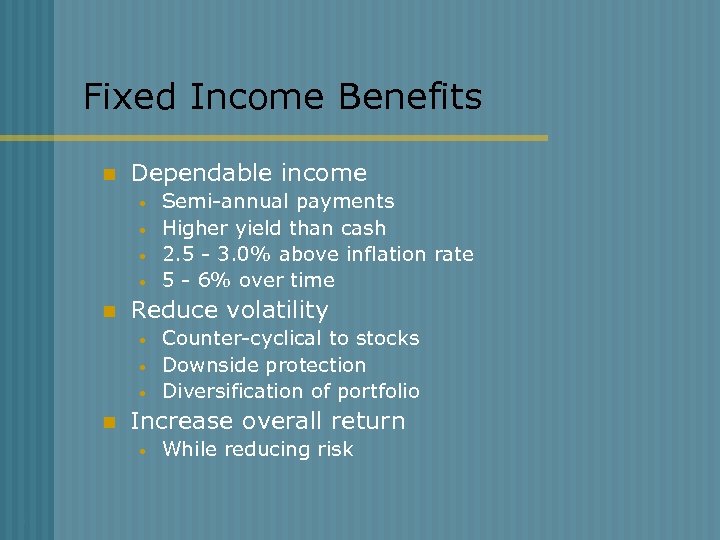
Fixed Income Benefits n Dependable income • • n Reduce volatility • • • n Counter-cyclical to stocks Downside protection Diversification of portfolio Increase overall return • 6 Semi-annual payments Higher yield than cash 2. 5 - 3. 0% above inflation rate 5 - 6% over time While reducing risk
Risks n Credit (default) risk n Interest rate risk (price volatility) n Re-investment risk n Inflation
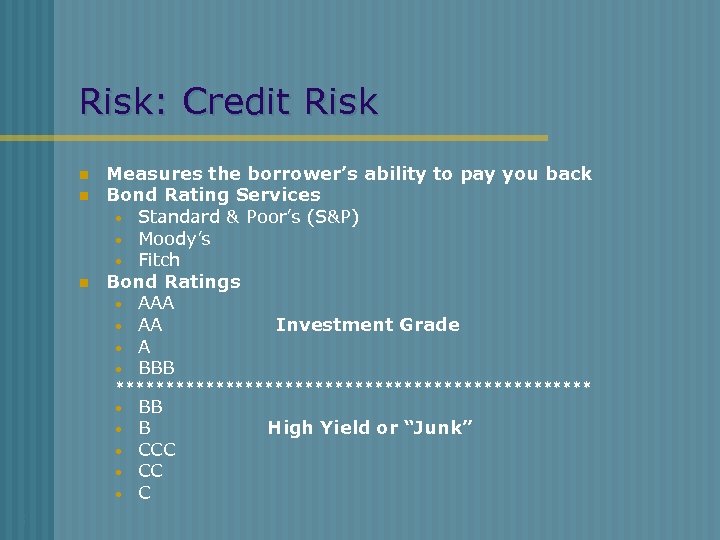
Risk: Credit Risk n n n Measures the borrower’s ability to pay you back Bond Rating Services • Standard & Poor’s (S&P) • Moody’s • Fitch Bond Ratings • AAA • AA Investment Grade • A • BBB ************************ • • • 8 BB B CCC CC C High Yield or “Junk”
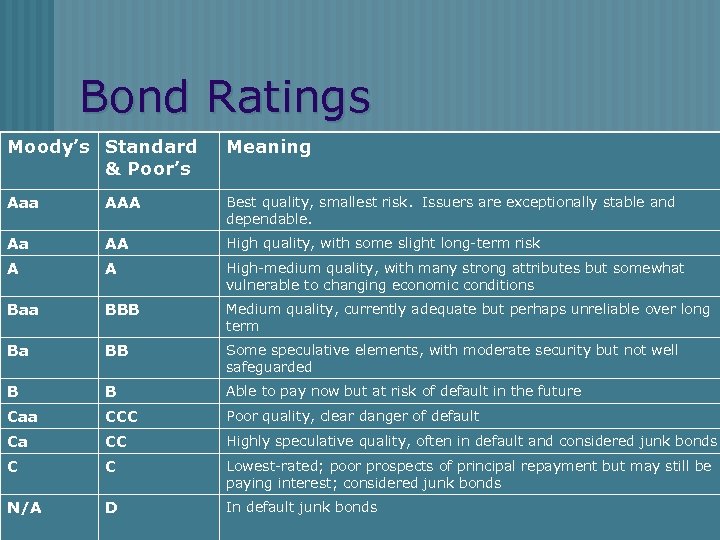
Bond Ratings Moody’s Standard & Poor’s Meaning Aaa AAA Best quality, smallest risk. Issuers are exceptionally stable and dependable. Aa AA High quality, with some slight long-term risk A A High-medium quality, with many strong attributes but somewhat vulnerable to changing economic conditions Baa BBB Medium quality, currently adequate but perhaps unreliable over long term Ba BB Some speculative elements, with moderate security but not well safeguarded B B Able to pay now but at risk of default in the future Caa CCC Poor quality, clear danger of default Ca CC Highly speculative quality, often in default and considered junk bonds C C Lowest-rated; poor prospects of principal repayment but may still be paying interest; considered junk bonds N/A D In default junk bonds 9
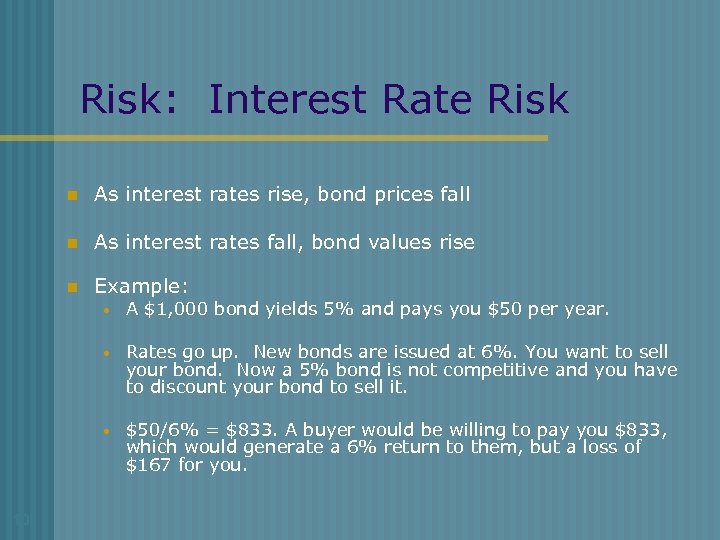
Risk: Interest Rate Risk n As interest rates rise, bond prices fall n As interest rates fall, bond values rise n Example: • • Rates go up. New bonds are issued at 6%. You want to sell your bond. Now a 5% bond is not competitive and you have to discount your bond to sell it. • 10 A $1, 000 bond yields 5% and pays you $50 per year. $50/6% = $833. A buyer would be willing to pay you $833, which would generate a 6% return to them, but a loss of $167 for you.
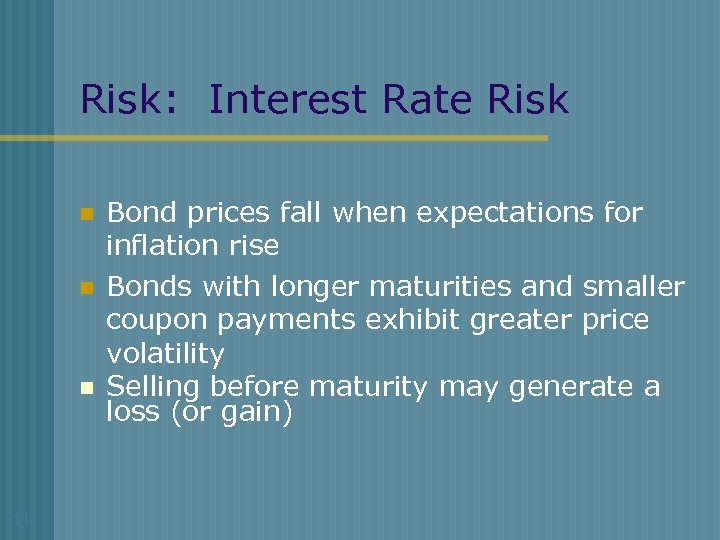
Risk: Interest Rate Risk n n n 11 Bond prices fall when expectations for inflation rise Bonds with longer maturities and smaller coupon payments exhibit greater price volatility Selling before maturity may generate a loss (or gain)
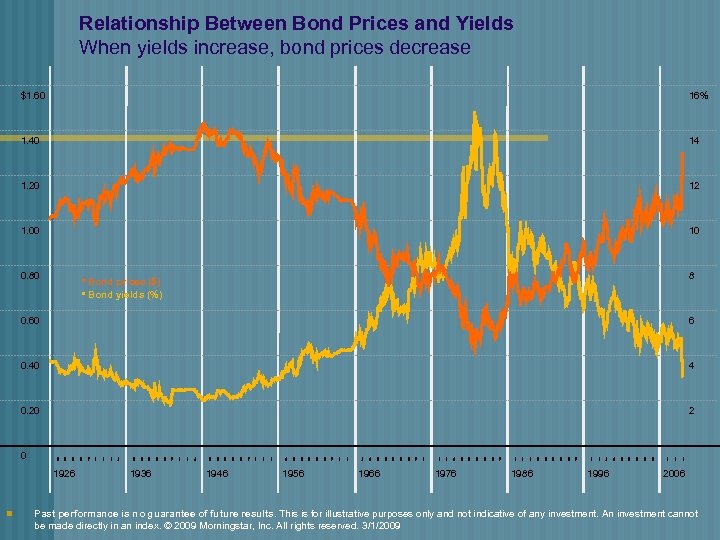
Relationship Between Bond Prices and Yields When yields increase, bond prices decrease $1. 60 16% 1. 40 14 1. 20 12 1. 00 10 0. 80 8 • Bond prices ($) • Bond yields (%) 0. 60 6 0. 40 4 0. 20 2 0 1926 n 1936 1946 1956 1966 1976 1986 1996 2006 Past performance is no guarantee of future results. This is for illustrative purposes only and not indicative of any investment. An investment cannot be made directly in an index. © 2009 Morningstar, Inc. All rights reserved. 3/1/2009
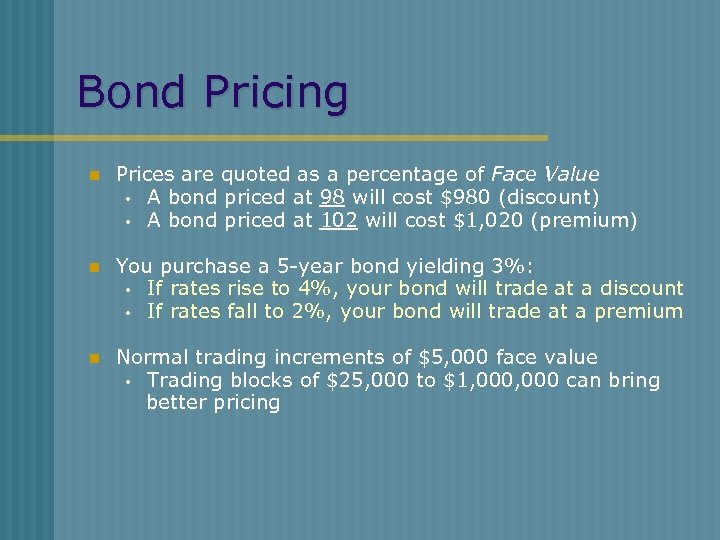
Bond Pricing n Prices are quoted as a percentage of Face Value A bond priced at 98 will cost $980 (discount) A bond priced at 102 will cost $1, 020 (premium) n You purchase a 5 -year bond yielding 3%: If rates rise to 4%, your bond will trade at a discount If rates fall to 2%, your bond will trade at a premium n Normal trading increments of $5, 000 face value Trading blocks of $25, 000 to $1, 000 can bring better pricing
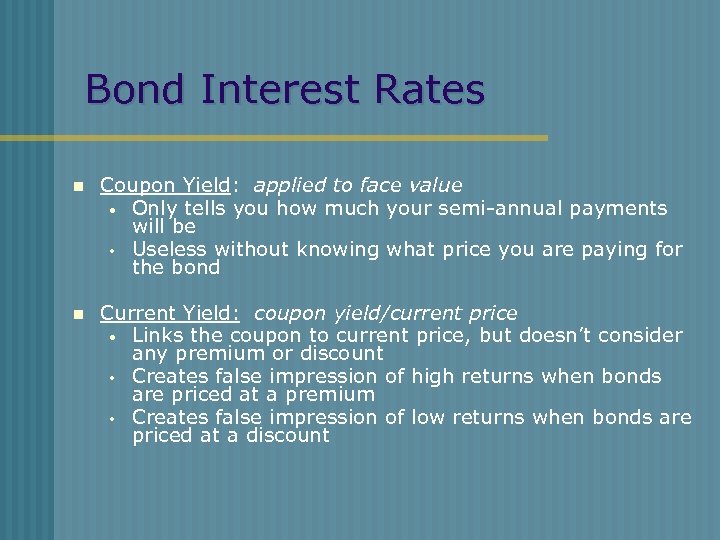
Bond Interest Rates n Coupon Yield: applied to face value • Only tells you how much your semi-annual payments will be Useless without knowing what price you are paying for the bond n Current Yield: coupon yield/current price • Links the coupon to current price, but doesn’t consider any premium or discount Creates false impression of high returns when bonds are priced at a premium Creates false impression of low returns when bonds are priced at a discount
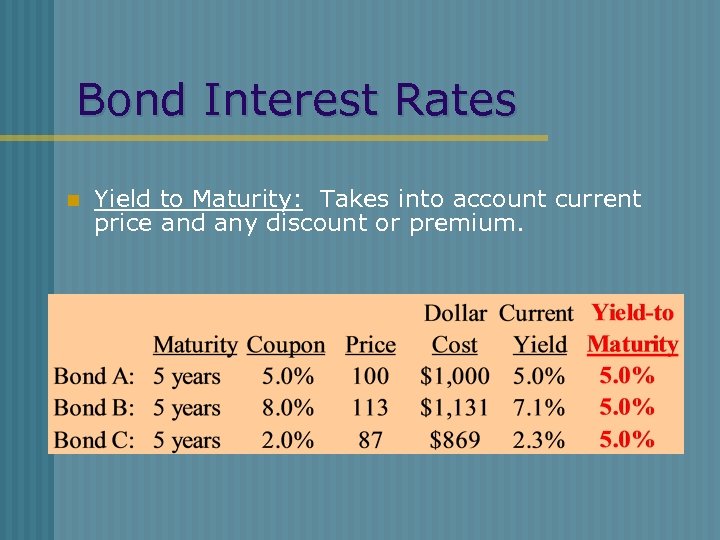
Bond Interest Rates n Yield to Maturity: Takes into account current price and any discount or premium.
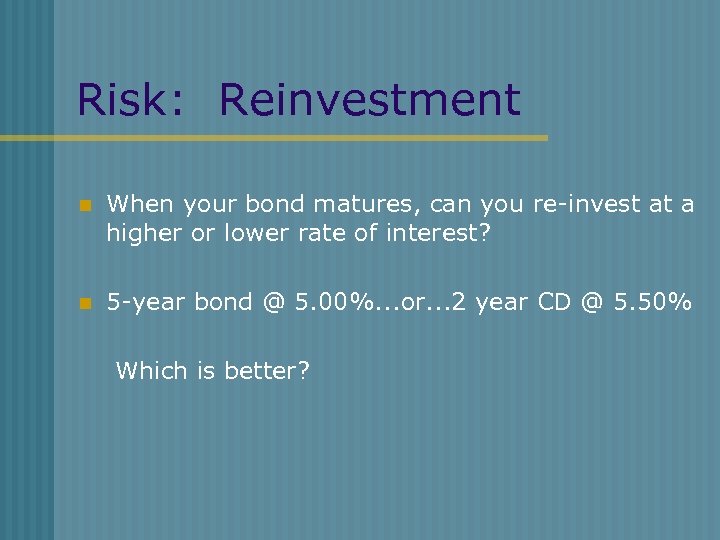
Risk: Reinvestment n When your bond matures, can you re-invest at a higher or lower rate of interest? n 5 -year bond @ 5. 00%. . . or. . . 2 year CD @ 5. 50% Which is better?
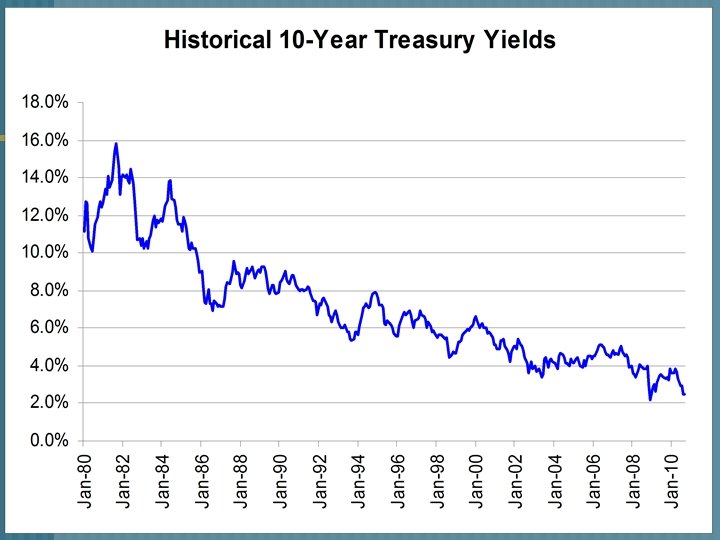
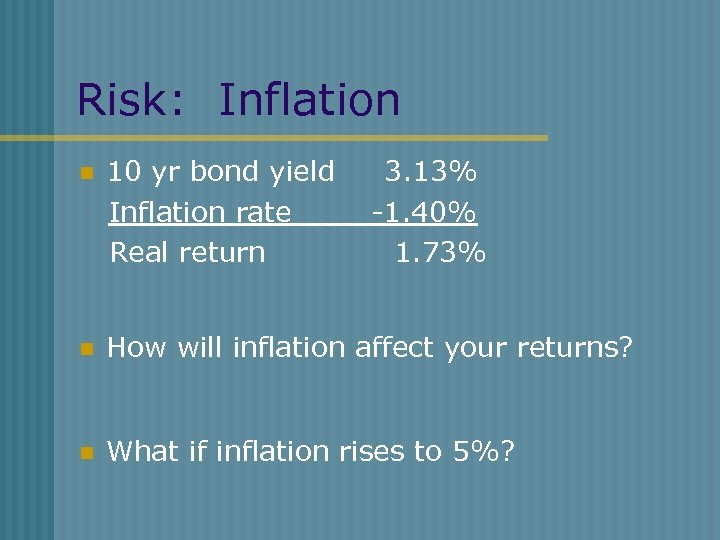
Risk: Inflation n 10 yr bond yield Inflation rate Real return 3. 13% -1. 40% 1. 73% n How will inflation affect your returns? n What if inflation rises to 5%?
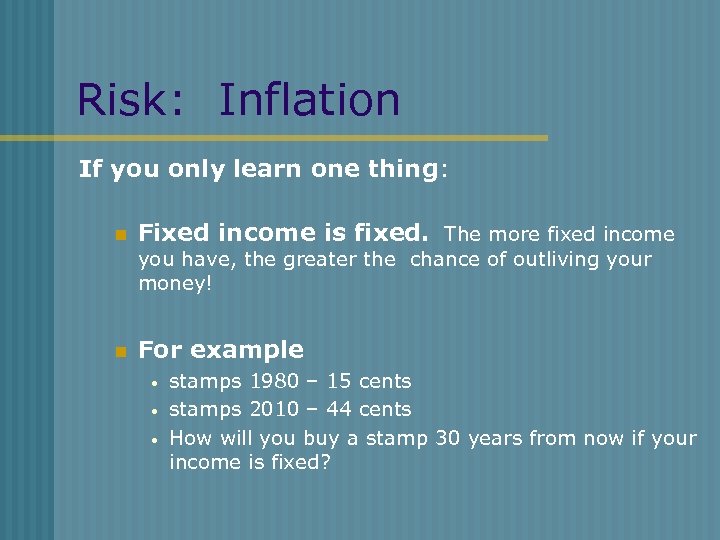
Risk: Inflation If you only learn one thing: n Fixed income is fixed. The more fixed income you have, the greater the chance of outliving your money! n For example • • • stamps 1980 – 15 cents stamps 2010 – 44 cents How will you buy a stamp 30 years from now if your income is fixed?
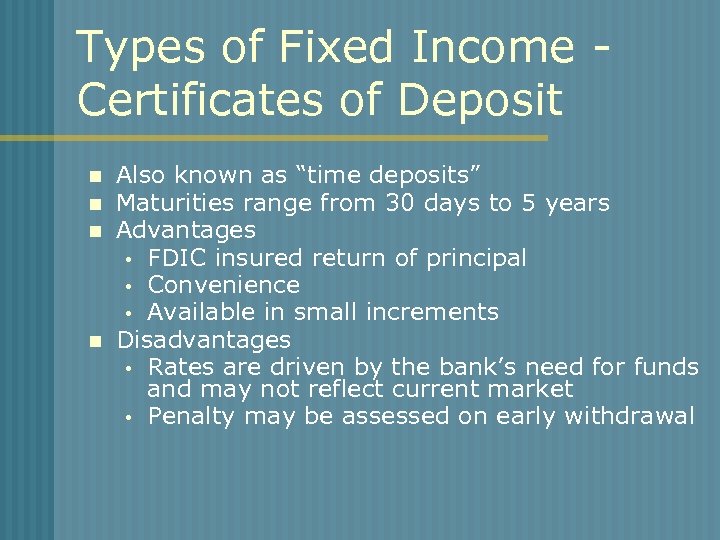
Types of Fixed Income Certificates of Deposit n n Also known as “time deposits” Maturities range from 30 days to 5 years Advantages FDIC insured return of principal Convenience Available in small increments Disadvantages Rates are driven by the bank’s need for funds and may not reflect current market Penalty may be assessed on early withdrawal
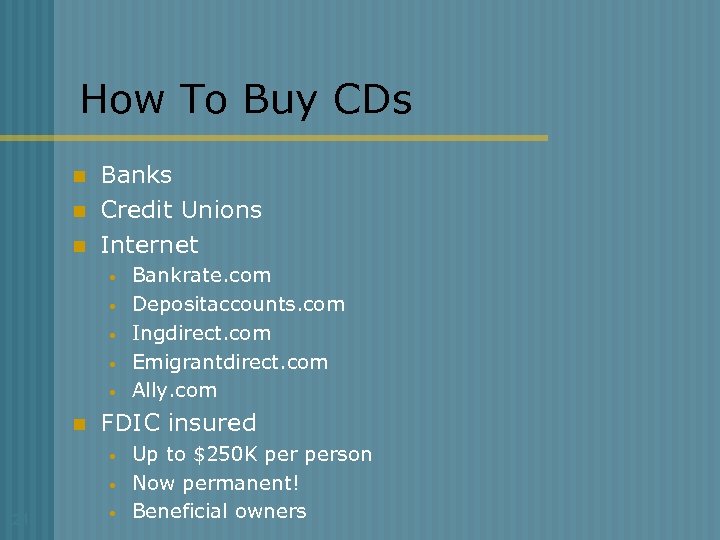
How To Buy CDs n n n Banks Credit Unions Internet • • • n FDIC insured • • 21 Bankrate. com Depositaccounts. com Ingdirect. com Emigrantdirect. com Ally. com • Up to $250 K person Now permanent! Beneficial owners
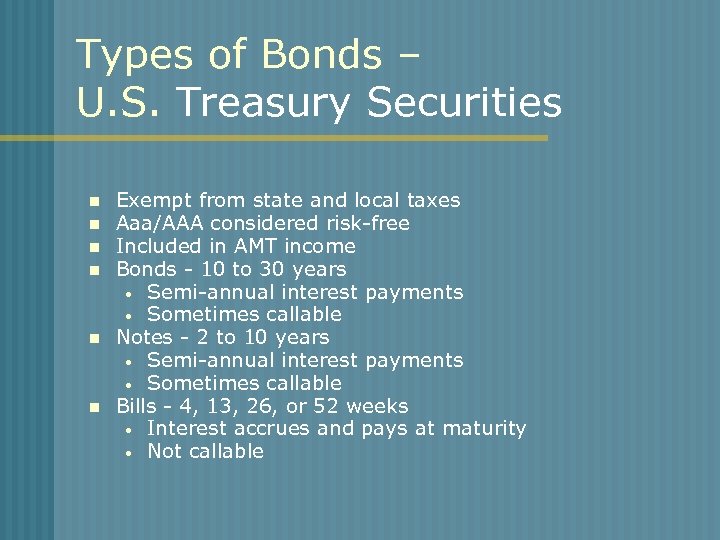
Types of Bonds – U. S. Treasury Securities n n n Exempt from state and local taxes Aaa/AAA considered risk-free Included in AMT income Bonds - 10 to 30 years • Semi-annual interest payments • Sometimes callable Notes - 2 to 10 years • Semi-annual interest payments • Sometimes callable Bills - 4, 13, 26, or 52 weeks • Interest accrues and pays at maturity • Not callable
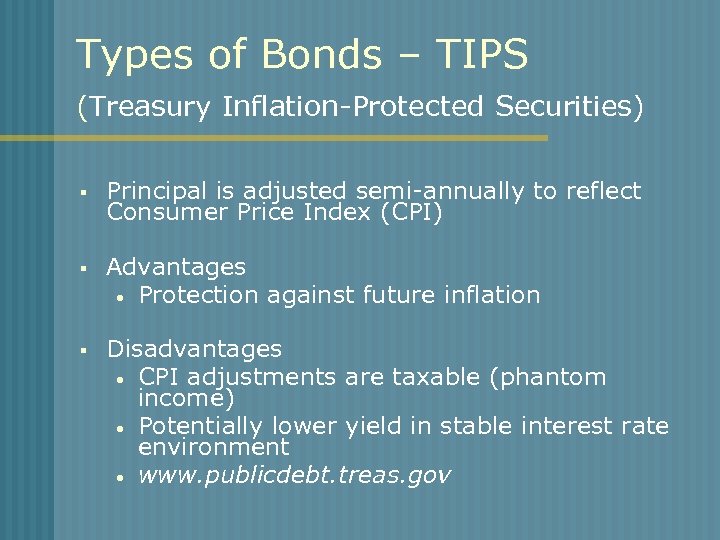
Types of Bonds – TIPS (Treasury Inflation-Protected Securities) § Principal is adjusted semi-annually to reflect Consumer Price Index (CPI) § Advantages • Protection against future inflation § Disadvantages • CPI adjustments are taxable (phantom income) • Potentially lower yield in stable interest rate environment • www. publicdebt. treas. gov
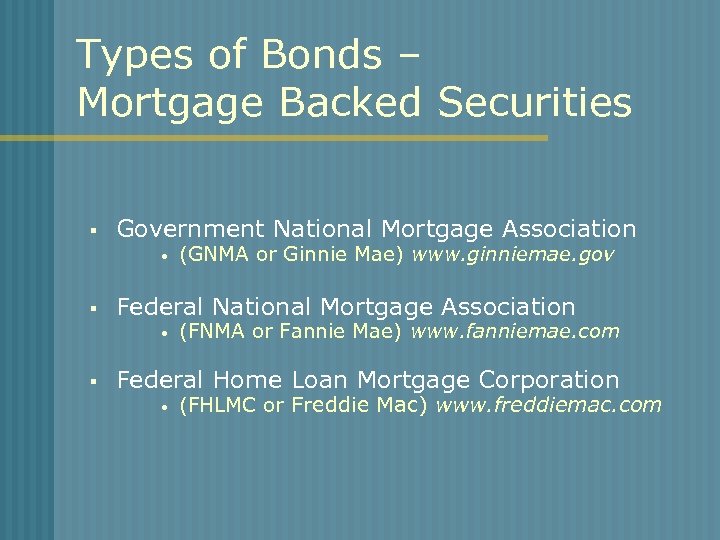
Types of Bonds – Mortgage Backed Securities § Government National Mortgage Association • § Federal National Mortgage Association • § (GNMA or Ginnie Mae) www. ginniemae. gov (FNMA or Fannie Mae) www. fanniemae. com Federal Home Loan Mortgage Corporation • (FHLMC or Freddie Mac) www. freddiemac. com
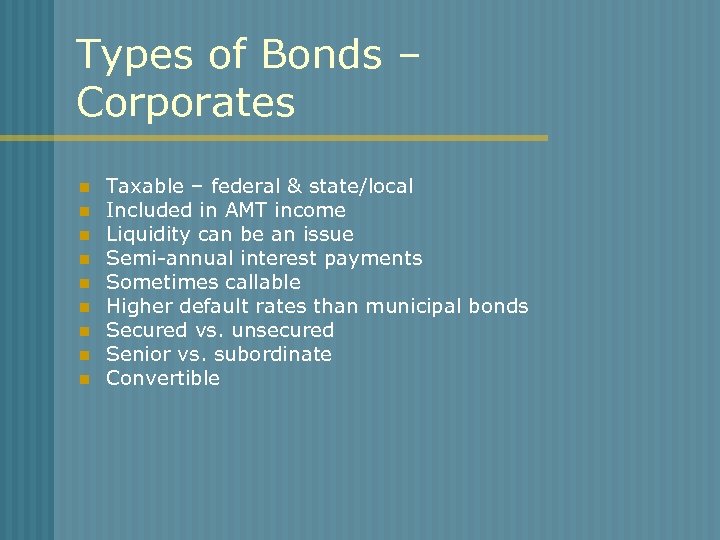
Types of Bonds – Corporates n n n n n Taxable – federal & state/local Included in AMT income Liquidity can be an issue Semi-annual interest payments Sometimes callable Higher default rates than municipal bonds Secured vs. unsecured Senior vs. subordinate Convertible
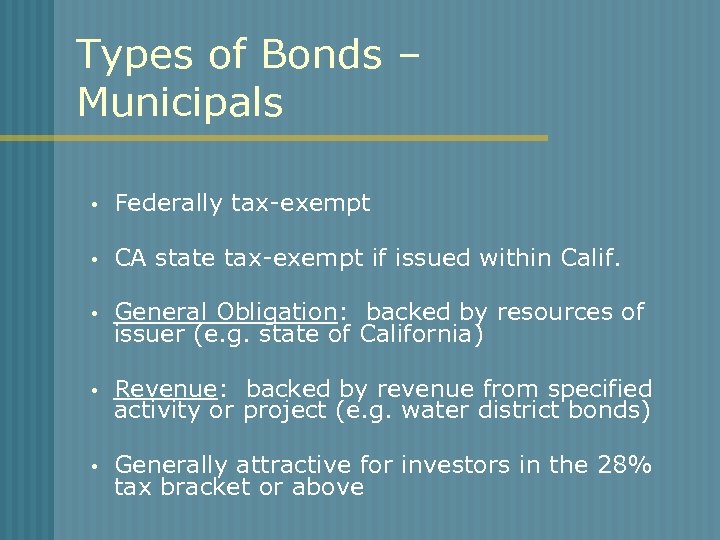
Types of Bonds – Municipals Federally tax-exempt CA state tax-exempt if issued within Calif. General Obligation: backed by resources of issuer (e. g. state of California) Revenue: backed by revenue from specified activity or project (e. g. water district bonds) Generally attractive for investors in the 28% tax bracket or above
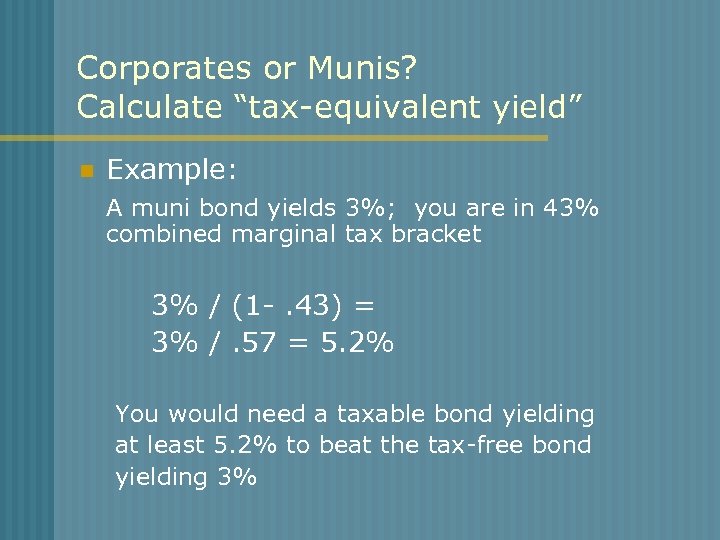
Corporates or Munis? Calculate “tax-equivalent yield” n Example: A muni bond yields 3%; you are in 43% combined marginal tax bracket 3% / (1 -. 43) = 3% /. 57 = 5. 2% You would need a taxable bond yielding at least 5. 2% to beat the tax-free bond yielding 3%
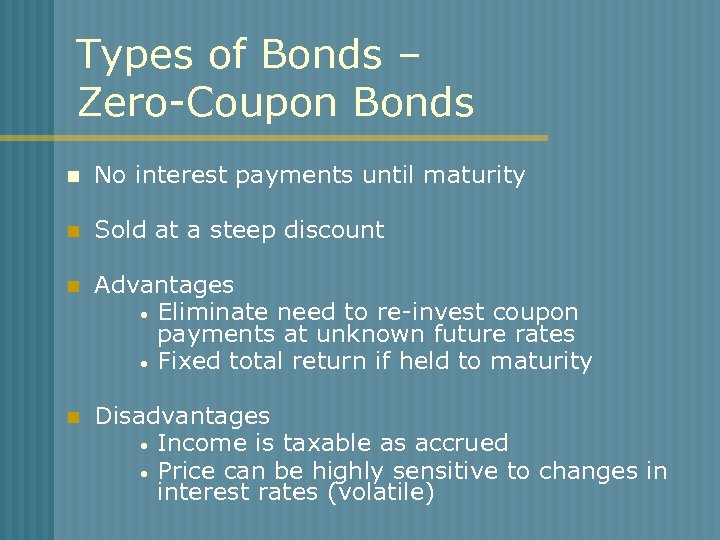
Types of Bonds – Zero-Coupon Bonds n No interest payments until maturity n Sold at a steep discount n Advantages • Eliminate need to re-invest coupon payments at unknown future rates • Fixed total return if held to maturity n Disadvantages • Income is taxable as accrued • Price can be highly sensitive to changes in interest rates (volatile)
Types of Bonds – Convertibles n A corporate bond than can be converted to shares of common stock n Advantages Upside potential of common stock Downside protection of bond n Disadvantages Lower returns if markets remain stable Supply and pricing issues
Types of Bonds – International n n Corporate Government Emerging markets Advantages n Diversification Non-correlation Disadvantages Currency risk Political risk Cost
Buying and Selling Bonds n No Central Exchange Bonds are generally bought and sold through brokerage firms Different brokerage firms may offer different price quotes for the same bond A brokerage firm’s desire to buy or sell a bond varies with the firm’s current inventory of bonds Recognizing a ‘fair price’ requires market knowledge -- quotes can vary significantly from broker to broker
Buying and Selling Bonds n No transparency (no commissions? ) Brokerage firms buy and sell from their own inventory --they own the bonds Bid: Price a broker will offer to buy a bond Ask: Price a broker will demand to sell the same bond Bid/Ask Spread: Difference between what brokerage firm paid for the bond and what firm sells the bond to you for You don’t know the bid/ask spread
Individual Bonds vs. Mutual Funds Pros and cons n Depends on n • • • Platform and access Size of portfolio Interim liquidity needs
Individual Bonds n n 34 Hold to term • Pay $1000 - earn interest – get $1000 back • Don’t worry about interim changes in value Ladder them – staggered maturities • Short-term: < 2 years • Intermediate-term: 2 -10 years • Long-term: 10 -100 years! Recommend don’t buy!! n Reduces • Credit risk • Interest rate risk • Re-investment risk • Inflation risk
Individual Bonds n Disadvantages • • • 35 Hard to get diversification – how many can you own? Shorter maturities result in lower returns Expensive to buy/expensive to sell (unless you buy when issued and hold to maturity) Research is intensive for little incremental return You don’t get the benefit of professional management
Mutual Funds n Advantages Diversification Professional Management Liquidity -- easy to buy and sell Convenience; stable distributions n Disadvantages Fees (general range: 0. 5% to 1. 5%) Less direct control over investments No fixed yield or maturity date
Bond Mutual Funds n n Type of Bonds Issuer • • n Duration (or maturity) • • • 37 Governments Agencies Corporates Municipals Short-term Intermediate-term Long-term
Selecting a Bond Fund n Current Yield is not a good criterion n Last year’s performance is not a good criterion n Watch fees! Low fee funds are the best long-term performers n Read the Prospectus
Selecting a Bond Fund n What are the fund’s guidelines for: Credit limits. What is the lowest rating the fund can hold? What is the average credit rating? Leverage. Can the fund borrow additional money to make investments? Borrowing additional funds is a more aggressive strategy. n Average Maturity. Also measured in terms of “Duration”. Longer maturities imply greater price volatility. Derivatives. Can the fund use derivatives? If so, for what purpose? Do management fees and “loads” appear reasonable?
Fixed Income Basics Thank you for coming. Happy investing!
Скачать презентацию Fixed Income Basics October 18 2010 Laura Tarbox
e8c64e4b363931166eb9b8fd060beb9f.ppt