


 Скачать презентацию Fishing The environmental impact of fishing can
Милаенко Ксюша.ppt
- Количество слайдов: 13

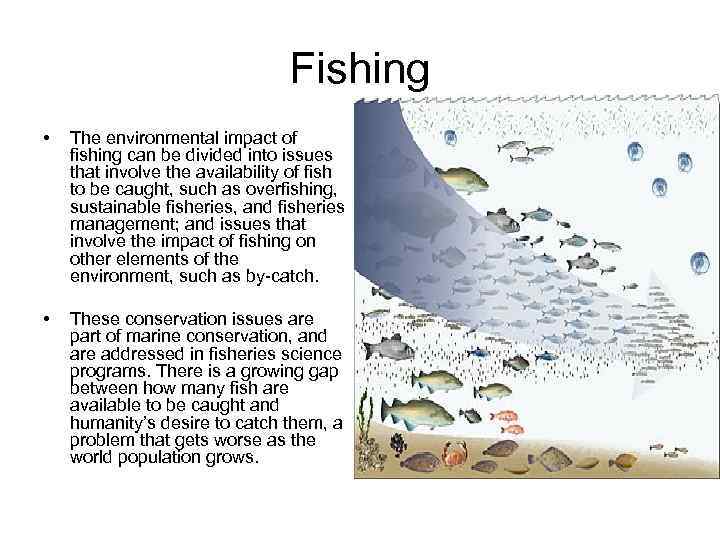 Fishing • The environmental impact of fishing can be divided into issues that involve the availability of fish to be caught, such as overfishing, sustainable fisheries, and fisheries management; and issues that involve the impact of fishing on other elements of the environment, such as by-catch. • These conservation issues are part of marine conservation, and are addressed in fisheries science programs. There is a growing gap between how many fish are available to be caught and humanity’s desire to catch them, a problem that gets worse as the world population grows.
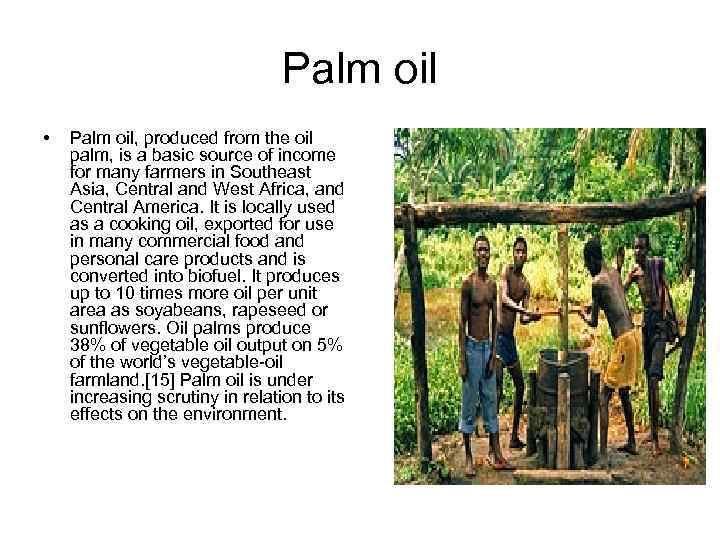 Palm oil • Palm oil, produced from the oil palm, is a basic source of income for many farmers in Southeast Asia, Central and West Africa, and Central America. It is locally used as a cooking oil, exported for use in many commercial food and personal care products and is converted into biofuel. It produces up to 10 times more oil per unit area as soyabeans, rapeseed or sunflowers. Oil palms produce 38% of vegetable oil output on 5% of the world’s vegetable-oil farmland. [15] Palm oil is under increasing scrutiny in relation to its effects on the environment.
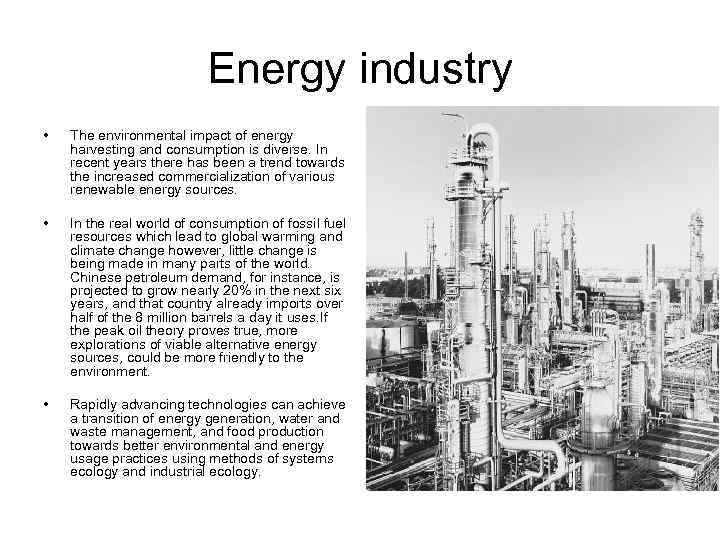 Energy industry • The environmental impact of energy harvesting and consumption is diverse. In recent years there has been a trend towards the increased commercialization of various renewable energy sources. • In the real world of consumption of fossil fuel resources which lead to global warming and climate change however, little change is being made in many parts of the world. Chinese petroleum demand, for instance, is projected to grow nearly 20% in the next six years, and that country already imports over half of the 8 million barrels a day it uses. If the peak oil theory proves true, more explorations of viable alternative energy sources, could be more friendly to the environment. • Rapidly advancing technologies can achieve a transition of energy generation, water and waste management, and food production towards better environmental and energy usage practices using methods of systems ecology and industrial ecology.
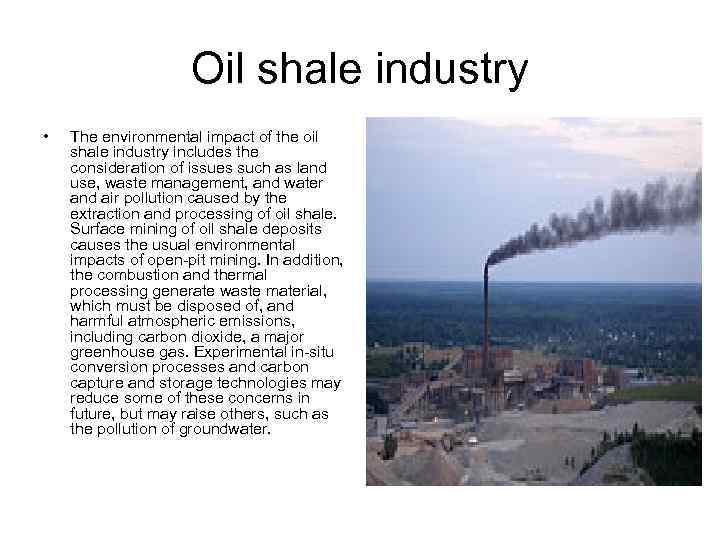 Oil shale industry • The environmental impact of the oil shale industry includes the consideration of issues such as land use, waste management, and water and air pollution caused by the extraction and processing of oil shale. Surface mining of oil shale deposits causes the usual environmental impacts of open-pit mining. In addition, the combustion and thermal processing generate waste material, which must be disposed of, and harmful atmospheric emissions, including carbon dioxide, a major greenhouse gas. Experimental in-situ conversion processes and carbon capture and storage technologies may reduce some of these concerns in future, but may raise others, such as the pollution of groundwater.
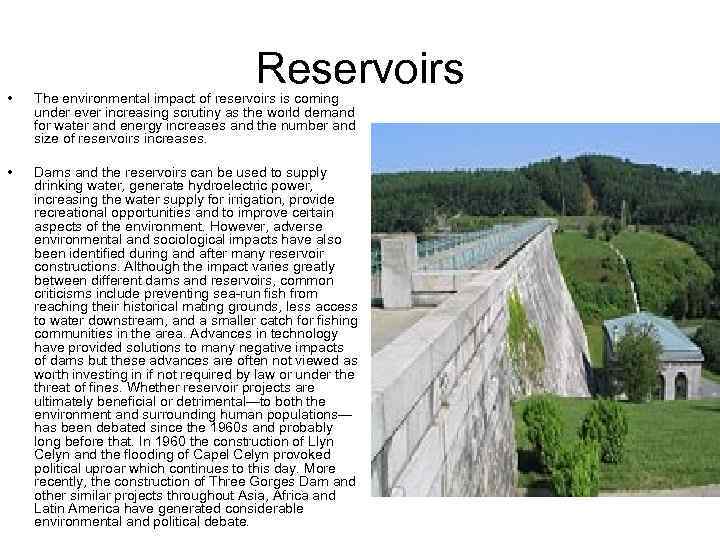 Reservoirs • The environmental impact of reservoirs is coming under ever increasing scrutiny as the world demand for water and energy increases and the number and size of reservoirs increases. • Dams and the reservoirs can be used to supply drinking water, generate hydroelectric power, increasing the water supply for irrigation, provide recreational opportunities and to improve certain aspects of the environment. However, adverse environmental and sociological impacts have also been identified during and after many reservoir constructions. Although the impact varies greatly between different dams and reservoirs, common criticisms include preventing sea-run fish from reaching their historical mating grounds, less access to water downstream, and a smaller catch for fishing communities in the area. Advances in technology have provided solutions to many negative impacts of dams but these advances are often not viewed as worth investing in if not required by law or under the threat of fines. Whether reservoir projects are ultimately beneficial or detrimental—to both the environment and surrounding human populations— has been debated since the 1960 s and probably long before that. In 1960 the construction of Llyn Celyn and the flooding of Capel Celyn provoked political uproar which continues to this day. More recently, the construction of Three Gorges Dam and other similar projects throughout Asia, Africa and Latin America have generated considerable environmental and political debate.
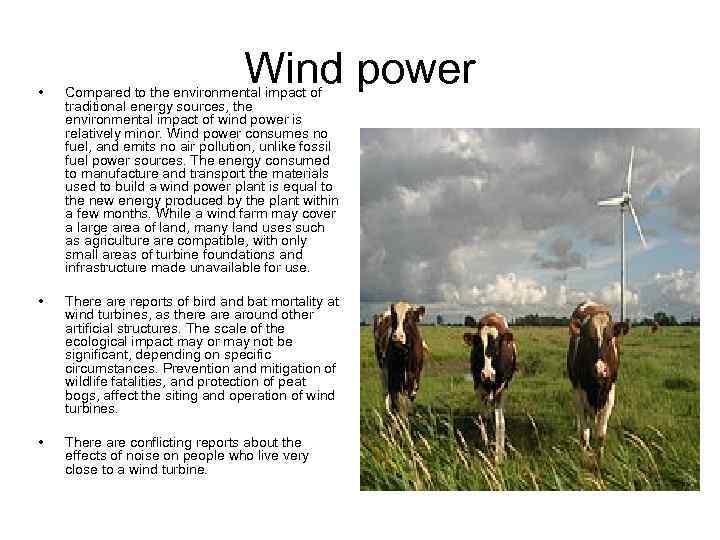 Wind power • Compared to the environmental impact of traditional energy sources, the environmental impact of wind power is relatively minor. Wind power consumes no fuel, and emits no air pollution, unlike fossil fuel power sources. The energy consumed to manufacture and transport the materials used to build a wind power plant is equal to the new energy produced by the plant within a few months. While a wind farm may cover a large area of land, many land uses such as agriculture are compatible, with only small areas of turbine foundations and infrastructure made unavailable for use. • There are reports of bird and bat mortality at wind turbines, as there around other artificial structures. The scale of the ecological impact may or may not be significant, depending on specific circumstances. Prevention and mitigation of wildlife fatalities, and protection of peat bogs, affect the siting and operation of wind turbines. • There are conflicting reports about the effects of noise on people who live very close to a wind turbine.
 Nanotechnology • Nanotechnology's environmental impact can be split into two aspects: the potential for nanotechnological innovations to help improve the environment, and the possibly novel type of pollution that nanotechnological materials might cause if released into the environment. As nanotechnology is an emerging field, there is great debate regarding to what extent industrial and commercial use of nanomaterials will affect organisms and ecosystems.
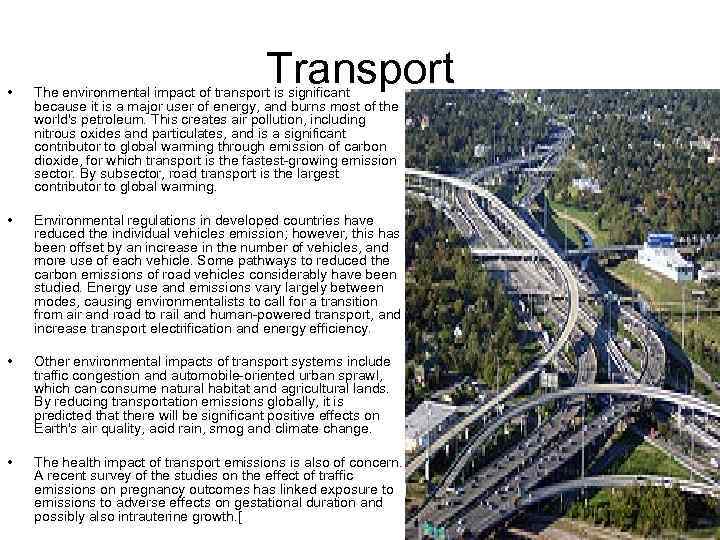 Transport • The environmental impact of transport is significant because it is a major user of energy, and burns most of the world's petroleum. This creates air pollution, including nitrous oxides and particulates, and is a significant contributor to global warming through emission of carbon dioxide, for which transport is the fastest-growing emission sector. By subsector, road transport is the largest contributor to global warming. • Environmental regulations in developed countries have reduced the individual vehicles emission; however, this has been offset by an increase in the number of vehicles, and more use of each vehicle. Some pathways to reduced the carbon emissions of road vehicles considerably have been studied. Energy use and emissions vary largely between modes, causing environmentalists to call for a transition from air and road to rail and human-powered transport, and increase transport electrification and energy efficiency. • Other environmental impacts of transport systems include traffic congestion and automobile-oriented urban sprawl, which can consume natural habitat and agricultural lands. By reducing transportation emissions globally, it is predicted that there will be significant positive effects on Earth's air quality, acid rain, smog and climate change. • The health impact of transport emissions is also of concern. A recent survey of the studies on the effect of traffic emissions on pregnancy outcomes has linked exposure to emissions to adverse effects on gestational duration and possibly also intrauterine growth. [
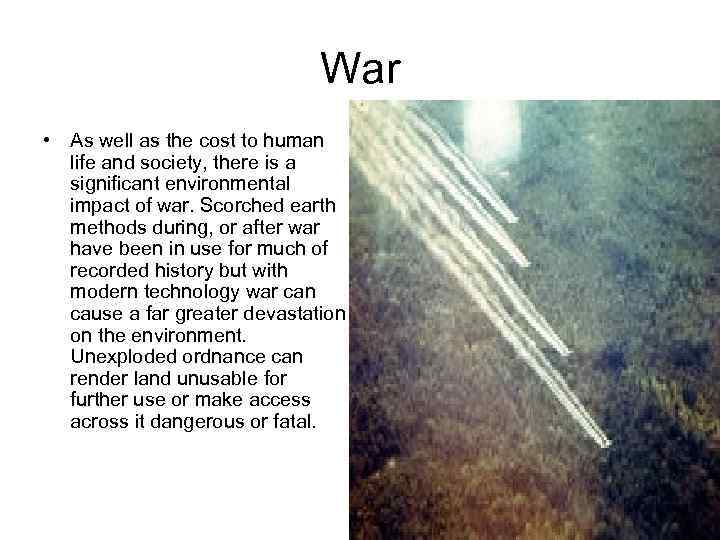 War • As well as the cost to human life and society, there is a significant environmental impact of war. Scorched earth methods during, or after war have been in use for much of recorded history but with modern technology war can cause a far greater devastation on the environment. Unexploded ordnance can render land unusable for further use or make access across it dangerous or fatal.
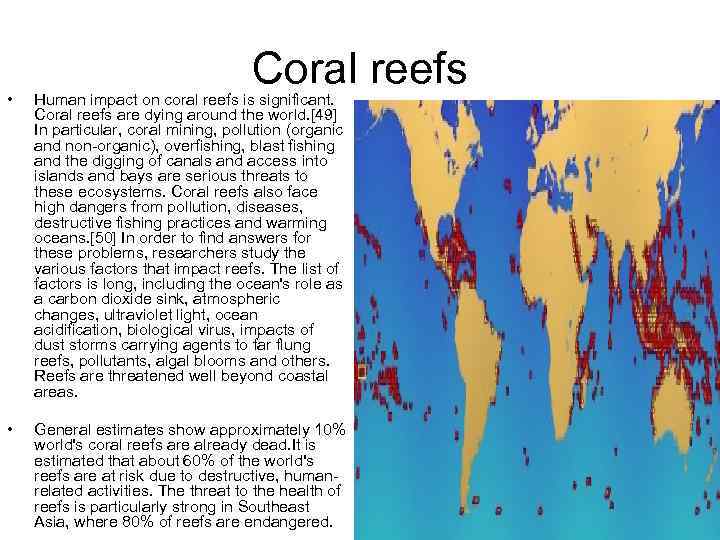 Coral reefs • Human impact on coral reefs is significant. Coral reefs are dying around the world. [49] In particular, coral mining, pollution (organic and non-organic), overfishing, blast fishing and the digging of canals and access into islands and bays are serious threats to these ecosystems. Coral reefs also face high dangers from pollution, diseases, destructive fishing practices and warming oceans. [50] In order to find answers for these problems, researchers study the various factors that impact reefs. The list of factors is long, including the ocean's role as a carbon dioxide sink, atmospheric changes, ultraviolet light, ocean acidification, biological virus, impacts of dust storms carrying agents to far flung reefs, pollutants, algal blooms and others. Reefs are threatened well beyond coastal areas. • General estimates show approximately 10% world's coral reefs are already dead. It is estimated that about 60% of the world's reefs are at risk due to destructive, humanrelated activities. The threat to the health of reefs is particularly strong in Southeast Asia, where 80% of reefs are endangered.
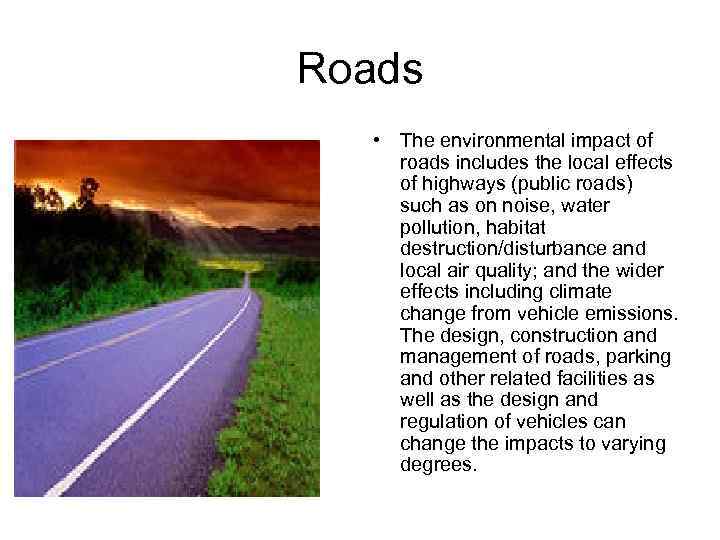 Roads • The environmental impact of roads includes the local effects of highways (public roads) such as on noise, water pollution, habitat destruction/disturbance and local air quality; and the wider effects including climate change from vehicle emissions. The design, construction and management of roads, parking and other related facilities as well as the design and regulation of vehicles can change the impacts to varying degrees.
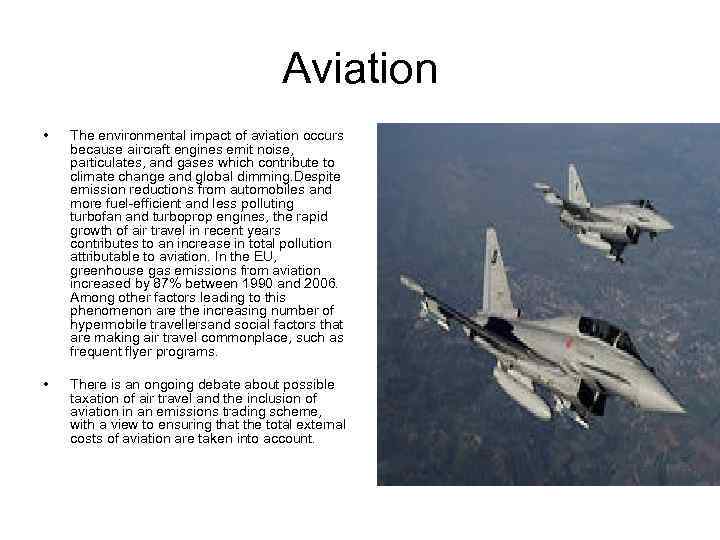 Aviation • The environmental impact of aviation occurs because aircraft engines emit noise, particulates, and gases which contribute to climate change and global dimming. Despite emission reductions from automobiles and more fuel-efficient and less polluting turbofan and turboprop engines, the rapid growth of air travel in recent years contributes to an increase in total pollution attributable to aviation. In the EU, greenhouse gas emissions from aviation increased by 87% between 1990 and 2006. Among other factors leading to this phenomenon are the increasing number of hypermobile travellersand social factors that are making air travel commonplace, such as frequent flyer programs. • There is an ongoing debate about possible taxation of air travel and the inclusion of aviation in an emissions trading scheme, with a view to ensuring that the total external costs of aviation are taken into account.