


 Скачать презентацию Fish Animal Science Level 1 Know ØTypes
ffb4899adcfc1e65d5461157dfb468b4.ppt
- Количество слайдов: 99
 Fish! Animal Science Level 1
 Know ØTypes of KNOW UNDERSTAND DO! Fish ØBasic Fish Anatomy and Care ØBasic Fish Diseases o o o Understand Classification Requirements Differences in care requirements Fish disease prevention Do Identify types of fish ID Basic Anatomical features required for fish survival Explore signs and symptoms of common fish diseases
 Key Learning: Fish Ø Unit EQ: Why do fish make good beginner pets? ? Concept : Types Lesson EQ: How are fish classified? Vocab Saltwater, Freshwater, Salinity Concept : Care Lesson EQ: What is a requirement for all fish care? Vocab Nitrogen Cycle, Ich, Dissolved Oxygen Concept : Anatomy Lesson EQ: How are fish adapted for swimming? ? Vocab Air Bladder, Gills, Fins
 Animals around us: Fish
 THINK WRITE SHARE: EXTENSION QUESTION ØTHINK l How are fish defined? Are their exceptions? (like in mammals) ØWRITE l 3 -5 Sentences Giving Examples ØSHARE l With you face partner
 Fish! Common Types Animal Science Level 1
 Objectives Ø Define Fish Ø Identify common fish sold in the animal science industry Ø Analyze common characteristics of fish
 Lit Frayer Model I think it means…. Because of… (clues) Fish we typically find in the pet store are from the group osteichthyes, which includes fish like goldfish and catfish but not sharks. It is actually defined as… Ways to help me remember this/Examples are
 Osteichthyes Defined Ø also called bony fish, are a taxonomic group of fish that have bony, as opposed to cartilaginous, skeletons. Ø The majority of fish species (including those kept as pets
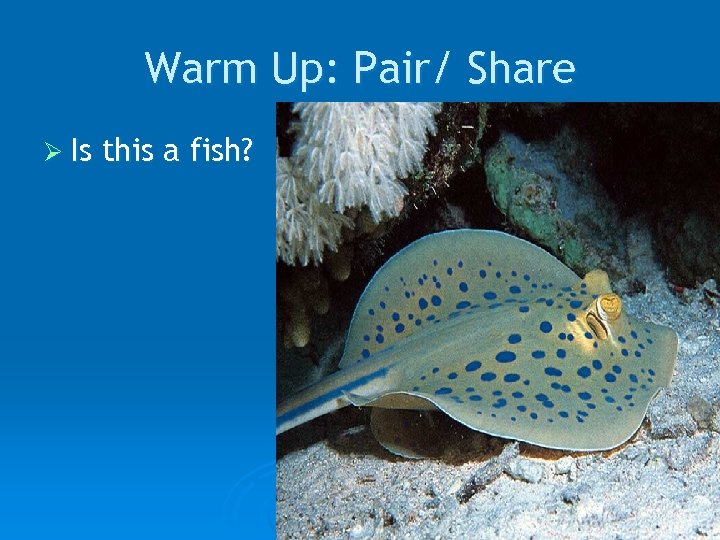 Warm Up: Pair/ Share Ø Is this a fish?
 Essential Question Ø How are fish classified?
 What is a fish? Ø Define: l Any of numerous cold-blooded aquatic vertebrates of the subclass Pisces, characteristically having fins, gills, and a streamlined body and including specifically:
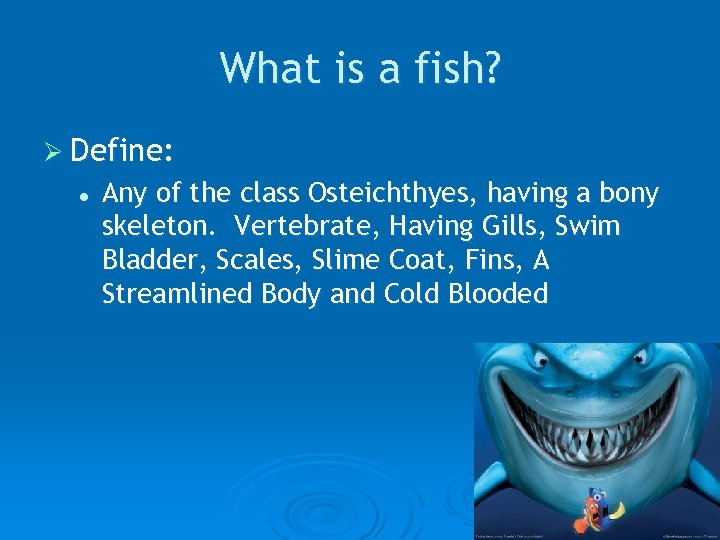 What is a fish? Ø Define: l Any of the class Osteichthyes, having a bony skeleton. Vertebrate, Having Gills, Swim Bladder, Scales, Slime Coat, Fins, A Streamlined Body and Cold Blooded
 Types of Fish Ø Freshwater: l fish that spend some or all of their lives in freshwater, such as rivers and lakes, with a salinity of less than 0. 05%
 Types of Fish Ø Salt l l water: Fish living in water containing from 3. 0 to 3. 5% total salts. Ocean type fish
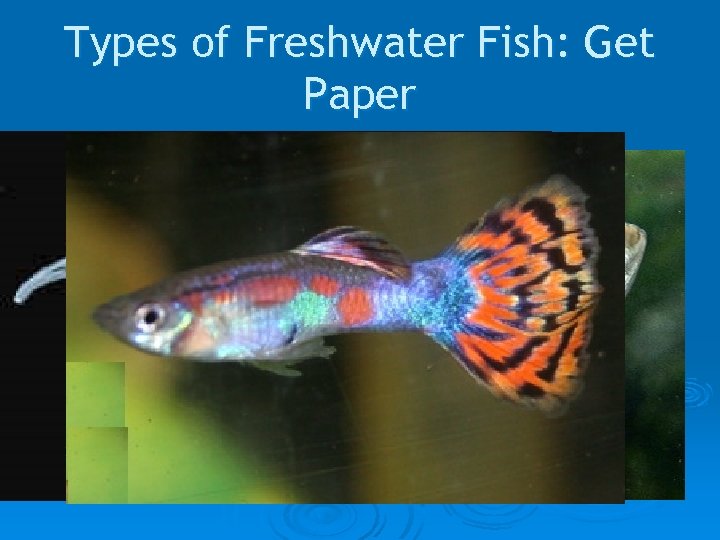
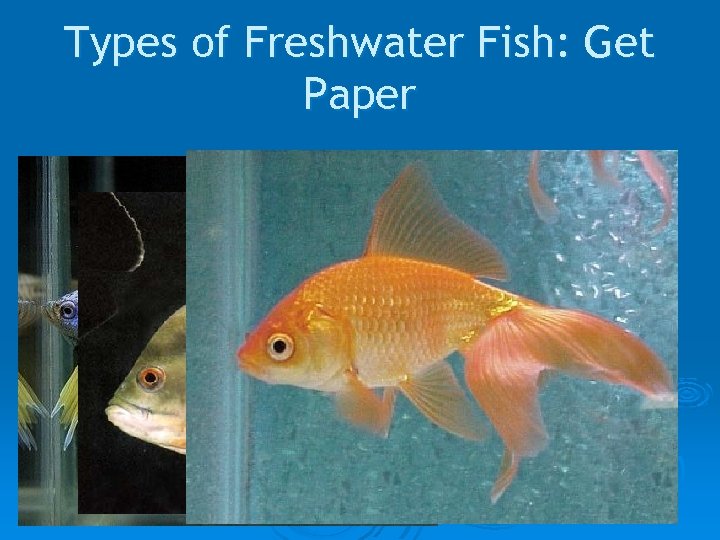
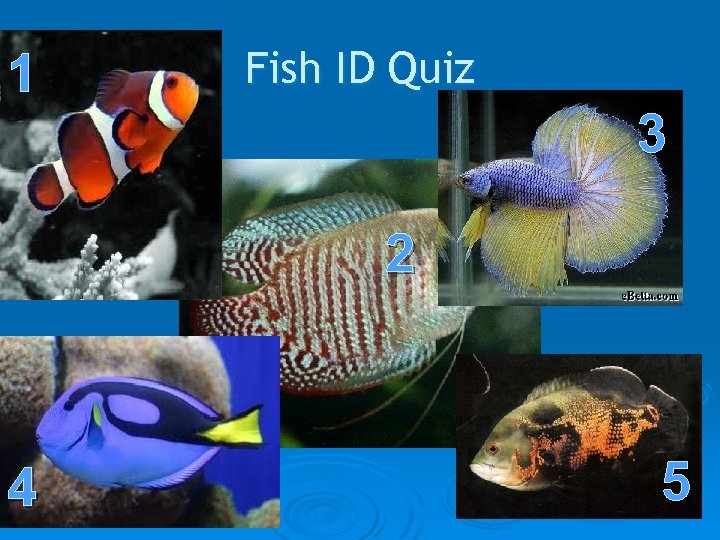
 Freshwater Ø Types: Livebearers, Guppies, Gouramis, Betta, Oscar, Cichlids, Goldfish (MUCH MORE!) Ø Diet: Omnivores
 Freshwater Ø Behavior l l to note for care: Certain fish occupy different levels in the tank Territorial
 Types of Freshwater Fish: Ø Liverbearers, and MORE! Guppies, Goldfish, Oscar
 Types of Freshwater Fish: Get Paper
 Types of Freshwater Fish: Get Paper
 Fresh Water Fish Types and Care Ø Each group has an article on a type of fish and care Ø Read your article complete 1 of your graphic organizers in your packet. Ø Then meet with 3 other students to complete 4 graphic organizers about 4 DIFFERENT kinds of fish
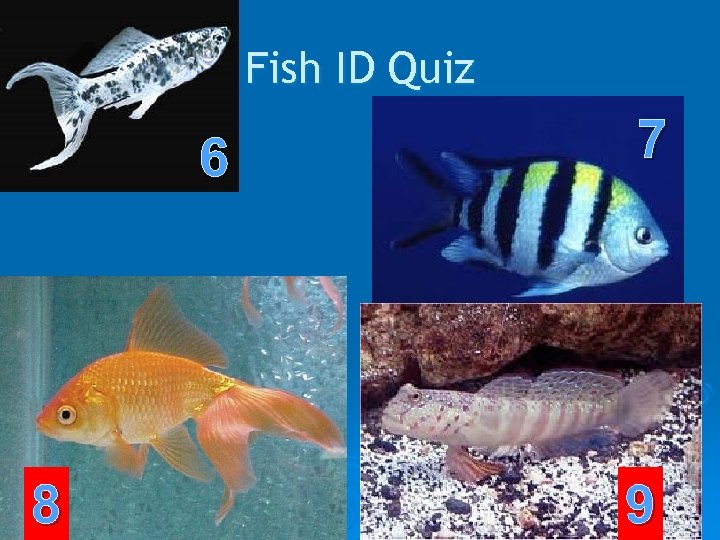
 Salt Water Ø Types: Damsels/Clownfish, Gobies, Tangs/Angels Ø Diet: Omnivores Ø Behavior: Territorial (most types)
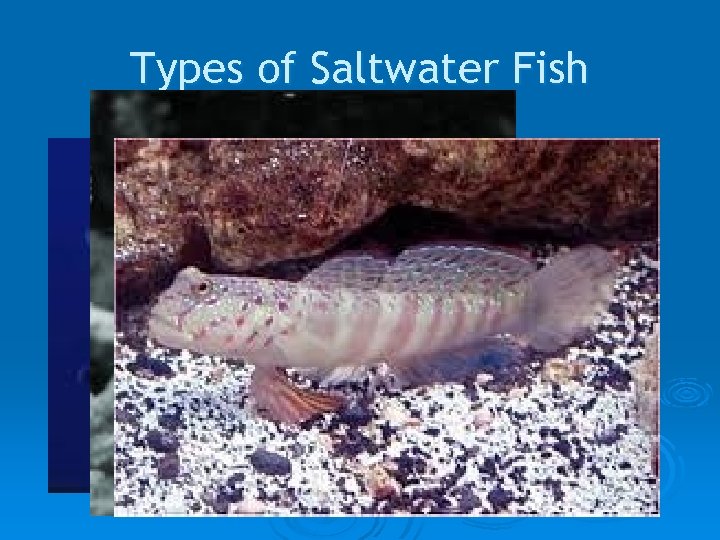 Types of Saltwater Fish
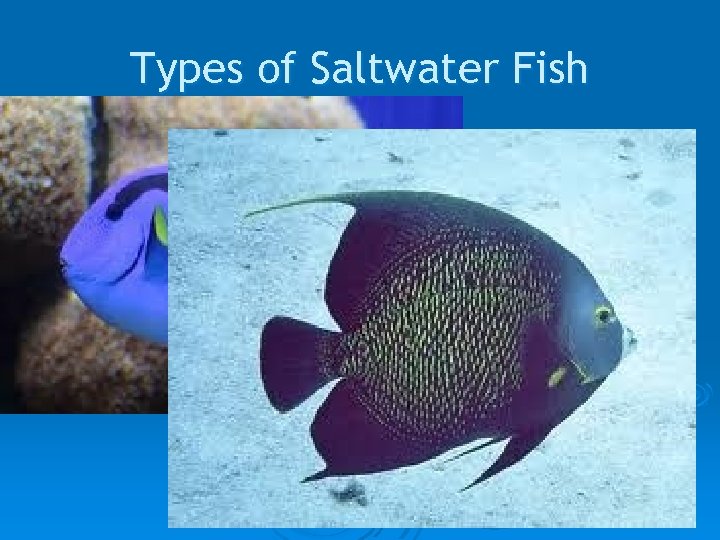 Types of Saltwater Fish
 Coral Reef Video
 THINK WRITE SHARE: EXTENSION QUESTION ØTHINK l What are 3 major differences between salt water and fresh water fish? How do you think this might influence their care? ØWRITE l 3 -5 Sentences Giving Examples ØSHARE l With you face partner
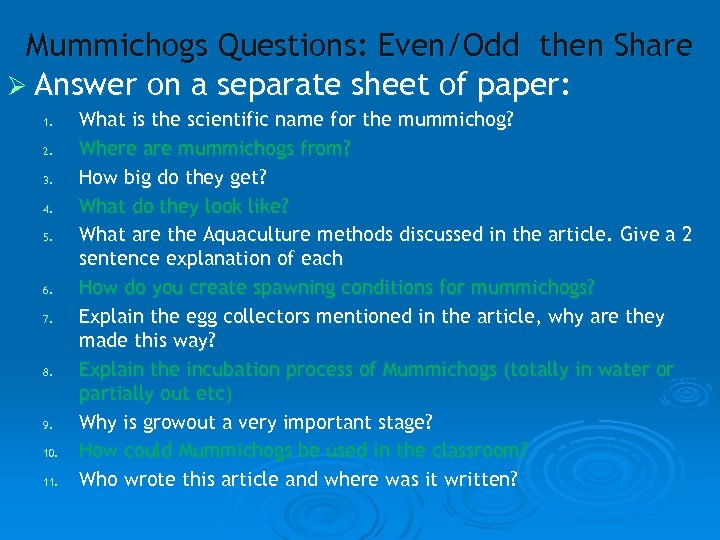 Mummichogs Questions: Even/Odd then Share Ø Answer on a separate sheet of paper: 1. 2. 3. 4. 5. 6. 7. 8. 9. 10. 11. What is the scientific name for the mummichog? Where are mummichogs from? How big do they get? What do they look like? What are the Aquaculture methods discussed in the article. Give a 2 sentence explanation of each How do you create spawning conditions for mummichogs? Explain the egg collectors mentioned in the article, why are they made this way? Explain the incubation process of Mummichogs (totally in water or partially out etc) Why is growout a very important stage? How could Mummichogs be used in the classroom? Who wrote this article and where was it written?
 Even/Odd Pair/Shared Reading Ø Even numbered seats: write the answers to even numbered questions Ø Odd numbered seats: write the answers to odd numbered questions Ø If you’re not WRITING you’e READING the answer to help your partner
 Extend… Ø Write 3 vocab/ NEW words you learned or don’t understand that were mentioned in the article
 THINK WRITE SHARE: EXTENSION QUESTION ØTHINK l Why is an understanding of types of fish be important to the study of mummichogs in Delaware? What information about FISH in general would better help the study of Mummichogs? ØWRITE l 3 -5 Sentences Giving Examples ØSHARE l With you face partner
 Take Home Activity Ø Complete the following for HW for use in next day’s class l l l 3 things you need to KNOW about fish (behavior, characteristics, etc) before setting up a tank 2 items you would need to set up a fish tank 1 place you could easily find all this information (BE SPECIFIC) (Don’t just say “the internet”)
 Vocabulary Ø Territorial: Ø Fish: Ø Freshwater: Ø Salt water:
 Fish! Care ID Quiz Review First! Animal Science Level 1
 1 Fish ID Quiz 3 2 4 5
 Fish ID Quiz 6 8 7 9
 Fish Video : Coral Reef Video
 THINK WRITE SHARE: EXTENSION QUESTION ØTHINK l Based on the video. . Predict. . What might be the most difficult part of fish care (based on characteristics of fish discussed)? ØWRITE l 3 -5 Sentences Giving Examples ØSHARE l With you face partner
 Objectives Ø Explore, Analyze, and Understand the basics of fish care
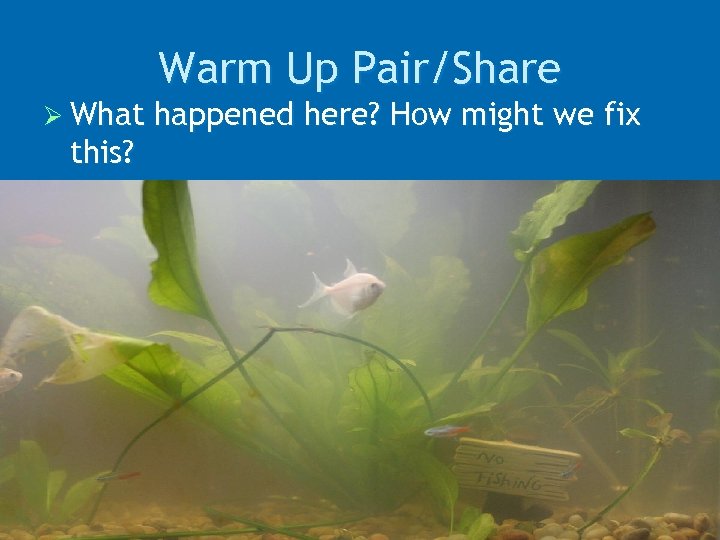 Warm Up Pair/Share Ø What this? happened here? How might we fix
 Lit Frayer Model I think it is…. Because of… (clues) The take became cloudy because the Nitrogen Cycle was not yet established since fish were recently added to the empty tank. It is actually defined as… Ways to help me remember this/Examples are
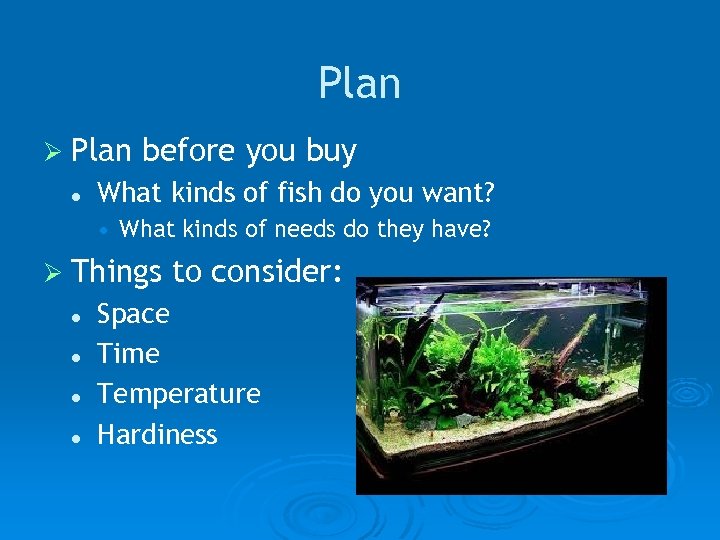 Plan Ø Plan l before you buy What kinds of fish do you want? • What kinds of needs do they have? Ø Things l l to consider: Space Time Temperature Hardiness
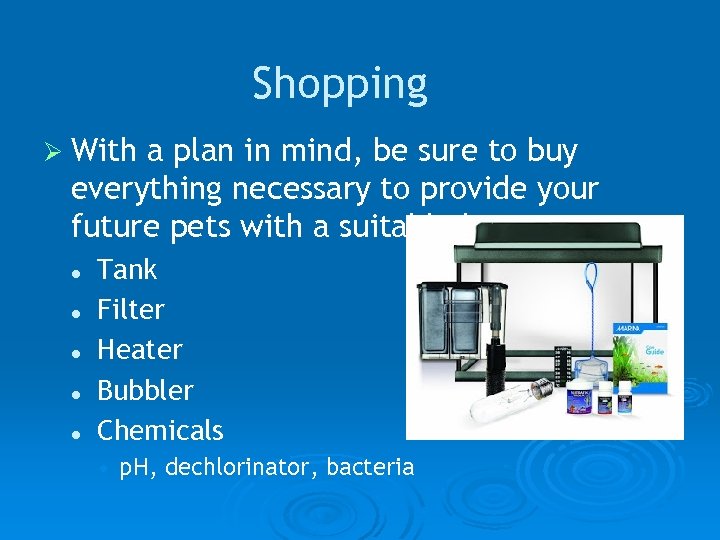 Shopping Ø With a plan in mind, be sure to buy everything necessary to provide your future pets with a suitable home l l l Tank Filter Heater Bubbler Chemicals • p. H, dechlorinator, bacteria
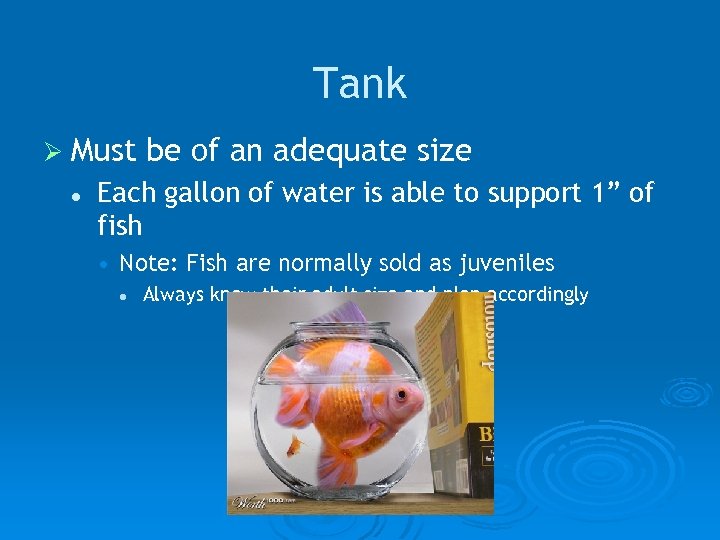 Tank Ø Must l be of an adequate size Each gallon of water is able to support 1” of fish • Note: Fish are normally sold as juveniles l Always know their adult size and plan accordingly
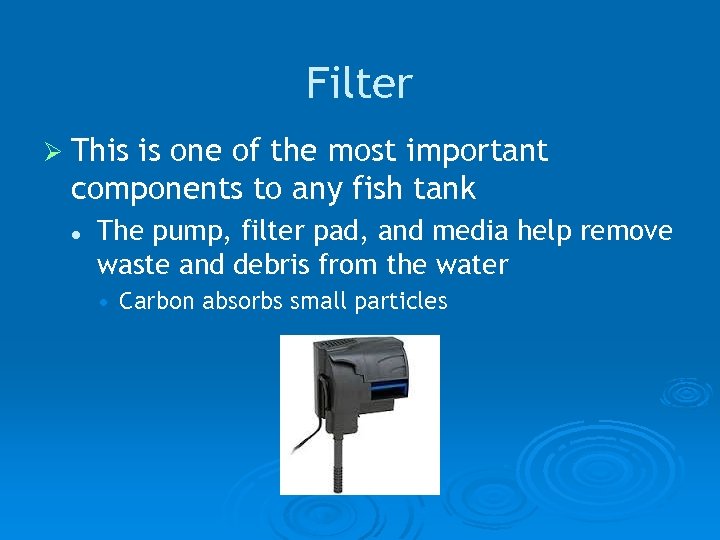 Filter Ø This is one of the most important components to any fish tank l The pump, filter pad, and media help remove waste and debris from the water • Carbon absorbs small particles
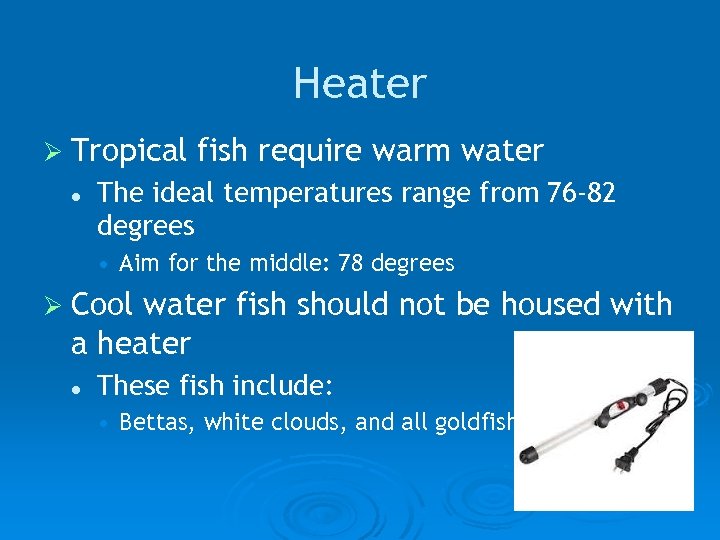 Heater Ø Tropical l fish require warm water The ideal temperatures range from 76 -82 degrees • Aim for the middle: 78 degrees Ø Cool water fish should not be housed with a heater l These fish include: • Bettas, white clouds, and all goldfish
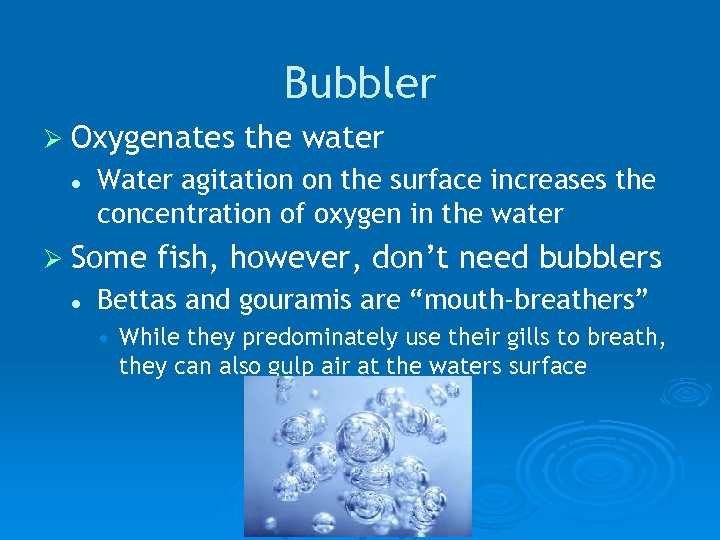 Bubbler Ø Oxygenates l Water agitation on the surface increases the concentration of oxygen in the water Ø Some l the water fish, however, don’t need bubblers Bettas and gouramis are “mouth-breathers” • While they predominately use their gills to breath, they can also gulp air at the waters surface
 Chemicals Ø p. H: l The p. H of tap water is generally too high for aquarium fish • Aim for 6. 8 -7. 0 Ø Dechlorinator: l Tap water contains chlorine and chloramine as well as other heavy metals that are toxic to fish Ø Bacteria: l Helps to break down fish waste in a new
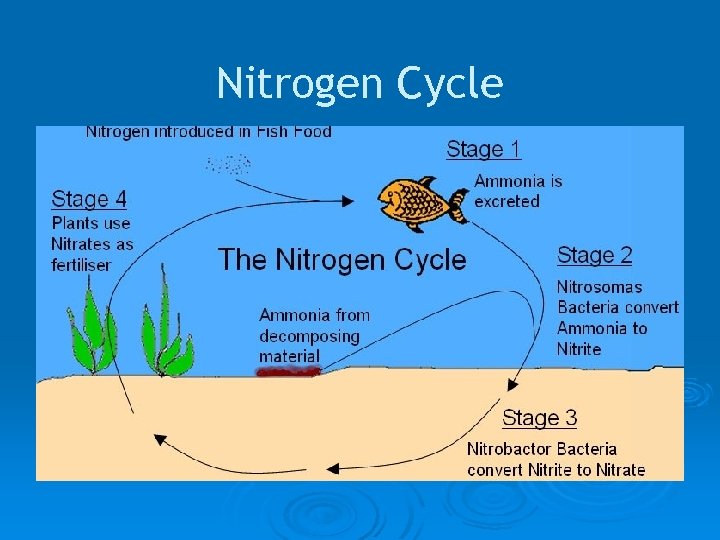 Nitrogen Cycle
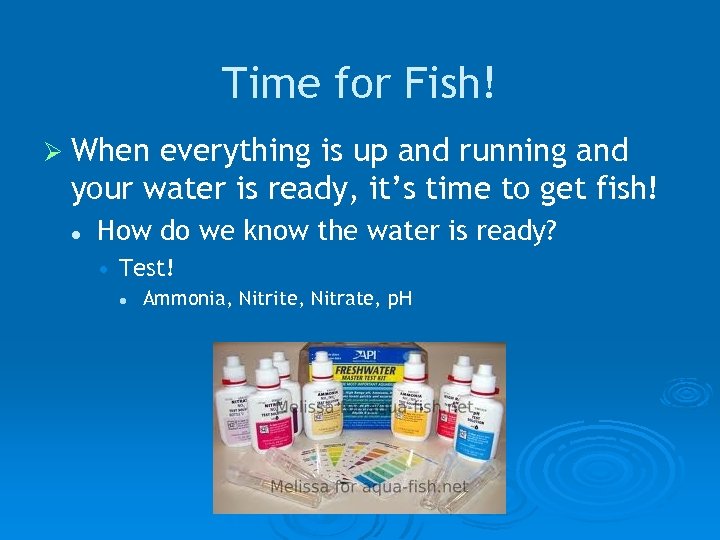 Time for Fish! Ø When everything is up and running and your water is ready, it’s time to get fish! l How do we know the water is ready? • Test! l Ammonia, Nitrite, Nitrate, p. H
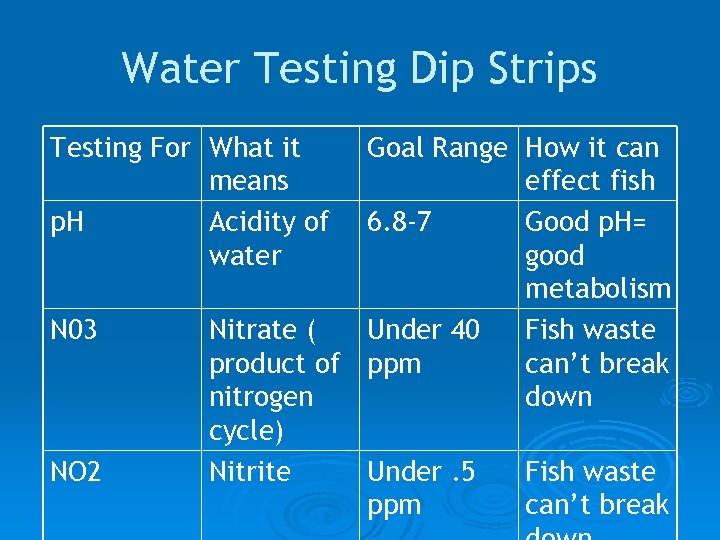 Water Testing Dip Strips Testing For What it means p. H Acidity of water N 03 NO 2 Goal Range How it can effect fish 6. 8 -7 Good p. H= good metabolism Nitrate ( Under 40 Fish waste product of ppm can’t break nitrogen down cycle) Nitrite Under. 5 Fish waste ppm can’t break
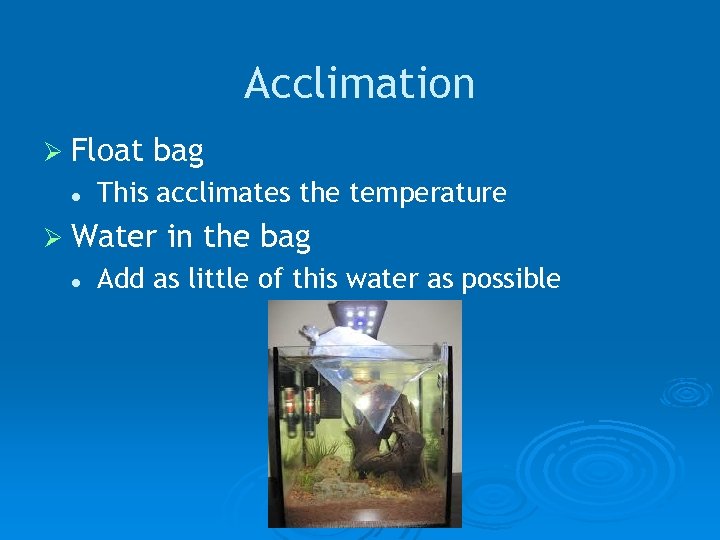 Acclimation Ø Float l bag This acclimates the temperature Ø Water l in the bag Add as little of this water as possible
 Nitrogen Cycle: Critical to Fish Care Ø Define: the establishment of beneficial bacteria in the aquarium and in the filter media that will help in the conversion of ammonia to nitrite and then the conversion of nitrite to nitrates.
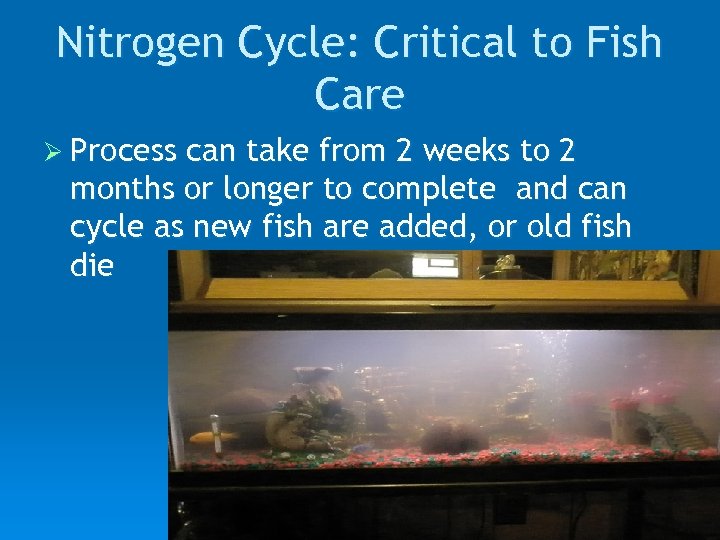 Nitrogen Cycle: Critical to Fish Care Ø Process can take from 2 weeks to 2 months or longer to complete and can cycle as new fish are added, or old fish die
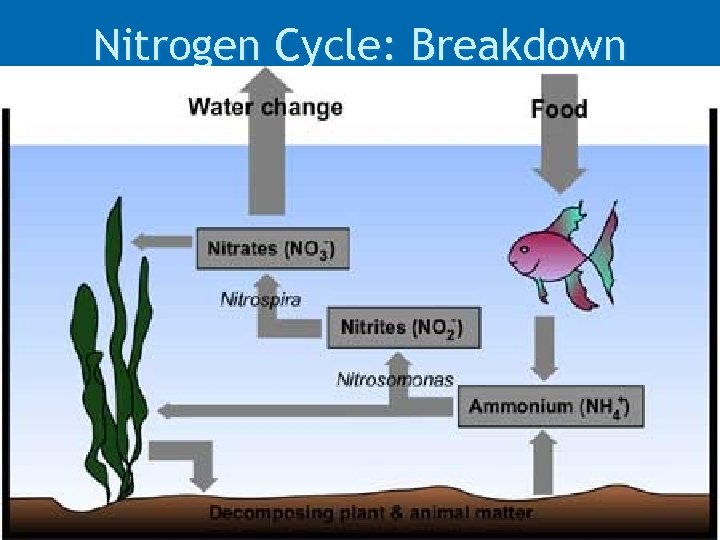 Nitrogen Cycle: Breakdown
 Summary Break Ø In l 10 words What is the Nitrogen Cycle? Ø Pair Share with your partner
 Station/Share Activity Ø 1. all numbered students meet up with your group l Ø All the 1’s together, all the 2’s together etc 2. Gather information about your disease with your numbered group l Fill in your graphic organizer notes 3. Return to you original seats (with a 1/2/3/4 student in all seats) Ø 4. Share the information for your disease (should be at least 4 different diseases shared) Ø l ONE talk ALL write
 Activities Ø Fish l l Care: Articles are located at stations throughout the room. You have questions to answer for each packet You will have time @ each station. There are 5 stations. Return to your “home base”
 Fish Tank Set Up Ø 1. Determine the type of tank l Ø 2. Determine the types of fish l Ø Where they swim, Aggressive vs Docile, Communal/Solitary/ Schooling 3. Determine Price Range l Ø Location, Time Investment, “Look” community (multiple types) Ornaments, Gravel, fish types 4. Purchase all non living items l Tank, Gravel, Fake Plants, Ornaments, Filters, Food
 Fish Tank Set Up Ø 5. Set up tank l Ø 6. Adding Fish: Acclimation l l Ø Fill with Water, De-cholorinate, test every few days (until levels are fish safe) Bag Method, Drip, Bucket Acclimated to Temp and Water Chemicals 7. Nitrogen Cycle Begins until Establishment l Bacteria Levels can fluctuate • Cloudy vs clear water Ø 8. Maintenance l Testing, Water Changes (25% / month), Siphoning • Removal of solid waster using tubing and back flush water pressure (vacc)
 Summary Break: The most important… The most important thing to remember about fish care is _______ because ______ 2. 1 Supporting Fact 3. 1 Supporting Fact 4. 1 Supporting Fact 5. But the MOST important thing to remember about Fish care is_______ 1.
 Write a Script Summarizing your Article Activity Ø Write a one page script (dialogue) that would happen between YOU (the fish expert) and a customer (knows NOTHING about fish) Ø The customer has asked you the following questions that you must answer. Use info from your articles to help you Ø l l l How do I start a fish tank? What materials might I need? How do I keep my fish tank healthy over time? (maintenance)? How do I introduce fish to my tank? How do I monitor the health of my tank? Are their any tests?
 Water Testing Lab Ø Complete Water tests for the Goldfish Tank and “pond” in the lab Ø Graphically Represent the results… Ø Summarize: l l What do we typically test for in fish environments? Why do you think we test for these? What can our results tell us about the health of our fish? How are the pond and goldfish tank different?
 Aquaponics Reading Q’s Ø Evens l l work with Evens, Odds with Odds 1 Read the Question, 1 Scans Article to find answer and TELLS your partner the answer, Partner writes down the answer THEN SWITCH Ø Draw Individually Ø Answer the thought question independently for HW l Compare and Contrast an Aquaponics system from the reading, a typical freshwater tank, and a natural pond environment for fish. Include examples from your reading and notes
 Questions to answer 1. 2. 3. 4. Define Aquaponics and Organic Aquaculture What are the key elements and considerations for aquaponics systems? What are some benefits of using aquaculture and vegetable farming together according to the North Carolina Study? What elements can be removed using wetland/hydroponic plants?
 Draw individually (1 sheet of paper): Label all PARTS in your photo North Carolina Serpano System Aquaponics System Cabbage Farm System A Basic Fish tank
 Take Home Ø Compare and Contrast an Aquaponics system from the reading, a typical freshwater tank, and a natural pond environment for fish. Include examples from your reading and notes l 5 -10 sentences
 Fish! Anatomy Follow along with your graphic organizer notes Animal Science Level 1
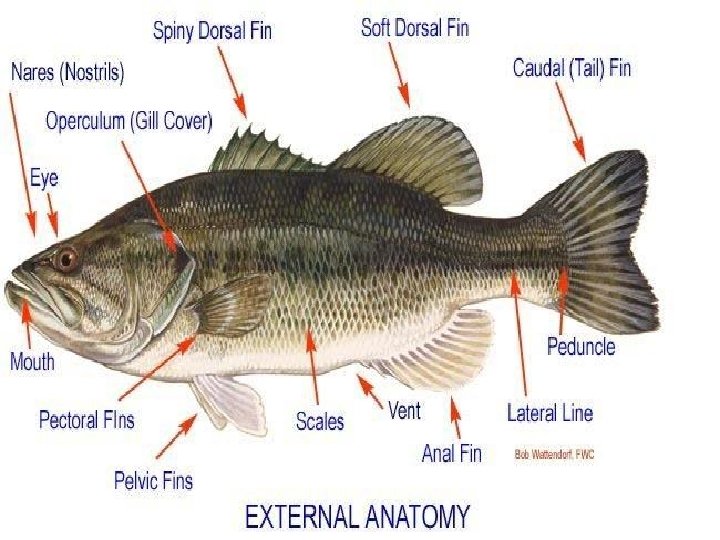
 Essential Question How are fish bodies adapted for swimming?
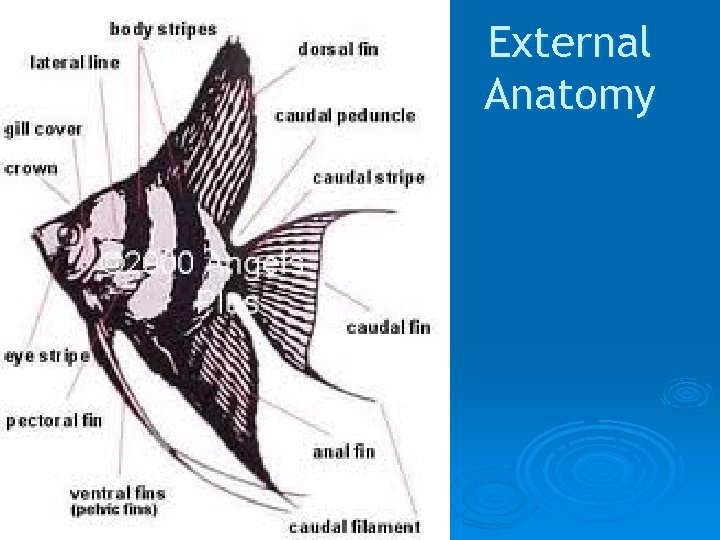 External Anatomy
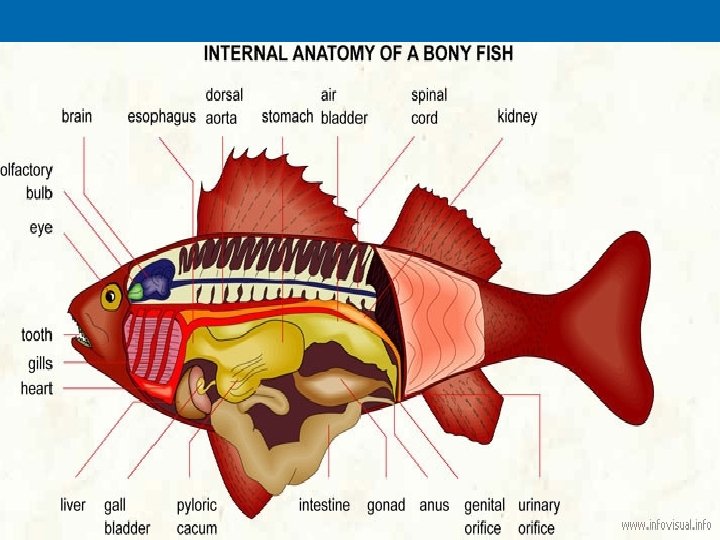 Internal Anatomy
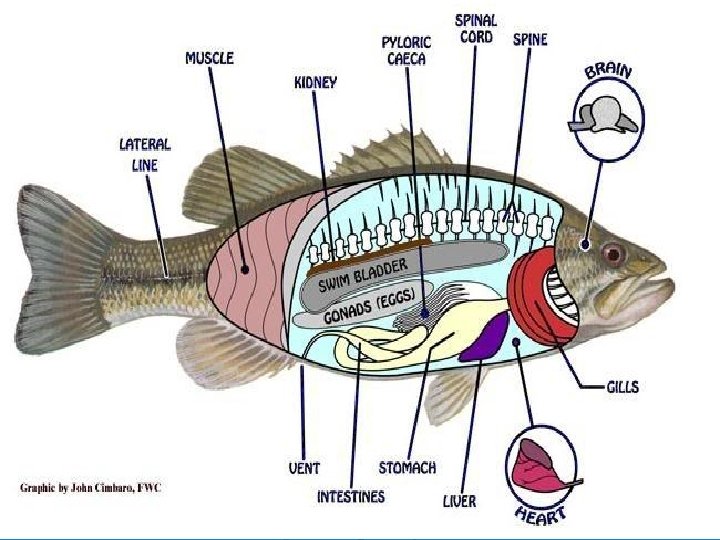
 Anatomy Explained Ø Brain: seat of the mental faculties of a fish. Ø Esophagus: part of the digestive tract connecting the mouth to the stomach. Ø Dorsal aorta: vessel in the back that carries blood from the heart to the organs.
 Anatomy Explained Ø Stomach: part of the digestive tract between the esophagus and the intestine. Ø Air bladder: pocket in which urine collects. Ø Spinal cord: part of the nervous system that connects the brain to all other parts of a fish
 Anatomy Explained Ø Kidney: blood-purifying organ. Ø Urinary orifice: opening for eliminating urine. Ø Genital Orifice: opening related to the genital organs. Ø Anus: end of the digestive tract. Ø Gonad: hormone-secreting sexual gland of a fish. Ø
 Anatomy Explained Ø Intestine: last part of the digestive tract. Ø Pyloric cecum: cul-de-sac related to the intestine. Ø Gall bladder: small sac containing the bile. Ø Liver: bile-producing digestive gland. Ø Heart: blood-pumping organ.
 Anatomy Explained Ø Gills: respiratory organ of a fish. Ø Tooth: hard organ of a fish used to shred food. Ø Eye: sight organ of a fish. Ø Olfactory bulb: bulging part of the smell organ of smell of a fish
 LIFE UNDER WATER Ø All Fish are able to survive under water because: l l l l Slim Coat: Provides protection and allows for easy swimming Streamline body: easier to swim under water Fins: to create push within the water for swimming to move horizontally in the water Gills: To breath under water Cold Blooded: to better adapt to life underwater where temperatures can change Air Bladder: To help them move vertically in the water Water Safe Eggs: for safe gestation (growing in the egg) while under water
 Summary Break Ø In l 10 words How are fish adapted for swimming? Ø Pair Share with your partner
 Science of the Sea
 Summary-> Think-> Write-> Share Ø The most important thing to remember about fish anatomy is ________ Ø 1 Fact Ø BUT the MOST important thing to remember about fish anatomy is ____ because _____
 Take Home : Activity Ø Comparing/ Contrast Fish, Reptile and Bird Anatomy worksheet l l Using the worksheet provided compare a FISH to either a mammal, reptile, or bird previously discussed Answer the prompts in complete sentences
 Fish! Diseases Animal Science Level 1
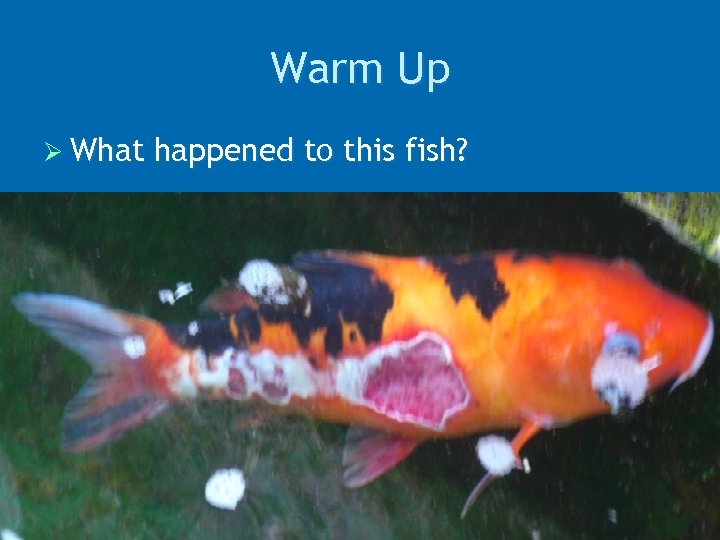 Warm Up Ø What happened to this fish?
 Essential Question Ø Why would fish disease be hard to spot?
 Common Fish Diseases Ø Clamped Fins The fish clamps its fins close against the its body Ø Shimmy Looks like the fish is swimming fast but staying in the same place.
 Common Fish Diseases Ø Ich Spots Ich looks like tiny white spots on the body and fins of the fish.
 Common Fish Diseases Ø Red or White Sores Many things can cause sores on fish such as fights with other fish, scraping on sharp rocks, and small wounds that get infected and grow bigger.
 Common Fish Diseases Ø Crashed on the Bottom When fish crash on the bottom and do not swim, it is usually a sign that they are exhausted. There are many reasons a fish can become exhausted, but quite often they have been sick, and probably showed symptoms such as gasping, shimmy, or clamped fins, before they became tired and crashed on the bottom.
 Diseases Ø Glancing is a fish behavior where a fish rubs itself on the bottom of the aquarium, or on the gravel, or on a rock or ornament. The fish rubs or glances because it is itchy.
 Diseases Ø Loss of Appetite If your fish is not eating or takes food in its mouth and then immediately spits it out, your fish is showing one of the Signs of Stress and Disease.
 Diseases Ø Pop-eye Ø in itself is not a disease but is more a symptom of an underlying infection.
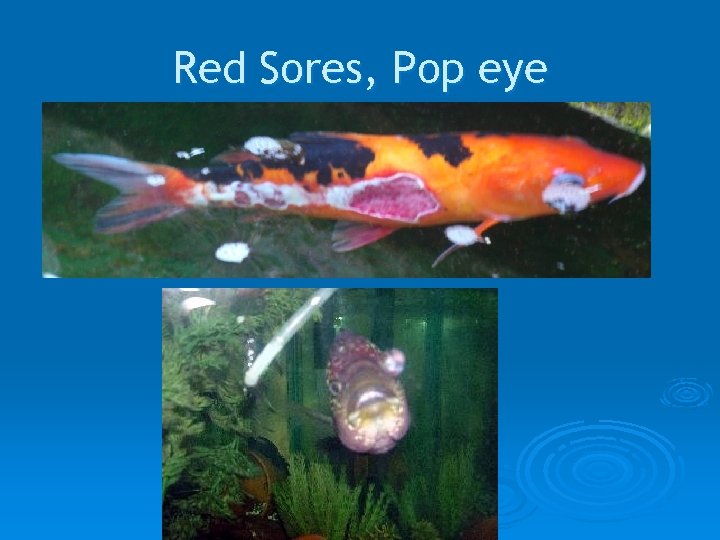 Red Sores, Pop eye
 Gasping at the Surface Ø Gasping at the Surface A fish that is gasping at the surface of the water is usually suffering from a lack of oxygen, that could be due to a lack of oxygen in the water or the fish's inability to absorb the oxygen from the water.
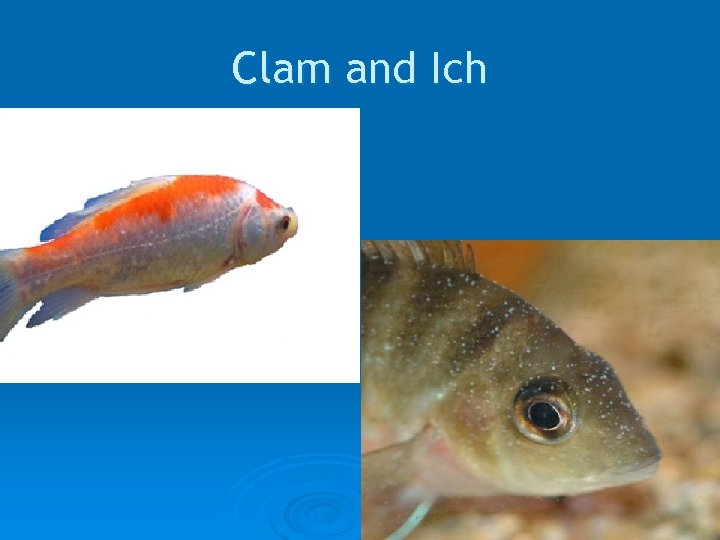 Clam and Ich
 THINK WRITE SHARE: EXTENSION QUESTION ØTHINK l Based on our notes. . Why do you think fish diseases might be difficult to diagnose and treat? Use one disease in supporting your answer ØWRITE l 3 -5 Sentences Giving Examples ØSHARE l With you face partner
 You’re the Expert! Ø Build l a Pond Activity Computer timed activity. Ø Summary: Think, Write, Share l What is the most important thing to consider when building/preparing a fish environment? • 3 -5 sentences • 3 examples with supporting information • Think, Write, Share
 Ø Video Reviews Care for Fish: l Ø Fish Care l l Ø http: //www. 5 min. com/Video/How-to-Care-for-Fishin-Aquariums-241278327 General Tips: http: //www. 5 min. com/Video/How-to. Maintain-an-Aquarium---General-Tips-142096974 Adding to your Tank : http: //www. 5 min. com/Video/How-to-Maintain-an. Aquarium---Adding-Fish-142097022 Fish Diseases: http: //www. 5 min. com/Video/How-to-Maintainan-Aquarium---Fish-Diseases-142097047
 Test Review Ø Ø Ø Ø Define from our notes: Fish, Freshwater, Saltwater, Territorial, Nitrogen Cycle List the internal organs of a fish (this is a diagram on your exam) Explain in 5 steps, how to set up an aquarium. What is a water test? What is tested? How do fish affect the results? What is the purpose of a water test? How would you acclimate a new fish to your tank? You can draw a diagram to help you answer. Give 3 sentences explaining your diagram How are fish adapted to life under water? Give 5 Examples with explanation (Think anatomy) Know the fish disease from your notes, their symptoms, prevention, and treatment