


 Скачать презентацию Fiscal Year 2011 In-Progress Review Department of the
2ce58734d08ea0d953e256a292d9aa38.ppt
- Количество слайдов: 27
 Fiscal Year 2011 In-Progress Review Department of the Navy Safety & Occupational Health Program April 25, 2012
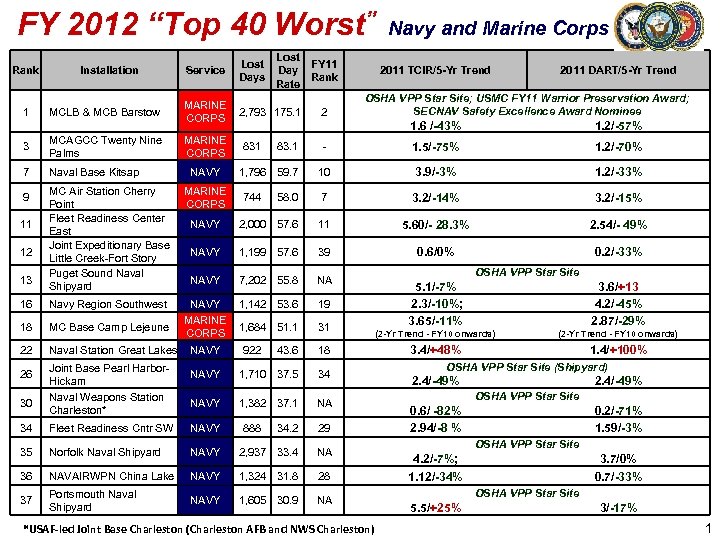 FY 2012 “Top 40 Worst” Rank Installation Lost Day Rate Service Lost Days 2, 793 175. 1 1 MCLB & MCB Barstow MARINE CORPS 3 MCAGCC Twenty Nine Palms MARINE CORPS 831 83. 1 7 Naval Base Kitsap NAVY 1, 796 MC Air Station Cherry Point Fleet Readiness Center East Joint Expeditionary Base Little Creek-Fort Story Puget Sound Naval Shipyard MARINE CORPS 16 Navy Region Southwest 18 MC Base Camp Lejeune 22 Naval Station Great Lakes 9 11 12 13 26 30 Joint Base Pearl Harbor. Hickam Naval Weapons Station Charleston* FY 11 Rank 2 Navy and Marine Corps 2011 TCIR/5 -Yr Trend 2011 DART/5 -Yr Trend OSHA VPP Star Site; USMC FY 11 Warrior Preservation Award; SECNAV Safety Excellence Award Nominee 1. 6 /-43% 1. 2/-57% - 1. 5/-75% 1. 2/-70% 59. 7 10 3. 9/-3% 1. 2/-33% 744 58. 0 7 3. 2/-14% 3. 2/-15% NAVY 2, 000 57. 6 11 5. 60/- 28. 3% 2. 54/- 49% NAVY 1, 199 57. 6 39 0. 6/0% 0. 2/-33% NAVY 7, 202 55. 8 NA NAVY MARINE CORPS 1, 142 53. 6 19 1, 684 51. 1 31 NAVY 922 43. 6 18 NAVY 1, 710 37. 5 34 NAVY 1, 382 37. 1 NA 34 Fleet Readiness Cntr SW NAVY 888 34. 2 29 35 Norfolk Naval Shipyard NAVY 2, 937 33. 4 NA 36 NAVAIRWPN China Lake NAVY 1, 324 31. 8 28 37 Portsmouth Naval Shipyard NAVY 1, 605 30. 9 NA *USAF-led Joint Base Charleston (Charleston AFB and NWS Charleston) OSHA VPP Star Site 5. 1/-7% 2. 3/-10%; 3. 65/-11% 3. 6/+13 4. 2/-45% 2. 87/-29% (2 -Yr Trend - FY 10 onwards) 3. 4/+48% 1. 4/+100% OSHA VPP Star Site (Shipyard) 2. 4/-49% OSHA VPP Star Site 0. 6/ -82% 2. 94/-8 % 0. 2/-71% 1. 59/-3% OSHA VPP Star Site 4. 2/-7%; 1. 12/-34% 3. 7/0% 0. 7/-33% OSHA VPP Star Site 5. 5/+25% 3/-17% 1
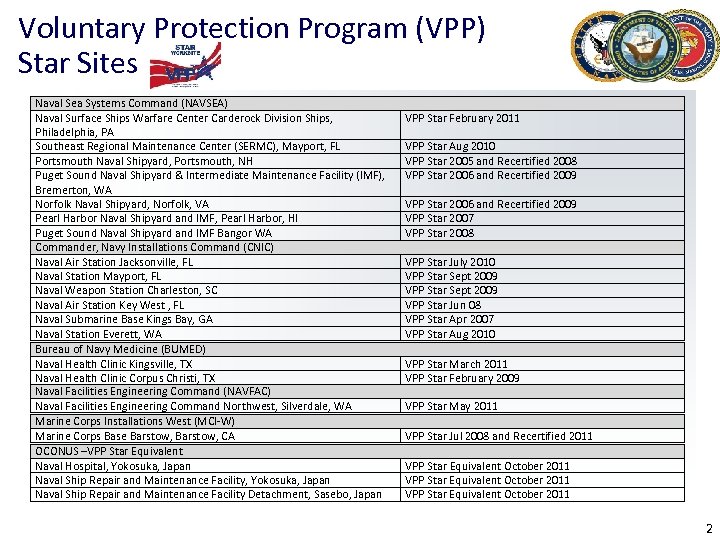 Voluntary Protection Program (VPP) Star Sites Naval Sea Systems Command (NAVSEA) Naval Surface Ships Warfare Center Carderock Division Ships, Philadelphia, PA Southeast Regional Maintenance Center (SERMC), Mayport, FL Portsmouth Naval Shipyard, Portsmouth, NH Puget Sound Naval Shipyard & Intermediate Maintenance Facility (IMF), Bremerton, WA Norfolk Naval Shipyard, Norfolk, VA Pearl Harbor Naval Shipyard and IMF, Pearl Harbor, HI Puget Sound Naval Shipyard and IMF Bangor WA Commander, Navy Installations Command (CNIC) Naval Air Station Jacksonville, FL Naval Station Mayport, FL Naval Weapon Station Charleston, SC Naval Air Station Key West , FL Naval Submarine Base Kings Bay, GA Naval Station Everett, WA Bureau of Navy Medicine (BUMED) Naval Health Clinic Kingsville, TX Naval Health Clinic Corpus Christi, TX Naval Facilities Engineering Command (NAVFAC) Naval Facilities Engineering Command Northwest, Silverdale, WA Marine Corps Installations West (MCI-W) Marine Corps Base Barstow, CA OCONUS –VPP Star Equivalent Naval Hospital, Yokosuka, Japan Naval Ship Repair and Maintenance Facility Detachment, Sasebo, Japan VPP Star February 2011 VPP Star Aug 2010 VPP Star 2005 and Recertified 2008 VPP Star 2006 and Recertified 2009 VPP Star 2007 VPP Star 2008 VPP Star July 2010 VPP Star Sept 2009 VPP Star Jun 08 VPP Star Apr 2007 VPP Star Aug 2010 VPP Star March 2011 VPP Star February 2009 VPP Star May 2011 VPP Star Jul 2008 and Recertified 2011 VPP Star Equivalent October 2011 2
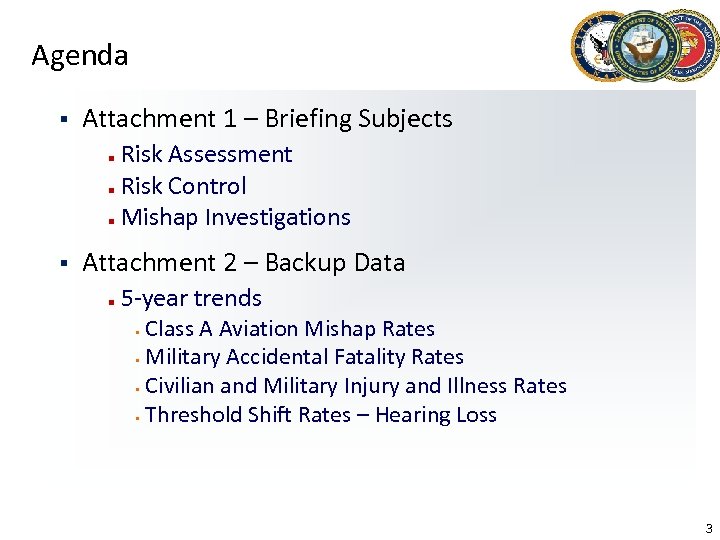 Agenda § Attachment 1 – Briefing Subjects n n n § Risk Assessment Risk Control Mishap Investigations Attachment 2 – Backup Data n 5 -year trends Class A Aviation Mishap Rates § Military Accidental Fatality Rates § Civilian and Military Injury and Illness Rates § Threshold Shift Rates – Hearing Loss § 3
 Attachment 1 Briefing Subjects 4
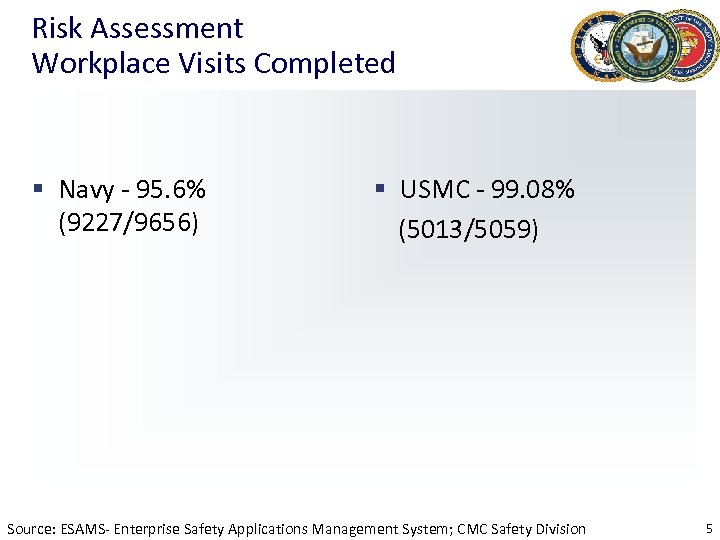 Risk Assessment Workplace Visits Completed § Navy - 95. 6% (9227/9656) § USMC - 99. 08% (5013/5059) Source: ESAMS- Enterprise Safety Applications Management System; CMC Safety Division 5
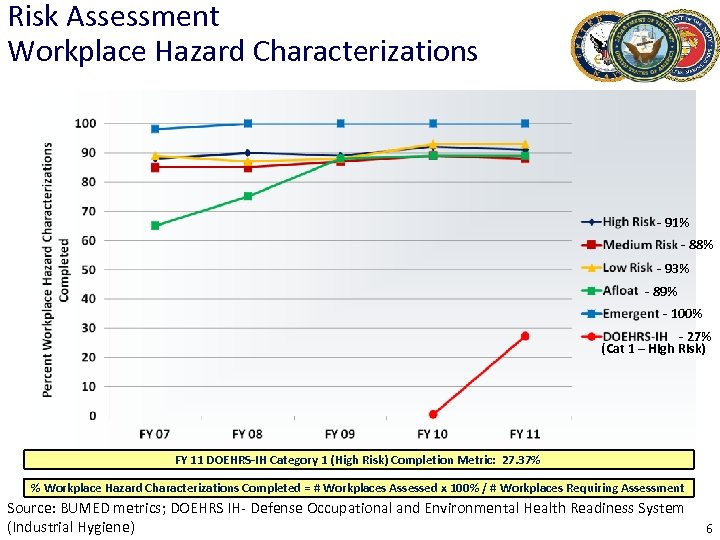 Risk Assessment Workplace Hazard Characterizations - 91% - 88% - 93% - 89% - 100% - 27% (Cat 1 – High Risk) FY 11 DOEHRS-IH Category 1 (High Risk) Completion Metric: 27. 37% % Workplace Hazard Characterizations Completed = # Workplaces Assessed x 100% / # Workplaces Requiring Assessment Source: BUMED metrics; DOEHRS IH- Defense Occupational and Environmental Health Readiness System (Industrial Hygiene) 6
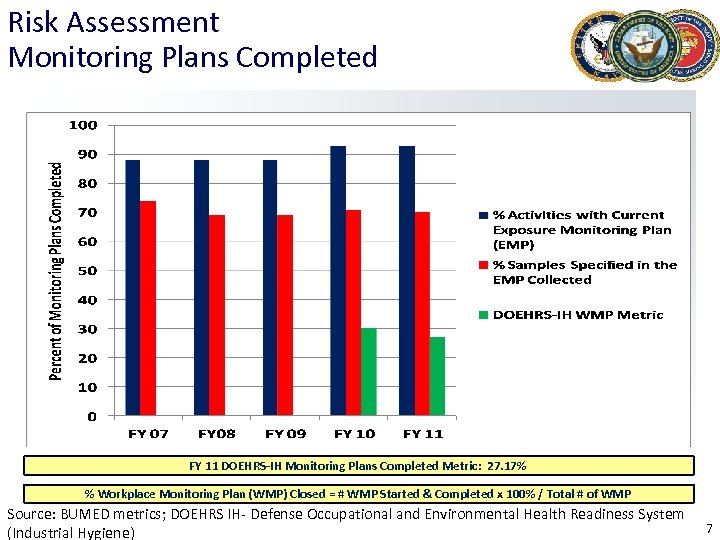 Risk Assessment Monitoring Plans Completed FY 11 DOEHRS-IH Monitoring Plans Completed Metric: 27. 17% % Workplace Monitoring Plan (WMP) Closed = # WMP Started & Completed x 100% / Total # of WMP Source: BUMED metrics; DOEHRS IH- Defense Occupational and Environmental Health Readiness System (Industrial Hygiene) 7
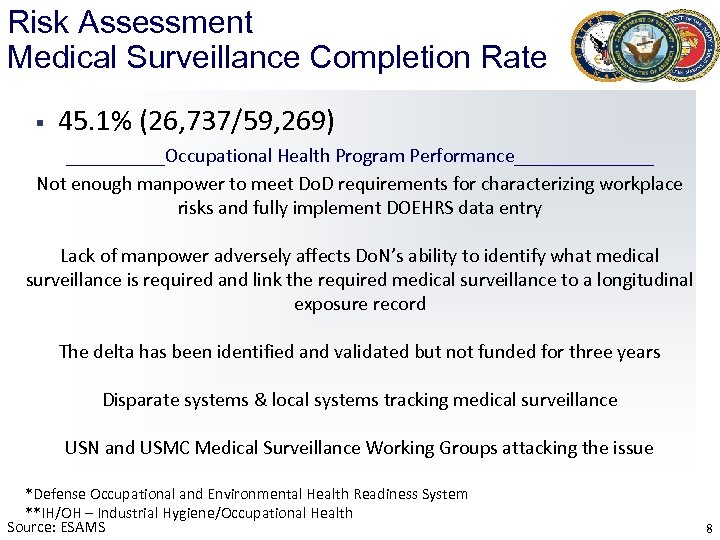 Risk Assessment Medical Surveillance Completion Rate § 45. 1% (26, 737/59, 269) _____Occupational Health Program Performance_______ Not enough manpower to meet Do. D requirements for characterizing workplace risks and fully implement DOEHRS data entry Lack of manpower adversely affects Do. N’s ability to identify what medical surveillance is required and link the required medical surveillance to a longitudinal exposure record The delta has been identified and validated but not funded for three years Disparate systems & local systems tracking medical surveillance USN and USMC Medical Surveillance Working Groups attacking the issue *Defense Occupational and Environmental Health Readiness System **IH/OH – Industrial Hygiene/Occupational Health Source: ESAMS 8
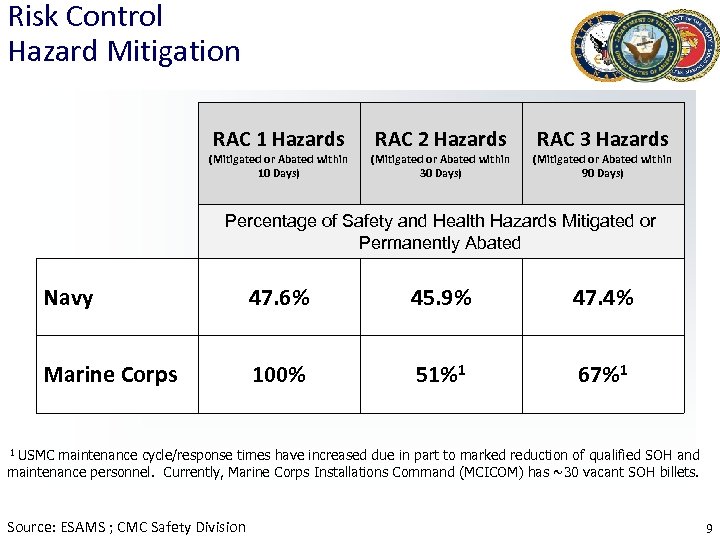 Risk Control Hazard Mitigation RAC 1 Hazards (Mitigated or Abated within 10 Days) RAC 2 Hazards (Mitigated or Abated within 30 Days) RAC 3 Hazards (Mitigated or Abated within 90 Days) Percentage of Safety and Health Hazards Mitigated or Permanently Abated Navy 47. 6% 45. 9% 47. 4% Marine Corps 100% 51%1 67%1 USMC maintenance cycle/response times have increased due in part to marked reduction of qualified SOH and maintenance personnel. Currently, Marine Corps Installations Command (MCICOM) has ~30 vacant SOH billets. 1 Source: ESAMS ; CMC Safety Division 9
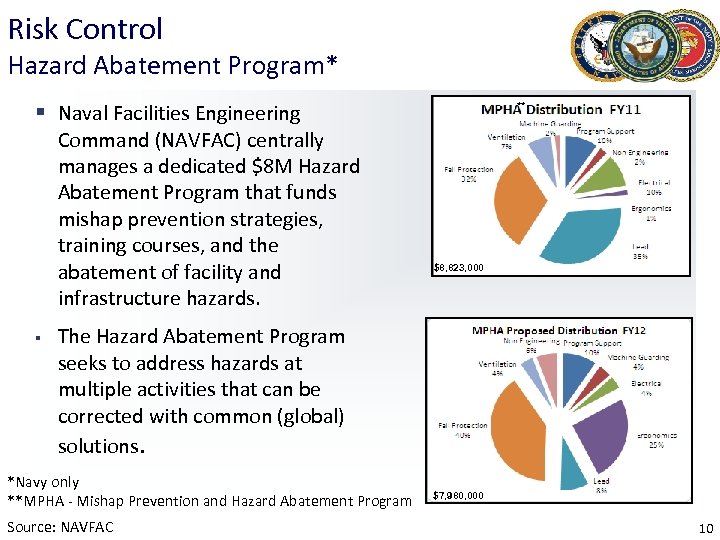 Risk Control Hazard Abatement Program* § Naval Facilities Engineering Command (NAVFAC) centrally manages a dedicated $8 M Hazard Abatement Program that funds mishap prevention strategies, training courses, and the abatement of facility and infrastructure hazards. § ** $8, 823, 000 The Hazard Abatement Program seeks to address hazards at multiple activities that can be corrected with common (global) solutions. *Navy only **MPHA - Mishap Prevention and Hazard Abatement Program Source: NAVFAC $7, 980, 000 10
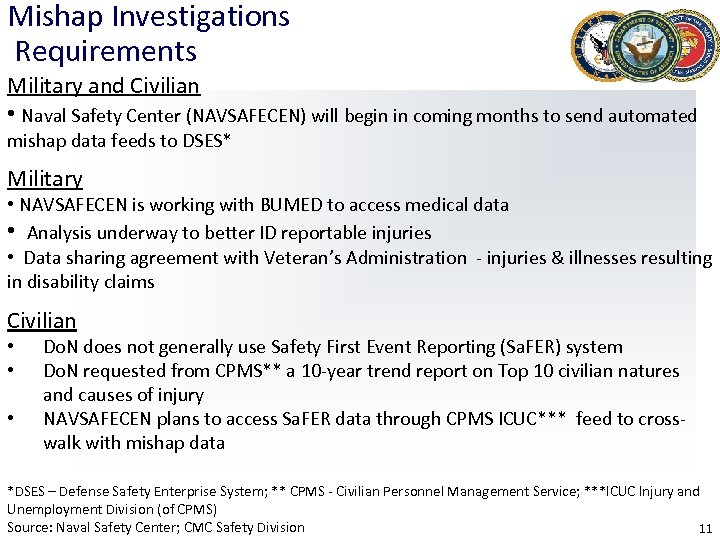 Mishap Investigations Requirements Military and Civilian • Naval Safety Center (NAVSAFECEN) will begin in coming months to send automated mishap data feeds to DSES* Military • NAVSAFECEN is working with BUMED to access medical data • Analysis underway to better ID reportable injuries • Data sharing agreement with Veteran’s Administration - injuries & illnesses resulting in disability claims Civilian • • • Do. N does not generally use Safety First Event Reporting (Sa. FER) system Do. N requested from CPMS** a 10 -year trend report on Top 10 civilian natures and causes of injury NAVSAFECEN plans to access Sa. FER data through CPMS ICUC*** feed to crosswalk with mishap data *DSES – Defense Safety Enterprise System; ** CPMS - Civilian Personnel Management Service; ***ICUC Injury and Unemployment Division (of CPMS) Source: Naval Safety Center; CMC Safety Division 11
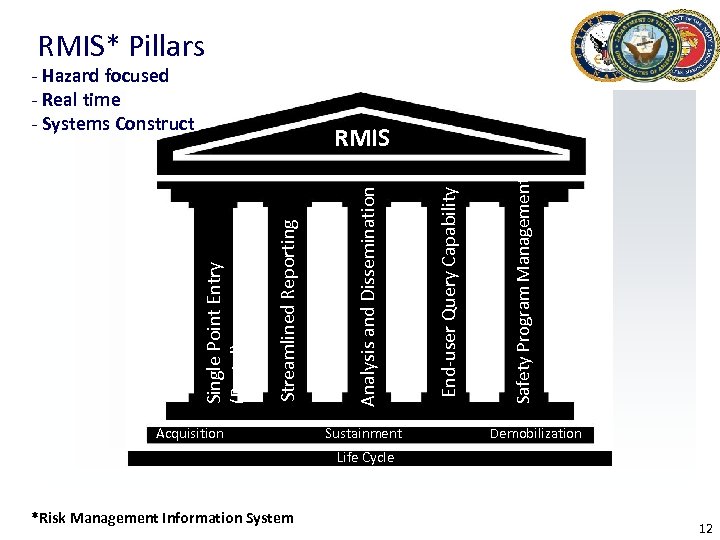 RMIS* Pillars - Hazard focused - Real time - Systems Construct Acquisition Sustainment Safety Program Management End-user Query Capability Analysis and Dissemination Streamlined Reporting Single Point Entry (Portal) RMIS Demobilization Life Cycle *Risk Management Information System 12
 Attachment 2 Backup Data 13
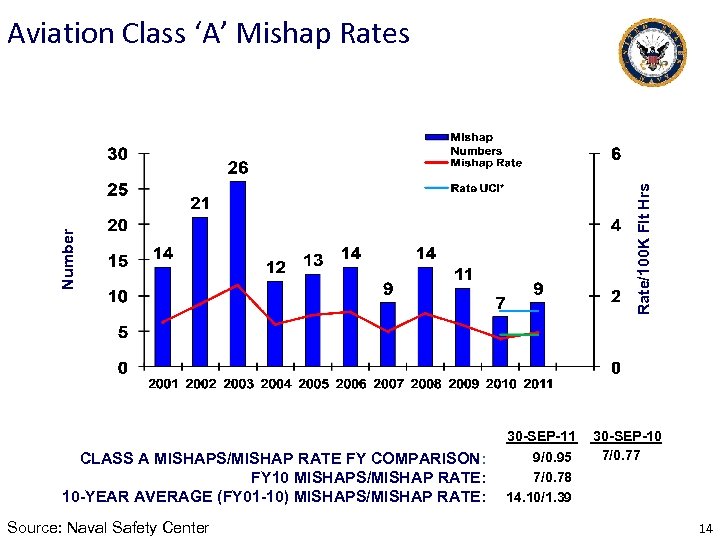 Number Rate/100 K Flt Hrs Aviation Class ‘A’ Mishap Rates 30 -SEP-11 CLASS A MISHAPS/MISHAP RATE FY COMPARISON: FY 10 MISHAPS/MISHAP RATE: 10 -YEAR AVERAGE (FY 01 -10) MISHAPS/MISHAP RATE: Source: Naval Safety Center 9/0. 95 7/0. 78 14. 10/1. 39 30 -SEP-10 7/0. 77 14
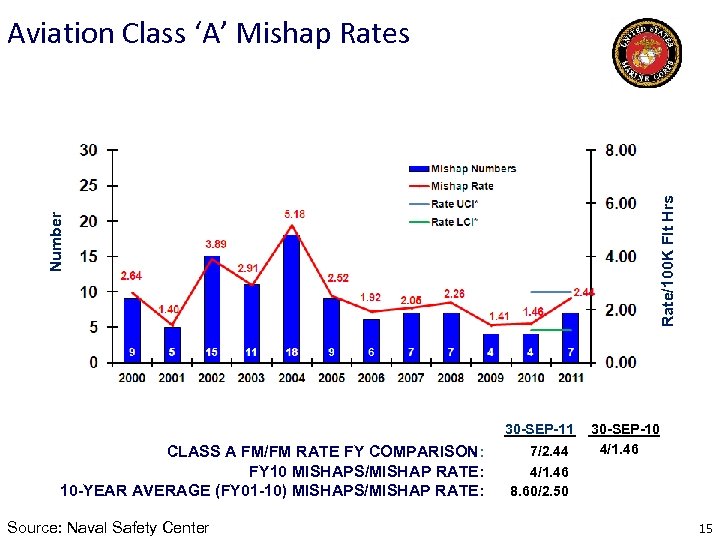 Number Rate/100 K Flt Hrs Aviation Class ‘A’ Mishap Rates 30 -SEP-11 CLASS A FM/FM RATE FY COMPARISON: FY 10 MISHAPS/MISHAP RATE: 10 -YEAR AVERAGE (FY 01 -10) MISHAPS/MISHAP RATE: Source: Naval Safety Center 7/2. 44 30 -SEP-10 4/1. 46 8. 60/2. 50 15
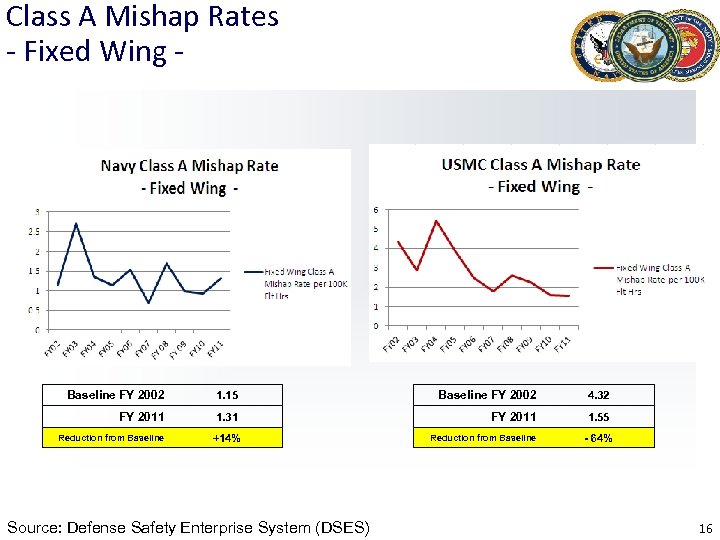 Class A Mishap Rates - Fixed Wing - Baseline FY 2002 1. 15 Baseline FY 2002 4. 32 FY 2011 1. 31 FY 2011 1. 55 Reduction from Baseline +14% Source: Defense Safety Enterprise System (DSES) Reduction from Baseline - 64% 16
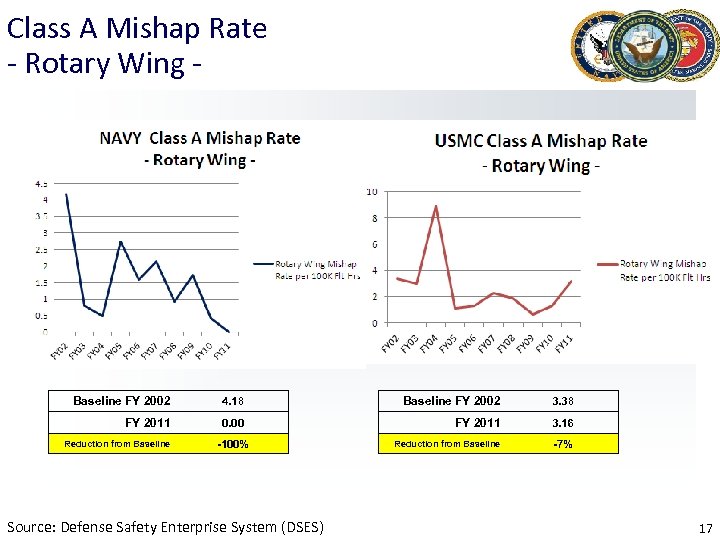 Class A Mishap Rate - Rotary Wing - Baseline FY 2002 4. 18 Baseline FY 2002 3. 38 FY 2011 0. 00 FY 2011 3. 16 Reduction from Baseline -7% Reduction from Baseline -100% Source: Defense Safety Enterprise System (DSES) 17
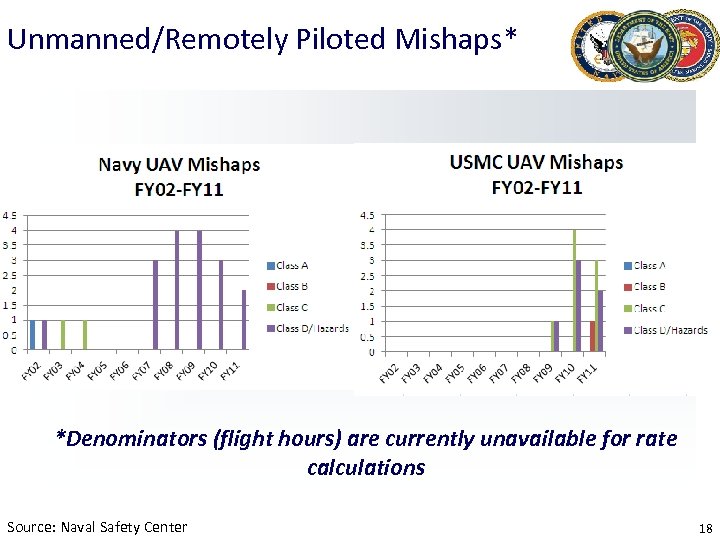 Unmanned/Remotely Piloted Mishaps* *Denominators (flight hours) are currently unavailable for rate calculations Source: Naval Safety Center 18
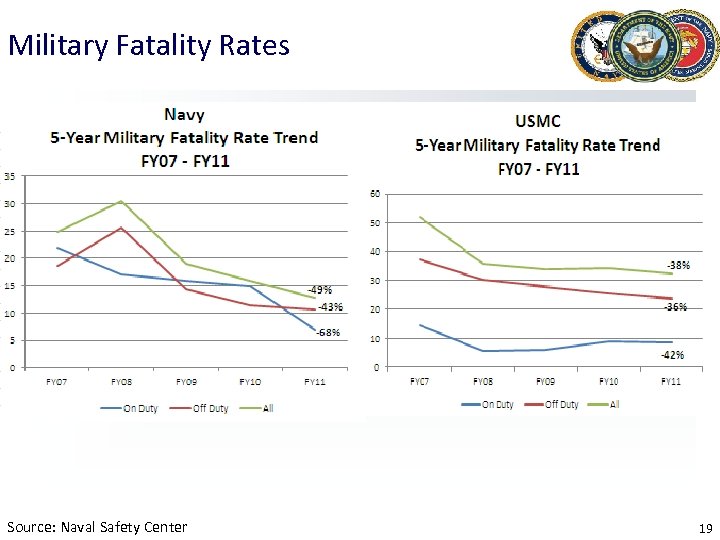 Military Fatality Rates Source: Naval Safety Center 19
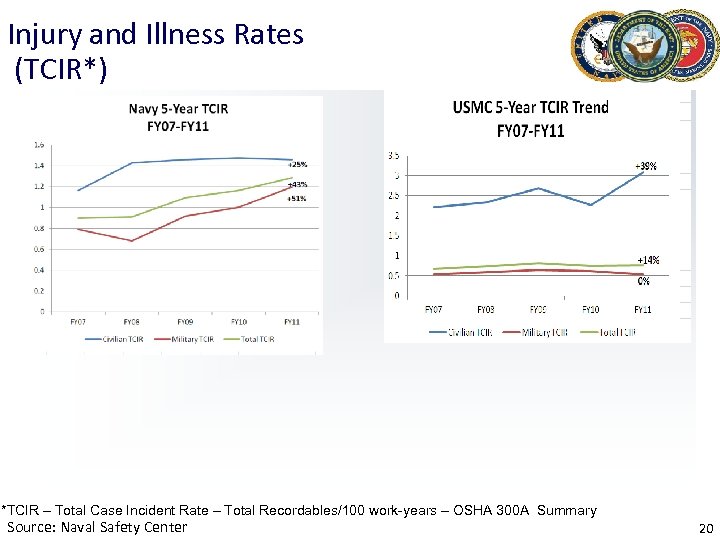 Injury and Illness Rates (TCIR*) *TCIR – Total Case Incident Rate – Total Recordables/100 work-years – OSHA 300 A Summary Source: Naval Safety Center 20
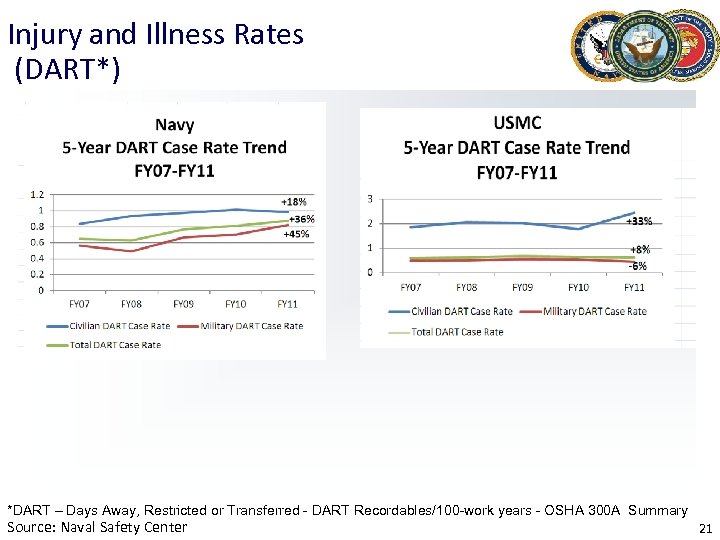 Injury and Illness Rates (DART*) *DART – Days Away, Restricted or Transferred - DART Recordables/100 -work years - OSHA 300 A Summary Source: Naval Safety Center 21
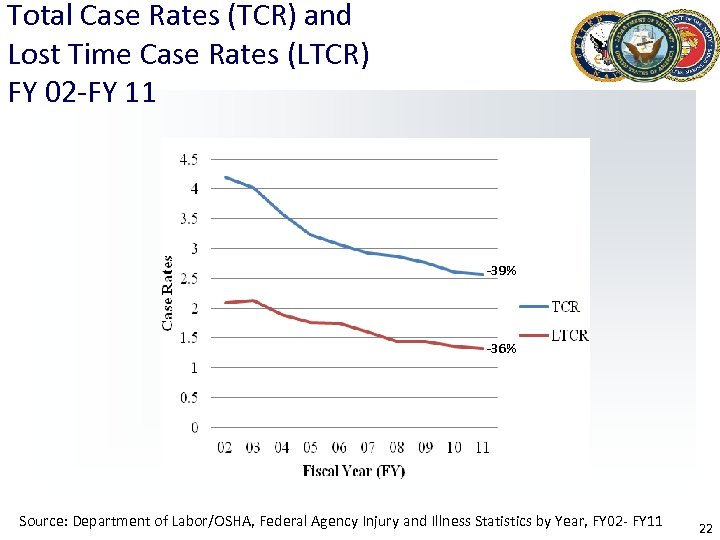 Total Case Rates (TCR) and Lost Time Case Rates (LTCR) FY 02 -FY 11 -39% -36% Source: Department of Labor/OSHA, Federal Agency Injury and Illness Statistics by Year, FY 02 - FY 11 22
 TCIR and DART Case Rate Increases Potential Confounding Factors: 1. Increased Injuries 2. More Thorough Reporting 3. FY 08 - Improved bridge between ESAMS and WESS* (Navy) 4. Aviation – Class C reporting threshold changed from 5 LWDs to 1 LWD (OPNAVINST 3750. 6 R, Naval Aviation Safety Program, 31 Dec 07 (Change 3, page 4 -4). ) 5. FY 11 - USMC is down 30 SOH billets 6. Increase in hearing loss claims (e. g. , NAVSEA) 7. Aging civilian workforce 8. BRAC realignment 9. Joint Basing There is currently no way to discern the extent of the impact of these factors on rates and trends. We expect RMIS to permit a more accurate and comprehensive analysis of our injury/illness data. *WESS – Web-Enabled Safety System 23
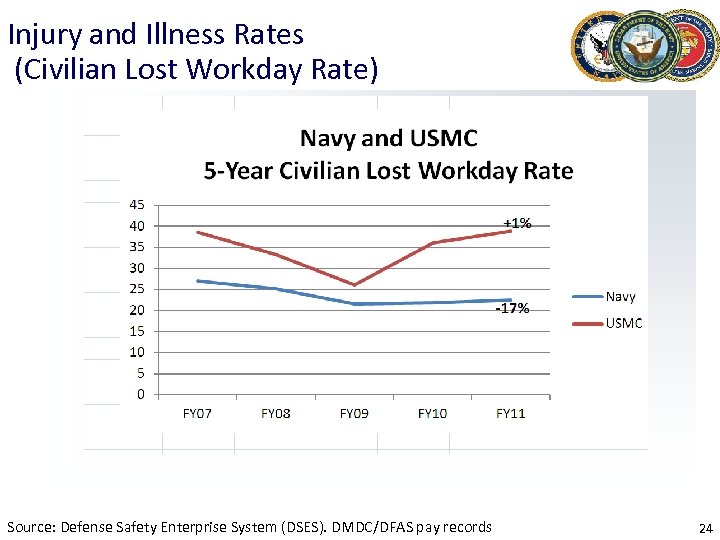 Injury and Illness Rates (Civilian Lost Workday Rate) Source: Defense Safety Enterprise System (DSES). DMDC/DFAS pay records 24
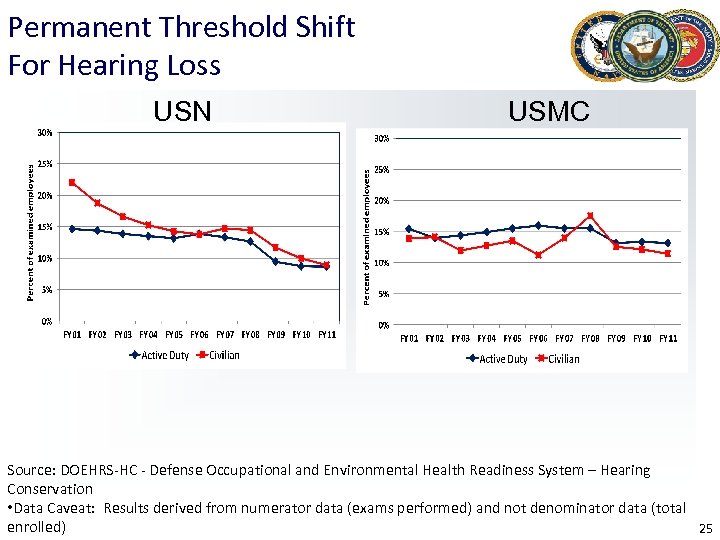 Permanent Threshold Shift For Hearing Loss USN USMC Source: DOEHRS-HC - Defense Occupational and Environmental Health Readiness System – Hearing Conservation • Data Caveat: Results derived from numerator data (exams performed) and not denominator data (total enrolled) 25
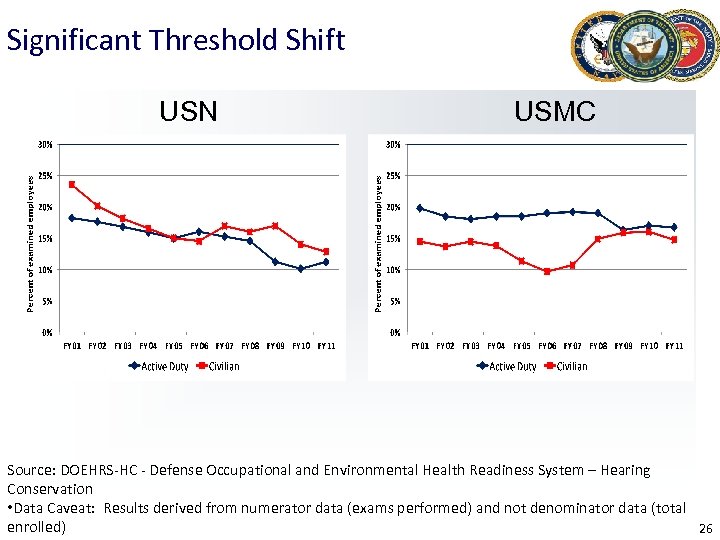 Significant Threshold Shift USN USMC Source: DOEHRS-HC - Defense Occupational and Environmental Health Readiness System – Hearing Conservation • Data Caveat: Results derived from numerator data (exams performed) and not denominator data (total enrolled) 26