Скачать презентацию Fiscal solidarity and decentralized government Germany CONVEGNO CNEL
162f7e8b3f054bbbb244fdf1f6efc6a2.ppt
- Количество слайдов: 36

 Fiscal solidarity and decentralized government: Germany CONVEGNO CNEL - ECONPUBBLICA Milano, 4 July 2003 Paul Bernd Spahn Goethe-Universität, Frankfurt am Main
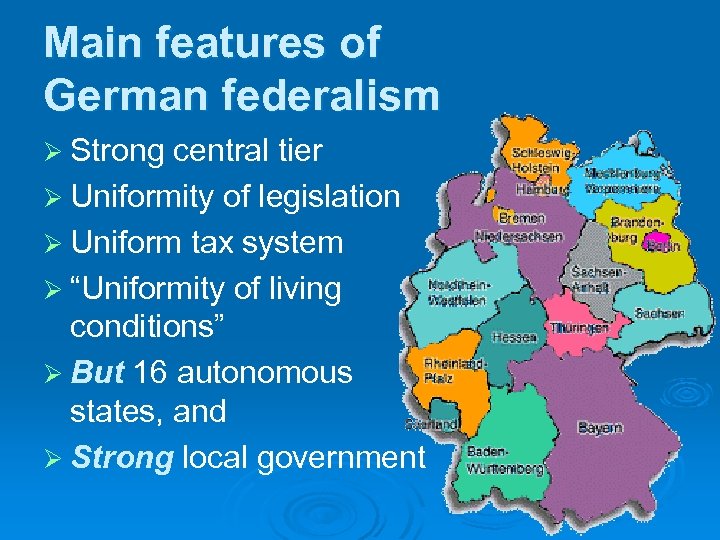 Main features of German federalism Ø Strong central tier Ø Uniformity of legislation Ø Uniform tax system Ø “Uniformity of living conditions” Ø But 16 autonomous states, and Ø Strong local government
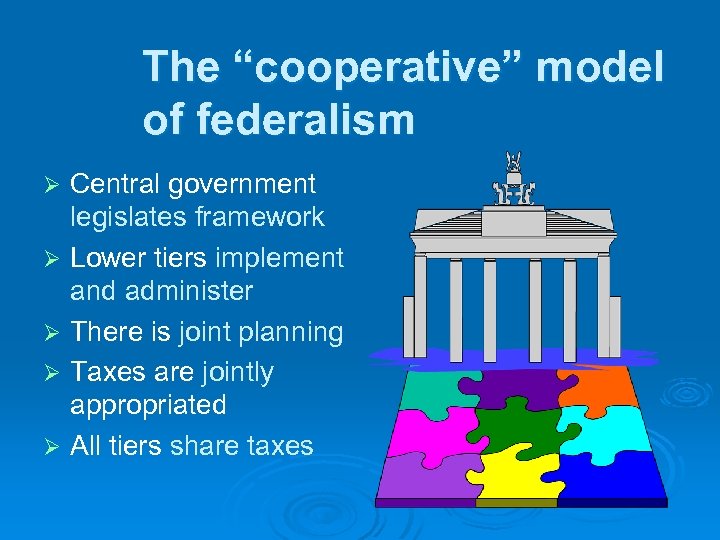 The “cooperative” model of federalism Ø Ø Ø Central government legislates framework Lower tiers implement and administer There is joint planning Taxes are jointly appropriated All tiers share taxes
 Legislation is exclusive and concurrent. Ø Concurrent legislation means that „the States have power to legislate as long as and to the extent that the Federation does not exercise its right to legislate“. Ø Concurrent legislation has enlarged the competency of the federal government over the years. Ø In addition to the exclusive and concurrent legislation, Article 75 GG enables the federal government to enact framework legislation for the legislation of the States as far as Article 74 a GG does not aver otherwise. Ø
 Protecting state sovereignty Today, legislation is typically centralized, and the administration of laws and their enforcement as well as service delivery are almost entirely decentralized. Ø There is a safeguard to protect state sovereignty: the Upper House or Bundesrat. Ø The states inject their voice into federal legislation through the Bundesrat, but only conjointly. Ø There a number of institutional arrangements for cooperating among governments: vertically and horizontally (cooperative federalism). Ø
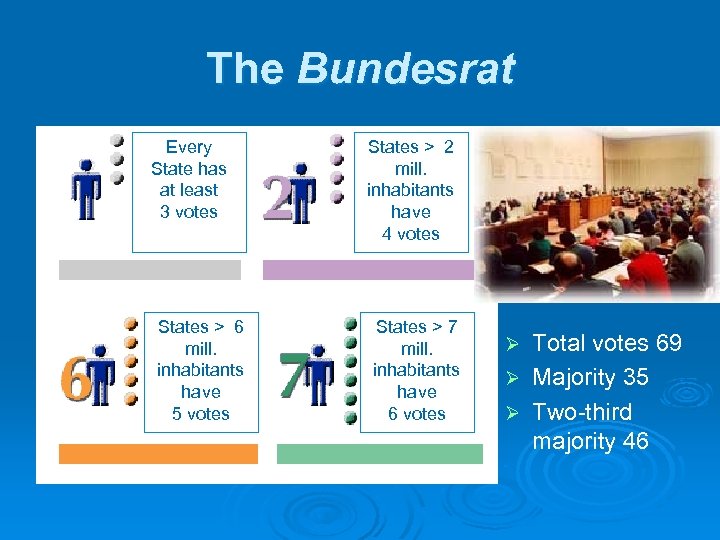 The Bundesrat Every State has at least 3 votes States > 6 mill. inhabitants have 5 votes States > 2 mill. inhabitants have 4 votes States > 7 mill. inhabitants have 6 votes Total votes 69 Ø Majority 35 Ø Two-third majority 46 Ø
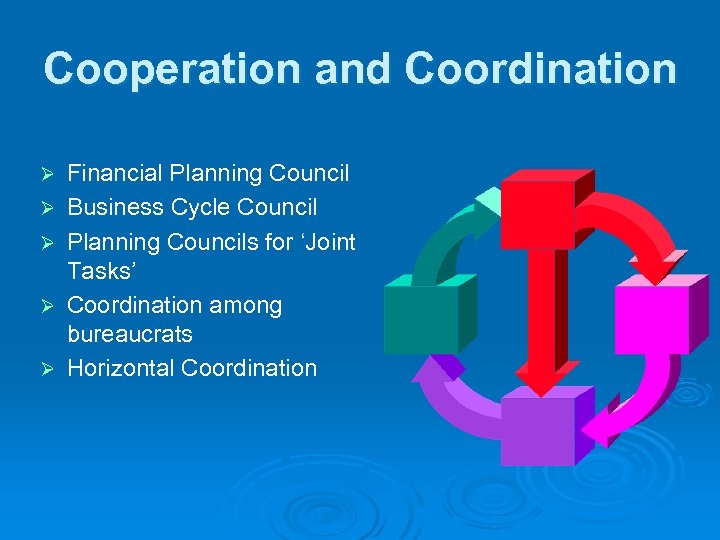 Cooperation and Coordination Ø Ø Ø Financial Planning Council Business Cycle Council Planning Councils for ‘Joint Tasks’ Coordination among bureaucrats Horizontal Coordination
 „Cooperative“ power sharing Cooperative federalism requires institutionalized forms of joint decision making and even cofinancing. Ø A prominent example is the „joint tasks“. Ø Political scientists suspect „joint tasks“ to blur accountability, but the instrument can also be seen to deal with interjurisdictional spillovers conforming to a contractual view of federalism. Ø Cooperative federalism exhibits a strong trend toward consensus forming—within institutions, and among institutions. Ø
 What functions are assigned to the Center? Ø Ø Ø Defense, foreign affairs Citizenship, immigration and emigration International treaties Currency matters Federal transport, postal and communication
 What functions are assigned to the States? Ø Ø Ø Culture, education Law and order Environmental policies Health Regional economic policies
 What functions are assigned to municipalities? Housing and road construction Ø School building Ø Communal services (e. g. sewerage, traffic) Ø Sports, recreation etc. Ø
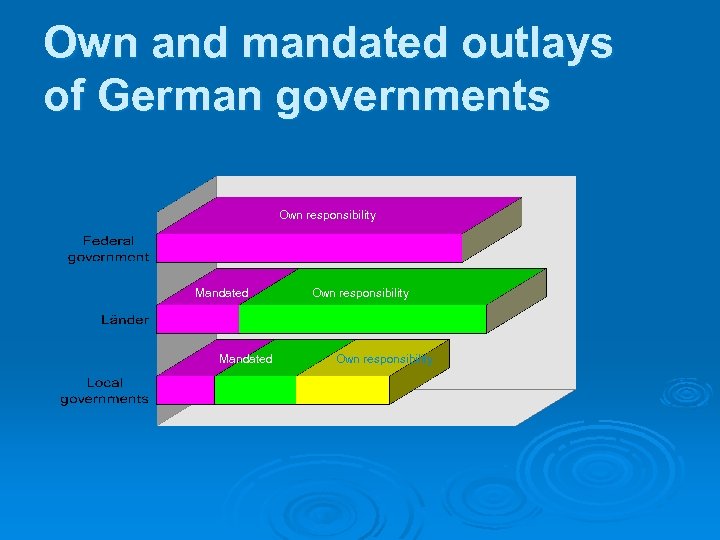 Own and mandated outlays of German governments Own responsibility Mandated Own responsibility
 Main features of the tax system (1) Legislation Ø Tax legislation is uniform and fully centralized Ø Tax laws have to pass the Bundesrat Ø There is limited discretion for municipal taxation Administration Ø The federal government administers customs duties, fiscal monopolies and federal excises Ø All other taxes are administered by the States (or municipalities)
 Main features of the tax system (2) Ø Ø Appropriation of proceeds from taxation The significance of directly assigned taxes is small The Federal taxes constitute about 15% of total taxes The State taxes constitute about 5% of total taxes The most important taxes are shared among levels l l l Ø The wage and the assessed income taxes The corporation tax The value-added tax The local business tax is also shared among all tiers
 Vertical equalization Germany attempts to achieve a vertical fiscal balance between layers of government. Ø The constitution presumes that it is possible Ø l l Ø to define “necessary expenditures” at both levels (state and federal governments), and to achieve a “fair compensation” (billiger Ausgleich) between both levels VAT sharing assumes the decisive role in securing “fairness” among layers of government. At present, the federal share of VAT is 50. 5 percent.
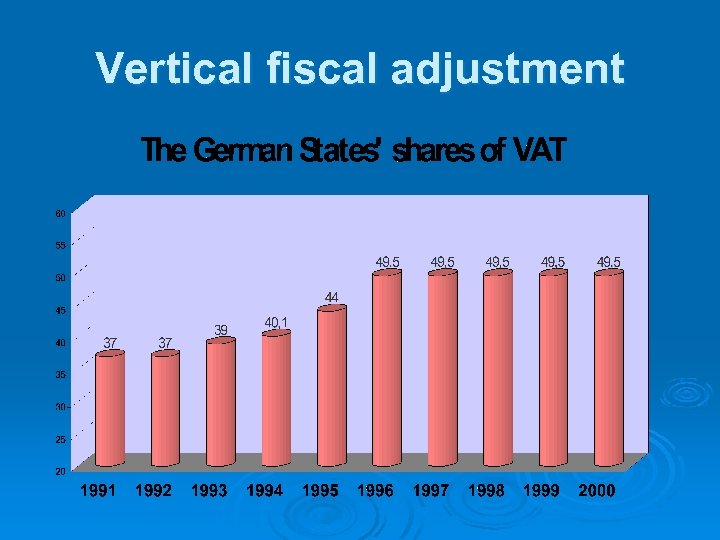 Vertical fiscal adjustment
 Interjurisdictional solidarity Apart from having created a „consensus democracy“, the German federation is characterized by a high degree of interjurisdictional solidarity. Ø After the War, the „uniformity of living conditions“ throughout the nation was a vital concern. It achieved constitutional rank. Ø Solidarity has reigned the equalization arrangements of post-war Germany, and has survived even the challenge of German unification. Ø
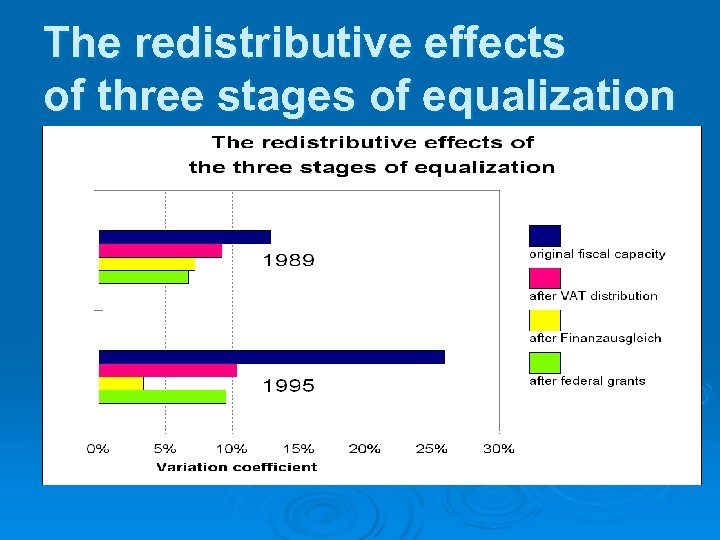
 Interjurisdictional solidarity and horizontal equalization The horizontal apportionment of the states‘ VAT share by region follows basically the number of population (for 75 percent of the share). Ø The remainder of the VAT share is used to bring the per capita level of financial resources up to 92 percent of the average of total state taxes. Ø The assignment of VAT revenue embodies a large degree of horizontal equalization already. Ø Germans consider VAT sharing as „legal entitlements“ rather than equalizing “grants”. Ø
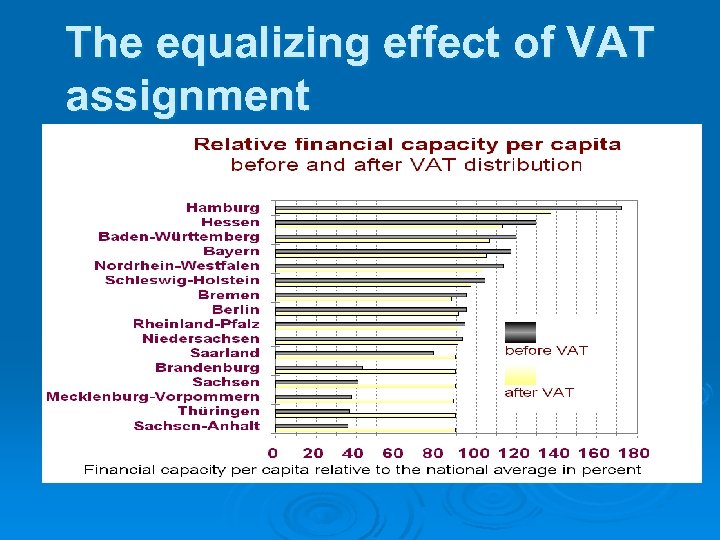 The equalizing effect of VAT assignment
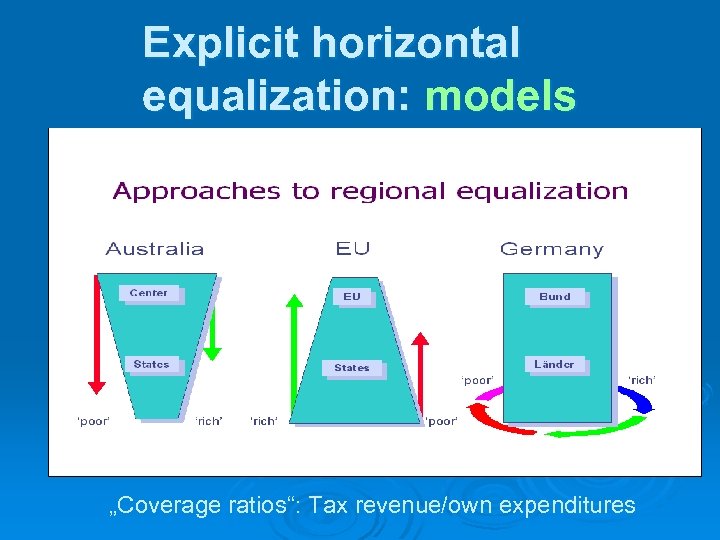 Explicit horizontal equalization: models „Coverage ratios“: Tax revenue/own expenditures
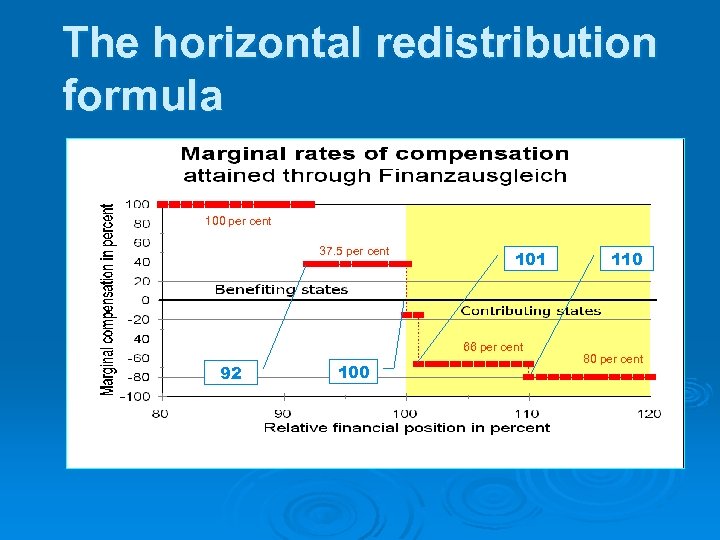
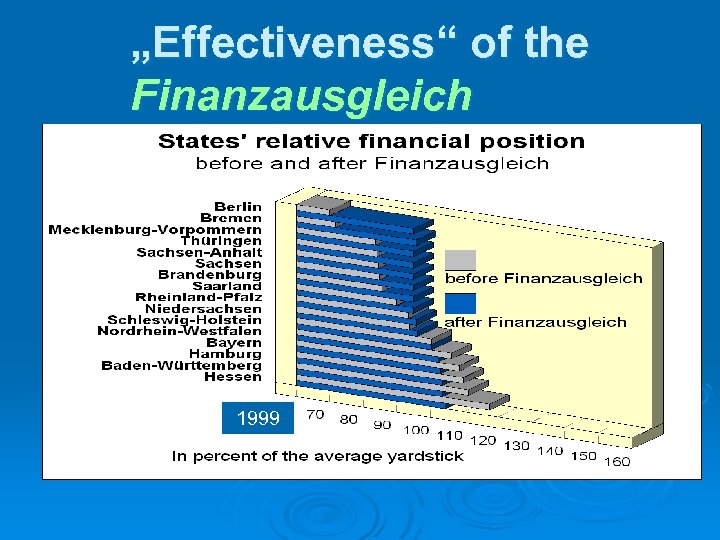
 Horizontal redistribution: Finanzausgleich (1) Ø Ø Ø The scheme equalizes tax capacities, not „needs“ or „cost differentials“. The measuring of tax capacity differentials requires a benchmark. It is found in a standardized “equalization yardstick” for state fiscal capacity (basically a national average per capita, times population). The procedure comprises a bias in favor of city-states whose populations are weighted by a factor of 1. 35. Moreover, there are some elements to alleviate supposed „special burdens“ (e. g. , for harbors).
 Horizontal redistribution: Finanzausgleich (2) The equalization yardstick is compared with the effective financial situation of each state, and the gap is equalized according to a formula. Ø States below the average receive a compensation. This compensation is carried, in progressive steps, by the states that lie above the average. Ø The scheme is a complete clearing mechanism. Ø The formula (or “tariff”) of the redistribution scheme reflects the degree of interregional solidarity among states. It is extremely progressive. Ø
 The horizontal redistribution formula 100 per cent 37. 5 per cent 101 66 per cent 92 100 110 80 per cent
 „Effectiveness“ of the Finanzausgleich 1999
 Asymmetrical federal grants Ø Ø Ø Moreover, there asymmetrical vertical federal grants: so-called „supplementary grants“. States receiving such grants are considered “weak in the provision of services”. In particular, factual “gap-filling grants” are used to guarantee at least 99. 5 percent of the average fiscal ability for all states. Moreover, 9 states out of 16 receive grants to relieve their costs of “political management”. The Eastern states (and some Western peers) receive federal grants for “special burdens”.
 The redistributive effects of three stages of equalization
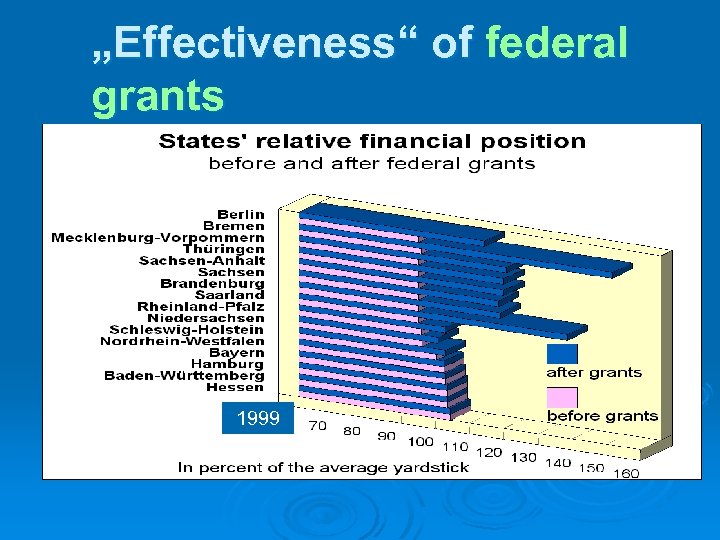 „Effectiveness“ of federal grants 1999
 A challenge of the Constitution Three states challenged the Constitution arguing that the scheme overstressed solidarity; and was inefficient. Ø The Constitutional Court criticized the Law to be Ø l not sufficiently transparent as to • the vertical distribution criteria; • alterations of the population criterion for horizontal equalization l to exaggerate the degree of equalization (violation of rank!)
 Contractual federalism in Germany? Where there are interjurisdictional spillovers, contractual forms of federalism could significantly improve the quality of public service delivery. Ø Financial flows corresponding to the service provided could correspond, more or less, to quid pro quo transactions, and any partner dissatisfied with the quality of the service could exit the market. Ø The cooperative machinery of German federalism is prone to dealing with interjurisdictional spillovers, but it would require more flexible contractual arrangements among authorities. Ø
 Interjurisdictional solidarity in Germany Interjurisdictional solidarity is firmly established and will prevail in Germany. Horizontal and asymmetrical forms of equalization will continue to be used to achieve it. Ø However, the Constitutional Court has limited the degree of equalization. Ø Federal grants will have to be limited to exceptional cases. Ø They will also typically have to be phased out over time. Ø
 Solidarity and economic efficiency Interjurisdictional contracts could lead to redesigning intergovernmental resource flows. Taking such flows into account renders equalization more efficient. Ø In particular negative financial incentives could be eliminated by allowing the states to generate some own revenue that is subject to legislation and control of regional authorities. Ø Marginal revenue must be protected against interregional redistribution to preserve the incentives. Ø Such protection of marginal revenue must not necessarily jeopardize solidarity among governments. Ø
 Is Germany prepared for competitive federalism? The concept of competitive federalism is contrary to the German perception of solidarity and uniformity in the provision of public services. Ø However, the states have begun to compete through service delivery and there are demands to allow some limited taxing autonomy for the states as well. Ø Competition among regions of the EU and globalizing trends will ultimately determine the pace of developments, but Germany’s corporatist approach appears to be ready to resist such trends. Ø
 Can the German system be reformed? The irony of the German system is that its basic philosophies and actual fiscal arrangements can be interpreted to foster a modernization of its intergovernmental cooperative machinery, as institutionalized cooperation could be considered to be an archetype of contractual federalism. Ø However the need for consensus, reluctance to compete, and a partisan-driven emphasis on strong regional solidarity may ultimately prevent this modernization of German federalism to materialize. Ø
 Thank you for your attention.