


 Скачать презентацию First World War Treaties and the League of
68efd9ab7a619430f1547db20aa47340.ppt
- Количество слайдов: 31
 First World War Treaties and the League of Nations
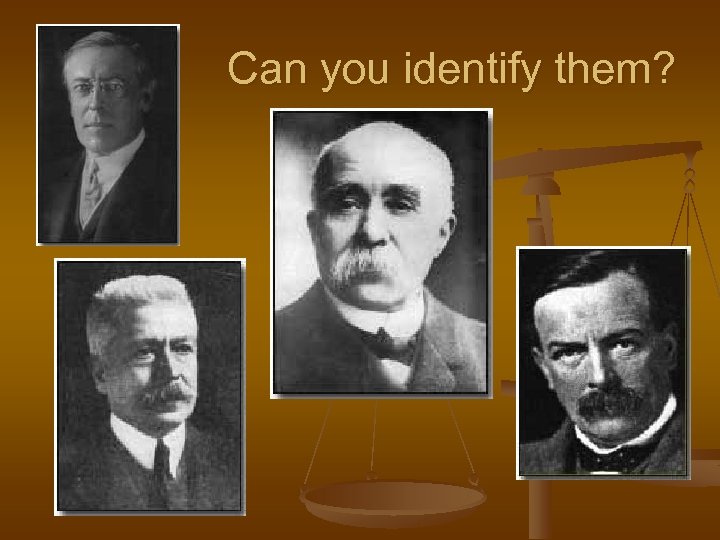 Can you identify them?
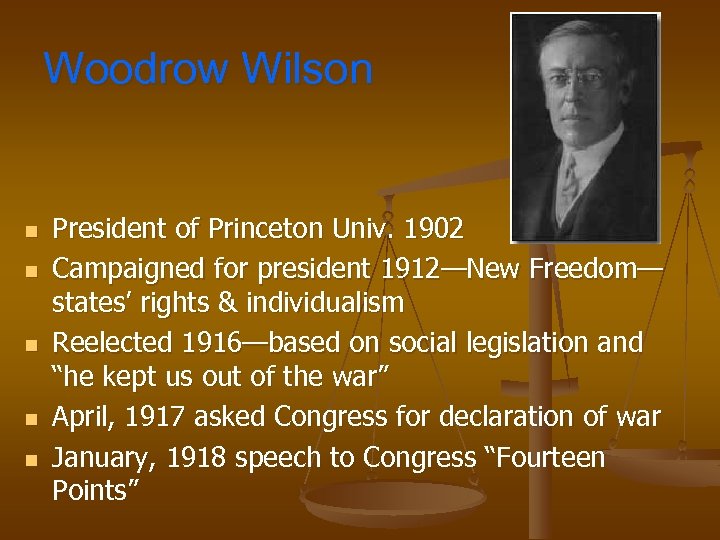 Woodrow Wilson n n President of Princeton Univ. 1902 Campaigned for president 1912—New Freedom— states’ rights & individualism Reelected 1916—based on social legislation and “he kept us out of the war” April, 1917 asked Congress for declaration of war January, 1918 speech to Congress “Fourteen Points”
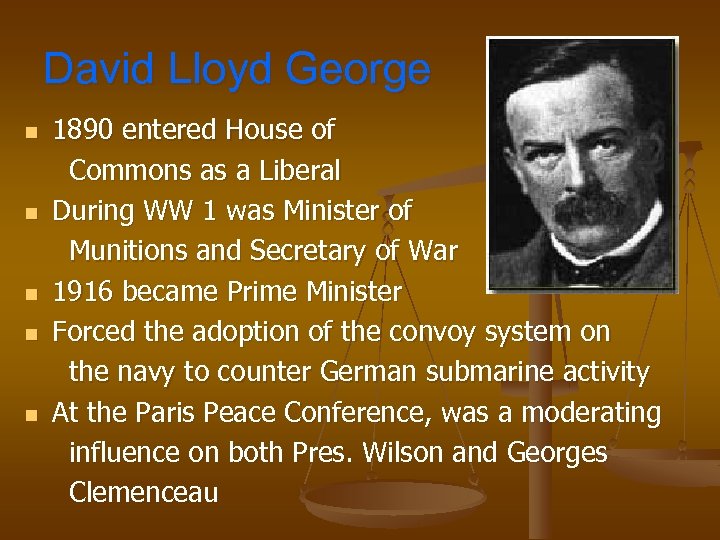 David Lloyd George n n n 1890 entered House of Commons as a Liberal During WW 1 was Minister of Munitions and Secretary of War 1916 became Prime Minister Forced the adoption of the convoy system on the navy to counter German submarine activity At the Paris Peace Conference, was a moderating influence on both Pres. Wilson and Georges Clemenceau
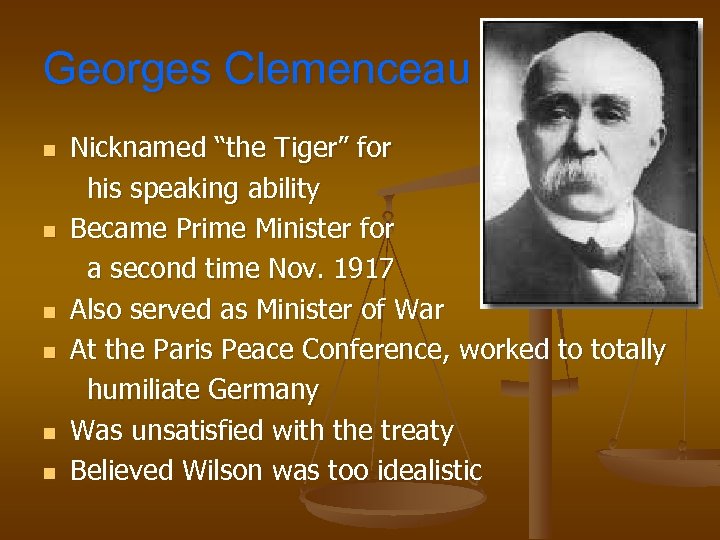 Georges Clemenceau n n n Nicknamed “the Tiger” for his speaking ability Became Prime Minister for a second time Nov. 1917 Also served as Minister of War At the Paris Peace Conference, worked to totally humiliate Germany Was unsatisfied with the treaty Believed Wilson was too idealistic
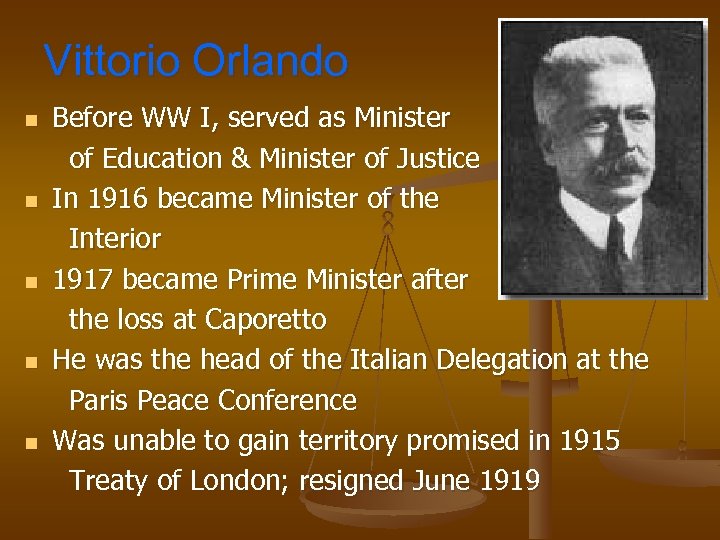 Vittorio Orlando n n n Before WW I, served as Minister of Education & Minister of Justice In 1916 became Minister of the Interior 1917 became Prime Minister after the loss at Caporetto He was the head of the Italian Delegation at the Paris Peace Conference Was unable to gain territory promised in 1915 Treaty of London; resigned June 1919
 The Treaties n n n Treaty of Versailles w/Germany 1919 440 Articles Article 231 “war guilt clause” Treaty of St. Germain w/Austria 1919 Treaty of Neuilly w/Bulgaria 1919 Treaty of Trianon w/Hungary 1920 Treaty of Sevres w/Turkey 1920 Treaty of Lausanne w/Turkey 1923
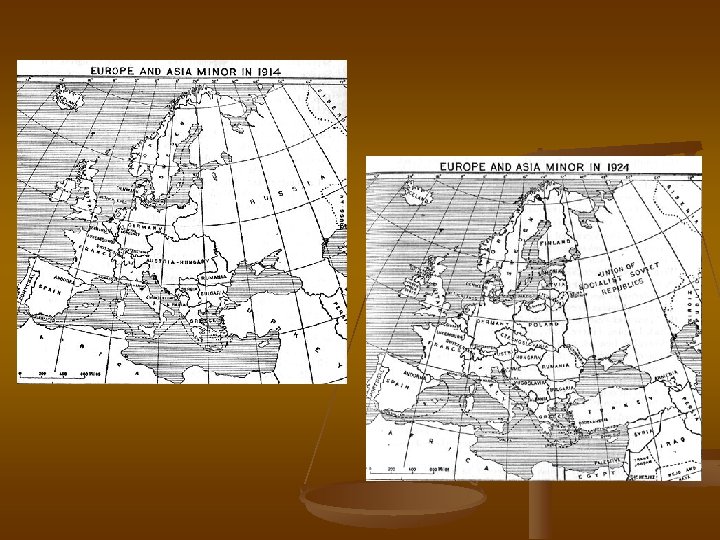
 Treaty of Versailles… were the terms carried out? n n n League of Nations was created Poland, France, Belgium & Denmark all did receive land; Germany did hand over all land stipulated by the treaty All overseas colonies were handed over to the League Land taken from Russia was given back, except Latvia, Lithuania & Estonia were made independent—national self-determination Germany’s army reduced to 100, 000 men; only on paper
 n n n Germany’s navy was reduced to 6 battleships & no submarines (Germany couldn’t afford to build battleships anyway & navies were moving to destroyers and aircraft carriers) Submariners were trained abroad—not covered in the treaty, so this did not break the treaty No air force… happened; but pilots trained abroad Western Germany was demilitarized There was no union with Austria
 n n Germany did pay some of the reparations; Germany did not refuse to pay in 1922, just did not produce the railroad ties; in the 1920 s the Allies reduced reparation payments Germany did not start systematically breaking the Versailles treaty until Hitler came to power
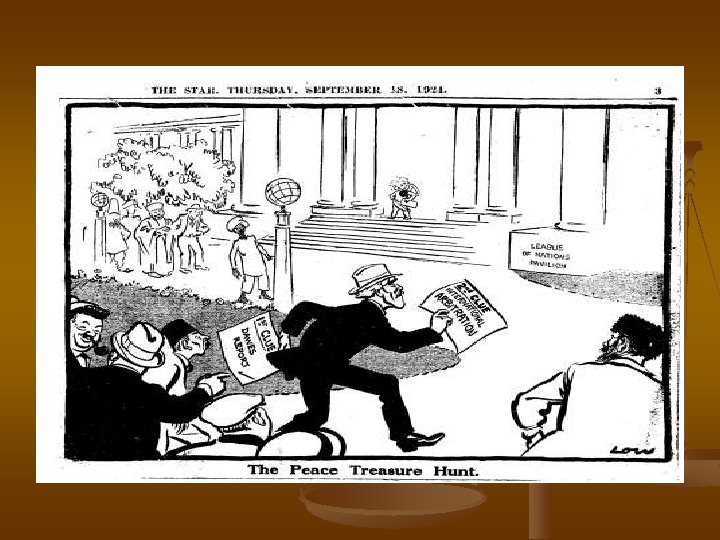
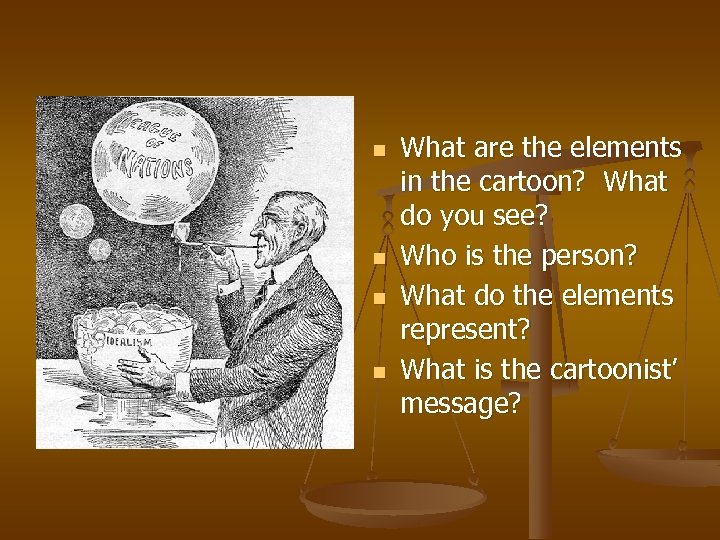 n n What are the elements in the cartoon? What do you see? Who is the person? What do the elements represent? What is the cartoonist’ message?
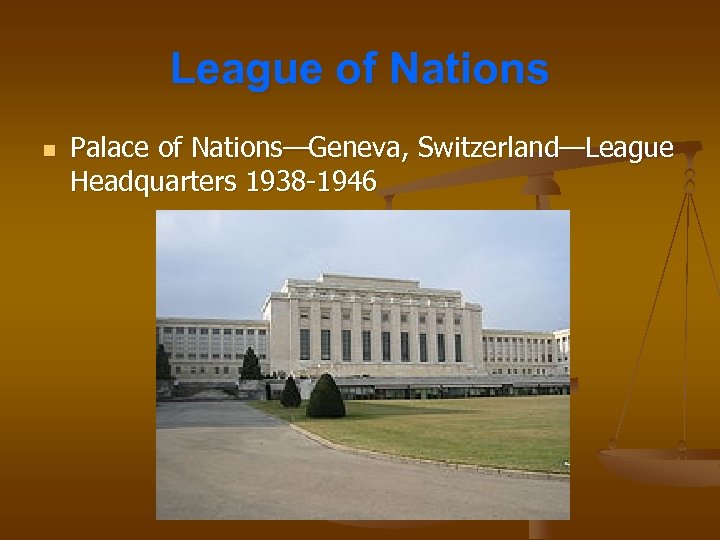 League of Nations n Palace of Nations—Geneva, Switzerland—League Headquarters 1938 -1946
 n n n Aims: promote int’l cooperation—settle disputes through negotiation prevent war through collective security improve global welfare disarmament January 1920: formally came into existence Official languages: French & English
 League Bodies n n n n Council Assembly Secretariat… headed by Secretary-General Closely related, but autonomous bodies… Permanent Court of International Justice International Labor Organization League established subsidiary bodies to promote cooperation in fields of health, education, social & economic matters
 n n No military or peacekeeping force Member nations were NOT required to provide troops if it became necessary to ensure peace “Anything the League does or does not do is due to the policies of the Government members of the League, who, in their turn, are moved by the pressure of public opinion behind them” https: //bl-libg-doghill. ads. iu. edu/leagueweb/book/title. html
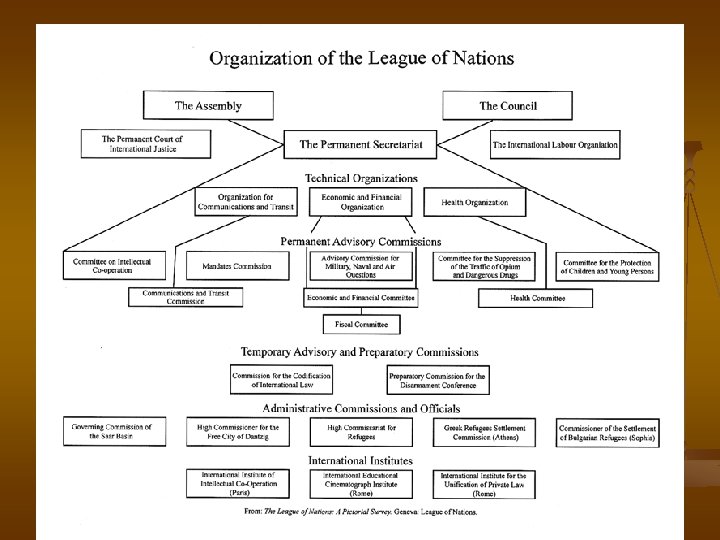
 Assembly n n n Contained all League members Each country had 1 vote, though could have up to three delegates Decisions were unanimous vote Questions of procedure, membership of committees or election of temporary members of the Council were majority decision New nations admitted by 2/3 vote
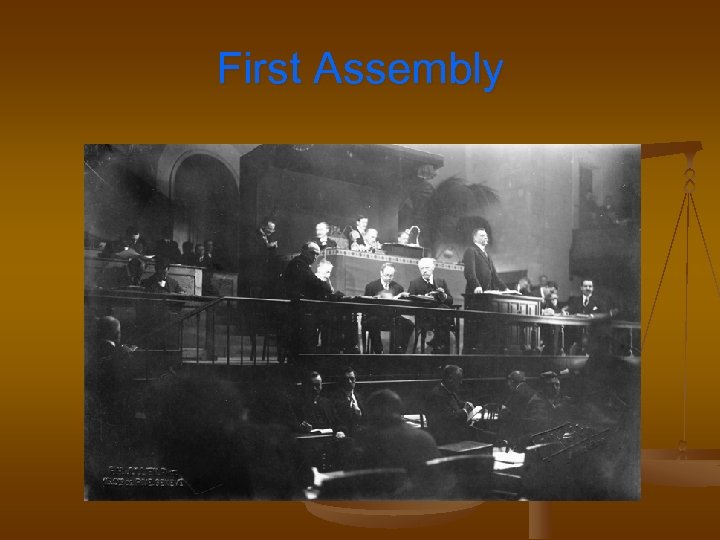 First Assembly
 n n 1920. . . 42 members During the 1920 s… 14 additional countries admitted Hungary (1922) Germany (1926) 2 countries withdrew (Brazil & Costa Rica)
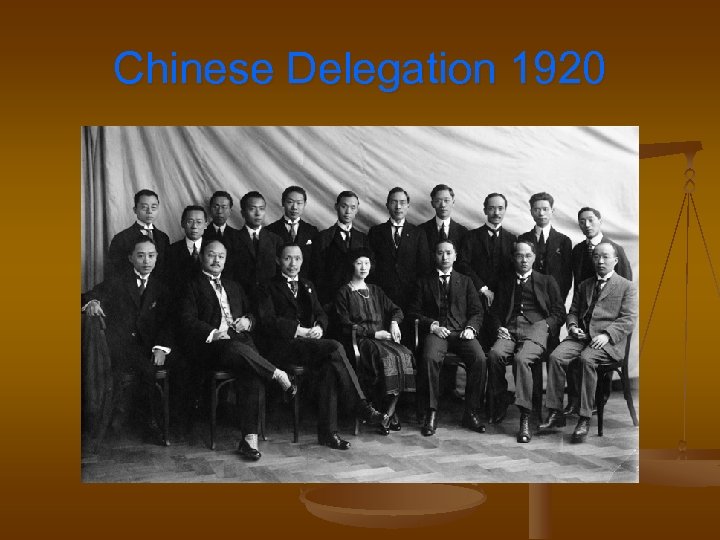 Chinese Delegation 1920
 n n n During the 1930 s… 7 additional countries admitted Kingdom of Iraq (1932) Turkey admitted (1932) USSR admitted (1934) 13 countries withdrew Germany & Japan (1933) Italy (1937) 2 countries annexed Austria (1938) Albania (1939) 1 country expelled… USSR (1939)
 Council n n n Met every three months Began with four permanent members… France, G. Britain, Italy, Japan USA was supposed to be a permanent member; Germany was given the US seat in 1926 There were four non-permanent members, later changed to 10 non-permanent members Main task was to settle international disputes
 n n Responsible for protecting minorities in different parts of Europe Oversaw Mandate system Responsible for the Saar Governing Commission Decisions were by unanimous vote
 Secretariat n n n The “civil service” of the League Were not representatives of their home governments Secretary-Generals… from UK 1920 -1933 from France 1933 -1940 from Ireland 1940 -1946
 Mandate System n n n The origin of the idea of a mandate system was in Wilson’s 5 th point of the 14 Points—”a free, openminded, and absolutely impartial adjustment of all colonial claims…” Set up in Article 22 of the Versailles Treaty Limited to former colonies of Germany and non. Turkish areas of the Ottoman Empire Mandatory countries were to file annual reports with the Permanent Mandates Commission There was no requirement that Mandatory countries take specific steps to help countries actually achieve self government & independence
 n n n Areas felt to be closest to achieving democratic self rule were referred to as “A” Mandates… all A Mandates were in the Middle East Areas felt to need guidance and protection of a mandatory power to learn to establish an eventual democratic nation were referred to as “B” Mandates… B Mandates were mostly in Africa Areas felt to be better off as part of a Mandatory nation; they might become independent far in the future and were referred to as “C” Mandates… they were located in Africa & the South Pacific
 Mandatory Countries n Great Britain France Japan South Africa Belgium Australia New Zealand n NOTE: Italy did NOT receive a mandate n n n
 Enforcement of League Decisions n n n Moral persuasion… use of diplomacy Economic sanctions Use of military force, but the League had no army… it had to rely on member states to provide military
 Sources n n n n http: //www. historylearningsite. co. uk/treaty_of_versailles. htm http: //www. indiana. edu/~league/ http: //www. spartacus. schoolnet. co. uk/FWWleague. htm http: //www. historylearningsite. co. ul/leagueofnations. htm http: //worldatwar. net/timeline/other/league 18 -46. html http: //www. unog. ch/80256 EE 600581 D 0 E/(http. Pages)/1 DB 47 BF 4 B 01671 BF 80256 EF 70059153 C? Open. Doc ument https: //bl-libg-doghill. ads. iu. edu/league-web/book/title. html http: //en. wikipedia. org/wiki/Palace_of_Nations http: //www. cartoons. ac. uk/browse/cartoon_item/anytext=League%20 of%20 Nations? artist=Low; %20 Da vid%20(1891 -1963) &subjects_text[]=League%20 of%20 Nations%201919&page=17 http: //www. firstworldwar. com/bio/wilson. htm http: //www. firstworldwar. com/bio/lloydgeorge. htm http: //www. firstworldwar. com/bio/clemenceau. htm http: //www. firstworldwar. com/bio/orlando. htm http: //homepage. mac. com/oldtownman/text/versaillestreaty/vercontents. html http: //www. americanforeignrelations. com/E-N/Mandates-and-Trusteeships-League-of-nationsmandates. html http: //www. nationsencyclopedia. com/United-Nations/The-Trusteeship-Council-THE-MANDATE-SYSTEMOF-THE-LEAGUE-OF-NATIONS. html