


 Скачать презентацию FIRST REVISION OF J 3016 UPDATE ON
87143341a287d94eca58192746372d5b.ppt
- Количество слайдов: 12
 FIRST REVISION OF J 3016 – UPDATE ON TASK FORCE ACTIVITIES ITU-TIA Meeting, Arlington, VA 07 December 2015 Barbara Wendling Chair, J 3016 Task Force (SAE On-Road Automated Vehicle Standards Committee)
 Background Revision history of original version of J 3016 • • • Full ORAV review August 2012 Survey ballot DEC 2012 (closed 04 JAN 2013) – passed 1 st formal ballot FEB 2013 – passed unanimously with comments 2 nd formal ballot NOV 2013 – passed unanimously with minor comments Published 11 JAN 2014 Primary source/reference documents for J 3016: JAN 2014 • BASt (Tom Gasser, et al. ) • NHTSA draft definitions (presented at January, 2013, SAE G-I Meeting) Motivation for revisions to J 3016 • BASt/VDA/OICA harmonization with J 3016 taxonomy and supporting definitions for WP 29 discussions • Application and adaptation of J 3016 levels and definitions in Adapt. IVe and CAMP AVR projects • Information and ideas gleaned from other sources (conferences, meetings, academic exchanges, etc. ) SAE INTERNATIONAL Paper # (if applicable) 2
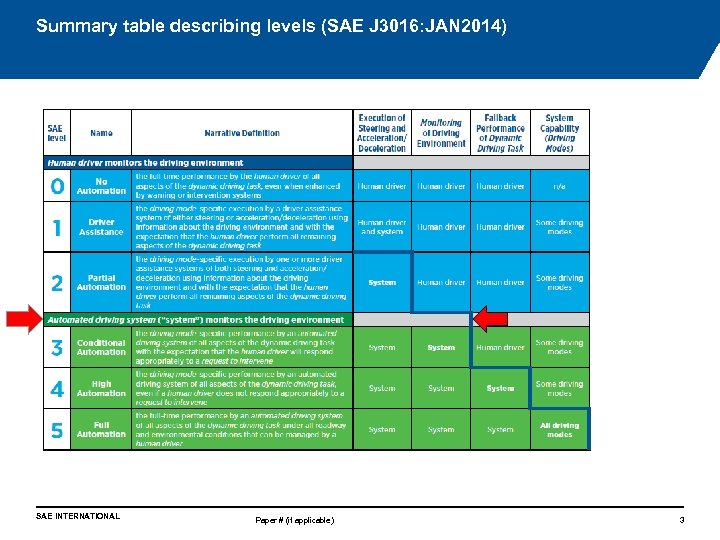 Summary table describing levels (SAE J 3016: JAN 2014) SAE INTERNATIONAL Paper # (if applicable) 3
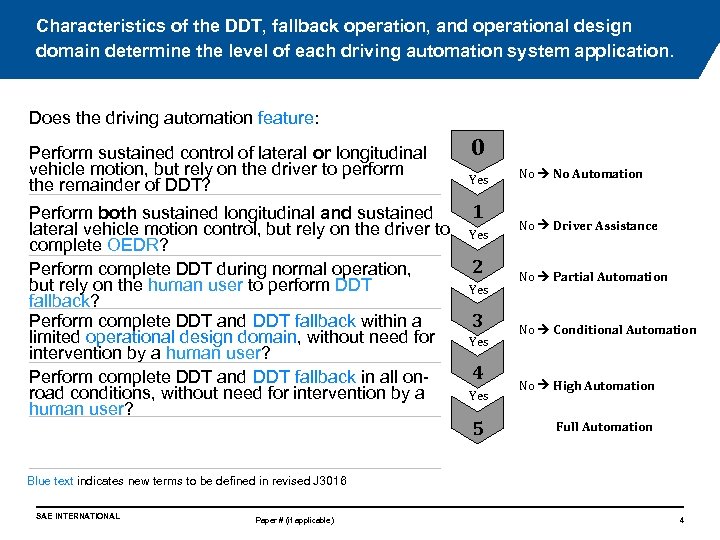 Characteristics of the DDT, fallback operation, and operational design domain determine the level of each driving automation system application. Does the driving automation feature: Perform both sustained longitudinal and sustained lateral vehicle motion control, but rely on the driver to complete OEDR? Perform complete DDT during normal operation, but rely on the human user to perform DDT fallback? Perform complete DDT and DDT fallback within a limited operational design domain, without need for intervention by a human user? Perform complete DDT and DDT fallback in all onroad conditions, without need for intervention by a human user? 0 Perform sustained control of lateral or longitudinal vehicle motion, but rely on the driver to perform the remainder of DDT? Yes 1 Yes 2 Yes 3 Yes 4 Yes 5 No Automation No Driver Assistance No Partial Automation No Conditional Automation No High Automation Full Automation Blue text indicates new terms to be defined in revised J 3016 SAE INTERNATIONAL Paper # (if applicable) 4
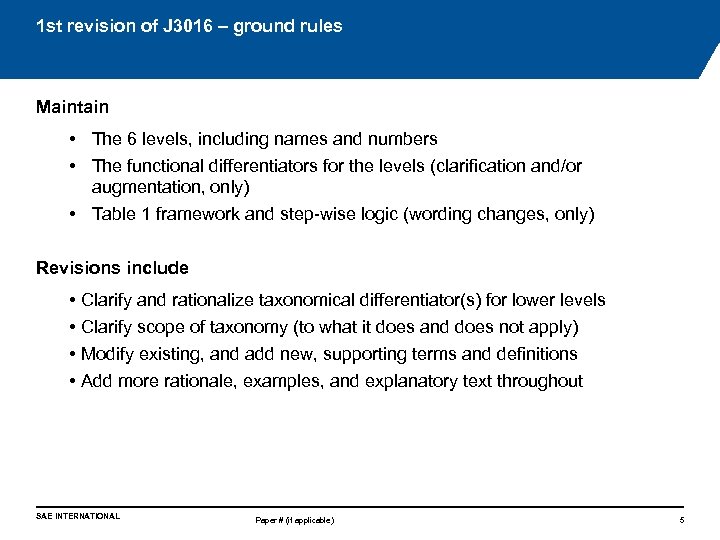 1 st revision of J 3016 – ground rules Maintain • The 6 levels, including names and numbers • The functional differentiators for the levels (clarification and/or augmentation, only) • Table 1 framework and step-wise logic (wording changes, only) Revisions include • Clarify and rationalize taxonomical differentiator(s) for lower levels • Clarify scope of taxonomy (to what it does and does not apply) • Modify existing, and add new, supporting terms and definitions • Add more rationale, examples, and explanatory text throughout SAE INTERNATIONAL Paper # (if applicable) 5
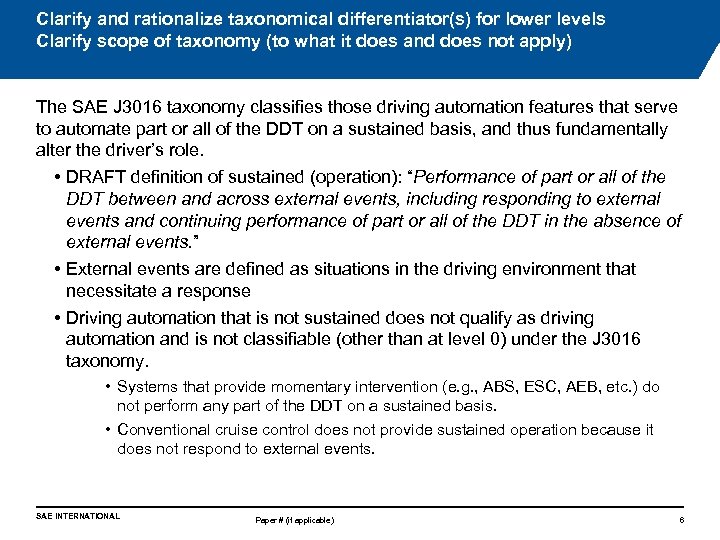 Clarify and rationalize taxonomical differentiator(s) for lower levels Clarify scope of taxonomy (to what it does and does not apply) The SAE J 3016 taxonomy classifies those driving automation features that serve to automate part or all of the DDT on a sustained basis, and thus fundamentally alter the driver’s role. • DRAFT definition of sustained (operation): “Performance of part or all of the DDT between and across external events, including responding to external events and continuing performance of part or all of the DDT in the absence of external events. ” • External events are defined as situations in the driving environment that necessitate a response • Driving automation that is not sustained does not qualify as driving automation and is not classifiable (other than at level 0) under the J 3016 taxonomy. • Systems that provide momentary intervention (e. g. , ABS, ESC, AEB, etc. ) do not perform any part of the DDT on a sustained basis. • Conventional cruise control does not provide sustained operation because it does not respond to external events. SAE INTERNATIONAL Paper # (if applicable) 6
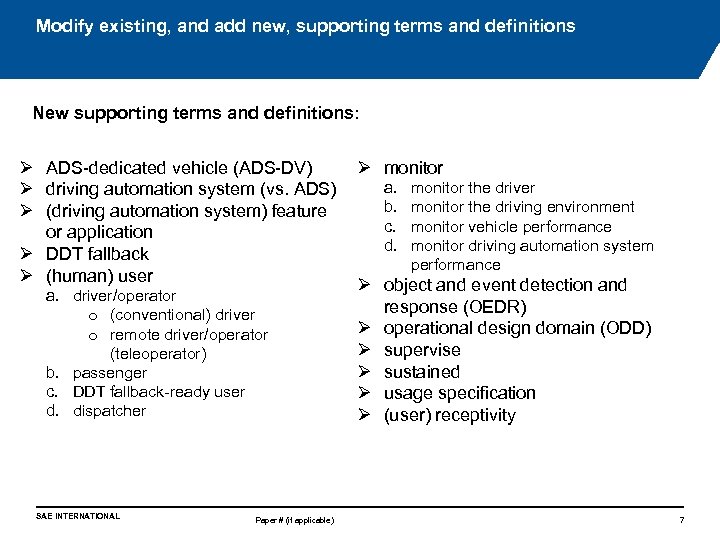 Modify existing, and add new, supporting terms and definitions New supporting terms and definitions: Ø ADS-dedicated vehicle (ADS-DV) Ø driving automation system (vs. ADS) Ø (driving automation system) feature or application Ø DDT fallback Ø (human) user a. driver/operator o (conventional) driver o remote driver/operator (teleoperator) b. passenger c. DDT fallback-ready user d. dispatcher SAE INTERNATIONAL Paper # (if applicable) Ø monitor a. b. c. d. monitor the driver monitor the driving environment monitor vehicle performance monitor driving automation system performance Ø object and event detection and response (OEDR) Ø operational design domain (ODD) Ø supervise Ø sustained Ø usage specification Ø (user) receptivity 7
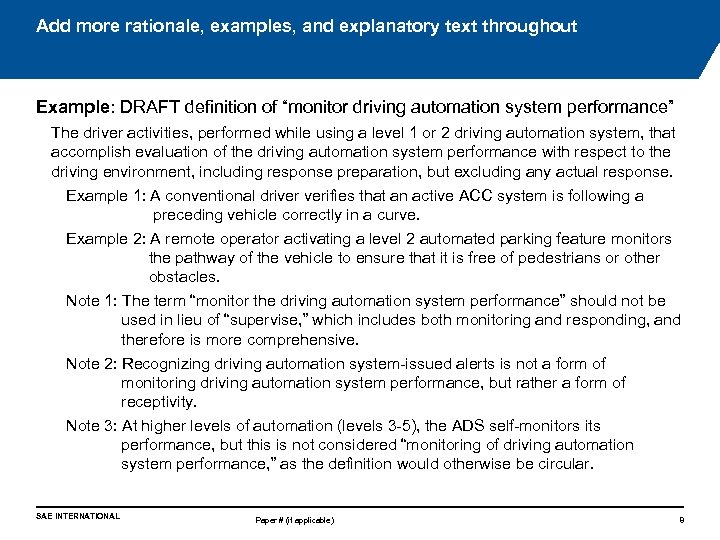 Add more rationale, examples, and explanatory text throughout Example: DRAFT definition of “monitor driving automation system performance” The driver activities, performed while using a level 1 or 2 driving automation system, that accomplish evaluation of the driving automation system performance with respect to the driving environment, including response preparation, but excluding any actual response. Example 1: A conventional driver verifies that an active ACC system is following a preceding vehicle correctly in a curve. Example 2: A remote operator activating a level 2 automated parking feature monitors the pathway of the vehicle to ensure that it is free of pedestrians or other obstacles. Note 1: The term “monitor the driving automation system performance” should not be used in lieu of “supervise, ” which includes both monitoring and responding, and therefore is more comprehensive. Note 2: Recognizing driving automation system-issued alerts is not a form of monitoring driving automation system performance, but rather a form of receptivity. Note 3: At higher levels of automation (levels 3 -5), the ADS self-monitors its performance, but this is not considered “monitoring of driving automation system performance, ” as the definition would otherwise be circular. SAE INTERNATIONAL Paper # (if applicable) 8
 Practical use of SAE J 3016 in Europe: Adapt. IVe Project Adapt. IVe (Automated driving applications and technologies for Intelligent Vehicles) • • € 25 million project running January 1, 2014 - June 30, 2017 • 29 partners from 8 countries – France, Germany, Greece, Italy, Spain, Sweden, The Netherlands, United Kingdom; including 11 original equipment manufacturers, 4 suppliers, 11 research institutes and universities, and 3 small/medium enterprises Objectives include human factors issues, evaluation methods, and legal aspects Deliverable D 2. 1 - System Classification and Glossary • Describes harmonization of levels between BASt, VDA, and SAE • Applies these harmonized levels and SAE J 3016 supporting terms • Provides further granularity via a systematic methodology for applying additional classification parameters • Document available for download: https: //www. adaptive-ip. eu/index. php/deliverables_papers. html • • Co-funded by the European Commission as part of the Seventh Framework Programme with € 14. 3 million supported by the European Council for Automotive R&D, EUCAR SAE INTERNATIONAL Paper # (if applicable) 9
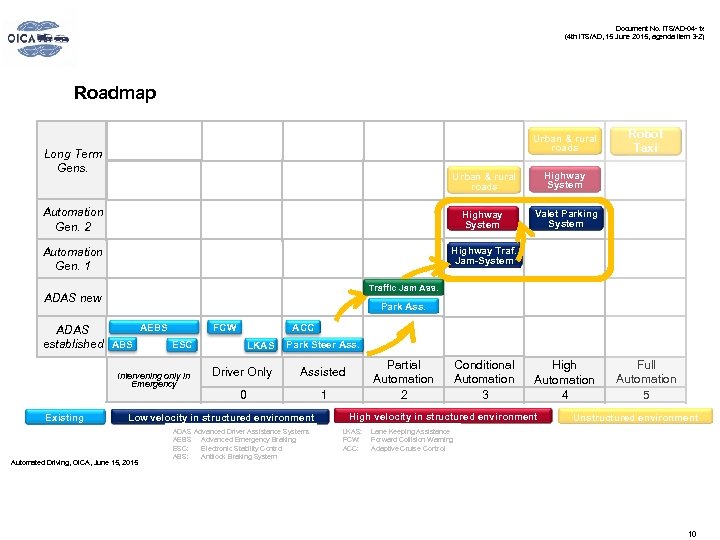 Document No. ITS/AD-04 -1 x (4 th ITS/AD, 15 June 2015, agenda item 3 -2) Roadmap Automated Driving - Example Functions Urban & rural roads Long Term Gens. Urban & rural roads Highway System Automation Gen. 2 Highway System Valet Parking System Automation Gen. 1 Robot Taxi Highway Traf. Jam-System Traffic Jam Ass. ADAS new Park Ass. AEBS ADAS established ABS ESC Intervening only in Emergency Existing ACC FCW LKAS Park Steer Ass. Driver Only 0 1 Low velocity in structured environment Automated Driving, OICA, June 15, 2015 Partial Automation 2 Assisted ADAS Advanced Driver Assistance Systems AEBS Advanced Emergency Braking ESC: Electronic Stability Control ABS: Antilock Braking System Conditional Automation 3 High Automation 4 High velocity in structured environment LKAS: FCW: ACC: Full Automation 5 Unstructured environment Lane Keeping Assistance Forward Collision Warning Adaptive Cruise Control 10
 Practical use of SAE J 3016 in US: CAMP AVR Project CAMP AVR (Crash Avoidance Metrics Partnership Automated Vehicle Research) • Cooperative Research Agreement with NHTSA running from November, 2013 through July, 2015 • Consortium members: Ford Motor Company, General Motors, Nissan, Mercedes-Benz, Toyota, and Volkswagen Group of America • Objectives included: functional descriptions of automation levels, list of potential driving automation features, level-specific safety principles, potential objective test methods for evaluating driving automation systems • CAMP AVR Consortium incorporated the SAE J 3016 levels and supporting terms and embellished upon them • Final report has been submitted to NHTSA SAE INTERNATIONAL Paper # (if applicable) 11
 For further information Outgoing ORAVS Comm. chair: Paul Perrone pperrone@perronerobotics. com Incoming ORAVS Comm. chair: Steve Underwood underw@umich. edu Definitions (J 3016) TF chair: Barbara Wendling barbara. wendling@vw. com SAE Staff Secretary: Nikki Ameredes nikki. ameredes@sae. org SAE INTERNATIONAL Paper # (if applicable) 12