


 Скачать презентацию First-person- and thirdperson-oriented genericity in Russian Elena Paducheva
18b6b329c5f6f7f64426f2c94ef54b78.ppt
- Количество слайдов: 32
 First-person- and thirdperson-oriented genericity in Russian Elena Paducheva (Moscow) http: //lexicograph. ruslang. ru/ elena. paducheva@yandex. ru SPE-6, St. Petersburg, 10 -14. 06. 2013
 The paper deals with Russian generic-personal sentences (GPS) – this term being applied, in the first place, to subjectless sentences with the predicate of the second person singular (present or future tense), with the implied subject referring to the generalized first person and meaning something like ‘me and those like me’. (Some of the examples below are taken from the Russian National Corpus, http: //www. ruscorpora. ru ) (1) a. Est’ mnogo slov, kotorye proiznosish’ po privychke ‘there are many words that
 n In Moltmann 2010 the meaning of generic one in English is described in basically the same way. It is claimed that this pronoun expresses first-person-oriented genericity. Taking into consideration the fact that in the American variety of English you is often used instead of one, I suggest that the implied subject of a Russian GPS (with the predicate of the second person) also expresses first-person-oriented genericity.
 n n Jespersen (Philosophy of grammar) about one and you; example from “Martin Eden” by Jack London. Ruth: “By the way, Mr. Eden, what is booze? You used it several times, you know. ” “Oh, booze, it’s slang. It’s whisky and beer – anything that will make you drunk. ” Ruth: “Don’t use you when you are impersonal. You is very personal, and your use of it just now is not precisely what you meant” “I don’t just see that. ” “Why, you said just now to me ‘whisky and beer – anything that will make you drunk’ – make me drunk, don’t you see? ” “Well, it would, wouldn’t it? ” “Yes, of course”, she smiled; but it would be nicer not to bring me into it. Substitute one for you, and see how much better it sounds. ”
 n So one and you do not mean the same. Still it is clear that 2 d person pronouns and verb forms express first-person-oriented genericity easier than the 1 st person ones do, both in English and in Russian. Perhaps in some other languages as well.
 There are other varieties of GPS in Russian – sentences with the generic ty ‘you’, ex. (3), (generic vy is also possible – when interpreted as a form of politeness, not plural): (3) Chto ty budesh’ delat’ s bessovestnymi ljud’mi! ‘what will you do with dishonest people!’ n Generic use of the implied subject of the imperative is also possible: (4) Podi dokazhi, chto ty ne verbljud ‘go and prove that you are not a camel’. n
 Other means of expressing first-person-oriented genericity – generic my ‘we’, ex. (5), and generic chelovek ‘man’, ex. (6): (5) Oxotno my darim, chto nam ne nadobno samim ‘gladly we give
 n n In what follows I deal with generic use of subjectless second person predicates, as in (1), (2), and of the second person pronouns, as in (3). I am ready to accept that English generic one behaves approximately in the same way as you in the American variety of English. So I compare the English generic one described in Moltmann 2010 with the Russian firstperson-generic ty ‘you’ and the implied 2 d person subject of the GPS.
 n The first obstacle. In Moltmann 2010 generic one is usually equated with the arbitrary PRO – or controlled PRO. But in Russian zero (and non-zero) 2 d person subject of a GPS usually is not interchangeable with the arbitrary PRO.
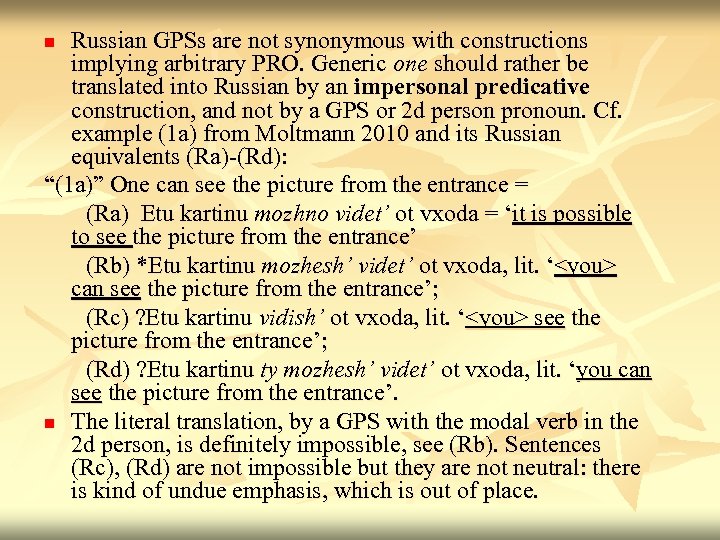 Russian GPSs are not synonymous with constructions implying arbitrary PRO. Generic one should rather be translated into Russian by an impersonal predicative construction, and not by a GPS or 2 d person pronoun. Cf. example (1 a) from Moltmann 2010 and its Russian equivalents (Ra)-(Rd): “(1 a)” One can see the picture from the entrance = (Ra) Etu kartinu mozhno videt’ ot vxoda = ‘it is possible to see the picture from the entrance’ (Rb) *Etu kartinu mozhesh’ videt’ ot vxoda, lit. ‘
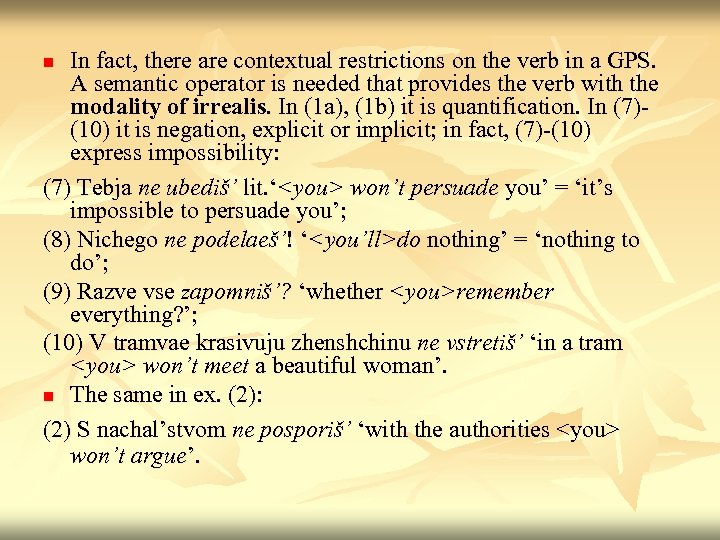 In fact, there are contextual restrictions on the verb in a GPS. A semantic operator is needed that provides the verb with the modality of irrealis. In (1 a), (1 b) it is quantification. In (7)(10) it is negation, explicit or implicit; in fact, (7)-(10) express impossibility: (7) Tebja ne ubediš’ lit. ‘
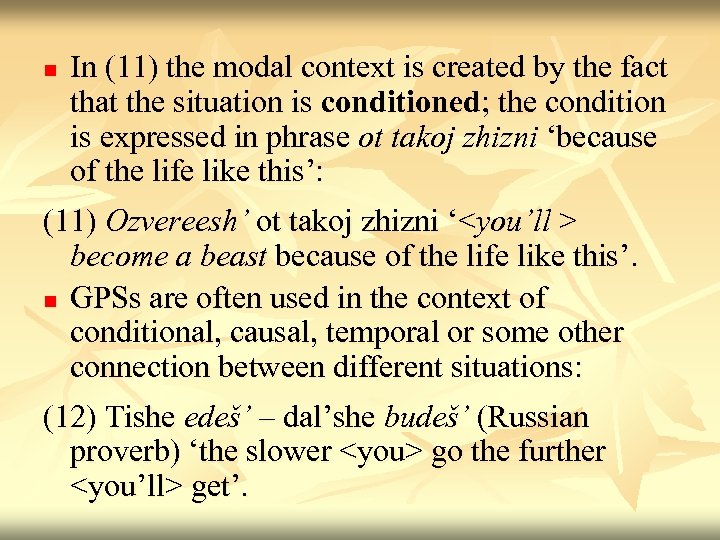 n In (11) the modal context is created by the fact that the situation is conditioned; the condition is expressed in phrase ot takoj zhizni ‘because of the life like this’: (11) Ozvereesh’ ot takoj zhizni ‘
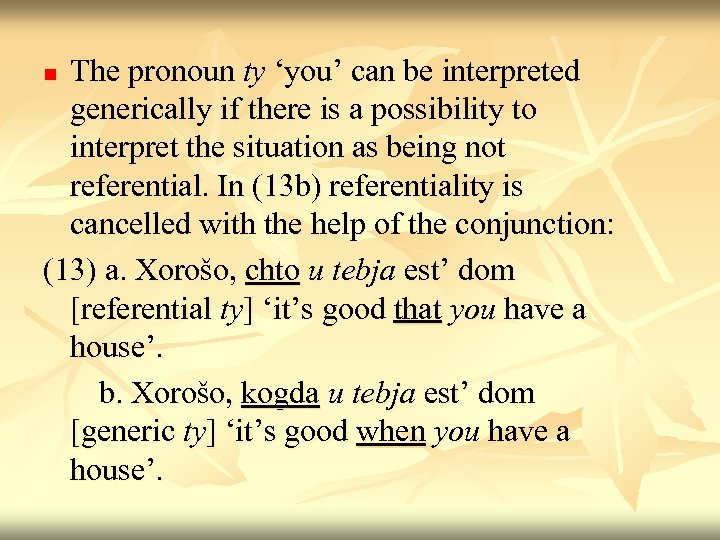 The pronoun ty ‘you’ can be interpreted generically if there is a possibility to interpret the situation as being not referential. In (13 b) referentiality is cancelled with the help of the conjunction: (13) a. Xorošo, chto u tebja est’ dom [referential ty] ‘it’s good that you have a house’. b. Xorošo, kogda u tebja est’ dom [generic ty] ‘it’s good when you have a house’. n
 n “…an agent generalizes a self-ascription of a property by abstracting from the particuliarities of his own situation and thus ascribing the property to anyone else — or rather anyone the agent can assume is as normal as he himself. Both of these components, the first-person connection, in whatever way it may manifest itself, and the generalization, are part of the meaning of generic one <…> or so I will argue. ” (Moltmann 2010).
 1) Generalization n A GPS usually denotes a repeatable situation – namely, it describes a situation that can take place with different participants, as in (14): (14) Slovo ne vorobej, vyletit – ne pojmaeš’ ‘a word is not a sparrow – if it flies away
 A GPS can also describe an event that concerns exactly one person, namely, the speaker. Then pronouns (and verbs) of the 1 st and 2 d person alternate – their reference being identical; see example from Knjazev 2008: (15) Znaesh’, na rabote ja tak vymatihvajus’. Ezdiš’ po Moskve so vsyakimi inostrancami, gidperevodchik. <. . . > Menya mutit ot zvukov angliyjskoyj rechi. <. . . >. Tak chto do domu dobereš’sya – i nikuda. (A. Gladilin). ‘You know I’m so exhausted at work.
 And even iterativity is not obligatory: (16) Odnazhdy obnaruzhivaeš’, chto tebja net. Ty razbit na tysjachu kuskov, i u kazhdogo kuska svoj glaz, nos, uxo. (L. Ulickaja. People of our king) ‘one day
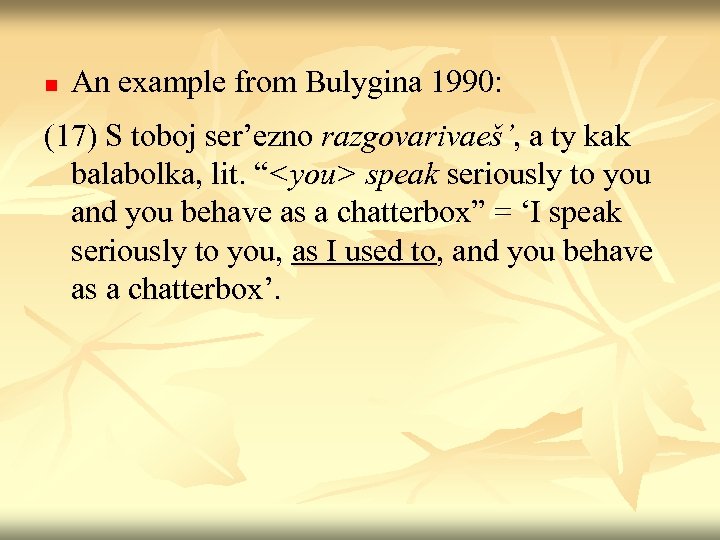 n An example from Bulygina 1990: (17) S toboj ser’ezno razgovarivaeš’, a ty kak balabolka, lit. “
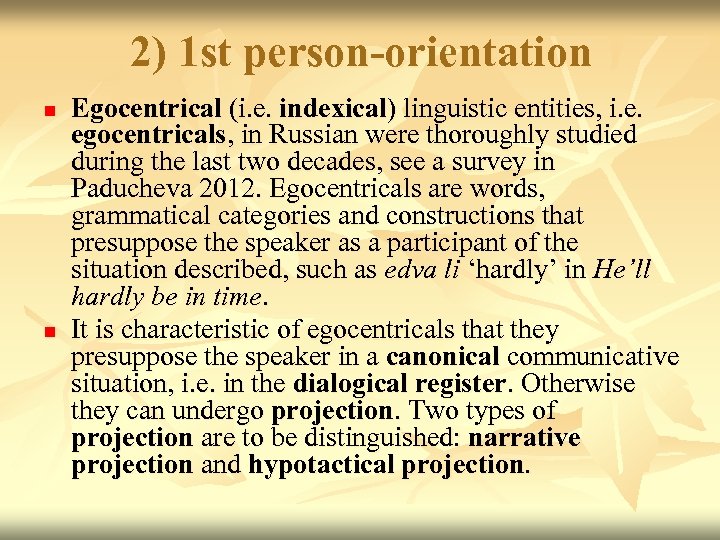 2) 1 st person-orientation n n Egocentrical (i. e. indexical) linguistic entities, i. e. egocentricals, in Russian were thoroughly studied during the last two decades, see a survey in Paducheva 2012. Egocentricals are words, grammatical categories and constructions that presuppose the speaker as a participant of the situation described, such as edva li ‘hardly’ in He’ll hardly be in time. It is characteristic of egocentricals that they presuppose the speaker in a canonical communicative situation, i. e. in the dialogical register. Otherwise they can undergo projection. Two types of projection are to be distinguished: narrative projection and hypotactical projection.
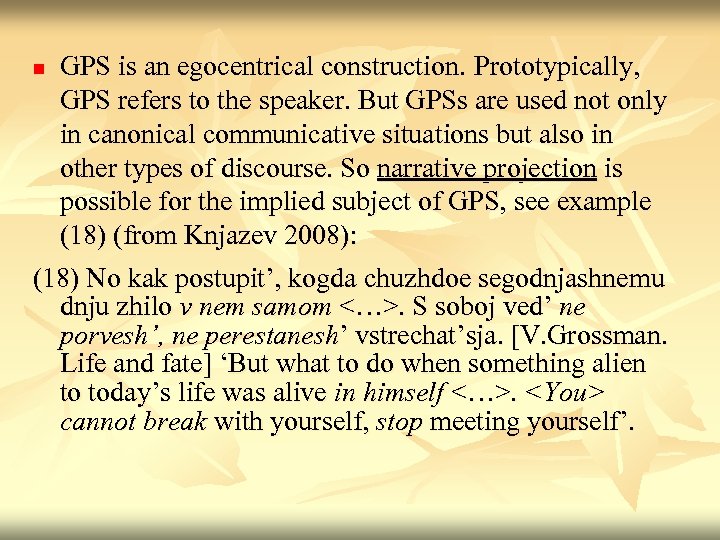 GPS is an egocentrical construction. Prototypically, GPS refers to the speaker. But GPSs are used not only in canonical communicative situations but also in other types of discourse. So narrative projection is possible for the implied subject of GPS, see example (18) (from Knjazev 2008): (18) No kak postupit’, kogda chuzhdoe segodnjashnemu dnju zhilo v nem samom <…>. S soboj ved’ ne porvesh’, ne perestanesh’ vstrechat’sja. [V. Grossman. Life and fate] ‘But what to do when something alien to today’s life was alive in himself <…>.
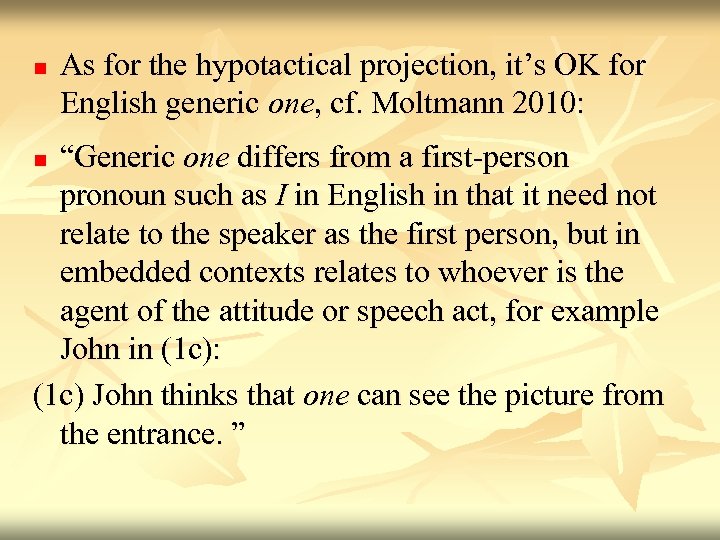 n As for the hypotactical projection, it’s OK for English generic one, cf. Moltmann 2010: “Generic one differs from a first-person pronoun such as I in English in that it need not relate to the speaker as the first person, but in embedded contexts relates to whoever is the agent of the attitude or speech act, for example John in (1 c): (1 c) John thinks that one can see the picture from the entrance. ” n
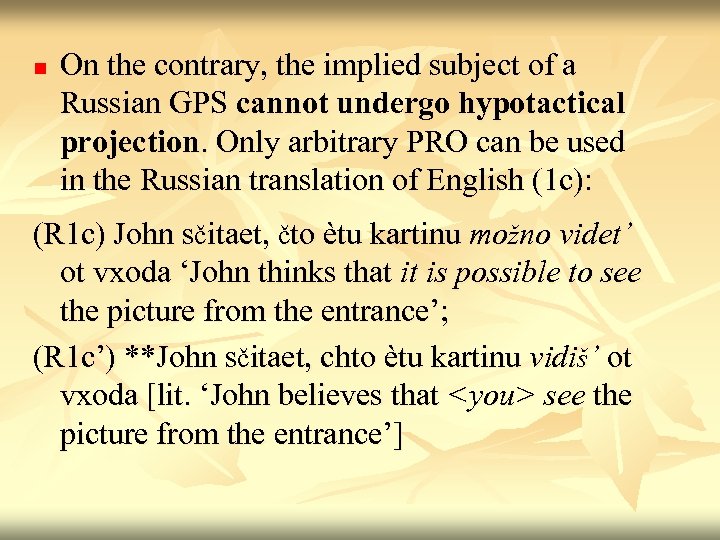 n On the contrary, the implied subject of a Russian GPS cannot undergo hypotactical projection. Only arbitrary PRO can be used in the Russian translation of English (1 c): (R 1 c) John sčitaet, čto ètu kartinu možno videt’ ot vxoda ‘John thinks that it is possible to see the picture from the entrance’; (R 1 c’) **John sčitaet, chto ètu kartinu vidiš’ ot vxoda [lit. ‘John believes that
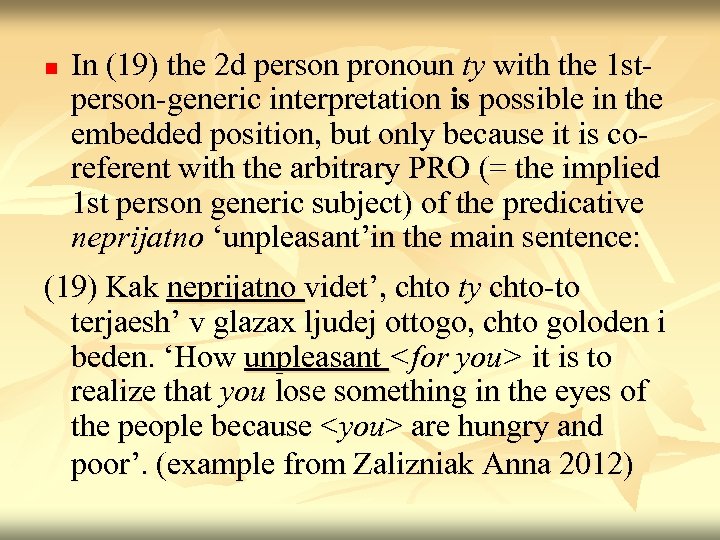 n In (19) the 2 d person pronoun ty with the 1 stperson-generic interpretation is possible in the embedded position, but only because it is coreferent with the arbitrary PRO (= the implied 1 st person generic subject) of the predicative neprijatno ‘unpleasant’in the main sentence: (19) Kak neprijatno videt’, chto ty chto-to terjaesh’ v glazax ljudej ottogo, chto goloden i beden. ‘How unpleasant
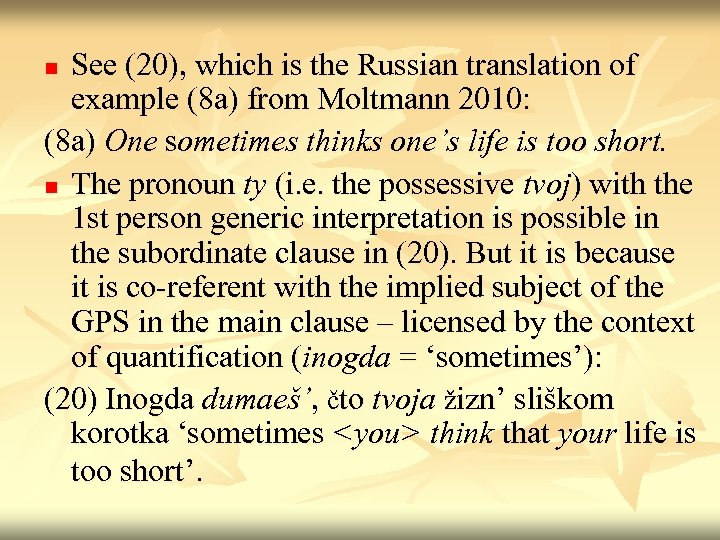 See (20), which is the Russian translation of example (8 a) from Moltmann 2010: (8 a) One sometimes thinks one’s life is too short. n The pronoun ty (i. e. the possessive tvoj) with the 1 st person generic interpretation is possible in the subordinate clause in (20). But it is because it is co-referent with the implied subject of the GPS in the main clause – licensed by the context of quantification (inogda = ‘sometimes’): (20) Inogda dumaeš’, čto tvoja žizn’ sliškom korotka ‘sometimes
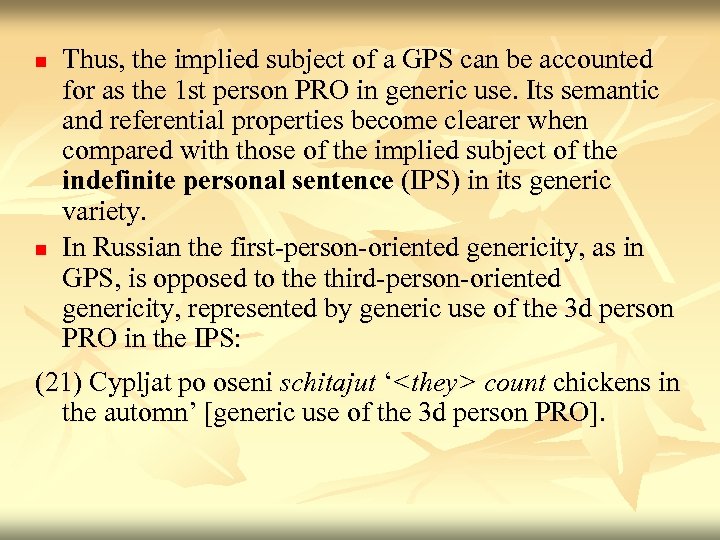 n n Thus, the implied subject of a GPS can be accounted for as the 1 st person PRO in generic use. Its semantic and referential properties become clearer when compared with those of the implied subject of the indefinite personal sentence (IPS) in its generic variety. In Russian the first-person-oriented genericity, as in GPS, is opposed to the third-person-oriented genericity, represented by generic use of the 3 d person PRO in the IPS: (21) Cypljat po oseni schitajut ‘
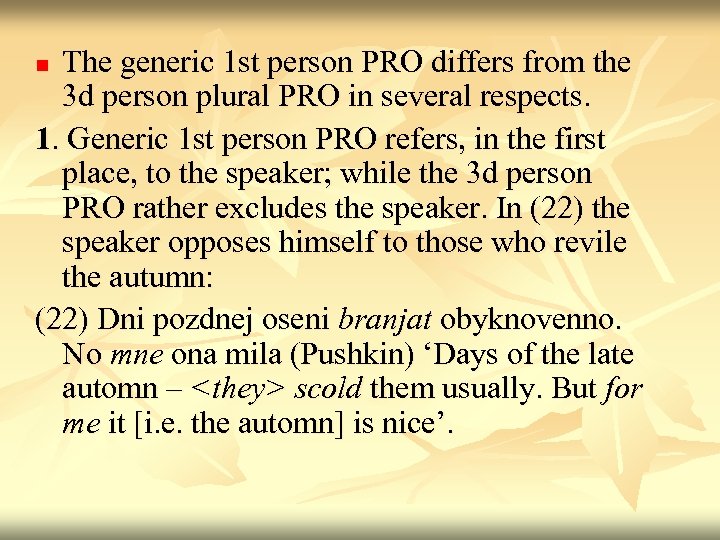 The generic 1 st person PRO differs from the 3 d person plural PRO in several respects. 1. Generic 1 st person PRO refers, in the first place, to the speaker; while the 3 d person PRO rather excludes the speaker. In (22) the speaker opposes himself to those who revile the autumn: (22) Dni pozdnej oseni branjat obyknovenno. No mne ona mila (Pushkin) ‘Days of the late automn –
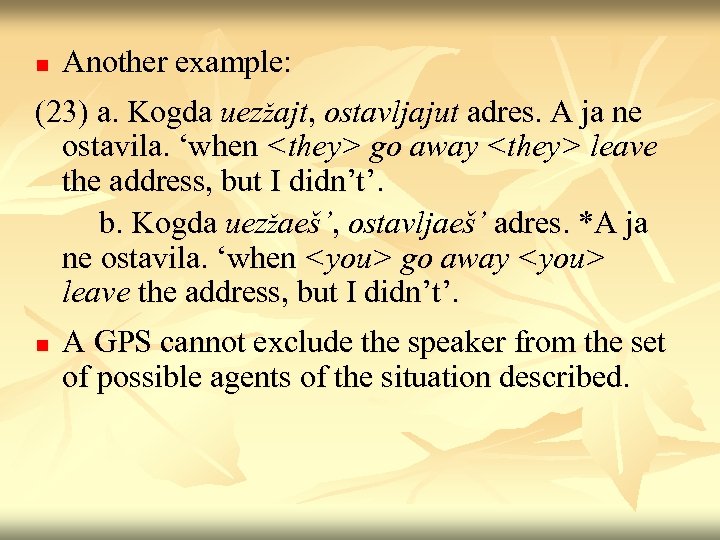 n Another example: (23) a. Kogda uezžajt, ostavljajut adres. A ja ne ostavila. ‘when
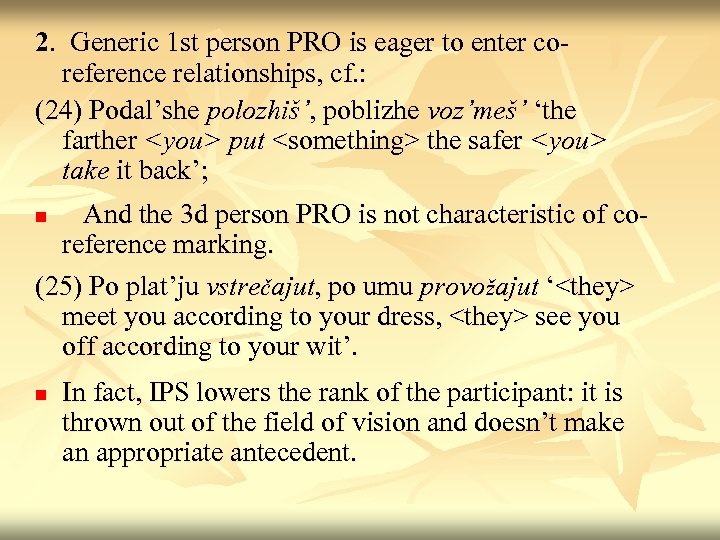 2. Generic 1 st person PRO is eager to enter coreference relationships, cf. : (24) Podal’she polozhiš’, poblizhe voz’meš’ ‘the farther
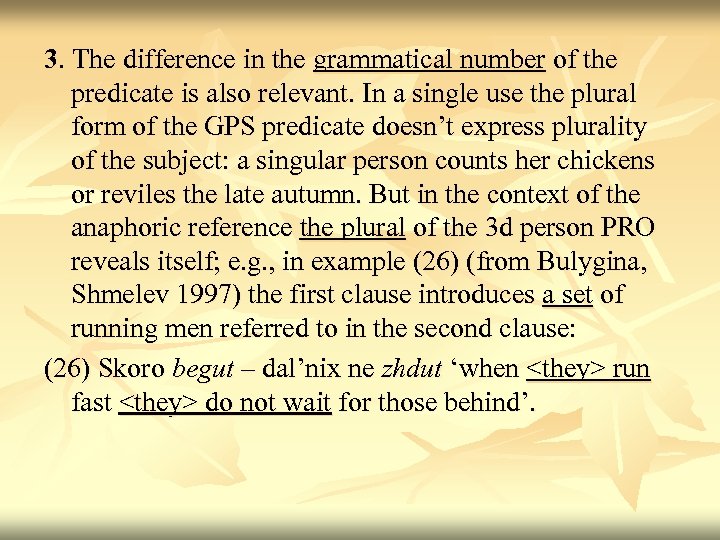 3. The difference in the grammatical number of the predicate is also relevant. In a single use the plural form of the GPS predicate doesn’t express plurality of the subject: a singular person counts her chickens or reviles the late autumn. But in the context of the anaphoric reference the plural of the 3 d person PRO reveals itself; e. g. , in example (26) (from Bulygina, Shmelev 1997) the first clause introduces a set of running men referred to in the second clause: (26) Skoro begut – dal’nix ne zhdut ‘when
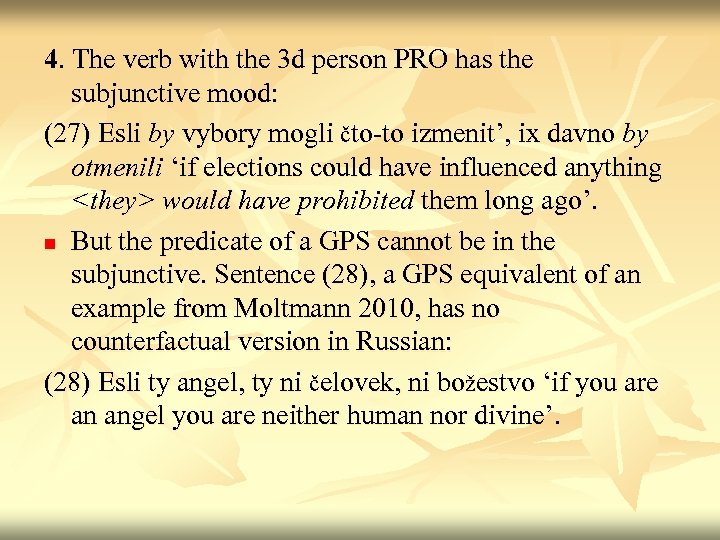 4. The verb with the 3 d person PRO has the subjunctive mood: (27) Esli by vybory mogli čto-to izmenit’, ix davno by otmenili ‘if elections could have influenced anything
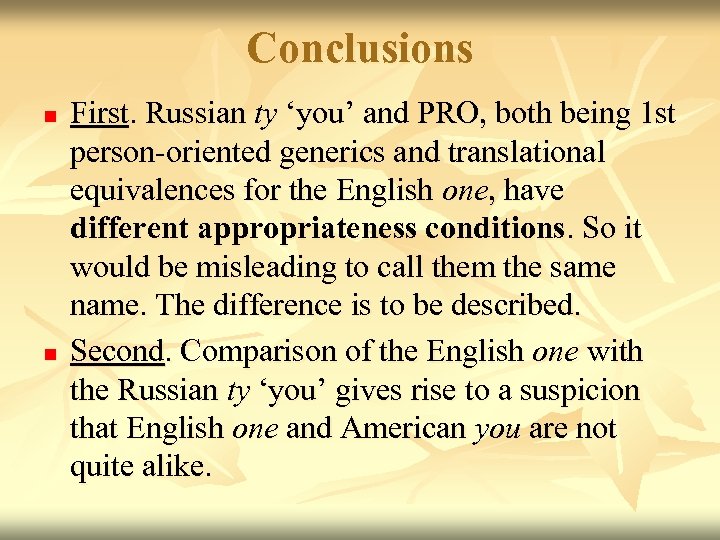 Conclusions n n First. Russian ty ‘you’ and PRO, both being 1 st person-oriented generics and translational equivalences for the English one, have different appropriateness conditions. So it would be misleading to call them the same name. The difference is to be described. Second. Comparison of the English one with the Russian ty ‘you’ gives rise to a suspicion that English one and American you are not quite alike.
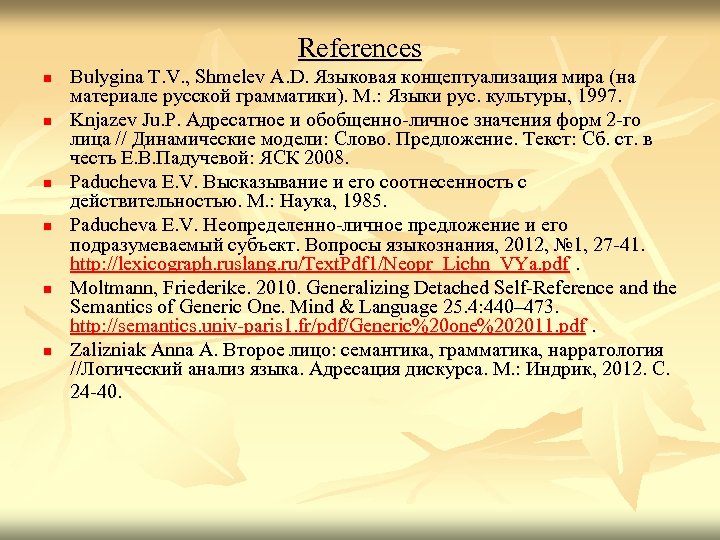 References n n n Bulygina T. V. , Shmelev A. D. Языковая концептуализация мира (на материале русской грамматики). М. : Языки рус. культуры, 1997. Knjazev Ju. P. Адресатное и обобщенно-личное значения форм 2 -го лица // Динамические модели: Слово. Предложение. Текст: Сб. ст. в честь Е. В. Падучевой: ЯСК 2008. Paducheva E. V. Высказывание и его соотнесенность с действительностью. М. : Наука, 1985. Paducheva E. V. Неопределенно-личное предложение и его подразумеваемый субъект. Вопросы языкознания, 2012, № 1, 27 -41. http: //lexicograph. ruslang. ru/Text. Pdf 1/Neopr_Lichn_VYa. pdf. Moltmann, Friederike. 2010. Generalizing Detached Self-Reference and the Semantics of Generic One. Mind & Language 25. 4: 440– 473. http: //semantics. univ-paris 1. fr/pdf/Generic%20 one%202011. pdf. Zalizniak Anna A. Второе лицо: семантика, грамматика, нарратология //Логический анализ языка. Адресация дискурса. М. : Индрик, 2012. С. 24 -40.