 Скачать презентацию FIRST MEETING PJJ ECN 3101 MICROECONOMICS 11 FEBRUARY
00ae993521a07645f3a5b0c3b1a670ad.ppt
- Количество слайдов: 164




FIRST MEETING PJJ ECN 3101: MICROECONOMICS 11 FEBRUARY 2012 (8. 30 -10. 20 AM) SEMESTER 2, 2011/2012
Chapter 2 The Basics of Supply and Demand
Lecture Outline l Supply and demand l Market mechanism l Effects of changes in market equilibrium l Elasticities of supply and demand l Effects of government intervention- price controls
Supply and Demand l Supply and demand analysis can: 1. Help to understand predict how world economic conditions affect market price and production. 2. Analyze the impact of government price controls, minimum wages, price supports, and production incentives on the economy. 3. Determine how taxes, subsidies, tariffs and import quotas affect consumers and producers
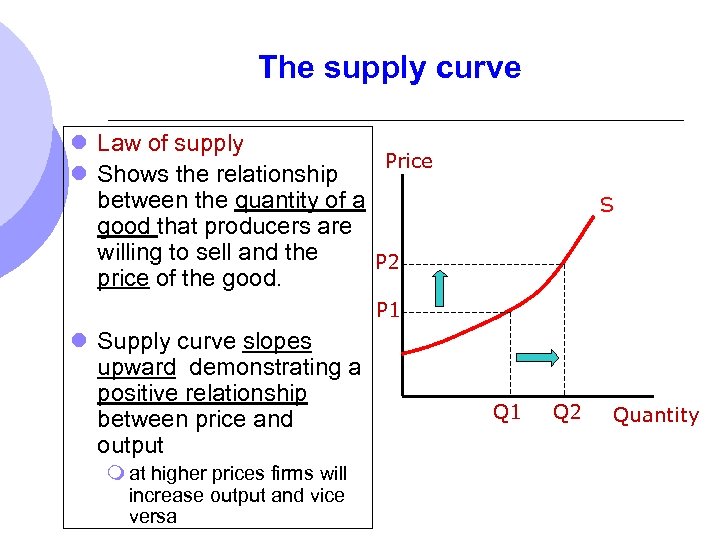
The supply curve l Law of supply Price l Shows the relationship between the quantity of a good that producers are willing to sell and the P 2 price of the good. S P 1 l Supply curve slopes upward demonstrating a positive relationship between price and output m at higher prices firms will increase output and vice versa Q 1 Q 2 Quantity
Movement and shifting of supply curve l Changes in the quantity supplied - movement along the curve caused by a change in price l Change in supply - shift of the curve caused by a change in something other than price m such as change in costs of production due to changes in input prices, technology improvement and increase in number of producers
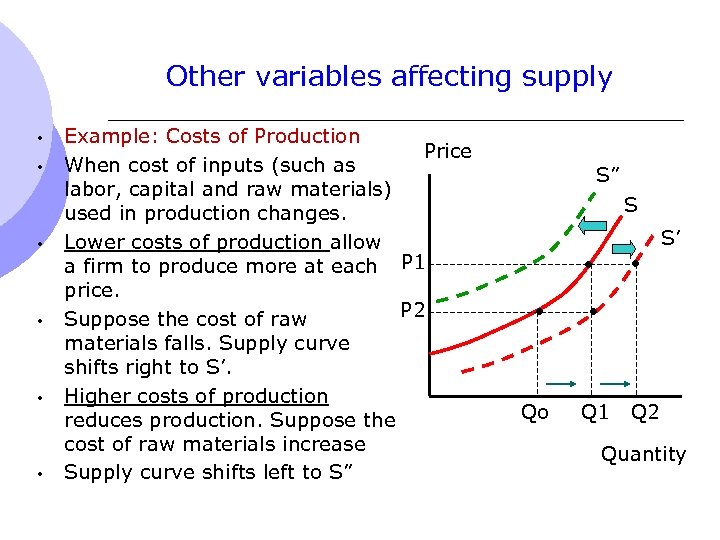
Other variables affecting supply • • • Example: Costs of Production Price When cost of inputs (such as labor, capital and raw materials) used in production changes. Lower costs of production allow a firm to produce more at each P 1 price. P 2 Suppose the cost of raw materials falls. Supply curve shifts right to S’. Higher costs of production reduces production. Suppose the cost of raw materials increase Supply curve shifts left to S” S” S Qo Q 1 S’ Q 2 Quantity
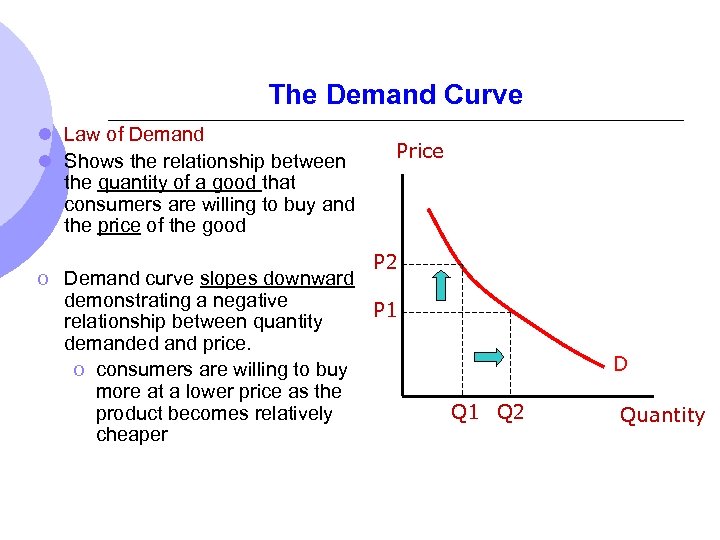
The Demand Curve l Law of Demand l Shows the relationship between the quantity of a good that consumers are willing to buy and the price of the good Price P 2 o Demand curve slopes downward demonstrating a negative P 1 relationship between quantity demanded and price. o consumers are willing to buy more at a lower price as the product becomes relatively cheaper D Q 1 Q 2 Quantity
Movement and shifting of demand curve ¢ Changes in the quantity demand - movements along the demand curve caused by a change in price ¢ Change in demand - a shift of the entire demand curve caused by a change in something other than price (such as income, taste and preferences, number of consumer, etc)
Other variables affecting demand l Income l increases in income allow consumers to purchase more at all prices m For normal goods – the relationship between income and demand is positive (income - demand for normal. m For inferior good - the relationship between income and demand is negative. l Price of related goods l l For substitutes goods (coffee and tea) the relationship – positive Price of coffee – quantity coffee demanded – demand for tea For complements goods (car and petrol) – negative relationship Price of petrol – quantity petrol demanded – demand for car l Consumer tastes l Number of consumer
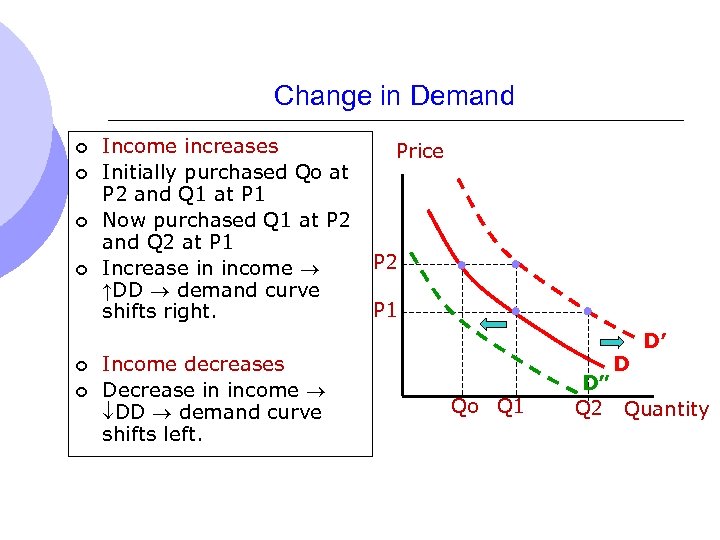
Change in Demand ¢ ¢ ¢ Income increases Initially purchased Qo at P 2 and Q 1 at P 1 Now purchased Q 1 at P 2 and Q 2 at P 1 Increase in income ↑DD demand curve shifts right. Income decreases Decrease in income DD demand curve shifts left. Price P 2 P 1 D Qo Q 1 D’ D” Q 2 Quantity
The market mechanism l Is the tendency in a free market for price to change until the market clears. l Markets clear when quantity demanded equals quantity supplied at the prevailing price. l Market clearing price – price at which markets clear or at equilibrium.
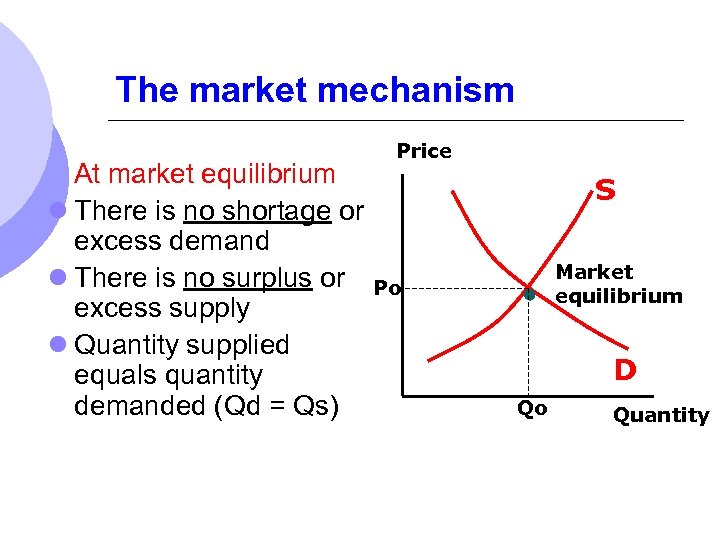
The market mechanism At market equilibrium l There is no shortage or excess demand l There is no surplus or excess supply l Quantity supplied equals quantity demanded (Qd = Qs) Price S Po Market equilibrium D Qo Quantity
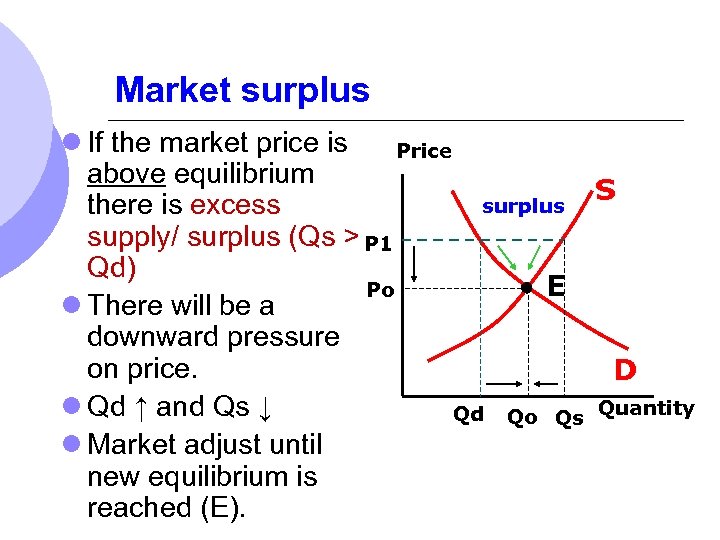
Market surplus l If the market price is Price above equilibrium S surplus there is excess supply/ surplus (Qs > P 1 Qd) E Po l There will be a downward pressure on price. D l Qd ↑ and Qs ↓ Qd Qo Qs Quantity l Market adjust until new equilibrium is reached (E).
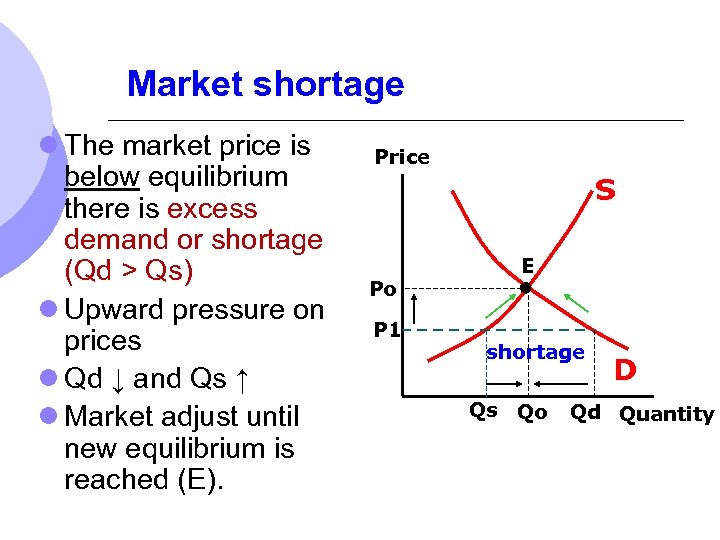
Market shortage l The market price is below equilibrium there is excess demand or shortage (Qd > Qs) l Upward pressure on prices l Qd ↓ and Qs ↑ l Market adjust until new equilibrium is reached (E). Price S Po P 1 E shortage Qs Qo D Qd Quantity
The Market Mechanism l Supply and demand interact to determine the market clearing price l When not in equilibrium, the market will adjust to eliminate shortage or surplus and return to equilibrium. l Market must be competitive for the mechanism to be efficient.
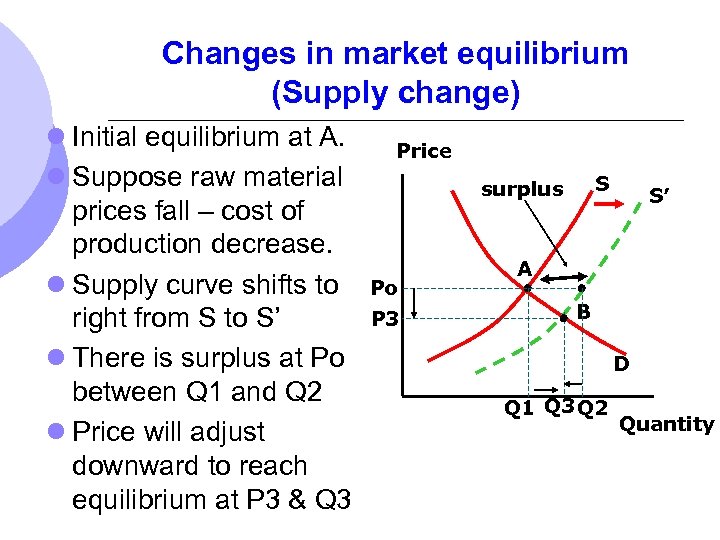
Changes in market equilibrium (Supply change) l Initial equilibrium at A. l Suppose raw material prices fall – cost of production decrease. l Supply curve shifts to right from S to S’ l There is surplus at Po between Q 1 and Q 2 l Price will adjust downward to reach equilibrium at P 3 & Q 3 Price surplus Po P 3 A S S’ B D Q 1 Q 3 Q 2 Quantity
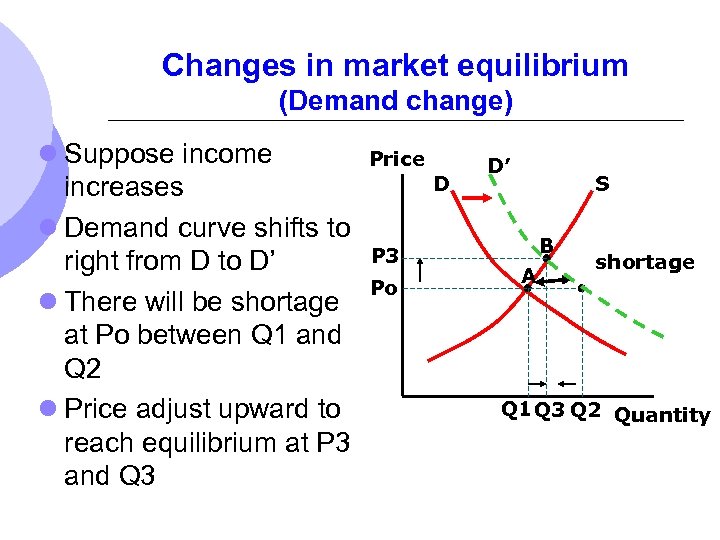
Changes in market equilibrium (Demand change) l Suppose income increases l Demand curve shifts to right from D to D’ l There will be shortage at Po between Q 1 and Q 2 l Price adjust upward to reach equilibrium at P 3 and Q 3 Price D P 3 Po D’ S A B shortage Q 1 Q 3 Q 2 Quantity
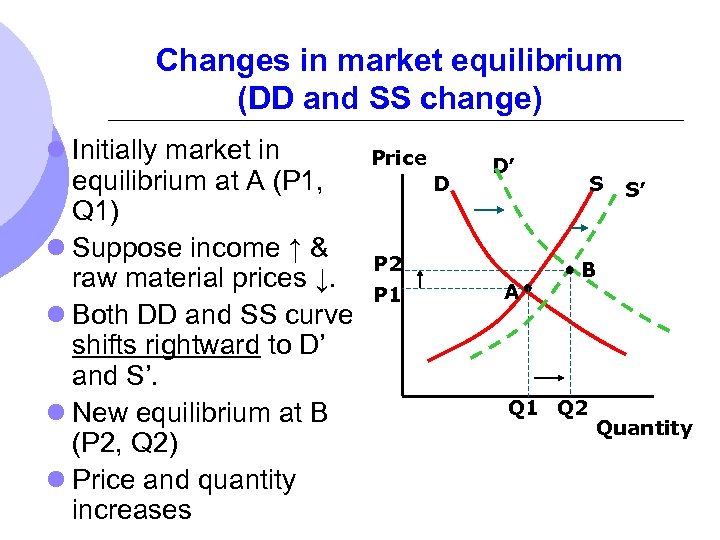
Changes in market equilibrium (DD and SS change) l Initially market in equilibrium at A (P 1, Q 1) l Suppose income ↑ & raw material prices ↓. l Both DD and SS curve shifts rightward to D’ and S’. l New equilibrium at B (P 2, Q 2) l Price and quantity increases Price D P 2 P 1 D’ A S S’ B Q 1 Q 2 Quantity
Shifts in supply and demand l When supply and demand change simultaneously, the impact on the equilibrium price & quantity is determined by: 1. The relative size and direction of the change. 2. The shape of the supply and demand curve.
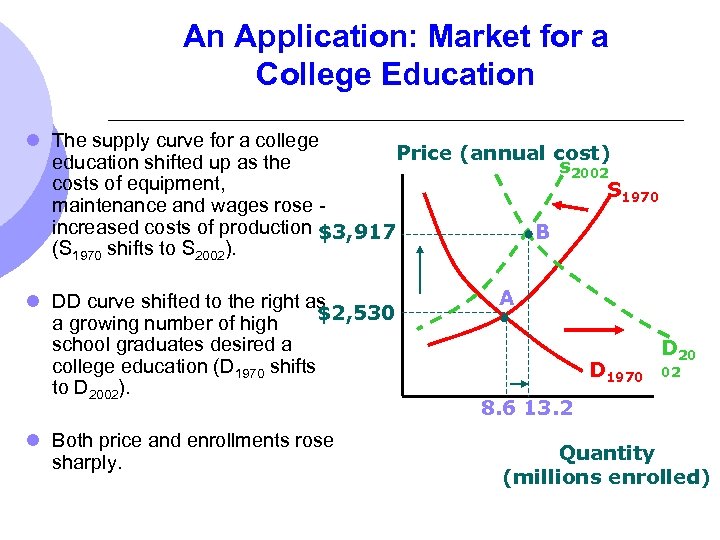
An Application: Market for a College Education l The supply curve for a college Price (annual cost) education shifted up as the s 2002 costs of equipment, S 1970 maintenance and wages rose increased costs of production $3, 917 B (S 1970 shifts to S 2002). l DD curve shifted to the right as $2, 530 a growing number of high school graduates desired a college education (D 1970 shifts to D 2002). l Both price and enrollments rose sharply. A D 1970 D 20 02 8. 6 13. 2 Quantity (millions enrolled)
Elasticities of Supply and Demand l Measures the sensitivity of quantity demanded to price or income changes. l It measures the percentage change in the quantity demanded of a good that results from a one percent change in price or incomes
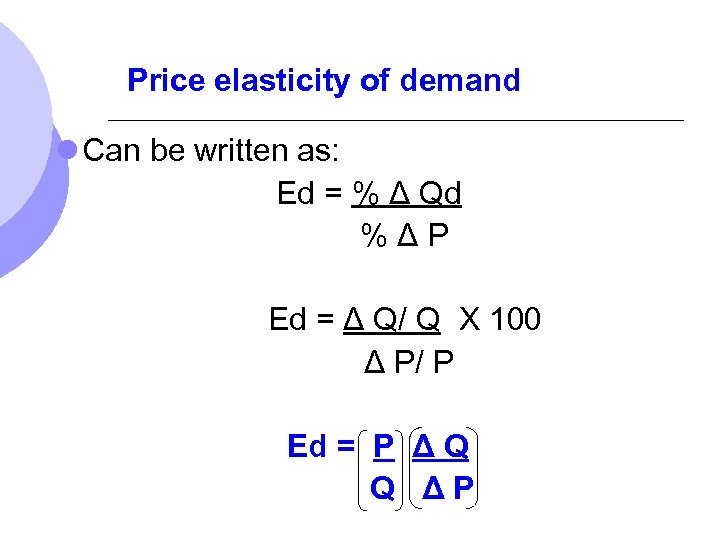
Price elasticity of demand l Can be written as: Ed = % Δ Qd %ΔP Ed = Δ Q/ Q X 100 Δ P/ P Ed = P Δ Q Q ΔP
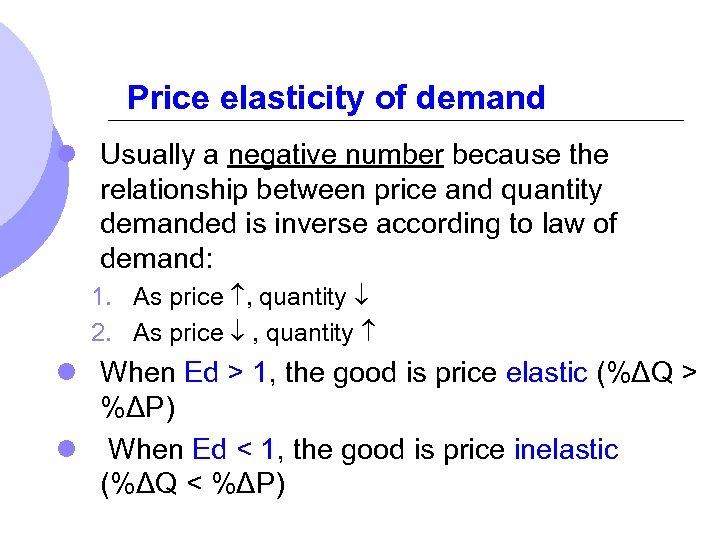
Price elasticity of demand l Usually a negative number because the relationship between price and quantity demanded is inverse according to law of demand: 1. As price , quantity 2. As price , quantity l When Ed > 1, the good is price elastic (%ΔQ > %ΔP) l When Ed < 1, the good is price inelastic (%ΔQ < %ΔP)
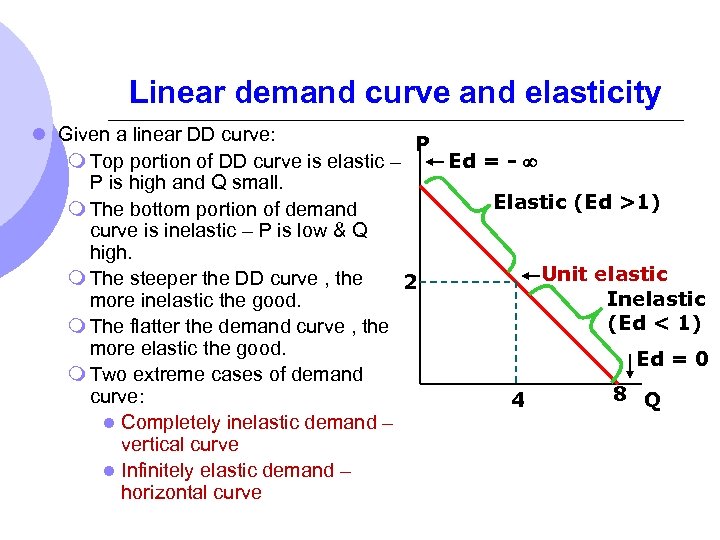
Linear demand curve and elasticity l Given a linear DD curve: P m Top portion of DD curve is elastic – Ed = - P is high and Q small. Elastic (Ed >1) m The bottom portion of demand curve is inelastic – P is low & Q high. Unit elastic m The steeper the DD curve , the 2 Inelastic more inelastic the good. (Ed < 1) m The flatter the demand curve , the more elastic the good. Ed = 0 m Two extreme cases of demand 8 Q curve: 4 l Completely inelastic demand – vertical curve l Infinitely elastic demand – horizontal curve
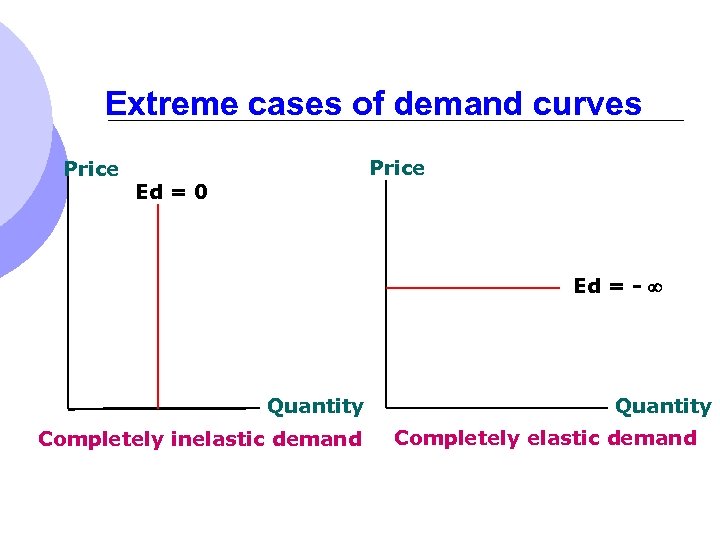
Extreme cases of demand curves Price Ed = 0 Ed = - Quantity Completely inelastic demand Quantity Completely elastic demand
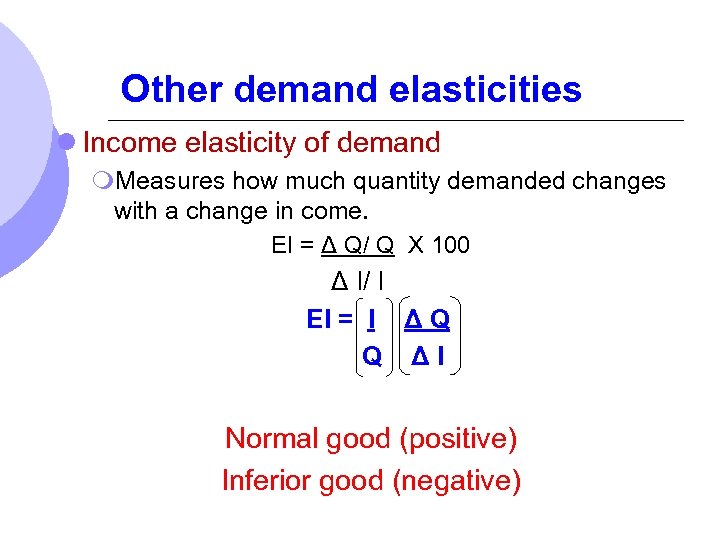
Other demand elasticities l Income elasticity of demand m. Measures how much quantity demanded changes with a change in come. EI = Δ Q/ Q X 100 Δ I/ I EI = I Δ Q Q ΔI Normal good (positive) Inferior good (negative)
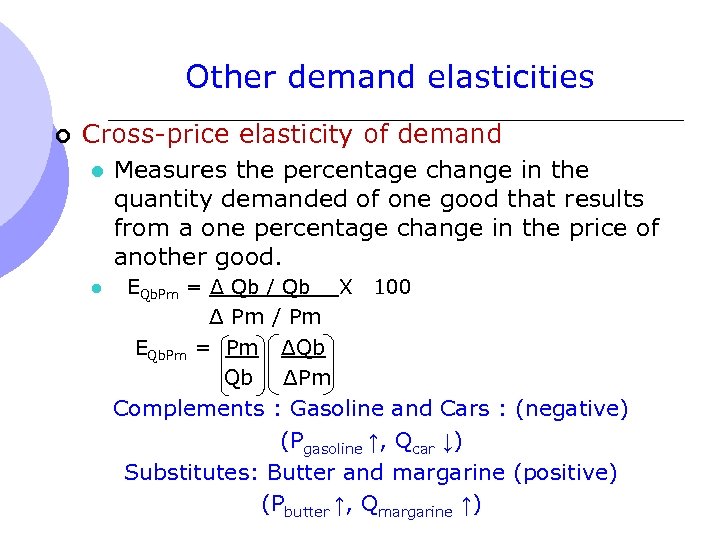
Other demand elasticities ¢ Cross-price elasticity of demand l l Measures the percentage change in the quantity demanded of one good that results from a one percentage change in the price of another good. EQb. Pm = Δ Qb / Qb Δ Pm EQb. Pm = Pm Qb Complements X 100 / Pm ΔQb ΔPm : Gasoline and Cars : (negative) (Pgasoline ↑, Qcar ↓) Substitutes: Butter and margarine (positive) (Pbutter ↑, Qmargarine ↑)
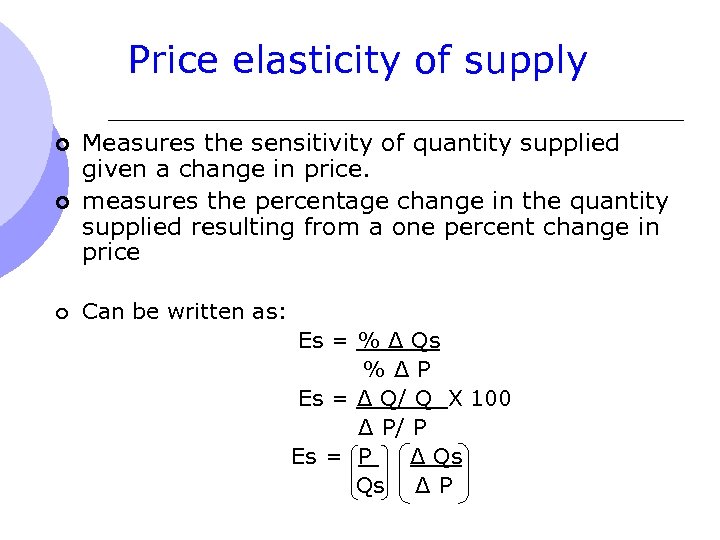
Price elasticity of supply ¢ Measures the sensitivity of quantity supplied given a change in price. measures the percentage change in the quantity supplied resulting from a one percent change in price ¢ Can be written as: ¢ Es = % Δ Qs %ΔP Es = Δ Q/ Q X 100 Δ P/ P Es = P Δ Qs Qs Δ P
Short-run vs long-run elasticity l To examine how much demand or supply changes in response to a change in price – must consider how much time is allowed for the quantity demanded or supplied to respond to the price change. l Short-run demand supply curves look very different from the long-run. l Influenced by m. Demand & durability m. Income elasticities m. Supply & durability
Short-run vs long-run elasticity i. Demand durability l For many goods – DD is more price elastic in longrun than short-run because it takes time for consumer to change their consumption habits. m. E. g. if P of coffee rises , the Qd will fall only gradually m. If P of gasoline rises, Qd decrease in the short-run but it has greatest impact on demand by inducing consumers to buy smaller & more fuel-efficient cars.
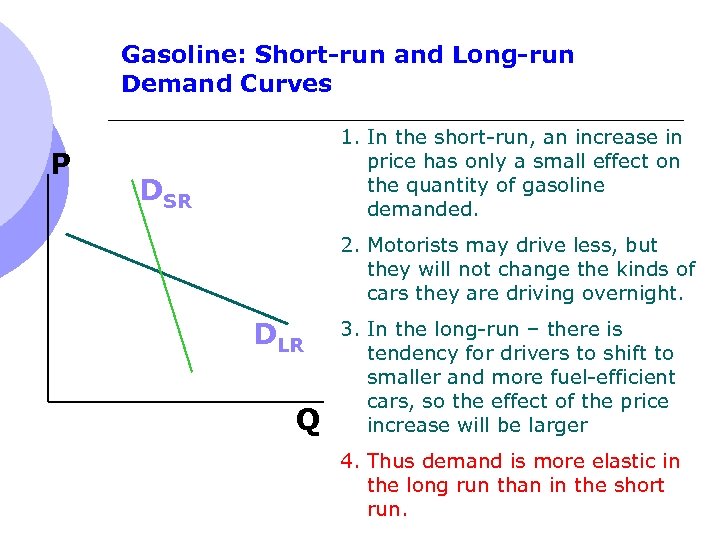
Gasoline: Short-run and Long-run Demand Curves P 1. In the short-run, an increase in price has only a small effect on the quantity of gasoline demanded. DSR 2. Motorists may drive less, but they will not change the kinds of cars they are driving overnight. DLR Q 3. In the long-run – there is tendency for drivers to shift to smaller and more fuel-efficient cars, so the effect of the price increase will be larger 4. Thus demand is more elastic in the long run than in the short run.
ii. Income elasticities o Also varies with the amount time consumers have to an income change. o For most goods & services – food, beverages, fuel, etc. – income elasticity of demand is larger in the long run than in the short run o This is because the change in consumption takes time, and demand initially increases only by a small amount. o The long-run elasticity will be larger than the short -run elasticity.
Elasticity of supply iii. Supply and durability o Elasticity of supply also differ from the long run to the short run. o For most products (agricultural products), long run supply is much more price elastic than short run supply. o Firms face capacity constraints in the short run and need time to expand capacity by building new production and hiring workers. o The output can be expanded more in the long run than in the short run. o For some goods & services, short-run supply is completely inelastic. E. g. rental housing. o In short run, there is only fixed number of rental units. An increase in demand will only pushes rents up. Only in the long run the quantity supplied increases.
Effects of Price controls l Markets are rarely free of government intervention m. Imposed taxes, grant subsidies and implement price controls l Price controls [price ceilings (max) and price floors (min)] usually hold the price above or below the equilibrium price. l When price is below equilibrium price – there is excess demand (shortage) l When price is above equilibrium price – there is excess supply (surplus)
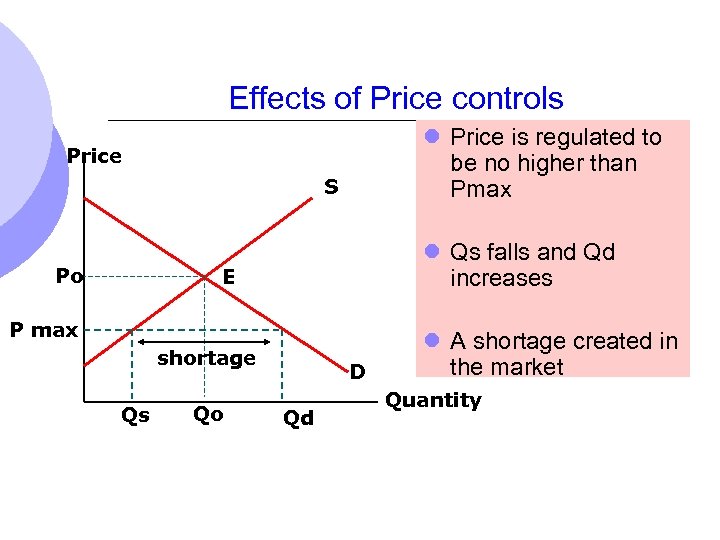
Effects of Price controls l Price is regulated to be no higher than Pmax Price S Po l Qs falls and Qd increases E P max shortage Qs Qo D Qd l A shortage created in the market Quantity
Chapter 3 Consumer Behavior
Consumer Behavior l Consumer preferences - Assumptions - Indifference curves and Indifference maps - The shape of Indifference curves - Marginal rate of substitution (MRS) - Perfect substitutes and perfect complements l Budget Constraints - Budget line - The effects of changes in income and prices l Corner Solutions l Marginal utility and consumer choice
Introduction l How are consumer preferences used to determine demand? l How do consumers allocate income to the purchase of different goods? l How do consumers with limited income decide what to buy? l How can we determine the nature of consumer preferences for observations of consumer behavior?
Theory of consumer behavior l The explanation of how consumers allocate income to the purchase of different goods and services l There are 3 steps involved in the study of consumer behavior 1. Consumer Preferences m To describe how and why people prefer one good to another 2. Budget Constraints m Consumer have limited incomes which restrict the quantities of goods they can buy 3. Consumer choice m What combination of goods will consumers buy to maximize their satisfaction – given their preferences and limited incomes?
Consumer Preferences – Basic Assumptions 1. Preferences are complete. m 2. Preferences are transitive. m 3. Consumers can compare and rank market baskets (for any market basket A and B – consumer will prefer A to B, will prefer B to A or indifferent (or equally satisfied) If prefer A to B, and B to C, then the consumer must prefer A to C. Transitivity is normally regarded as necessary for consumer consistency. Consumers always prefer more of any good to less. m More is better – however some goods may be undesirable such air-pollution.
Consumer Preferences l Consumer preferences can be represented graphically using indifference curves l An Indifference curve represent all combinations of market baskets that provide a consumer with the same level of satisfaction. m. A person will be equally satisfied with either choice
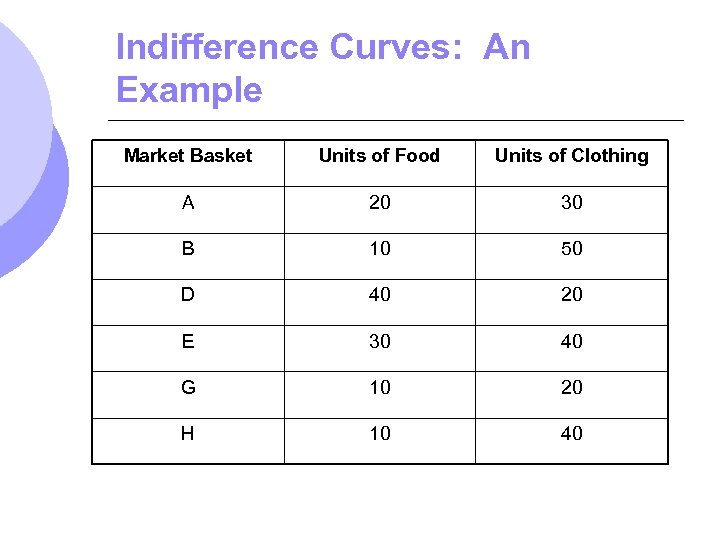
Indifference Curves: An Example Market Basket Units of Food Units of Clothing A 20 30 B 10 50 D 40 20 E 30 40 G 10 20 H 10 40
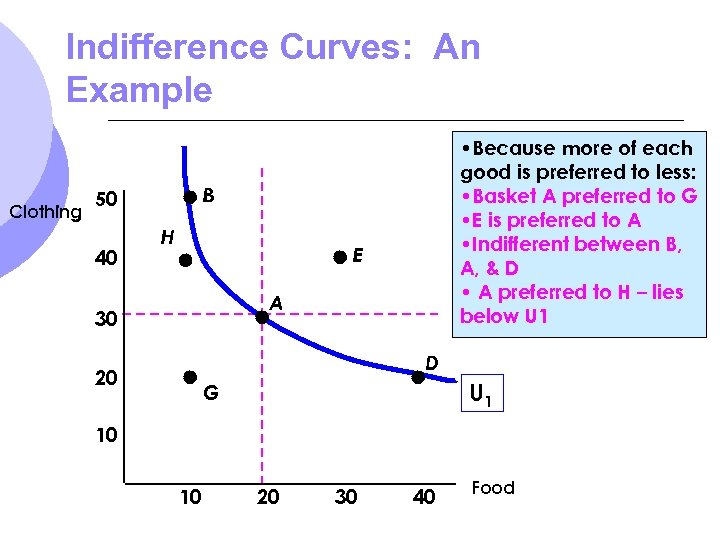
Indifference Curves: An Example Clothing B 50 40 • Because more of each good is preferred to less: • Basket A preferred to G • E is preferred to A • Indifferent between B, A, & D • A preferred to H – lies below U 1 H E A 30 D 20 U 1 G 10 10 20 30 40 Food
Indifference Curves l Any market basket lying northeast of an indifference curve is preferred to any market basket that lies on the indifference curve. l Points on the curve are preferred to points southwest of the curve l Indifference curves slope downward to the right. m. If it sloped upward it would violate the assumption that more is preferred to less (compare point A and E).
Indifference Maps l To describe preferences for all combinations of goods/services, we have a set of indifference curves – an indifference map m. Each indifference curve in the map shows the market baskets among which the person is indifferent.
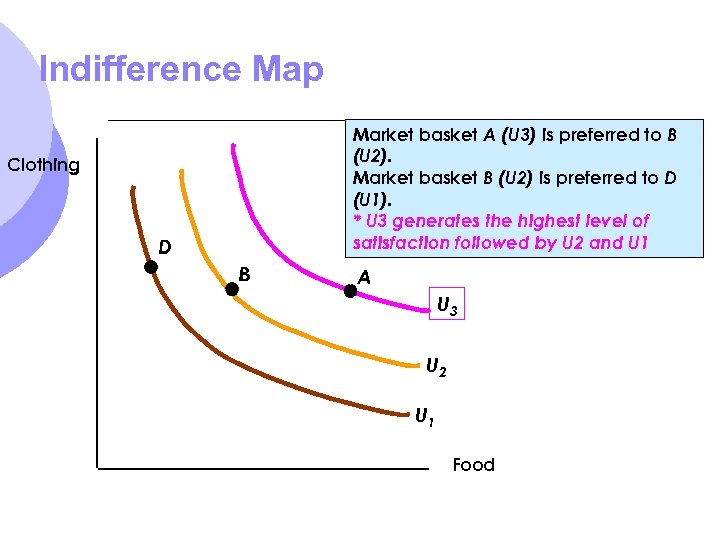
Indifference Map Market basket A (U 3) is preferred to B (U 2). Market basket B (U 2) is preferred to D (U 1). * U 3 generates the highest level of satisfaction followed by U 2 and U 1 Clothing D B A U 3 U 2 U 1 Food
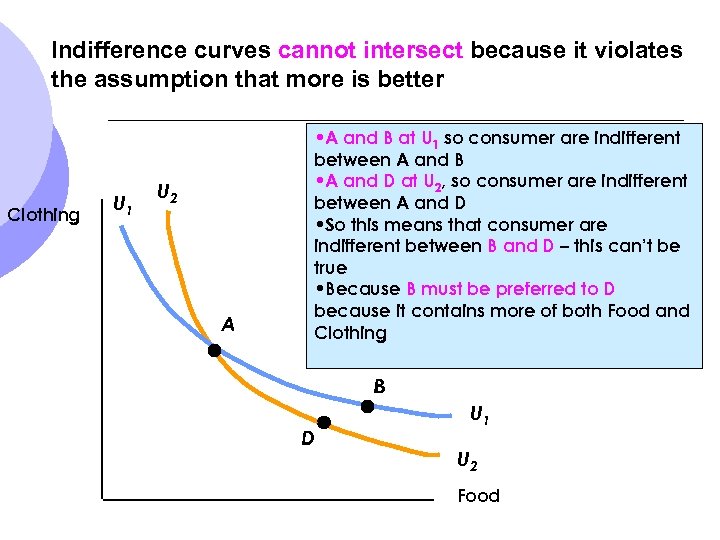
Indifference curves cannot intersect because it violates the assumption that more is better Clothing U 1 U 2 A • A and B at U 1 so consumer are indifferent between A and B • A and D at U 2, so consumer are indifferent between A and D • So this means that consumer are indifferent between B and D – this can’t be true • Because B must be preferred to D because it contains more of both Food and Clothing B D U 1 U 2 Food
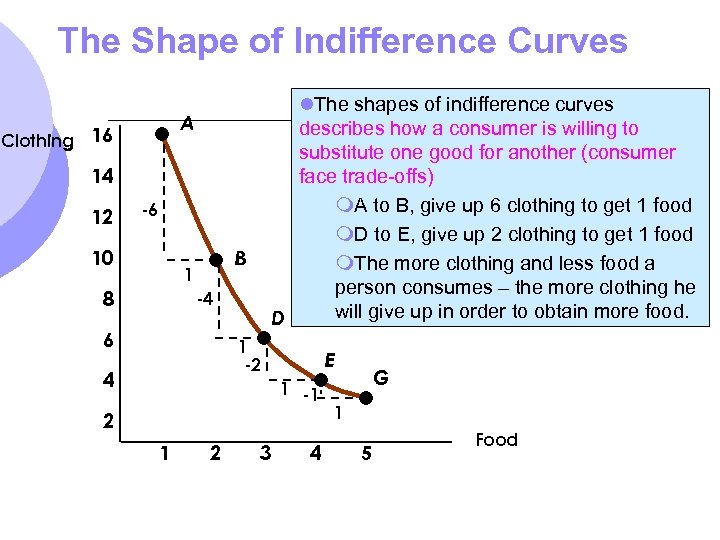
The Shape of Indifference Curves l. The shapes of indifference curves describes how a consumer is willing to substitute one good for another (consumer face trade-offs) m. A to B, give up 6 clothing to get 1 food m. D to E, give up 2 clothing to get 1 food m. The more clothing and less food a person consumes – the more clothing he will give up in order to obtain more food. D A Clothing 16 14 12 -6 10 B 1 8 -4 6 1 -2 4 E 1 -1 2 3 4 G 1 5 Food
Marginal Rate of Substitution l The slope of the indifference curve is called marginal rate of substitution (MRS) l It quantifies the maximum amount of a good a consumer is willing to give up in order to obtain one additional unit of another good.
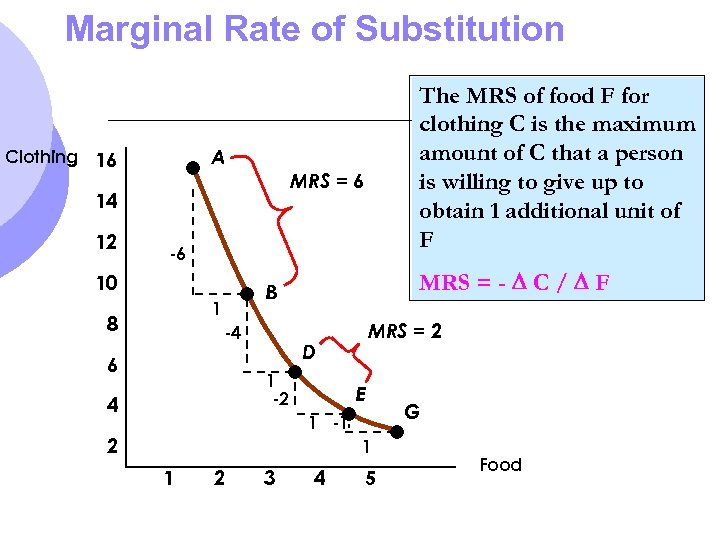
Marginal Rate of Substitution A Clothing 16 MRS = 6 14 12 The MRS of food F for clothing C is the maximum amount of C that a person is willing to give up to obtain 1 additional unit of F -6 10 1 8 MRS = - C / F B -4 6 D 1 -2 4 MRS = 2 E 1 -1 2 1 1 2 3 4 5 G Food
Diminishing Marginal Rate of Substitution l The MRS decreases as we move down the indifference curve m The MRS went from 6 to 4 to 1 l This is because the indifference curves are convex m As more of one good is consumed, a consumer would prefer to give up fewer units of a second good to get additional units of the first one. l Another way of describing this principle is to say that consumers generally prefer a balanced market basket
Perfect Substitutes and Perfect Complements l The shape of an indifference curve describes the willingness of a consumer to substitute one good to another l Indifference curves with different shapes imply a different willingness to substitute l Two extreme cases are m. Perfect substitutes m. Perfect complements
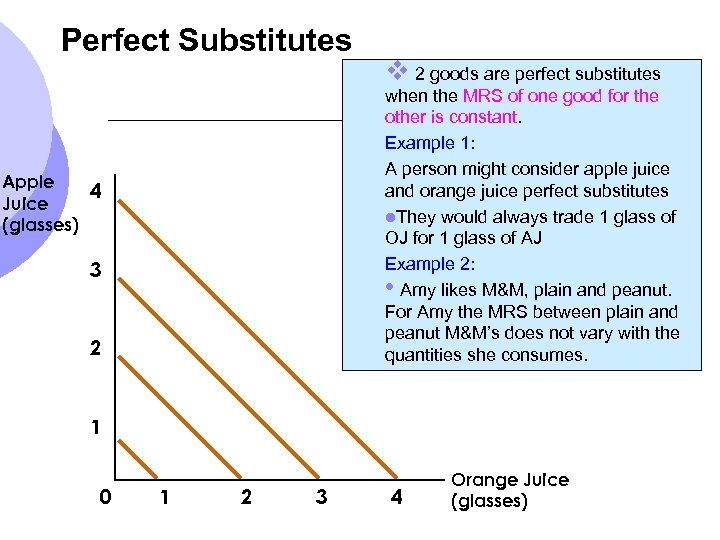
Perfect Substitutes v 2 goods are perfect substitutes when the MRS of one good for the other is constant. Example 1: A person might consider apple juice and orange juice perfect substitutes l. They would always trade 1 glass of OJ for 1 glass of AJ Example 2: • Amy likes M&M, plain and peanut. For Amy the MRS between plain and peanut M&M’s does not vary with the quantities she consumes. Apple 4 Juice (glasses) 3 2 1 0 1 2 3 4 Orange Juice (glasses)
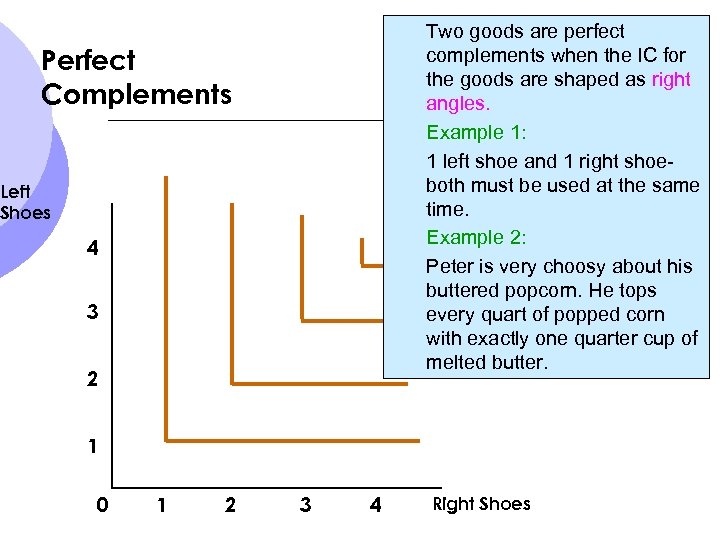
Two goods are perfect complements when the IC for the goods are shaped as right angles. Example 1: 1 left shoe and 1 right shoeboth must be used at the same time. Example 2: Peter is very choosy about his buttered popcorn. He tops every quart of popped corn with exactly one quarter cup of melted butter. Perfect Complements Left Shoes 4 3 2 1 0 1 2 3 4 Right Shoes
Measuring Consumer Preferences l The theory of consumer behavior does not required assigning a numerical value to the level of satisfaction l Although ranking of market baskets are good (where we use indifference curve to describe graphically consumer preferences), sometimes numerical value are useful l The concept is known as Utility m. A numerical score representing the satisfaction that a consumer gets from a given market basket.
Utility l Utility function m. Formula that assigns a level of utility to individual market baskets m. If the utility function is U(F, C) = F + 2 C It tells the level of satisfaction obtained from consuming F units of food and C units of clothing o A market basket with 8 units of food and 3 units of clothing gives a utility of 14 = 8 + 2(3)
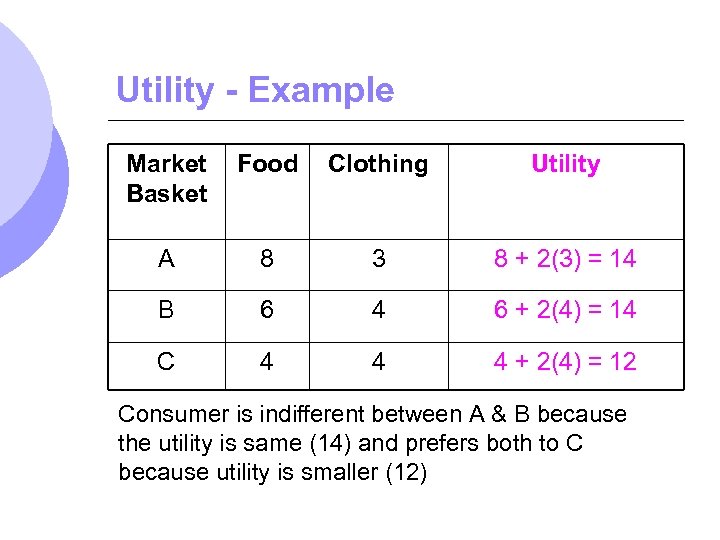
Utility - Example Market Basket Food Clothing Utility A 8 3 8 + 2(3) = 14 B 6 4 6 + 2(4) = 14 C 4 4 4 + 2(4) = 12 Consumer is indifferent between A & B because the utility is same (14) and prefers both to C because utility is smaller (12)
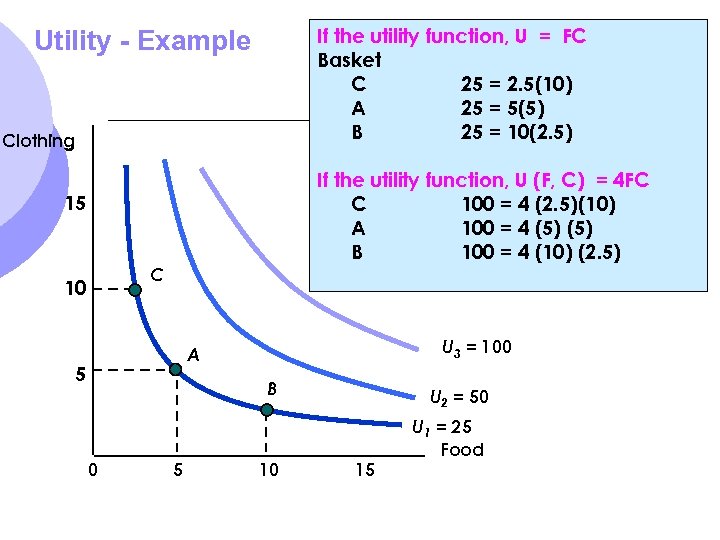
If the utility function, U = FC Basket C 25 = 2. 5(10) A 25 = 5(5) B 25 = 10(2. 5) Utility - Example Clothing If the utility function, U (F, C) = 4 FC C 100 = 4 (2. 5)(10) A 100 = 4 (5) B 100 = 4 (10) (2. 5) 15 C 10 U 3 = 100 A 5 B 0 5 10 U 2 = 50 15 U 1 = 25 Food
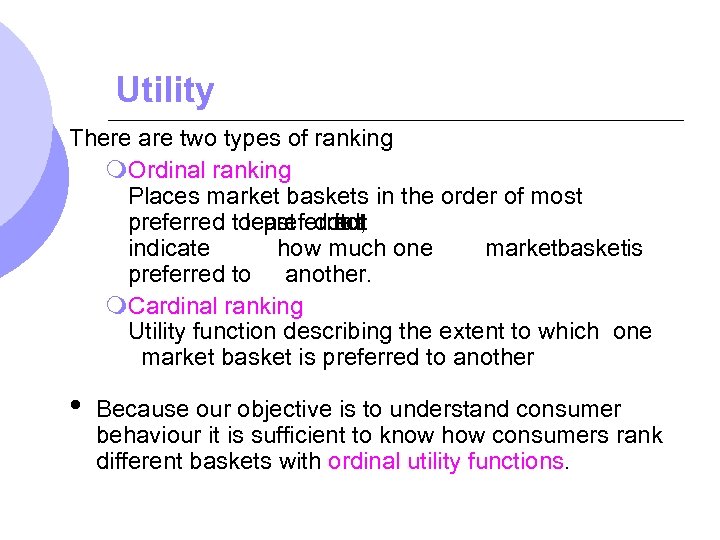
Utility There are two types of ranking m. Ordinal ranking Places market baskets in the order of most preferred to preferred, least does not but it indicate how much one marketbasketis preferred to another. m. Cardinal ranking Utility function describing the extent to which one market basket is preferred to another • Because our objective is to understand consumer behaviour it is sufficient to know how consumers rank different baskets with ordinal utility functions.
Budget Constraints l Budget constraints limit an individual’s ability to consume in light of the prices they must pay for various goods and services. l The Budget Line m. Indicates all combinations of two commodities for which total money spent equals total income. m. We assume only 2 goods are consumed, so we do not consider savings (all income are spent)
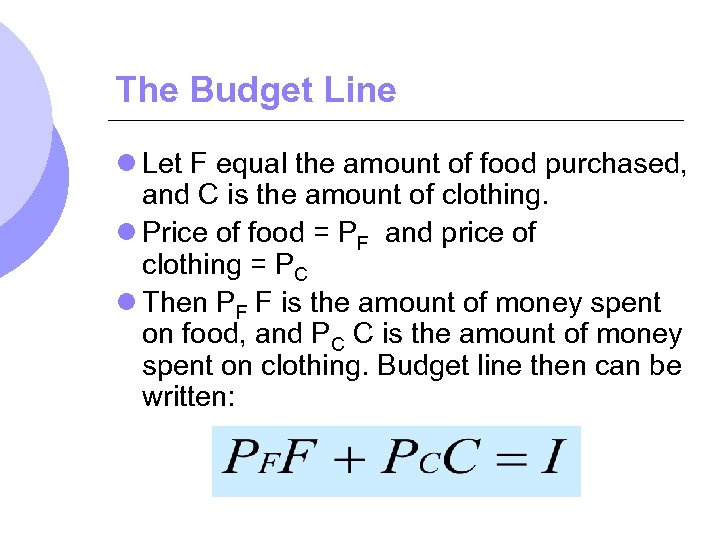
The Budget Line l Let F equal the amount of food purchased, and C is the amount of clothing. l Price of food = PF and price of clothing = PC l Then PF F is the amount of money spent on food, and PC C is the amount of money spent on clothing. Budget line then can be written:
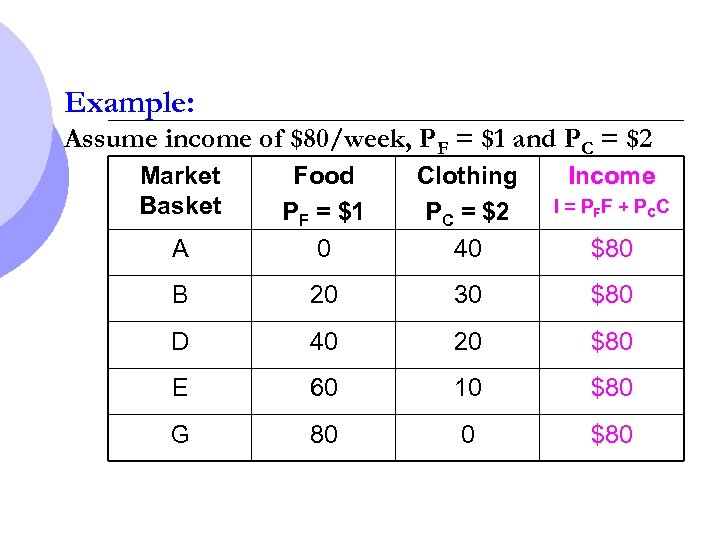
Example: Assume income of $80/week, PF = $1 and PC = $2 Market Basket Clothing PC = $2 40 I = PFF + PCC A Food PF = $1 0 Income B 20 30 $80 D 40 20 $80 E 60 10 $80 G 80 0 $80
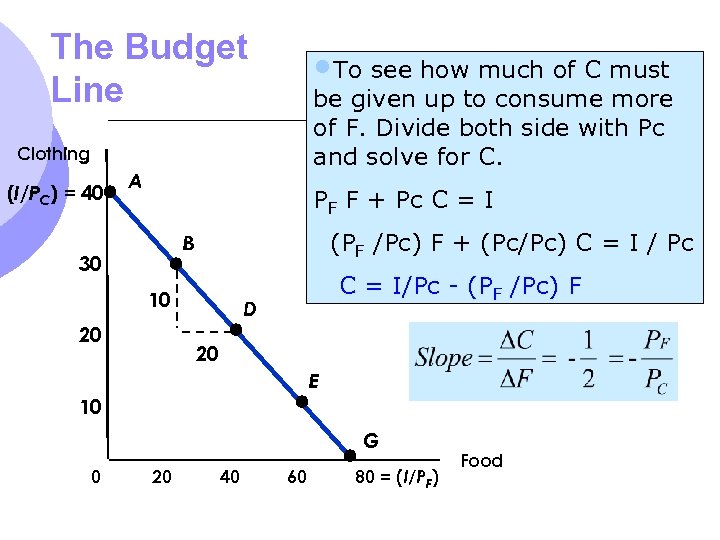
The Budget Line • To see how much of C must be given up to consume more of F. Divide both side with Pc and solve for C. Clothing (I/PC) = 40 A PF F + Pc C = I (PF /Pc) F + (Pc/Pc) C = I / Pc B 30 10 20 C = I/Pc - (PF /Pc) F D 20 E 10 G 0 20 40 60 80 = (I/PF) Food
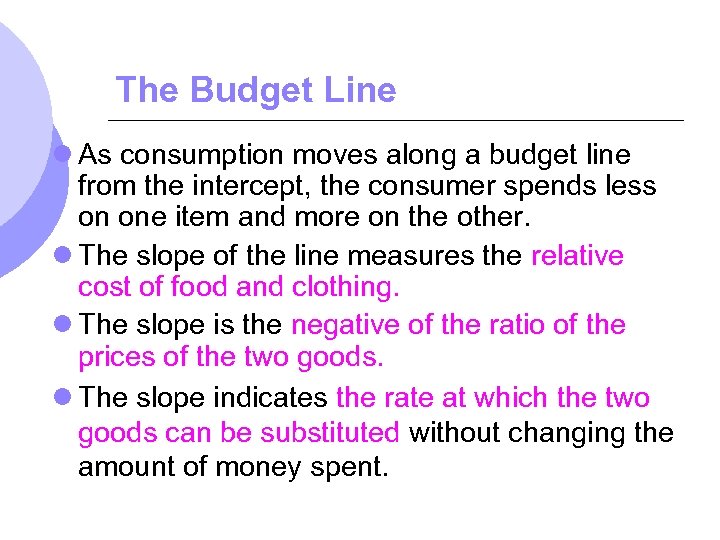
The Budget Line l As consumption moves along a budget line from the intercept, the consumer spends less on one item and more on the other. l The slope of the line measures the relative cost of food and clothing. l The slope is the negative of the ratio of the prices of the two goods. l The slope indicates the rate at which the two goods can be substituted without changing the amount of money spent.
The Budget Line - Changes l The Effects of Changes in Income m. An increase in income causes the budget line to shift outward, parallel to the original line (holding prices constant). l Can buy more of both goods with more income m. A decrease in income causes the budget line to shift inward, parallel to the original line (holding prices constant). l Can buy less of both goods with less income l In both cases there will be changes in the vertical intercept of the budget line but does not change the slope
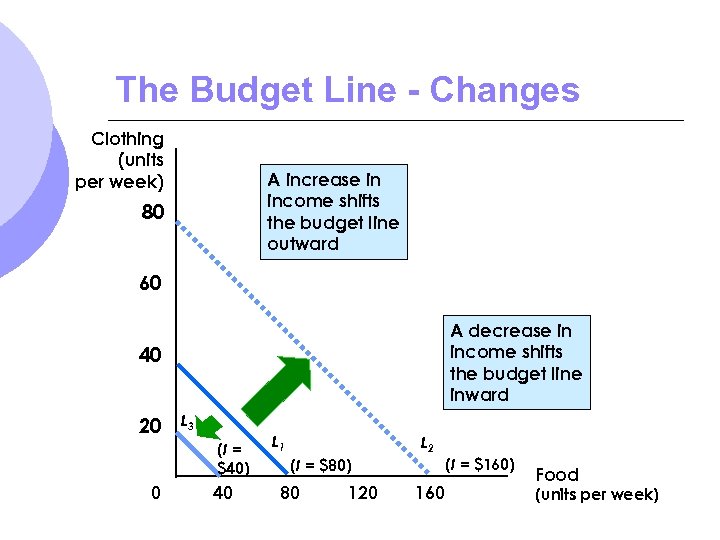
The Budget Line - Changes Clothing (units per week) A increase in income shifts the budget line outward 80 60 A decrease in income shifts the budget line inward 40 20 L 3 (I = $40) 0 40 L 1 L 2 (I = $80) 80 120 (I = $160) 160 Food (units per week)
The Budget Line - Changes l The Effects of Changes in Prices m. If the price of one good increases, the budget line rotates inward, pivoting from the other good’s intercept. m. If price of food increases and you buy only food (x -intercept), then can’t buy as much food. The point shifts in. m. If buy only clothing (y-intercept), can buy the same amount. No change
The Budget Line - Changes l The Effects of Changes in Prices m. If the price of one good decreases, the budget line rotates outward, pivoting from the other good’s intercept. m. If price of food decreases and you buy only food (x-intercept), then can buy more food. The point shifts out. m. If buy only clothing (y-intercept), can buy the same amount. No change
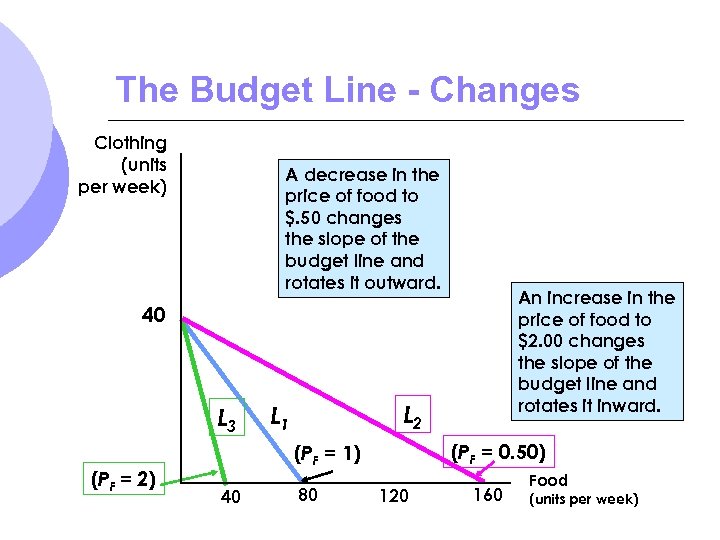
The Budget Line - Changes Clothing (units per week) A decrease in the price of food to $. 50 changes the slope of the budget line and rotates it outward. An increase in the price of food to $2. 00 changes the slope of the budget line and rotates it inward. 40 L 3 (PF = 2) L 2 L 1 (PF = 0. 50) (PF = 1) 40 80 120 160 Food (units per week)
The Budget Line - Changes l The Effects of Changes in Prices m. If the two goods increase in price, but the ratio of the two prices is unchanged, the slope will not change. m. However, the budget line will shift inward to a point parallel to the original budget line m. If the two goods decrease in price, but the ratio of the two prices is unchanged, the slope will not change. m. However, the budget line will shift outward to a point parallel to the original budget line
Consumer Choice l Given preferences and budget constraints, how do consumers choose what to buy? l Consumers choose a combination of goods that will maximize their satisfaction, given the limited budget available to them. l The maximizing market basket must satisfy two conditions: 1. It must be located on the budget line. m They spend all their income – more is better 2. It must give the consumer the most preferred combination of goods and services.
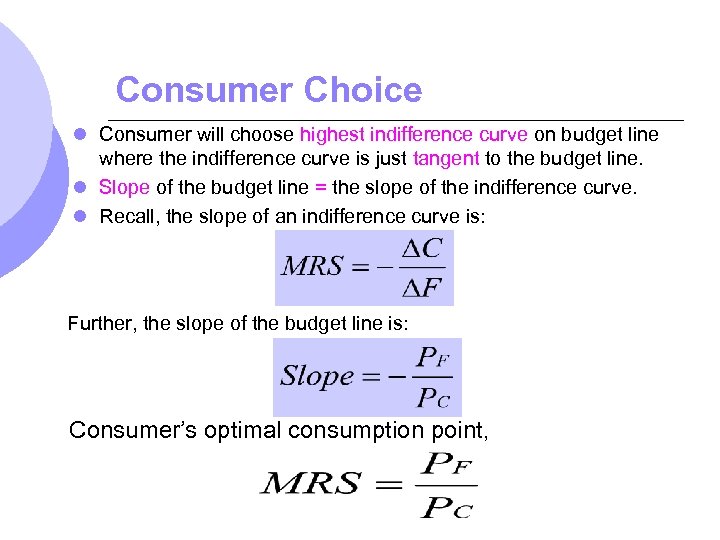
Consumer Choice l Consumer will choose highest indifference curve on budget line where the indifference curve is just tangent to the budget line. l Slope of the budget line = the slope of the indifference curve. l Recall, the slope of an indifference curve is: Further, the slope of the budget line is: Consumer’s optimal consumption point,
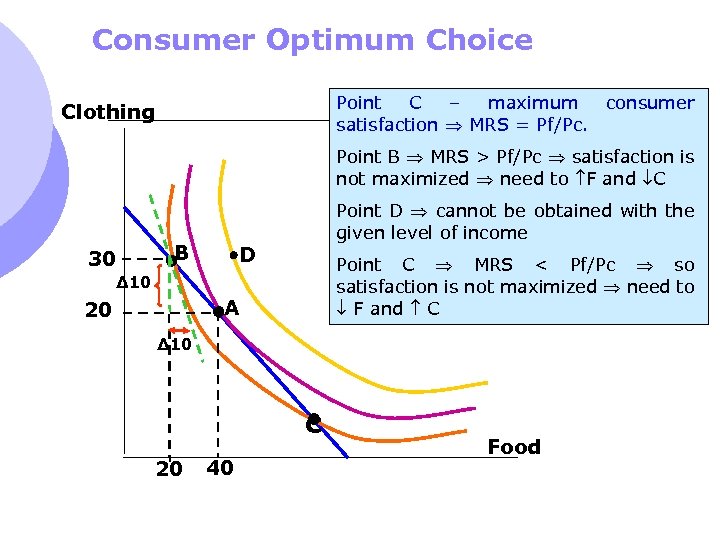
Consumer Optimum Choice Point C – maximum consumer satisfaction MRS = Pf/Pc. Clothing Point B MRS > Pf/Pc satisfaction is not maximized need to F and C 30 ∆10 B Point D cannot be obtained with the given level of income D Point C MRS < Pf/Pc so satisfaction is not maximized need to F and C A 20 ∆10 ● c 20 40 Food
Corner Solution l A corner solution exists if a consumer buys in extremes, and buys all of one category of good and none of another. m. MRS is not necessarily equal to slope of budget line m. For a corner solution, utility is maximized at a point on one axis where the budget constraint intersects the highest attainable indifference curve at zero consumption for one good with all income used for the other good.
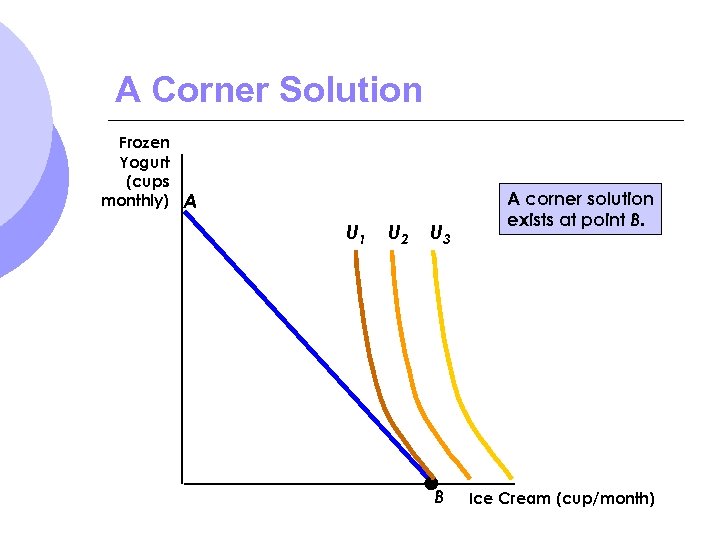
A Corner Solution Frozen Yogurt (cups monthly) A U 1 U 2 U 3 B A corner solution exists at point B. Ice Cream (cup/month)
Chapter 4 Individual and Market Demand
Topics to be Discussed l Individual Demand l Income and Substitution Effects l Market Demand l Consumer Surplus l Network Externalities Chapter 4 78
Individual Demand curve can be derived from consumption choices made by consumer who is faced with budget constraint l Price Changes m m m Chapter 4 The impact of a change in the price can be illustrated using indifference curves. For each price change, we can determine how much of the good the individual would purchase given their budget lines and indifference curves When there is a decrease in price, the budget line will rotate outward (Q↑), while when the price increase the budget line will rotate inward (↓Q). 79
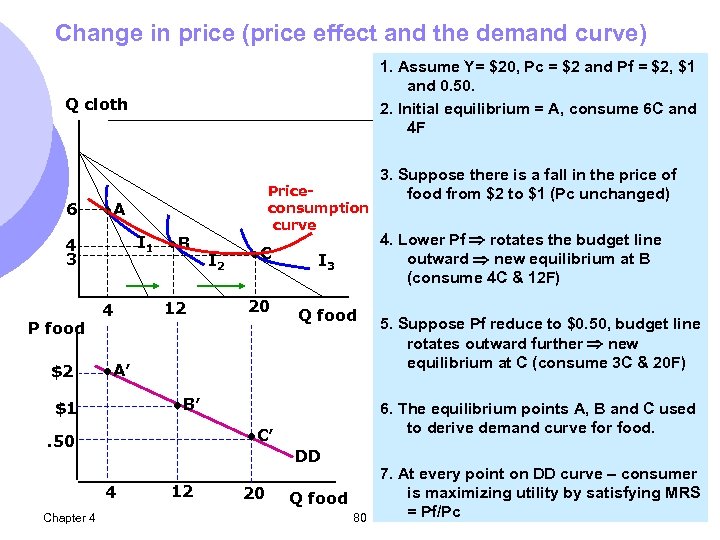
Change in price (price effect and the demand curve) 1. Assume Y= $20, Pc = $2 and Pf = $2, $1 and 0. 50. 2. Initial equilibrium = A, consume 6 C and 4 F Q cloth 6 ●A I 1 ●B 4 3 P food $2 4 12 I 2 ●C 20 I 3 Q food ●A’ ●B’ $1 DD 4 12 20 4. Lower Pf rotates the budget line outward new equilibrium at B (consume 4 C & 12 F) 5. Suppose Pf reduce to $0. 50, budget line rotates outward further new equilibrium at C (consume 3 C & 20 F) 6. The equilibrium points A, B and C used to derive demand curve for food. ●C’ . 50 Chapter 4 Priceconsumption curve 3. Suppose there is a fall in the price of food from $2 to $1 (Pc unchanged) Q food 80 7. At every point on DD curve – consumer is maximizing utility by satisfying MRS = Pf/Pc
Individual Demand Curves – Important Properties l The level of utility changes as we move along the curve (the lower the price of product, the higher the consumer’s purchasing power and the higher its level of utility). l At every point on the demand curve, the consumer is maximizing utility by satisfying the condition that the MRS = Pf / Pc. l If the price consumption curve is downward-sloping, the two goods are considered substitutes. l If the price consumption curve is upward-sloping, the two goods are considered complements. Chapter 4 81
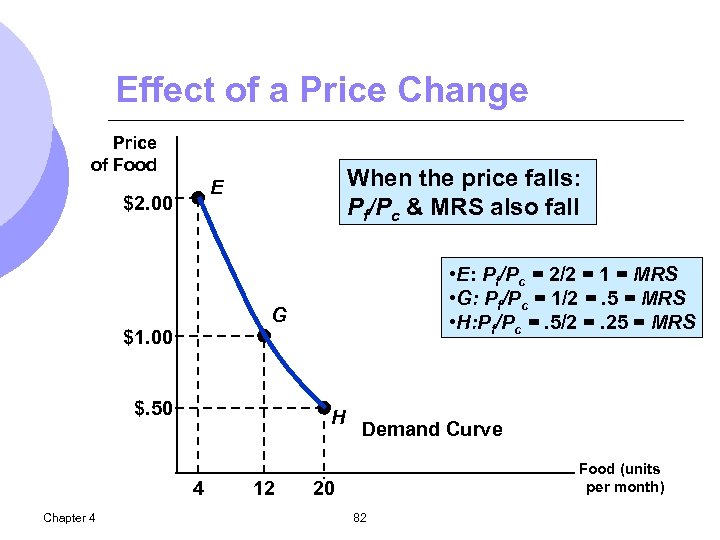
Effect of a Price Change Price of Food When the price falls: Pf/Pc & MRS also fall E $2. 00 G $1. 00 $. 50 H 4 Chapter 4 • E: Pf/Pc = 2/2 = 1 = MRS • G: Pf/Pc = 1/2 =. 5 = MRS • H: Pf/Pc =. 5/2 =. 25 = MRS 12 Demand Curve Food (units per month) 20 82
Individual Demand l Income Changes m. Changing income, with prices fixed, causes consumer to change their market baskets. m An increase in income shifts the budget line to the right, increasing consumption along the incomeconsumption curve. m Simultaneously, the increase in income shifts the demand curve to the right. m. The income-consumption curve traces out the utility -maximizing combinations of food and clothing associated with every income level. Chapter 4 83
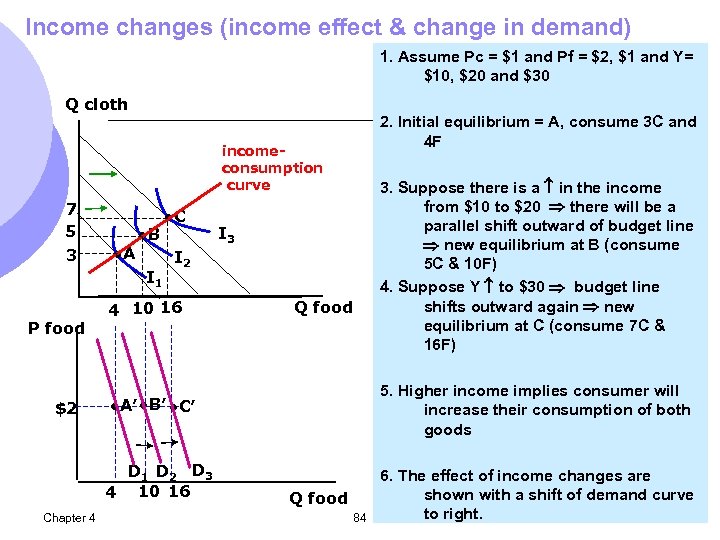
Income changes (income effect & change in demand) 1. Assume Pc = $1 and Pf = $2, $1 and Y= $10, $20 and $30 Q cloth 2. Initial equilibrium = A, consume 3 C and 4 F incomeconsumption curve 7 5 3 ●A ●B I 1 P food $2 ●C I 3 I 2 4 10 16 Q food 5. Higher income implies consumer will increase their consumption of both goods ●A’ ●B’ ●C’ D 1 D 2 D 3 4 10 16 Chapter 4 3. Suppose there is a in the income from $10 to $20 there will be a parallel shift outward of budget line new equilibrium at B (consume 5 C & 10 F) 4. Suppose Y to $30 budget line shifts outward again new equilibrium at C (consume 7 C & 16 F) Q food 84 6. The effect of income changes are shown with a shift of demand curve to right.
Normal versus Inferior l Income Changes m. When the income-consumption curve has a positive slope: l The quantity demanded increases with income. l The income elasticity of demand is positive. l The good is a normal good. m. When the income-consumption curve has a negative slope: l The quantity demanded decreases with income. l The income elasticity of demand is negative. l The good is an inferior good. Chapter 4 85
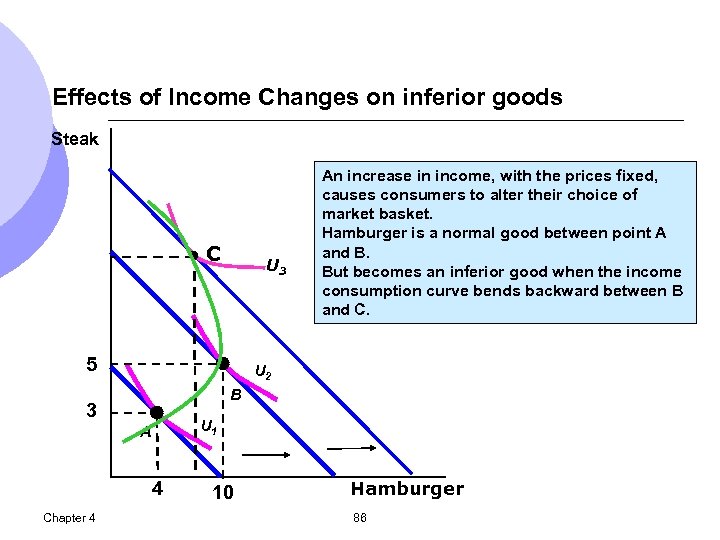
Effects of Income Changes on inferior goods Steak ●C U 3 5 U 2 B 3 U 1 A 4 Chapter 4 An increase in income, with the prices fixed, causes consumers to alter their choice of market basket. Hamburger is a normal good between point A and B. But becomes an inferior good when the income consumption curve bends backward between B and C. 10 Hamburger 86
Engel Curves l Income-consumption curves can be used to construct Engel curves l Engel Curves m Engel curves relate the quantity of good consumed to income. m If the good is a normal good, the Engel curve is upward sloping. m If the good is an inferior good, the Engel curve is downward sloping. Chapter 4 87
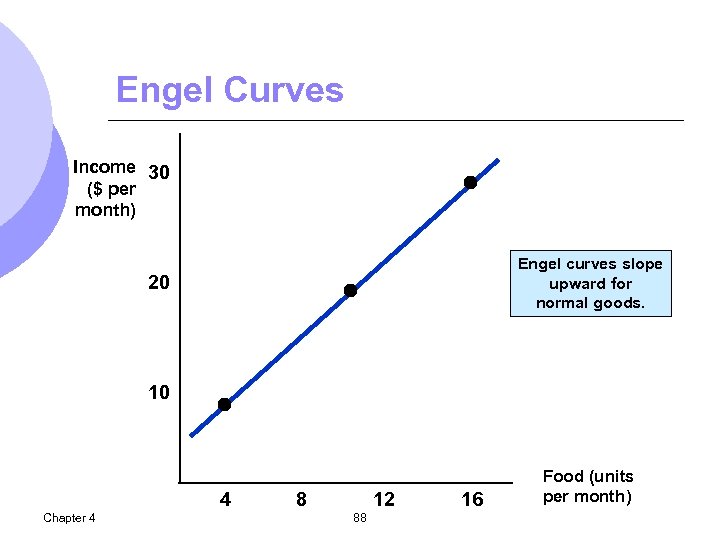
Engel Curves Income 30 ($ per month) Engel curves slope upward for normal goods. 20 10 4 Chapter 4 8 12 88 16 Food (units per month)
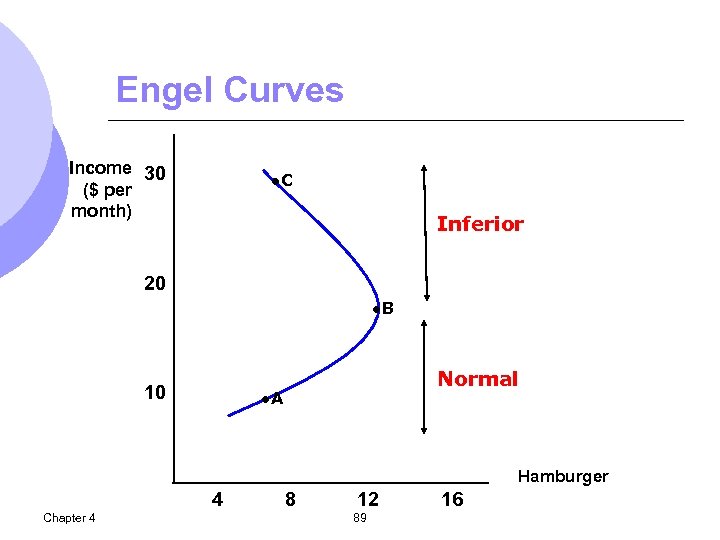
Engel Curves Income 30 ($ per month) ●C Inferior 20 ●B 10 Normal ●A Hamburger 4 Chapter 4 8 12 89 16
Income and Substitution Effects l A change in the price of a good has two effects: i. Substitution Effect m Relative price of a good changes when price changes m Consumers will tend to buy more of the good that has become relatively cheaper, and less of the good that is relatively more expensive. ii. Income Effect m Consumers experience an increase in real purchasing power when the price of one good falls. Chapter 4 90
Income and Substitution Effects l Substitution Effect m. The substitution effect is the change in an item’s consumption associated with a change in the price of the item, with the level of utility held constant. m. When the price of an item declines, the substitution effect always leads to an increase in the quantity demanded of the good. Chapter 4 91
Income and Substitution Effects l Income Effect m. The income effect is the change in an item’s consumption brought about by the increase in purchasing power, with the price of the item held constant. m. When a person’s income increases, the quantity demanded for the product may increase or decrease. Chapter 4 92
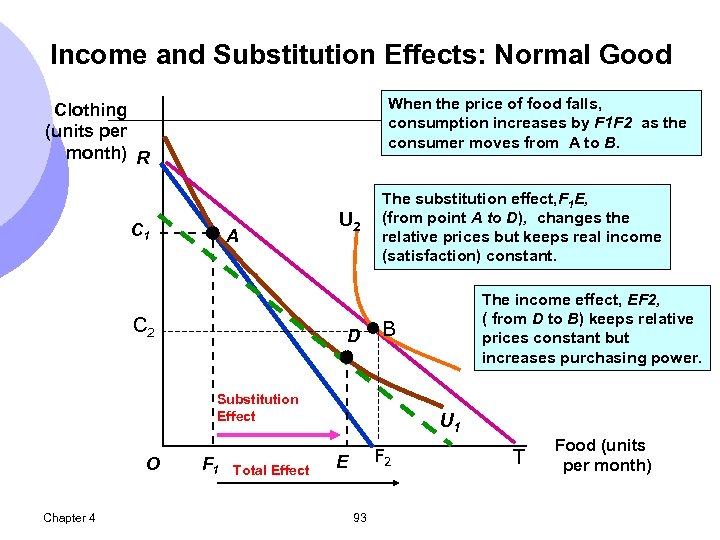
Income and Substitution Effects: Normal Good When the price of food falls, consumption increases by F 1 F 2 as the consumer moves from A to B. Clothing (units per month) R C 1 A C 2 The substitution effect, F 1 E, (from point A to D), changes the relative prices but keeps real income (satisfaction) constant. U 2 D ●B Substitution Effect O Chapter 4 F 1 Total Effect The income effect, EF 2, ( from D to B) keeps relative prices constant but increases purchasing power. U 1 F 2 E 93 T Food (units per month)
Chapter 6 Firm Theory: Production
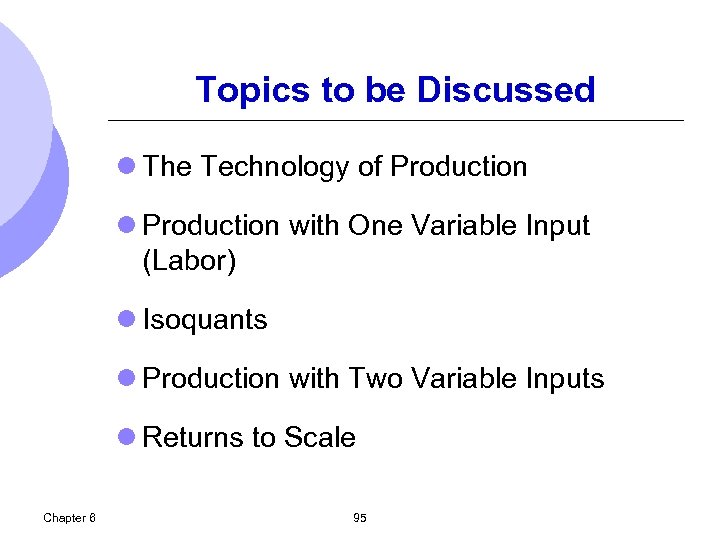
Topics to be Discussed l The Technology of Production l Production with One Variable Input (Labor) l Isoquants l Production with Two Variable Inputs l Returns to Scale Chapter 6 95
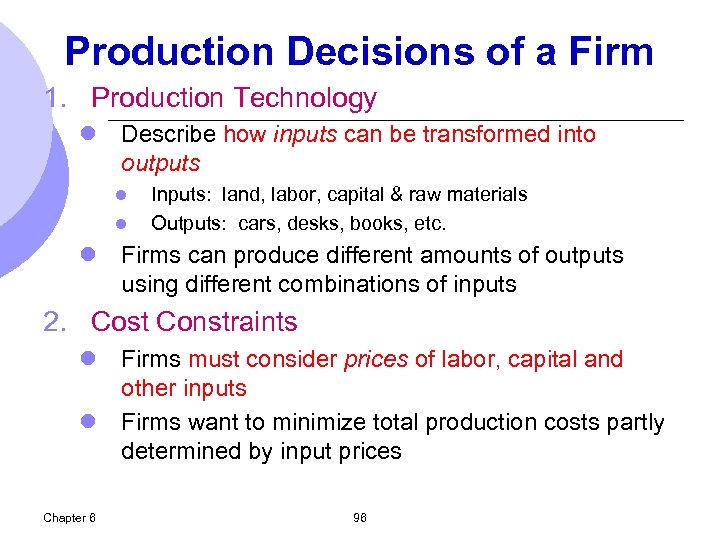
Production Decisions of a Firm 1. Production Technology l Describe how inputs can be transformed into outputs l l Inputs: land, labor, capital & raw materials Outputs: cars, desks, books, etc. l Firms can produce different amounts of outputs using different combinations of inputs 2. Cost Constraints l Firms must consider prices of labor, capital and other inputs l Firms want to minimize total production costs partly determined by input prices Chapter 6 96
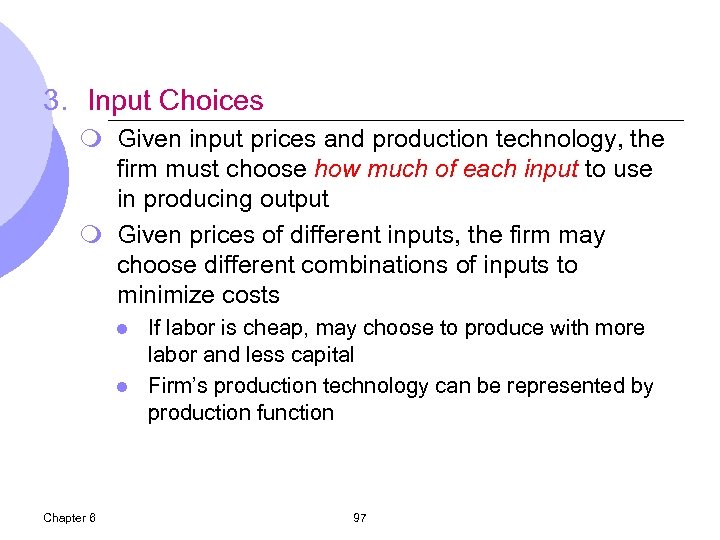
3. Input Choices m Given input prices and production technology, the firm must choose how much of each input to use in producing output m Given prices of different inputs, the firm may choose different combinations of inputs to minimize costs If labor is cheap, may choose to produce with more labor and less capital l Firm’s production technology can be represented by production function l Chapter 6 97
The Technology of Production l The production function for two inputs: q = F(K, L) m. Shows what is technically feasible when the firm operates efficiently. m. Function shows the highest output that a firm can produce for every specified combinations of inputs m. Output (q) is a function of capital (K) and Labor (L) m. The production function is true for a given technology l Chapter 6 If technology increases, more output can be produced for a given level of inputs 98
Short Run versus Long Run m. It takes time for a firm to adjust production from one set of inputs to another m. Firms must consider not only what inputs can be varied but over what period of time that can occur l Short Run m. Period of time in which quantities of one or more production factors cannot be changed m. These inputs are called fixed inputs (capital is fixed and labour is variable). l Long-run m. Amount of time needed to make all production inputs variable. Chapter 6 99
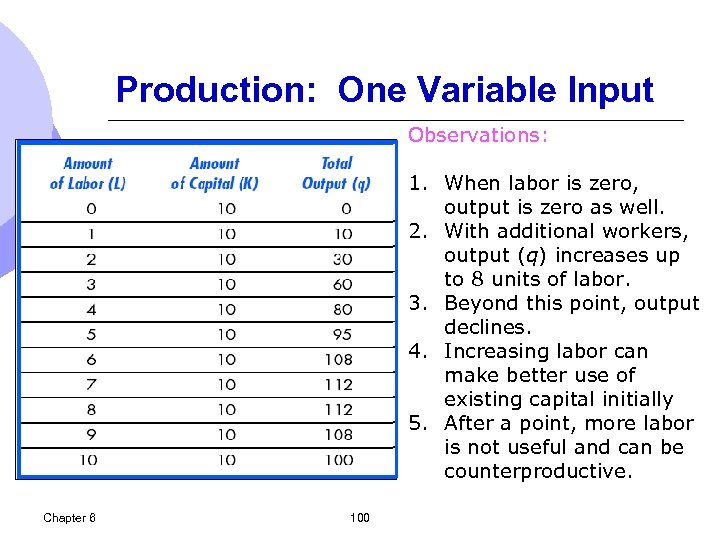
Production: One Variable Input Observations: 1. When labor is zero, output is zero as well. 2. With additional workers, output (q) increases up to 8 units of labor. 3. Beyond this point, output declines. 4. Increasing labor can make better use of existing capital initially 5. After a point, more labor is not useful and can be counterproductive. Chapter 6 100
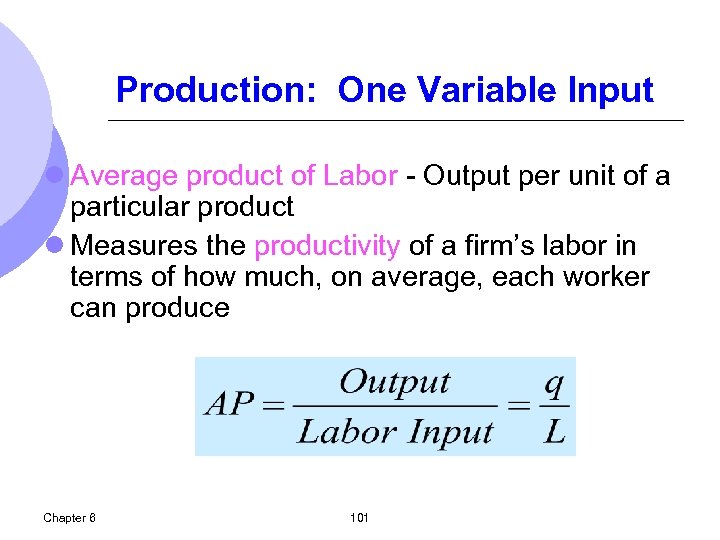
Production: One Variable Input l Average product of Labor - Output per unit of a particular product l Measures the productivity of a firm’s labor in terms of how much, on average, each worker can produce Chapter 6 101
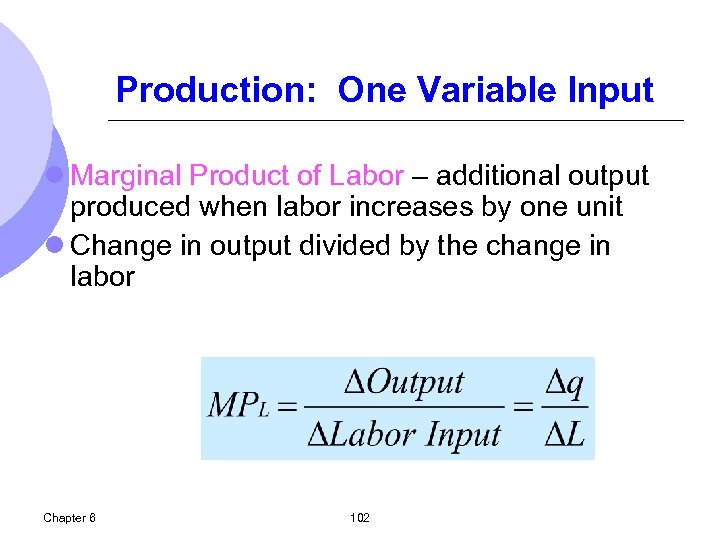
Production: One Variable Input l Marginal Product of Labor – additional output produced when labor increases by one unit l Change in output divided by the change in labor Chapter 6 102
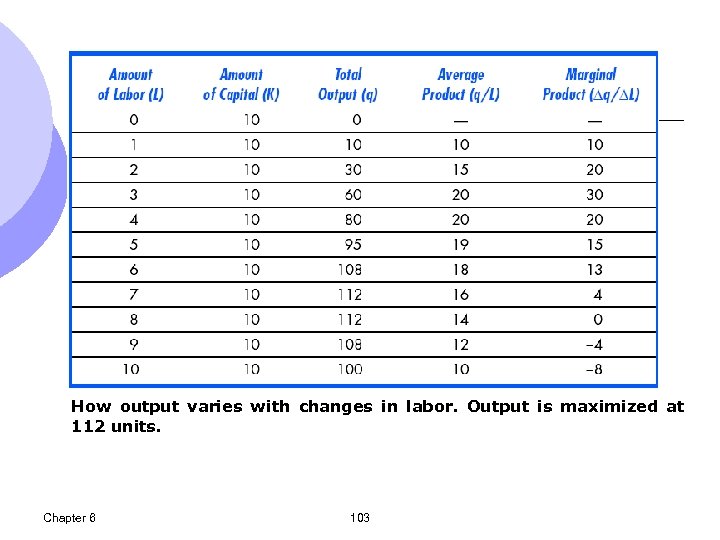
How output varies with changes in labor. Output is maximized at 112 units. Chapter 6 103
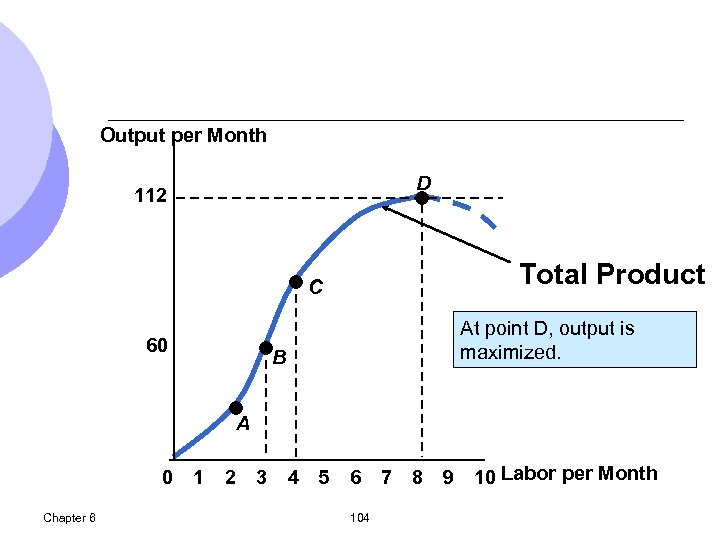
Output per Month D 112 Total Product C 60 At point D, output is maximized. B A 0 Chapter 6 1 2 3 4 5 6 7 104 8 9 10 Labor per Month
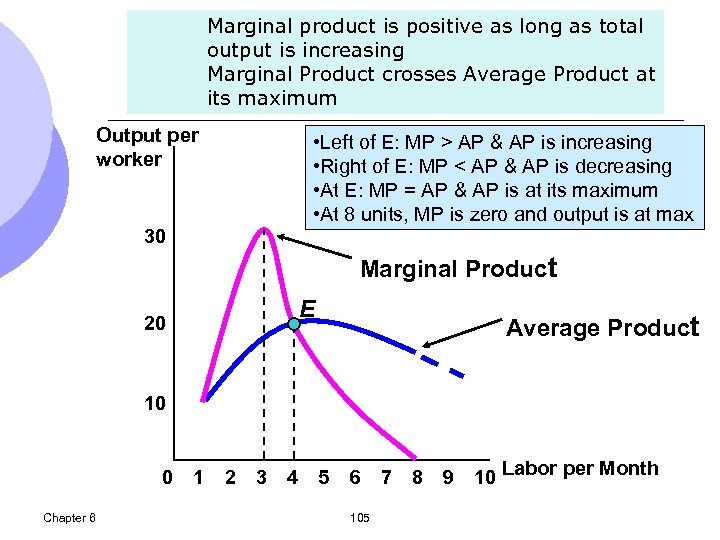
Marginal product is positive as long as total output is increasing Marginal Product crosses Average Product at its maximum Output per worker • Left of E: MP > AP & AP is increasing • Right of E: MP < AP & AP is decreasing • At E: MP = AP & AP is at its maximum • At 8 units, MP is zero and output is at max 30 Marginal Product E 20 Average Product 10 0 Chapter 6 1 2 3 4 5 6 105 7 8 9 10 Labor per Month
Law of Diminishing Marginal Returns l As the use of an input increases with other inputs fixed, the resulting additions to output will eventually decrease. l When the labor input is small and capital is fixed, output increases considerably since workers can begin to specialize and MP of labor increases l When the labor input is large, some workers become less efficient and MP of labor decreases l Usually used for short run when one variable input is fixed Chapter 6 106
Law of Diminishing Marginal Returns Assumptions made: l Assumes the quality of the variable input is constant l Assumes a constant technology m. Changes in technology will cause shifts in the total product curve m. More output can be produced with same inputs m. Labor productivity can increase if there are improvements in technology, even though any given production process exhibits diminishing returns to labor. Chapter 6 107
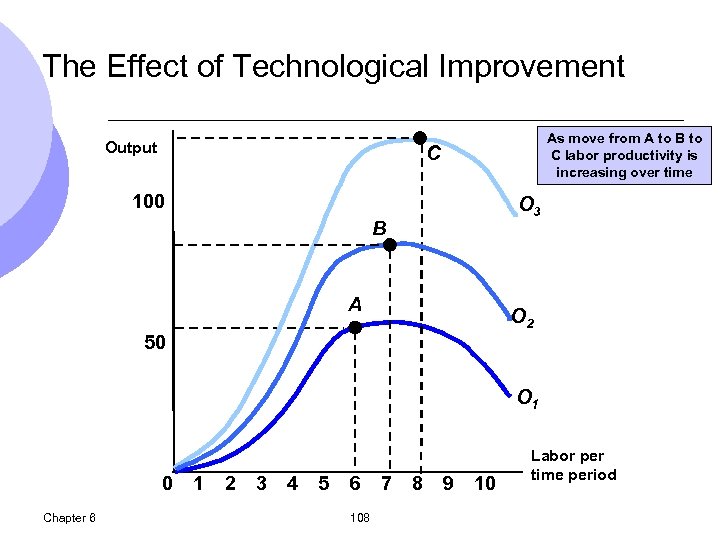
The Effect of Technological Improvement Output As move from A to B to C labor productivity is increasing over time C 100 O 3 B A O 2 50 O 1 0 Chapter 6 1 2 3 4 5 6 108 7 8 9 10 Labor per time period
Long run: Production with Two Variable Inputs l Firm can produce output by combining different amounts of labor and capital l In the long-run, capital and labor are both variable. Chapter 6 109
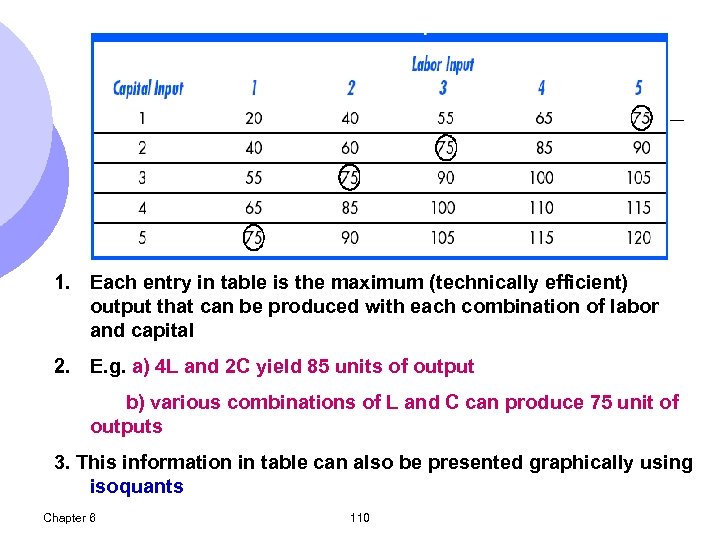
1. Each entry in table is the maximum (technically efficient) output that can be produced with each combination of labor and capital 2. E. g. a) 4 L and 2 C yield 85 units of output b) various combinations of L and C can produce 75 unit of outputs 3. This information in table can also be presented graphically using isoquants Chapter 6 110
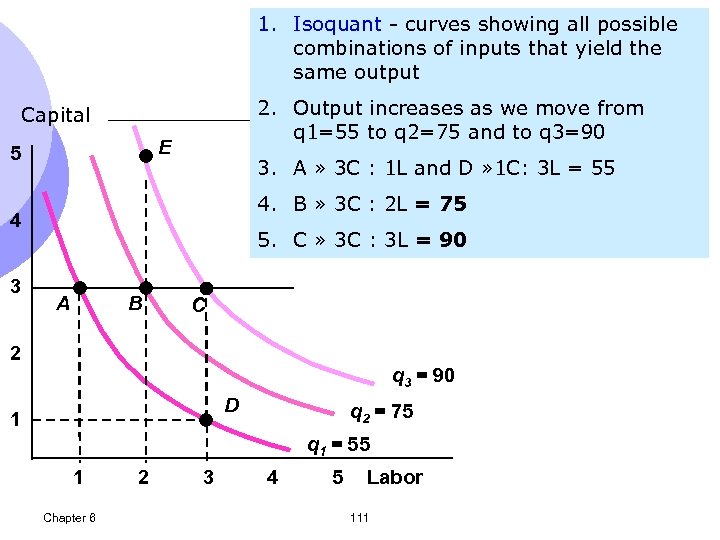
1. Isoquant - curves showing all possible combinations of inputs that yield the same output 2. Output increases as we move from q 1=55 to q 2=75 and to q 3=90 Capital E 5 3. A » 3 C : 1 L and D » 1 C: 3 L = 55 4. B » 3 C : 2 L = 75 4 3 5. C » 3 C : 3 L = 90 A B C 2 q 3 = 90 D 1 q 2 = 75 q 1 = 55 1 Chapter 6 2 3 4 5 Labor 111
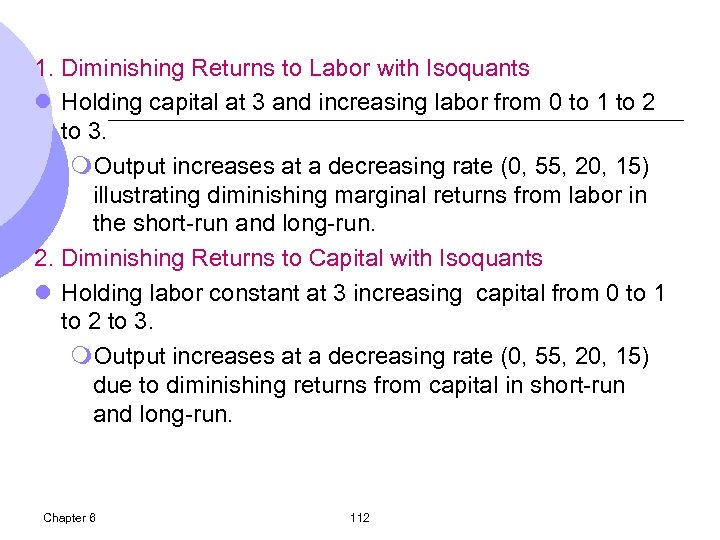
1. Diminishing Returns to Labor with Isoquants l Holding capital at 3 and increasing labor from 0 to 1 to 2 to 3. m. Output increases at a decreasing rate (0, 55, 20, 15) illustrating diminishing marginal returns from labor in the short-run and long-run. 2. Diminishing Returns to Capital with Isoquants l Holding labor constant at 3 increasing capital from 0 to 1 to 2 to 3. m. Output increases at a decreasing rate (0, 55, 20, 15) due to diminishing returns from capital in short-run and long-run. Chapter 6 112
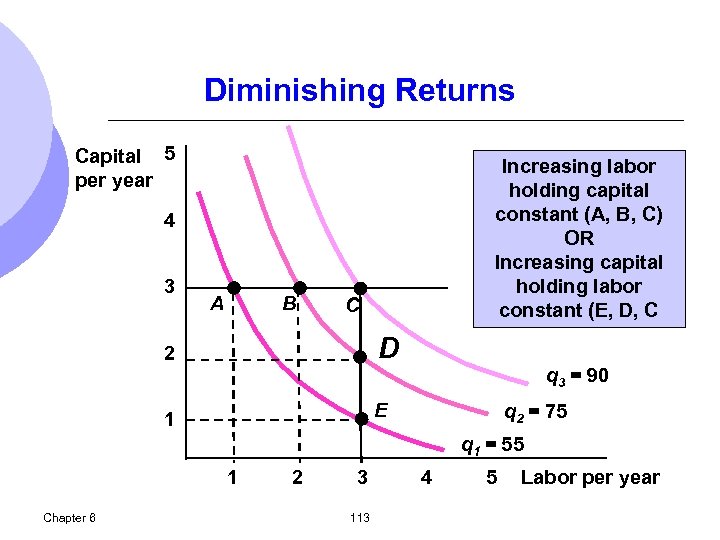
Diminishing Returns Capital 5 per year Increasing labor holding capital constant (A, B, C) OR Increasing capital holding labor constant (E, D, C 4 3 A B C 2 D 1 E q 3 = 90 q 2 = 75 q 1 = 55 1 Chapter 6 2 3 113 4 5 Labor per year
l Slope of Isoquant : Substituting Among Inputs m. Firms must decide what combination of inputs to use to produce a certain quantity of output m. There is a trade-off between inputs allowing them to use more of one input and less of another for the same level of output. m. Slope of the isoquant shows how one input can be substituted for the other and keep the level of output the same. m. Slope of isoquant is the marginal rate of technical substitution (MRTS) l Chapter 6 Amount by which the quantity of one input can be reduced when one extra unit of another input is used, so that output remains constant. 114
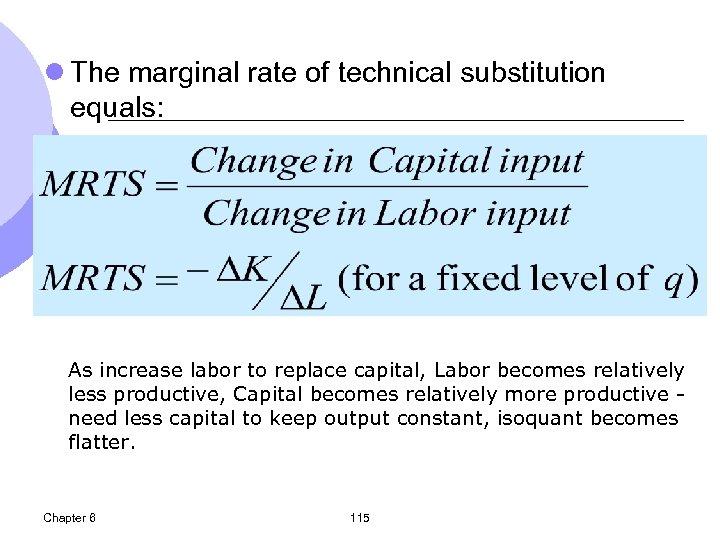
l The marginal rate of technical substitution equals: As increase labor to replace capital, Labor becomes relatively less productive, Capital becomes relatively more productive need less capital to keep output constant, isoquant becomes flatter. Chapter 6 115
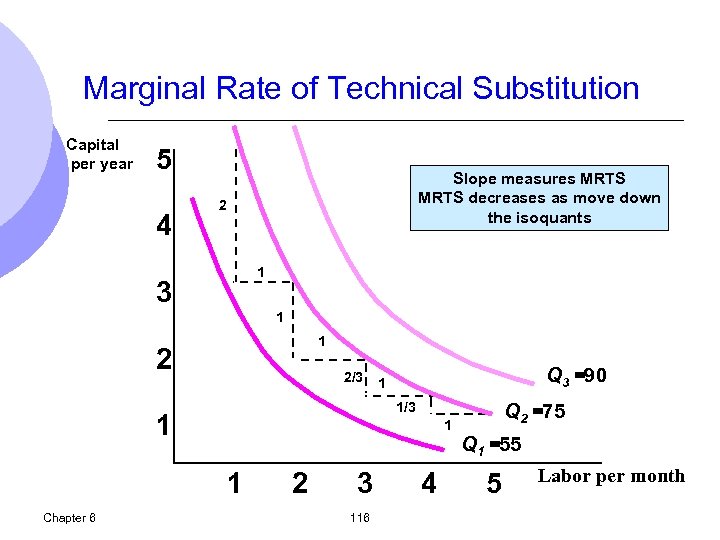
Marginal Rate of Technical Substitution Capital per year 5 4 Slope measures MRTS decreases as move down the isoquants 2 1 3 1 1 2 2/3 1 Q 2 =75 1 Q 1 =55 1 Chapter 6 Q 3 =90 1 2 3 116 4 5 Labor per month
MRTS and Isoquants l Assuming there is diminishing MRTS m. Increasing labor in one unit increments from 1 to 5 results in a decreasing MRTS from 1 to 1/2. m. Productivity of any one input is limited l Diminishing MRTS occurs because of diminishing returns and implies isoquants are convex. l There is a relationship between MRTS and marginal products of inputs. Chapter 6 117
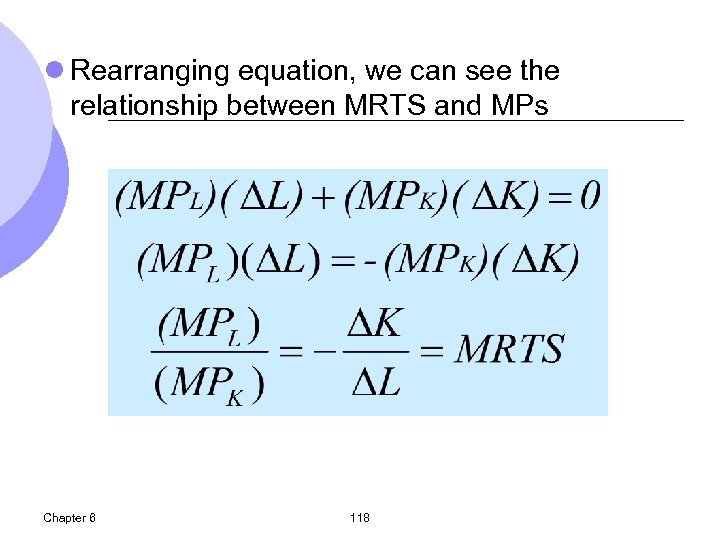
l Rearranging equation, we can see the relationship between MRTS and MPs Chapter 6 118
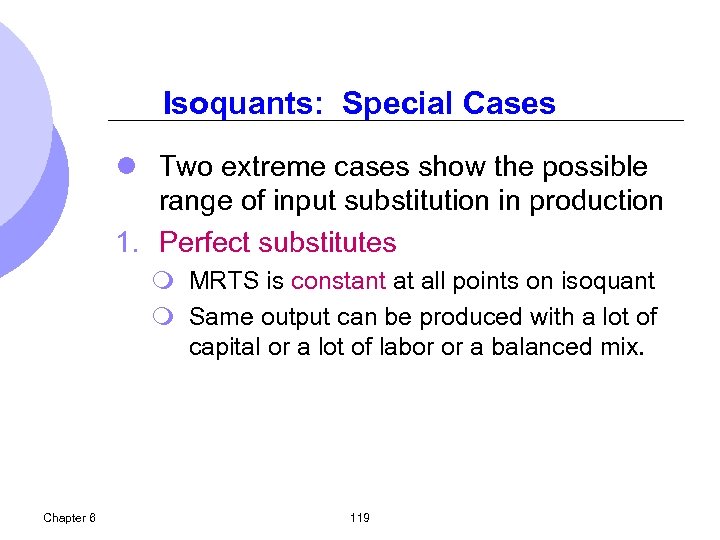
Isoquants: Special Cases l Two extreme cases show the possible range of input substitution in production 1. Perfect substitutes m MRTS is constant at all points on isoquant m Same output can be produced with a lot of capital or a lot of labor or a balanced mix. Chapter 6 119
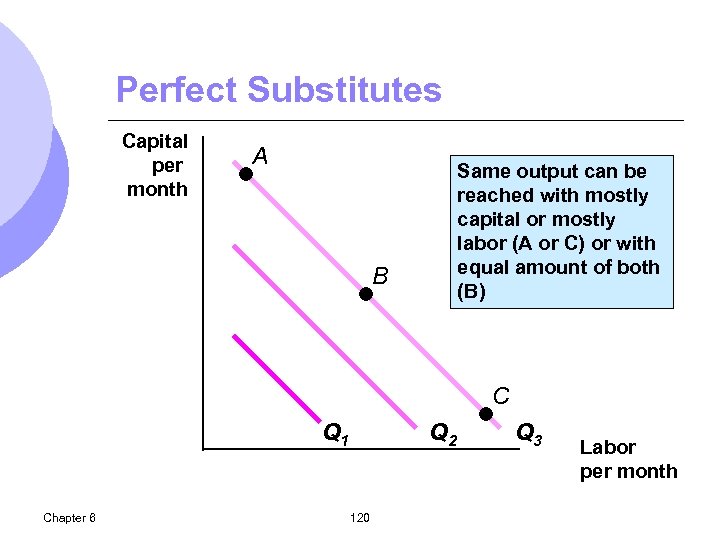
Perfect Substitutes Capital per month A Same output can be reached with mostly capital or mostly labor (A or C) or with equal amount of both (B) B C Q 1 Chapter 6 Q 2 120 Q 3 Labor per month
Perfect Complements m Fixed proportions production function m There is no substitution available between inputs m The output can be made with only a specific proportion of capital and labor m Cannot increase output unless increase both capital and labor in that specific proportion Chapter 6 121
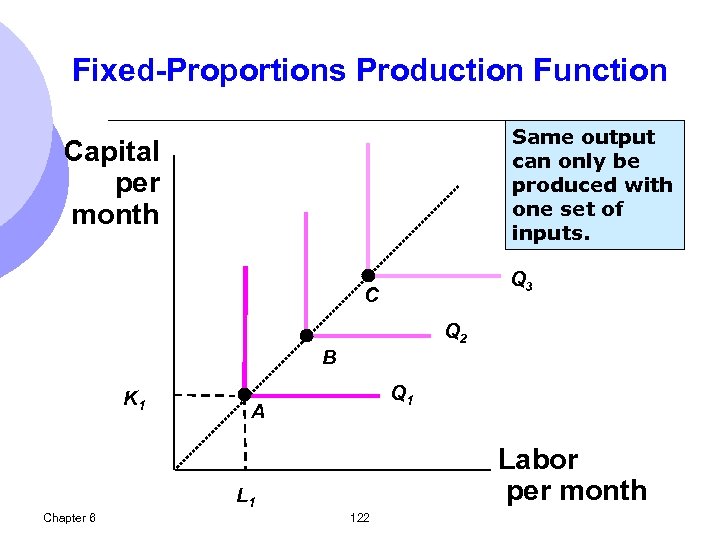
Fixed-Proportions Production Function Same output can only be produced with one set of inputs. Capital per month Q 3 C Q 2 B K 1 Q 1 A Labor per month L 1 Chapter 6 122
Returns to Scale l Besides tradeoff between inputs to keep production the same, we are also concern on how does a firm decide on the best way to increase output in the long run l One of the way is to change the scale of production by increasing all inputs in proportion (If double inputs, output will most likely increase but by how much? ) l There are 3 types of returns to scale (rate at which output increases as inputs are increased proportionately) m. Increasing returns to scale m. Constant returns to scale m. Decreasing returns to scale Chapter 6 123
Increasing returns to scale: m. Output more than doubles when all inputs are doubled (input increase 10%, output increases more than 10%) m. Larger output associated with lower cost. m. Arise because the larger scale of operation allows managers and workers to specialize their tasks and use of more sophisticated equipments and factories Chapter 6 124
Constant returns to scale: m Output doubles when all inputs are doubled (input increase 10%, output increases 10%) m Size of firm’s operation does not affect productivity. Decreasing returns to scale: m output less than doubles when all inputs are doubled. m Decreasing Chapter 6 efficiency with large size. 125
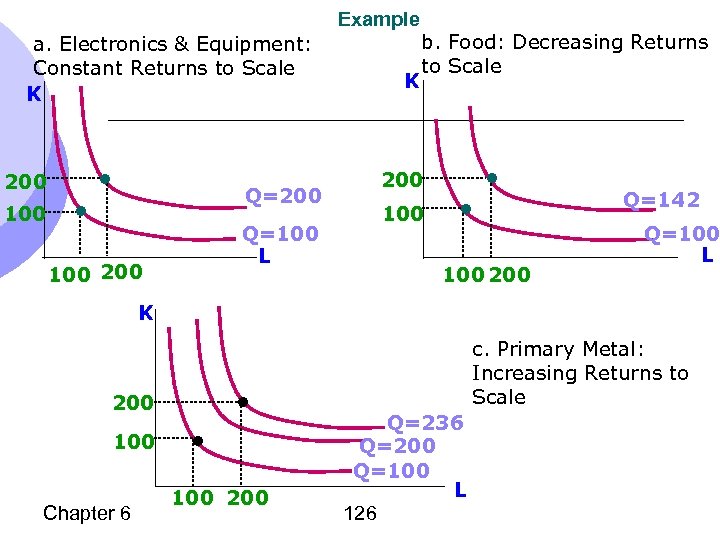
Example a. Electronics & Equipment: Constant Returns to Scale K • 200 100 Q=200 • Q=100 L 100 200 K b. Food: Decreasing Returns to Scale • 200 100 • 100 200 Q=142 Q=100 L K • 200 100 Chapter 6 • 100 200 c. Primary Metal: Increasing Returns to Scale Q=236 Q=200 Q=100 L 126
Chapter 7 The Cost of Production
Topics to be Discussed l Measuring Cost l Cost in the Short Run l Cost in the Long Run l Long-Run Versus Short-Run Cost Curves Chapter 7 128
Introduction l Production technology, together with prices of factor inputs, determine the firm’s cost of production l The optimal, cost minimizing, level of inputs can be determined. l A firm’s costs depend on the rate of output and will change over time. l The characteristics of the firm’s production technology can affect costs in the long run and short run. Chapter 7 129
Measuring Cost: Which Costs Matter? Economic Cost vs Accounting Cost l Accountants tend to take a retrospective view of firms costs, where as economists tend to take a forward-looking view l Accounting Cost m. Actual expenses plus depreciation charges for capital equipment l Economic Cost m. Cost to a firm of utilizing economic resources in production, including opportunity cost l Accountants and economists often treat depreciation differently as well Chapter 7 130
Economic Costs l Economic costs distinguish between costs the firm can control and those it cannot m Concept of opportunity cost plays an important role l Opportunity cost m Cost associated with opportunities that are foregone when a firm’s resources are not put to their highestvalue use. l An Example m A firm owns its own building and pays no rent for office space. The building could have been rented instead. m Foregone rent is the opportunity cost of using the building for production and should be included in economic costs of doing business Chapter 7 131
Sunk Cost l Although opportunity costs are hidden and should be taken into account, sunk costs should not l Sunk Cost m Expenditure that has been made and cannot be recovered m Should not influence a firm’s future economic decisions. l Firm buys a piece of equipment that cannot be converted to another use l Expenditure on the equipment is a sunk cost m Has no alternative use so cost cannot be recovered – opportunity cost is zero Chapter 7 132
Fixed Costs and Variable Costs l Some costs vary with output, while some remain the same no matter amount of output l Total cost can be divided into: 1. Fixed Cost m Does not vary with the level of output 2. Variable Cost m Cost that varies as output varies Chapter 7 133
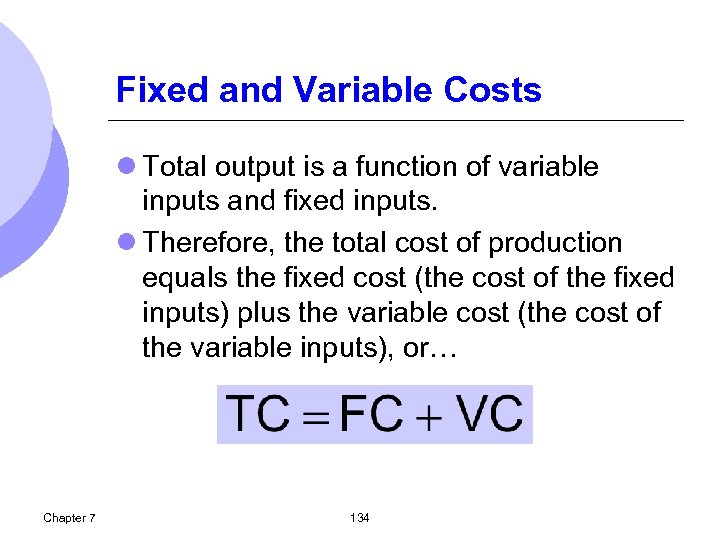
Fixed and Variable Costs l Total output is a function of variable inputs and fixed inputs. l Therefore, the total cost of production equals the fixed cost (the cost of the fixed inputs) plus the variable cost (the cost of the variable inputs), or… Chapter 7 134
Short run versus long run l Which costs are variable and which are fixed depends on the time horizon l Short time horizon – most costs are fixed l Long time horizon – many costs become variable Chapter 7 135
Fixed Cost Versus Sunk Cost l Fixed cost and sunk cost are often confused l Fixed Cost m. Cost paid by a firm that is in business regardless of the level of output l Sunk Cost m. Cost that have been incurred and cannot be recovered Chapter 7 136
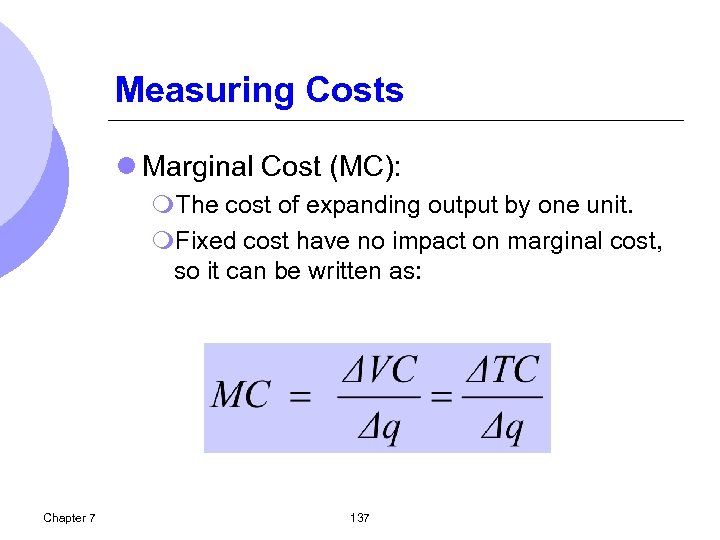
Measuring Costs l Marginal Cost (MC): m. The cost of expanding output by one unit. m. Fixed cost have no impact on marginal cost, so it can be written as: Chapter 7 137
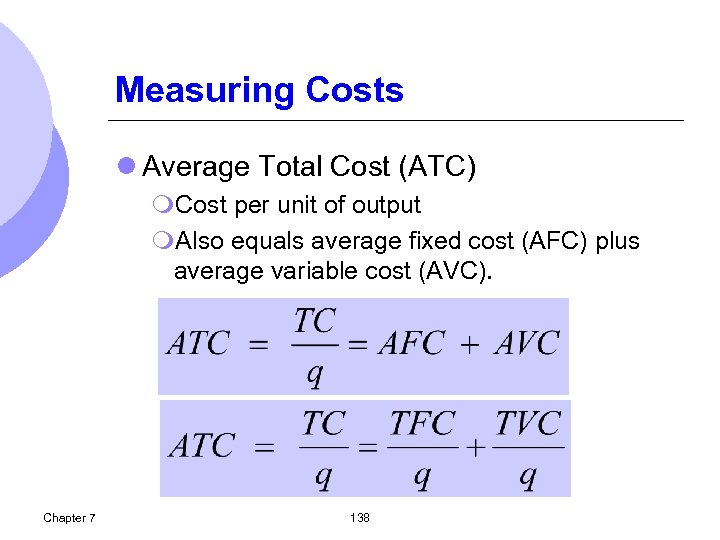
Measuring Costs l Average Total Cost (ATC) m. Cost per unit of output m. Also equals average fixed cost (AFC) plus average variable cost (AVC). Chapter 7 138
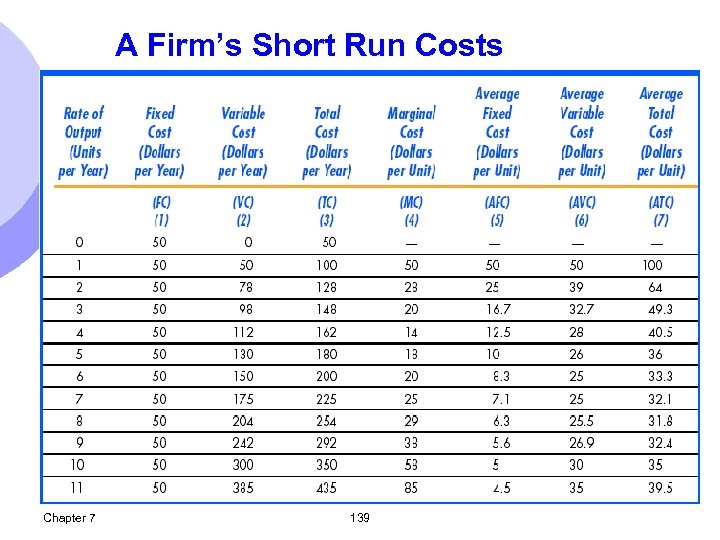
A Firm’s Short Run Costs Chapter 7 139
Determinants of Short-run Costs l The rate at which these costs increase depends on the nature of the production process m The extent to which production involves diminishing returns to variable factors l Diminishing returns to labor m When marginal product of labor is decreasing l If marginal product of labor decreases significantly as more labor is hired m Costs of production increase rapidly m Greater and greater expenditures must be made to produce more output Chapter 7 140
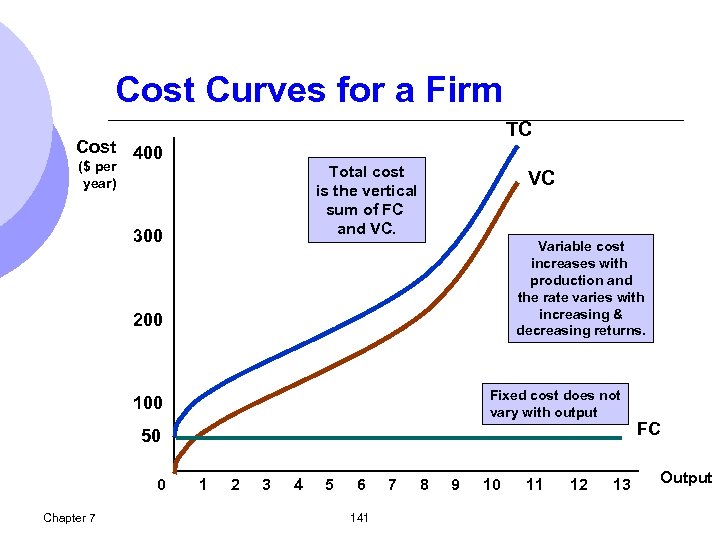
Cost Curves for a Firm TC Cost 400 ($ per year) Total cost is the vertical sum of FC and VC. 300 VC Variable cost increases with production and the rate varies with increasing & decreasing returns. 200 Fixed cost does not vary with output 100 50 0 Chapter 7 1 2 3 4 5 6 141 7 8 9 10 11 12 13 FC Output
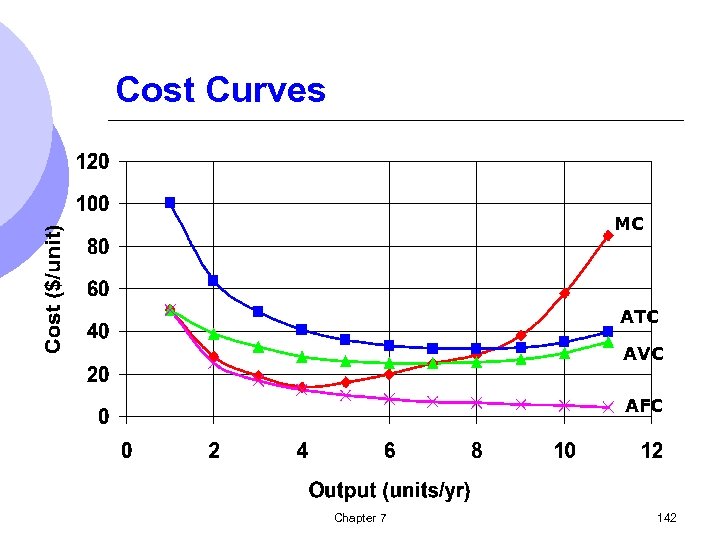
Cost Curves MC ATC AVC AFC Chapter 7 142
Cost Curves l When MC is below AVC, AVC is falling l When MC is above AVC, AVC is rising l When MC is below ATC, ATC is falling l When MC is above ATC, ATC is rising l Therefore, MC crosses AVC and ATC at the minimums m. The Average – Marginal relationship Chapter 7 143
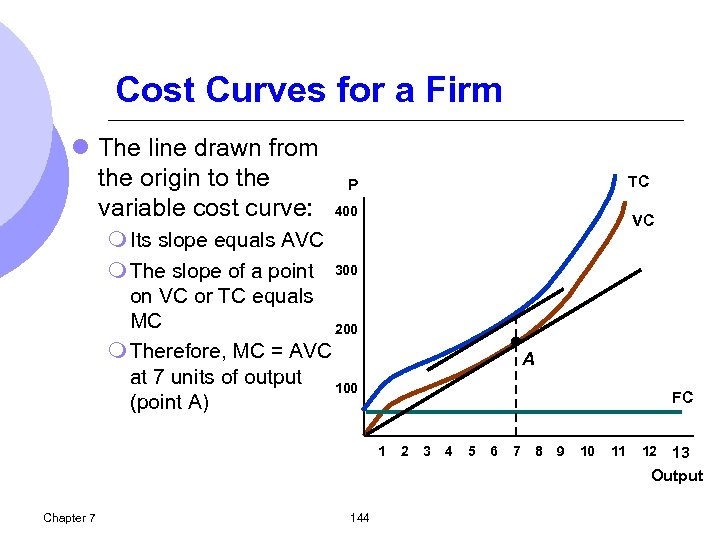
Cost Curves for a Firm l The line drawn from the origin to the variable cost curve: TC P 400 VC m Its slope equals AVC m The slope of a point 300 on VC or TC equals MC 200 m Therefore, MC = AVC at 7 units of output 100 (point A) A FC 1 Chapter 7 144 2 3 4 5 6 7 8 9 10 11 12 13 Output
Cost in the Long Run l In the long run a firm can change all of its inputs l In making cost minimizing choices, must look at the cost of using capital and labor in production decisions Chapter 7 145
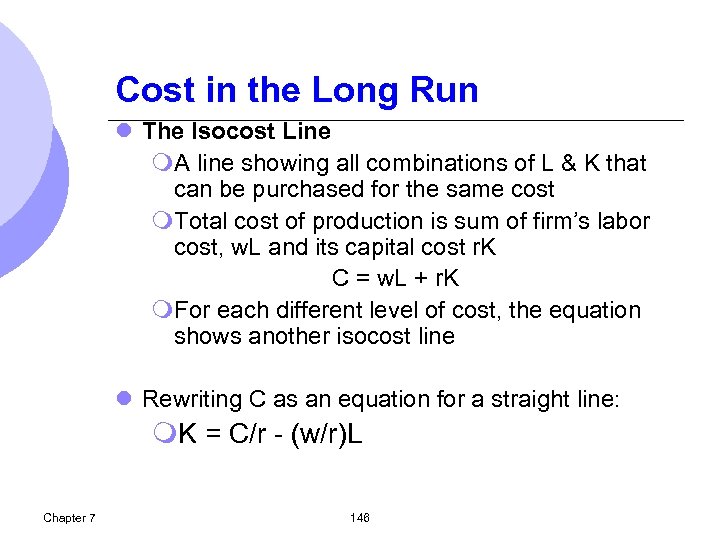
Cost in the Long Run l The Isocost Line m. A line showing all combinations of L & K that can be purchased for the same cost m. Total cost of production is sum of firm’s labor cost, w. L and its capital cost r. K C = w. L + r. K m. For each different level of cost, the equation shows another isocost line l Rewriting C as an equation for a straight line: m. K = C/r - (w/r)L Chapter 7 146
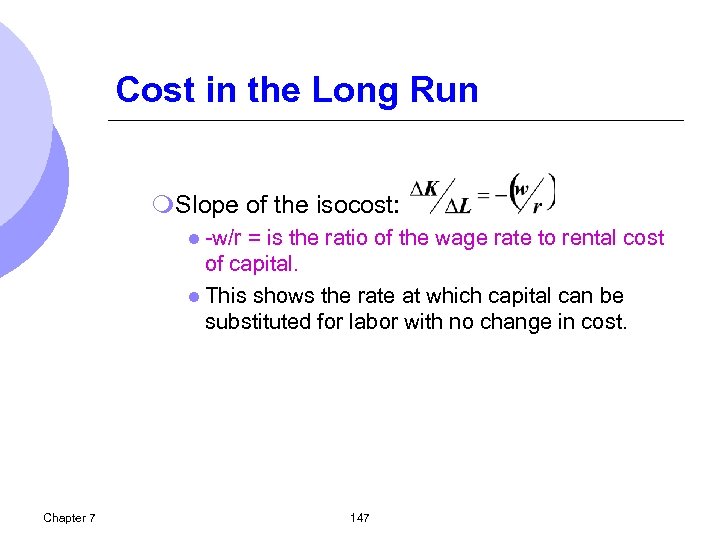
Cost in the Long Run m. Slope of the isocost: l -w/r = is the ratio of the wage rate to rental cost of capital. l This shows the rate at which capital can be substituted for labor with no change in cost. Chapter 7 147
Optimal Combination of inputs l Determined by combining isocosts with isoquants l Firm choose the output to produce and then determine how to do that at minimum cost m. Isoquant is the quantity firm wish to produce m. Isocost is the combination of K and L that gives a set cost Chapter 7 148
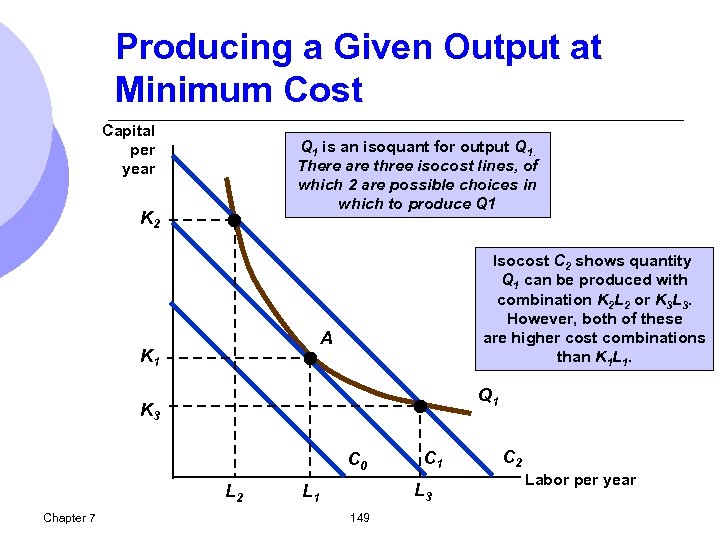
Producing a Given Output at Minimum Cost Capital per year Q 1 is an isoquant for output Q 1. There are three isocost lines, of which 2 are possible choices in which to produce Q 1 K 2 Isocost C 2 shows quantity Q 1 can be produced with combination K 2 L 2 or K 3 L 3. However, both of these are higher cost combinations than K 1 L 1. A K 1 Q 1 K 3 C 0 L 2 Chapter 7 C 1 L 3 L 1 149 C 2 Labor per year
Input Substitution When an Input Price Change l If the price of labor changes, then the slope of the isocost line change, w/r l It now takes a new quantity of labor and capital to produce the output l If price of labor increases relative to price of capital - capital is substituted for labor as capital are relatively cheaper Chapter 7 150
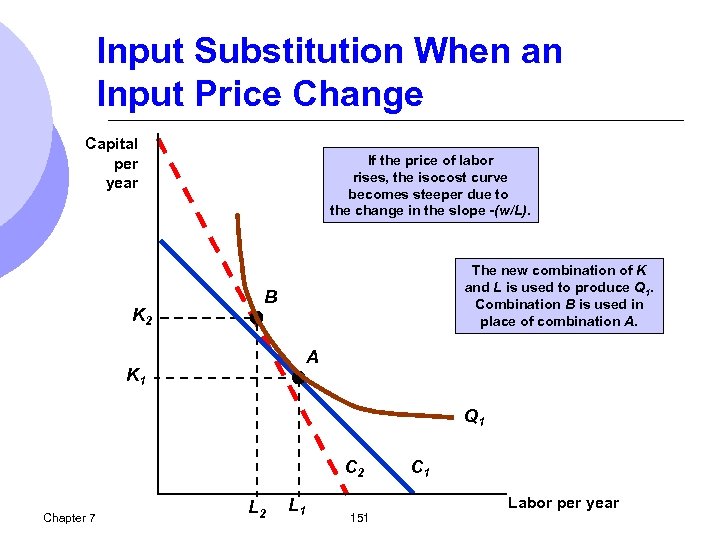
Input Substitution When an Input Price Change Capital per year K 2 If the price of labor rises, the isocost curve becomes steeper due to the change in the slope -(w/L). The new combination of K and L is used to produce Q 1. Combination B is used in place of combination A. B A K 1 Q 1 C 2 Chapter 7 L 2 L 1 151 C 1 Labor per year
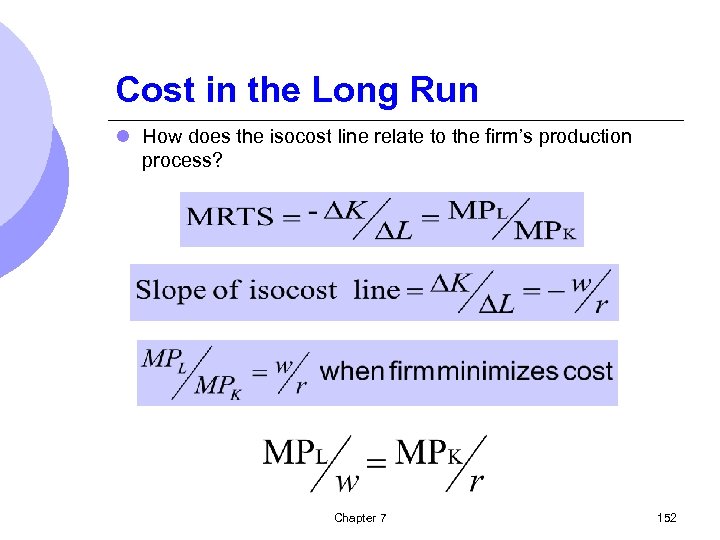
Cost in the Long Run l How does the isocost line relate to the firm’s production process? Chapter 7 152
Cost in the Long Run l Cost minimization with Varying Output Levels m. For each level of output, there is an isocost curve showing minimum cost for that output level m. A firm’s expansion path shows the minimum cost combinations of labor and capital at each level of output. m. Slope equals K/ L Chapter 7 153
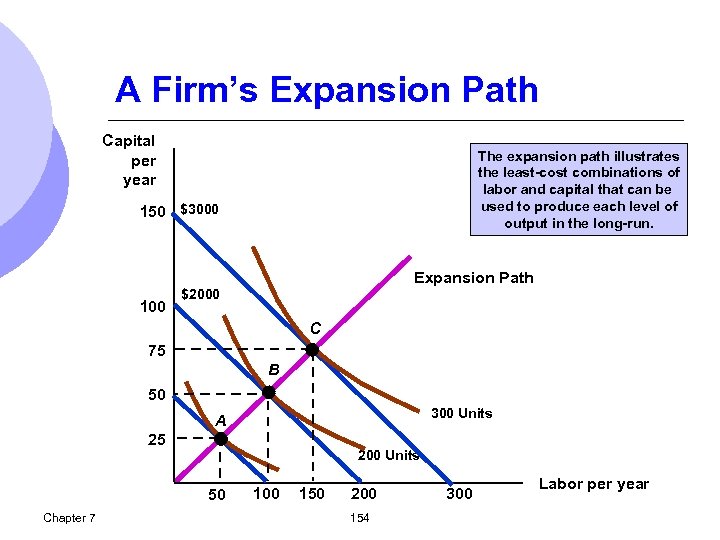
A Firm’s Expansion Path Capital per year The expansion path illustrates the least-cost combinations of labor and capital that can be used to produce each level of output in the long-run. 150 $3000 Expansion Path 100 $2000 C 75 B 50 300 Units A 25 200 Units 50 Chapter 7 100 150 200 154 300 Labor per year
Long-Run Versus Short-Run Cost Curves l In the short run some costs are fixed l In the long run firm can change anything including plant size m. Can produce at a lower average cost in long run than in short run m. Capital and labor are both flexible l We can show this by holding capital fixed in the short run and flexible in long run Chapter 7 155
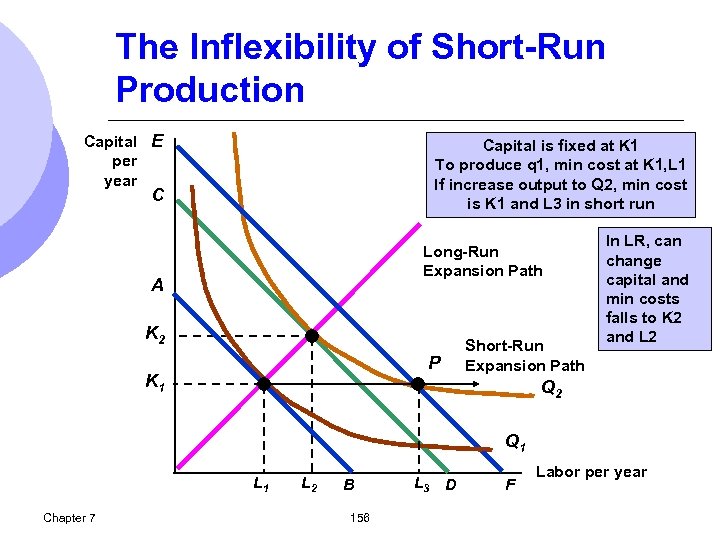
The Inflexibility of Short-Run Production Capital E per year Capital is fixed at K 1 To produce q 1, min cost at K 1, L 1 If increase output to Q 2, min cost is K 1 and L 3 in short run C Long-Run Expansion Path A K 2 P K 1 Short-Run Expansion Path In LR, can change capital and min costs falls to K 2 and L 2 Q 1 L 1 Chapter 7 L 2 B 156 L 3 D F Labor per year
Long-Run Versus Short-Run Cost Curves l In the long-run: m. Firms experience increasing and decreasing returns to scale and therefore long-run average cost is “U” shaped. m. U-shaped LAC shows economies of scale for relatively low output levels and diseconomies of scale for higher levels Long-run marginal cost curve measures the change in long-run total costs as output is increased by 1 unit. Chapter 7 157
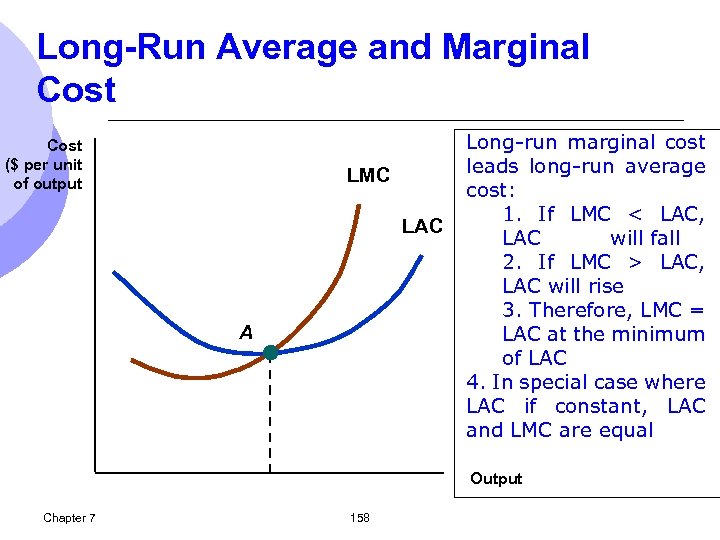
Long-Run Average and Marginal Cost ($ per unit of output LMC LAC A Long-run marginal cost leads long-run average cost: 1. If LMC < LAC, LAC will fall 2. If LMC > LAC, LAC will rise 3. Therefore, LMC = LAC at the minimum of LAC 4. In special case where LAC if constant, LAC and LMC are equal Output Chapter 7 158
Economies and Diseconomies of Scale Economies of scale (firm able to double output for less then twice the cost) l As output increases, firm’s AC of producing is likely to decline to a point 1. On a larger scale, workers can better specialize 2. Scale can provide flexibility to vary the combination of inputs used – managers can organize production more effectively 3. Firm may be able to get inputs at lower cost if can get quantity discounts. Lower prices might lead to different input mix Chapter 7 159
Diseconomies of scale (doubling output requires more than twice the cost) l At some point, AC will begin to increase 1. Factory space and machinery make it more difficult for workers to do their job efficiently 2. Managing a larger firm may become more complex and inefficient as the number of tasks increase 3. Bulk discounts can no longer be utilized. Limited availability of inputs may cause price to rise Chapter 7 160
The Relationship between Long. Run and Short-Run Cost Curves l We will use short and long-run cost to determine the optimal plant size l We can show the short run average costs for 3 different plant sizes (SAC 1, SAC 2 and SAC 3) l This decision is important because once built, the firm may not be able to change plant size for a while Chapter 7 161
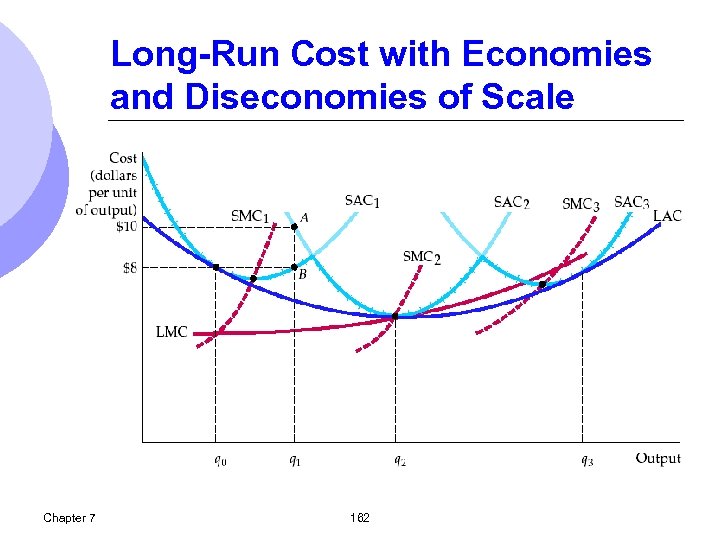
Long-Run Cost with Economies and Diseconomies of Scale Chapter 7 162
Long-Run Cost with Economies and Diseconomies of Scale l The optimal plant size will depend on the anticipated output m. If expect to produce q 0, then should build smallest plant: AC = $8 m. If produce more, like q 1, AC rises m. If expect to produce q 2, middle plant is least cost m. If expect to produce q 3, largest plant is best Chapter 7 163
End
Скачать презентацию FIRST MEETING PJJ ECN 3101 MICROECONOMICS 11 FEBRUARY
00ae993521a07645f3a5b0c3b1a670ad.ppt