


 Скачать презентацию First Meeting of Forensic Specialists Organization of American
f23a53bddbe36381daf4e292618ee58e.ppt
- Количество слайдов: 27
 First Meeting of Forensic Specialists Organization of American States Washington D. C. 24 -25 September 2009 INTERPOL & International DNA Data Exchange Presentation by Werner Schuller, MSc Assistant Director Forensic Support and Specialized Technical Databases Manager INTERPOL DNA Projects Secretary INTERPOL DNA MEG © IPSG Lyon AD W. Schuller
 INTERPOL’s Primary Objective “To facilitate cross-border police cooperation, and to support and assist all organizations, authorities and services whose mission is to prevent or combat international crime. ” INTERPOL General Secretariat Lyon France
 INTERPOL – an international organization • Created in 1923, INTERPOL is the world’s largest international police organization, with 187 member countries • General Secretariat in Lyon, France, six Regional Bureaus, one Liaison Office, and Special Representatives of INTERPOL to the United Nations in New York and to the European Union in Brussels • Four official languages: Arabic, English, French and Spanish • A National Central Bureau (NCB) in each member country
 Milestones in INTERPOL’s history 1914 – First International Criminal Police Congress held in Monaco (23 countries in attendance) 1923 – Creation of International Criminal Police Commission, based in Vienna, Austria 1946 – Organization rebuilt after WWII and based in Paris; notice system created and first Red Notices issued 1956 – Renamed International Criminal Police Organization INTERPOL 1971 – Recognised as intergovernmental organization by the UN 1989 – General Secretariat moves from Paris to Lyon 2004 – INTERPOL representative office opened at the UN in New York 2008 – INTERPOL representative office opened at the European Union in Brussels
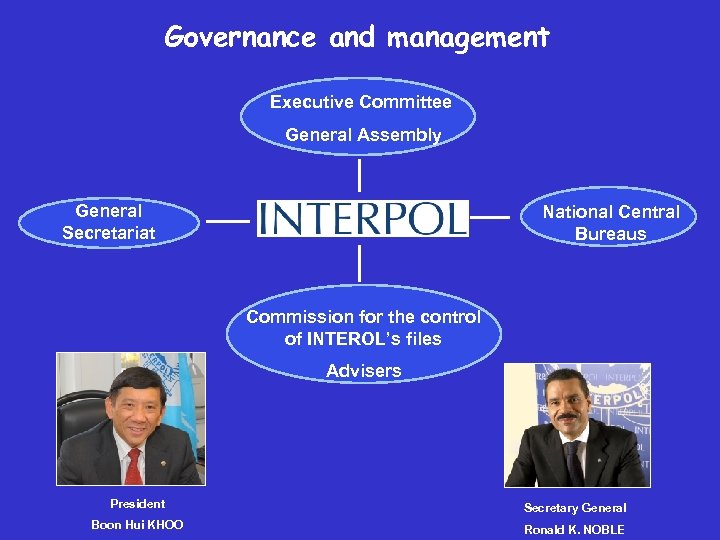 Governance and management Executive Committee General Assembly General Secretariat National Central Bureaus Commission for the control of INTEROL’s files Advisers President Secretary General Boon Hui KHOO Ronald K. NOBLE
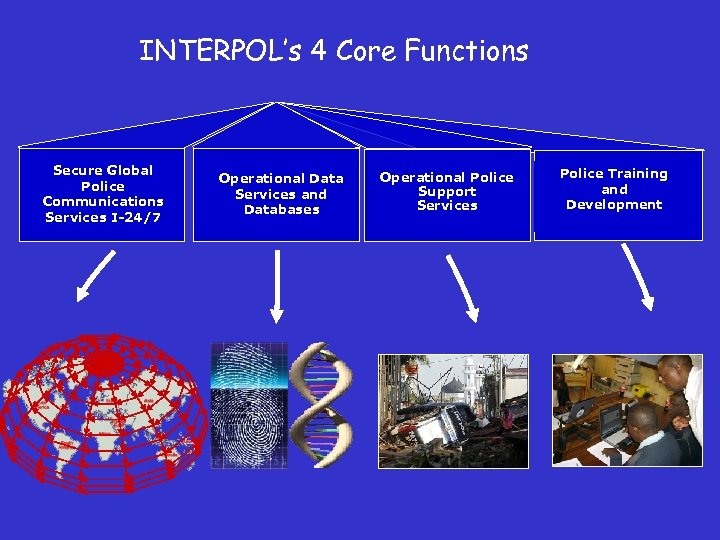 INTERPOL’s 4 Core Functions Secure Global Police Communications Services I-24/7 Operational Data Services and Databases Operational Police Support Services Police Training and Development
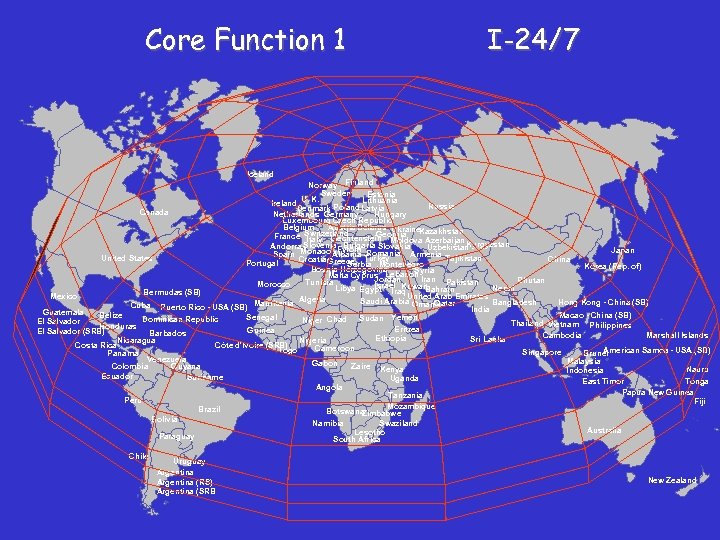 Core Function 1 I-24/7 Iceland Norway Finland Sweden Estonia Lithuania Ireland U. K. Russia Denmark Poland Latvia Canada Hungary Netherlands Germany Luxembourg Czech Republic Belgium Austria Belarus Ukraine. Kazakhstan Georgia France Switzerland Italy Liechtenstein Moldova Azerbaijan Kyrgyzstan Bulgaria Slovakia Andorra Slovenia Fyrom Uzbekistan Japan Romania Armenia Spain Monaco Albania Turkey Tajikistan United States Croatia Greece China Portugal Serbia Montenegro Korea (Rep. of) Bosnia-Herzegovina Syria Malta Cyprus Lebanon Iran Jordan Bhutan Pakistan Tunisia Morocco Israel Kuwait Nepal Libya Egypt Iraq Bahrain Bermudas (SB) Mexico United Arab Emirates Algeria Saudi Arabia Oman. Qatar Bangladesh Hong Kong - China (SB) Cuba Puerto Rico - USA (SB) Mauritania India Guatemala Belize Macao - China (SB) Senegal Sudan Yemen Dominican Republic Niger Chad El Salvador Thailand Vietnam Philippines Honduras Eritrea Guinea El Salvador (SRB) Barbados Cambodia Marshall Islands Ethiopia Sri Lanka Nigeria Nicaragua Costa Rica Côte d'Ivoire (SRB) Cameroon American Samoa - USA (SB) Togo Singapore Panama Brunei Venezuela Malaysia Gabon Colombia Guyana Zaire Kenya Nauru Indonesia Ecuador Suriname Uganda East Timor Tonga Angola Papua New Guinea Tanzania Peru Fiji Mozambique Brazil Botswana Zimbabwe Bolivia Namibia Swaziland Australia Lesotho Paraguay South Africa Chile Uruguay Argentina (RS) Argentina (SRB New Zealand
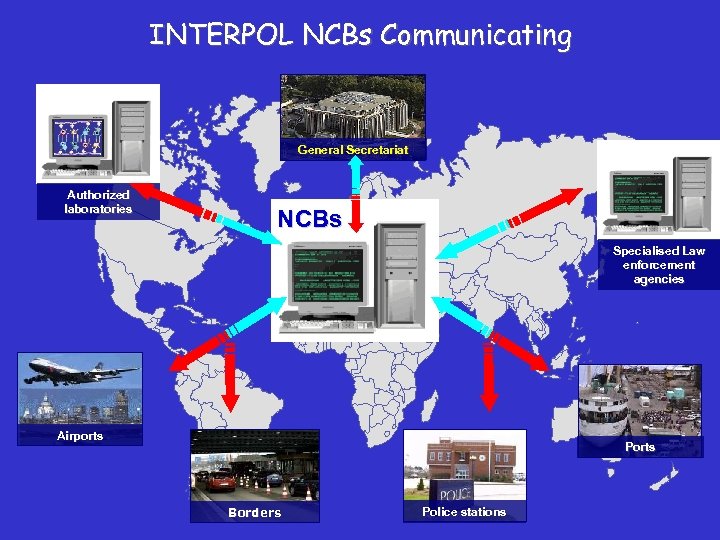 INTERPOL NCBs Communicating General Secretariat Authorized laboratories NCBs Specialised Law enforcement agencies Airports Ports Borders Police stations
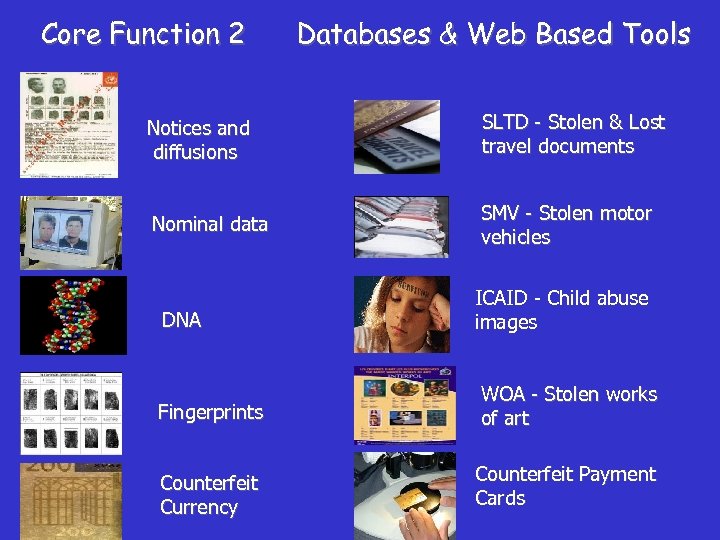 Core Function 2 Databases & Web Based Tools Notices and diffusions SLTD - Stolen & Lost travel documents Nominal data SMV - Stolen motor vehicles DNA ICAID - Child abuse images Fingerprints WOA - Stolen works of art Counterfeit Currency Counterfeit Payment Cards
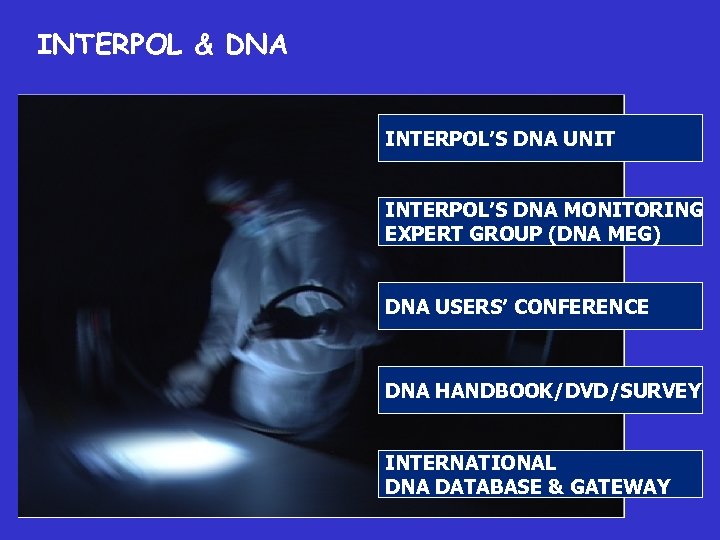 INTERPOL & DNA INTERPOL’S DNA UNIT INTERPOL’S DNA MONITORING EXPERT GROUP (DNA MEG) DNA USERS’ CONFERENCE DNA HANDBOOK/DVD/SURVEY INTERNATIONAL DNA DATABASE & GATEWAY
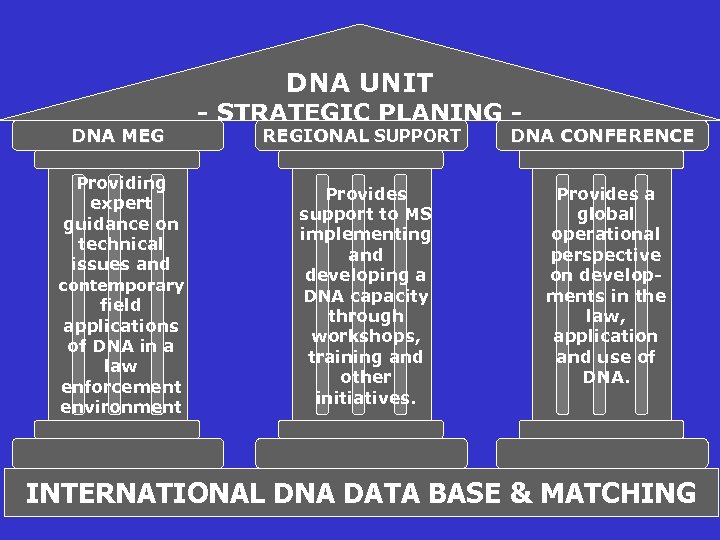 DNA UNIT DNA MEG Providing expert guidance on technical issues and contemporary field applications of DNA in a law enforcement environment - STRATEGIC PLANING REGIONAL SUPPORT DNA CONFERENCE Provides support to MS implementing and developing a DNA capacity through workshops, training and other initiatives. Provides a global operational perspective on developments in the law, application and use of DNA. INTERNATIONAL DNA DATA BASE & MATCHING
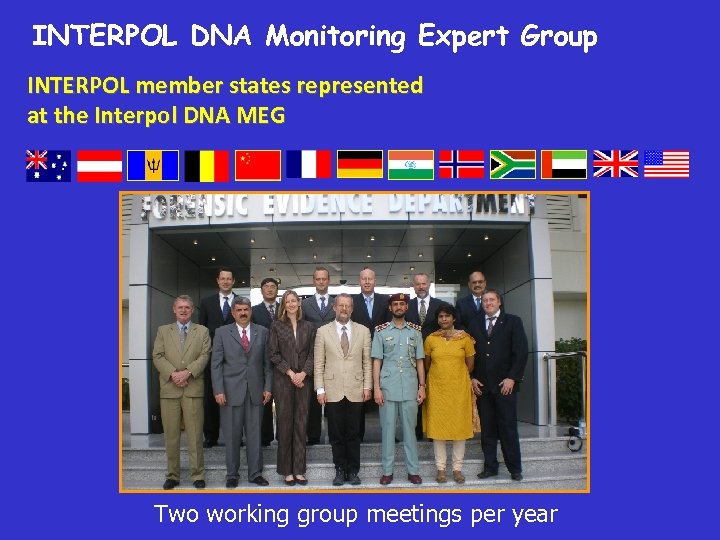 INTERPOL DNA Monitoring Expert Group INTERPOL member states represented at the Interpol DNA MEG Two working group meetings per year
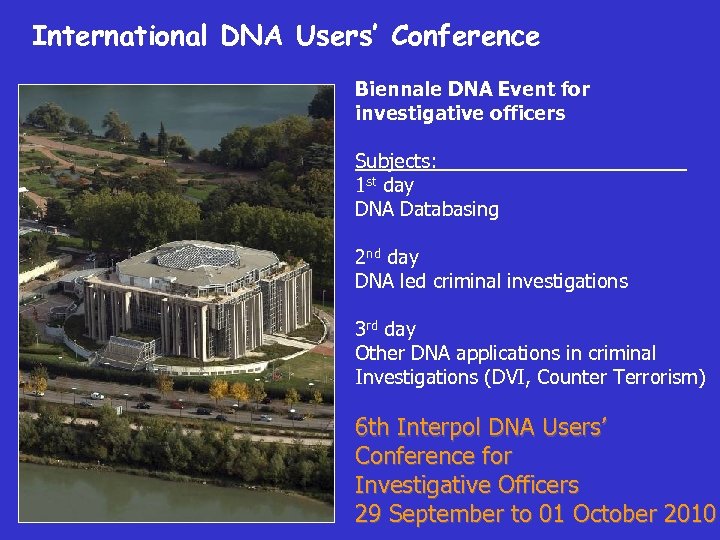 International DNA Users’ Conference Biennale DNA Event for investigative officers Subjects: 1 st day DNA Databasing 2 nd day DNA led criminal investigations 3 rd day Other DNA applications in criminal Investigations (DVI, Counter Terrorism) 6 th Interpol DNA Users’ Conference for Investigative Officers 29 September to 01 October 2010
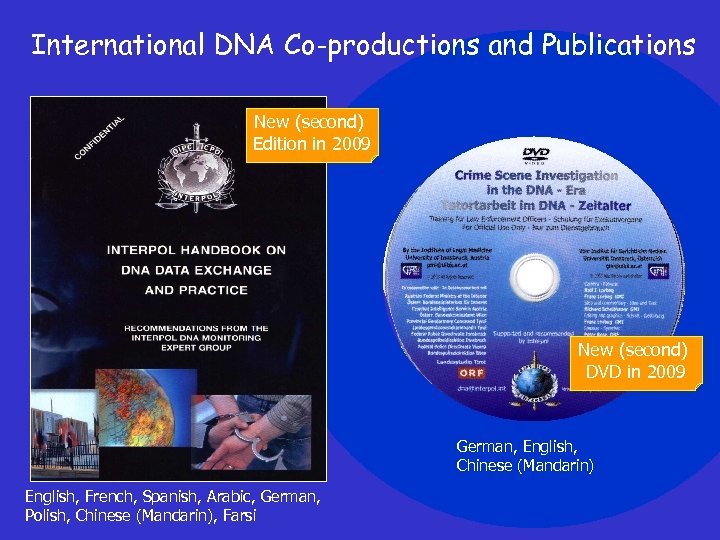 International DNA Co-productions and Publications New (second) Edition in 2009 New (second) DVD in 2009 German, English, Chinese (Mandarin) English, French, Spanish, Arabic, German, Polish, Chinese (Mandarin), Farsi
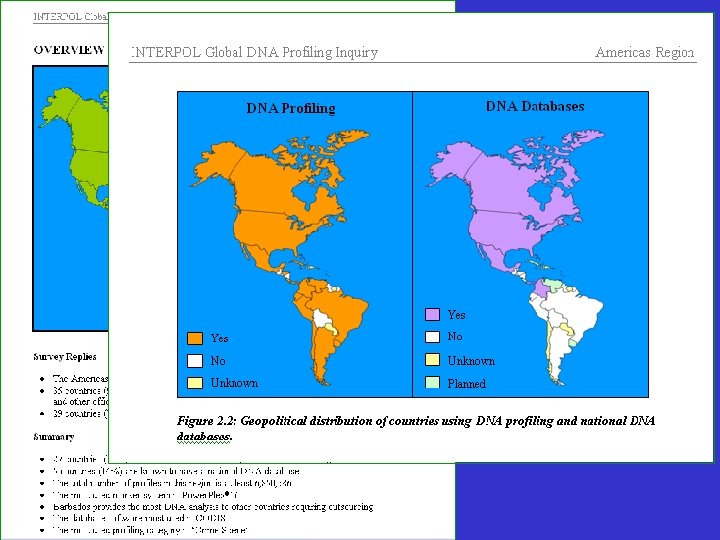
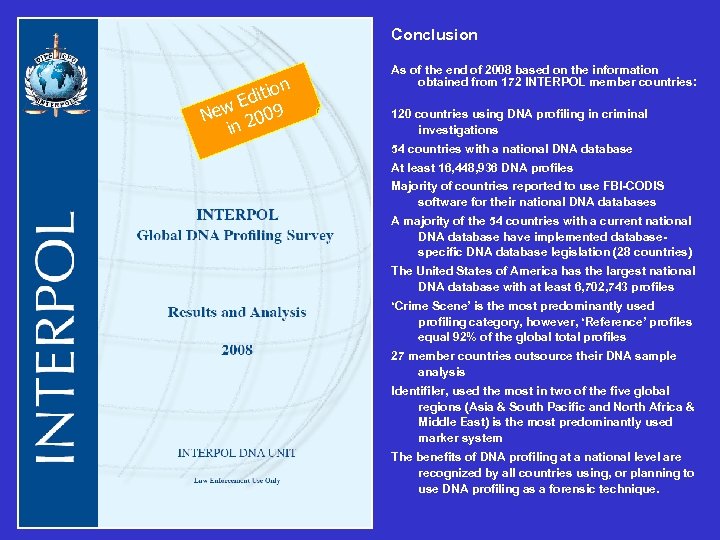 Conclusion Edit New 2009 in As of the end of 2008 based on the information obtained from 172 INTERPOL member countries: 120 countries using DNA profiling in criminal investigations 54 countries with a national DNA database At least 16, 448, 936 DNA profiles Majority of countries reported to use FBI-CODIS software for their national DNA databases A majority of the 54 countries with a current national DNA database have implemented databasespecific DNA database legislation (28 countries) The United States of America has the largest national DNA database with at least 6, 702, 743 profiles ‘Crime Scene’ is the most predominantly used profiling category, however, ‘Reference’ profiles equal 92% of the global total profiles 27 member countries outsource their DNA sample analysis Identifiler, used the most in two of the five global regions (Asia & South Pacific and North Africa & Middle East) is the most predominantly used marker system The benefits of DNA profiling at a national level are recognized by all countries using, or planning to use DNA profiling as a forensic technique.
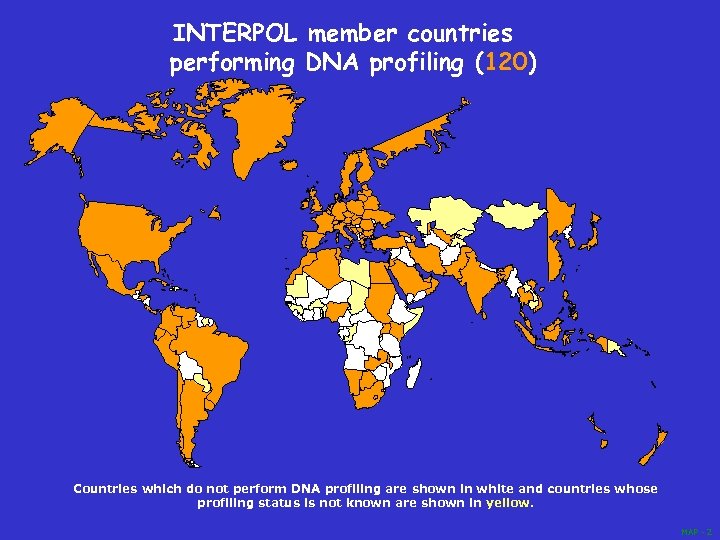 INTERPOL member countries performing DNA profiling (120) Countries which do not perform DNA profiling are shown in white and countries whose profiling status is not known are shown in yellow. MAP - 2
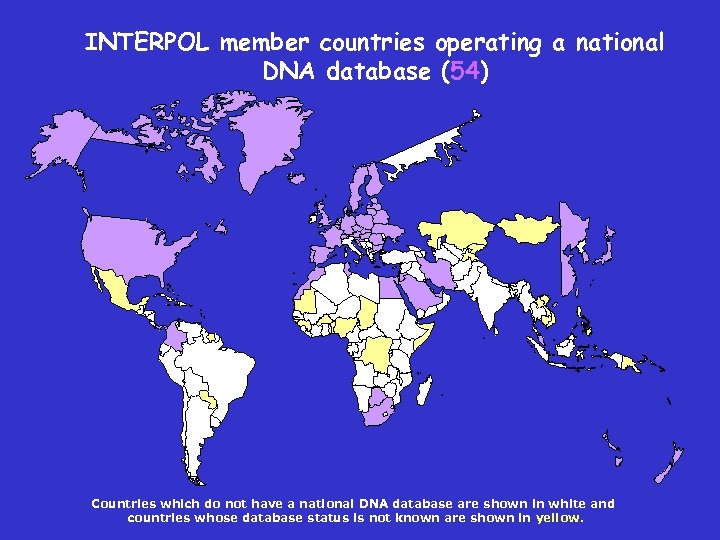 INTERPOL member countries operating a national DNA database (54) Countries which do not have a national DNA database are shown in white and countries whose database status is not known are shown in yellow.
 Interpol Charter International DNA Gateway Charte Interpol Passerelle internationale En matière d’ADN Carta de Interpol Pasarela internacional de ADN ﻣﻴﺜﺎﻕ ﺍﻻﻧﺘﺮﺑﻮﻝ ﺍﻟﺒﻮﺍﺑﺔ ﺍﻟﺪﻭﻟﻴﺔ ﻟﺒﻴﺎﻧﺎﺕ ﺍﻟﺪﻧﺎ INTERPOL DNA Gateway and Database
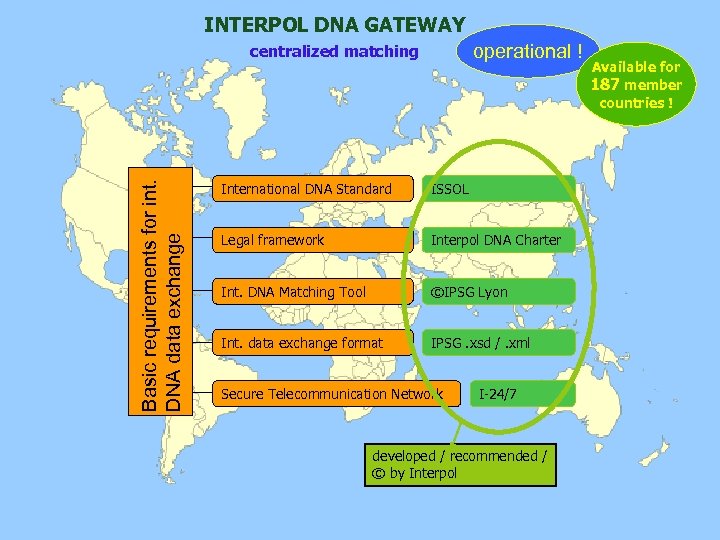 INTERPOL DNA GATEWAY operational ! Basic requirements for int. DNA data exchange centralized matching International DNA Standard ISSOL Legal framework Interpol DNA Charter Int. DNA Matching Tool ©IPSG Lyon Int. data exchange format IPSG. xsd /. xml Secure Telecommunication Network I-24/7 developed / recommended / © by Interpol Available for 187 member countries !
 Interpol DNA Gateway and Database SAFEGUARDS • INTERPOL’s rules on the processing of information for the purposes of international police cooperation • DNA Charter – legal framework • Signature of the Written Undertaken is mandatory for online access • Autonomous server – no connection to any other IPSG database • Data transfer via. I-24/7 – INTERPOL’s secure global police communications system • Access to I-24/7 DNA application under the control of the NCBs, the local I-24/7 NSO and IPSG Lyon • No nominal data in the DNA database • • • 24/7 data control by the contributing member countries online Matching tool respects the access rights chosen The INTERPOL DNA database is providing a single solution for all major marker systems, microvariants and nomenclature worldwide • Commission for the Control of Interpol’s Files (CCF)
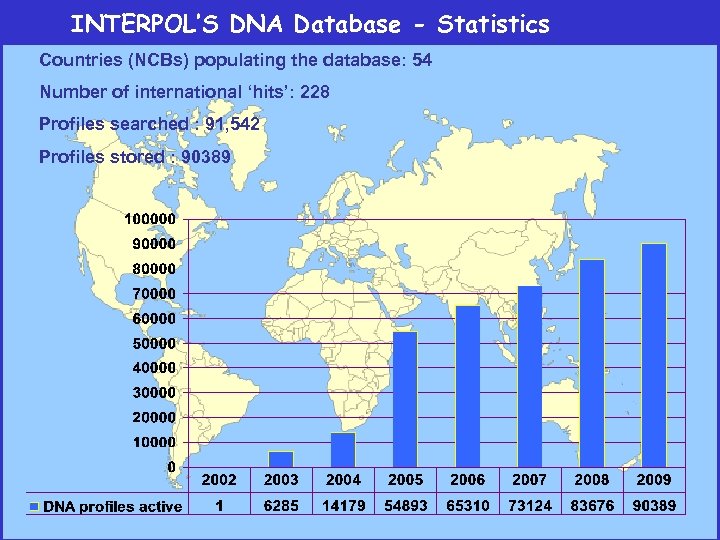 INTERPOL’S DNA Database - Statistics Countries (NCBs) populating the database: 54 Number of international ‘hits’: 228 Profiles searched : 91, 542 Profiles stored : 90389
 Compatibility and cooperation with other transnational DNA profile search and matching initiatives • May 2005 – European Union - Prüm Convention • On the stepping up of cross-border cooperation, particularly in combating terrorism, cross-border crime and illegal migration. Chapter 2, Article 2 – Establishment of national DNA analysis files. • 7 (+ 10) signatory European Union Member States.
 Prüm Council Decision (2) By means of Decision 2008/615/JHA, the basic elements of the Treaty of 27 May 2005 …. . were transposed into the legal framework of the European Union. (3) Article 33 of Decision 2008/615/JHA provides that the Council is to adopt the measures necessary to implement Decision 2008/615/JHA at the level of the Union … The aim of this Decision is to lay down the necessary administrative and technical provisions for the implementation of Decision 2008/615/JHA, in particular as regards the automated exchange of DNA data, … data The Prüm Convention DNA matching software is fully compatible with the INTERPOL DNA Gateway / Database.
 Compatibility and cooperation with other transnational DNA profile search and matching initiatives November 2005 - FBI – CODIS Agreement between INTERPOL Lyon and the FBI regarding the amendment of the FBI’s Combined DNA Index System software. The CODIS version 5. 7. 3 called “INTERPOL Export Tool” will facilitate the extraction of DNA profiles by member countries ready for data input into the Interpol DNA Gateway. Majority of national DNA databases operated by FBI-CODIS
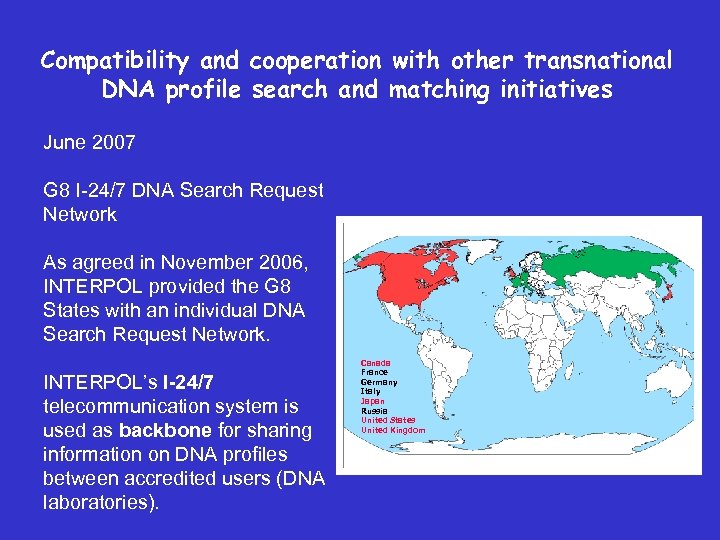 Compatibility and cooperation with other transnational DNA profile search and matching initiatives June 2007 G 8 I-24/7 DNA Search Request Network As agreed in November 2006, INTERPOL provided the G 8 States with an individual DNA Search Request Network. INTERPOL’s I-24/7 telecommunication system is used as backbone for sharing information on DNA profiles between accredited users (DNA laboratories). Canada France Germany Italy Japan Russia United States United Kingdom
 Thank you for your attention Werner Schuller Assistant Director Forensic Support & Specialized Technical Databases, IPSG Lyon w. schuller@interpol. int