


 Скачать презентацию First FRCR Examination in Clinical Radiology Statutory Requirements
28e66dc25285f761e0765957419a99c9.ppt
- Количество слайдов: 43
 First FRCR Examination in Clinical Radiology Statutory Requirements and Non-Statutory Recommendations Ionising Radiations Regulations 1999 John Saunderson Radiation Protection Adviser 15/03/2018 1
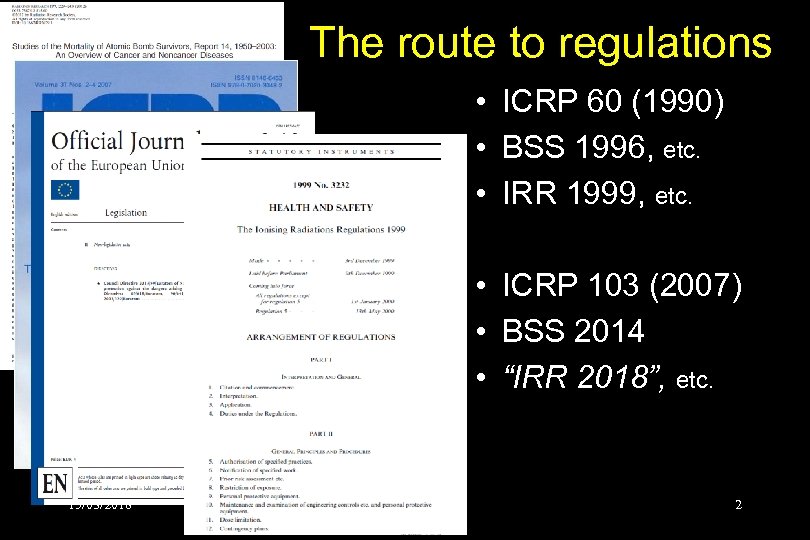 The route to regulations • ICRP 60 (1990) • BSS 1996, etc. • IRR 1999, etc. • ICRP 103 (2007) • BSS 2014 • “IRR 2018”, etc. 15/03/2018 2
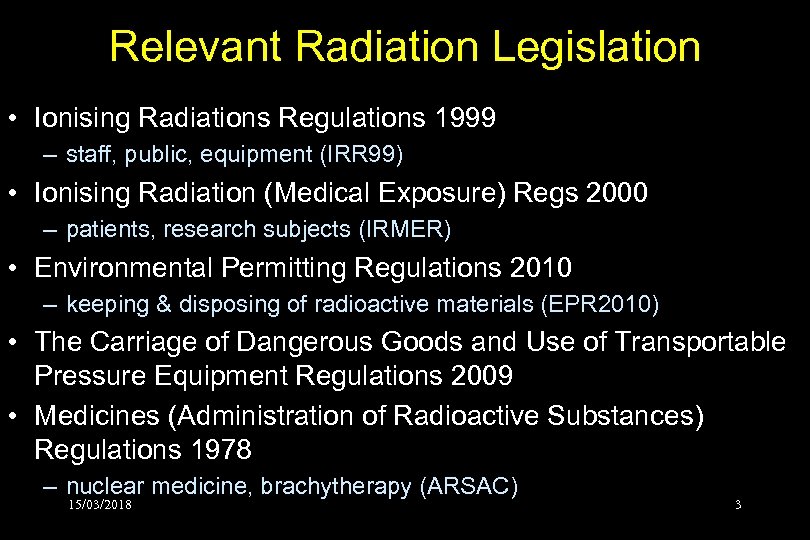 Relevant Radiation Legislation • Ionising Radiations Regulations 1999 – staff, public, equipment (IRR 99) • Ionising Radiation (Medical Exposure) Regs 2000 – patients, research subjects (IRMER) • Environmental Permitting Regulations 2010 – keeping & disposing of radioactive materials (EPR 2010) • The Carriage of Dangerous Goods and Use of Transportable Pressure Equipment Regulations 2009 • Medicines (Administration of Radioactive Substances) Regulations 1978 – nuclear medicine, brachytherapy (ARSAC) 15/03/2018 3
 Guidance • • • Approved Code of Practice (ACOP) Guidance Notes odd HSE guidance etc. IPEM, NRPB, RCR, BIR, etc. stuff. 15/03/2018 4
 Ionising Radiations Regulations 1999 • Responsibility for radiation safety • Local rules and procedures • Role of radiation protection adviser and radiation protection supervisor • Classified workers • Restriction of exposure (through design, systems of work and ppe) • Dose limits • Equipment used for medical exposures • Notification of incidents • Dose constraints for comforters and carers • Routine inspection and testing of equipment • Notification of incidents. 15/03/2018 5
 Responsibility for radiation safety • Radiation employer - i. e. an NHS Trust, private dentist, etc. –Authorisation of practices –Required for x-rays used for industrial radiography, processing of products, research or exposure of persons for medical treatment –HSE issued generic authorisations, with conditions –Notification to HSE – 28 days in advance of first use –Forthwith of any material changes –Prior risk assessments –PRIOR to any new activity (e. g. . ) –Must consult an RPA on plans for new installations, etc. 6
 Responsibility for radiation safety • Employee must –not knowingly expose himself greater than necessary –use personal protective equipment provided –report equipment defects –look after PPE –(extra duties for classified persons) 15/03/2018 7
 Prior risk assessment a) b) c) d) e) f) g) h) i) j) k) l) m) sources of radiation estimated dose rates contamination risk the results of monitoring manufacturer advice engineering control measures and design features any planned systems of work; estimated levels of contamination likely personal protective equipment (PPE) unrestricted access where significant dose rates or contamination possible accident scenarios possible failures of control measures steps to prevent identified accidents situations, or limit their 8 consequences.
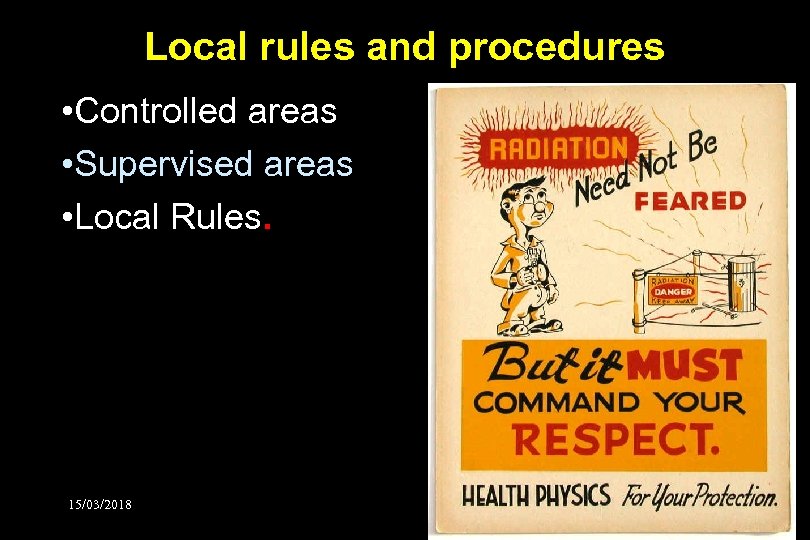 Local rules and procedures • Controlled areas • Supervised areas • Local Rules. 15/03/2018 9
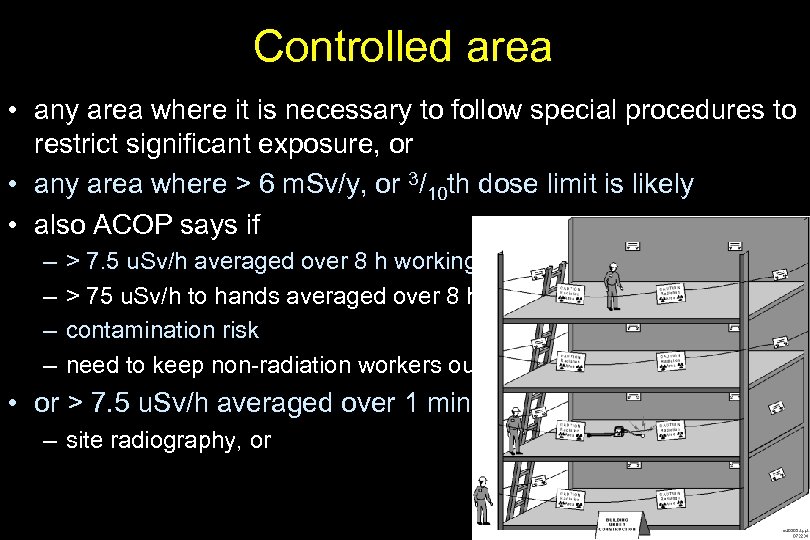 Controlled area • any area where it is necessary to follow special procedures to restrict significant exposure, or • any area where > 6 m. Sv/y, or 3/10 th dose limit is likely • also ACOP says if – – > 7. 5 u. Sv/h averaged over 8 h working day > 75 u. Sv/h to hands averaged over 8 h working day contamination risk need to keep non-radiation workers out • or > 7. 5 u. Sv/h averaged over 1 minute and – site radiography, or 10
 Controlled area • any area where it is necessary to follow special procedures to restrict significant exposure, or • any area where > 6 m. Sv/y, or 3/10 th dose limit is likely • also ACOP says if – – > 7. 5 u. Sv/h averaged over 8 h working day > 75 u. Sv/h to hands averaged over 8 h working day contamination risk need to keep non-radiation workers out • or > 7. 5 u. Sv/h averaged over 1 minute and – site radiography, or – employees untrained in radiation protection enter area (unless radioactivity is dispersed inside a person). 11
 Supervised area • any area where it is necessary to keep conditions under review, or • any area where > 1 m. Sv in a year, or 1/10 th dose limit is likely. 15/03/2018 12
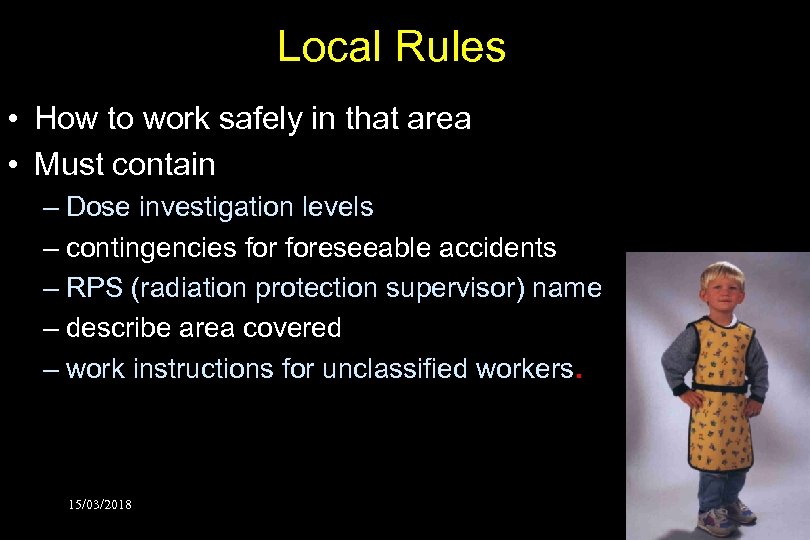 Local Rules • How to work safely in that area • Must contain – Dose investigation levels – contingencies foreseeable accidents – RPS (radiation protection supervisor) name – describe area covered – work instructions for unclassified workers. 15/03/2018 13
 Local Rules • Could also contain – management and supervision of work – testing and maintenance of safety features – radiation and contamination monitoring – testing of monitors – personal dosimetry – arrangements for pregnant and breast feeding staff – risk assessments – programme to review ALARA – RPA contact. 15/03/2018 14
 Local Rules • Usually get new employees to read Local Rules and sign to say they have understood them. 15/03/2018 15
 Role of radiation protection adviser and radiation protection supervisor 15/03/2018 16
 Radiation Protection Adviser R. P. A. • Must have qualification approved by HSE (e. g. RPA 2000 certificate) • Must be appointed in writing • Must be consulted on –controlled and supervised areas. –prior examination of plans –regular calibration of dose monitoring equipment –periodic testing of safety features and warning devices –risk assessment of new radiation work. –incidents where more then 6 m. Sv has been received. –critical examination of safety features of new radiation equipment.
 R. P. A. need not be appointed if only • Very, small amounts of radioactive material (below specified levels) • Very low dose (< 1 u. Sv/h @ 10 cm) x-ray units of a design approved by HSE • VDUs with < 1 u. Sv/h @ 10 cm • < 30 k. V and < 1 u. Sv/h @ 10 cm. 15/03/2018 18
 Radiation Protection Supervisor R. P. S. • Must be appointed “for the purpose of securing compliance with these Regulations” in controlled or supervised areas • Name must be in Local Rules • It is recommended that – know & understand regs. and local rules – command sufficient authority – understand necessary precautions – know what to do in an emergency. 15/03/2018 19
 Classified person • Anyone who may exceed 6 m. Sv effective dose per year, or 3/ th of a dose limit (e. g. 150 m. Sv hand dose, or 45 m. Sv lens dose) 10 • Must be informed (!) • Must be 18 or over • Must be certified fit to work with radiation by a suitable doctor • Dose monitored and recorded for 50 years with an HSE Approved Dosimetry Service - results to HSE • Radiation passbook for “outside workers” • Adequate (at least yearly) medical surveillance - record for 50 y. 15/03/2018 20
 Restriction of exposure (through design, systems of work and ppe) • Restrict exposure 1. By engineering 2. By systems of work 3. By personal protective equipment • Controlled areas - demarcate and sign • Non-classified workers can only enter under written system of work • Must demonstrate by personal dose monitoring or other means that doses are restricted 21
 Dose Limits Schedule 4 Part 1 15/03/2018 22
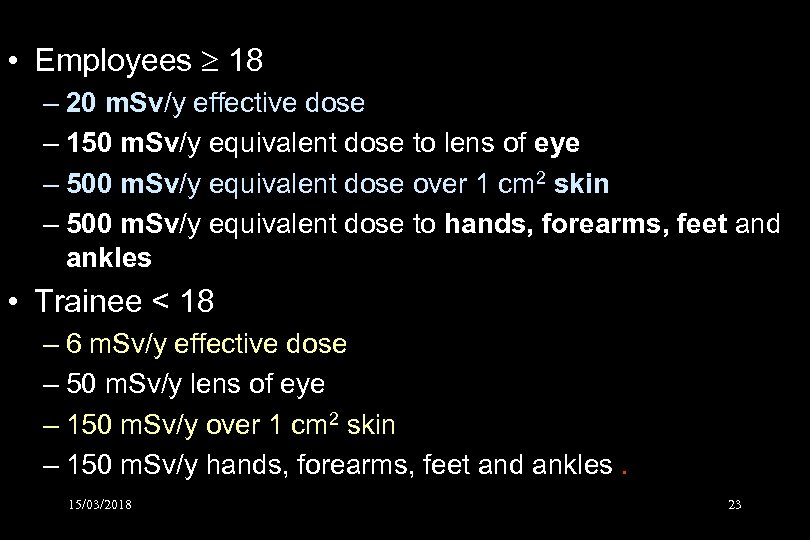 • Employees 18 – 20 m. Sv/y effective dose – 150 m. Sv/y equivalent dose to lens of eye – 500 m. Sv/y equivalent dose over 1 cm 2 skin – 500 m. Sv/y equivalent dose to hands, forearms, feet and ankles • Trainee < 18 – 6 m. Sv/y effective dose – 50 m. Sv/y lens of eye – 150 m. Sv/y over 1 cm 2 skin – 150 m. Sv/y hands, forearms, feet and ankles. 15/03/2018 23
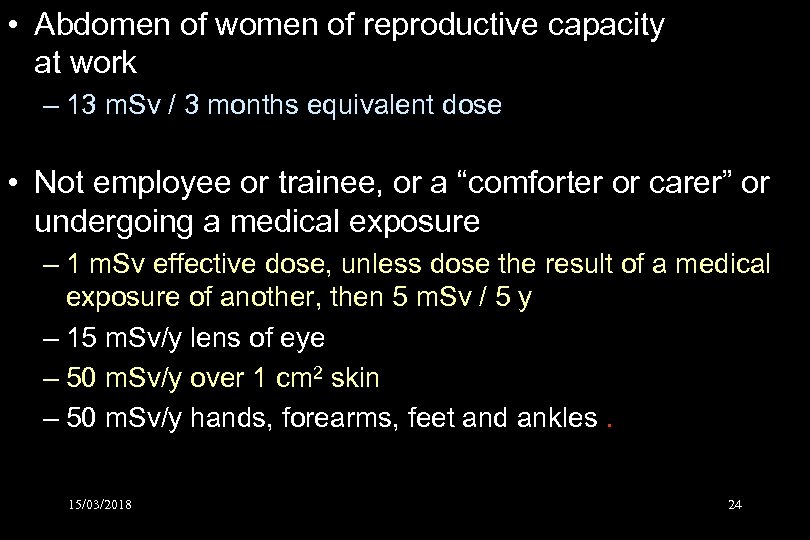 • Abdomen of women of reproductive capacity at work – 13 m. Sv / 3 months equivalent dose • Not employee or trainee, or a “comforter or carer” or undergoing a medical exposure – 1 m. Sv effective dose, unless dose the result of a medical exposure of another, then 5 m. Sv / 5 y – 15 m. Sv/y lens of eye – 50 m. Sv/y over 1 cm 2 skin – 50 m. Sv/y hands, forearms, feet and ankles. 15/03/2018 24
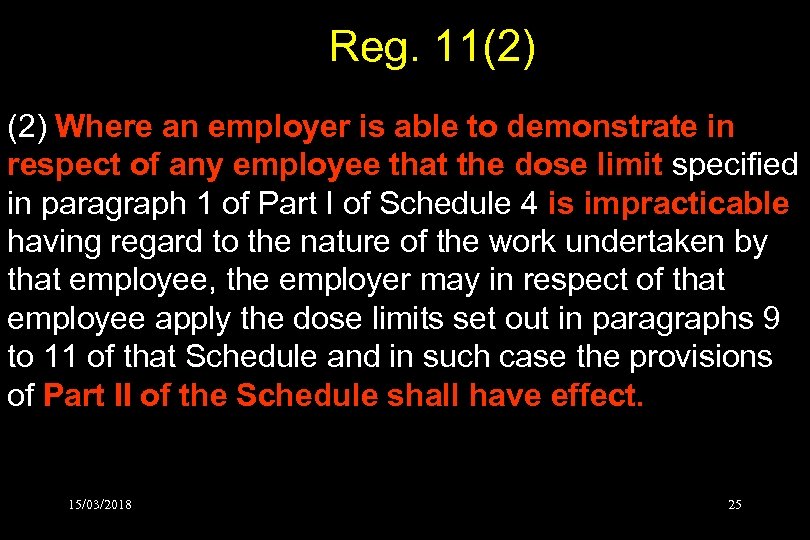 Reg. 11(2) Where an employer is able to demonstrate in respect of any employee that the dose limit specified in paragraph 1 of Part I of Schedule 4 is impracticable having regard to the nature of the work undertaken by that employee, the employer may in respect of that employee apply the dose limits set out in paragraphs 9 to 11 of that Schedule and in such case the provisions of Part II of the Schedule shall have effect. 15/03/2018 25
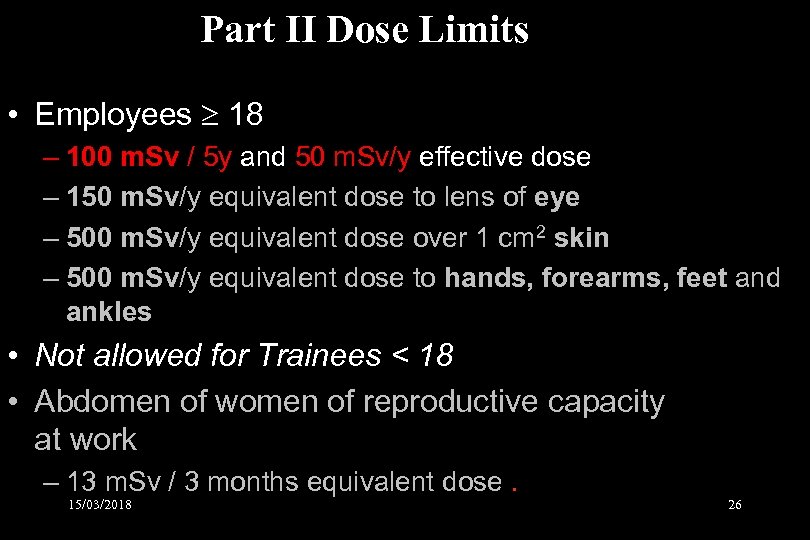 Part II Dose Limits • Employees 18 – 100 m. Sv / 5 y and 50 m. Sv/y effective dose – 150 m. Sv/y equivalent dose to lens of eye – 500 m. Sv/y equivalent dose over 1 cm 2 skin – 500 m. Sv/y equivalent dose to hands, forearms, feet and ankles • Not allowed for Trainees < 18 • Abdomen of women of reproductive capacity at work – 13 m. Sv / 3 months equivalent dose. 15/03/2018 26
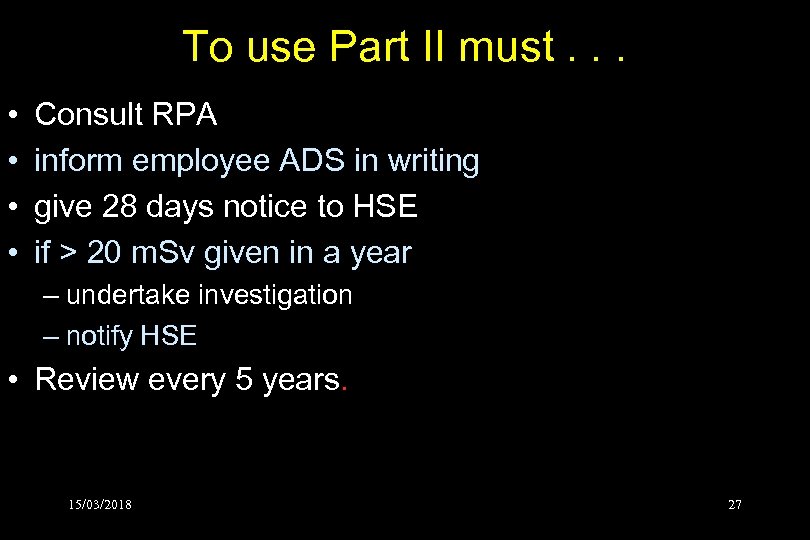 To use Part II must. . . • • Consult RPA inform employee ADS in writing give 28 days notice to HSE if > 20 m. Sv given in a year – undertake investigation – notify HSE • Review every 5 years. 15/03/2018 27
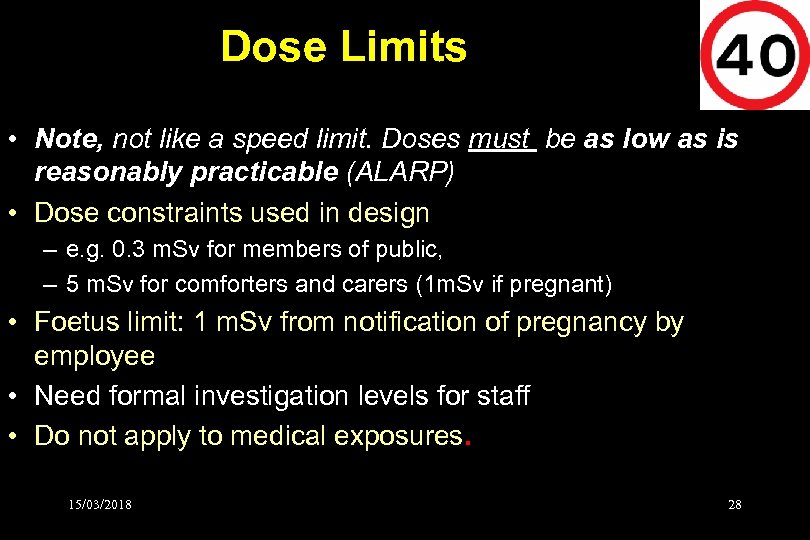 Dose Limits • Note, not like a speed limit. Doses must be as low as is reasonably practicable (ALARP) • Dose constraints used in design – e. g. 0. 3 m. Sv for members of public, – 5 m. Sv for comforters and carers (1 m. Sv if pregnant) • Foetus limit: 1 m. Sv from notification of pregnancy by employee • Need formal investigation levels for staff • Do not apply to medical exposures. 15/03/2018 28
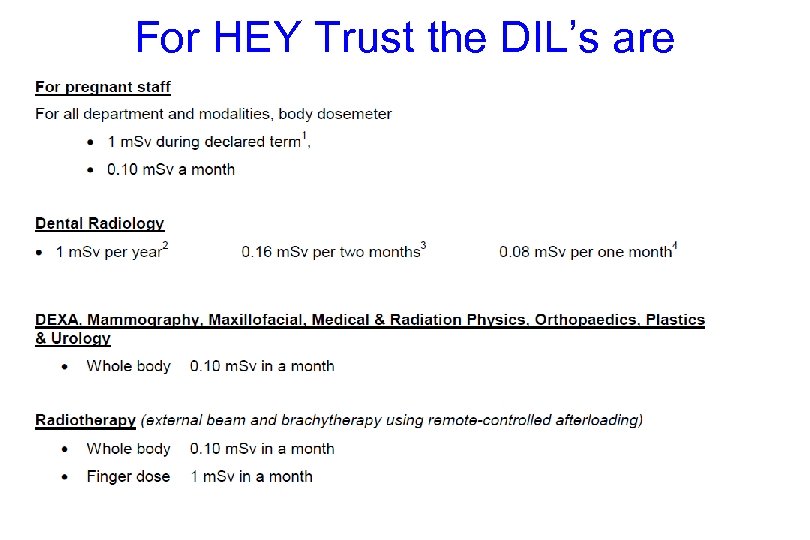 For HEY Trust the DIL’s are 15/03/2018 29
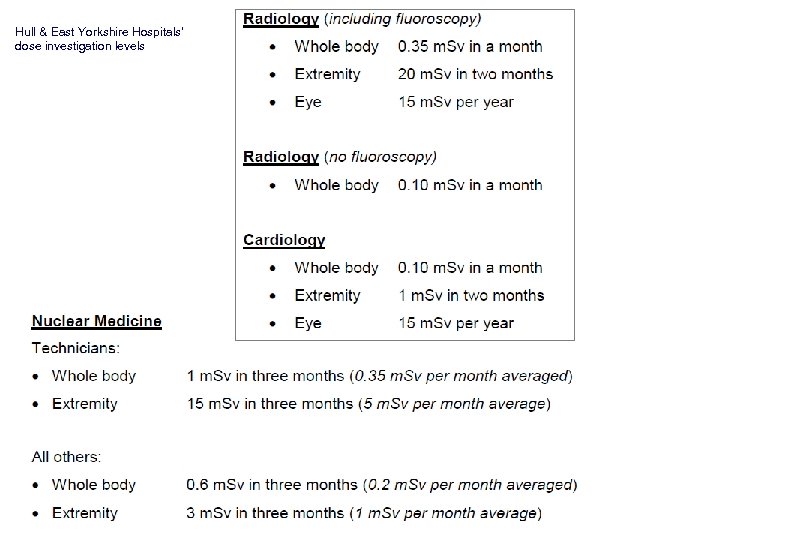 Hull & East Yorkshire Hospitals’ dose investigation levels Radiation Protection Adviser 15/03/2018 30
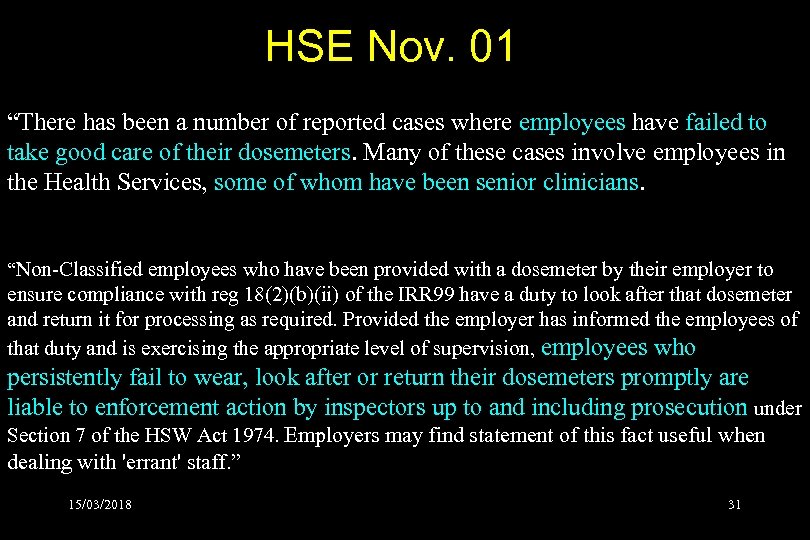 HSE Nov. 01 “There has been a number of reported cases where employees have failed to take good care of their dosemeters. Many of these cases involve employees in the Health Services, some of whom have been senior clinicians. “Non-Classified employees who have been provided with a dosemeter by their employer to ensure compliance with reg 18(2)(b)(ii) of the IRR 99 have a duty to look after that dosemeter and return it for processing as required. Provided the employer has informed the employees of that duty and is exercising the appropriate level of supervision, employees who persistently fail to wear, look after or return their dosemeters promptly are liable to enforcement action by inspectors up to and including prosecution under Section 7 of the HSW Act 1974. Employers may find statement of this fact useful when dealing with 'errant' staff. ” 15/03/2018 31
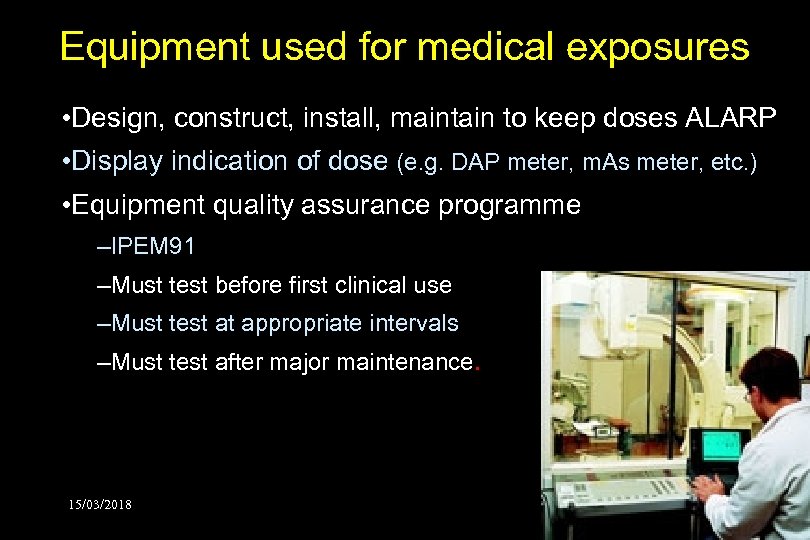 Equipment used for medical exposures • Design, construct, install, maintain to keep doses ALARP • Display indication of dose (e. g. DAP meter, m. As meter, etc. ) • Equipment quality assurance programme –IPEM 91 –Must test before first clinical use –Must test at appropriate intervals –Must test after major maintenance. 15/03/2018 32
 Routine inspection and testing of equipment • Follow IPEM 91 –Test, e. g k. V accuracy –Expertise, e. g. A = radiographer, B = medical physics –Frequency, e. g. annual for B general –Remedial level, e. g. +/- 10% for k. V –Suspension level, e. g. +/- 20% for k. V 15/03/2018 33
 Notification of incidents Must report to HSE where dose to patient is “much greater than intended” due to equipment fault.
![Patient Doses Much Greater Than Intended [HSE PM 77 (3 rd)] • x 20](https://present5.com/presentation/28e66dc25285f761e0765957419a99c9/image-35.jpg "Patient Doses Much Greater Than Intended [HSE PM 77 (3 rd)] • x 20") Patient Doses Much Greater Than Intended [HSE PM 77 (3 rd)] • x 20 - extremities, skull, chest, dentition, shoulder, chest, elbow, knee and nuclear medicine where intend <=0. 5 m. Sv • x 1. 5 – Interventional radiology, use of contrast, CT, nuclear medicine where intend >5 m. Sv • x 10 – other imaging. 15/03/2018 35
Patient Doses Much Greater Than Intended [HSE PM 77 (3 rd)] • x 20 - extremities, skull, chest, dentition, shoulder, chest, elbow, knee and nuclear medicine where intend <=0. 5 m. Sv • x 1. 5 – Interventional radiology, use of contrast, CT, nuclear medicine where intend >5 m. Sv • x 10 – other imaging. 15/03/2018 35
![Patient Doses Much Greater Than Intended [HSE PM 77 (3 rd)] • x 1.](https://present5.com/presentation/28e66dc25285f761e0765957419a99c9/image-36.jpg "Patient Doses Much Greater Than Intended [HSE PM 77 (3 rd)] • x 1.") Patient Doses Much Greater Than Intended [HSE PM 77 (3 rd)] • x 1. 1 – whole course of radiotherapy • x 1. 2 – single fraction of radiotherapy, or unsealed radionuclide therapy. 15/03/2018 36
Patient Doses Much Greater Than Intended [HSE PM 77 (3 rd)] • x 1. 1 – whole course of radiotherapy • x 1. 2 – single fraction of radiotherapy, or unsealed radionuclide therapy. 15/03/2018 36
 Incidents • Any untoward occurrence which may result in excess radiation to staff or patients must be referred to the Radiation Protection Supervisor and the Radiation Protection Adviser, who will estimate the dose and liase with management, HSE, Do. H, HCC, EA, etc. as appropriate • Suspect equipment must be withdrawn from service and labelled according. 15/03/2018 37
 Investigation · establishing what happened · identifying the failure · deciding on remedial action to minimise the chance of a similar failure · estimating the doses involved · decide whether patient informed (usually yes). 15/03/2018 38
 Here on 22 nd Oct 15/03/2018 39
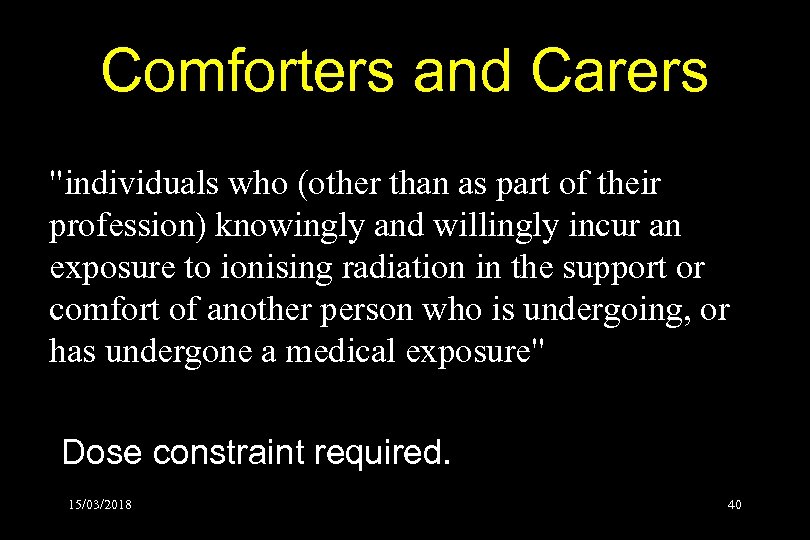 Comforters and Carers "individuals who (other than as part of their profession) knowingly and willingly incur an exposure to ionising radiation in the support or comfort of another person who is undergoing, or has undergone a medical exposure" Dose constraint required. 15/03/2018 40
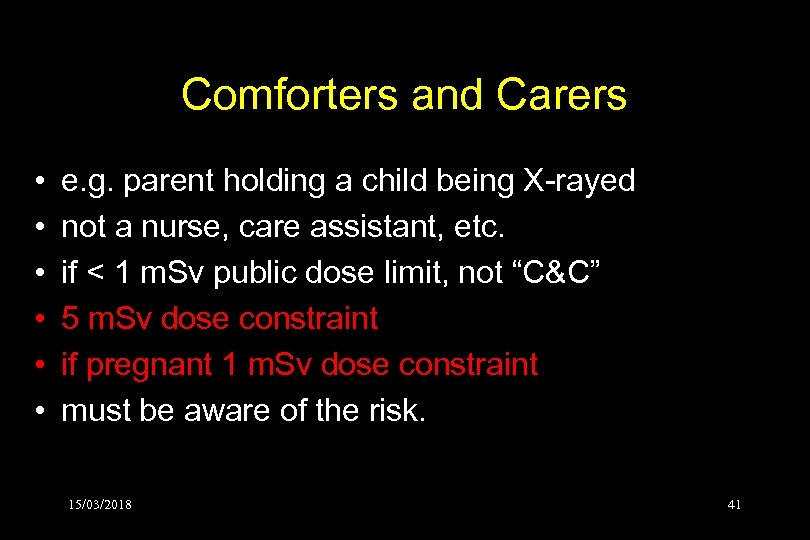 Comforters and Carers • • • e. g. parent holding a child being X-rayed not a nurse, care assistant, etc. if < 1 m. Sv public dose limit, not “C&C” 5 m. Sv dose constraint if pregnant 1 m. Sv dose constraint must be aware of the risk. 15/03/2018 41
 15/03/2018 42
 Reference Book List • Advice on Exposure to Ionising Radiation during Pregnancy • Guidance Notes • IPEM 91 15/03/2018 43