


 Скачать презентацию Firm-wide Corporate Risk Management Prof Ali Nejadmalayeri a
b1226470748226306ca46709eb788dcd.ppt
- Количество слайдов: 18
 Firm-wide, Corporate Risk Management Prof. Ali Nejadmalayeri, a. k. a. “Dr N” N
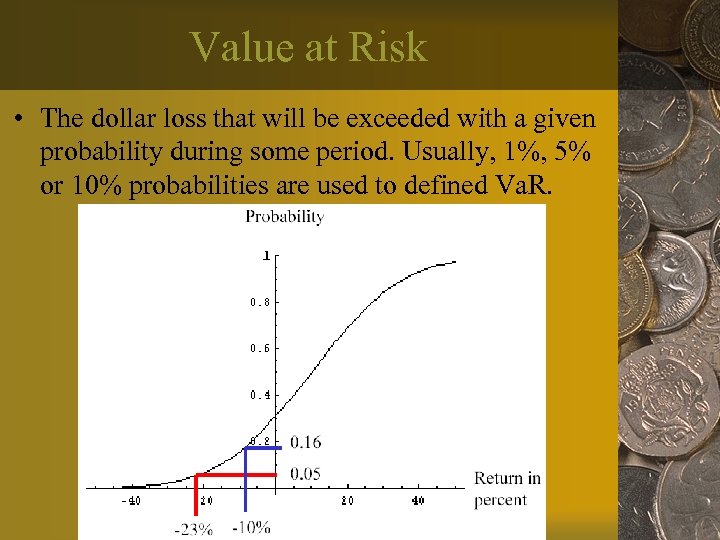 Value at Risk • The dollar loss that will be exceeded with a given probability during some period. Usually, 1%, 5% or 10% probabilities are used to defined Va. R.
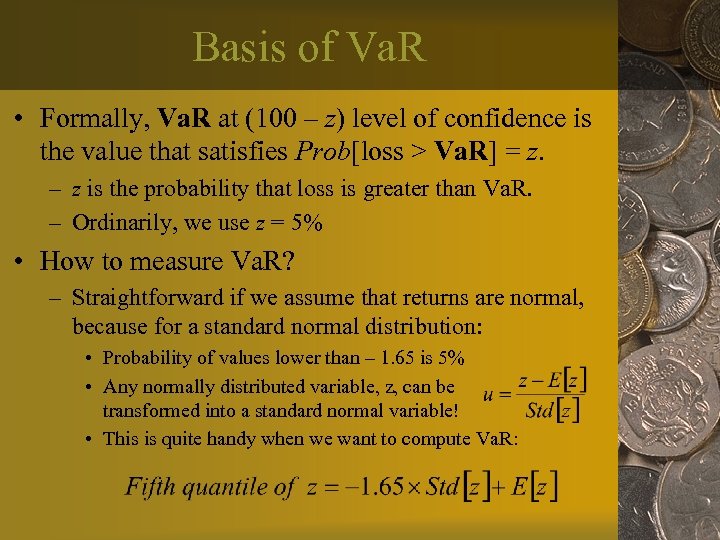 Basis of Va. R • Formally, Va. R at (100 – z) level of confidence is the value that satisfies Prob[loss > Va. R] = z. – z is the probability that loss is greater than Va. R. – Ordinarily, we use z = 5% • How to measure Va. R? – Straightforward if we assume that returns are normal, because for a standard normal distribution: • Probability of values lower than – 1. 65 is 5% • Any normally distributed variable, z, can be transformed into a standard normal variable! • This is quite handy when we want to compute Va. R:
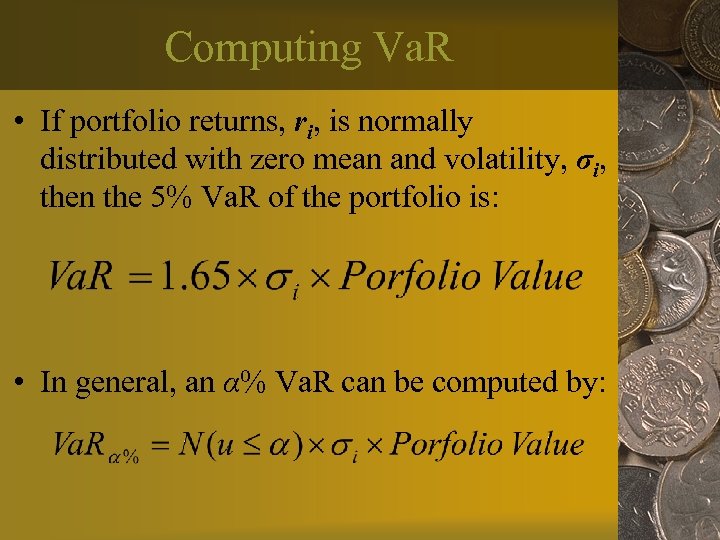 Computing Va. R • If portfolio returns, ri, is normally distributed with zero mean and volatility, σi, then the 5% Va. R of the portfolio is: • In general, an α% Va. R can be computed by:
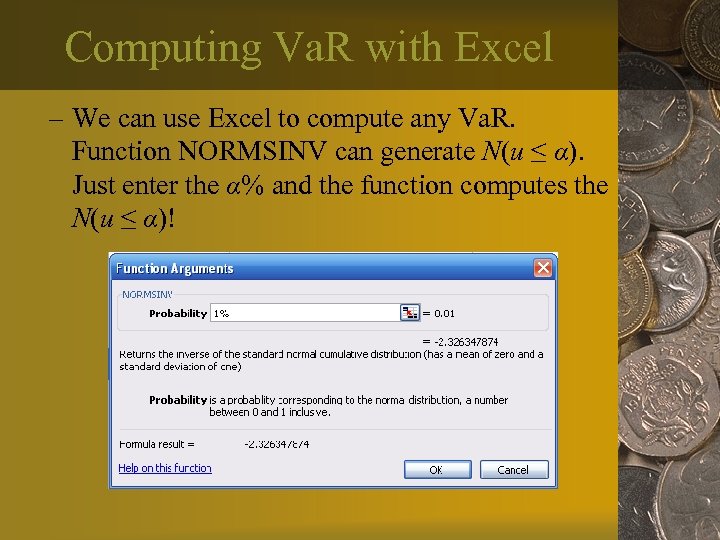 Computing Va. R with Excel – We can use Excel to compute any Va. R. Function NORMSINV can generate N(u ≤ α). Just enter the α% and the function computes the N(u ≤ α)!
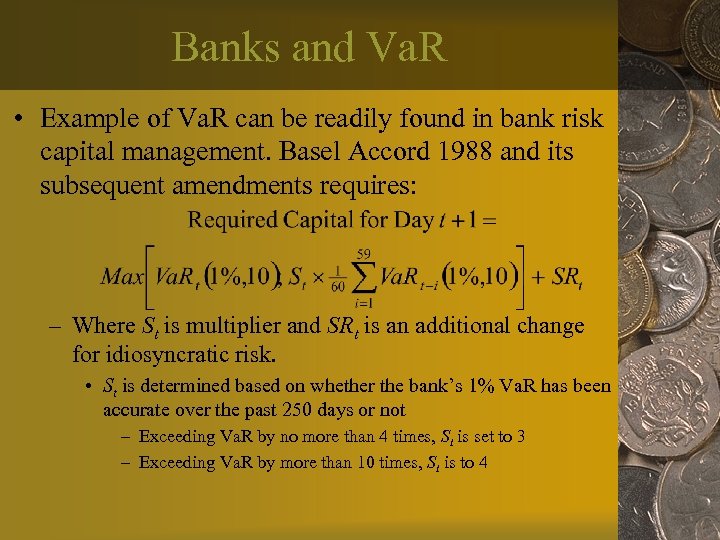 Banks and Va. R • Example of Va. R can be readily found in bank risk capital management. Basel Accord 1988 and its subsequent amendments requires: – Where St is multiplier and SRt is an additional change for idiosyncratic risk. • St is determined based on whether the bank’s 1% Va. R has been accurate over the past 250 days or not – Exceeding Va. R by no more than 4 times, St is set to 3 – Exceeding Va. R by more than 10 times, St is to 4
 Va. R in Practice • Risk. Metrics, a former division of JPMorgan, has devised complex techniques to evaluate the Va. R for any bank – Challenge for a bank with thousands of clients and thousands of transactions is not only compute each position Va. R but to account for cross correlations to find firm-wide Va. R! – The solution is to map assets into major asset classes, e. g. , country indexes, and then compute the volatilities, correlations and Va. Rs.
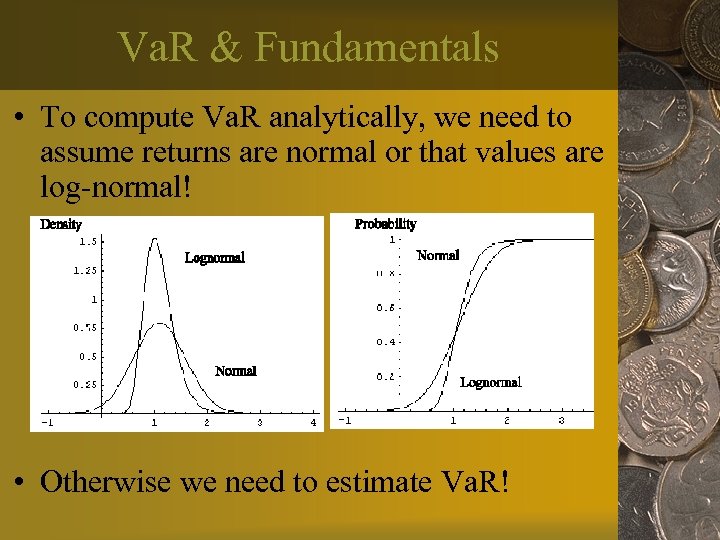 Va. R & Fundamentals • To compute Va. R analytically, we need to assume returns are normal or that values are log-normal! • Otherwise we need to estimate Va. R!
 Cash Flow at Risk • For non-financial, the important element is cash flows and not per se value. So we need to define a measure to capture same intuition as Va. R, or Ca. R! • Ca. R at p% reports the least cash shortfall with probability of p%. • Formally, Ca. R at p % is defined as: Prob[E(C) – C > Ca. R] = p%
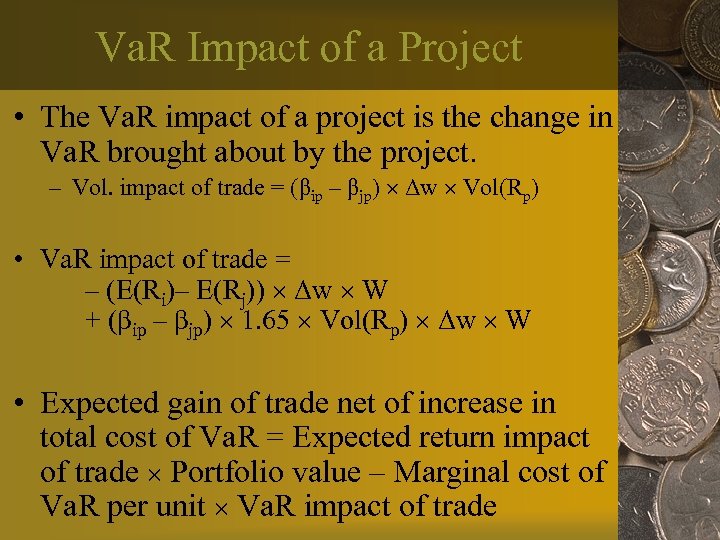 Va. R Impact of a Project • The Va. R impact of a project is the change in Va. R brought about by the project. – Vol. impact of trade = (βip – βjp) Δw Vol(Rp) • Va. R impact of trade = – (E(Ri)– E(Rj)) Δw W + (βip – βjp) 1. 65 Vol(Rp) Δw W • Expected gain of trade net of increase in total cost of Va. R = Expected return impact of trade Portfolio value – Marginal cost of Va. R per unit Va. R impact of trade
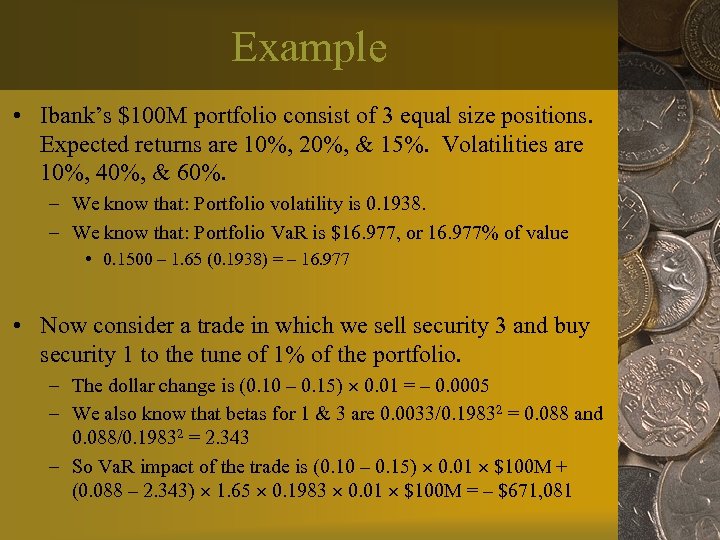 Example • Ibank’s $100 M portfolio consist of 3 equal size positions. Expected returns are 10%, 20%, & 15%. Volatilities are 10%, 40%, & 60%. – We know that: Portfolio volatility is 0. 1938. – We know that: Portfolio Va. R is $16. 977, or 16. 977% of value • 0. 1500 – 1. 65 (0. 1938) = – 16. 977 • Now consider a trade in which we sell security 3 and buy security 1 to the tune of 1% of the portfolio. – The dollar change is (0. 10 – 0. 15) 0. 01 = – 0. 0005 – We also know that betas for 1 & 3 are 0. 0033/0. 19832 = 0. 088 and 0. 088/0. 19832 = 2. 343 – So Va. R impact of the trade is (0. 10 – 0. 15) 0. 01 $100 M + (0. 088 – 2. 343) 1. 65 0. 1983 0. 01 $100 M = – $671, 081
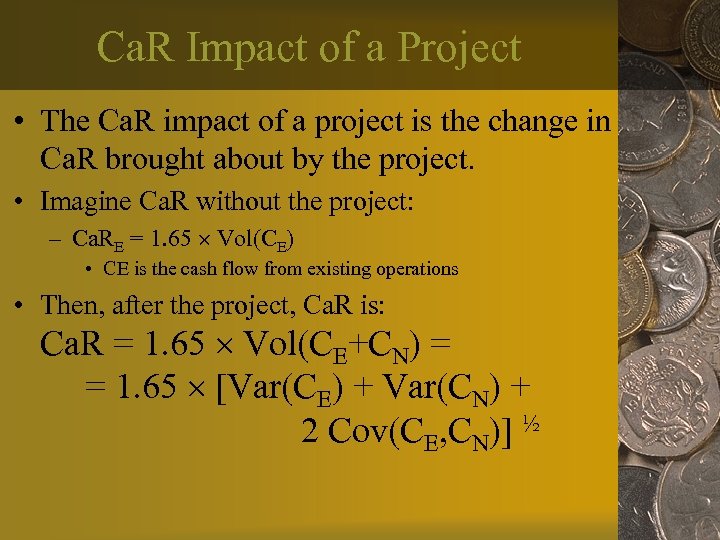 Ca. R Impact of a Project • The Ca. R impact of a project is the change in Ca. R brought about by the project. • Imagine Ca. R without the project: – Ca. RE = 1. 65 Vol(CE) • CE is the cash flow from existing operations • Then, after the project, Ca. R is: Ca. R = 1. 65 Vol(CE+CN) = = 1. 65 [Var(CE) + Var(CN) + 2 Cov(CE, CN)] ½
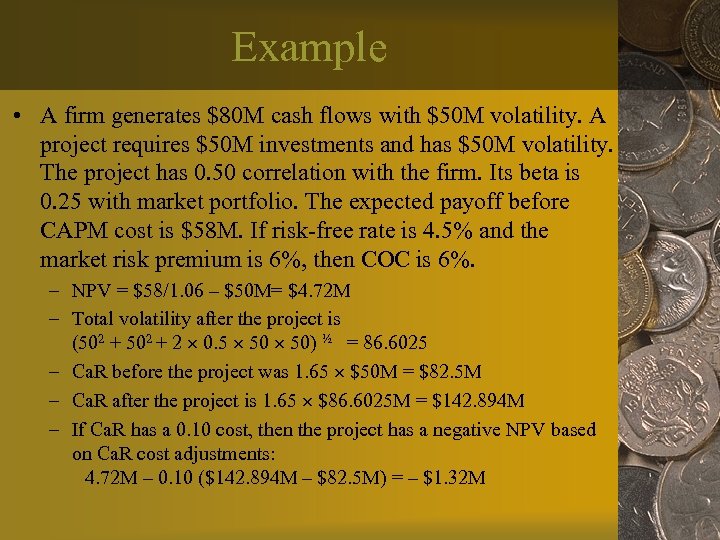 Example • A firm generates $80 M cash flows with $50 M volatility. A project requires $50 M investments and has $50 M volatility. The project has 0. 50 correlation with the firm. Its beta is 0. 25 with market portfolio. The expected payoff before CAPM cost is $58 M. If risk-free rate is 4. 5% and the market risk premium is 6%, then COC is 6%. – NPV = $58/1. 06 – $50 M= $4. 72 M – Total volatility after the project is (502 + 2 0. 5 50) ½ = 86. 6025 – Ca. R before the project was 1. 65 $50 M = $82. 5 M – Ca. R after the project is 1. 65 $86. 6025 M = $142. 894 M – If Ca. R has a 0. 10 cost, then the project has a negative NPV based on Ca. R cost adjustments: 4. 72 M – 0. 10 ($142. 894 M – $82. 5 M) = – $1. 32 M
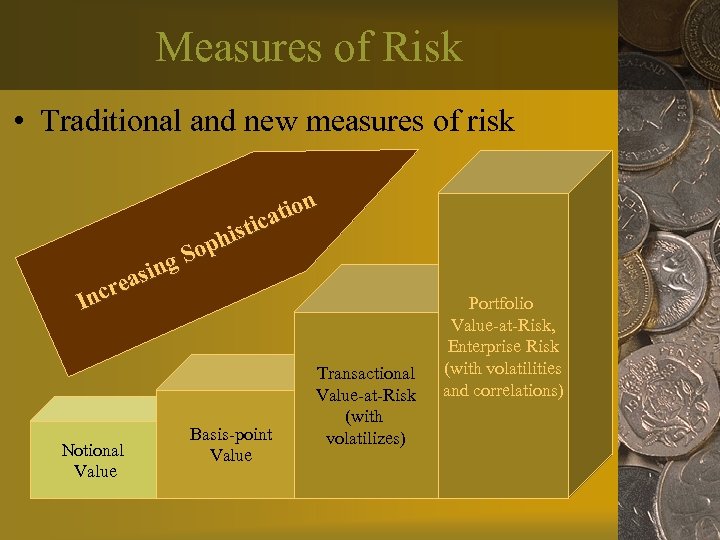 Measures of Risk • Traditional and new measures of risk sing rea Inc Notional Value tion a stic phi So Basis-point Value Transactional Value-at-Risk (with volatilizes) Portfolio Value-at-Risk, Enterprise Risk (with volatilities and correlations)
 Notional Amount • Literally taking into account the notional value of positions. For instance, saying that $1 M US T-bond is at risk, so risk capital is equal to $1 M. • Shortcomings: – No distinction between assets with high and low probabilities of capital loss – No distinction for offsetting positions. For instance, an option market maker has $20 M call options on SP 100 and $18 M puts on SP 100. In notional value sense, the market maker has $38 M risk capital whereas in reality she has only $2 M at risk!
 Basis-Point Approach • For every basis-point change in fundamentals what happens to value? – Bonds and options risks are reported in these terms – In case of bonds, interest rates are the key – In case options, the “Greeks” are the key • • • Delta, or price risk Gamma, or convexity risk (how delta changes) Vega, or volatility risk Theta, or time decay risk Rho, or discount rate risk
 Value-at-Risk • • Based on distribution of value, find out what is the minimum loss in rare events Where to get the distributions? 1. Selection of Risk Factors 1. Factors that drive value; such as exchange rates, interest rates, volatilities, etc. 2. Selection of Methodology • • Analytical covariance-variance Historical Simulation – Random draws from past results (random sampling) • Monte Carlo Simulation – Forecast evolution of risk factors
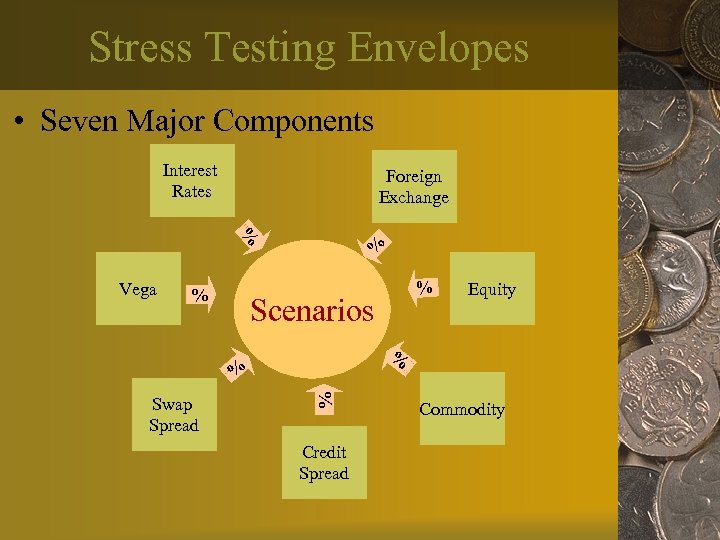 Stress Testing Envelopes • Seven Major Components Interest Rates Foreign Exchange Scenarios Equity % % % Swap Spread % % Vega Credit Spread Commodity