


 Скачать презентацию Firm-Specific Industry-Specific and Occupational Human Capital and the
6da75c7cc10ebcaeab46bbe0259de3e8.ppt
- Количество слайдов: 12
 Firm-Specific, Industry-Specific, and Occupational Human Capital and the Sourcing of Knowledge Work Organization Science (Forthcoming) Kyle J. Mayer Univ. of Southern California Deepak Somaya UIUC Presented by: Danielle Jones Ian O. Williamson Melbourne Business School 1
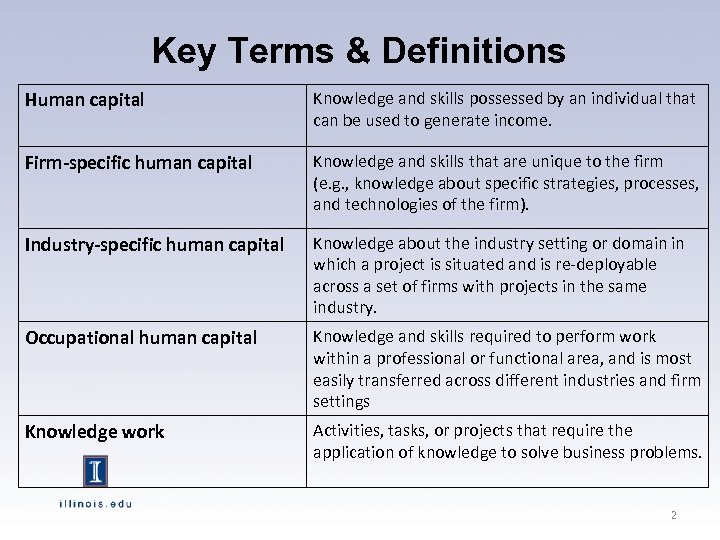 Key Terms & Definitions Human capital Knowledge and skills possessed by an individual that can be used to generate income. Firm-specific human capital Knowledge and skills that are unique to the firm (e. g. , knowledge about specific strategies, processes, and technologies of the firm). Industry-specific human capital Knowledge about the industry setting or domain in which a project is situated and is re-deployable across a set of firms with projects in the same industry. Occupational human capital Knowledge and skills required to perform work within a professional or functional area, and is most easily transferred across different industries and firm settings Knowledge work Activities, tasks, or projects that require the application of knowledge to solve business problems. 2
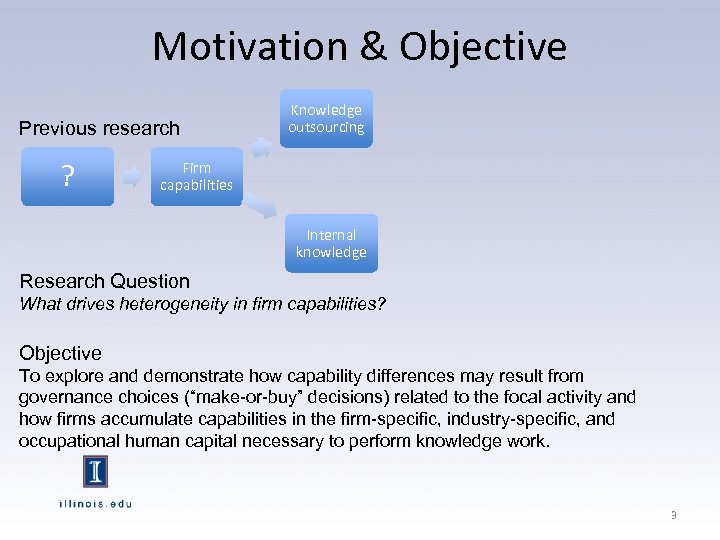 Motivation & Objective Previous research ? Knowledge outsourcing Firm capabilities Internal knowledge Research Question What drives heterogeneity in firm capabilities? Objective To explore and demonstrate how capability differences may result from governance choices (“make-or-buy” decisions) related to the focal activity and how firms accumulate capabilities in the firm-specific, industry-specific, and occupational human capital necessary to perform knowledge work. 3
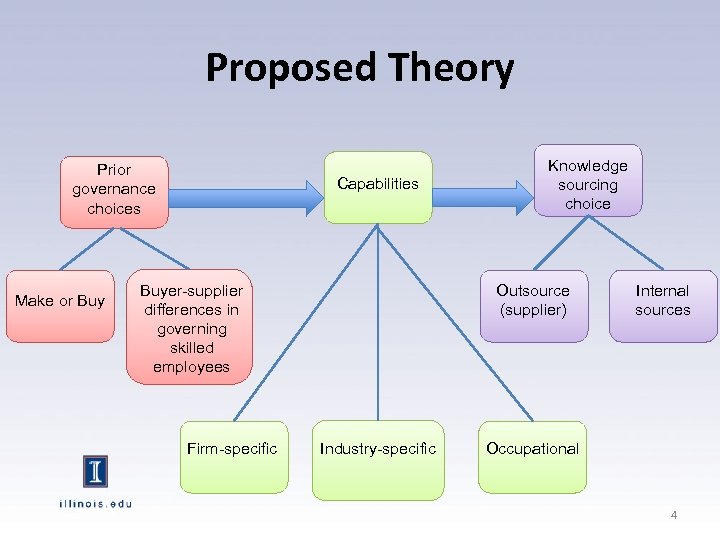 Proposed Theory Prior governance choices Make or Buy Capabilities Buyer-supplier differences in governing skilled employees Firm-specific Knowledge sourcing choice Outsource (supplier) Industry-specific Internal sources Occupational 4
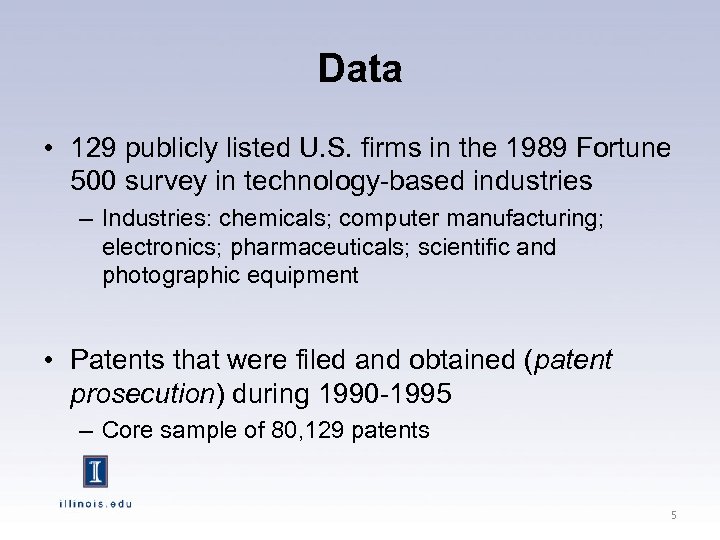 Data • 129 publicly listed U. S. firms in the 1989 Fortune 500 survey in technology-based industries – Industries: chemicals; computer manufacturing; electronics; pharmaceuticals; scientific and photographic equipment • Patents that were filed and obtained (patent prosecution) during 1990 -1995 – Core sample of 80, 129 patents 5
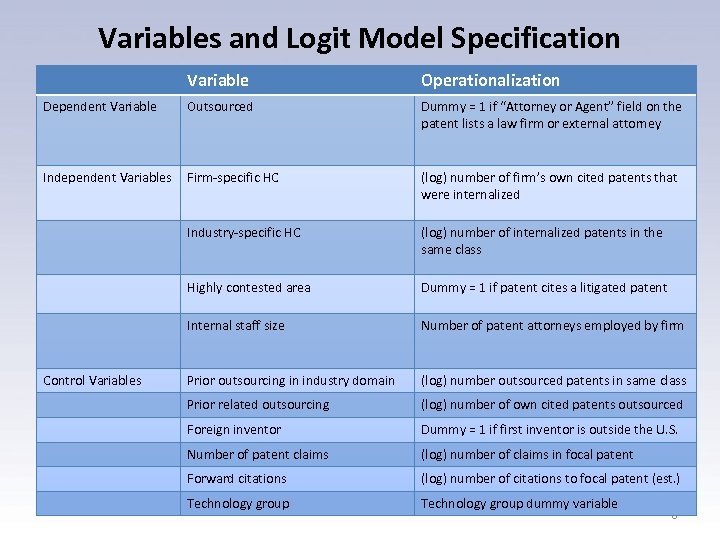 Variables and Logit Model Specification Variable Operationalization Dependent Variable Outsourced Dummy = 1 if “Attorney or Agent” field on the patent lists a law firm or external attorney Independent Variables Firm-specific HC (log) number of firm’s own cited patents that were internalized Industry-specific HC (log) number of internalized patents in the same class Highly contested area Dummy = 1 if patent cites a litigated patent Internal staff size Number of patent attorneys employed by firm Prior outsourcing in industry domain (log) number outsourced patents in same class Prior related outsourcing (log) number of own cited patents outsourced Foreign inventor Dummy = 1 if first inventor is outside the U. S. Number of patent claims (log) number of claims in focal patent Forward citations (log) number of citations to focal patent (est. ) Technology group dummy variable Control Variables 6
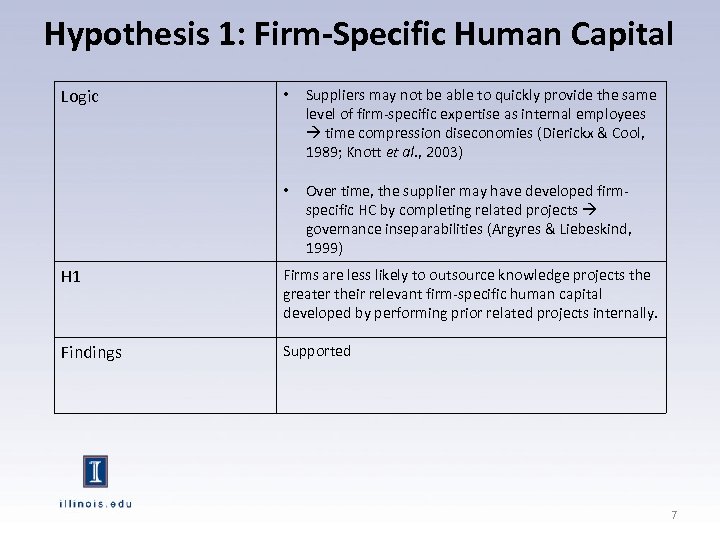 Hypothesis 1: Firm-Specific Human Capital Logic • Suppliers may not be able to quickly provide the same level of firm-specific expertise as internal employees time compression diseconomies (Dierickx & Cool, 1989; Knott et al. , 2003) • Over time, the supplier may have developed firmspecific HC by completing related projects governance inseparabilities (Argyres & Liebeskind, 1999) H 1 Firms are less likely to outsource knowledge projects the greater their relevant firm-specific human capital developed by performing prior related projects internally. Findings Supported 7
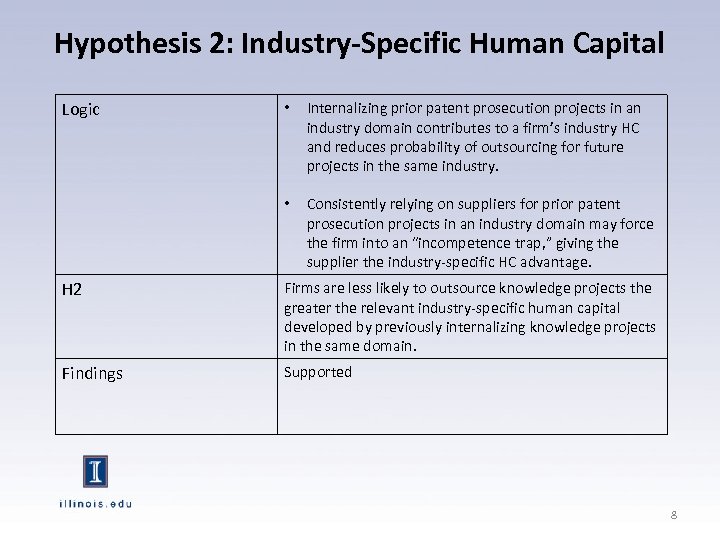 Hypothesis 2: Industry-Specific Human Capital Logic • Internalizing prior patent prosecution projects in an industry domain contributes to a firm’s industry HC and reduces probability of outsourcing for future projects in the same industry. • Consistently relying on suppliers for prior patent prosecution projects in an industry domain may force the firm into an “incompetence trap, ” giving the supplier the industry-specific HC advantage. H 2 Firms are less likely to outsource knowledge projects the greater the relevant industry-specific human capital developed by previously internalizing knowledge projects in the same domain. Findings Supported 8
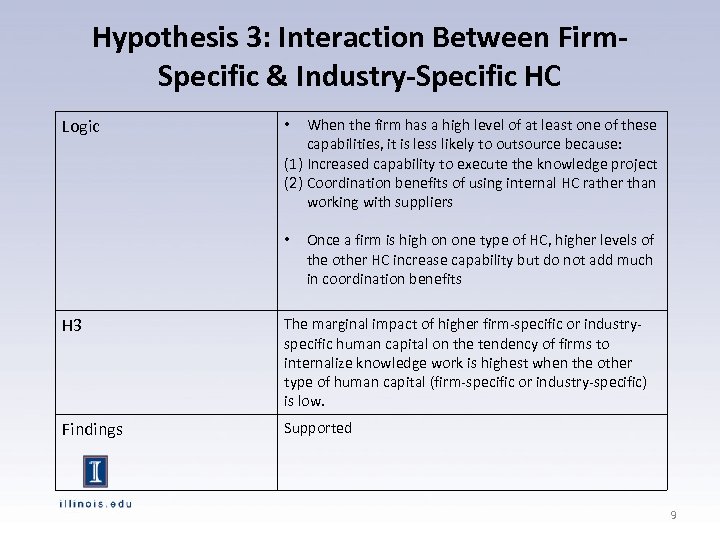 Hypothesis 3: Interaction Between Firm. Specific & Industry-Specific HC Logic When the firm has a high level of at least one of these capabilities, it is less likely to outsource because: (1) Increased capability to execute the knowledge project (2) Coordination benefits of using internal HC rather than working with suppliers • • Once a firm is high on one type of HC, higher levels of the other HC increase capability but do not add much in coordination benefits H 3 The marginal impact of higher firm-specific or industryspecific human capital on the tendency of firms to internalize knowledge work is highest when the other type of human capital (firm-specific or industry-specific) is low. Findings Supported 9
 Hypothesis 4: Occupational Human Capital Logic The incentives to access external occupational HC are strongest when the negative consequences of potential errors are large, or when the perceived gains from using expert occupational HC are large H 4 Firms are more likely to outsource knowledge projects situated in areas that are highly contested (and thus rely heavily on occupational human capital) Findings Supported 10
 Hypothesis 5: Occupational Human Capital – Size of Internal Staff as a Moderator Logic • A large internal staff may enable the firm to offset some of the incentive and learning advantages of suppliers in developing occupational HC. • The firm can organize internal staff more effectively as a knowledge hierarchy, allowing some people to specialize as occupational experts and leverage the talents of others (within firm learning). H 5 The larger the firm’s internal staff (in the focal occupational area), the weaker the (positive) effect of a project being in a highly contested area on the probability of outsourcing (i. e. , the size of the firm’s internal staff negatively moderates the effect of being in a highly contested area on outsourcing). Findings Supported 11
 Discussion • Contributions: – Extend Castanias & Helfat’s (1991, 2001) framework of firm-specific, industry-specific, and general HC by focusing on occupational HC as a subset of general HC – Demonstrate how governance choices impact HC-based capability development, which influences knowledge sourcing decisions – Integrate TCE (governance) and RBV (capabilities) theories – Use unstructured manager interviews to corroborate findings • Limitations: – Sample only includes large Fortune 500 firms – Takes a dichotomous approach to outsourcing (a firm either outsources or it doesn’t) • Implications – Organizations should carefully consider the long-term effects of outsourcing decisions on the development of HC 12