


 Скачать презентацию Firewalls Prevent specific types of information from
13e29a9c461b07e6456be282e161b6e3.ppt
- Количество слайдов: 54
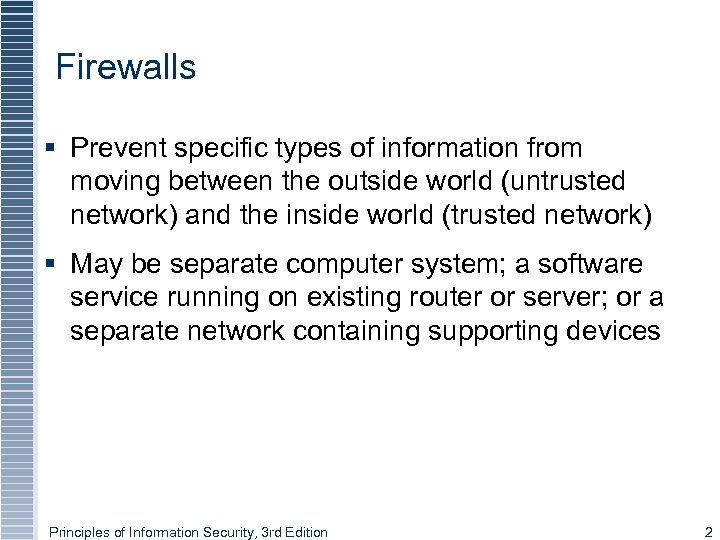 Firewalls § Prevent specific types of information from moving between the outside world (untrusted network) and the inside world (trusted network) § May be separate computer system; a software service running on existing router or server; or a separate network containing supporting devices Principles of Information Security, 3 rd Edition 2
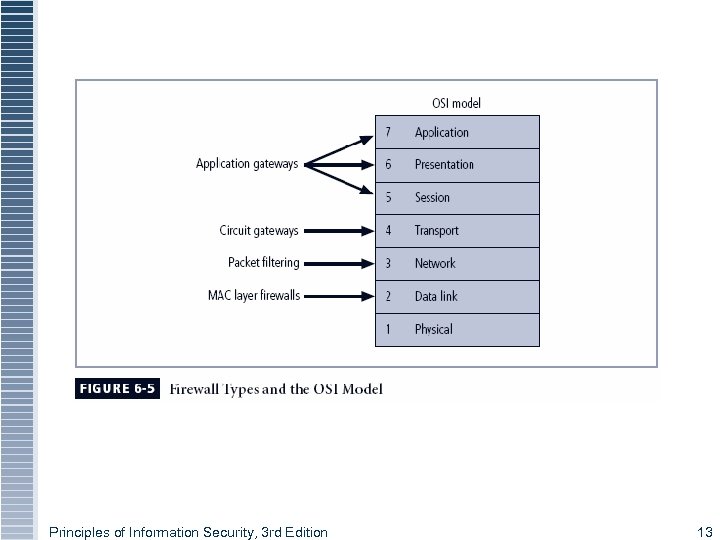
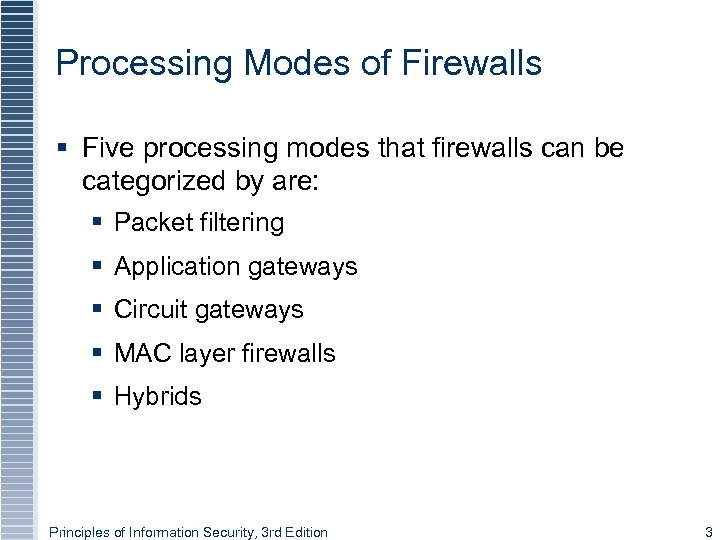 Processing Modes of Firewalls § Five processing modes that firewalls can be categorized by are: § Packet filtering § Application gateways § Circuit gateways § MAC layer firewalls § Hybrids Principles of Information Security, 3 rd Edition 3
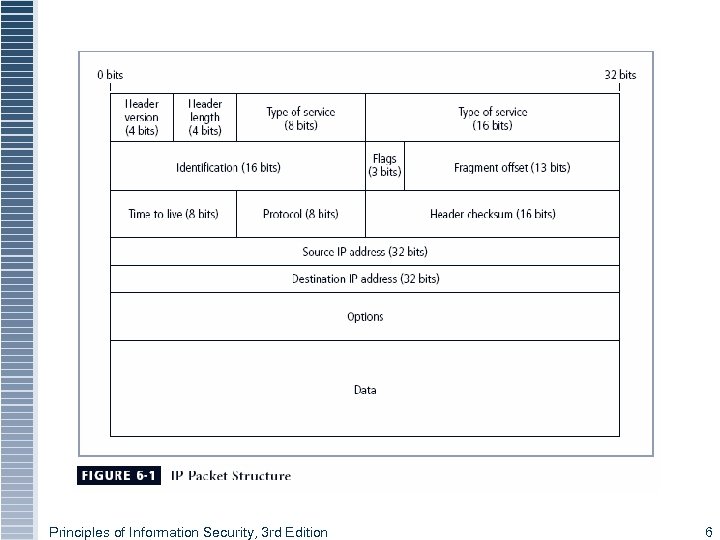
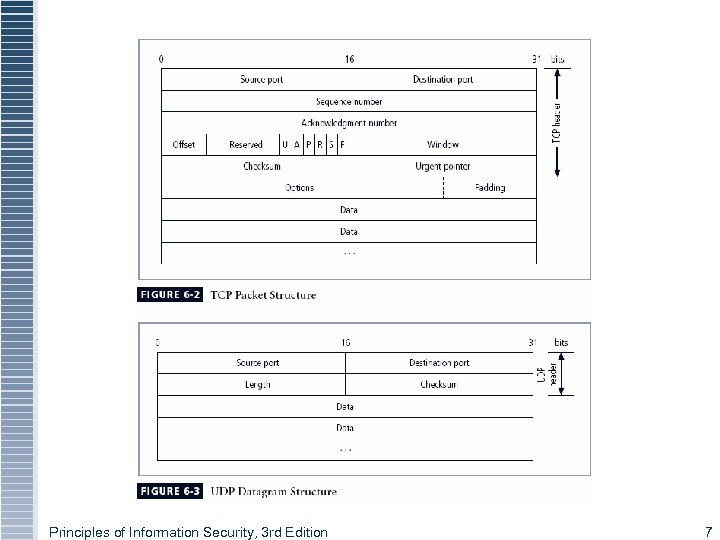
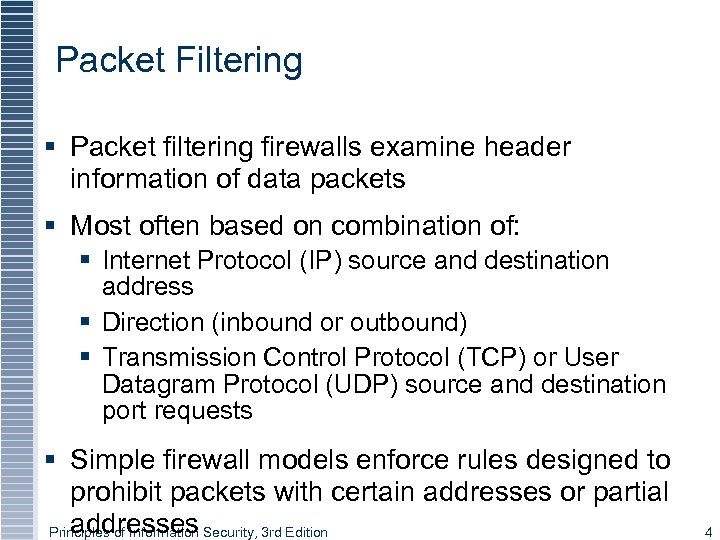 Packet Filtering § Packet filtering firewalls examine header information of data packets § Most often based on combination of: § Internet Protocol (IP) source and destination address § Direction (inbound or outbound) § Transmission Control Protocol (TCP) or User Datagram Protocol (UDP) source and destination port requests § Simple firewall models enforce rules designed to prohibit packets with certain addresses or partial addresses Principles of Information Security, 3 rd Edition 4
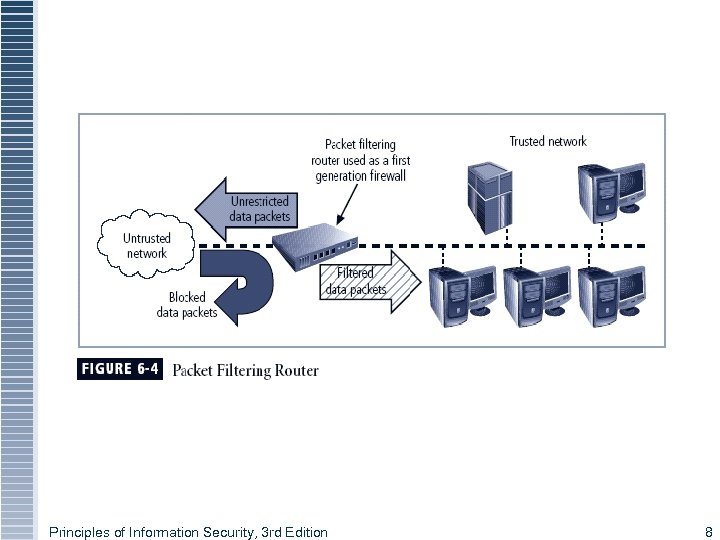
 Packet Filtering (continued) § Three subsets of packet filtering firewalls: § Static filtering: requires that filtering rules governing how the firewall decides which packets are allowed and which are denied are developed and installed § Dynamic filtering: allows firewall to react to emergent event and update or create rules to deal with event § Stateful inspection: firewalls that keep track of each network connection between internal and external Security, 3 rd Edition Principles of Information systems using a state table 5
 Principles of Information Security, 3 rd Edition 6
 Principles of Information Security, 3 rd Edition 7
 Principles of Information Security, 3 rd Edition 8
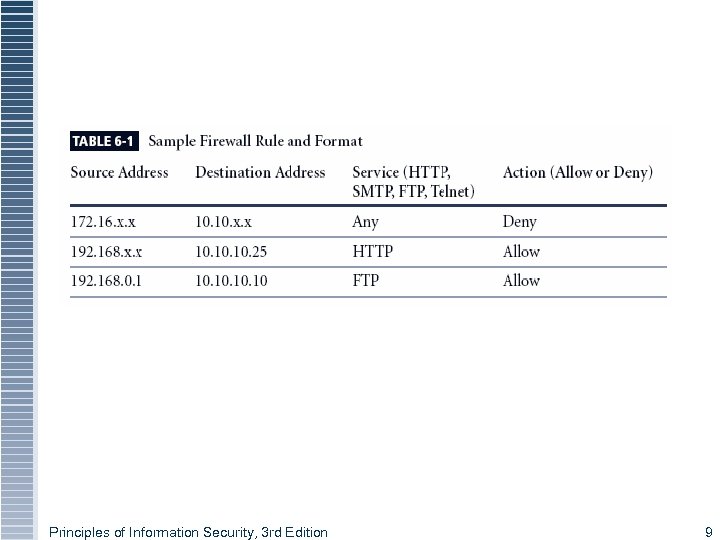 Principles of Information Security, 3 rd Edition 9
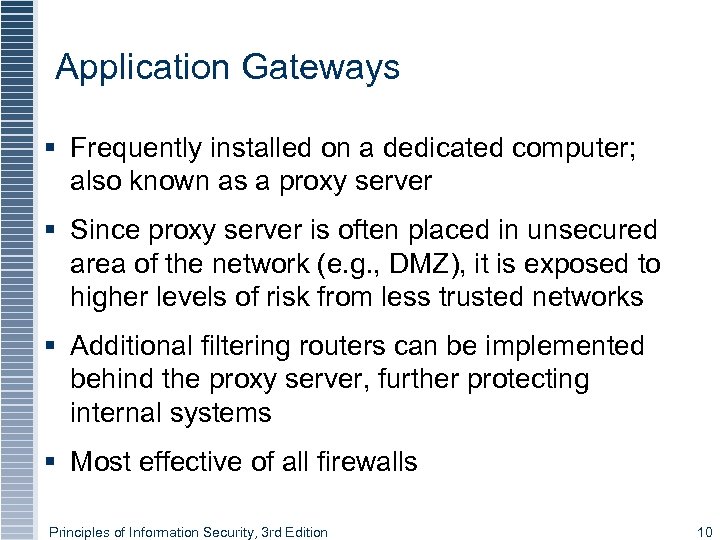 Application Gateways § Frequently installed on a dedicated computer; also known as a proxy server § Since proxy server is often placed in unsecured area of the network (e. g. , DMZ), it is exposed to higher levels of risk from less trusted networks § Additional filtering routers can be implemented behind the proxy server, further protecting internal systems § Most effective of all firewalls Principles of Information Security, 3 rd Edition 10
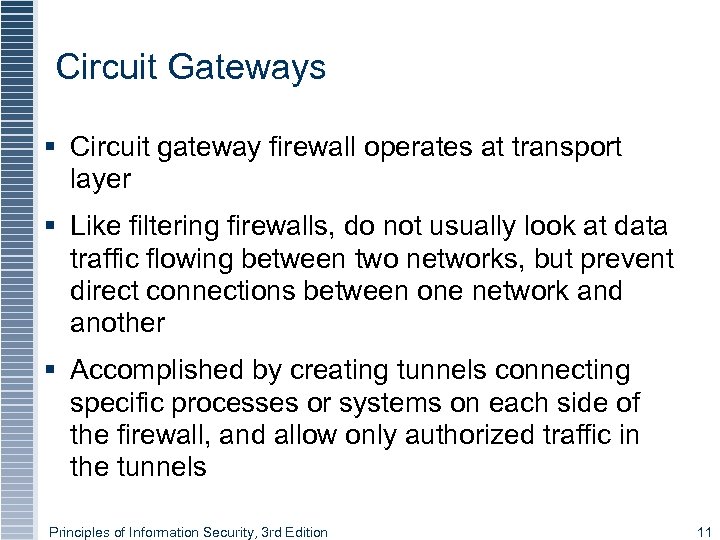 Circuit Gateways § Circuit gateway firewall operates at transport layer § Like filtering firewalls, do not usually look at data traffic flowing between two networks, but prevent direct connections between one network and another § Accomplished by creating tunnels connecting specific processes or systems on each side of the firewall, and allow only authorized traffic in the tunnels Principles of Information Security, 3 rd Edition 11
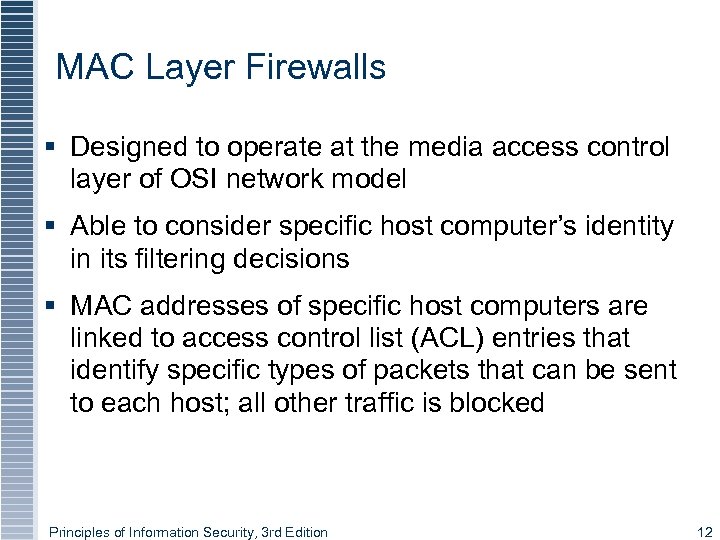 MAC Layer Firewalls § Designed to operate at the media access control layer of OSI network model § Able to consider specific host computer’s identity in its filtering decisions § MAC addresses of specific host computers are linked to access control list (ACL) entries that identify specific types of packets that can be sent to each host; all other traffic is blocked Principles of Information Security, 3 rd Edition 12
 Principles of Information Security, 3 rd Edition 13
 Hybrid Firewalls § Combine elements of other types of firewalls; i. e. , elements of packet filtering and proxy services, or of packet filtering and circuit gateways § Alternately, may consist of two separate firewall devices; each a separate firewall system, but connected to work in tandem Principles of Information Security, 3 rd Edition 14
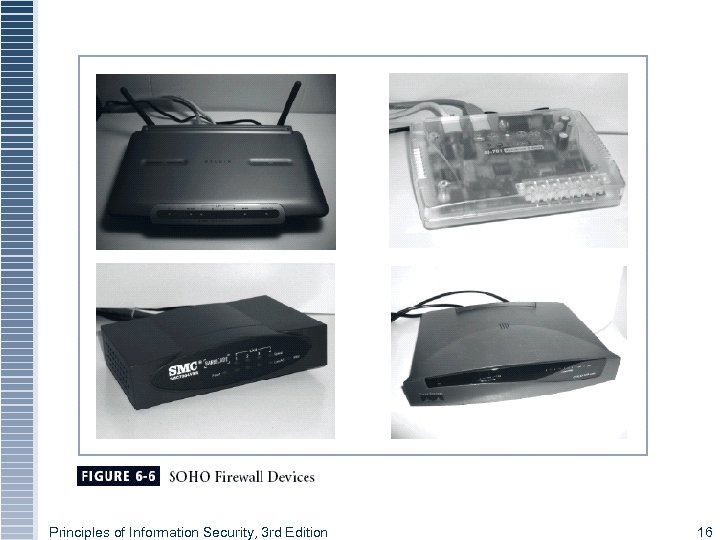
 Firewalls Categorized by Structure § Most firewalls are appliances: stand-alone, selfcontained systems § Commercial-grade firewall system consists of firewall application software running on generalpurpose computer § Small office/home office (SOHO) or residentialgrade firewalls, aka broadband gateways or DSL/cable modem routers, connect user’s local area network or a specific computer system to Internetworking device § Residential-grade firewall software is installed directly on the user’s system Principles of Information Security, 3 rd Edition 15
 Principles of Information Security, 3 rd Edition 16
 Software vs. Hardware: the SOHO Firewall Debate § Which firewall type should the residential user implement? § Where would you rather defend against a hacker? § With the software option, hacker is inside your computer § With the hardware device, even if hacker manages to crash firewall system, computer and information are still safely behind the now disabled connection Principles of Information Security, 3 rd Edition 17
 Firewall Architectures § Firewall devices can be configured in a number of network connection architectures § Configuration that works best depends on three factors: § Objectives of the network § Organization’s ability to develop and implement architectures § Budget available for function § Four common architectural implementations of firewalls: packet filtering routers, screened host firewalls, dual-homed firewalls, screened subnet Principles of Information Security, 3 rd Edition 18
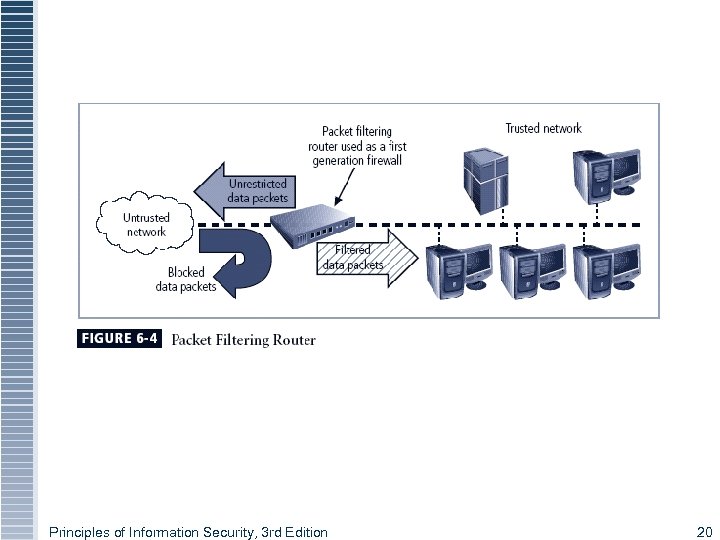
 Packet Filtering Routers § Most organizations with Internet connection have a router serving as interface to Internet § Many of these routers can be configured to reject packets that organization does not allow into network § Drawbacks include a lack of auditing and strong authentication Principles of Information Security, 3 rd Edition 19
 Principles of Information Security, 3 rd Edition 20
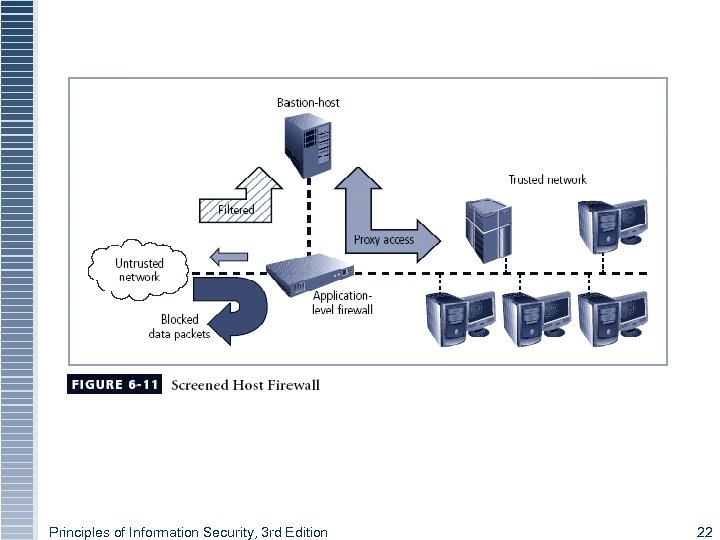
 Screened Host Firewalls § Combines packet filtering router with separate, dedicated firewall such as an application proxy server § Allows router to prescreen packets to minimize traffic/load on internal proxy § Separate host is often referred to as bastion host; can be rich target for external attacks and should be very thoroughly secured Principles of Information Security, 3 rd Edition 21
 Principles of Information Security, 3 rd Edition 22
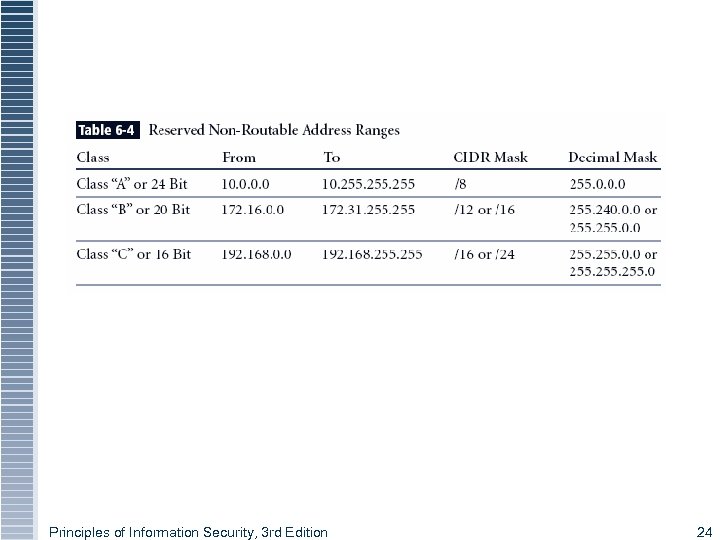
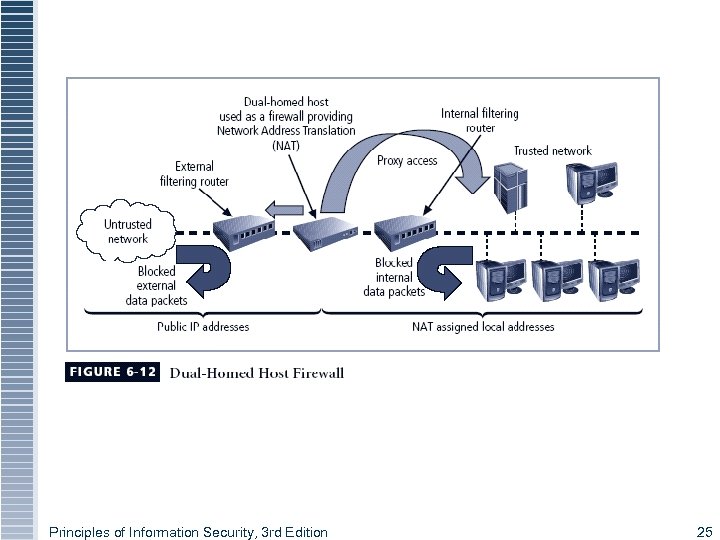
 Dual-Homed Host Firewalls § Bastion host contains two network interface cards (NICs): one connected to external network, one connected to internal network § Implementation of this architecture often makes use of network address translation (NAT), creating another barrier to intrusion from external attackers Principles of Information Security, 3 rd Edition 23
 Principles of Information Security, 3 rd Edition 24
 Principles of Information Security, 3 rd Edition 25
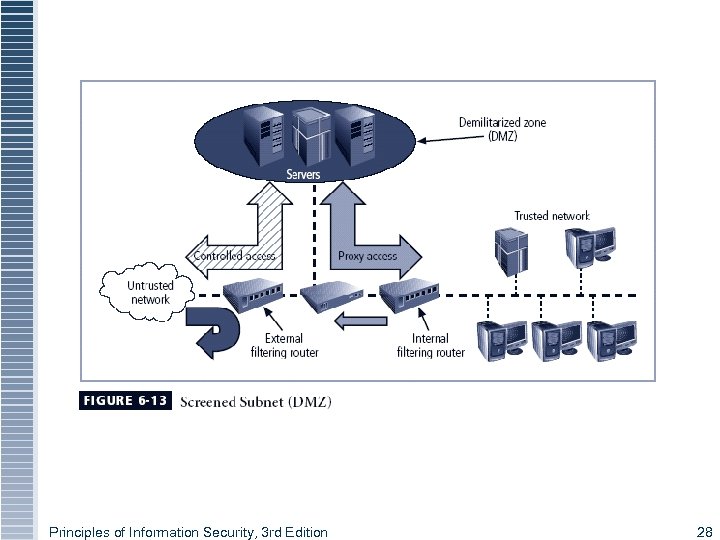
 Screened Subnet Firewalls (with DMZ) § Dominant architecture used today is the screened subnet firewall § Commonly consists of two or more internal bastion hosts behind packet filtering router, with each host protecting trusted network: § Connections from outside (untrusted network) routed through external filtering router § Connections from outside (untrusted network) are routed into and out of routing firewall to separate network segment known as DMZ § Connections into trusted internal network allowed only from DMZ bastion host servers Principles of Information Security, 3 rd Edition 26
 Screened Subnet Firewalls (with DMZ) (continued) § Screened subnet performs two functions: § Protects DMZ systems and information from outside threats § Protects the internal networks by limiting how external connections can gain access to internal systems § Another facet of DMZs: extranets Principles of Information Security, 3 rd Edition 27
 Principles of Information Security, 3 rd Edition 28
 Selecting the Right Firewall § When selecting firewall, consider a number of factors: § What firewall offers right balance between protection and cost for needs of organization? § Which features are included in base price and which are not? § Ease of setup and configuration? How accessible are staff technicians who can configure the firewall? § Can firewall adapt to organization’s growing Principles of Information Security, 3 rd Edition 29
 Configuring and Managing Firewalls § Each firewall device must have own set of configuration rules regulating its actions § Firewall policy configuration is usually complex and difficult § Configuring firewall policies is both an art and a science § When security rules conflict with the performance of business, security often loses Principles of Information Security, 3 rd Edition 30
 Best Practices for Firewalls § All traffic from trusted network is allowed out § Firewall device never directly accessed from public network § Simple Mail Transport Protocol (SMTP) data allowed to pass through firewall § Internet Control Message Protocol (ICMP) data denied § Telnet access to internal servers should be blocked § When Web services offered outside firewall, Principles of Information Security, 3 rd Edition 31
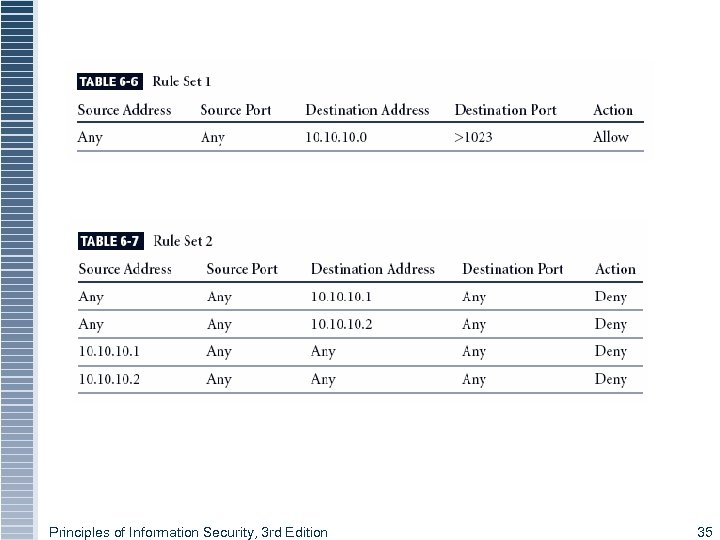
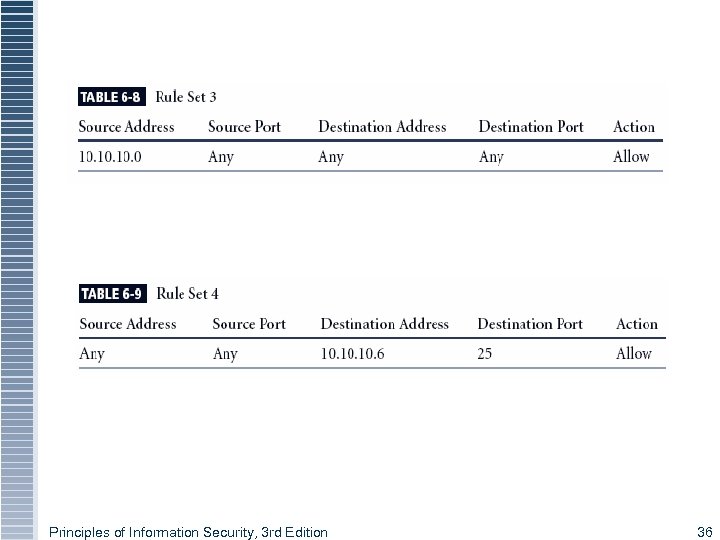
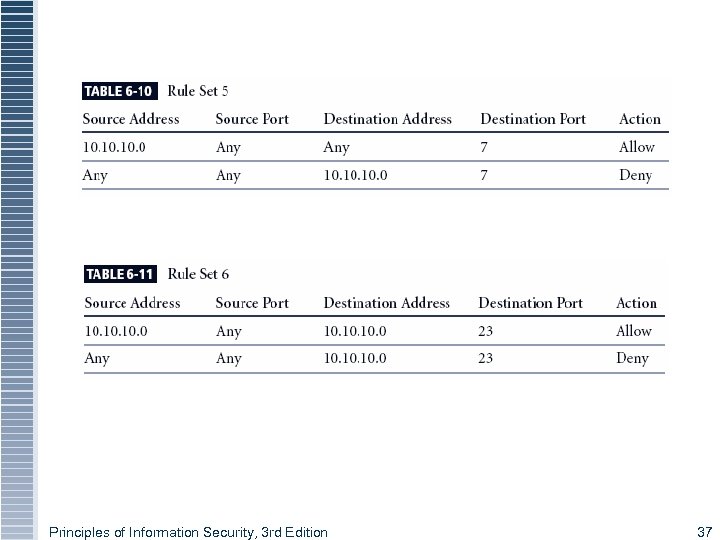
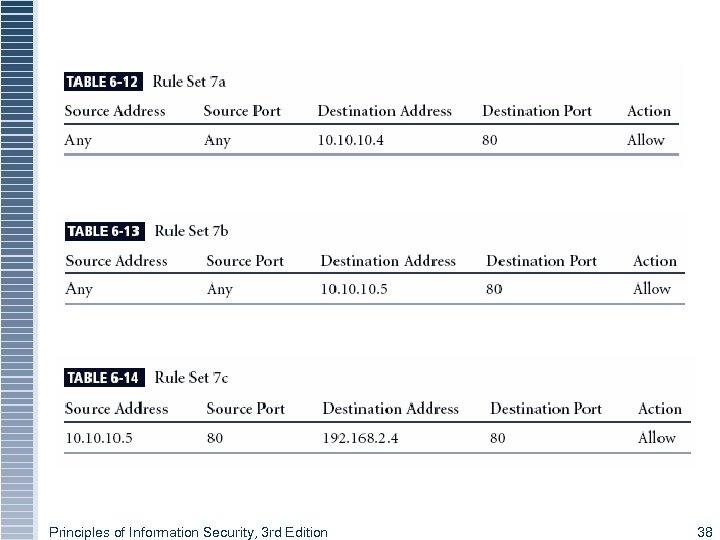
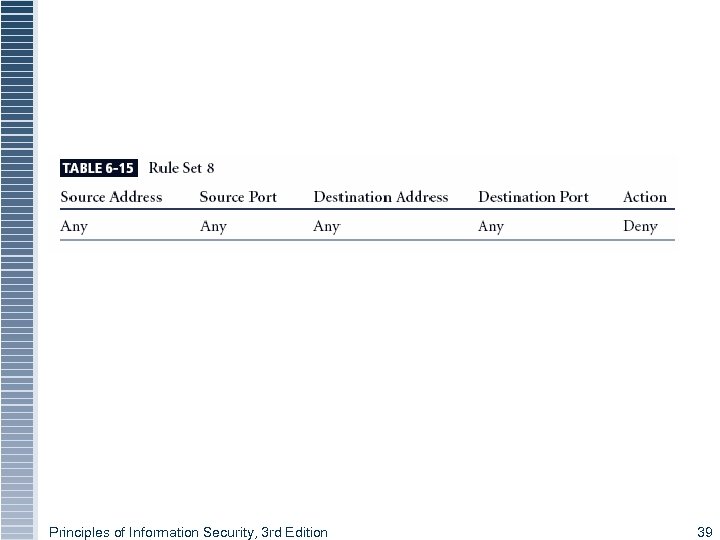
 Firewall Rules § Operate by examining data packets and performing comparison with predetermined logical rules § Logic based on set of guidelines most commonly referred to as firewall rules, rule base, or firewall logic § Most firewalls use packet header information to determine whether specific packet should be allowed or denied Principles of Information Security, 3 rd Edition 32
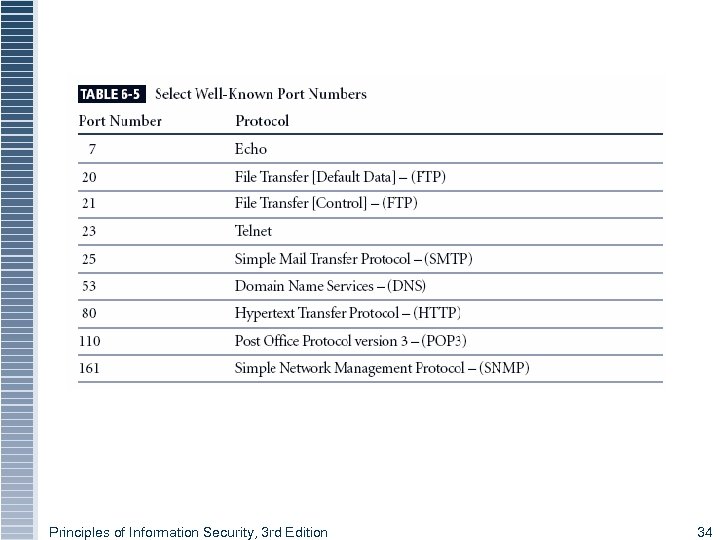
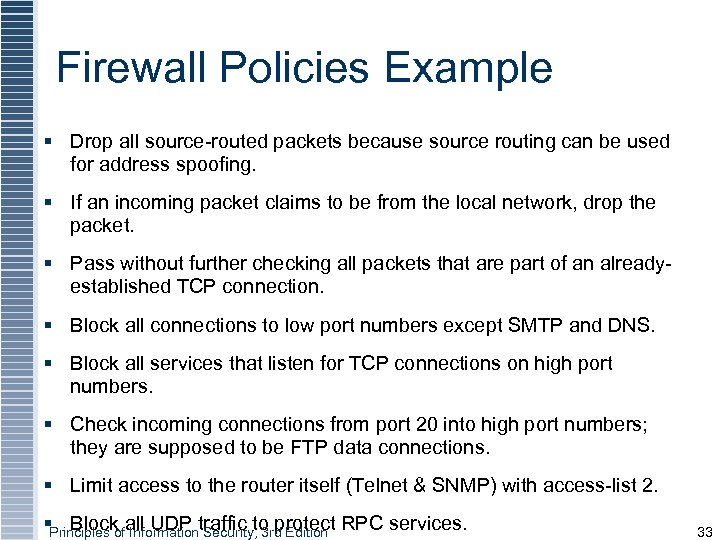 Firewall Policies Example § Drop all source-routed packets because source routing can be used for address spoofing. § If an incoming packet claims to be from the local network, drop the packet. § Pass without further checking all packets that are part of an alreadyestablished TCP connection. § Block all connections to low port numbers except SMTP and DNS. § Block all services that listen for TCP connections on high port numbers. § Check incoming connections from port 20 into high port numbers; they are supposed to be FTP data connections. § Limit access to the router itself (Telnet & SNMP) with access-list 2. §Principles ofall UDP traffic to protect RPC services. Block Information Security, 3 rd Edition 33
 Principles of Information Security, 3 rd Edition 34
 Principles of Information Security, 3 rd Edition 35
 Principles of Information Security, 3 rd Edition 36
 Principles of Information Security, 3 rd Edition 37
 Principles of Information Security, 3 rd Edition 38
 Principles of Information Security, 3 rd Edition 39
 Content Filters § Software filter—not a firewall—that allows administrators to restrict content access from within network § Essentially a set of scripts or programs restricting user access to certain networking protocols/Internet locations § Primary focus to restrict internal access to external material § Most common content filters restrict users from Principles of Information Security, 3 rd Edition accessing non-business Web sites or deny 40
 Protecting Remote Connections § Installing Internetwork connections requires leased lines or other data channels; these connections are usually secured under requirements of formal service agreement § When individuals seek to connect to organization’s network, more flexible option must be provided § Options such as virtual private networks (VPNs) have become more popular due to spread of Internet Principles of Information Security, 3 rd Edition 41
 Remote Access § Unsecured, dial-up connection points represent a substantial exposure to attack § Attacker can use device called a war dialer to locate connection points § War dialer: automatic phone-dialing program that dials every number in a configured range and records number if modem picks up § Some technologies (RADIUS systems; TACACS; CHAP password systems) have improved authentication process Principles of Information Security, 3 rd Edition 42
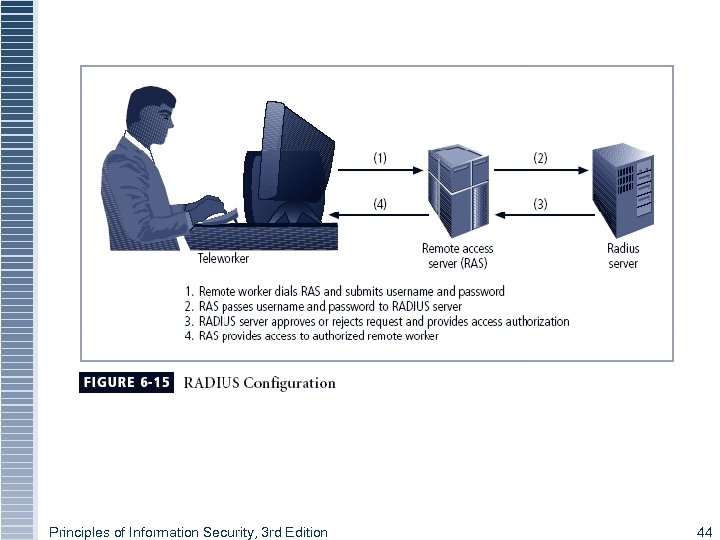
 RADIUS, TACACS, and Diameter § Systems that authenticate user credentials for those trying to access an organization’s network via dial-up § Remote Authentication Dial-In User Service (RADIUS): centralizes management of user authentication system in a central RADIUS server § Diameter: emerging alternative derived from RADIUS Principles of Information Security, 3 rd Edition 43
 Principles of Information Security, 3 rd Edition 44
 Securing Authentication with Kerberos § Provides secure third-party authentication § Uses symmetric key encryption to validate individual user to various network resources § Keeps database containing private keys of clients/servers § Consists of three interacting services: § Authentication server (AS) § Key Distribution Center (KDC) § Kerberos ticket granting service (TGS) Principles of Information Security, 3 rd Edition 45
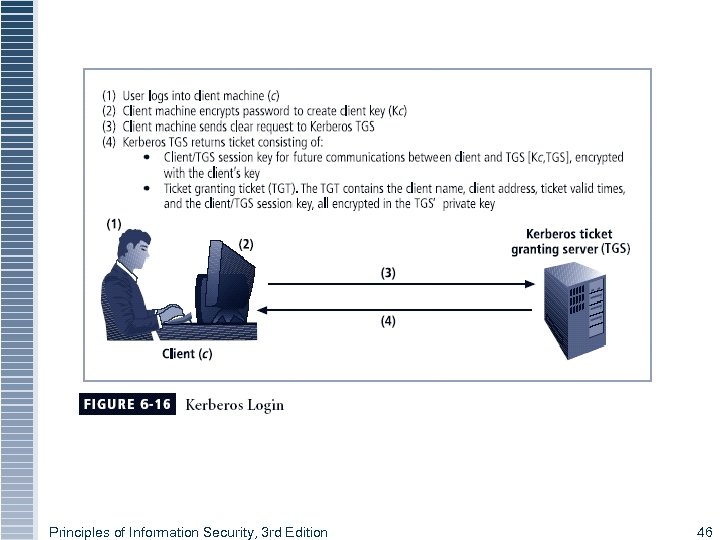 Principles of Information Security, 3 rd Edition 46
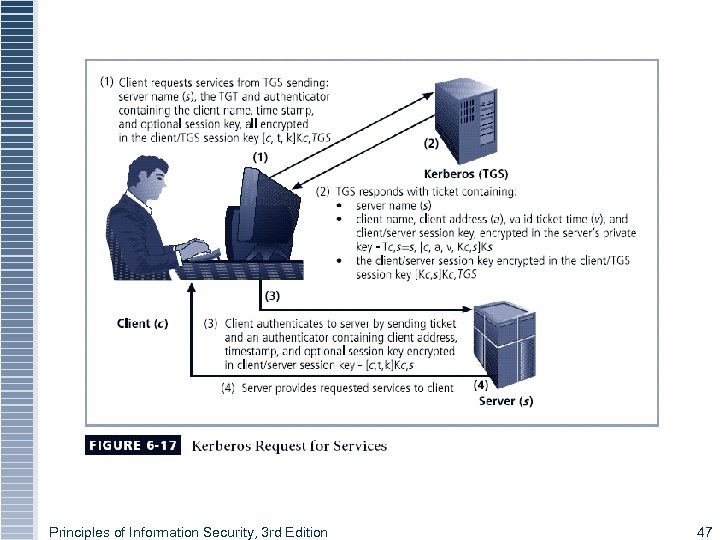 Principles of Information Security, 3 rd Edition 47
 Virtual Private Networks (VPNs) § Private and secure network connection between systems; uses data communication capability of unsecured and public network § Securely extends organization’s internal network connections to remote locations beyond trusted network § Three VPN technologies defined: § Trusted VPN § Secure VPN § Hybrid VPN (combines trusted and secure) Principles of Information Security, 3 rd Edition 48
 Virtual Private Networks (VPNs) (continued) § VPN must accomplish: § Encapsulation of incoming and outgoing data § Encryption of incoming and outgoing data § Authentication of remote computer and (perhaps) remote user as well Principles of Information Security, 3 rd Edition 49
 Transport Mode § Data within IP packet is encrypted, but header information is not § Allows user to establish secure link directly with remote host, encrypting only data contents of packet § Two popular uses: § End-to-end transport of encrypted data § Remote access worker connects to office network over Internet by connecting to a VPN server on the perimeter Principles of Information Security, 3 rd Edition 50
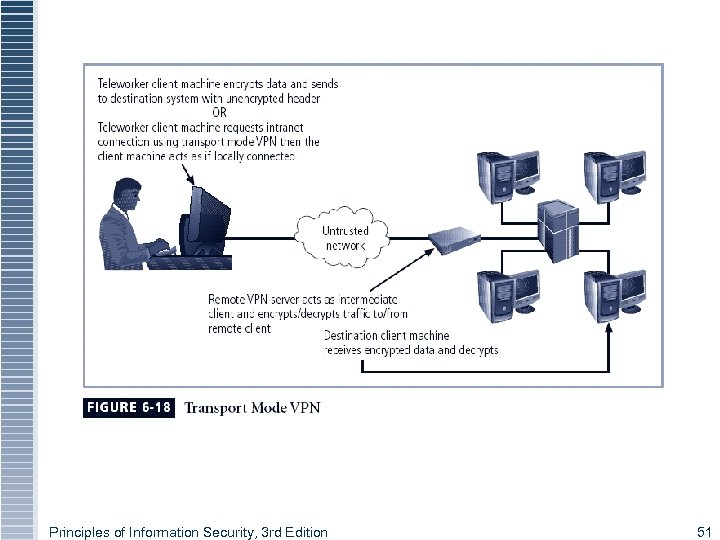 Principles of Information Security, 3 rd Edition 51
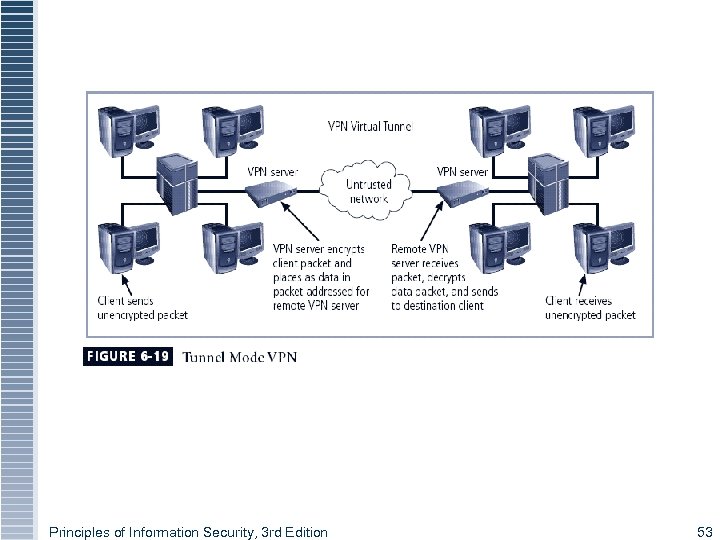
 Tunnel Mode § Organization establishes two perimeter tunnel servers § These servers act as encryption points, encrypting all traffic that will traverse unsecured network § Primary benefit to this model is that an intercepted packet reveals nothing about true destination system § Example of tunnel mode VPN: Microsoft’s Principles of Information Security, 3 rd Edition 52
 Principles of Information Security, 3 rd Edition 53
 Summary § Firewall technology § Various approaches to remote and dial-up access protection § Content filtering technology § Virtual private networks Principles of Information Security, 3 rd Edition 54