 Скачать презентацию Fire Safety at Rensselaer Greek Life Presented by
7ea74967fb26a0df4f51e4f77884b38b.ppt
- Количество слайдов: 32



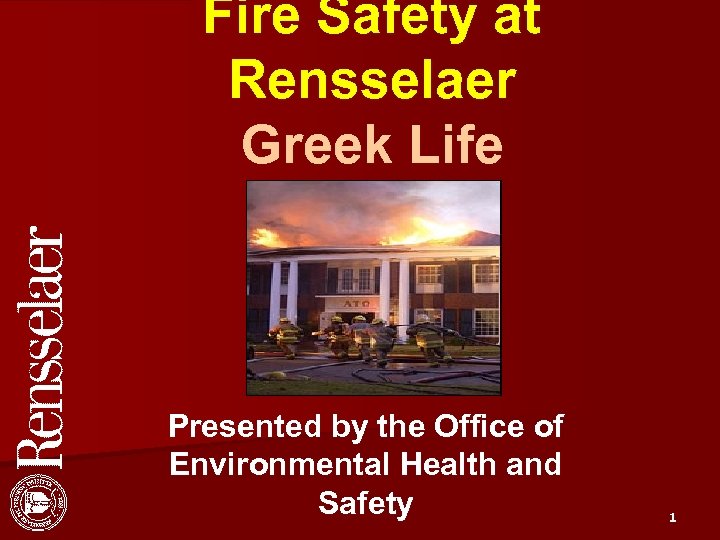
Fire Safety at Rensselaer Greek Life Presented by the Office of Environmental Health and Safety 1
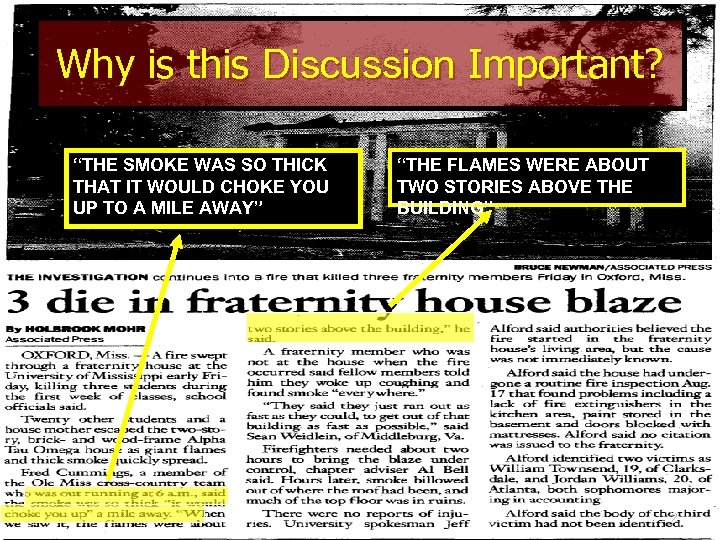
Why is this Discussion Important? “THE SMOKE WAS SO THICK THAT IT WOULD CHOKE YOU UP TO A MILE AWAY” “THE FLAMES WERE ABOUT TWO STORIES ABOVE THE BUILDING” 2
Fraternity and Sorority Fire Facts n Every year in the US, there an estimated 150 fires in fraternity and sorority houses. n Fires in fraternity and sorority houses peak when the college or university is in season and on weekends Information courtesy of the NYS Office of Fire Prevention and Control 3
Fraternity and Sorority Fire Facts n Fires in fraternity and sorority houses are five times more costly on average than those that occur in dormitories n Arson is the leading cause of fraternity and sorority house fires; open flame is the next leading cause, with candles playing a major role. Information courtesy of the NYS Office of Fire Prevention and Control 4
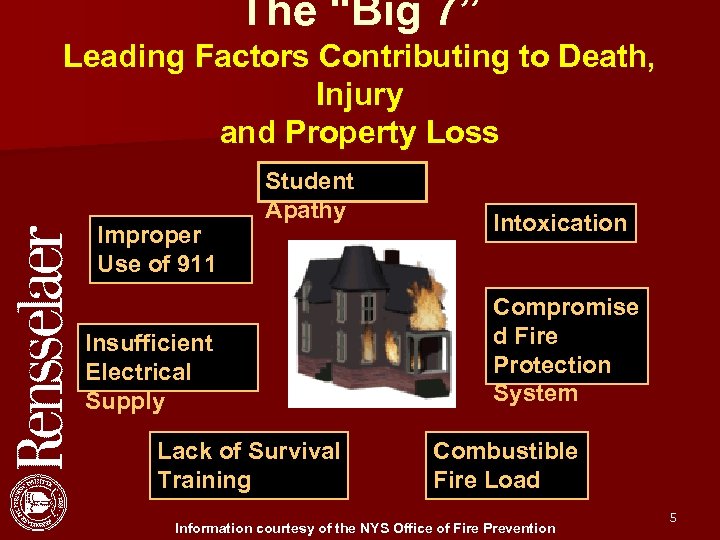
The “Big 7” Leading Factors Contributing to Death, Injury and Property Loss Improper Use of 911 Student Apathy Insufficient Electrical Supply Lack of Survival Training Intoxication Compromise d Fire Protection System Combustible Fire Load Information courtesy of the NYS Office of Fire Prevention 5
Recent Greek Fires n San Jose State, CA n Binghamton University, NY n Hobart & William Smith College, NY 6
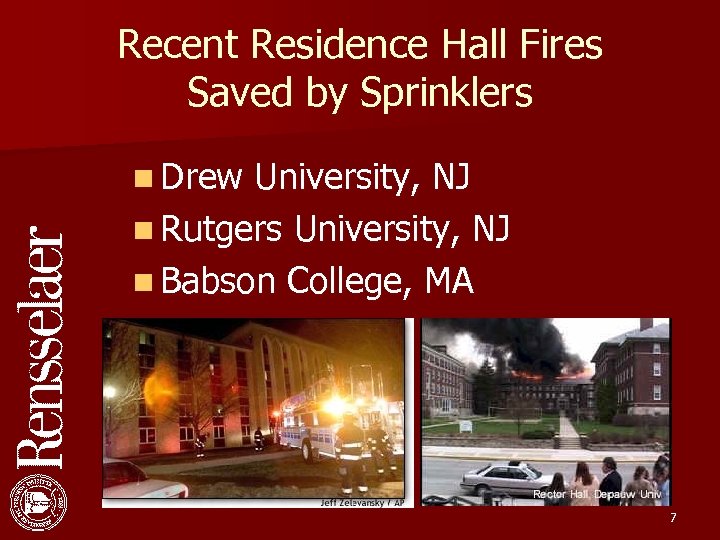
Recent Residence Hall Fires Saved by Sprinklers n Drew University, NJ n Rutgers University, NJ n Babson College, MA 7
R-2 Fire and Life Safety Standards Compliance Fire Code of New York State (19 NYCRR Part 1225. 1) Relationship Statement 8
Designation of Chapter Risk Manager n Each Chapter must designate a Risk Manager who will: n Reside in the Chapter House n Attend all Mandatory “training sessions” n Conduct/Document a Mandatory Education Session for all Chapter Members on Fire Safety and Sanitation issues n Ensure the compliance with required evacuation drills 9
Designation of Chapter Risk Manager n Each Chapter must designate a risk Manager who will: n Ensures that any/all issues generated during the house inspection process are rectified within 20 days n Ensures that evacuation diagrams are properly created/posted n Maintain adequate records n Reports all incidents to the Dean of Students within 24 hours of occurrence 10
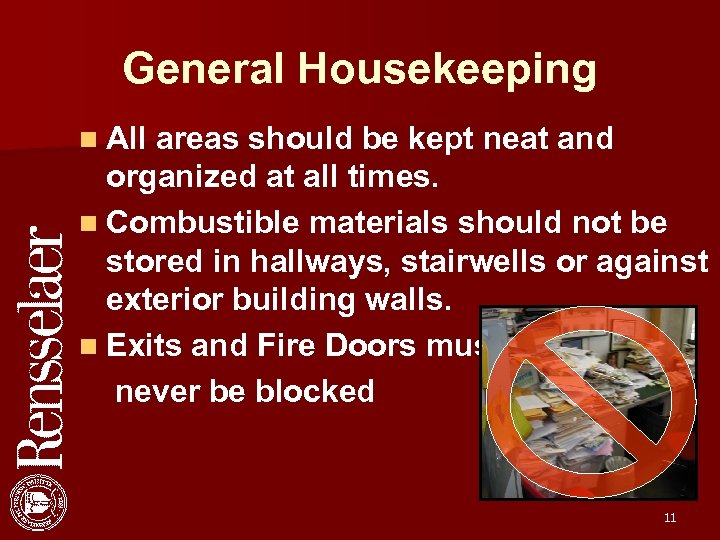
General Housekeeping n All areas should be kept neat and organized at all times. n Combustible materials should not be stored in hallways, stairwells or against exterior building walls. n Exits and Fire Doors must never be blocked 11
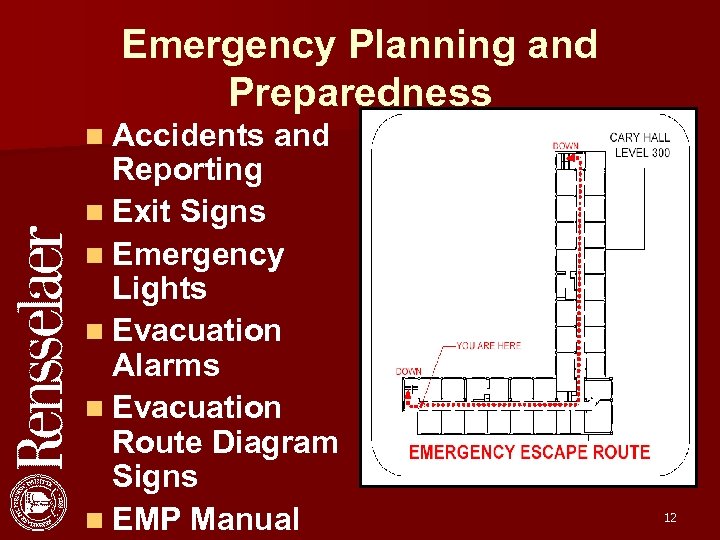
Emergency Planning and Preparedness n Accidents and Reporting n Exit Signs n Emergency Lights n Evacuation Alarms n Evacuation Route Diagram Signs n EMP Manual 12
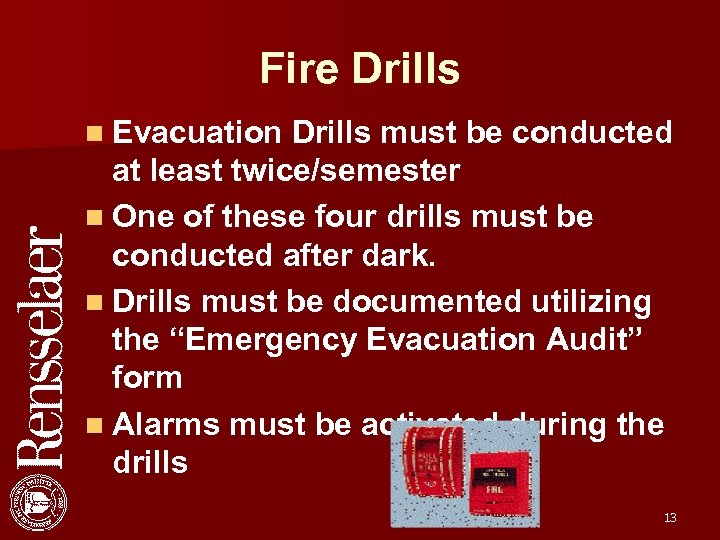
Fire Drills n Evacuation Drills must be conducted at least twice/semester n One of these four drills must be conducted after dark. n Drills must be documented utilizing the “Emergency Evacuation Audit” form n Alarms must be activated during the drills 13
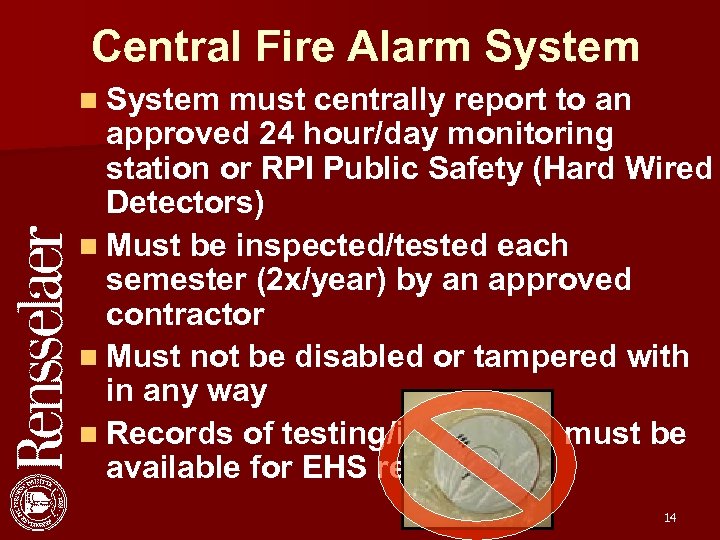
Central Fire Alarm System n System must centrally report to an approved 24 hour/day monitoring station or RPI Public Safety (Hard Wired Detectors) n Must be inspected/tested each semester (2 x/year) by an approved contractor n Must not be disabled or tampered with in any way n Records of testing/inspection must be available for EHS review 14
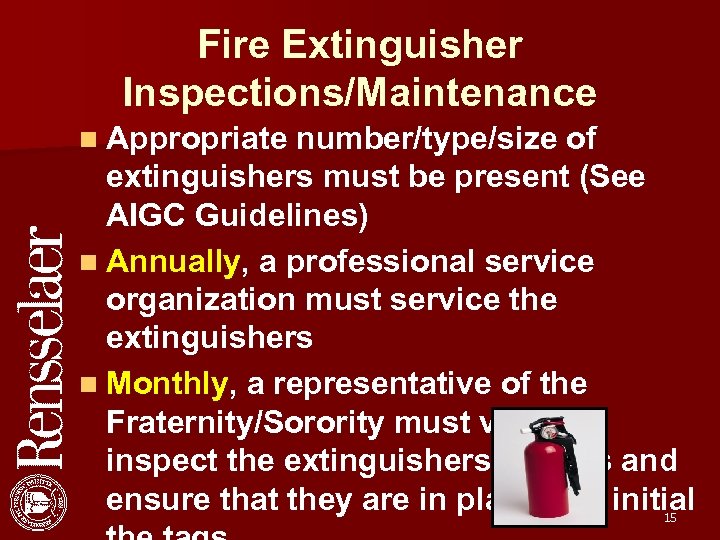
Fire Extinguisher Inspections/Maintenance n Appropriate number/type/size of extinguishers must be present (See AIGC Guidelines) n Annually, a professional service organization must service the extinguishers n Monthly, a representative of the Fraternity/Sorority must visually inspect the extinguishers gauges and ensure that they are in place and initial 15
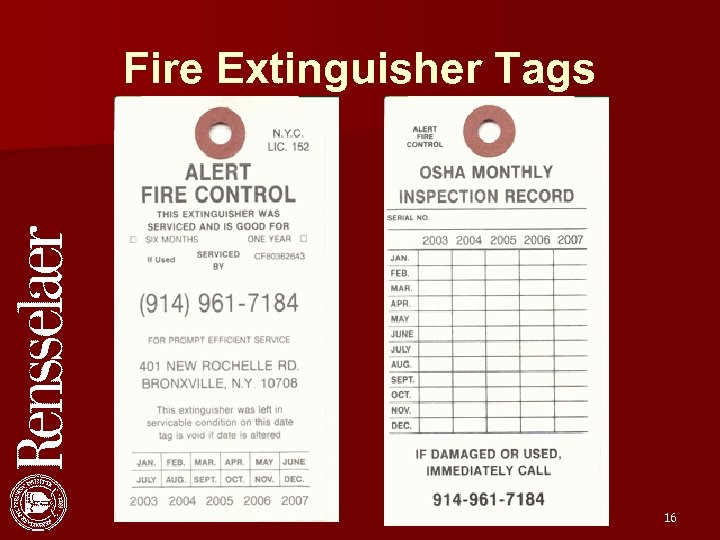
Fire Extinguisher Tags 16
Kitchens/Cooking Areas n Hood Fire Suppression system must be inspected by a qualified individual twice per year. n Must have back-up manual activation switch at least 10 feet from the hood n Hood ventilation system must be cleaned as needed and at least once per year. n Must have a Portable Fire Extinguisher within 30 feet of the hood- Class “K” for deep fryers 17
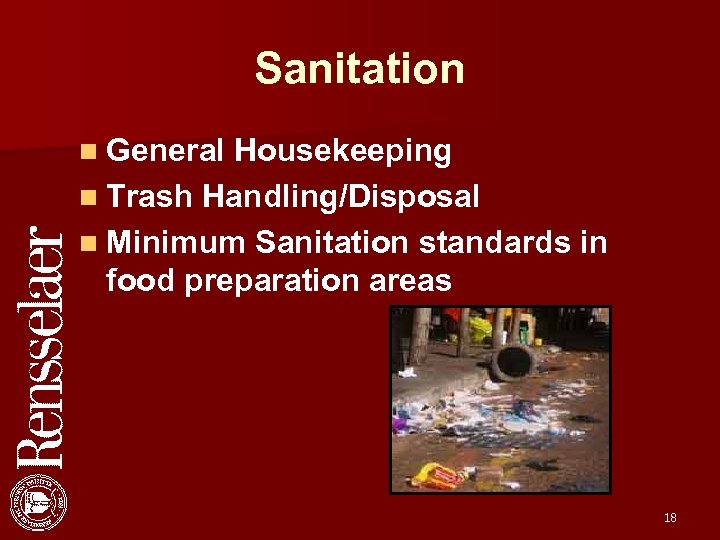
Sanitation n General Housekeeping n Trash Handling/Disposal n Minimum Sanitation standards in food preparation areas 18
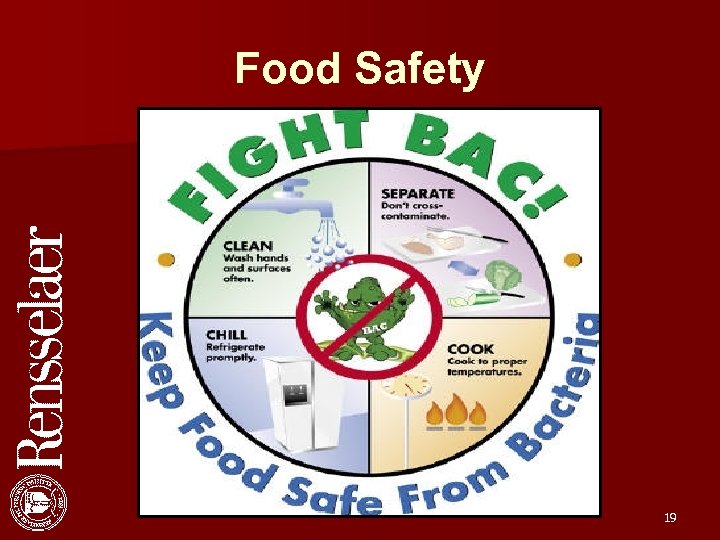
Food Safety 19
Boilers n Annual Inspection Required by Subpart 4 -4 of NYS Labor Law for high pressure units. n Specific Inspection/Testing Regiment dependent upon design and construction specifics. 20
Boilers n Low pressure (<=15 psi steam, <= 160 psi hot water not exceeding 250 deg. F) n Inspection Requirements: – External biennially for units >100, 000 BTU – Internal § Steam every 3 years § Hot Water every 5 years 21
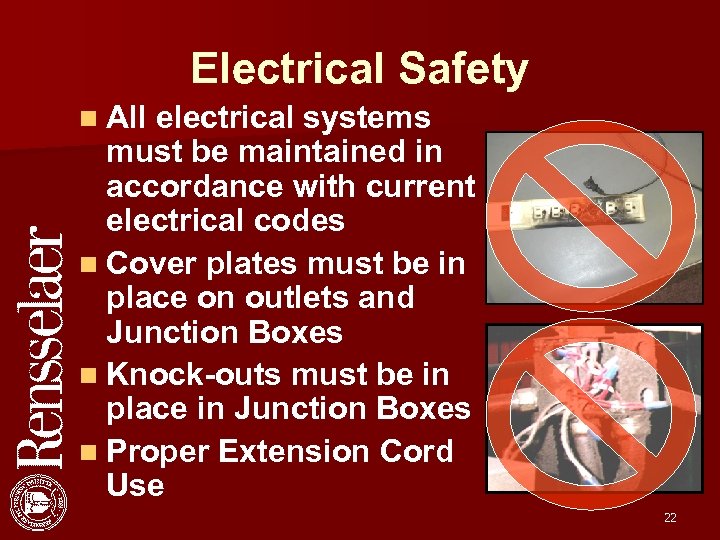
Electrical Safety n All electrical systems must be maintained in accordance with current electrical codes n Cover plates must be in place on outlets and Junction Boxes n Knock-outs must be in place in Junction Boxes n Proper Extension Cord Use 22
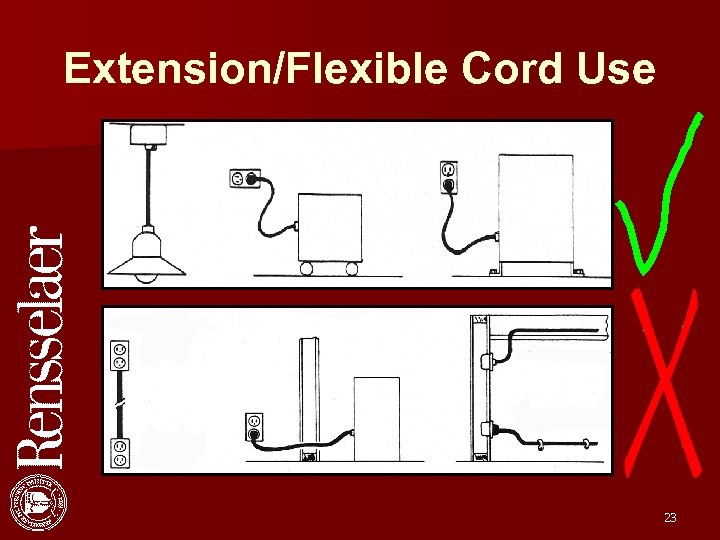
Extension/Flexible Cord Use 23
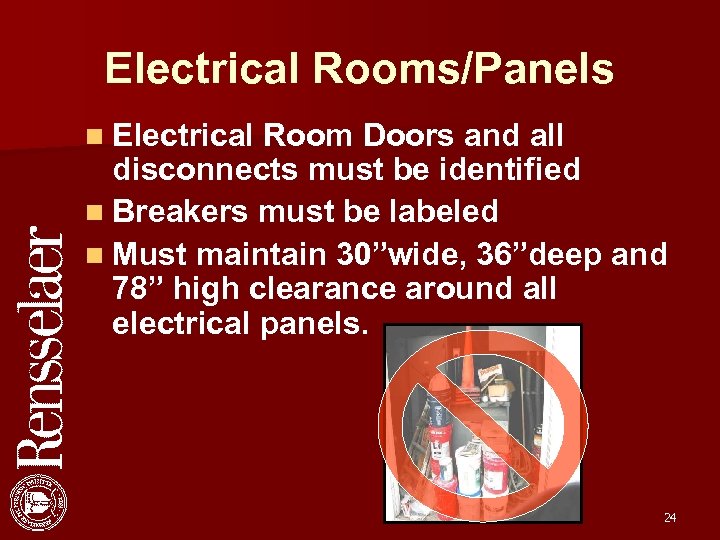
Electrical Rooms/Panels n Electrical Room Doors and all disconnects must be identified n Breakers must be labeled n Must maintain 30”wide, 36”deep and 78” high clearance around all electrical panels. 24
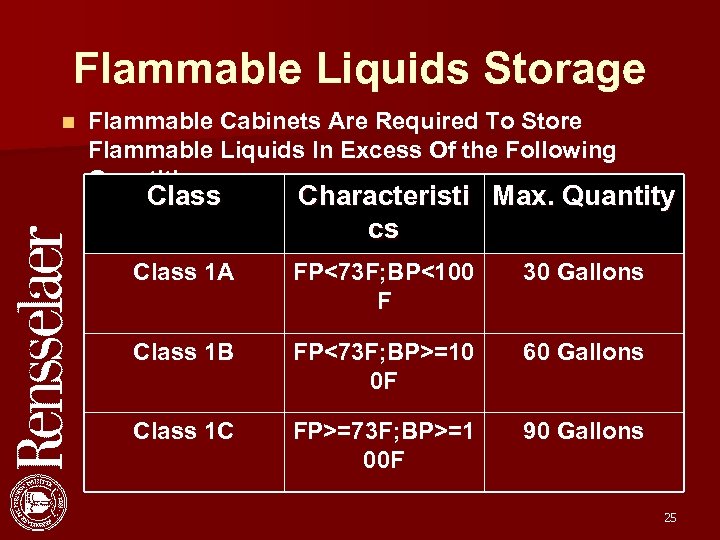
Flammable Liquids Storage n Flammable Cabinets Are Required To Store Flammable Liquids In Excess Of the Following Quantities: Class Characteristi Max. Quantity cs Class 1 A FP<73 F; BP<100 F 30 Gallons Class 1 B FP<73 F; BP>=10 0 F 60 Gallons Class 1 C FP>=73 F; BP>=1 00 F 90 Gallons 25
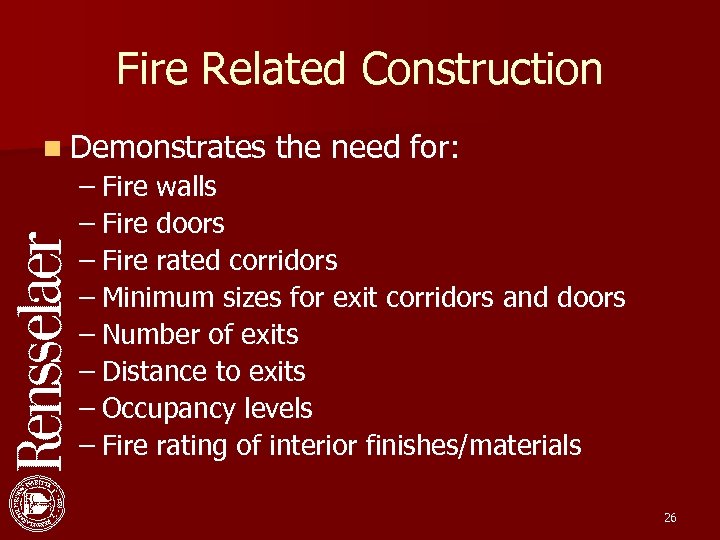
Fire Related Construction n Demonstrates the need for: – Fire walls – Fire doors – Fire rated corridors – Minimum sizes for exit corridors and doors – Number of exits – Distance to exits – Occupancy levels – Fire rating of interior finishes/materials 26
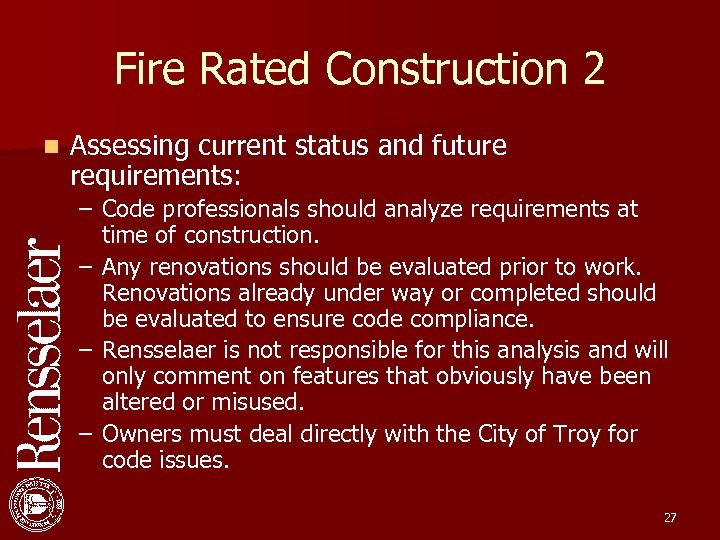
Fire Rated Construction 2 n Assessing current status and future requirements: – Code professionals should analyze requirements at time of construction. – Any renovations should be evaluated prior to work. Renovations already under way or completed should be evaluated to ensure code compliance. – Rensselaer is not responsible for this analysis and will only comment on features that obviously have been altered or misused. – Owners must deal directly with the City of Troy for code issues. 27
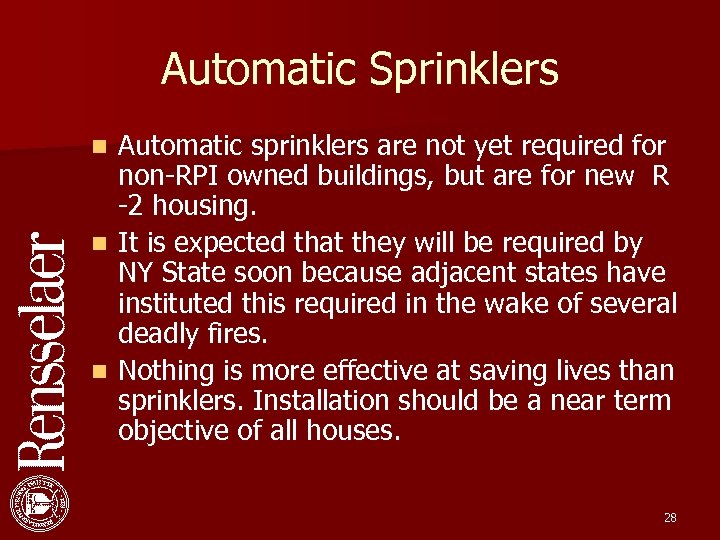
Automatic Sprinklers Automatic sprinklers are not yet required for non-RPI owned buildings, but are for new R -2 housing. n It is expected that they will be required by NY State soon because adjacent states have instituted this required in the wake of several deadly fires. n Nothing is more effective at saving lives than sprinklers. Installation should be a near term objective of all houses. n 28
Lofts n 1. 2. 3. 4. Greek Life Policy Mirrors Residence Life Policy for Construction Requirements: Lofts Must Not Be Permanently Affixed to the Building Lofts Must Not Impede Egress From the Room Lofts Must Be At Least 3 Feet Below Ceiling Level Lofts Cannot Be More Than 4 Feet 29
Drinking and Fires n½ of all adults who die in residential fires have high blood-alcohol levels n Burn victims who have consumed alcohol have a mortality rate 3 times that of victims who have not n Alcohol consumption reduces ability to detect fire, respond to a fire or fire alarm, and safely escape a fire Information courtesy of the NYS Office of Fire Prevention 30
Summary n These Issues Can Be a Matter of Life and Death n All Chapter Members Must Be Aware of the Risks/Requirements and Act Accordingly n Use The Tools Provided By This Program To Improve The Safety in Your Chapter House! n Nothing Is Any More Important! 31
Questions? 32
Скачать презентацию Fire Safety at Rensselaer Greek Life Presented by
7ea74967fb26a0df4f51e4f77884b38b.ppt