


 Скачать презентацию Fire Detection and Suppression Chapter 2 Fire Detection
d9c52f0c868ff1210596601aa6b40142.ppt
- Количество слайдов: 33
 Fire Detection and Suppression Chapter 2 Fire Detection and Signaling Systems
 Fire Detection and Signaling Systems The early detection of a fire and the signaling of an appropriate alarm remain the most significant factors in preventing large losses from occurring. 1 Fire Detection and Signaling Systems
 Standards and Codes • Component tests by nationally recognized labs — Underwriters Laboratories — Factory Mutual • Codes — NFPA 70, National Electrical Code — NPFA 72, The National Fire Alarm Code — Local codes and ordinances 2 Fire Detection and Signaling Systems
 Basic System Components • System control unit (alarm panel) — Brain of system — Processes alarm signals from actuating devices and transmits them to the local or other alerting system 3 Fire Detection and Signaling Systems
 Basic System Components (cont. ) • Power supply — Primary power supply – Public electric utility – Engine-driven generator — Secondary power supply – Storage battery and charger – Engine-driven generator and 4 -hour storage battery – Multiple engine-driven generators — Trouble signal power supply 4 Fire Detection and Signaling Systems
 Basic System Components (cont. ) • Initiating devices: manual pull stations, heat detectors, smoke detectors, flame detectors, waterflow devices, tamper switches, and combination detectors • Notification appliances: bells, buzzers, horns, recorded voice messages, strobe lights, speakers, and other warning appliances • Auxiliary services 5 Fire Detection and Signaling Systems
 Types of Fire Alarm Systems • Selection factors — Level of life-safety hazard — Structural features of the building — Level of hazard presented by the contents of the building — Availability of fire suppression resources — State and local code requirements (Continued) 6 Fire Detection and Signaling Systems
 Types of Fire Alarm Systems (cont. ) • Local system — Noncoded local alarm – Simultaneous operation of all alarm-indicating devices – Only practical in small occupancies with limited number of rooms — Master coded local alarm – Serves the premises as a local control unit and receives input from other fire alarm control units – Used in occupancies that use the alarm signals for other purposes (Continued) 7 Fire Detection and Signaling Systems
 Types of Fire Alarm Systems • Local system (cont. ) — Zoned/annunciated alarm – Identifies fire location quickly and accurately – Alarm-initiating devices arranged in circuits or zones – Initiating device sounds alarm and lights corresponding lamp on control unit – Annunciator panel remote from control panel – Coded signals — Presignal alarm (Continued) 8 Fire Detection and Signaling Systems
 Types of Fire Alarm Systems (cont. ) • Auxiliary system — Facility that receives signals where personnel are always present to respond – Initiation devices – Local requirements and policies — Types of auxiliary systems – Local energy system – Shunt system – Parallel telephone system (Continued) 9 Fire Detection and Signaling Systems
 Types of Fire Alarm Systems (cont. ) • Remote station system — Connected to dispatch center by means other than municipal fire alarm box system — Local alarm capability — Monitoring options (Continued) 10 Fire Detection and Signaling Systems
 Types of Fire Alarm Systems (cont. ) • Proprietary system — Used to protect large buildings or facilities — Systems for individual buildings or areas wired into common receiving point — Wide-ranging capabilities (Continued) 11 Fire Detection and Signaling Systems
 Types of Fire Alarm Systems (cont. ) • Central station system — Similar to proprietary system but receiving point is an outside, contracted central station — Alarm activation information received by central station employees, who initiate emergency response (Continued) 12 Fire Detection and Signaling Systems
 Types of Fire Alarm Systems (cont. ) • Emergency voice/alarm communications system — Supplements other systems — Communicates detailed information to occupants and fire fighting personnel — One-way/two-way 13 Fire Detection and Signaling Systems
 Manual Alarm-Initiating Devices • General requirements — Mounting and distribution — Generally not required in fully sprinklered structures — Outmoded “broken glass” pull stations • Coded versus noncoded pull stations • Single-action and double-action pull stations 14 Fire Detection and Signaling Systems
 Automatic Alarm-Initiating Devices • Continuously monitor atmosphere • Four basic types — Heat detectors — Smoke detectors — Fire-gas detectors — Flame detectors 15 Fire Detection and Signaling Systems
 Heat Detectors • Fixed temperature heat detectors — Fusible links/frangible bulbs — Continuous line detector — Bimetallic detector • Rate-of-rise heat detector — Pneumatic rate-of-rise spot detector (Fig. 2. 34) — Pneumatic rate-of-rise line detector (Fig. 2. 35) — Rate compensated detector (Fig. 2. 36) — Thermoelectric detector 16 Fire Detection and Signaling Systems
 Smoke Detectors • Photoelectric smoke detector — Projected beam (Fig. 2. 37) — Refractory photocell (Fig. 2. 38) • Ionization smoke detector (Fig. 2. 39) — Dual chamber — Air-sampling smoke detectors – Cloud chamber (Fig. 2. 40) – Second type (Fig. 2. 41) (Continued) 17 Fire Detection and Signaling Systems
 Smoke Detectors (cont. ) • Limitations — May not provide early warning of a fire developing on another level of a building — May not detect fire developing on the other side of a closed door — May not be effective when fire is caused by explosions resulting from careless housekeeping 18 Fire Detection and Signaling Systems
 Flame Detectors • Types — Ultraviolet (UV) Fig. (2. 42 a) — Infrared (IR) Fig. (2. 42 b) • Fast to respond • Frequent false alarms 19 Fire Detection and Signaling Systems
 Fire Gas Detectors • Monitors levels of gases released by combustion — Carbon dioxide — Carbon monoxide • Faster than heat detectors but slower than smoke detectors 20 Fire Detection and Signaling Systems
 Combination Detectors • Various possible combinations — Fixed rate/rate-of-rise detectors — Heat/smoke detectors — Smoke/fire gas detectors • Offer benefits of both systems and increase responsiveness to fire conditions 21 Fire Detection and Signaling Systems
 Acceptance Testing • Should be observe by representatives of building owner, fire department, system installer, and system manufacturer. • All functions of the fire detection and signaling system should be operated: — All alarm-indicating and alarm-initiating devices — Restorable heat detectors — Response of outside entities responsible for monitoring the system 22 Fire Detection and Signaling Systems
 General Inspections • Fire department participation • Checkpoints — Condition of wiring and batteries — All equipment free of foreign materials — Adequate clearance around system control units, recording instruments, and other devices 23 Fire Detection and Signaling Systems
 Inspecting and Service Testing Initiating Devices (cont. ) • Manual alarm-initiating devices • Automatic alarm-initiating devices — Detectors must not be damaged or painted. — Replace or send the following detectors to a recognized testing laboratory for testing: – Detectors on systems that are being restored to service after a period of disuse – Detectors that are obviously corroded (Continued) 24 Fire Detection and Signaling Systems
 Inspecting and Service Testing Initiating Devices (cont. ) • Automatic alarm-initiating devices — Replace or send the following detectors to a recognized testing laboratory for testing (cont. ): – Detectors that have been painted over, even if attempts were made to clean them – Detectors that have been mechanically damaged or abused – Detectors on circuits that were subjected to current surges, overvoltages, or lightning strikes (Continued) 25 Fire Detection and Signaling Systems
 Inspecting and Service Testing Initiating Devices (cont. ) • Automatic alarm-initiating devices — Replace or send the following detectors to a recognized testing laboratory for testing (cont. ): – Detectors subjected to foreign substances that might affect their operation – Detectors subjected to either direct flame, excessive heat, or smoke damage — Testing – Nonrestorable – Restorable 26 Fire Detection and Signaling Systems
 Inspecting System Control Units • Control panel switches and functions • Auxiliary devices • Receiving signals 27 Fire Detection and Signaling Systems
 System Testing Timetables • Local systems: local guidelines • Central station systems: monthly • Auxiliary systems: monthly (noncoded fire alarm boxes: monthly) • Remote station and proprietary systems: authority having jurisdiction • Emergency voice/alarm systems: quarterly • NOTE: In all cases, check the most current edition of NFPA 72, National Fire Alarm Code. 28 Fire Detection and Signaling Systems
 Record Keeping • Maintaining Files and Records — Documents: – – – – Inspection reports, forms, and letters Violation notices Summonses Plans review comments, approvals, and drawings Fire reports Investigations Permits and certificates issued (Continued) 29 Fire Detection and Signaling Systems
 Record Keeping • Maintaining Files and Records (cont. ) — Occupancies: – Those that have been issued a permit, certificate, or license – Those that contain automatic fire suppression or detection systems – Those that conduct hazardous operations or routinely house hazardous materials — Duration: life of structure — Public record (Continued) 30 Fire Detection and Signaling Systems
 Record Keeping (cont. ) • Written records — File for each inspected property — Cataloging and storage • Electronic records — Two primary methods of entering data: – Inspectors use laptop computers or handheld electronic data recording equipment during the inspection. – Inspectors use written forms during the inspection and then enter the information upon returning to the office. (Continued) 31 Fire Detection and Signaling Systems
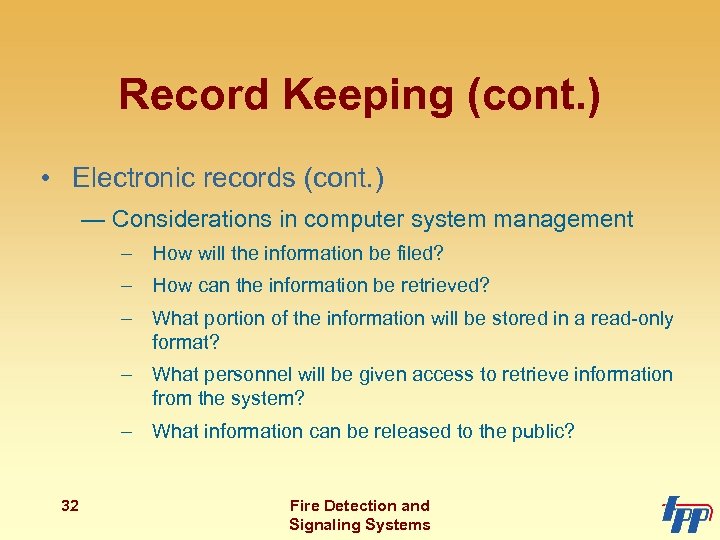 Record Keeping (cont. ) • Electronic records (cont. ) — Considerations in computer system management – How will the information be filed? – How can the information be retrieved? – What portion of the information will be stored in a read-only format? – What personnel will be given access to retrieve information from the system? – What information can be released to the public? 32 Fire Detection and Signaling Systems