


 Скачать презентацию Fire and the Analysis of Fire Residues
1a7384654ea7faa106b698a8c5a4bf40.ppt
- Количество слайдов: 30
 Fire and the Analysis of Fire Residues
 The Problem with Arson w One of the fastest growing crimes in US w Arson for its own sake – pyromania w Arson to cover up other crimes such as murder or embezzlement w Not hard to determine if a fire is arson w Difficult to determine who caused the fire
 What Is Fire? w Essentially a combustion reaction with a fuel, oxygen and sufficient temperature. This is the fire triangle. w 2 C 8 H 18 + 25 O 2 = 18 H 2 O + 16 CO 2 w An explosion and a fire involve the same process. – The only difference is the speed of the reaction. – Combustion may cause an explosion if confined
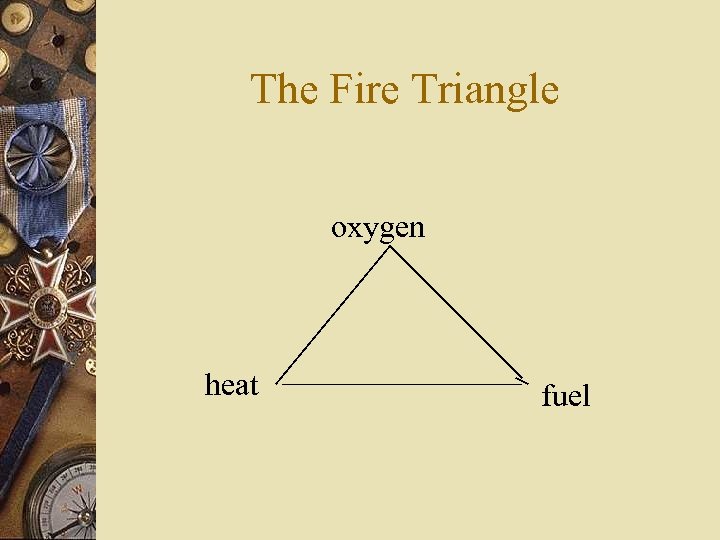 The Fire Triangle oxygen heat fuel
 Types of Fires w Burning or flaming fire – Sufficient oxygen and fuel – Flames and smoke visible w Smoldering fire – Oxygen deprived – Can burst into explosive flame if oxygen is suddenly supplied
 Arson w Deliberately set. Also sometimes called an incendiary fire w May involve the use of an accelerant w Accelerant is a substance that causes a fire to start that would not ordinarily start or to burn faster than in the absence of the accelerant. These are usually fuels such as gasoline
 Conditions for a Fire w A fire must have: – Oxygen – Fuel – Sufficient heat to get the fire started w Deprive the fire of one of these and it will cease or won’t start
 Conditions for a fire w Generally only gases (vapors) will burn. Solids and liquids will not burn w Sufficient heat is required to vaporize some of the fuel and break oxygen molecules apart into oxygen atoms w Fire will produce enough heat to continue vaporization and keep fire going
 Investigating the Fire Scene w Done by fire scene investigator w Search for point(s) of origin w Possible causes: – Accidental (leave the stove on, accidental malfunction in appliance) – Natural (lightening) – Deliberate (Use an accelerant, deliberately sabotage an appliance)
 The Point of Origin w Crucial piece of evidence in determining type of fire w Often most intense location of burning w Usually at a low point in the building-may be buried under tons of rubble w Smoke or damage often shows “V” pattern
 Determination of Arson w Eliminate all natural and accidental causes: leaves only arson w Multiple points of origin w Fire trail w Presence of accelerant in debris w Presence of accelerant in observation of fire: thick black smoke
 The Role of an Accelerant w The accelerant supplies the heat needed to get substances into the vapor phase so they can burn. w Presence of an accelerant does not necessarily mean that fire is arson. Why? w Absence of an accelerant does not rule out arson. Why?
 Finding Accelerants w Find point of origin w Look for absorbent materials w Use fire dog – capable of sniffing out miniscule quantities of accelerants w Look for fire trails
 Role of the Crime Laboratory w Lab does not determine if fire is arson or not w Examines debris to determine if an accelerant may be present w Isolates and identifies accelerants w This may support the fire scene investigator in determination of arson
 Methods of Isolating and Concentrating Accelerant Residues w. Heated headspace w. Purge and trap
 Heated Headspace w Closed container w Samples headspace over residue w Henry’s law - heating drives equilibrium to vapor w Favors volatile components
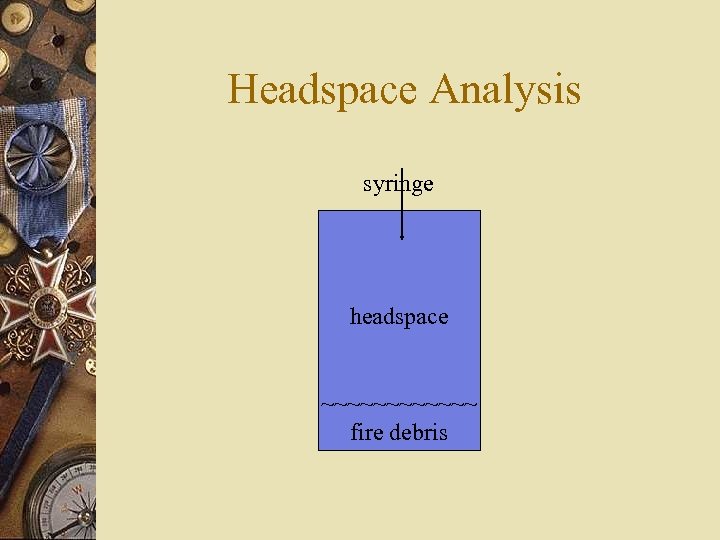 Headspace Analysis syringe headspace ~~~~~~ fire debris
 Purge and Trap w Closed container w Uses charcoal strip or charcoal tube to trap accelerants w Uses vacuum or positive pressure with inert gas to force accelerant vapor through charcoal trap
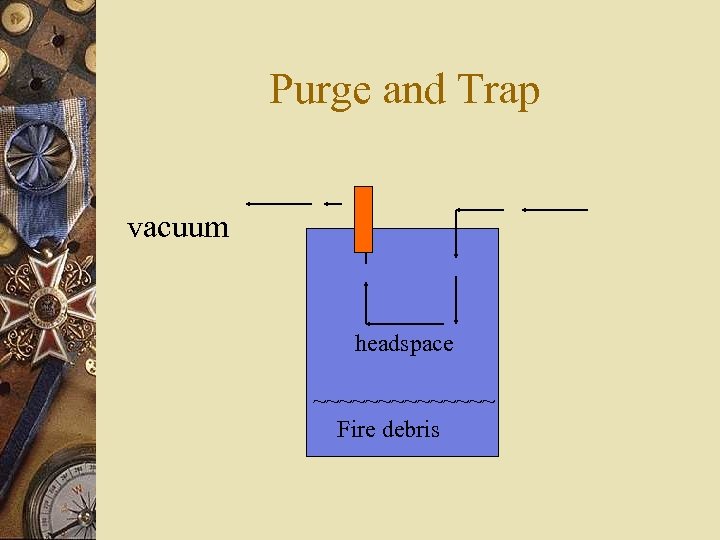 Purge and Trap vacuum headspace ~~~~~~~ Fire debris
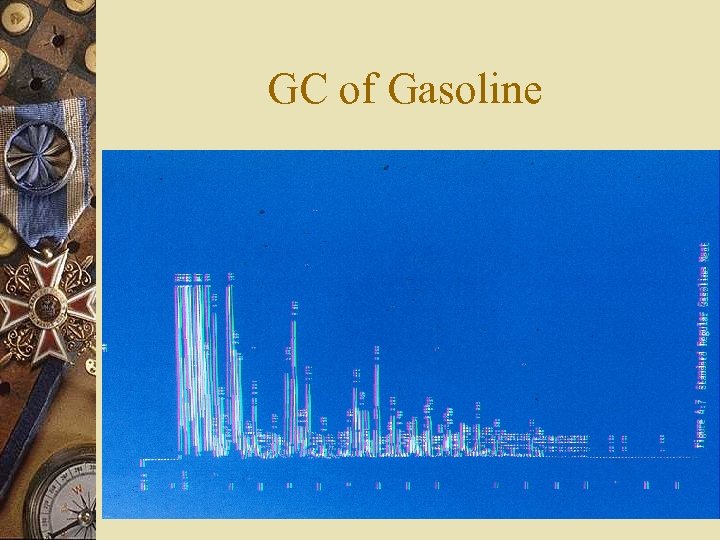
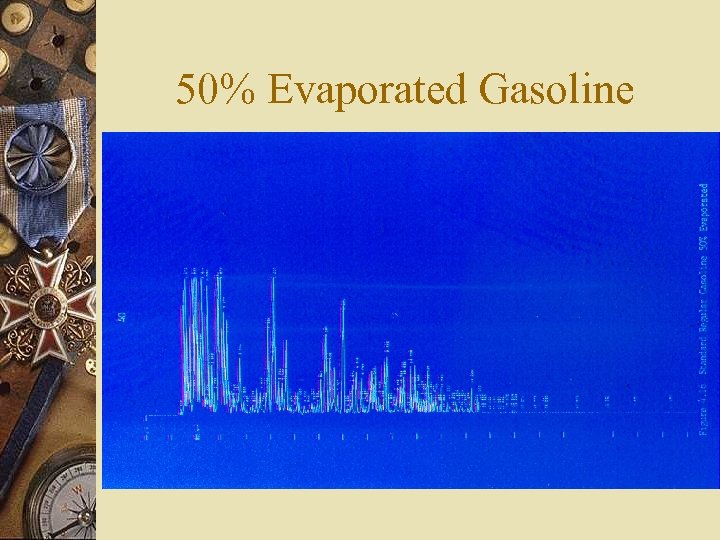
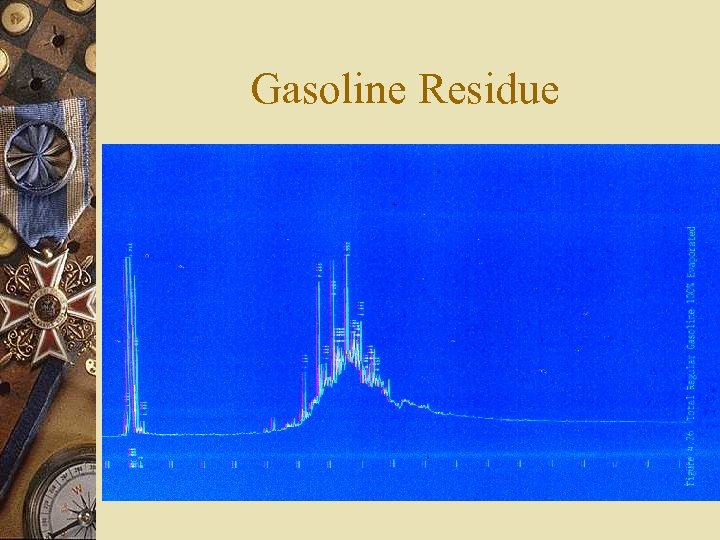
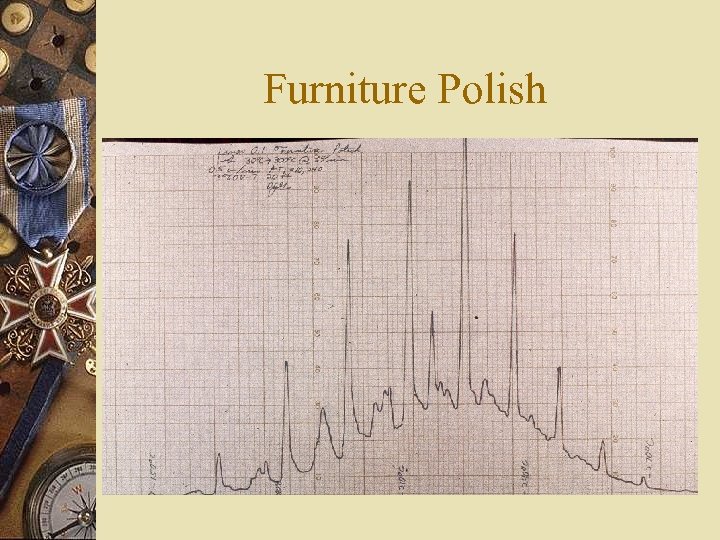
 Analysis of Residues w Uses GC or GC/MS for comparisons – MS has advantage of identifying particular compounds which are present in certain accelerants w Analyst should have own library of knowns for comparison
 GC of Gasoline
 50% Evaporated Gasoline
 Gasoline Residue
 Furniture Polish
 Cases w Dentist who liquidated his assets w Smoldering fire w Body in the trunk of the car
 Dentist Who Liquidated His Assets w Dentist had failing practice in deteriorating neighborhood w Had offer to relocate practice with partner but needed $$$$$ to get started w Used gasoline to make fire trail to each room in office w Building destroyed but witness saw him leave building before fire started w Convicted of arson
 Smoldering Fire w Man catches wife fooling around and decides to set trap for her. w He seals up all windows and doors to house and sets a fire in living room w Fire flames first and then, having used up oxygen, settles into glowing, smoldering fire.
 Smoldering Fire w He expects wife to come home from work and enter house. This will cause influx of oxygen into house and rekindle the fire explosively, killing her instantly w She has an auto accident on the way home and is delayed. Meanwhile a neighbor smells smoke and calls fire department w They arrive at scene and recognize that whole house is sealed up and enter very carefully. w Husband is charged with arson and attempted murder
 Body in the Trunk w This was believed to be a “gangland” killing over drugs w Police were called to scene of fire in a car w They popped the trunk and found a charred body w ME said that body was burned and then put in trunk
 Body in the Trunk w Inside of car was searched for accelerant and fingerprints (superglue fumed entire inside of car). w Gasoline was found in car on seats. Since gas tank didn’t explode, gasoline came from elsewhere w Fingerprints found but no suspect. AFIS search came up empty. Case still open