


 Скачать презентацию Fiona Mc Coll Peakcare I THINK I AM
94380cb21d15a7219e039d26a883a4fa.ppt
- Количество слайдов: 35
 Fiona Mc. Coll Peakcare “I THINK I AM CULTURALLY COMPETENT – THEREFORE I AM”
 I think I am Culturally Competent Therefore I am …. Fiona Mc. Coll – Peak. Care Queensland Inc.
 Culture Matters Exploring the Implications of Cultural Competency in Child Protection Assessment and Intervention with Culturally and Linguistically Diverse Communities and Families. Culture Matters is an ongoing, three phase, research project which is examining the inter-relationship between culture and current child protection policies and practices in the Queensland non-government and government sectors.
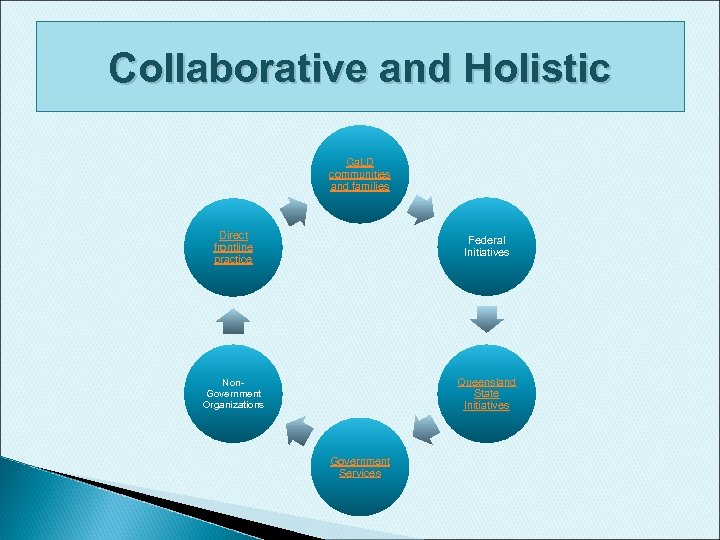 Collaborative and Holistic Ca. LD communities and families Direct frontline practice Federal Initiatives Non. Government Organizations Queensland State Initiatives Government Services
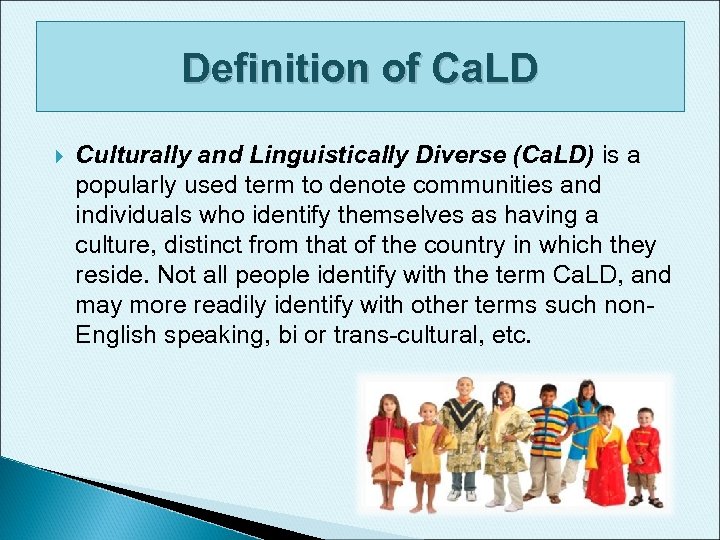 Definition of Ca. LD Culturally and Linguistically Diverse (Ca. LD) is a popularly used term to denote communities and individuals who identify themselves as having a culture, distinct from that of the country in which they reside. Not all people identify with the term Ca. LD, and may more readily identify with other terms such non. English speaking, bi or trans-cultural, etc.
 Definition of Cultural Competency Having the awareness, knowledge, and skill, necessary to perform a myriad of tasks that recognises the diverse worldviews and practices of oneself and of clients from different ethnic/cultural backgrounds (New Zealand Psychologists Board, 2006). The ability of individuals and systems to respond respectfully and effectively to people of all cultures, classes, races, ethnic backgrounds and religions in a manner that recognises, affirms, and values the cultural differences and similarities and the worth of individuals, families, and communities and protects and preserves the dignity of each (Seattle King Country Dept of Public Health, 1994).
 Definition of Child Protection Child protection is frequently seen to be tertiary interventions such as notifications, assessments and removal of children. Child protection will be used contextually for this project to mean all supports and services provided to vulnerable children and their families, whether the resources are preventative, early intervention, secondary or tertiary.
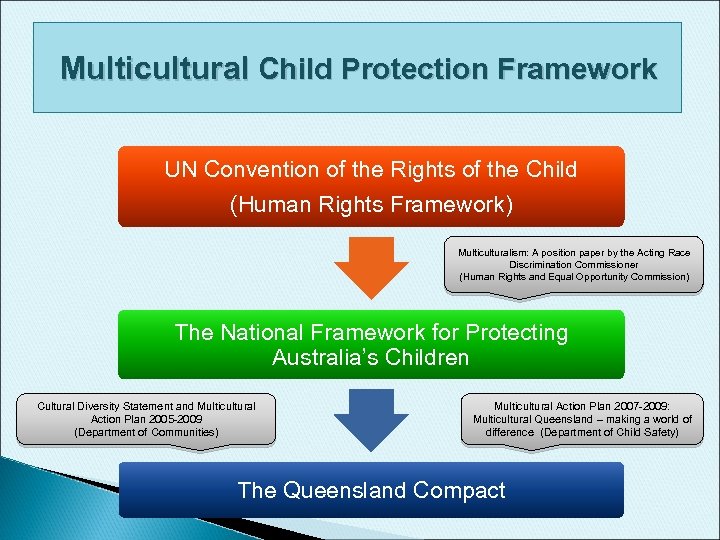 Multicultural Child Protection Framework UN Convention of the Rights of the Child (Human Rights Framework) Multiculturalism: A position paper by the Acting Race Discrimination Commissioner (Human Rights and Equal Opportunity Commission) The National Framework for Protecting Australia’s Children Cultural Diversity Statement and Multicultural Action Plan 2005 -2009 (Department of Communities) Multicultural Action Plan 2007 -2009: Multicultural Queensland – making a world of difference (Department of Child Safety) The Queensland Compact
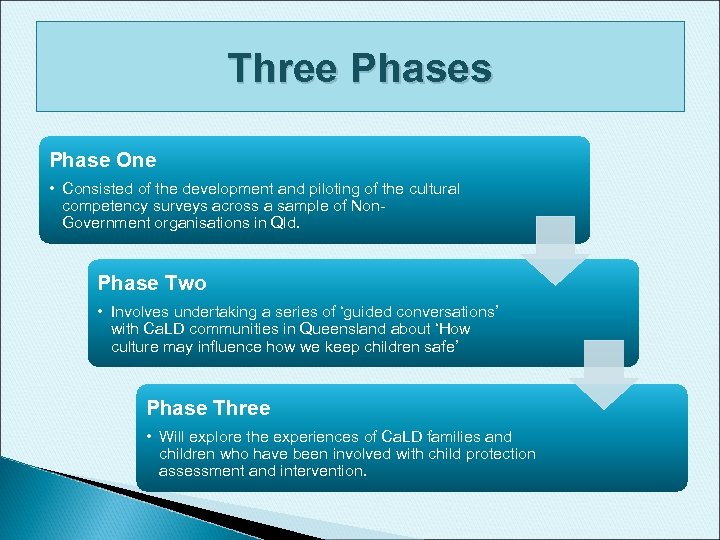 Three Phases Phase One • Consisted of the development and piloting of the cultural competency surveys across a sample of Non. Government organisations in Qld. Phase Two • Involves undertaking a series of ‘guided conversations’ with Ca. LD communities in Queensland about ‘How culture may influence how we keep children safe’ Phase Three • Will explore the experiences of Ca. LD families and children who have been involved with child protection assessment and intervention.
 Phase One of this project consists of the development and piloting of a survey, which measures the cultural competency of non-government organisations and practitioners and their capacity to deliver supports and services to Ca. LD children and families. This Phase explored cultural competency at an organisational/policy level juxtaposed against a practice level to provide indication of areas where NGO’s can improve service provision to the Ca. LD community. A survey was developed for piloting, which engaged the NGO sector and allowed for preliminary collection of ‘evidence’ of need around cultural competency education and training.
 Phase One Cont. Literature Review The review involved a substantial search of International, Federal and local State writings on the subject of cultural competency terminology, measures and current child safety/protection initiatives for Ca. LD communities, children and families. What did we learn?
 Literature Review Findings. . Despite the fact that Australia places itself amongst the most dynamic and diverse countries in the world, (Sawrikar & Katz, 2008) government services are still struggling to ensure culturally sensitive and competent services and practitioners. There is a large body of professionals and practitioners who work with Ca. LD people across many fields. The literature demonstrates the need for professionals to better understand the culture, religion, history and attitudes of others, in order to increase their effectiveness.
 Literature Review Findings Cont. In order to do so, the practitioners need sound measures of cultural competency for undertaking assessment, appropriate intervention and evaluating policy, service system design, and the delivery of services (Geron, 2002). In Australia, there is limited research about the intersection of Ca. LD communities, children and families with continuum of supports and services. There is even less information available on the link between Ca. LD communities and statutory child protection agencies (Kaur, 2009). In addition, there are no standard cultural competency tools for analysing child protection issues for Ca. LD families in Australia.
 Phase One - Beginning At the time this project was conceptualized it was recognized that many of the non-government organizations had signed undertakings to demonstrate cultural competency as part of their service agreements. Despite the requirement to demonstrate cultural competency compliance as part of licensing agreements, it was generally agreed that there were vastly differing ideas of what constituted cultural competency and no ready means to evaluate whether a service is culturally competent or not. The Department of Child Safety (Do. CS), Queensland has acknowledged an increase in child protection notifications, however the number of these notifications, which pertain to Ca. LD children and their families, is unknown. To date Do. CS cultural data collection has been confined to Aboriginal and Torres Strait Islander children and families. Consequently there is little means to identify whethere has been under or over reporting of child protection concerns in Ca. LD communities. Without an evidence base to demonstrate need, policies and practices, which impact Ca. LD children and their families, have been largely neglected.
 Phase One – Beginning Cont. Frameworks for best practice in child protection reflect complexity. This complexity is heightened by the consideration of working across cultures, which may involve different languages, religions, ideas about identity, child-rearing practices, different understandings about family, community, massively different life experiences and histories and very different ideas about external intervention into family matters. This complexity can be so overwhelming that the resultant immobilization can become an excuse to do nothing at all and becomes a risk factor in and of itself. Finally, there was ongoing discussion about what sorts of education or training might be most useful to assist an organization to become culturally competent from policy through to direct practice.
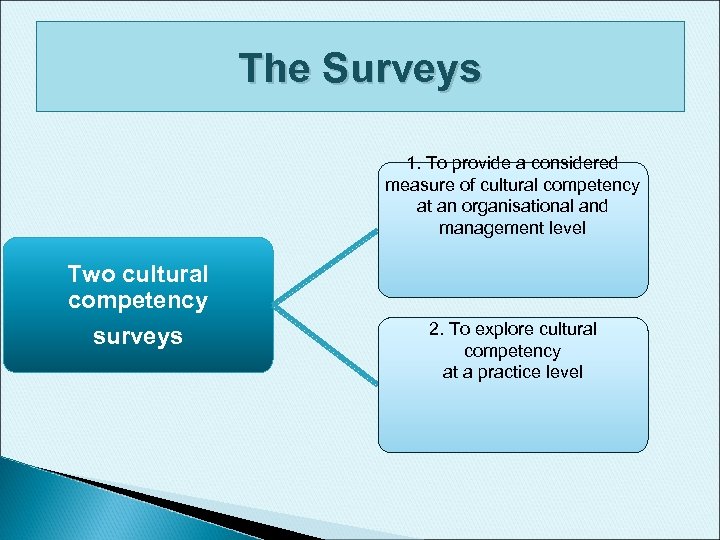 The Surveys 1. To provide a considered measure of cultural competency at an organisational and management level Two cultural competency surveys 2. To explore cultural competency at a practice level
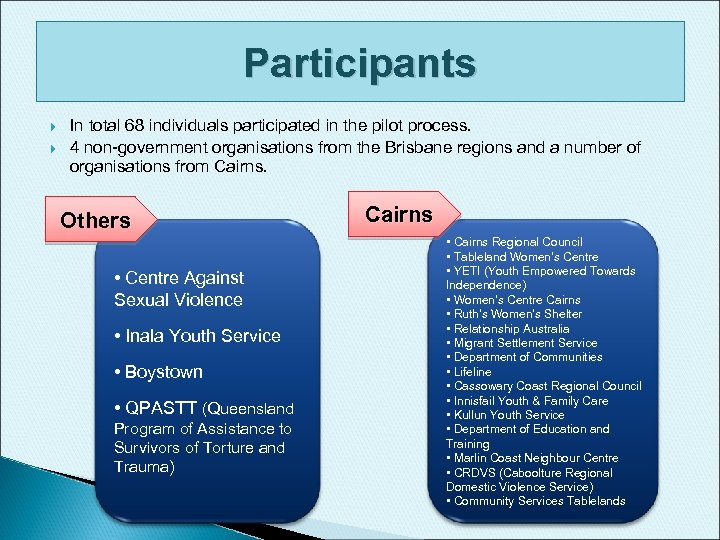 Participants In total 68 individuals participated in the pilot process. 4 non-government organisations from the Brisbane regions and a number of organisations from Cairns. Others • Centre Against Sexual Violence • Inala Youth Service • Boystown • QPASTT (Queensland Program of Assistance to Survivors of Torture and Trauma) Cairns • Cairns Regional Council • Tableland Women’s Centre • YETI (Youth Empowered Towards Independence) • Women’s Centre Cairns • Ruth’s Women’s Shelter • Relationship Australia • Migrant Settlement Service • Department of Communities • Lifeline • Cassowary Coast Regional Council • Innisfail Youth & Family Care • Kullun Youth Service • Department of Education and Training • Marlin Coast Neighbour Centre • CRDVS (Caboolture Regional Domestic Violence Service) • Community Services Tablelands
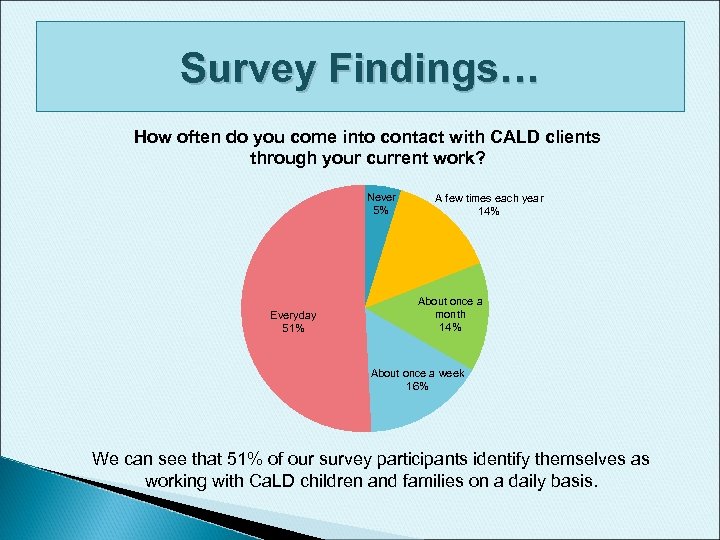 Survey Findings… How often do you come into contact with CALD clients through your current work? Never 5% Everyday 51% A few times each year 14% About once a month 14% About once a week 16% We can see that 51% of our survey participants identify themselves as working with Ca. LD children and families on a daily basis.
 Relationship between educational attainment and cultural competency It is often supposed that if a child protection worker has a higher level of education, cultural competency training is unnecessary. One of the interesting findings in our pilot was the minimal evidence that educational attainment was an indicator of the ability to practice in a culturally competent manner. For instance, 62% of respondents had a Bachelor Degree or higher yet still struggle to cultural competency in their practice.
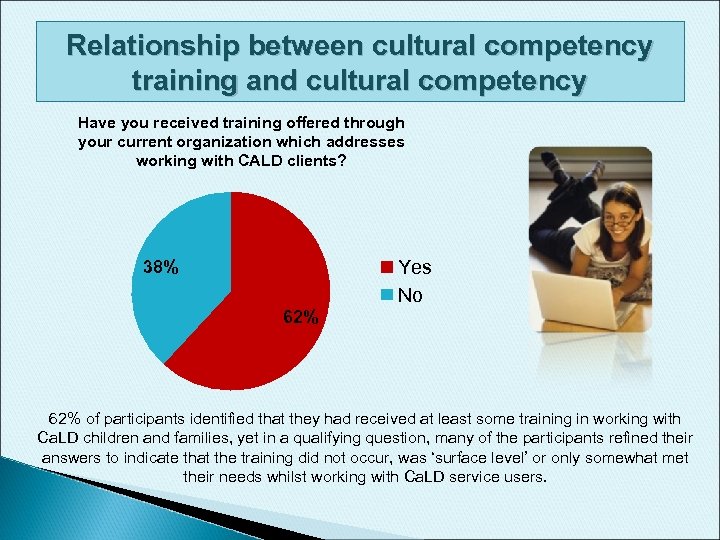 Relationship between cultural competency training and cultural competency Have you received training offered through your current organization which addresses working with CALD clients? Yes No 38% 62% of participants identified that they had received at least some training in working with Ca. LD children and families, yet in a qualifying question, many of the participants refined their answers to indicate that the training did not occur, was ‘surface level’ or only somewhat met their needs whilst working with Ca. LD service users.
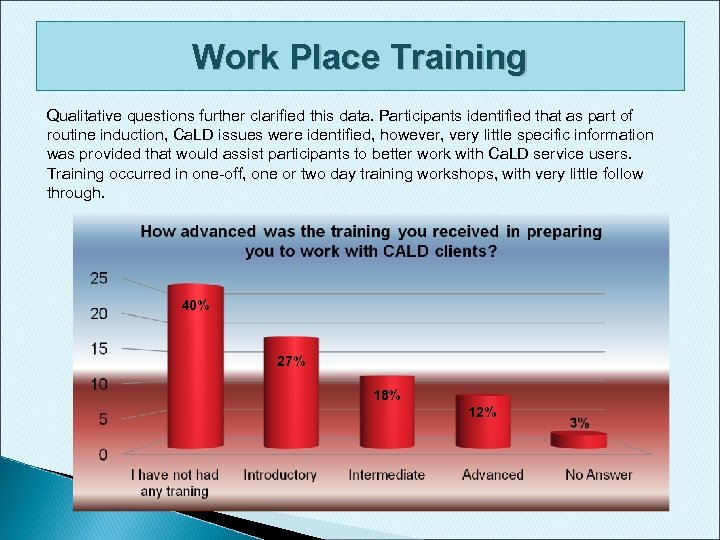 Work Place Training Qualitative questions further clarified this data. Participants identified that as part of routine induction, Ca. LD issues were identified, however, very little specific information was provided that would assist participants to better work with Ca. LD service users. Training occurred in one-off, one or two day training workshops, with very little follow through. 40% 27% 18% 12%
 Work Place Training Cont. Despite 62% of participants having accessed cultural competency training it was not a good indicator of the capacity to manage or practice in a culturally competent manner. Further research would need to be undertaken about the content of training people have received both as part of their educational foundation and professional development types of training. Robert Bean has undertaken a excellent body of Australian research in the area of training.
 Self Reflection… 3% 42%
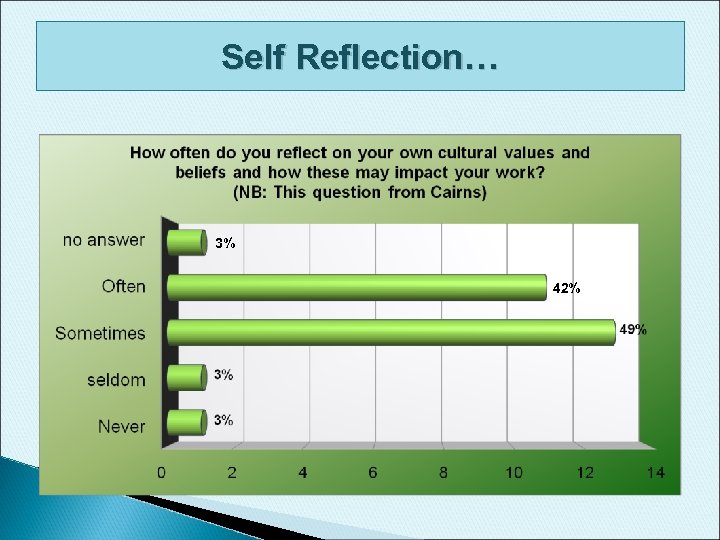
 How do we know what we know? Although a significant number of respondents identify that they regularly practice critical reflection in the course of their work, qualitative questions did not bear this out. A number of respondents who had received little or no cultural competency training, viewed themselves as ‘culturally competent enough’ to undertake their roles with Ca. LD children and families. Other participants who identified having had advanced cultural competency training, rated their cultural competency as lower. This suggests that ‘the more you learn, the more aware you become of how much more there is to know’ – and highlights the need for cultural competency as part of ongoing professional development. It also clearly demonstrates the need for robust supervision which is grounded in cultural competency.
 Recommendations We acknowledge that as in many research endeavours, Phase One of the Culture Matters Project has raised as many questions as it has answered. There are, however, some early recommendations that can be made from the work we have undertaken to date.
 Recommendations Cont. If we are to work effectively with Ca. LD children and their families we must work collaboratively, with our communities, in a flexible, respectful and ‘culturally curious’ manner. We must be prepared to engage with Ca. LD communities and service users to better understand how to offer our services in culturally appropriate ways. We will need to understand that culture is incredibly complex, and the only real way forward will be to undertake this learning, one person, one relationship at a time.
 Recommendations Cont. Cultural competency and training needs to be incorporated into degree curriculum requirements in a more robust and considered manner. The AASW are in the final stages of drafting suggested cultural competency curriculum guidelines and various Australian universities and TAFEs are demonstrating leadership by upgrading their curriculums. Cross cultural education and training needs to be embedded into other certification programs, which accredit child protection workers across the service delivery spectrum, from prevention to tertiary.
 Recommendations Cont. Organizations need to critically reflect on the organisational and social factors influencing the organizations capacity to support practice to be culturally sensitive and safe. If cultural competency is to be a part of service agreements, we must have a standardized tool, which allows for regular and considered evaluation and is part of a continual improvement framework.
 Recommendations Cont. Managers and supervisors of organizations need to receive robust and ongoing professional development in the area of cultural competency. This will best ensure that supervision may be used to facilitate critical reflection about cross-cultural issues emerging in practice. The capacity for culturally competent practice is intrinsically related to the ability to critically reflect on personal and professional cultural identities and the influence they have on practice. Therefore, we need to see learning organizations, which are capable of encouraging and supporting critically reflective practice.
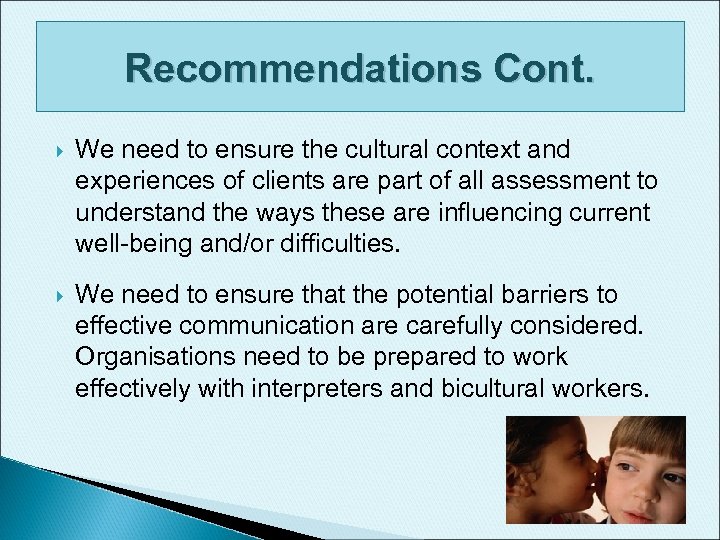 Recommendations Cont. We need to ensure the cultural context and experiences of clients are part of all assessment to understand the ways these are influencing current well-being and/or difficulties. We need to ensure that the potential barriers to effective communication are carefully considered. Organisations need to be prepared to work effectively with interpreters and bicultural workers.
 Future Research: Where to next? Phase Two will look to undertake a series of ‘guided conversations’ with Queensland Ca. LD communities. This component of the research project will attempt to create opportunity for Ca. LD communities to contribute their experiences and views about how the Australian context of child well-being may be impacted by diversity of cultural orientation.
 Community Consultation A series of community focus groups are in process of being organised where the following questions will be used to guide discussion. In your own culture, what are the responsibilities of families and communities in raising children and ensuring their well-being and safety? What do you see as the similarities and differences between your culture and Australian culture with regards to raising children? What do you feel are the difficulties your community faces in raising children in Australia? What would social services need to look like to be relevant and appropriate to your culture? How could organisations best get information regarding their services out to newly-arrived immigrants from your culture or country?
 Phase Three The final phase of Culture Matters project seeks to explore how culture and the perception of culture, may shape the experiences of Ca. LD families and children who have received child protection assessment and intervention.
 References Office of the United Nations High Commissioner for Human Rights. (1990). UN Convention of the Rights of the Child. From http: //www 2. ohchr. org/english/law/pdf/crc. pdf Commonwealth of Australia. (2009). Protecting Children is Everyone’s Business: The National Framework for Protecting Australia’s Children 2009 -2020. From http: //www. fahcsia. gov. au/sa/families/pubs/framework_protecting_children/Documents/child_prot ection_framework. pdf Queensland Government. (2008). The Queensland Compact: Towards a Fairer Queensland. from http: //www. qcoss. org. au/upload/4716__FINAL_251108_135808%20 QG%20 Compact%20 Booklet_FINAL_LR. pdf Human Rights and Equal Opportunity Commission. (2007). Multiculturalism: A position paper by the Acting Race Discrimination Commissioner. From http: //www. hreoc. gov. au/racial_discrimination/multiculturalism 2007. pdf Department of Communities. (2005). Cultural Diversity Statement and Multicultural Action Plan 2005 -2009. From http: //www. communityservices. qld. gov. au/department/publications/multicultural_action_plan/docu ments/pdf/multicultural_action_plan. pdf Department of Child Safety. (2007). Multicultural Action Plan 2007 -2009. From http: //www. communityservices. qld. gov. au/department/publications/multicultural_action_plan/docu ments/pdf/multicultural_action_plan. pdf Bean, R. (2008). The Effectiveness of Cross Cultural Training in the Australian Context. Cultural Diversity Service Pty Ltd.
 Fiona Mc. Coll (Training & Development Manager) Phone: (07) 3368 1050 Fax: (07) 3368 1160 Mobile: 0408 699 159 Email: fmccoll@peakcare. com. au Web: www. peakcare. com. au Address: 17 Ross Street, Paddington QLD 4064 Postal Address: PO Box 159, Paddington QLD 4064 Research Assistants • Leanne Vines (Peak. Care) • Kathryn Mettler (University of Queensland) • Candace Bool (Griffith University) • Yoon Jung, Oh (University of Queensland)