


 Скачать презентацию Finnish-Hungarian-Italian Working Culture Summary LOGO Final Project Product
bb275b1c4157bb70f4baf9dab8415d31.ppt
- Количество слайдов: 15
 Finnish-Hungarian-Italian Working Culture Summary LOGO Final Project Product of Hungarian Team
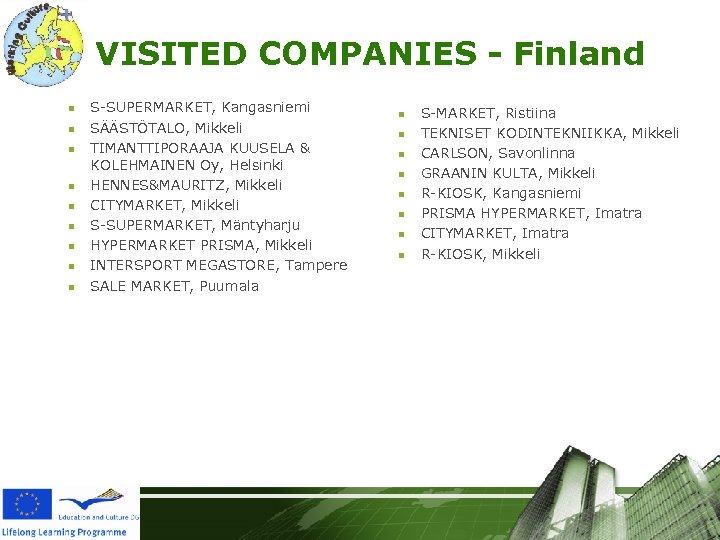 VISITED COMPANIES - Finland n n n n n S-SUPERMARKET, Kangasniemi SÄÄSTÖTALO, Mikkeli TIMANTTIPORAAJA KUUSELA & KOLEHMAINEN Oy, Helsinki HENNES&MAURITZ, Mikkeli CITYMARKET, Mikkeli S-SUPERMARKET, Mäntyharju HYPERMARKET PRISMA, Mikkeli INTERSPORT MEGASTORE, Tampere SALE MARKET, Puumala n n n n S-MARKET, Ristiina TEKNISET KODINTEKNIIKKA, Mikkeli CARLSON, Savonlinna GRAANIN KULTA, Mikkeli R-KIOSK, Kangasniemi PRISMA HYPERMARKET, Imatra CITYMARKET, Imatra R-KIOSK, Mikkeli
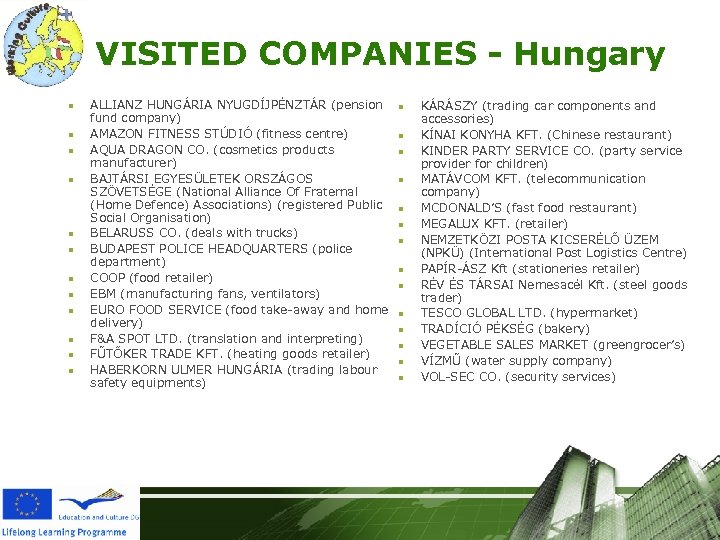 VISITED COMPANIES - Hungary n n n ALLIANZ HUNGÁRIA NYUGDÍJPÉNZTÁR (pension fund company) AMAZON FITNESS STÚDIÓ (fitness centre) AQUA DRAGON CO. (cosmetics products manufacturer) BAJTÁRSI EGYESÜLETEK ORSZÁGOS SZÖVETSÉGE (National Alliance Of Fraternal (Home Defence) Associations) (registered Public Social Organisation) BELARUSS CO. (deals with trucks) BUDAPEST POLICE HEADQUARTERS (police department) COOP (food retailer) EBM (manufacturing fans, ventilators) EURO FOOD SERVICE (food take-away and home delivery) F&A SPOT LTD. (translation and interpreting) FŰTŐKER TRADE KFT. (heating goods retailer) HABERKORN ULMER HUNGÁRIA (trading labour safety equipments) n n n n KÁRÁSZY (trading car components and accessories) KÍNAI KONYHA KFT. (Chinese restaurant) KINDER PARTY SERVICE CO. (party service provider for children) MATÁVCOM KFT. (telecommunication company) MCDONALD’S (fast food restaurant) MEGALUX KFT. (retailer) NEMZETKÖZI POSTA KICSERÉLŐ ÜZEM (NPKÜ) (International Post Logistics Centre) PAPÍR-ÁSZ Kft (stationeries retailer) RÉV ÉS TÁRSAI Nemesacél Kft. (steel goods trader) TESCO GLOBAL LTD. (hypermarket) TRADÍCIÓ PÉKSÉG (bakery) VEGETABLE SALES MARKET (greengrocer’s) VÍZMŰ (water supply company) VOL-SEC CO. (security services)
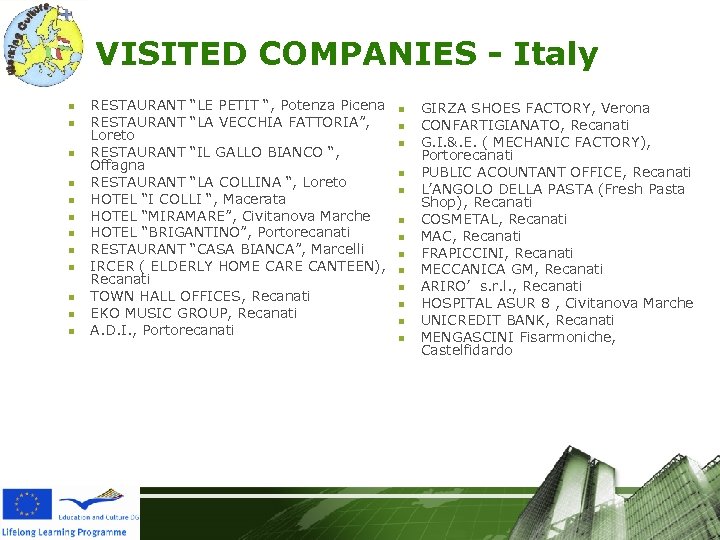 VISITED COMPANIES - Italy n n n RESTAURANT “LE PETIT “, Potenza Picena RESTAURANT “LA VECCHIA FATTORIA”, Loreto RESTAURANT “IL GALLO BIANCO “, Offagna RESTAURANT “LA COLLINA “, Loreto HOTEL “I COLLI “, Macerata HOTEL “MIRAMARE”, Civitanova Marche HOTEL “BRIGANTINO”, Portorecanati RESTAURANT “CASA BIANCA”, Marcelli IRCER ( ELDERLY HOME CARE CANTEEN), Recanati TOWN HALL OFFICES, Recanati EKO MUSIC GROUP, Recanati A. D. I. , Portorecanati n n n n GIRZA SHOES FACTORY, Verona CONFARTIGIANATO, Recanati G. I. &. E. ( MECHANIC FACTORY), Portorecanati PUBLIC ACOUNTANT OFFICE, Recanati L’ANGOLO DELLA PASTA (Fresh Pasta Shop), Recanati COSMETAL, Recanati MAC, Recanati FRAPICCINI, Recanati MECCANICA GM, Recanati ARIRO’ s. r. l. , Recanati HOSPITAL ASUR 8 , Civitanova Marche UNICREDIT BANK, Recanati MENGASCINI Fisarmoniche, Castelfidardo
 PHYSICAL SURROUNDINGS n The companies have good or very good premises and also provide good equipment to the workers, employees. n Canteens, if exist, are usually in good conditions. n Canteens are not typical at Hungarian and Italian workplaces but tea rooms and a separate place where workers can have their snacks or lunch are usually available. n Restrooms, dressing rooms and showers are usually fair, clean and in good conditions. n n However, in Hungary and Italy, these facilities are usually provided in companies which profile/type require that. While they are typical at Finnish companies.
 ETIQUETTE AT WORKPLACE I. n Clothing and appearance are varied from formal to casual depending on the company profile and uniforms are also typical in all three countries. n For example, office or bank workers wear formal clothes while hotel, restaurant or vocational workers have uniforms. n Working hours are usually fixed but can be flexible depending on the type of the company and the position. n Most often, the relationships between colleagues are informal at the companies but more formal towards the managers. n Getting an appointment with the manager is usually easy.
 ETIQUETTE AT WORKPLACE II. n The work places are usually quiet. n In a work discussion, simultaneous talking may happen and you might also experience interruption in Hungary and Italy, while it is not respected in Finland. n Punctuality is always respected in Hungary and Italy but it is a must at Finnish workplaces or meetings. n At work, women and men possess equal opportunities and treatment in all three countries. n Job descriptions are usually determined by positions and usually customized in Hungary, while in Italy and Finland the contracts are usually uniform.
 ETIQUETTE AT WORKPLACE III. n Working language is usually mother tongue (Finnish, Hungarian and Italian), the most typical foreign language at work is English, German is used in Hungary, Swedish and Russian in Finland. n Namedays, birthdays, retirement are usually celebrated at workplaces and Christmas parties are also often held. n Companies usually organize coffee or equivalent to introduce new employees or welcome visitors.
 SALARY, FRINGE BENEFITS n Salary is determined in contracts and based on positions. So negotiating salary after contracting is usually not possible. n Discussing salary is usually a sensitive topic, even among friends. n During working hours employees can usually have medical checkups, and personal, private matters can always be settled in Hungary and Italy. n Workers can use working time to study, as well. n Exceptions are big multinational or very small companies.
 FRINGE BENEFITS n In Italy, bonuses are not offered. n In Hungary, luncheon/hot meal and holiday vouchers are the most typical and popular. Commuting costs are usually paid, due to legislation, however, it is rare in Italy. n Business trips are always paid in all three countries. n Company car, telephone and computer is usually provided for only managers, or if the company profile requires it. n Free meals are rarely or never provided, except for hotels, restaurants and e. g. bakeries. n Cultural or physical recreational bonuses are rare opportunities, however, in Finland, it is possible to buy reduced price gym vouchers from many workplaces.
 VOCATIONAL TRAINING AT WORKPLACE n In Finland, many companies encourage further training and in some cases, the workers can be retrained to a new profession/position within the company. n In Hungary, multinational companies always organise internal trainings and facilitate further training, while smaller ones rarely offer that. If company profile requires, trainings and studies are generally encouraged. n In Italy, some companies sometimes organise internal training but further training is rarely encouraged.
 HOLIDAY n The timing of holidays are usually freely discussed with the managers in Finland Hungary. The dates have to be fixed well beforehand. n However, some workers can take their holidays only in fixed period decided by the management. n They are usually service providers, hotel, restaurant or factory workers. n In Italy, the holiday periods are determined by the management. n The amount of holidays is determined by the law. The number of days is dependent on the years of service in a particular company and for how long one has been in a working life. In Hungary, the age and the number of children also influence the amount.
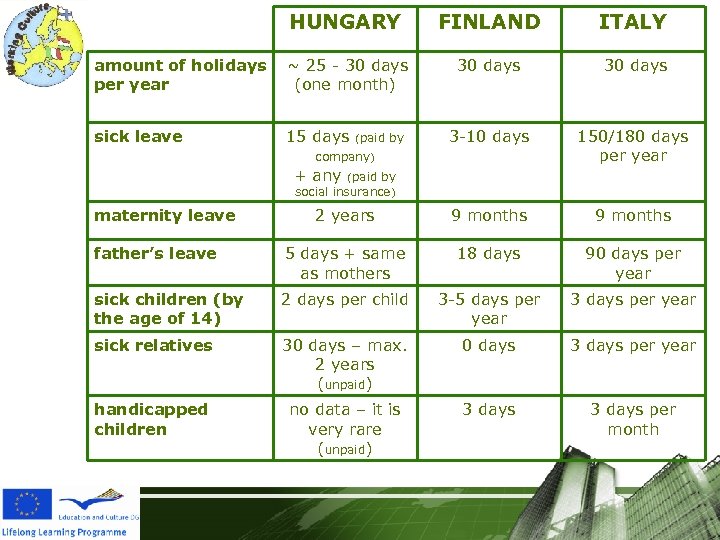 HUNGARY FINLAND ITALY amount of holidays per year ~ 25 - 30 days (one month) 30 days sick leave 15 days 3 -10 days 150/180 days per year 2 years 9 months father’s leave 5 days + same as mothers 18 days 90 days per year sick children (by the age of 14) 2 days per child 3 -5 days per year 3 days per year sick relatives 30 days – max. 2 years (unpaid) 0 days 3 days per year handicapped children no data – it is very rare (unpaid) 3 days per month (paid by company) + any (paid by social insurance) maternity leave
 AFTER WORK ACTIVITIES n At some companies social activities are sometimes organized. n They can be sport, recreational or cultural events, or even dinners. n For example, sauna for Finnish, football matches for Hungarian employees. n Organising Christmas parties are quite usual in all the three countries.
 THANK YOU FOR YOUR ATTENTION! WE HOPE YOU ENJOYED THE PRESENTATION!