


 Скачать презентацию Finite State Verification c 2007 Mauro Pezzè
eb6c912c4c4b4949ed6cae1700ef0ae9.ppt
- Количество слайдов: 44
 Finite State Verification (c) 2007 Mauro Pezzè & Michal Young 1
 Limits and trade-offs • Most important properties of program execution are undecidable in general • Finite state verification can automatically prove some significant properties of a finite model of the infinite execution space – balance trade-offs among • • generality of properties to be checked class of programs or models that can be checked computational effort in checking human effort in producing models and specifying properties (c) 2007 Mauro Pezzè & Michal Young 3
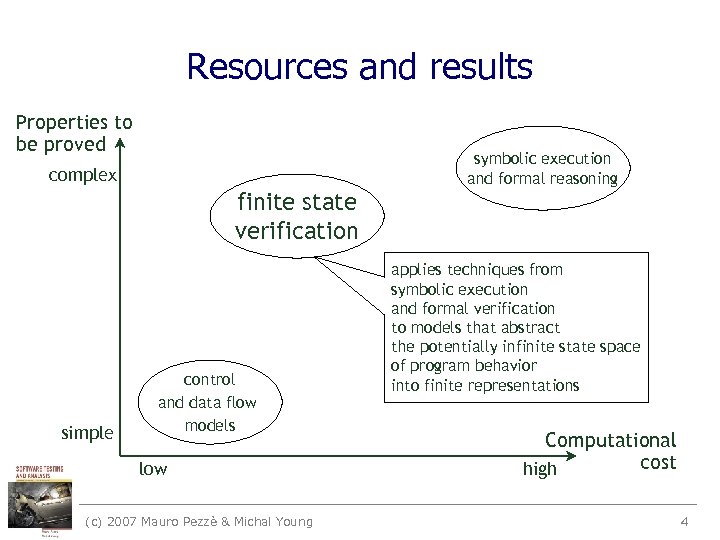 Resources and results Properties to be proved symbolic execution and formal reasoning complex finite state verification simple control and data flow models low (c) 2007 Mauro Pezzè & Michal Young applies techniques from symbolic execution and formal verification to models that abstract the potentially infinite state space of program behavior into finite representations Computational cost high 4
 Cost trade-offs • Human effort and skill are required – to prepare a finite state model – to prepare a suitable specification for automated analysis • Iterative process: – – prepare a model and specify properties attempt verification receive reports of impossible or unimportant faults refine the specification or the model • Automated step – computationally costly • computational cost impacts the cost of preparing model and specification, which must be tuned to make verification feasible – manually refining model and specification less expensive with near-interactive analysis tools (c) 2007 Mauro Pezzè & Michal Young 5
 Analysis of models (c) 2007 Mauro Pezzè & Michal Young 6
 Applications for Finite State Verification • Concurrent (multi-threaded, distributed, . . . ) – Difficult to test thoroughly (apparent nondeterminism based on scheduler); sensitive to differences between development environment and field environment – First and most well-developed application of FSV • Data models – Difficult to identify “corner cases” and interactions among constraints, or to thoroughly test them • Security – Some threats depend on unusual (and untested) use (c) 2007 Mauro Pezzè & Michal Young 7
 State space exploration – Concurrent system example • Specification: an on-line purchasing system – In-memory data structure initialized by reading configuration tables at system start-up – Initialization of the data structure must appear atomic – The system must be reinitialized on occasion – The structure is kept in memory • Implementation (with bugs): – No monitor (Java synchronized): too expensive* – Double-checked locking idiom* for a fast system *Bad decision, broken idiom. . . but extremely hard to find the bug through testing. (c) 2007 Mauro Pezzè & Michal Young 9
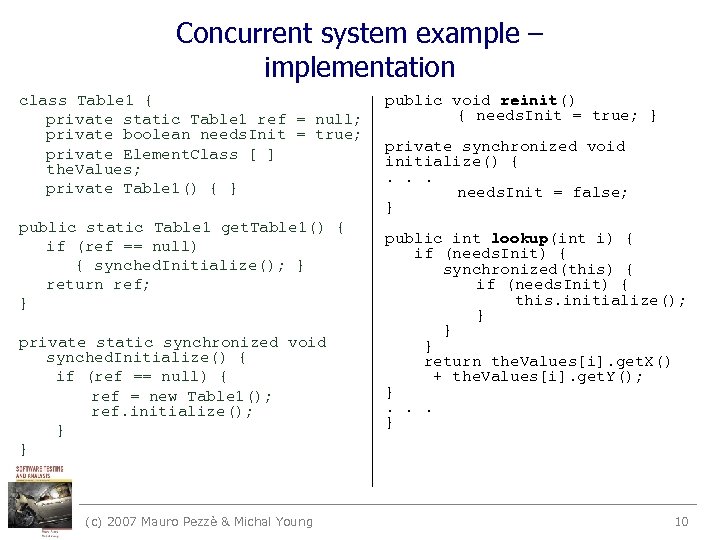 Concurrent system example – implementation class Table 1 { private static Table 1 ref = null; private boolean needs. Init = true; private Element. Class [ ] the. Values; private Table 1() { } public static Table 1 get. Table 1() { if (ref == null) { synched. Initialize(); } return ref; } private static synchronized void synched. Initialize() { if (ref == null) { ref = new Table 1(); ref. initialize(); } } (c) 2007 Mauro Pezzè & Michal Young public void reinit() { needs. Init = true; } private synchronized void initialize() {. . . needs. Init = false; } public int lookup(int i) { if (needs. Init) { synchronized(this) { if (needs. Init) { this. initialize(); } } } return the. Values[i]. get. X() + the. Values[i]. get. Y(); }. . . } 10
 Analysis • Start from models of individual threads • Systematically trace all the possible interleavings of threads • Like hand-executing all possible sequences of execution, but automated . . . begin by constructing a finite state machine model of each individual thread. . . (c) 2007 Mauro Pezzè & Michal Young 11
 A finite state machine model for each thread (c) 2007 Mauro Pezzè & Michal Young 12
 Analysis • Java threading rules: – when one thread has obtained a monitor lock – the other thread cannot obtain the same lock • Locking – prevents threads from concurrently calling initialize – Does not prevent possible race condition between threads executing the lookup method • Tracing possible executions by hand is completely impractical (c) 2007 Mauro Pezzè & Michal Young 13
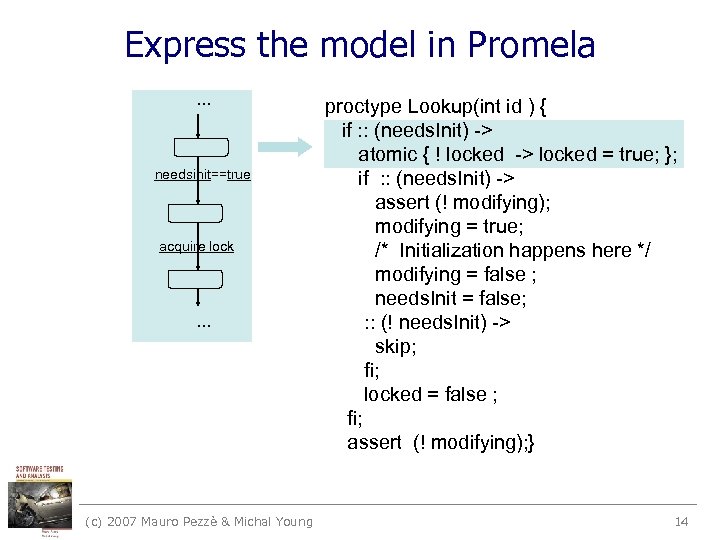 Express the model in Promela. . . needsinit==true acquire lock . . . (c) 2007 Mauro Pezzè & Michal Young proctype Lookup(int id ) { if : : (needs. Init) -> atomic { ! locked -> locked = true; }; if : : (needs. Init) -> assert (! modifying); modifying = true; /* Initialization happens here */ modifying = false ; needs. Init = false; : : (! needs. Init) -> skip; fi; locked = false ; fi; assert (! modifying); } 14
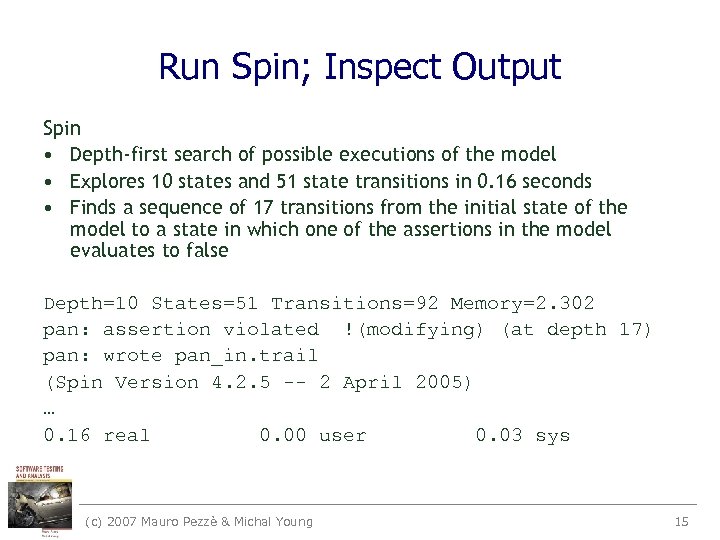 Run Spin; Inspect Output Spin • Depth-first search of possible executions of the model • Explores 10 states and 51 state transitions in 0. 16 seconds • Finds a sequence of 17 transitions from the initial state of the model to a state in which one of the assertions in the model evaluates to false Depth=10 States=51 Transitions=92 Memory=2. 302 pan: assertion violated !(modifying) (at depth 17) pan: wrote pan_in. trail (Spin Version 4. 2. 5 -- 2 April 2005) … 0. 16 real 0. 00 user 0. 03 sys (c) 2007 Mauro Pezzè & Michal Young 15
 Interpret the trace (c) 2007 Mauro Pezzè & Michal Young 16
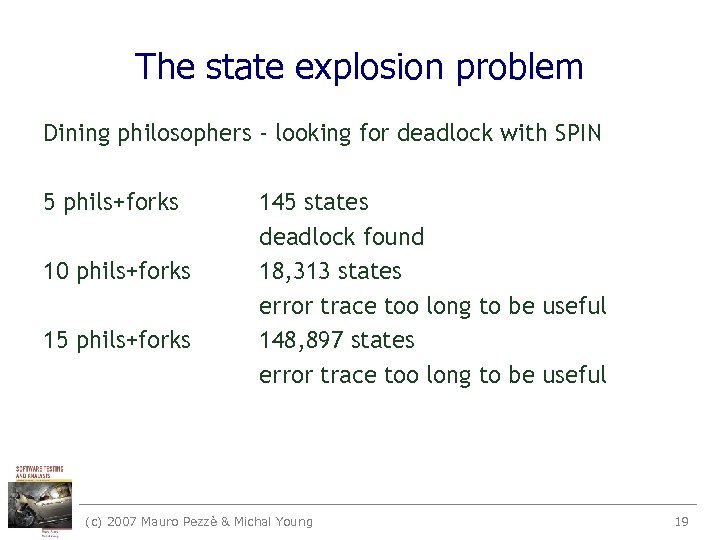 The state explosion problem Dining philosophers - looking for deadlock with SPIN 5 phils+forks 10 phils+forks 15 phils+forks 145 states deadlock found 18, 313 states error trace too long to be useful 148, 897 states error trace too long to be useful (c) 2007 Mauro Pezzè & Michal Young 19
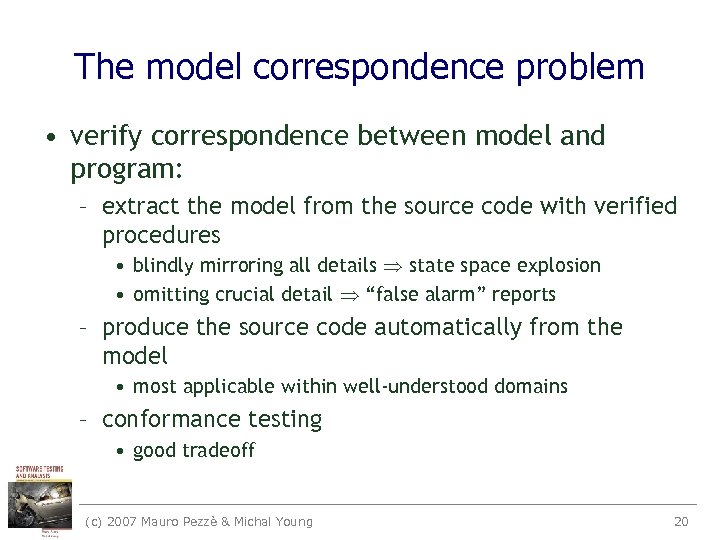 The model correspondence problem • verify correspondence between model and program: – extract the model from the source code with verified procedures • blindly mirroring all details state space explosion • omitting crucial detail “false alarm” reports – produce the source code automatically from the model • most applicable within well-understood domains – conformance testing • good tradeoff (c) 2007 Mauro Pezzè & Michal Young 20
 Granularity of modeling (c) 2007 Mauro Pezzè & Michal Young 21
 Analysis of different models we can find the race only with fine-grain models (c) 2007 Mauro Pezzè & Michal Young 22
 Looking for the appropriate granularity • Compilers may rearrange the order of instruction – a simple store of a value into a memory cell may be compiled into a store into a local register, with the actual store to memory appearing later (or not at all) – Two loads or stores to different memory locations may be reordered for reasons of efficiency – Parallel computers may place values initially in the cache memory of a local processor, and only later write into a memory area • Even representing each memory access as an individual action is not always sufficient! (c) 2007 Mauro Pezzè & Michal Young 23
 Example • Suppose we use the double-check idiom only for lazy initialization • It would still be wrong, but… • it is unlikely we would discover the flaw through finite state verification: – Spin assumes that memory accesses occur in the order given in the Promela program, and. . . – we code them in the same order as the Java program, but … – Java does not guarantee that they will be executed in that order (c) 2007 Mauro Pezzè & Michal Young 24
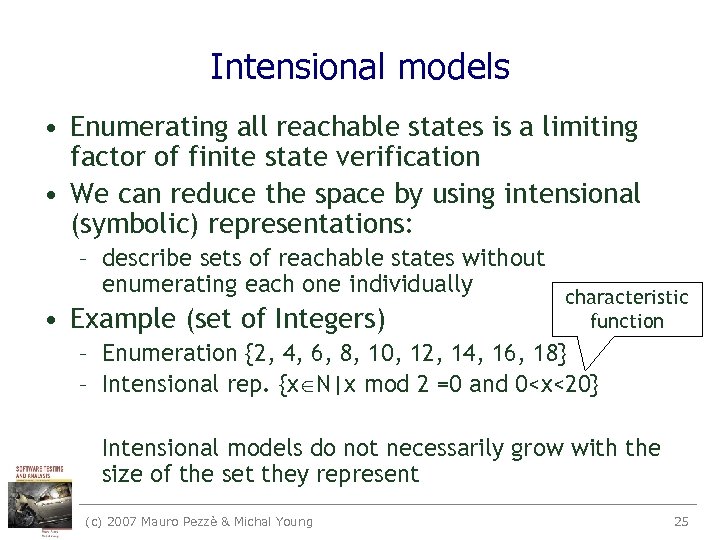 Intensional models • Enumerating all reachable states is a limiting factor of finite state verification • We can reduce the space by using intensional (symbolic) representations: – describe sets of reachable states without enumerating each one individually • Example (set of Integers) characteristic function – Enumeration {2, 4, 6, 8, 10, 12, 14, 16, 18} – Intensional rep. {x N|x mod 2 =0 and 0
 A useful intensional model: OBDD • Ordered Binary Decision Diagrams – A compact representation of Boolean functions • Characteristic function for transition relations – Transitions = pairs of states – Function from pairs of states to Booleans: • True if there is a transition between the pair – Built iteratively by breadth-first expansion of the state space: • creating a representation of the whole set of states reachable in k+1 steps from the set of states reachable in k steps • the OBDD stabilizes when all the transitions that can occur in the next step are already represented in the OBDD (c) 2007 Mauro Pezzè & Michal Young 26
 From OBDDs to Symbolic Checking • An intensional representation is not enough • We must have an algorithm for determining whether that set satisfies the property we are checking example: • OBDD to represent – the transition relation of a set of communicating state machines – a class of temporal logic specification formulas • Combine OBDD representations of model and specification to produce a representation of just the set of transitions leading to a violation of the specification – If the set is empty, the property has been verified (c) 2007 Mauro Pezzè & Michal Young 27
 Represent transition relations as Boolean functions a b and c not(a) or (b and c) the BDD is a decision tree that has been transformed into an acyclic graph by merging nodes leading to identical subtrees (c) 2007 Mauro Pezzè & Michal Young 28
 Representing transition relations as Boolean functions A. Assign a label to each state B. Encode transitions C. The transition tuples correspond to paths leading to true; all other paths lead to false (c) 2007 Mauro Pezzè & Michal Young 29
 Intensional vs explicit representations • Worst case: given a large set S of states a representation capable of distinguishing each subset of S cannot be more compact on average than the representation that simply lists elements of the chosen subset. • Intensional representations work well when they exploit structure and regularity of the state space (c) 2007 Mauro Pezzè & Michal Young 30
 Model refinement • Construction of finite state models – balancing precision and efficiency • Often the first model is unsatisfactory – report potential failures that are obviously impossible – exhaust resources before producing any result • Minor differences in the model can have large effects on tractability of the verification procedure • finite state verification as iterative process (c) 2007 Mauro Pezzè & Michal Young 31
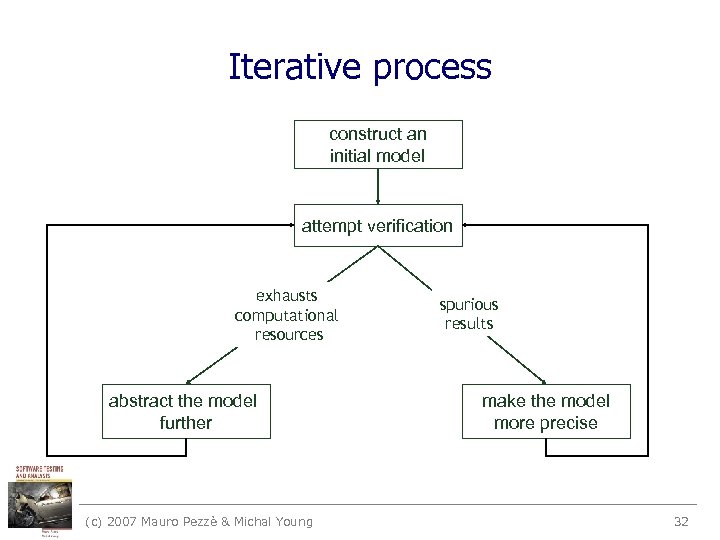 Iterative process construct an initial model attempt verification exhausts computational resources abstract the model further (c) 2007 Mauro Pezzè & Michal Young spurious results make the model more precise 32
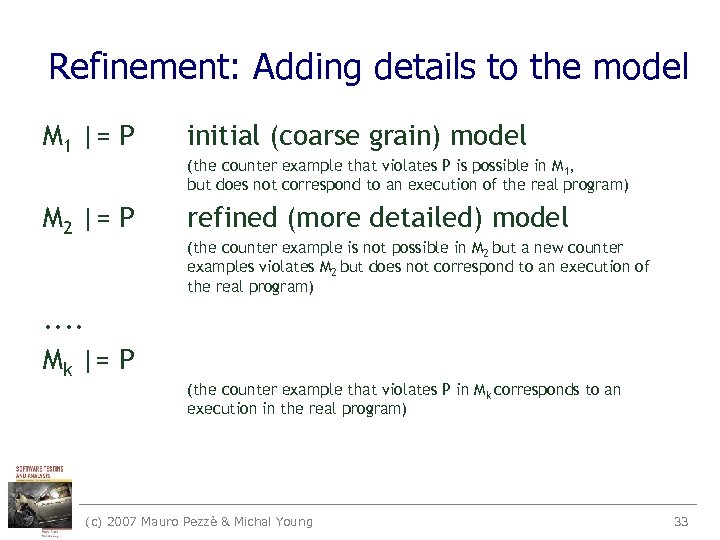 Refinement: Adding details to the model M 1 |= P initial (coarse grain) model M 2 |= P refined (more detailed) model . . Mk |= P (the counter example that violates P is possible in M 1, but does not correspond to an execution of the real program) (the counter example is not possible in M 2 but a new counter examples violates M 2 but does not correspond to an execution of the real program) (the counter example that violates P in Mk corresponds to an execution in the real program) (c) 2007 Mauro Pezzè & Michal Young 33
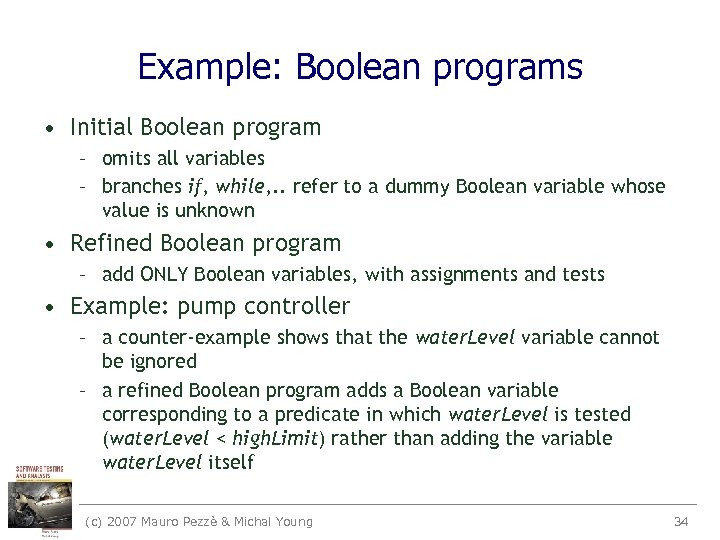 Example: Boolean programs • Initial Boolean program – omits all variables – branches if, while, . . refer to a dummy Boolean variable whose value is unknown • Refined Boolean program – add ONLY Boolean variables, with assignments and tests • Example: pump controller – a counter-example shows that the water. Level variable cannot be ignored – a refined Boolean program adds a Boolean variable corresponding to a predicate in which water. Level is tested (water. Level < high. Limit) rather than adding the variable water. Level itself (c) 2007 Mauro Pezzè & Michal Young 34
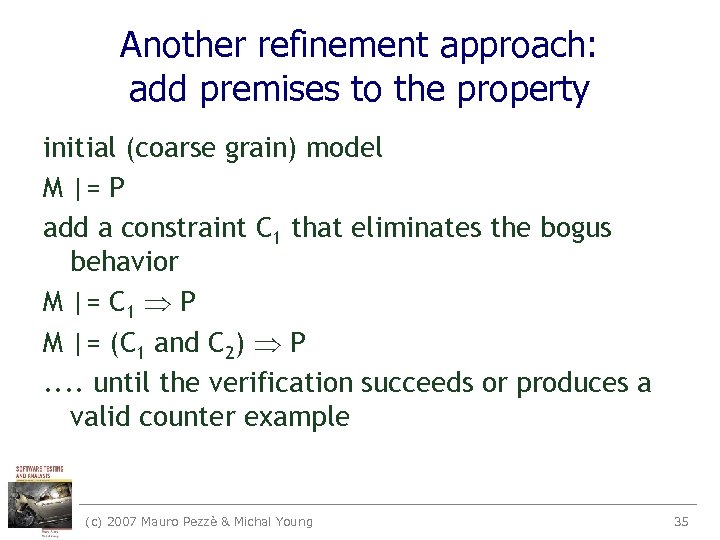 Another refinement approach: add premises to the property initial (coarse grain) model M |= P add a constraint C 1 that eliminates the bogus behavior M |= C 1 P M |= (C 1 and C 2) P. . until the verification succeeds or produces a valid counter example (c) 2007 Mauro Pezzè & Michal Young 35
 Other Domains for Finite-State Verification • Concurrent systems are the most common application domain • But the same general principle (systematic analysis of models, where thorough testing is impractical) has other applications • Example: Complex data models – Difficult to consider all the possible combinations of choices in a complex data model (c) 2007 Mauro Pezzè & Michal Young 36
 Data model verification and relational algebra • Many information systems are characterized by – simple logic and algorithms – complex data structures • Key element of these systems is the data model (UML class and object diagrams + OCL assertions) = sets of data and relations among them • The challenge is to prove that – individual constraint are consistent and – together they ensure the desired properties of the system as a whole (c) 2007 Mauro Pezzè & Michal Young 37
 Example: a simple web site Signature = Sets + Relations • A set of pages divided among restricted, unrestricted, maintenance pages – unrestricted pages: freely accessible – restricted pages: accessible only to registered users – maintenance pages: inaccessible to both sets of users • A set of users: administrator, registered, and unregistered • A set of links relations among pages – private links lead to restricted pages – public links lead to unrestricted pages – Maintenance links lead to maintenance pages • A set of access rights relations between users and pages – unregistered users can access only unrestricted pages – registered users can access both restricted and unrestricted pages – administrator can access all pages including maintenance pages (c) 2007 Mauro Pezzè & Michal Young 38
 Complete a specification with constraints Example constraints for the web site: • Exclude self loops from links relations • Allow at most one type of link between two pages – NOTE: relations need not be symmetric:
 The data model for the simple web site (c) 2007 Mauro Pezzè & Michal Young 40
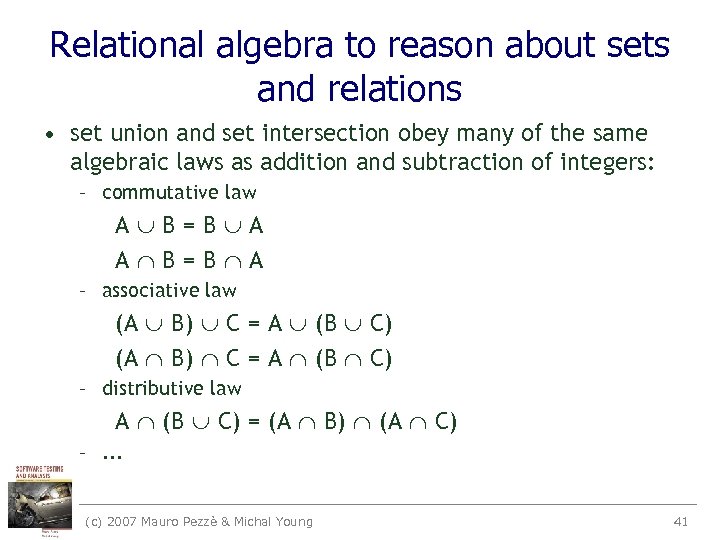 Relational algebra to reason about sets and relations • set union and set intersection obey many of the same algebraic laws as addition and subtraction of integers: – commutative law A B=B A – associative law (A B) C = A (B C) – distributive law A (B C) = (A B) (A C) –. . . (c) 2007 Mauro Pezzè & Michal Young 41
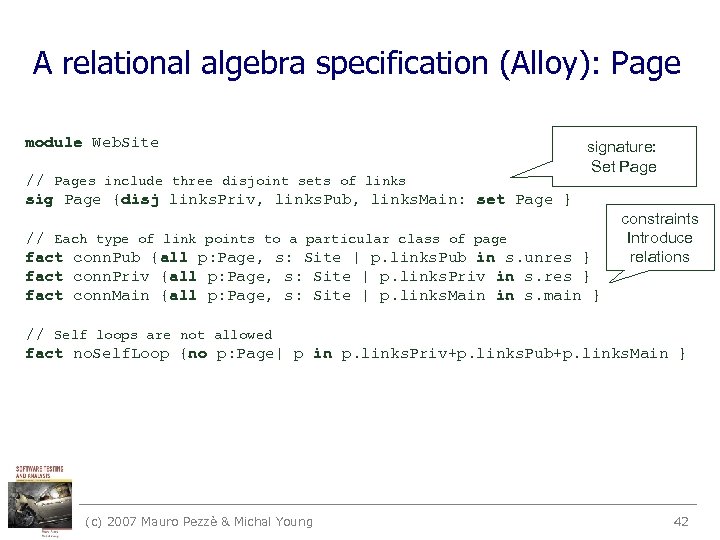 A relational algebra specification (Alloy): Page module Web. Site // Pages include three disjoint sets of links sig Page {disj links. Priv, links. Pub, links. Main: set Page } signature: Set Page // Each type of link points to a particular class of page fact conn. Pub {all p: Page, s: Site | p. links. Pub in s. unres } fact conn. Priv {all p: Page, s: Site | p. links. Priv in s. res } fact conn. Main {all p: Page, s: Site | p. links. Main in s. main } constraints Introduce relations // Self loops are not allowed fact no. Self. Loop {no p: Page| p in p. links. Priv+p. links. Pub+p. links. Main } (c) 2007 Mauro Pezzè & Michal Young 42
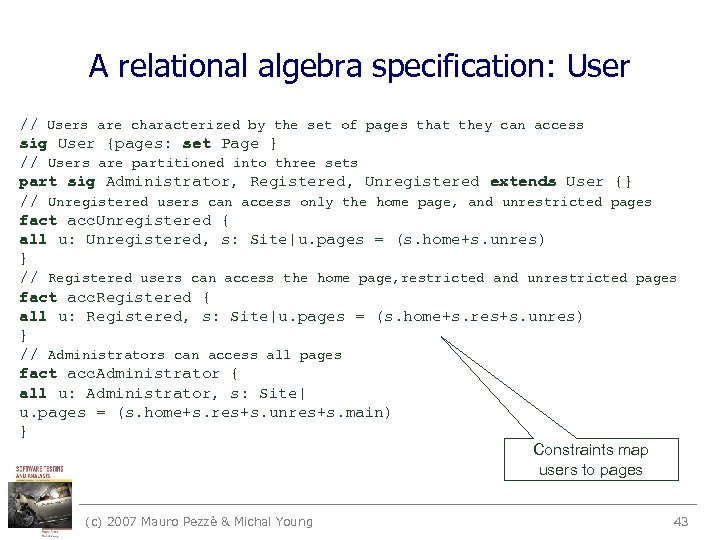 A relational algebra specification: User // Users are characterized by the set of pages that they can access sig User {pages: set Page } // Users are partitioned into three sets part sig Administrator, Registered, Unregistered extends User {} // Unregistered users can access only the home page, and unrestricted pages fact acc. Unregistered { all u: Unregistered, s: Site|u. pages = (s. home+s. unres) } // Registered users can access the home page, restricted and unrestricted pages fact acc. Registered { all u: Registered, s: Site|u. pages = (s. home+s. res+s. unres) } // Administrators can access all pages fact acc. Administrator { all u: Administrator, s: Site| u. pages = (s. home+s. res+s. unres+s. main) } Constraints map users to pages (c) 2007 Mauro Pezzè & Michal Young 43
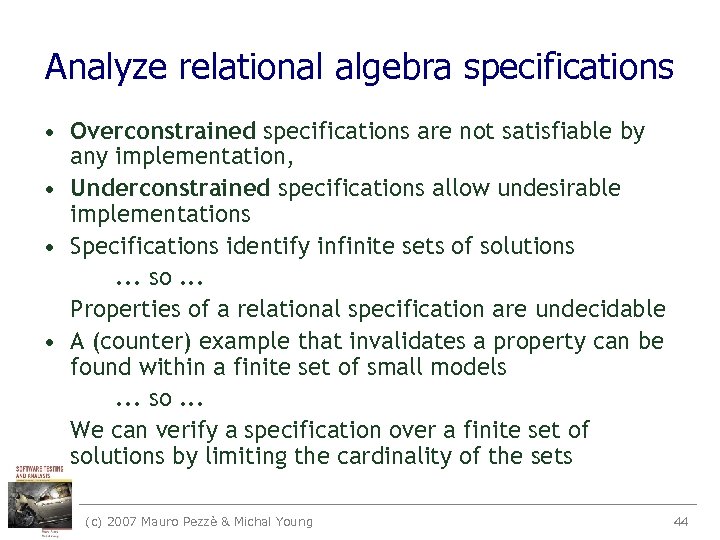 Analyze relational algebra specifications • Overconstrained specifications are not satisfiable by any implementation, • Underconstrained specifications allow undesirable implementations • Specifications identify infinite sets of solutions. . . so. . . Properties of a relational specification are undecidable • A (counter) example that invalidates a property can be found within a finite set of small models. . . so. . . We can verify a specification over a finite set of solutions by limiting the cardinality of the sets (c) 2007 Mauro Pezzè & Michal Young 44
 Checking a finite set of solutions • If an example is found: – There are no logical contradictions in the model – The solution is not overconstrained • If no counterexample of a property is found: – no reasonably small solution (property violation) exists – BUT NOT that NO solution exists • We depend on a “small scope hypothesis”: Most bugs that can cause failure with large collections of objects can also cause failure with very small collections (so it’s worth looking for bugs in small collections even if we can’t afford to look in big ones) (c) 2007 Mauro Pezzè & Michal Young 45
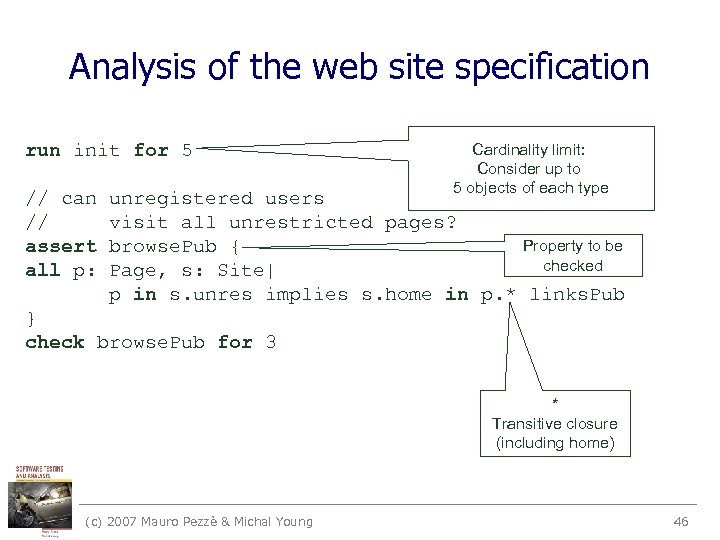 Analysis of the web site specification run init for 5 // can // assert all p: Cardinality limit: Consider up to 5 objects of each type unregistered users visit all unrestricted pages? Property to be browse. Pub { checked Page, s: Site| p in s. unres implies s. home in p. * links. Pub } check browse. Pub for 3 * Transitive closure (including home) (c) 2007 Mauro Pezzè & Michal Young 46
 Analysis result Counterexample: • Unregistered User_2 cannot visit the unrestricted page_2 • The only path from the home page to page_2 goes through the restricted page_0 • The property is violated because unrestricted browsing paths can be interrupted by restricted pages or pages under maintenance (c) 2007 Mauro Pezzè & Michal Young 47
 Correcting the specification • We can eliminate the problem by eliminating public links from maintenance or reserved pages: fact descendant { all p: Pages, s: Site|p in s. main+s. res implies no p. links. link. Pub } • Analysis would find no counterexample of cardinality 3 • We cannot conclude that no larger counter-example exists, but we may be satisfied that there is no reason to expect this property to be violated only in larger models (c) 2007 Mauro Pezzè & Michal Young 48