


 Скачать презентацию Finding the Higgs or something else ideas to
dd414da4f21dba4ea4c4ac418ded15a4.ppt
- Количество слайдов: 36
 Finding the Higgs or something else ideas to improve the discovery potential at hadron colliders Sascha Caron Freiburg Seminar, Sept. 2005
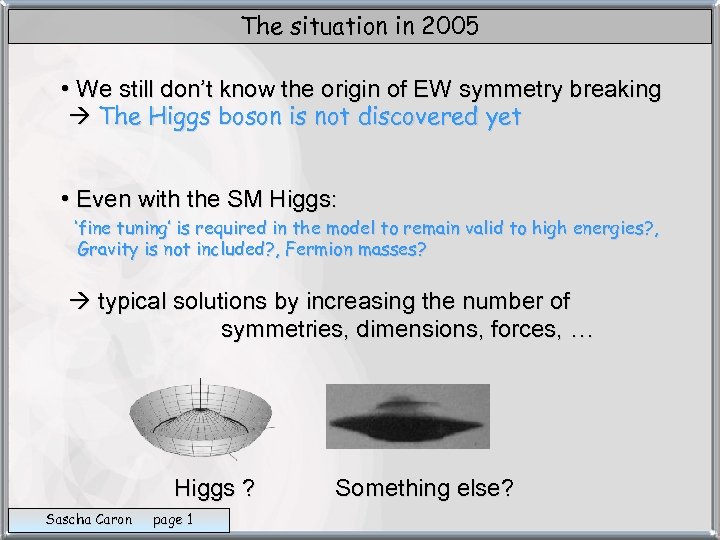 The situation in 2005 • We still don’t know the origin of EW symmetry breaking The Higgs boson is not discovered yet • Even with the SM Higgs: ‘fine tuning’ is required in the model to remain valid to high energies? , Gravity is not included? , Fermion masses? typical solutions by increasing the number of symmetries, dimensions, forces, … Higgs ? Sascha Caron page 1 Something else?
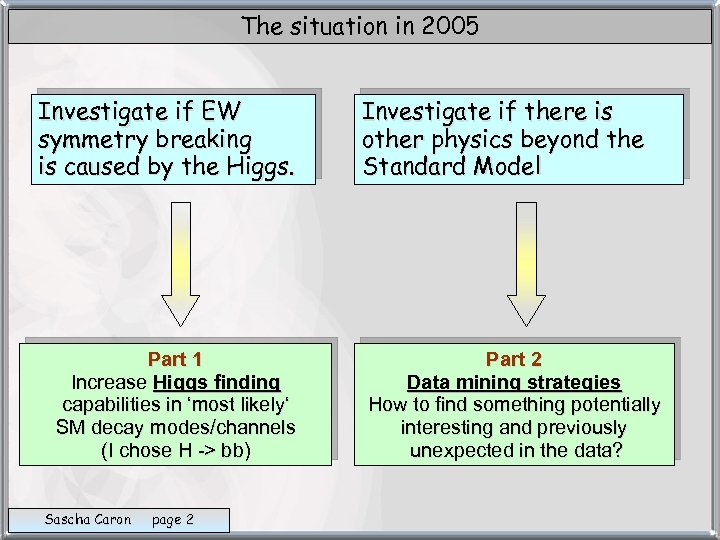 The situation in 2005 Investigate if EW symmetry breaking is caused by the Higgs. Part 1 Increase Higgs finding capabilities in ‘most likely‘ SM decay modes/channels (I chose H -> bb) Sascha Caron page 2 Investigate if there is other physics beyond the Standard Model Part 2 Data mining strategies How to find something potentially interesting and previously unexpected in the data?
 Outline • Part 1 Some ideas to improve H->bb • Part 2 Is there something else? Sascha Caron page 3
 Part 1 Some ideas to improve H->bb
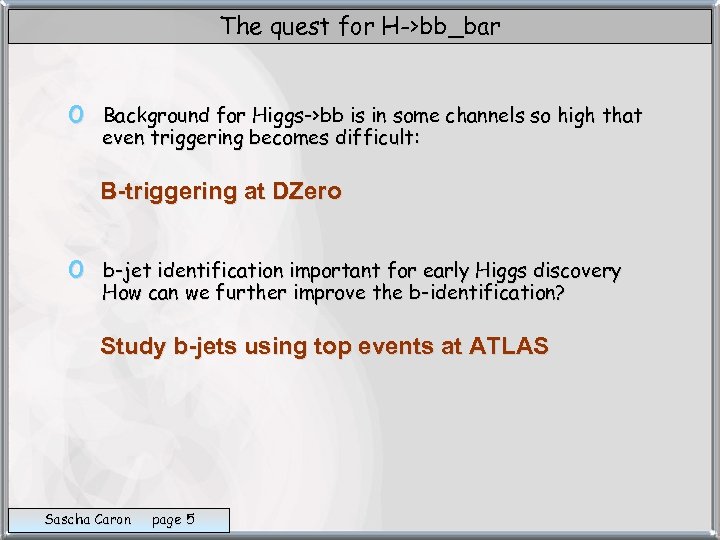 The quest for H->bb_bar o Background for Higgs->bb is in some channels so high that even triggering becomes difficult: B-triggering at DZero o b-jet identification important for early Higgs discovery How can we further improve the b-identification? Study b-jets using top events at ATLAS Sascha Caron page 5
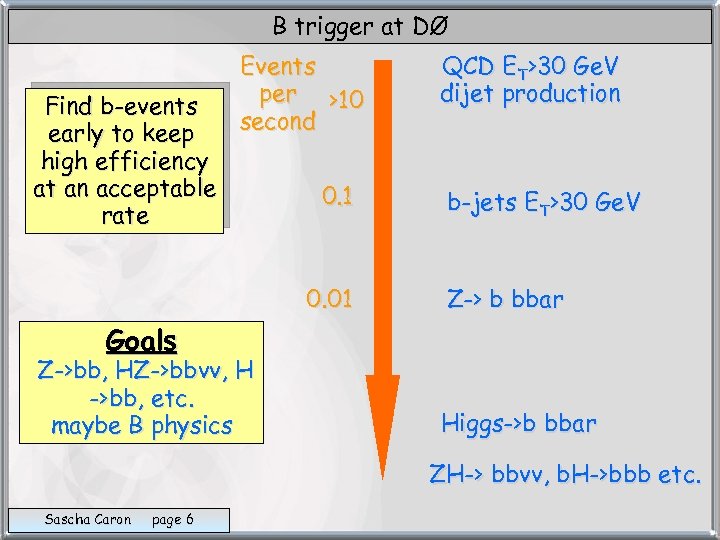 B trigger at DØ Find b-events early to keep high efficiency at an acceptable rate Events per >10 second 0. 1 0. 01 QCD ET>30 Ge. V dijet production b-jets ET>30 Ge. V Z-> b bbar Goals Z->bb, HZ->bbvv, H ->bb, etc. maybe B physics Higgs->b bbar ZH-> bbvv, b. H->bbb etc. Sascha Caron page 6
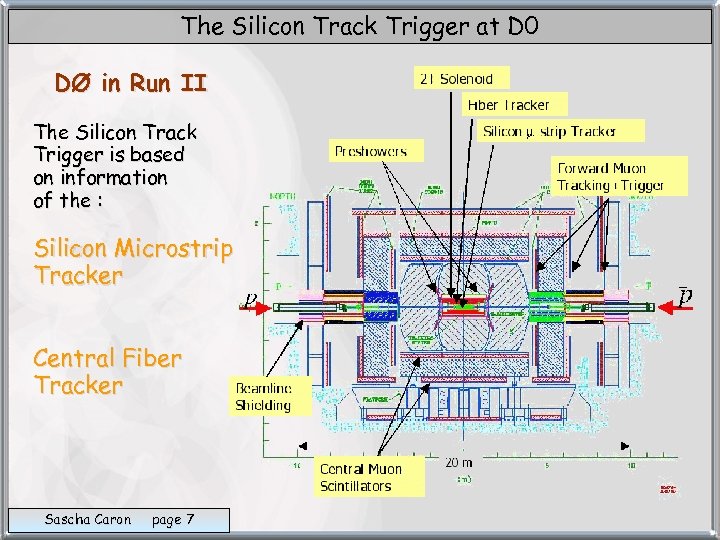 The Silicon Track Trigger at D 0 DØ in Run II The Silicon Track Trigger is based on information of the : Silicon Microstrip Tracker Central Fiber Tracker Sascha Caron page 7
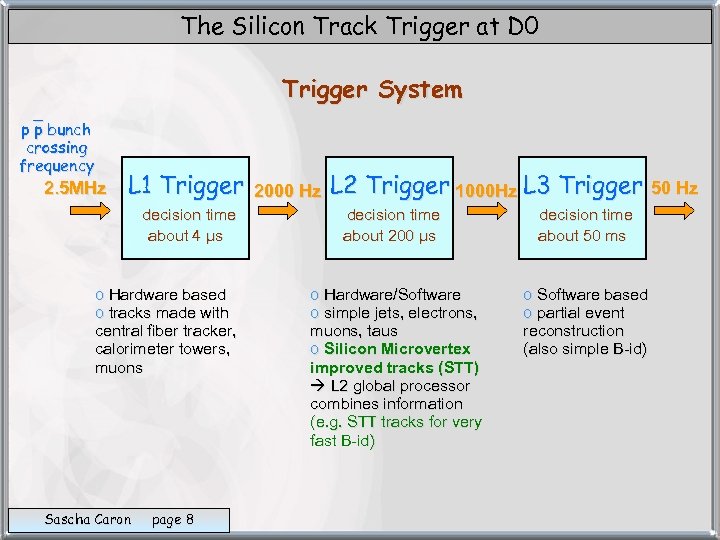 The Silicon Track Trigger at D 0 Trigger System p ¯ bunch p crossing frequency 2. 5 MHz L 1 Trigger decision time about 4 μs o Hardware based o tracks made with central fiber tracker, calorimeter towers, muons Sascha Caron page 8 2000 Hz L 2 Trigger 1000 Hz L 3 Trigger decision time about 200 μs decision time about 50 ms o Hardware/Software o simple jets, electrons, muons, taus o Silicon Microvertex improved tracks (STT) L 2 global processor combines information (e. g. STT tracks for very fast B-id) o Software based o partial event reconstruction (also simple B-id) 50 Hz
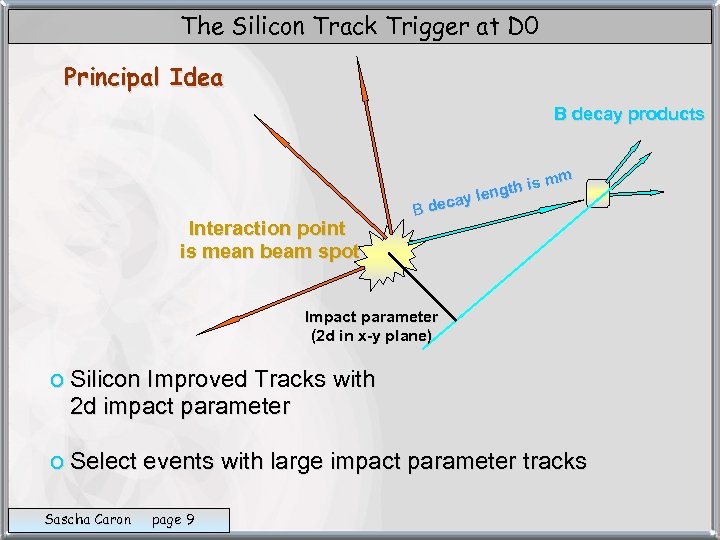 The Silicon Track Trigger at D 0 Principal Idea B decay products Interaction point is mean beam spot mm th is leng ecay Bd Impact parameter (2 d in x-y plane) o Silicon Improved Tracks with 2 d impact parameter o Select events with large impact parameter tracks Sascha Caron page 9
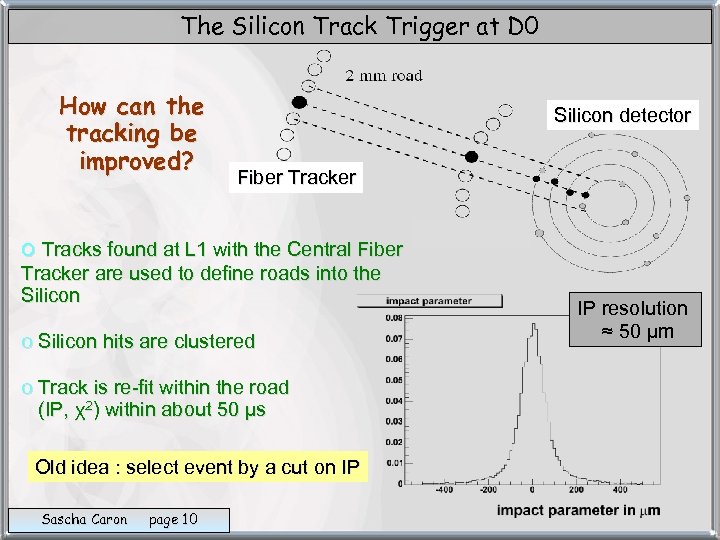 The Silicon Track Trigger at D 0 How can the tracking be improved? Silicon detector Fiber Tracker o Tracks found at L 1 with the Central Fiber Tracker are used to define roads into the Silicon o Silicon hits are clustered o Track is re-fit within the road (IP, χ2) within about 50 µs Old idea : select event by a cut on IP Sascha Caron page 10 IP resolution ≈ 50 μm
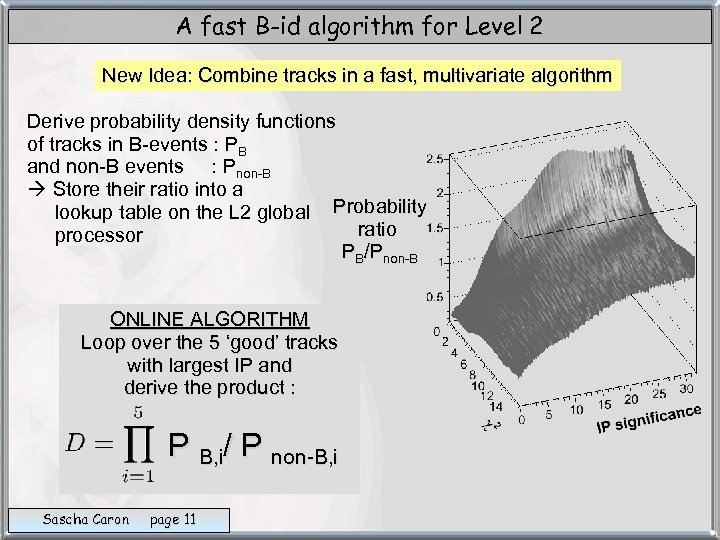 A fast B-id algorithm for Level 2 New Idea: Combine tracks in a fast, multivariate algorithm Derive probability density functions of tracks in B-events : PB and non-B events : Pnon-B Store their ratio into a lookup table on the L 2 global Probability ratio processor PB/Pnon-B ONLINE ALGORITHM Loop over the 5 ‘good’ tracks with largest IP and derive the product : P B, i/ P non-B, i Sascha Caron page 11
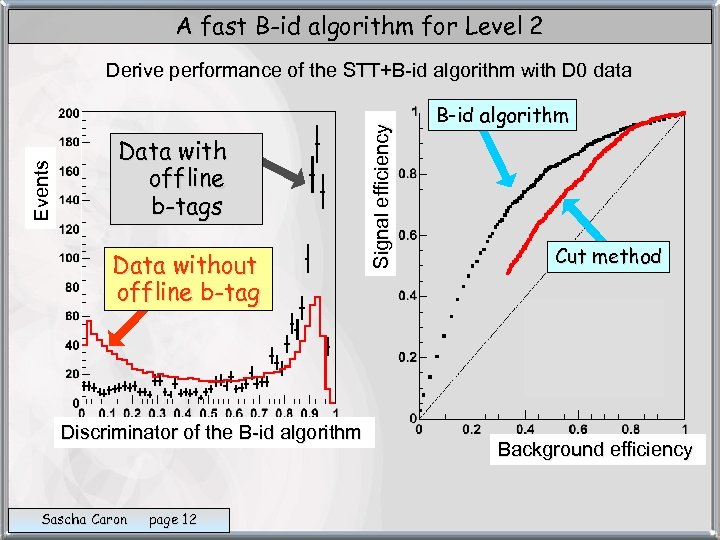 A fast B-id algorithm for Level 2 Data with offline b-tags Data without offline b-tag Discriminator of the B-id algorithm Sascha Caron page 12 Signal efficiency Events Derive performance of the STT+B-id algorithm with D 0 data B-id algorithm Cut method Background efficiency
 The quest for H->bb_bar o Silicon Track Trigger at DZero works o Further improvement by up to a factor 2 with the B-id algorithm Impact in next Higgs trigger strategy for difficult channels Next step: Have we learned something for ATLAS/CMS? Sascha Caron page 13
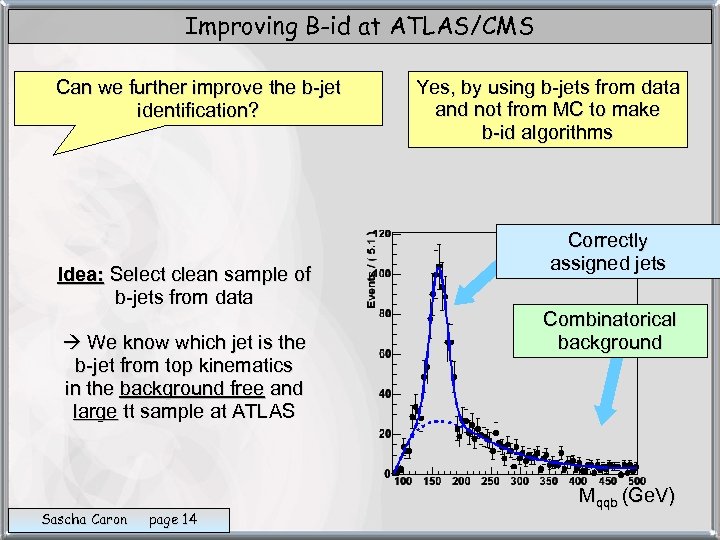 Improving B-id at ATLAS/CMS Can we further improve the b-jet identification? Idea: Select clean sample of b-jets from data We know which jet is the b-jet from top kinematics in the background free and large tt sample at ATLAS Sascha Caron page 14 Yes, by using b-jets from data and not from MC to make b-id algorithms Correctly assigned jets Combinatorical background Mqqb (Ge. V)
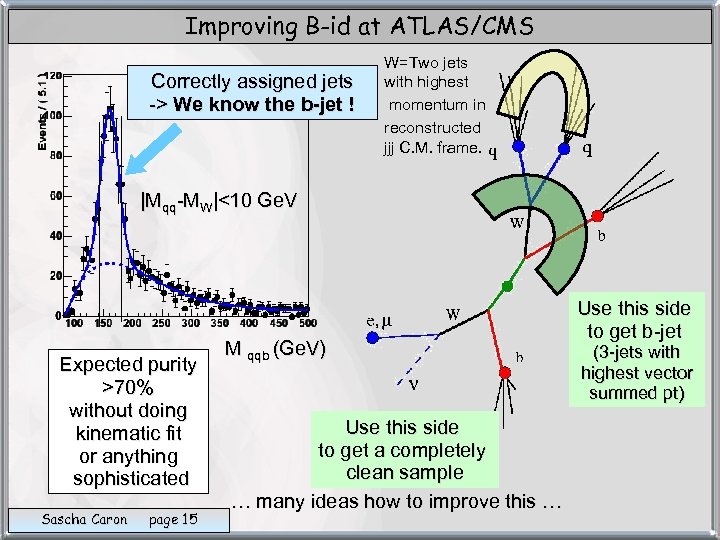 Improving B-id at ATLAS/CMS Correctly assigned jets -> We know the b-jet ! W=Two jets with highest momentum in reconstructed jjj C. M. frame. |Mqq-MW|<10 Ge. V Expected purity >70% without doing kinematic fit or anything sophisticated Sascha Caron page 15 M qqb (Ge. V) Use this side to get a completely clean sample … many ideas how to improve this … Use this side to get b-jet (3 -jets with highest vector summed pt)
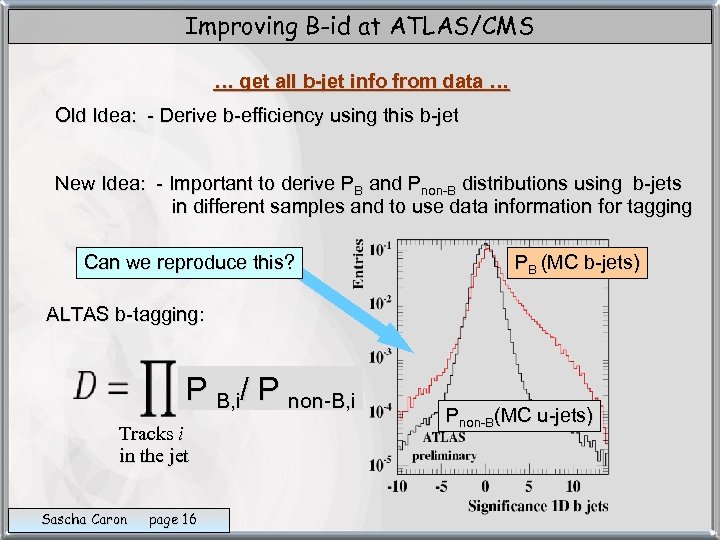 Improving B-id at ATLAS/CMS … get all b-jet info from data … Old Idea: - Derive b-efficiency using this b-jet New Idea: - Important to derive PB and Pnon-B distributions using b-jets in different samples and to use data information for tagging Can we reproduce this? PB (MC b-jets) ALTAS b-tagging: P B, i/ P non-B, i Tracks i in the jet Sascha Caron page 16 Pnon-B(MC u-jets)
 Part 2 Is there something else ?
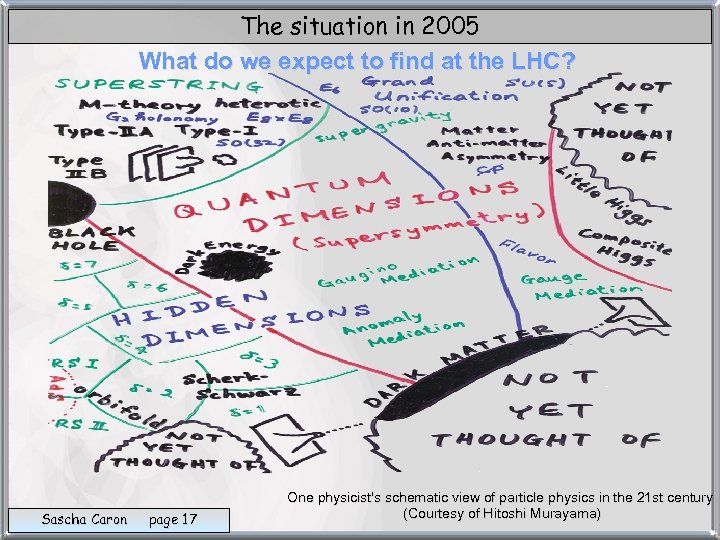 The situation in 2005 What do we expect to find at the LHC? Sascha Caron page 17 One physicist's schematic view of particle physics in the 21 st century (Courtesy of Hitoshi Murayama)
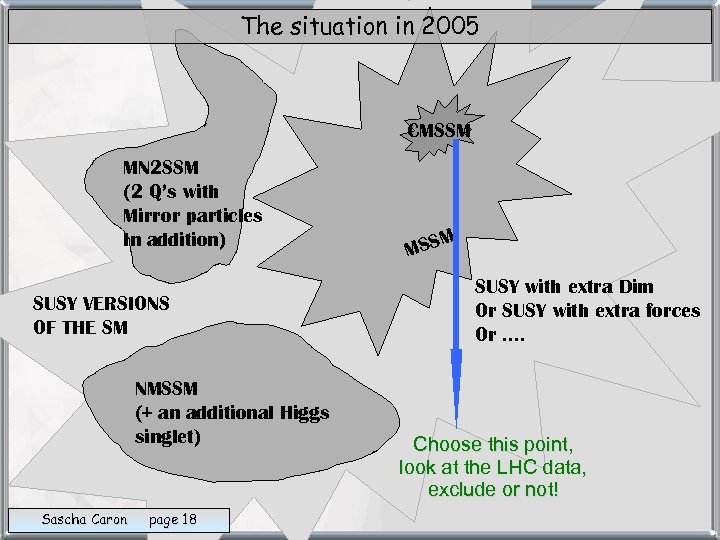 The situation in 2005 CMSSM MN 2 SSM (2 Q’s with Mirror particles In addition) SUSY VERSIONS OF THE SM NMSSM (+ an additional Higgs singlet) Sascha Caron page 18 M MSS SUSY with extra Dim Or SUSY with extra forces Or …. Choose this point, look at the LHC data, exclude or not!
 We found no deviation We have excluded this point/area which is epsilon of the parameter space We found a deviation Does this mean that the ‘real’ model is this parameter point? Is it efficient to work like this?
 Finding the unexpected – explaining the origin New Strategy: START FROM THE DATA 1) Search for deviations in all final states (they are all interesting either as signal or to understand background) 2) Determine the regions of ‘greatest deviation’ 3) Determine the origin of these deviations Is this possible? YES, IT HAS BEEN DONE ! General Search for new Phenomena at H 1 Sascha Caron page 19
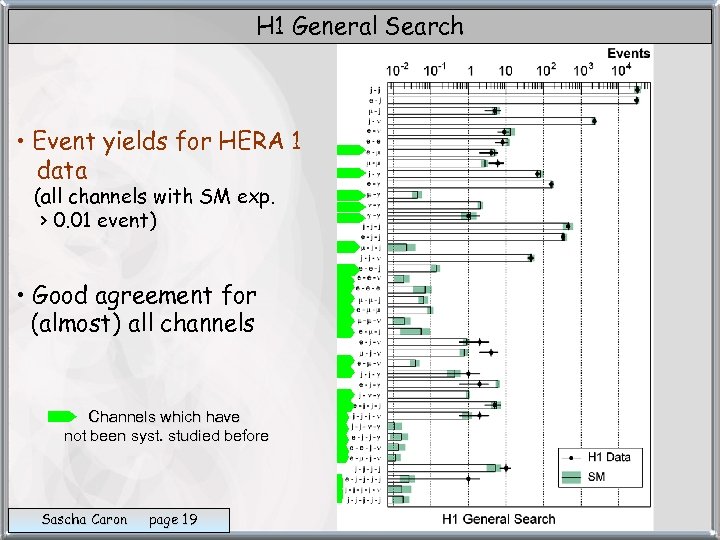 H 1 General Search • Event yields for HERA 1 data (all channels with SM exp. > 0. 01 event) • Good agreement for (almost) all channels Channels which have not been syst. studied before Sascha Caron page 19
 General Search I spend some time at the New Phenomena web pages at LHC experiments A count of final states planned to be studied leads to 100 -500 However consider permutations of j, b, e, µ, τ, v, γ, + consider e. g. charge? Up to 8 particle final states lead to about 40000 Did you have events with 2 photons , a jet and a muon at your LEP exp. ? Sascha Caron page 19
 H 1 General Search for deviations Need to explore automated data analysis strategies - Idea to completely automate a search (DØ Sleuth analysis) - H 1 General Search : Search for deviations between data and SM prediction in 1 dim. distributions most sensitive to new physics Very simple and remarkably powerful Sascha Caron page 20
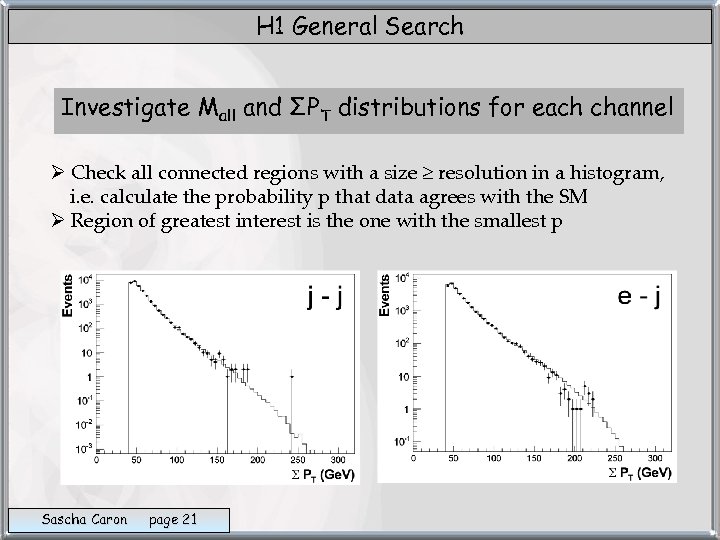 H 1 General Search Investigate Mall and ΣPT distributions for each channel Ø Check all connected regions with a size ≥ resolution in a histogram, i. e. calculate the probability p that data agrees with the SM Ø Region of greatest interest is the one with the smallest p Sascha Caron page 21
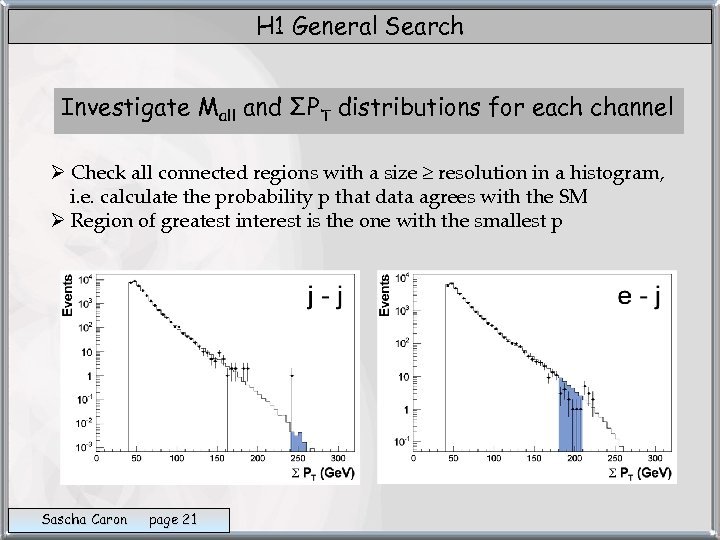 H 1 General Search Investigate Mall and ΣPT distributions for each channel Ø Check all connected regions with a size ≥ resolution in a histogram, i. e. calculate the probability p that data agrees with the SM Ø Region of greatest interest is the one with the smallest p Sascha Caron page 21
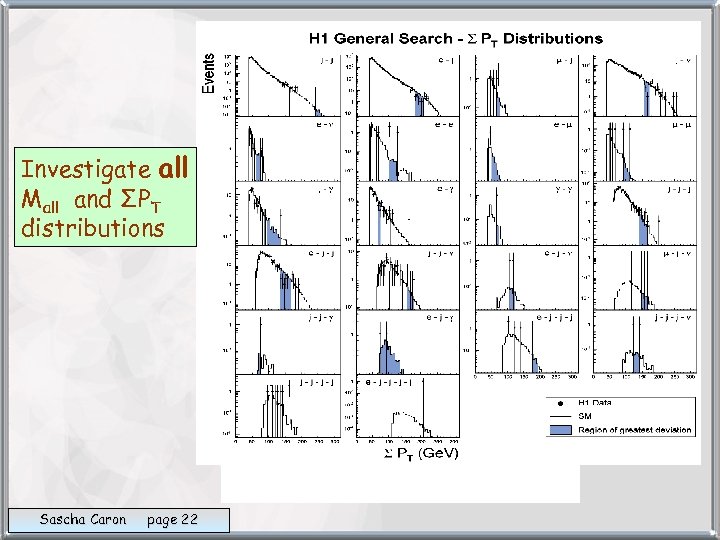 Investigate all Mall and ΣPT distributions Sascha Caron page 22
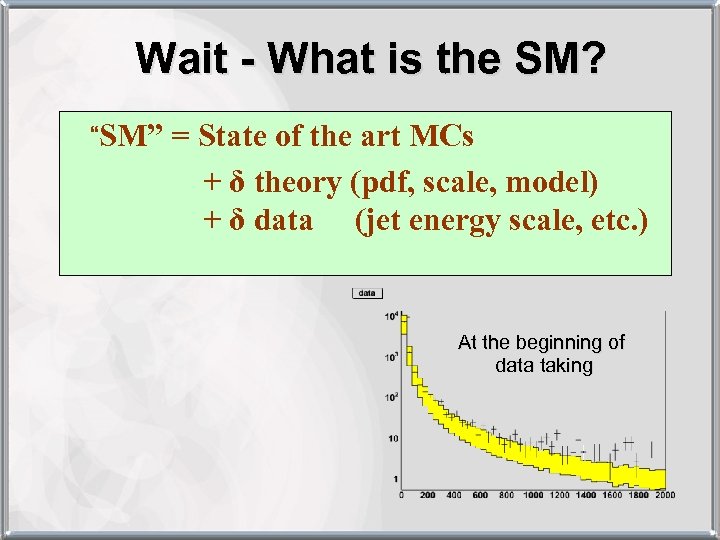 Wait - What is the SM? “SM” = State of the art MCs + δ theory (pdf, scale, model) + δ data (jet energy scale, etc. ) At the beginning of data taking
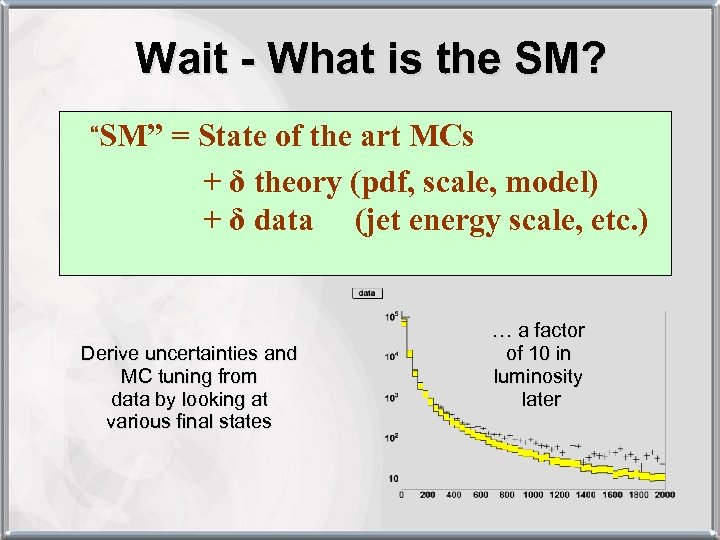 Wait - What is the SM? “SM” = State of the art MCs + δ theory (pdf, scale, model) + δ data (jet energy scale, etc. ) Derive uncertainties and MC tuning from data by looking at various final states … a factor of 10 in luminosity later
 A significant danger is finding correlations and signals that do not really exist. Many examples in particle physics history We are looking for deviations … How surprised should we be to find some? How likely is a 4 -5 sigma deviation at LHC even if there is nothing in the data? Sascha Caron page 24 Unsolvable problem if you use 2000 Ph. D students
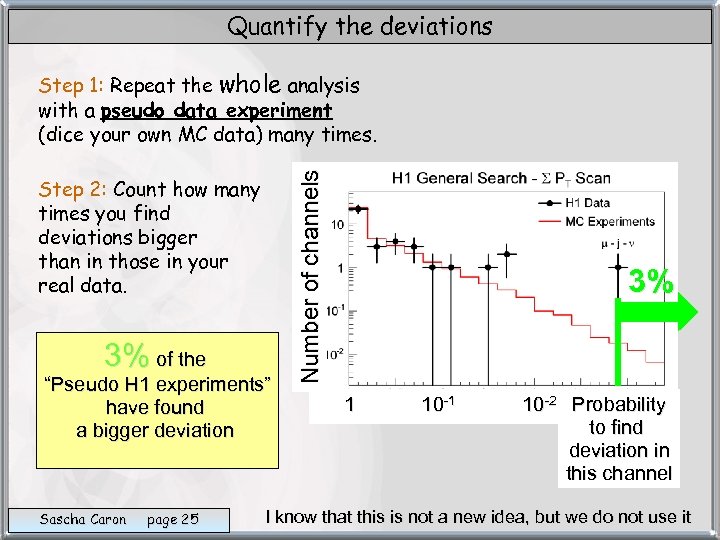 Quantify the deviations Step 2: Count how many times you find deviations bigger than in those in your real data. 3% of the “Pseudo H 1 experiments” have found a bigger deviation Sascha Caron page 25 Number of channels Step 1: Repeat the whole analysis with a pseudo data experiment (dice your own MC data) many times. 3% 1 10 -2 Probability to find deviation in this channel I know that this is not a new idea, but we do not use it
 What are the numbers for ATLAS?
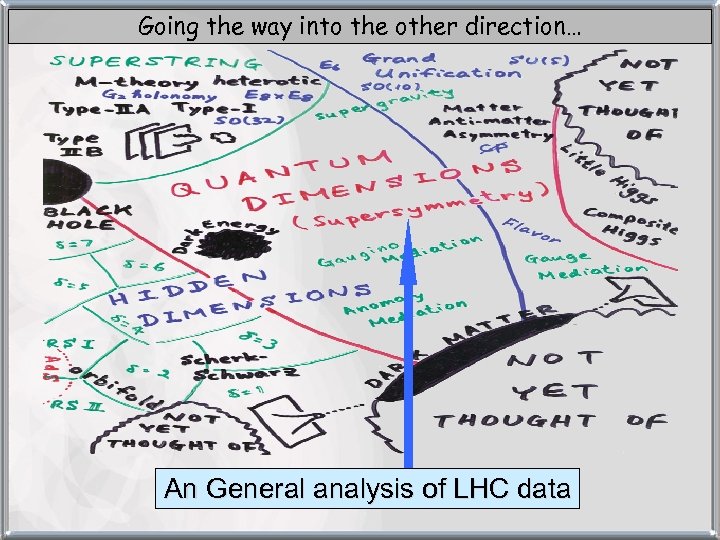 Going the way into the other direction… An General analysis of LHC data
 Summary I’ve tried to illustrate some ideas to improve the discovery potential at LHC and the Tevatron. Improving the Higgs discovery potential by an improved Trigger and B-id A General Search for new phenomena strategy for the LHC
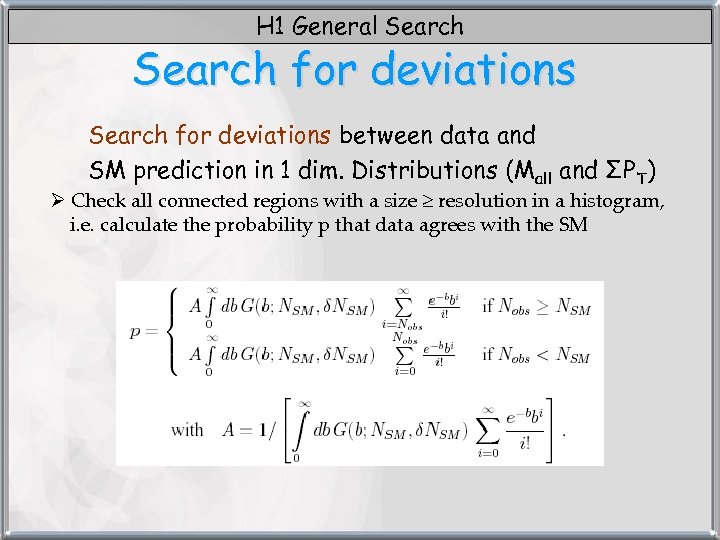 H 1 General Search for deviations between data and SM prediction in 1 dim. Distributions (Mall and ΣPT) Ø Check all connected regions with a size ≥ resolution in a histogram, i. e. calculate the probability p that data agrees with the SM