 Скачать презентацию Finding Linking Opportunities through Relationship-based Analysis Joonhee Yoo
f00b566b8c7e5c9be5fef5e064d03b4f.ppt
- Количество слайдов: 104




Finding Linking Opportunities through Relationship-based Analysis Joonhee Yoo & Michael Bieber Collaborative Hypermedia Research Lab Computer & Information Science Department New Jersey Institute of Technology joonyoo@pegasus. rutgers. edu bieber@njit. edu - http: //www. cis. njit. edu/~bieber
Outline Relationship Analysis • motivation • relationship analysis & examples • research issues • evaluation

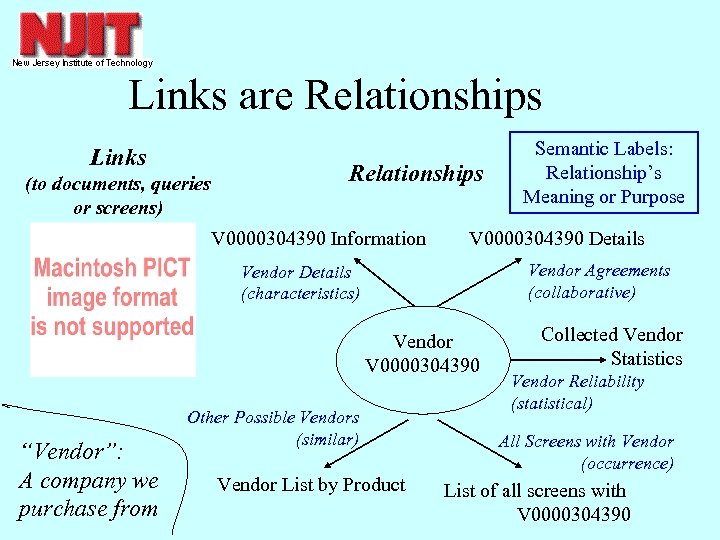
Links are Relationships Links (to documents, queries or screens) Relationships V 0000304390 Information V 0000304390 Details Vendor Agreements (collaborative) Vendor Details (characteristics) Vendor V 0000304390 “Vendor”: A company we purchase from Semantic Labels: Relationship’s Meaning or Purpose Other Possible Vendors (similar) Vendor List by Product Collected Vendor Statistics Vendor Reliability (statistical) All Screens with Vendor (occurrence) List of all screens with V 0000304390
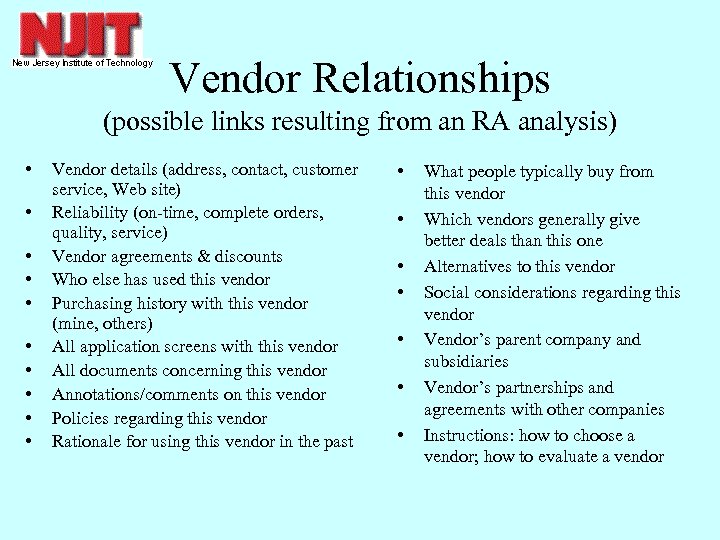
Vendor Relationships (possible links resulting from an RA analysis) • • • Vendor details (address, contact, customer service, Web site) Reliability (on-time, complete orders, quality, service) Vendor agreements & discounts Who else has used this vendor Purchasing history with this vendor (mine, others) All application screens with this vendor All documents concerning this vendor Annotations/comments on this vendor Policies regarding this vendor Rationale for using this vendor in the past • • What people typically buy from this vendor Which vendors generally give better deals than this one Alternatives to this vendor Social considerations regarding this vendor Vendor’s parent company and subsidiaries Vendor’s partnerships and agreements with other companies Instructions: how to choose a vendor; how to evaluate a vendor
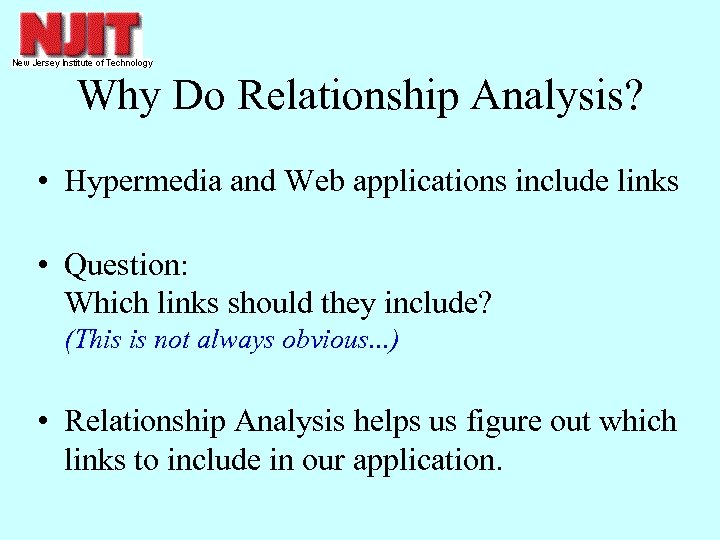
Why Do Relationship Analysis? • Hypermedia and Web applications include links • Question: Which links should they include? (This is not always obvious. . . ) • Relationship Analysis helps us figure out which links to include in our application.
Outline Relationship Analysis • motivation • relationship analysis & examples • research issues • evaluation
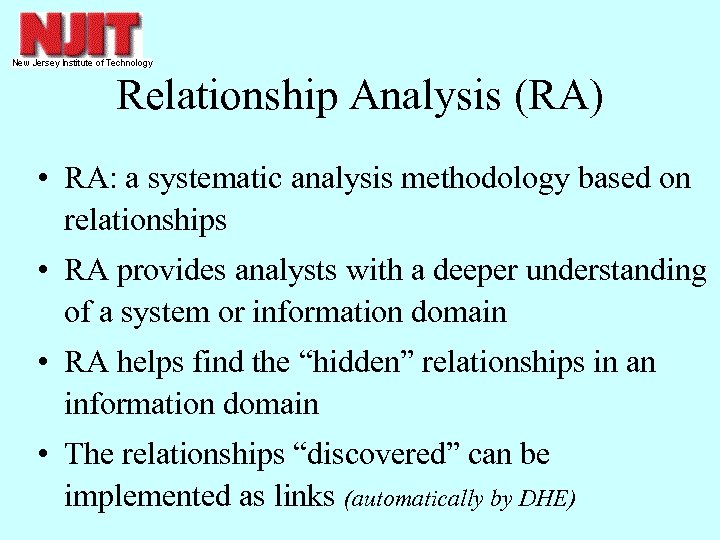
Relationship Analysis (RA) • RA: a systematic analysis methodology based on relationships • RA provides analysts with a deeper understanding of a system or information domain • RA helps find the “hidden” relationships in an information domain • The relationships “discovered” can be implemented as links (automatically by DHE)
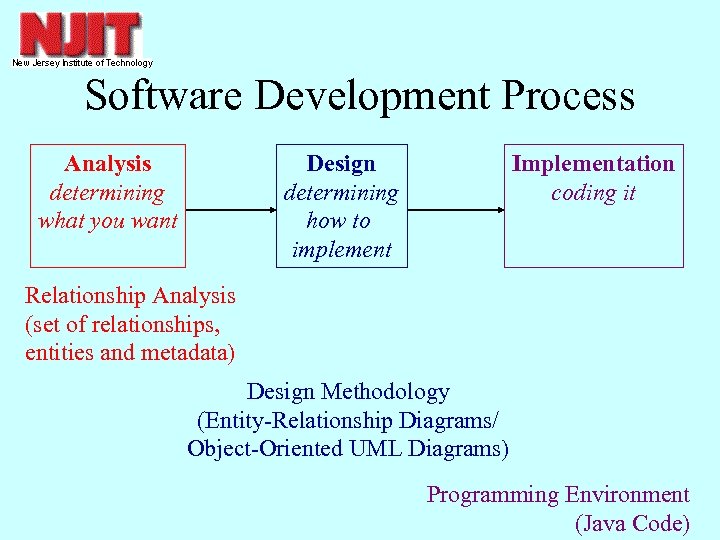
Software Development Process Analysis determining what you want Design determining how to implement Implementation coding it Relationship Analysis (set of relationships, entities and metadata) Design Methodology (Entity-Relationship Diagrams/ Object-Oriented UML Diagrams) Programming Environment (Java Code)
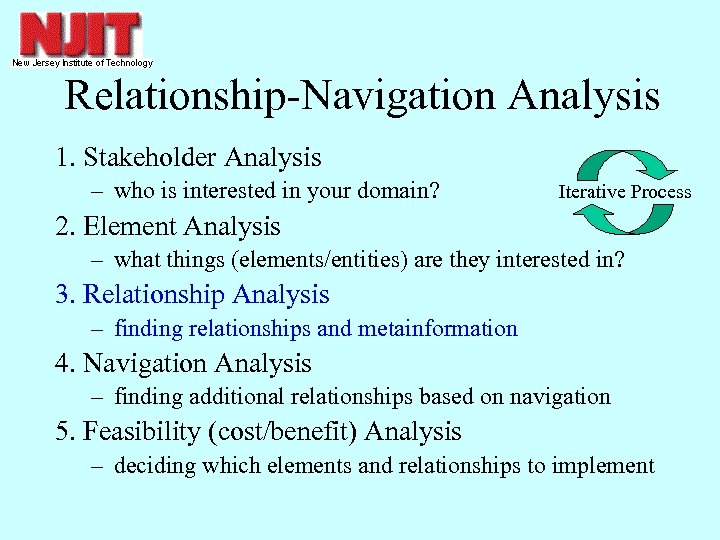
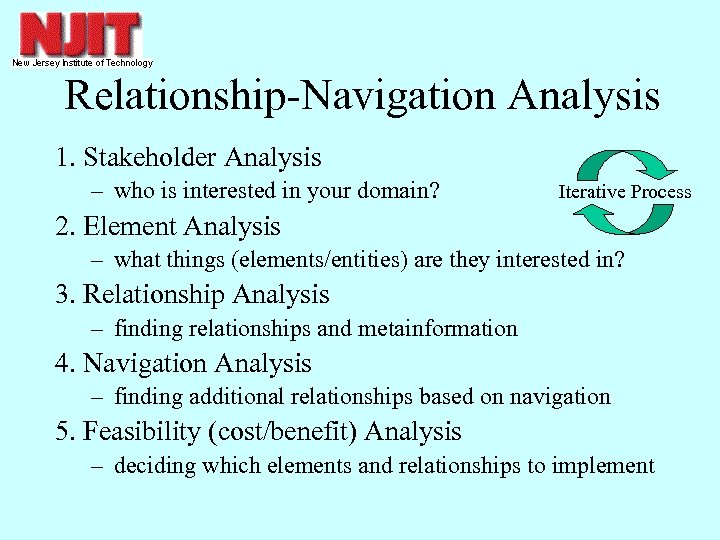
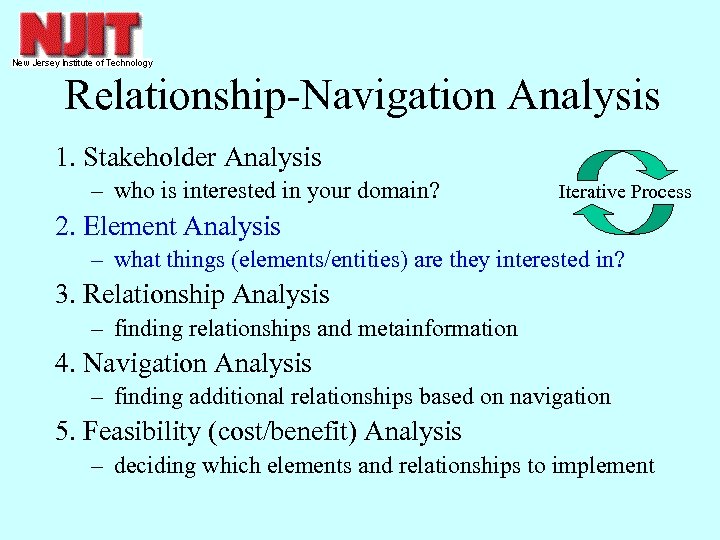
Relationship-Navigation Analysis 1. Stakeholder Analysis – who is interested in your domain? Iterative Process 2. Element Analysis – what things (elements/entities) are they interested in? 3. Relationship Analysis – finding relationships and metainformation 4. Navigation Analysis – finding additional relationships based on navigation 5. Feasibility (cost/benefit) Analysis – deciding which elements and relationships to implement
Relationship Analysis • Questions come from a taxonomy or classification of relationship types • Brainstorming: Analyst asks these questions about each element
Relationship Taxonomy
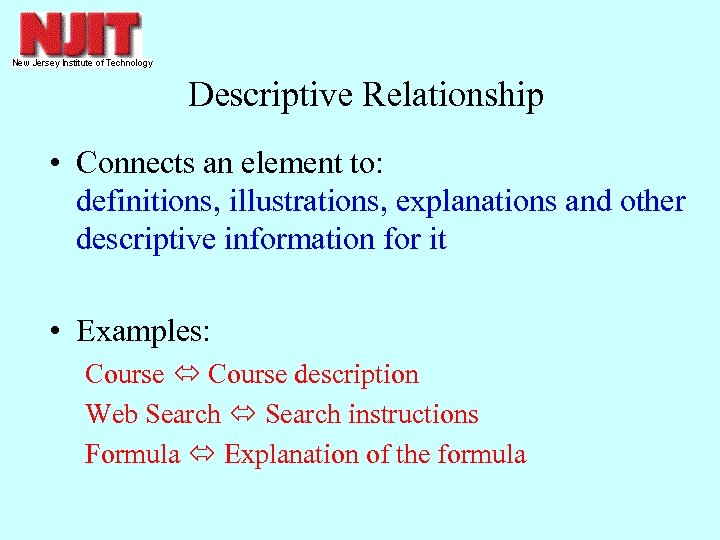
Descriptive Relationship • Connects an element to: definitions, illustrations, explanations and other descriptive information for it • Examples: Course description Web Search instructions Formula Explanation of the formula
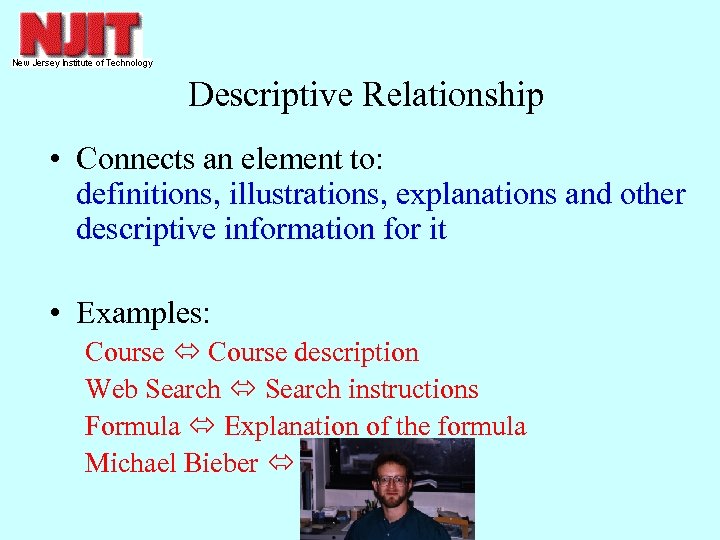
Descriptive Relationship • Connects an element to: definitions, illustrations, explanations and other descriptive information for it • Examples: Course description Web Search instructions Formula Explanation of the formula Michael Bieber
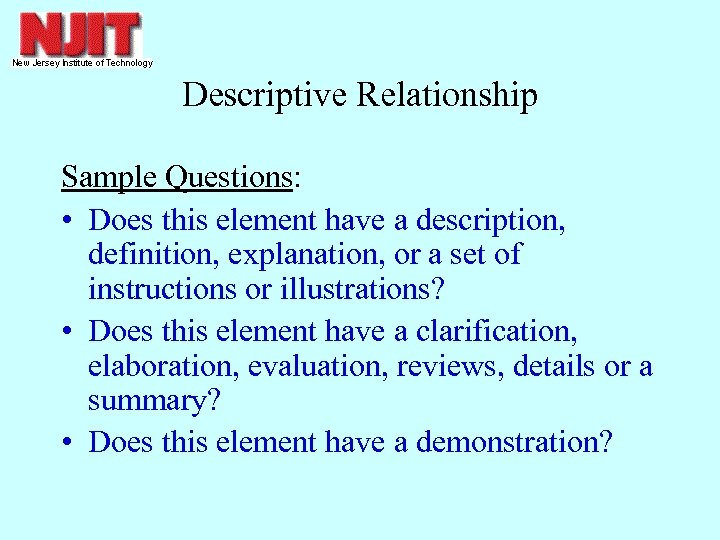
Descriptive Relationship Sample Questions: • Does this element have a description, definition, explanation, or a set of instructions or illustrations? • Does this element have a clarification, elaboration, evaluation, reviews, details or a summary? • Does this element have a demonstration?
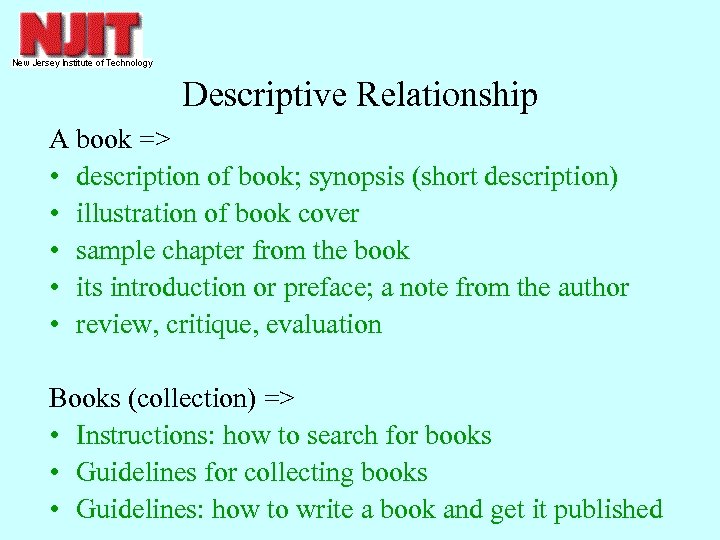
Descriptive Relationship A book => • description of book; synopsis (short description) • illustration of book cover • sample chapter from the book • its introduction or preface; a note from the author • review, critique, evaluation Books (collection) => • Instructions: how to search for books • Guidelines for collecting books • Guidelines: how to write a book and get it published
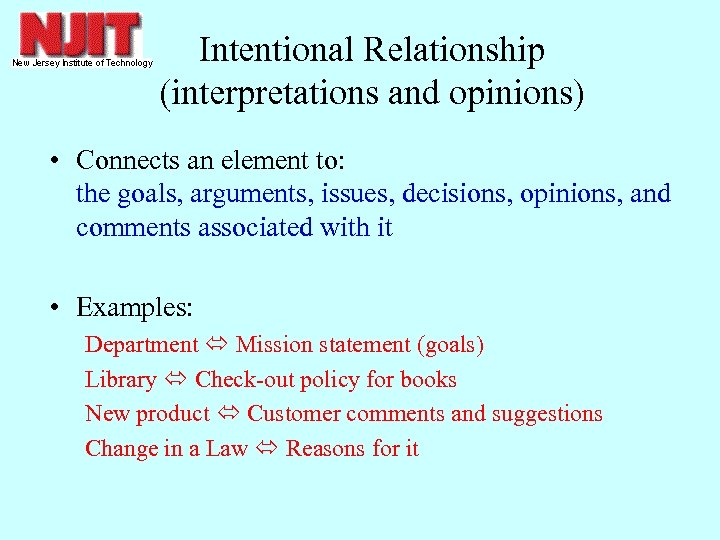
Intentional Relationship (interpretations and opinions) • Connects an element to: the goals, arguments, issues, decisions, opinions, and comments associated with it • Examples: Department Mission statement (goals) Library Check-out policy for books New product Customer comments and suggestions Change in a Law Reasons for it
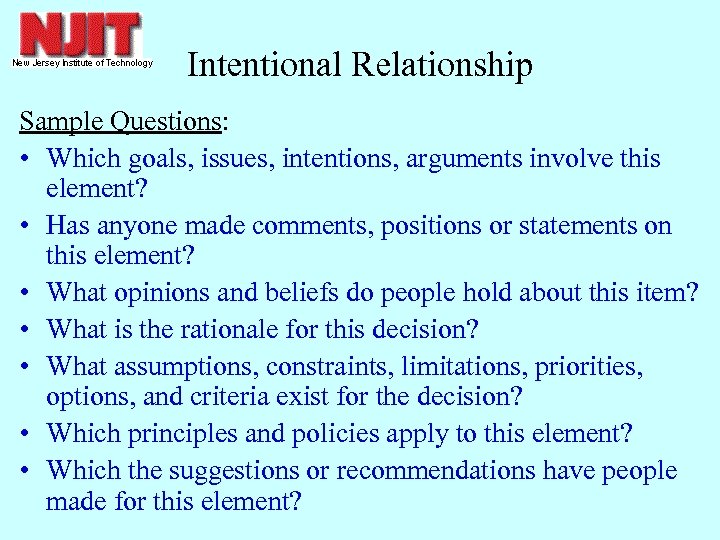
Intentional Relationship Sample Questions: • Which goals, issues, intentions, arguments involve this element? • Has anyone made comments, positions or statements on this element? • What opinions and beliefs do people hold about this item? • What is the rationale for this decision? • What assumptions, constraints, limitations, priorities, options, and criteria exist for the decision? • Which principles and policies apply to this element? • Which the suggestions or recommendations have people made for this element?
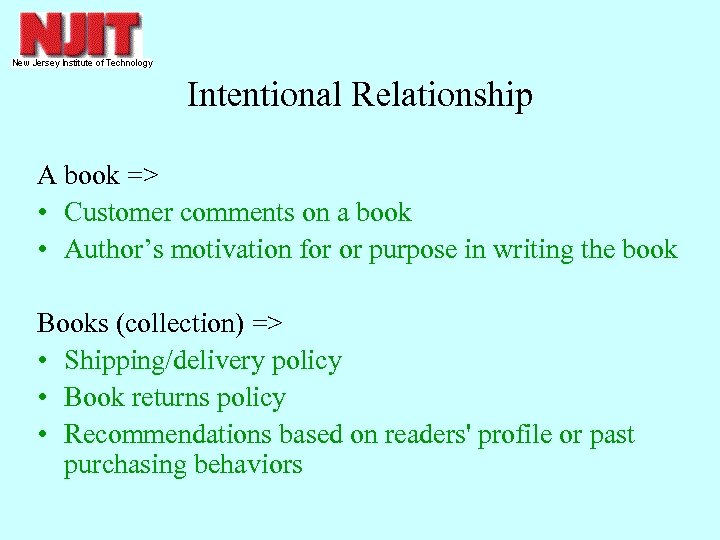
Intentional Relationship A book => • Customer comments on a book • Author’s motivation for or purpose in writing the book Books (collection) => • Shipping/delivery policy • Book returns policy • Recommendations based on readers' profile or past purchasing behaviors
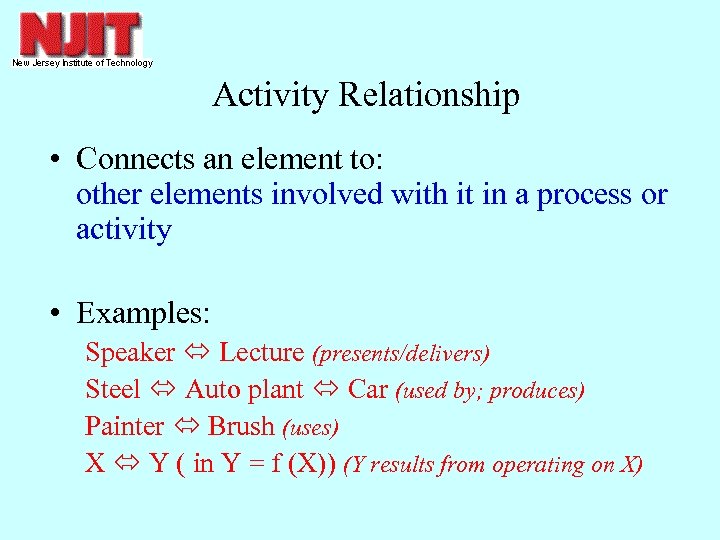
Activity Relationship • Connects an element to: other elements involved with it in a process or activity • Examples: Speaker Lecture (presents/delivers) Steel Auto plant Car (used by; produces) Painter Brush (uses) X Y ( in Y = f (X)) (Y results from operating on X)
Activity Relationship Sample Questions: • What are this element’s inputs and outputs? • What resources, instruments and mechanisms are required to execute this element? • Which people and other elements are involved in the activities using this element? • Which elements does this element map to? • What functions can be applied to this element?
Activity Relationship A book => • People who (would) read this book (Which types of customers might want to buy this book? ) • People who (would) give this book as a gift (Is the bookstore's Web site set up to facilitate people looking for gifts? ) • Book groups who (would) read this book (Is the bookstore doing anything to support book groups? )
Activity Relationship A book => • Its inputs: – paper (Is the paper good quality? Is it printed on recycled paper? ) – binding (Was the book manufactured to last? ) – cover (Is it hardcover or softcover? ) • Which activities it results from: – result of research – result of a journey the author took – result of a crisis in the author's life
Relationship Taxonomy
Relationship Taxonomy
Relationship-Navigation Analysis Contributions • Only systematic, domain-independent analysis methodology with focus on relationships • Result of an Experiment: RNA leads to better understanding and deeper analyses.
RA Taxonomy (Rx? ) • generic link categories at the top level (main contribution) • lower-level domain-independent categories are based on classifications/taxonomies in the literature • all other relationship & link taxonomies fit within RA’s generic taxonomy • relationship attributes. . .
Outline Relationship Analysis • motivation • relationship analysis & examples • research issues • evaluation
Develop the Full RNA Methodology • Refine Relationship Analysis • Develop: – – 1. Stakeholder Analysis 2. Element Analysis 4. Navigation Analysis 5. Feasibility (cost/benefit) Analysis • Develop Full Guidelines for Each Step
Scaling RNA • Analysts have no time for a full RNA • Develop a scalable version of RNA (from 1 hour to a week) • Need to prioritize relationship types and questions for different types of domains.
Extend RNA for Collaborative Relationship Analysis • Collaboration: a major research focus at NJIT • Is RNA adequate?
Integrate RNA with Existing Analysis and Design Methodologies • RNA Focus: relationship analysis • RNA should supplement, not replace existing analysis and design methodologies • Integrate RNA with design methodologies, including hypermedia design methodologies • Integrate RNA with OOHDM
RNA of any complex system? • RNA currently is for analyzing information system domains • Could we use RNA to model any complex system?
Outline Relationship Analysis • motivation • relationship analysis & examples • research issues • evaluation
RNA Evaluation: Goals (1) Completeness - to do a complete analysis of a complex system. (2) Relevance - to find the most important relationships in the time available (3) Usefulness in Implementation - to find the detailed requirements necessary to implement each relationship found as a links in DHE (4) Usefulness to Analyst - to gain a deeper understanding of the domain - to perform a better analysis and design than with an analysis not focusing on relationships
RNA Experiments • Compare analysis using RNA, and using another analysis technique • Compare program designs and implementations with/without RNA analysis
RNA Evaluation: Propositions and Measures • Proposition P 1: RNA results in a more complete relationship analysis • Measures for the completeness: – number of entities and relationships found – expert’s judgment on design quality – perceived completeness of the design
RNA Evaluation: Propositions and Measures • Proposition P 2: RNA is more likely to identify the important entities and relationships, given a limited time for analysis • Measures for the quality of output: – – extent of important entities and relationships covered, expert’s judgment on design quality perceived completeness of the design perceived time pressure
RNA Evaluation: Propositions and Measures • Proposition P 3: System design with RNA is easier to implement • Measures for the ability to implement: – time for implementation – perceived effort in implementation – expert judgment on the implemented system quality
RNA Evaluation: Propositions and Measures • Proposition P 4: RNA gives analysts a better understanding of the information domain • Measures for understanding the domain: – perceived extent of understanding – recall after system design
Relationship Analysis (RA) – Motivation: What to link? – RA: a systematic analysis methodology based on relationships – RA provides analysts with a deeper understanding of a system or information domain – The relationships “discovered” can be implemented as links (automatically by DHE) Thanks!
Relationship Taxonomy
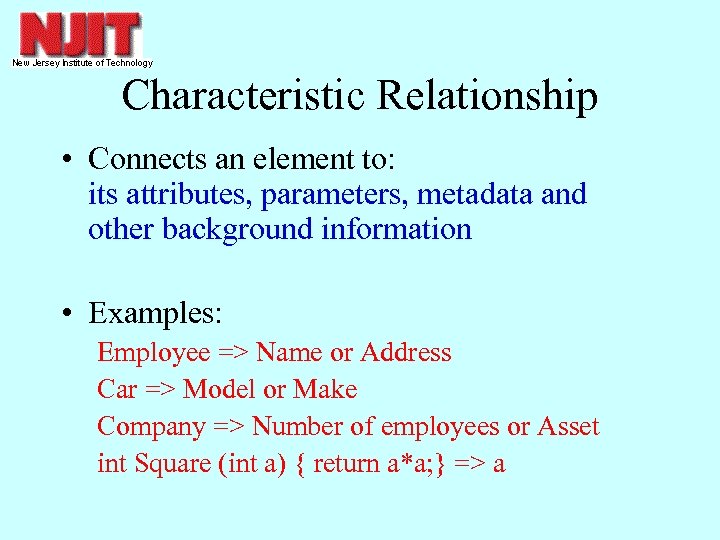
Characteristic Relationship • Connects an element to: its attributes, parameters, metadata and other background information • Examples: Employee => Name or Address Car => Model or Make Company => Number of employees or Asset int Square (int a) { return a*a; } => a
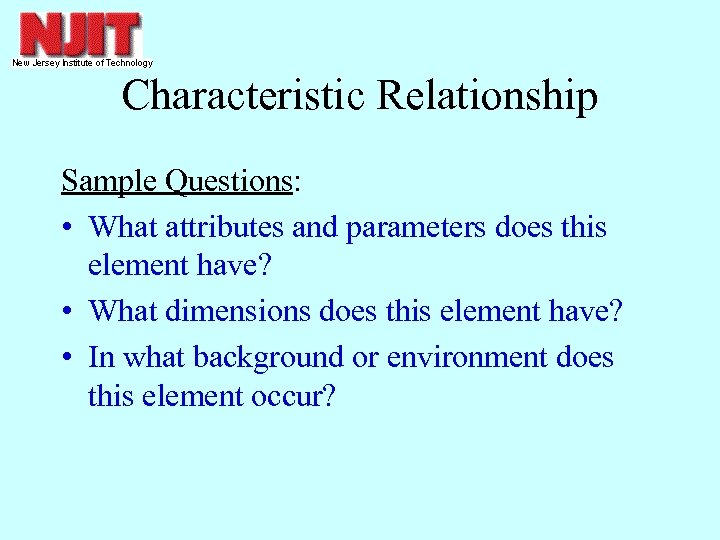
Characteristic Relationship Sample Questions: • What attributes and parameters does this element have? • What dimensions does this element have? • In what background or environment does this element occur?
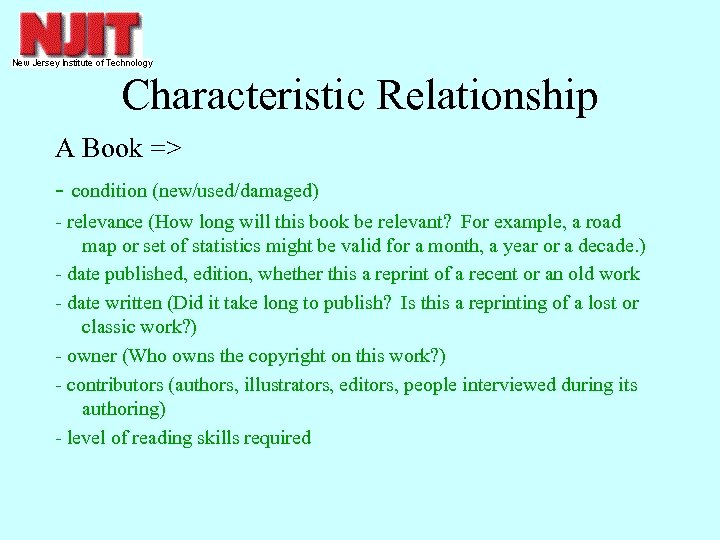
Characteristic Relationship A Book => - condition (new/used/damaged) - relevance (How long will this book be relevant? For example, a road map or set of statistics might be valid for a month, a year or a decade. ) - date published, edition, whether this a reprint of a recent or an old work - date written (Did it take long to publish? Is this a reprinting of a lost or classic work? ) - owner (Who owns the copyright on this work? ) - contributors (authors, illustrators, editors, people interviewed during its authoring) - level of reading skills required
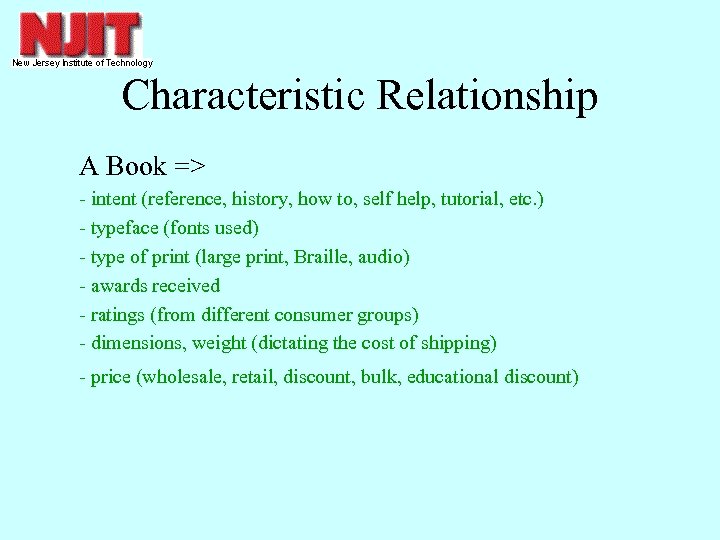
Characteristic Relationship A Book => - intent (reference, history, how to, self help, tutorial, etc. ) - typeface (fonts used) - type of print (large print, Braille, audio) - awards received - ratings (from different consumer groups) - dimensions, weight (dictating the cost of shipping) - price (wholesale, retail, discount, bulk, educational discount)
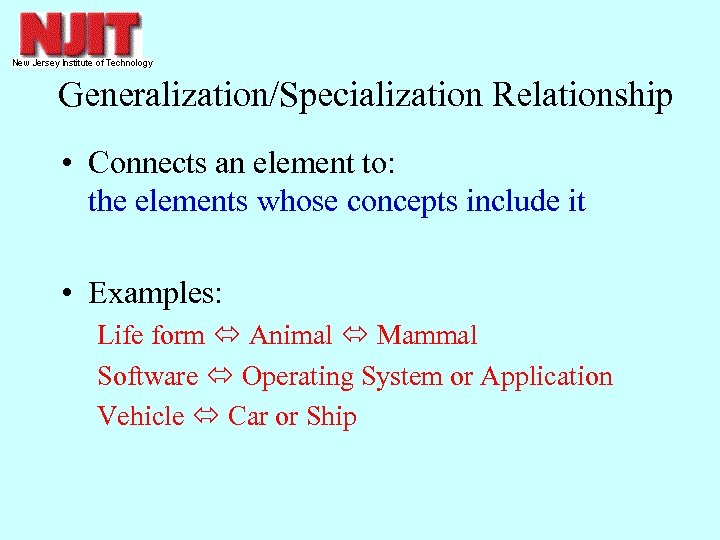
Generalization/Specialization Relationship • Connects an element to: the elements whose concepts include it • Examples: Life form Animal Mammal Software Operating System or Application Vehicle Car or Ship
Generalization/Specialization Relationship Sample Questions: • Is there a broader term for this element? • Is there a narrower term for this element? • Does this element completely include or encompass other elements?
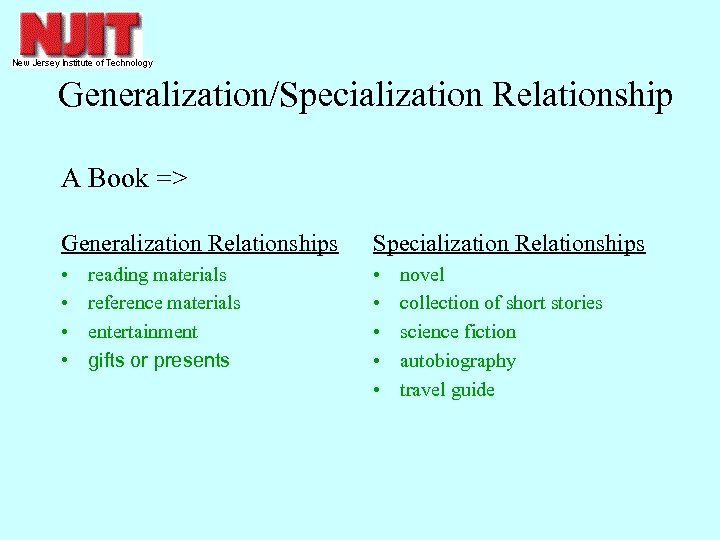
Generalization/Specialization Relationship A Book => Generalization Relationships Specialization Relationships • • • reading materials reference materials entertainment gifts or presents novel collection of short stories science fiction autobiography travel guide
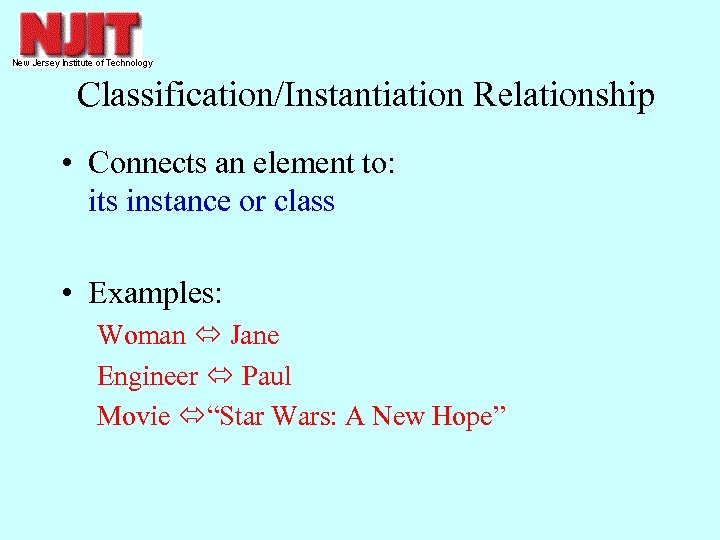
Classification/Instantiation Relationship • Connects an element to: its instance or class • Examples: Woman Jane Engineer Paul Movie “Star Wars: A New Hope”
Classification/Instantiation Relationship Sample Questions: • Is this element an example of a certain class? • If a class, which instances exist for this element's class?
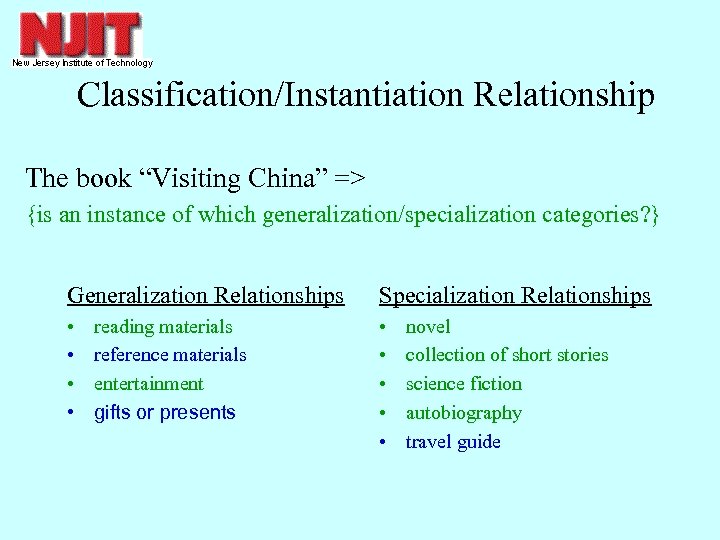
Classification/Instantiation Relationship The book “Visiting China” => {is an instance of which generalization/specialization categories? } Generalization Relationships Specialization Relationships • • • reading materials reference materials entertainment gifts or presents novel collection of short stories science fiction autobiography travel guide
Configuration/Aggregation Relationship • Connects a part to: other parts or a whole (functionally or structurally) • Examples: Clock Hands Airplane Wings Tea Water Shopping Paying China Beijing
Configuration/Aggregation Relationship Sample Questions: • Which components consist of this element? • What materials are used to make this element? • What is this element a part of? • What places are included in this area? • What phases are in this whole activity?
Configuration/Aggregation Relationship A Book => • other books in a series (which customers might wish to read) • its chapters (Is the table of contents available? Can the customer read the first chapter? ) • its index (giving an indication of the book's level of detail and expertise) • its forward (which might entice a customer) • its introduction (giving an indication of the book's level of detail and expertise) • its illustrations (customers may be enticed by the illustrations in a children's book or figures in a technical book)
Membership/Grouping Relationship • Connects an element to: other members of a collection, or to a whole collection • Examples: Bowl of Rice Kernel of Rice Forest Tree Dance couple (Ginger and Fred) Ginger or Fred
Membership/Grouping Relationship Sample Questions: • Is this item a segment of the whole item? • Is this item a member of a collection or set? • Is this item a member of a partnership or pair?
Membership/Grouping Relationship A book => the other books… • that have the same author, title, or subject • in a collection (e. g. , a library) • that are nominees for an award • that are new releases • on a recommendation list • that are on sale
Similar/Dissimilar Relationship • Connects an element to: elements that are similar or dissimilar to some degree • Examples: Suzhou University Wang School of Law Harvard University Law School Business-To-Business Marketing Plan #1 Alternative Plan #2 Many Few Desktop Computer Notebook Computer IBM PC Apple Macintosh
Similar/Dissimilar Relationship Sample Questions: • Which elements are similar to this element? • What serves the same purposes as this element? • Which elements share common features with this element? • What are synonyms for this element (words that mean the same thing)? • Which elements are opposite to this elements? • What are antonyms for this element (words that mean the opposite thing)?
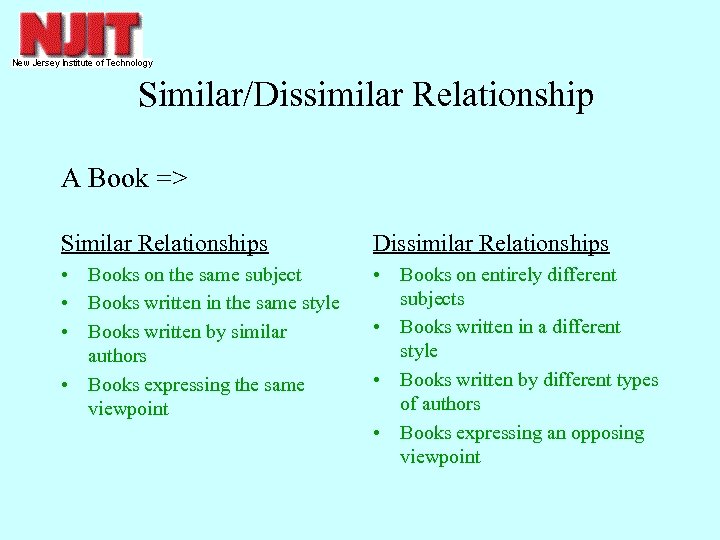
Similar/Dissimilar Relationship A Book => Similar Relationships Dissimilar Relationships • Books on the same subject • Books written in the same style • Books written by similar authors • Books expressing the same viewpoint • Books on entirely different subjects • Books written in a different style • Books written by different types of authors • Books expressing an opposing viewpoint
Equivalence Relationship • Connects an element to: the exact same element or equivalent elements • Examples: The same copies of a book in a library Exact matches from a query “Help” “Assist” (1 + 3) (2 + 2)
Equivalence Relationship Sample Questions: • What is equivalent in this domain? • Does this element have copies anywhere? • Are there exact matches for this? • Does this element have synonyms?
Equivalence Relationship A book => • Other copies of the same book • Photocopies of the book
Temporal Relationship • Connects an element to: other items in some temporal dimension • Examples: ’ 98 car model ’ 99 car model This year’s sales last year’s sales Painting A Painting B (painted in the same dynasty)
Temporal Relationship Sample Questions: • Does this element occur before other element? • Does this element occur while other elements occur? • What other elements occur at the same time when this element occurs?
Temporal Relationship A book => • books taking place in the same time period • its publication date (characteristic) • Other books published at the same time • Other books reviewed at the same time as this Books (collection) => • Set of “new releases” • Order history (books I have ordered in the past)
Spatial Relationship • Connects an element to: other items in some spatial dimension • Examples: Contains: Beijing China In same region: Shanghai Suzhou On same page: NJIT Logo title: “Spatial Relationship” Neighbors: China India In same building: Classrooms Copy Center
Spatial Relationship Sample Questions: • Which elements is this element close to? • Is this element nearer to a destination than others? • Does this element overlap with others? • Which other elements does this element contain? • Which elements is this separate from? • Does this element meet other elements? • What else lies in the same direction as this element?
Spatial Relationship A book => • Other books with a particular shape or distinctive features (pop-ups, unusual layouts, cover has a "peek through" hole) • Any regional subset of other relationships, such as other stores in the area that sell it
Influence Relationship • Connects an element to: elements over which it has some kind of influence (effect, dependence, control) • Examples: El Nino => U. S Weather Sunlight => Life on Earth Vice President for Marketing Approach Parents Child Teacher Students Operating system Software Compatibility
Influence Relationship Sample Questions: • What elements cause this item to be created, changed or deleted? • What elements have control over this item? • Who and what other elements enable this element to happen? • Who and what other elements constrain or override this element?
Influence Relationship A book => The people, events, philosophies, and other books which influenced the: – author – subject matter of a book. (Readers might want to read other books to learn more about these influences. )
Socio-organizational Relationship • Connects an element to: the positions, authority, alliances, roles, and communications associated with the element in a social setting or organizational structure • Examples: Suzhou University NJIT (through my visit/Professor Lu’s visit in 1998) Supplier Manufacturer Museum Other museums sharing collections Purchase money back guarantee Principal Teacher Student Parent Child
Socio-organizational Relationship Sample Questions: • Who depends upon whom for their role/position in an organization or social setting? • What alliances concern this element? • Who is committed to this element in the organizational structure? • Who communicates with this element or about it?
Socio-organizational Relationship Social or organizational settings surrounding books can be considered as socio-organizational relationships. Books (collection) => • Awards • Purchase Circles (highly specialized bestseller lists) • Book Clubs • Commitment – safety and security guarantee for on-line sales – sharing bookstore purchasing/library lending data – bookseller’s money-back guarantee
Socio-organizational Relationship Social or organizational settings surrounding books can be considered as socio-organizational relationships. Books (collection) => • Agreements on rules of online transactions among participants in commercial transactions concerning books • Strategic alliances – associates or affiliates, partners, online sellers, web site owners • Organizational structures – Libraries and Bookstores – Local and global organizations of book stores
Occurrence Relationship • Connects an element to: other instances, views, uses, views and transformations of the same element • Examples: Windows 95 Windows 2000 English version Chinese version Program module in this file Same module in other files Michael as a father Michael as a teacher Relationship in RA analysis the link implementing it
Occurrence Relationship Sample Questions: • Where else does this element appear in the application domain? • What are all uses of this element? • Are different views, formats and styles available for this element? • Is this element transformed or derived from other elements through translation, conversion, evolution, or versioning? • What different roles does this element represent in the application domain?
Occurrence Relationship A book => • Best seller lists this book is on • Reviews and Discussions about this book • Translations of this book • Newer/older/early/drafts of this book (perhaps under a different name) • Prequels or sequels of this book • Other vendors of this book • Libraries with this book
Occurrence Relationship The occurrence relationship also leads to warnings an on-line bookstore could provide: - "You already have a copy of this book in your shopping basket. Are you sure you want another? " - "You purchased this book last week, but it has not been delivered yet. " - "You purchased this book last December. "
Ordering Relationship • Connects an element to: other elements in some kind of sequence • Examples: Football teams ranked by winnings Phase II Sunday Monday Tuesday Analysis Design Implementation Revision
Ordering Relationship Sample Questions: • What prerequisites or preconditions exist for this element? • What logically follows this element for a given user’s task? • What other elements are located in some sequence with this element? • What other elements are located in some rank or priority ordering with this element? • What are the next elements in a series of actions? • What are the next phases, states, or steps for this element?
Ordering Relationship A book => • next/prior volume in the collection or series • next/prior edition of the book • next/prior draft of the book • next favorite book (according to the reader) • next book written (by the author) • next book read (by a reader/school class) • next book purchased/checked out by a reader
Ordering Relationship Books in general involve various orderings and rankings. These become characteristics and socio-organizational categories, and define membership collections. You can also find the next/prior book within these. • reader level (introductory, intermediate, advanced) • age level preschool, teenager, senior • rankings on a bestseller list • rankings on purchase circles (highly specialized bestseller lists) • rankings according to average customer review • rankings by amount sold • used book condition categories (new, very good, fair, and poor) • price ranges • identification numbers (ISBN)
Relationship-Navigation Analysis 1. Stakeholder Analysis – who is interested in your domain? Iterative Process 2. Element Analysis – what things (elements/entities) are they interested in? 3. Relationship Analysis – finding relationships and metainformation 4. Navigation Analysis – finding additional relationships based on navigation 5. Feasibility (cost/benefit) Analysis – deciding which elements and relationships to implement
Stakeholder Analysis (Who is interested in your domain? ) Identify Stakeholders: • From list of standard user types – managers, analysts – customers, general public, government regulators – customer service representatives, technical support • Through goal, task and domain analysis • Through use-case scenarios
Relationship-Navigation Analysis 1. Stakeholder Analysis – who is interested in your domain? Iterative Process 2. Element Analysis – what things (elements/entities) are they interested in? 3. Relationship Analysis – finding relationships and metainformation 4. Navigation Analysis – finding additional relationships based on navigation 5. Feasibility (cost/benefit) Analysis – deciding which elements and relationships to implement
Element Analysis (What things are stakeholders interested in? ) Identify Elements: • From display screens (existing systems) • From planned “mock-up” display screens (new systems) • Through use-case scenarios • By asking the stakeholders
Element Analysis (What things are stakeholders interested in? ) Potential elements include: • domain objects where a description is available • components – model, data, comments, and descriptions • aggregates of individual components – hierarchies, trees, paths, tours • properties and attributes • results of any operation – documents, calculations, error messages, explanations (AI) • the stakeholders themselves; other people/organizations
Navigation Analysis: Finding Additional Relationships • Brainstorming Questions: – If this element were in an index, what other elements should appear in this index – If this element were on a guided tour, what other elements should appear on this tour
Navigation Analysis: Building Navigation Structures • How best to present a set of related elements based on the user’s task: – As a guided tour? – As an index? *** But these are really design questions RNA relationships can help instead on…
Navigation Analysis: Building Navigation Structures • RNA relationships guide what else to place in navigational structures with the current element – Guided tour or Index: use membership and ordering relationships to identify other elements – History Navigation: use ordering relationship – Query Results: use similar relationship to group elements
Relationship Attributes • Structural – any relationship already built into an application, either directly or indirectly. – Database tuples are structurally related to their table. • Schema – any relationship that explicitly exists in a system's design documents • Implemented/Operation – any relationship representing connecting an element to the result of operating upon it. – Menu options, command line operations, executable commands
Relationship Attributes • Statistical – any relationship giving access to elements occurring under similar conditions or statistically related. – Related elements found through data mining • Process – any relationship representing elements connected through a process.
Relationship Attributes • Coordinated – any relationship in which one element occurs automatically when other elements occur. • Coupling – joins two elements if changing one requires to check the other for correctness to preserve consistency
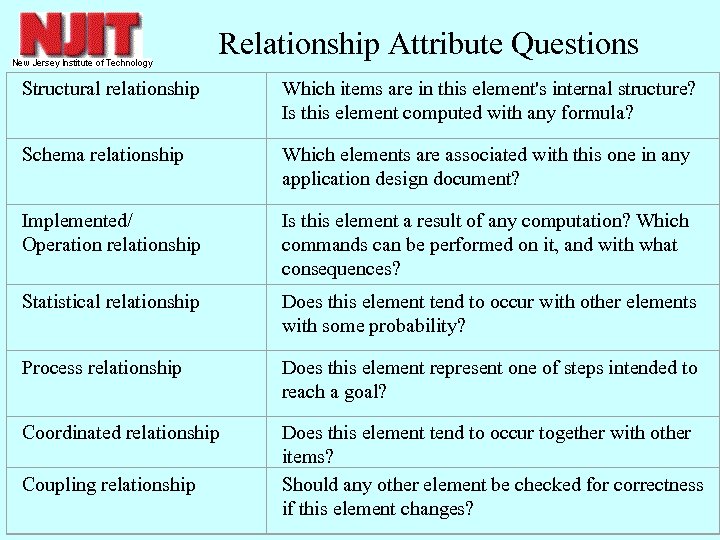
Relationship Attribute Questions Structural relationship Which items are in this element's internal structure? Is this element computed with any formula? Schema relationship Which elements are associated with this one in any application design document? Implemented/ Operation relationship Is this element a result of any computation? Which commands can be performed on it, and with what consequences? Statistical relationship Does this element tend to occur with other elements with some probability? Process relationship Does this element represent one of steps intended to reach a goal? Coordinated relationship Does this element tend to occur together with other items? Should any other element be checked for correctness if this element changes? Coupling relationship
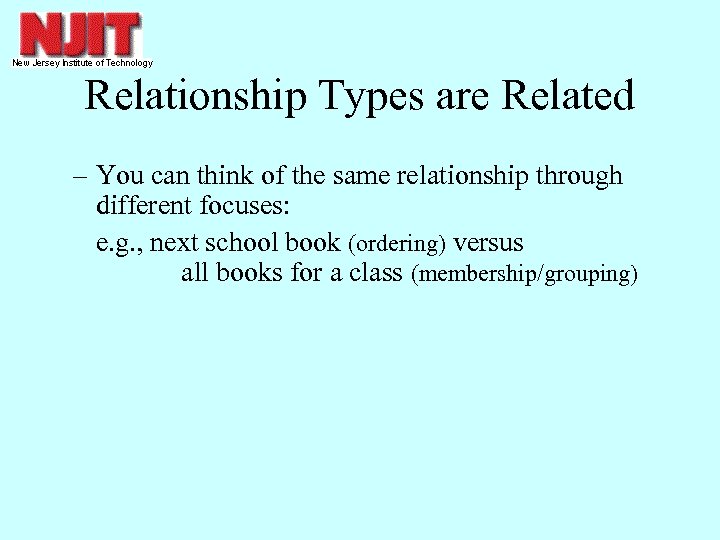
Relationship Types are Related – You can think of the same relationship through different focuses: e. g. , next school book (ordering) versus all books for a class (membership/grouping)
Relationship Taxonomy Focus
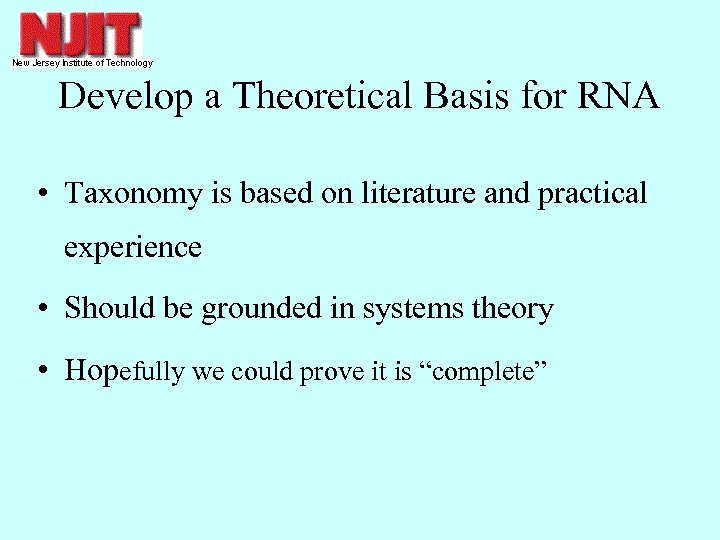
Develop a Theoretical Basis for RNA • Taxonomy is based on literature and practical experience • Should be grounded in systems theory • Hopefully we could prove it is “complete”
Selected References (1) Dynamic Hypermedia Engine (DHym. E) and Hypermedia Functionality – Bieber, Michael, Harri Oinas-Kukkonen and V. Balasubramanian, "Hypertext Functionality, " ACM Computing Surveys (forthcoming) http: //www. cis. njit. edu/~bieber/pub/acmcs/cs-bob. html – Bieber, Michael, Fabio Vitali, Helen Ashman, V. Balasubramanian, and Harri Oinas. Kukkonen, "Fourth Generation Hypermedia: Some Missing Links for the World Wide Web" International Journal of Human-Computer Studies 47, 1997, 31 -65 http: //www. hbuk. co. uk/ap/ijhcs/webusability/ – Bieber, Michael and Charles Kacmar, "Designing Hypertext Support for Computational Applications" Communications of the ACM, 38(8), August 1995, 99107 http: //www. cis. njit. edu/~bieber/pub/BK 95. pdf – Bieber, Michael and Fabio Vitali, "Toward Support for Hypermedia on the World Wide Web" IEEE Computer 30(1), 1997 http: //www. cs. unibo. it/~fabio/papers/1997/IEEEC 97/January/IEEEC 0197. html
Selected References (2) Relationship Analysis (RA) and Hypermedia Design Methodologies – Bieber, Michael and Joonheee Yoo "Hypermedia: A Design Philosophy, " ACM Computing Surveys (forthcoming) http: //www. cis. njit. edu/~bieber/pub/acmcs/cs-yb. html – Yoo, Joonhee and Michael Bieber, "Towards a Relationship Navigation Analysis, " Proceedings of the 33 rd Hawaii International Conference on System Sciences, IEEE Press, Washington, D. C. , 2000 http: //www. cis. njit. edu/~bieber/pub/hicss 00/INWEB 02. pdf – Balasubramanian, V. , Michael Bieber and Tomás Isakowitz, "Systematic Hypermedia Design, " Information Systems Journal (forthcoming) http: //www. cis. njit. edu/~bieber/pub/ISJ 98/isj 98. pdf (3) Collaborative Knowledge Evolution – Bieber, Michael, Roxanne Hiltz, Murray Turoff et al. , Collaborative Knowledge Support for Virtual Communities, NSF Grant Proposal, 2000 ask for URL…
Скачать презентацию Finding Linking Opportunities through Relationship-based Analysis Joonhee Yoo
f00b566b8c7e5c9be5fef5e064d03b4f.ppt