 Скачать презентацию Financing sustainable urban transport infrastructure Dorothée Coucharrière DG
d30dea5f03076fa4f2d370b02d0fedb5.ppt
- Количество слайдов: 16



Financing sustainable urban transport infrastructure Dorothée Coucharrière, DG Move C 1 Jld. FE 2015 - November 5 th, 2015 Brussels Transport
Main problems to fix 1) Energy supply at risk Oil accounts for 94% of transport fuels, causing an enourmous EU import bill of up to one billion Euros a day. 2) GHG emissions reduction necessary According to the White Paper on Transport 2011, the sector has to reduce 60 % of its CO 2 emissions by 2050 (benchmark 1990). 3) Air quality and congested infrastructure New and clean forms of mobility need to be established. 4) Competitiveness of EU industry Growth and jobs can be created by restoring world leadership of the EU transport industry. Transport
Policy drivers • The 2011 Transport White Paper - Two 'urban' goals • • Phase out the use of conventionally fuelled cars in cities by 2050 Towards "zero emission" city logistics in major urban centres by 2030 • Urban Mobility Package -2013 Promotion of Sustainable Urban Mobility Plans (SUMP's): Urban Logistics, Urban ITS, Urban access regulations, Urban Road safety • Directive for the deployment of alternative fuels infrastucture-2014: national plans for the deployment in urban areas for CNG refuelling points and electric recharging point by 2020 • The 2030 Climate and Energy policy framework: “comprehensive and technology neutral approach for the promotion of emissions reduction and energy efficiency in transport, for electric transportation and for renewable energy sources in transport also after 2020". • The Energy Union package Feb 25 th, 2015: "tightening CO₂ emission standards for passenger cars and vans post-2020, and on measures to increase fuel efficiency and reduce CO₂ emissions for heavy duty vehicles and buses"; "Electrification of transport […] especially for road (short and medium distance) and rail transport. " "The Commission will take further action to create the right market conditions for an increased deployment of alternative fuels and to further promote procurement of clean vehicles". Transport
Urban nodes Connecting Europe Facility (CEF) Transport
Financing innovative urban infrastructure in Europe Connecting Europe Facility (CEF) with 'urban nodes’ and 'innovation': grant schemes and Innovative Financial Instruments (26 bn€ for TEN-T for 2014 -2020): networks, cross-border infrastructure, urban nodes, innovation of which 11 bn€ comes from Cohesion Funds. • TEN-T guidelines - Article 30 – "urban node": means an urban area where the transport infrastructure of the trans-European transport network, such as ports including passenger terminals, airports, railway stations, logistic platforms and freight terminals located in and around an urban area, is connected with other parts of that infrastructure and with the infrastructure for regional and local traffic; • TEN-T guidelines - Article 33 - "innovation" : to support and promote the decarbonisation of transport through transition to innovative and sustainable transport technologies […] by stimulating energy efficiency, introduce alternative propulsion systems, including electricity supply systems, and provide corresponding infrastructure… Transport
Urban nodes : link between long-distance and last-mile • Importance of urban dimension in TEN-T: 80% EU GDP is generated in urban areas 73% EU population live in urban areas. • First and last mile • Most passenger journeys start and end in urban areas e. g. links to stations and airports, journey planning, ticketing, information, assistance, people with special needs. • Urban freight are often part of international/national supply chains – first and last mile disproportionally expensive. Transport
Through journeys across urban areas • Links between corridors: Passengers – infrastructure, services, information, tickets. Freight – infrastructure, ICT • Links between modes: - Passengers – infrastructure, information, tickets, facilities, liability - Freight – logistics centres, integrated services • Integration of physical infrastructure and: - Levels of government - Neighbouring administrative districts - Public and private actors - Modes - Innovative procurement • • Transport
Alternative fuels in urban nodes Urban nodes priority aims at promoting action along the multi-modal core network corridors which makes vital contributions to the achievement of the overall corridor objectives, such as: • • • significant CO₂ pollutant and noise reduction (with urban areas standing for a major share of the overall emissions from transport); enhancing service quality levels (travelling time, travelling comfort, safety, etc. ); address missing links, bottlenecks and other barriers in the transfer between the trans-European and the urban legs of TEN-T journeys (link SUMPs and TEN-T)… Ø Works/studies with pilot activities to test and validate alternative fuels infrastructure for road transport in urban nodes. Transport
Horizon 2020 WP 2016 -2017 Integrating urban nodes in the TEN-T core network Transport
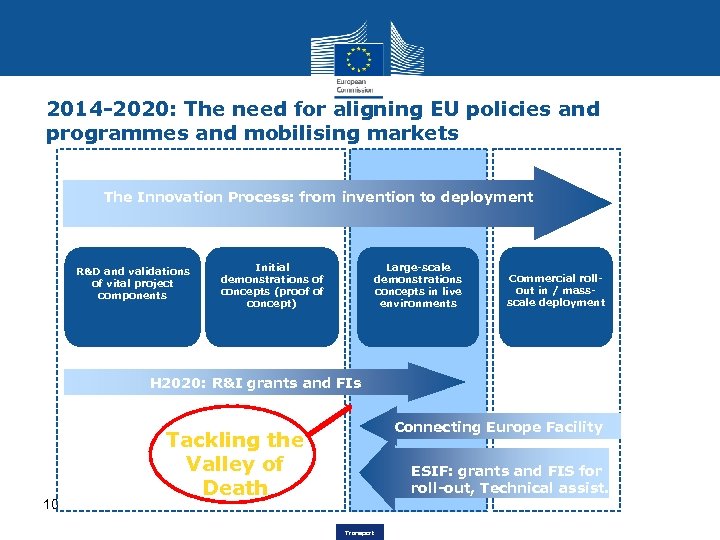
2014 -2020: The need for aligning EU policies and programmes and mobilising markets The Innovation Process: from invention to deployment R&D and validations of vital project components Initial demonstrations of concepts (proof of concept) Large-scale demonstrations concepts in live environments Commercial rollout in / massscale deployment H 2020: R&I grants and FIs 10 Connecting Europe Facility Tackling the Valley of Death ESIF: grants and FIS for roll-out, Technical assist. Transport
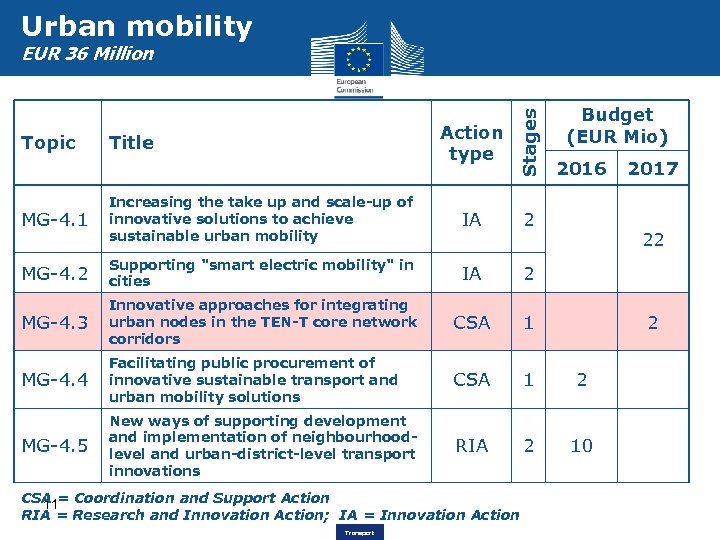
Urban mobility EUR 36 Million Action type Stages Budget (EUR Mio) MG-4. 1 Increasing the take up and scale-up of innovative solutions to achieve sustainable urban mobility IA 2 MG-4. 2 Supporting "smart electric mobility" in cities IA 2 MG-4. 3 Innovative approaches for integrating urban nodes in the TEN-T core network corridors CSA 1 MG-4. 4 Facilitating public procurement of innovative sustainable transport and urban mobility solutions CSA 1 2 MG-4. 5 New ways of supporting development and implementation of neighbourhoodlevel and urban-district-level transport innovations RIA 2 10 Topic Title CSA = Coordination and Support Action 11 RIA = Research and Innovation Action; IA = Innovation Action Transport 2016 2017 22 2
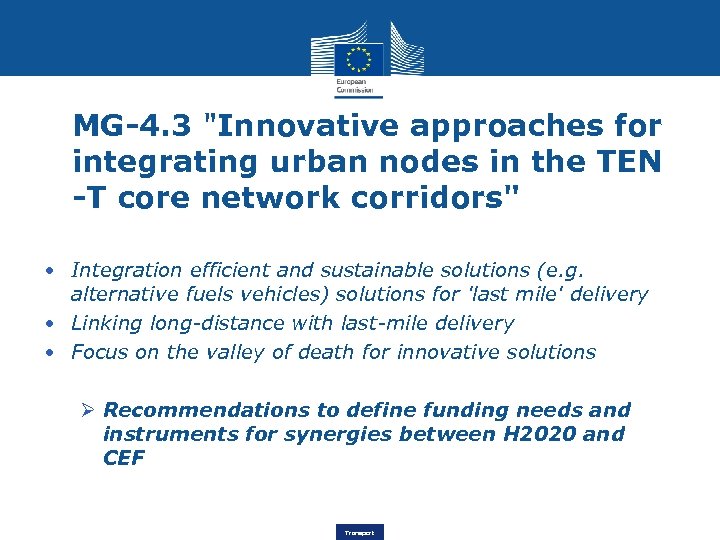
MG-4. 3 "Innovative approaches for integrating urban nodes in the TEN -T core network corridors" • Integration efficient and sustainable solutions (e. g. alternative fuels vehicles) solutions for 'last mile' delivery • Linking long-distance with last-mile delivery • Focus on the valley of death for innovative solutions Ø Recommendations to define funding needs and instruments for synergies between H 2020 and CEF Transport
The European Fund for Strategic Investments (EFSI) • € 21 billion guarantee to leverage an extra financing capacity of € 255 billion => total extra financing of € 315 billion • Cities and private promoters active in cities should engage with the EIB and the National Promotional Banks • Investment Platforms will be created under the EFSI Regulations for certain countries and sectors, for example transport Transport
EFSI Urban transport § Public and private investors to engage with EFSI through: o project co-financing, on a risk-sharing basis with EIB covered by EFSI o participation to Investment Platforms which support a number of projects § MS to support national promotional banks, institutions, investment platforms or funds. § EIB to guarantee platforms, funds or national promotional banks or institutions that invest in eligible operations such as: o national or sub-national investment platforms o multi-country or regional platforms covering several Member States / third countries o thematic platforms that group investment projects in a given sector Ø Investment platforms : public authorities, experts, education, training and research institutions, the relevant social partners and representatives of the civil society and other relevant actors at Union, national and regional levels. Transport
• EFSI guarantee will enable the EIB to take riskier projects, e. g. smart urban mobility and alternative fuels projects • Research and innovation is one of the key priorities, as is urban mobility. EFSI funds are expected to invest 11 -12 EUR billion in urban mobility over 2014 -2020. • Innovative projects can also employ financial instruments, facilitated by investment platforms. • Advisory Hub will function as a one-stop-shop and work together with a network of national promotional banks. • Regional hubs are likely to be created: http: //www. eib. org/eiah/index. htm Transport
Thank you ! dorothee. coucharriere@ec. europa. eu INEA Helpdesk: INEA-CEF-transport-calls-2014@ec. europa. eu Consult INEA website: http: //inea. ec. europa. eu Transport
Скачать презентацию Financing sustainable urban transport infrastructure Dorothée Coucharrière DG
d30dea5f03076fa4f2d370b02d0fedb5.ppt