


 Скачать презентацию Financial statements taxes and cash flow Chapter
2ce224d61e85f7486e6ab9e5b74d88a1.ppt
- Количество слайдов: 31
 Financial statements, taxes and cash flow Chapter 2
 Key concepts and skills • Know the difference between book value and market value • Know the difference between accounting income and cash flow • Know the difference between average and marginal tax rates • Know how to determine a firm’s cash flow from its financial statements Copyright © 2011 Mc. Graw-Hill Australia Pty Ltd PPTs t/a Essentials of Corporate Finance 2 e by Ross et al. Slides prepared by David E. Allen and Abhay K. Singh 2 -2
 Chapter outline • The balance sheet • The income statement • Taxes • Cash flow Copyright © 2011 Mc. Graw-Hill Australia Pty Ltd PPTs t/a Essentials of Corporate Finance 2 e by Ross et al. Slides prepared by David E. Allen and Abhay K. Singh 2 -3
 The balance sheet • The balance sheet is a snapshot of a firm’s assets and liabilities at a given point in time. • Assets: The left-hand side: − Current or fixed − In order of decreasing liquidity • Liabilities and owners’ equity: The right-hand side: – Current or long term – In ascending order of when due to be paid • Balance sheet identity Assets = Liabilities + Shareholders’ equity Copyright © 2011 Mc. Graw-Hill Australia Pty Ltd PPTs t/a Essentials of Corporate Finance 2 e by Ross et al. Slides prepared by David E. Allen and Abhay K. Singh 2 -4
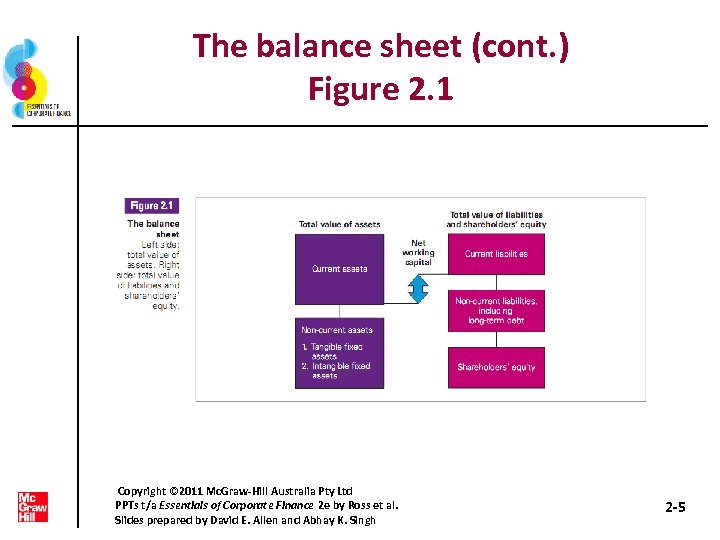 The balance sheet (cont. ) Figure 2. 1 Copyright © 2011 Mc. Graw-Hill Australia Pty Ltd PPTs t/a Essentials of Corporate Finance 2 e by Ross et al. Slides prepared by David E. Allen and Abhay K. Singh 2 -5
 The balance sheet (cont. ) • Net working capital – Current assets minus current liabilities – Usually positive for a healthy firm • Liquidity − Speed and ease of conversion to cash without significant loss of value − Valuable in avoiding financial distress • Debt versus equity − Shareholders’ equity = Assets - Liabilities Copyright © 2011 Mc. Graw-Hill Australia Pty Ltd PPTs t/a Essentials of Corporate Finance 2 e by Ross et al. Slides prepared by David E. Allen and Abhay K. Singh 2 -6
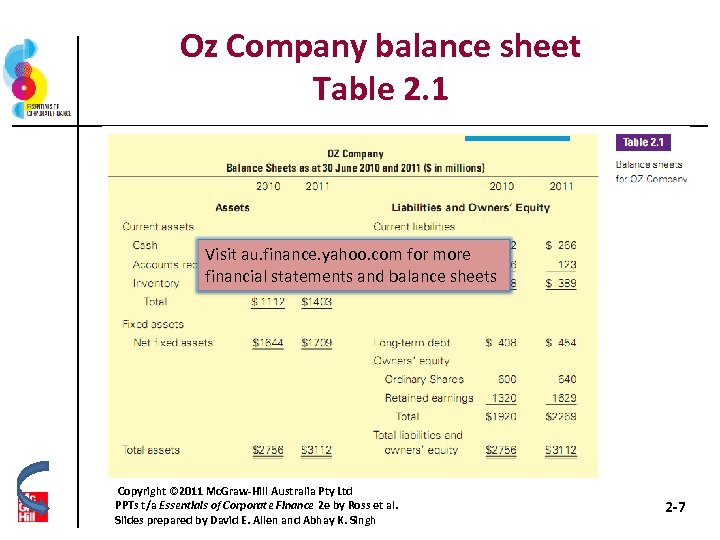 Oz Company balance sheet Table 2. 1 Visit au. finance. yahoo. com for more financial statements and balance sheets Copyright © 2011 Mc. Graw-Hill Australia Pty Ltd PPTs t/a Essentials of Corporate Finance 2 e by Ross et al. Slides prepared by David E. Allen and Abhay K. Singh 2 -7
 Market value vs book value • Market value is the price at which assets, liabilities or equity can actually be bought or sold. • The balance sheet provides the book value of assets, liabilities and equity. • Market value and book value are often very different. Why? • Which is more important to the decisionmaking process? Copyright © 2011 Mc. Graw-Hill Australia Pty Ltd PPTs t/a Essentials of Corporate Finance 2 e by Ross et al. Slides prepared by David E. Allen and Abhay K. Singh 2 -8
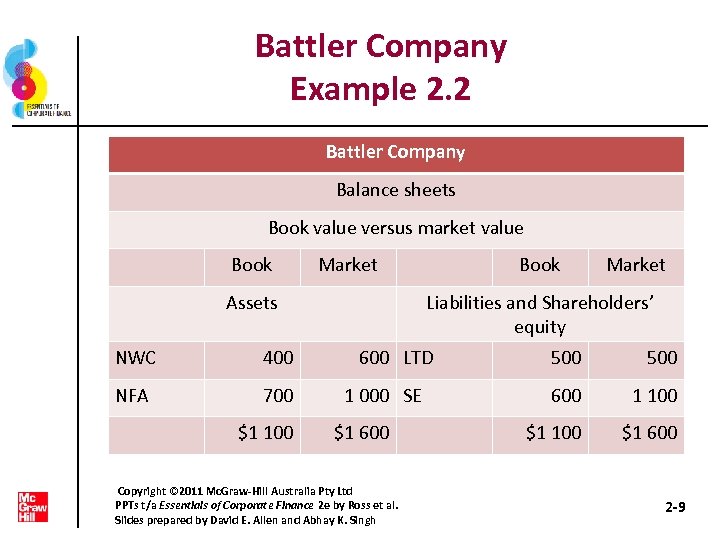 Battler Company Example 2. 2 Battler Company Balance sheets Book value versus market value Book Market Assets NWC 400 NFA 700 $1 100 Book Market Liabilities and Shareholders’ equity 600 LTD 1 000 SE $1 600 Copyright © 2011 Mc. Graw-Hill Australia Pty Ltd PPTs t/a Essentials of Corporate Finance 2 e by Ross et al. Slides prepared by David E. Allen and Abhay K. Singh 500 600 1 100 $1 600 2 -9
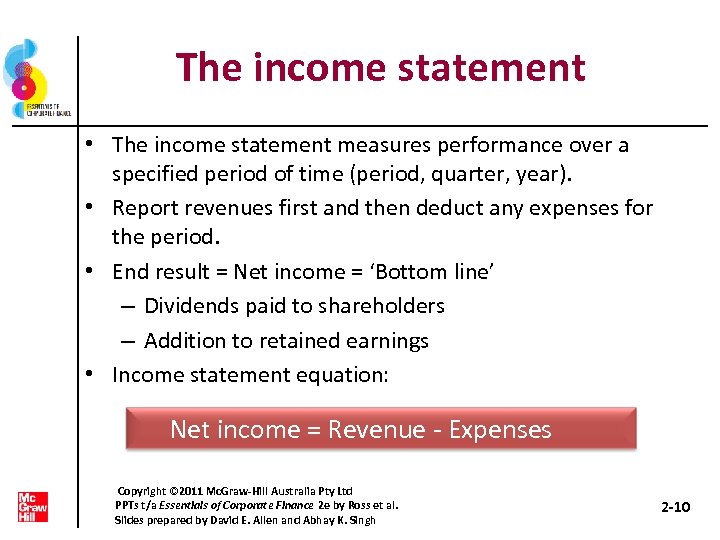 The income statement • The income statement measures performance over a specified period of time (period, quarter, year). • Report revenues first and then deduct any expenses for the period. • End result = Net income = ‘Bottom line’ – Dividends paid to shareholders – Addition to retained earnings • Income statement equation: Net income = Revenue - Expenses Copyright © 2011 Mc. Graw-Hill Australia Pty Ltd PPTs t/a Essentials of Corporate Finance 2 e by Ross et al. Slides prepared by David E. Allen and Abhay K. Singh 2 -10
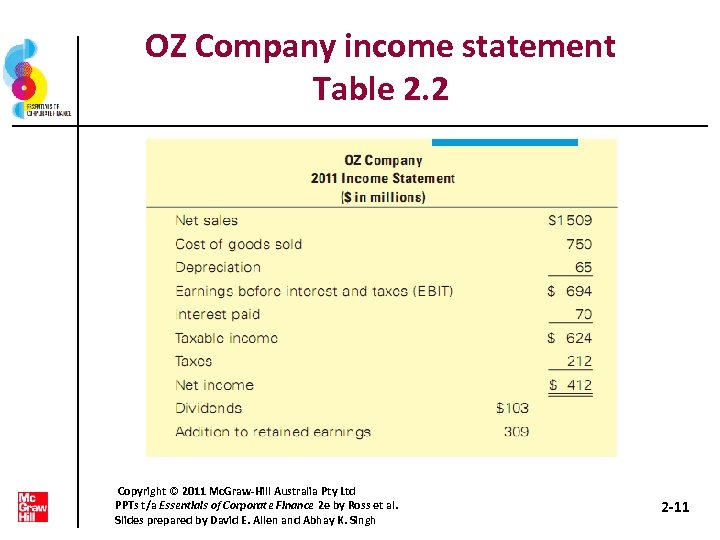 OZ Company income statement Table 2. 2 Copyright © 2011 Mc. Graw-Hill Australia Pty Ltd PPTs t/a Essentials of Corporate Finance 2 e by Ross et al. Slides prepared by David E. Allen and Abhay K. Singh 2 -11
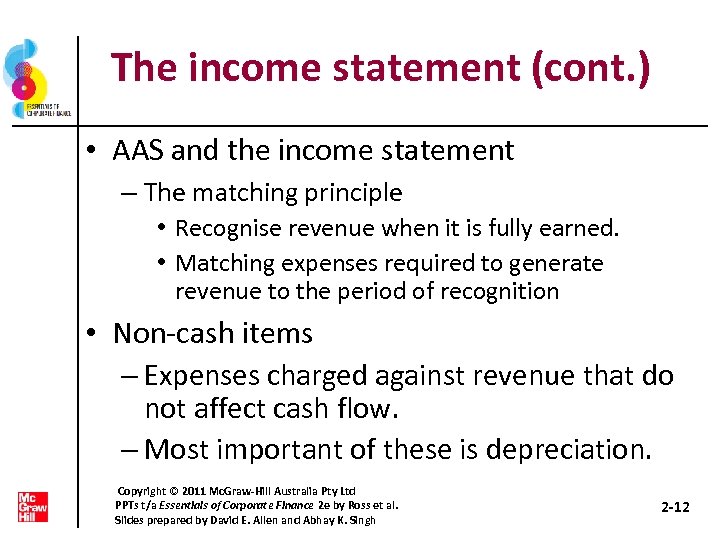 The income statement (cont. ) • AAS and the income statement – The matching principle • Recognise revenue when it is fully earned. • Matching expenses required to generate revenue to the period of recognition • Non-cash items – Expenses charged against revenue that do not affect cash flow. – Most important of these is depreciation. Copyright © 2011 Mc. Graw-Hill Australia Pty Ltd PPTs t/a Essentials of Corporate Finance 2 e by Ross et al. Slides prepared by David E. Allen and Abhay K. Singh 2 -12
 The income statement (cont. ) • Time and costs – Fixed or variable costs – Not obvious on income statement • Earnings management – Smoothing earnings – Wriggle room Copyright © 2011 Mc. Graw-Hill Australia Pty Ltd PPTs t/a Essentials of Corporate Finance 2 e by Ross et al. Slides prepared by David E. Allen and Abhay K. Singh 2 -13
 Example: Work the Web • Most Australian companies post their annual reports on their websites. Look for them in the investor or shareholder areas. • Go to companies’ websites and see what kinds of financial reports you can find. • Example: Virgin Blue Copyright © 2011 Mc. Graw-Hill Australia Pty Ltd PPTs t/a Essentials of Corporate Finance 2 e by Ross et al. Slides prepared by David E. Allen and Abhay K. Singh 2 -14
 Taxes • The one thing we can rely on with taxes is that they are always changing. • Tax bill depends on tax code, which can be amended by political will. • Corporate tax in Australia and New Zealand – Flat rate tax (currently 30%) • Marginal vs average tax rates – Marginal–the percentage paid on the next dollar earned – Average–the tax bill/taxable income • Other taxes Copyright © 2011 Mc. Graw-Hill Australia Pty Ltd PPTs t/a Essentials of Corporate Finance 2 e by Ross et al. Slides prepared by David E. Allen and Abhay K. Singh 2 -15
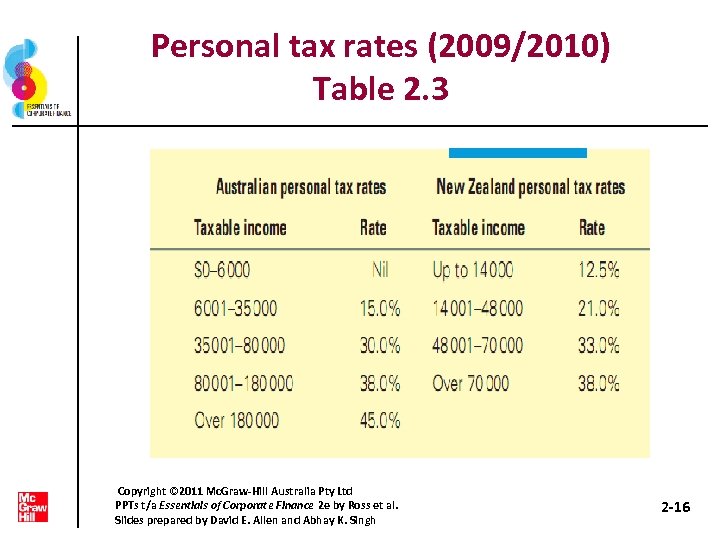 Personal tax rates (2009/2010) Table 2. 3 Copyright © 2011 Mc. Graw-Hill Australia Pty Ltd PPTs t/a Essentials of Corporate Finance 2 e by Ross et al. Slides prepared by David E. Allen and Abhay K. Singh 2 -16
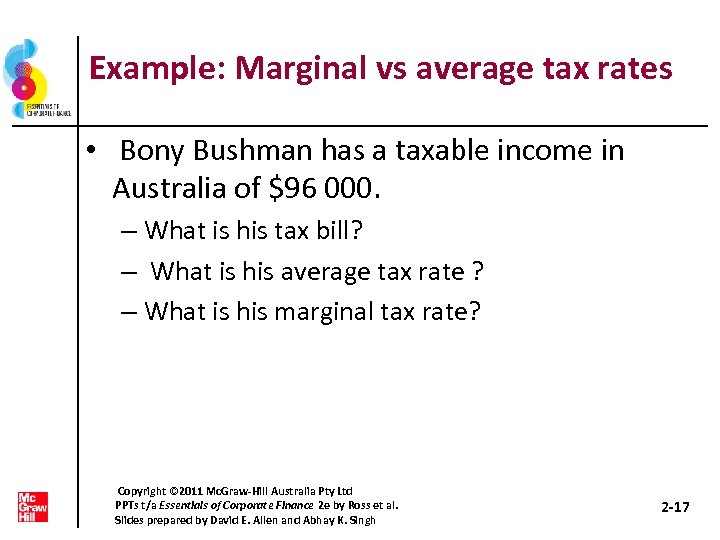 Example: Marginal vs average tax rates • Bony Bushman has a taxable income in Australia of $96 000. – What is his tax bill? – What is his average tax rate ? – What is his marginal tax rate? Copyright © 2011 Mc. Graw-Hill Australia Pty Ltd PPTs t/a Essentials of Corporate Finance 2 e by Ross et al. Slides prepared by David E. Allen and Abhay K. Singh 2 -17
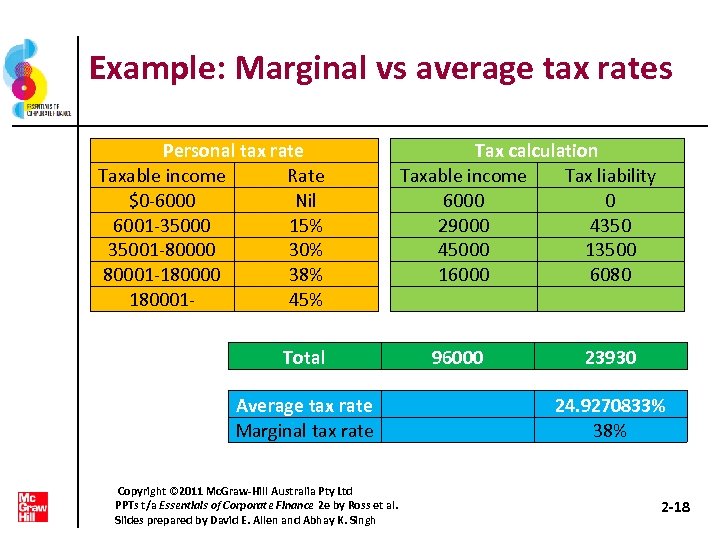 Example: Marginal vs average tax rates Personal tax rate Taxable income Rate $0 -6000 Nil 6001 -35000 15% 35001 -80000 30% 80001 -180000 38% 18000145% Tax calculation Taxable income Tax liability 6000 0 29000 4350 45000 13500 16000 6080 Total 96000 23930 Average tax rate Marginal tax rate 24. 9270833% 38% Copyright © 2011 Mc. Graw-Hill Australia Pty Ltd PPTs t/a Essentials of Corporate Finance 2 e by Ross et al. Slides prepared by David E. Allen and Abhay K. Singh 2 -18
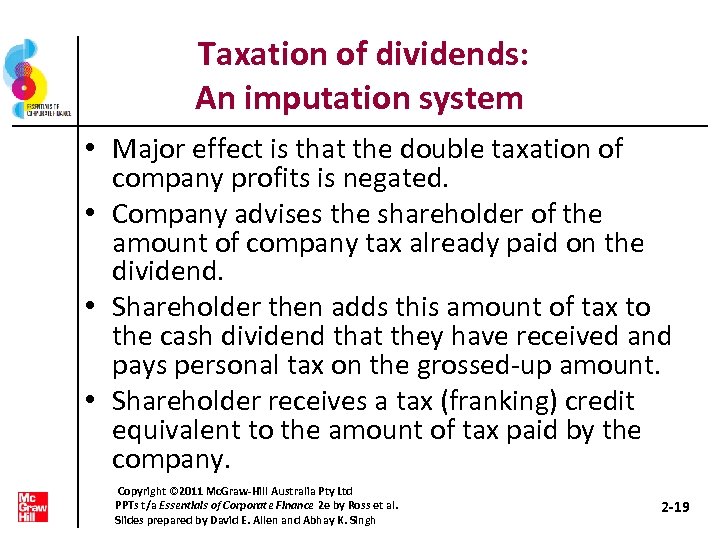 Taxation of dividends: An imputation system • Major effect is that the double taxation of company profits is negated. • Company advises the shareholder of the amount of company tax already paid on the dividend. • Shareholder then adds this amount of tax to the cash dividend that they have received and pays personal tax on the grossed-up amount. • Shareholder receives a tax (franking) credit equivalent to the amount of tax paid by the company. Copyright © 2011 Mc. Graw-Hill Australia Pty Ltd PPTs t/a Essentials of Corporate Finance 2 e by Ross et al. Slides prepared by David E. Allen and Abhay K. Singh 2 -19
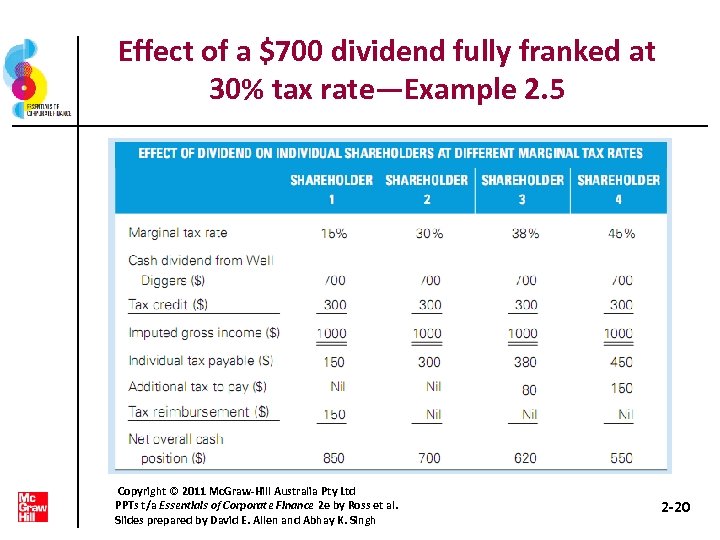 Effect of a $700 dividend fully franked at 30% tax rate—Example 2. 5 Copyright © 2011 Mc. Graw-Hill Australia Pty Ltd PPTs t/a Essentials of Corporate Finance 2 e by Ross et al. Slides prepared by David E. Allen and Abhay K. Singh 2 -20
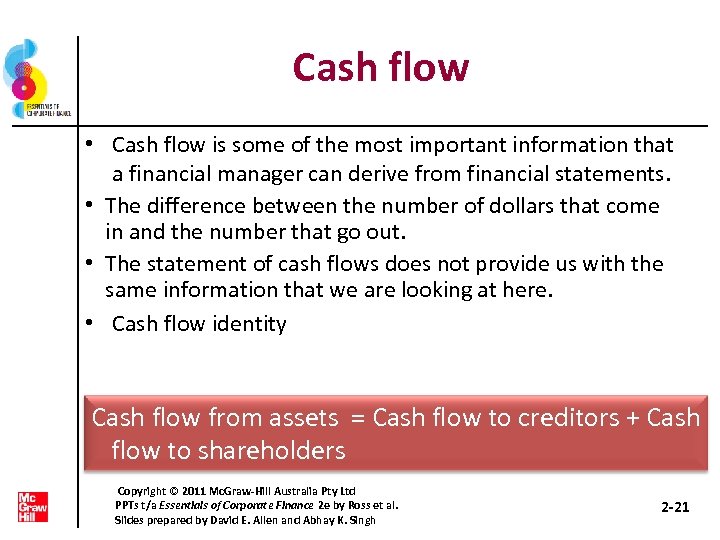 Cash flow • Cash flow is some of the most important information that a financial manager can derive from financial statements. • The difference between the number of dollars that come in and the number that go out. • The statement of cash flows does not provide us with the same information that we are looking at here. • Cash flow identity Cash flow from assets = Cash flow to creditors + Cash flow to shareholders Copyright © 2011 Mc. Graw-Hill Australia Pty Ltd PPTs t/a Essentials of Corporate Finance 2 e by Ross et al. Slides prepared by David E. Allen and Abhay K. Singh 2 -21
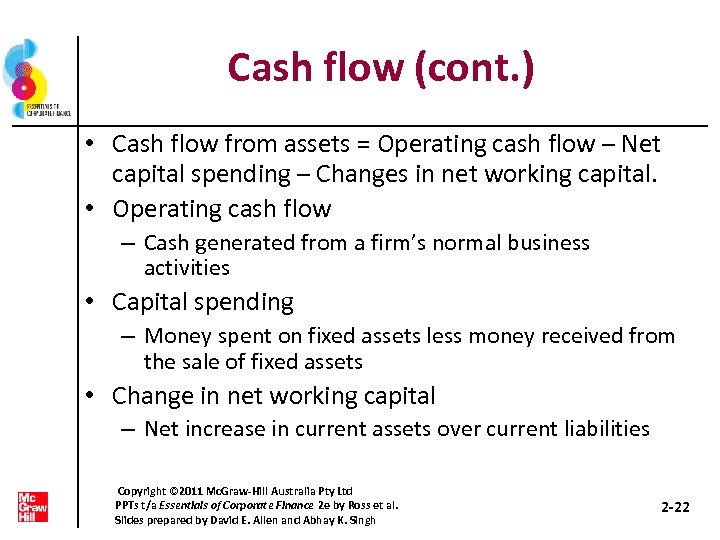 Cash flow (cont. ) • Cash flow from assets = Operating cash flow – Net capital spending – Changes in net working capital. • Operating cash flow – Cash generated from a firm’s normal business activities • Capital spending – Money spent on fixed assets less money received from the sale of fixed assets • Change in net working capital – Net increase in current assets over current liabilities Copyright © 2011 Mc. Graw-Hill Australia Pty Ltd PPTs t/a Essentials of Corporate Finance 2 e by Ross et al. Slides prepared by David E. Allen and Abhay K. Singh 2 -22
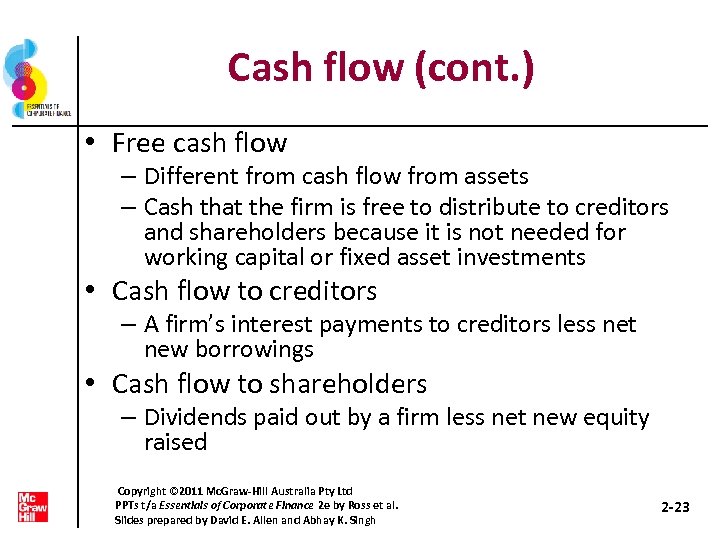 Cash flow (cont. ) • Free cash flow – Different from cash flow from assets – Cash that the firm is free to distribute to creditors and shareholders because it is not needed for working capital or fixed asset investments • Cash flow to creditors – A firm’s interest payments to creditors less net new borrowings • Cash flow to shareholders – Dividends paid out by a firm less net new equity raised Copyright © 2011 Mc. Graw-Hill Australia Pty Ltd PPTs t/a Essentials of Corporate Finance 2 e by Ross et al. Slides prepared by David E. Allen and Abhay K. Singh 2 -23
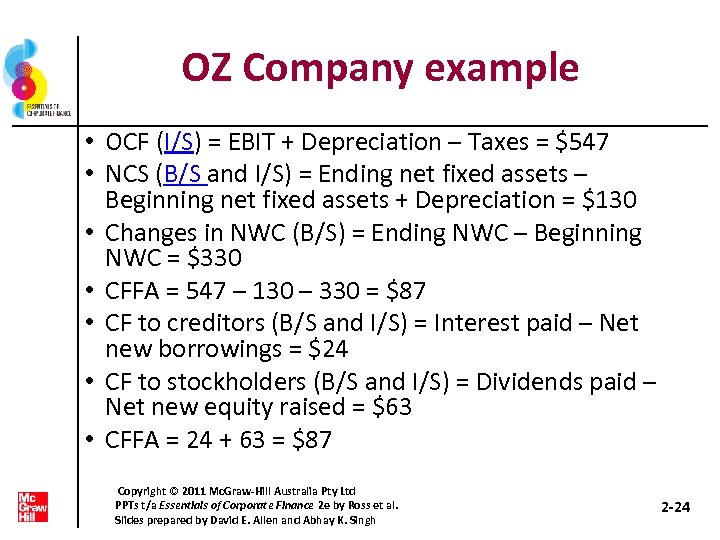 OZ Company example • OCF (I/S) = EBIT + Depreciation – Taxes = $547 • NCS (B/S and I/S) = Ending net fixed assets – Beginning net fixed assets + Depreciation = $130 • Changes in NWC (B/S) = Ending NWC – Beginning NWC = $330 • CFFA = 547 – 130 – 330 = $87 • CF to creditors (B/S and I/S) = Interest paid – Net new borrowings = $24 • CF to stockholders (B/S and I/S) = Dividends paid – Net new equity raised = $63 • CFFA = 24 + 63 = $87 Copyright © 2011 Mc. Graw-Hill Australia Pty Ltd PPTs t/a Essentials of Corporate Finance 2 e by Ross et al. Slides prepared by David E. Allen and Abhay K. Singh 2 -24
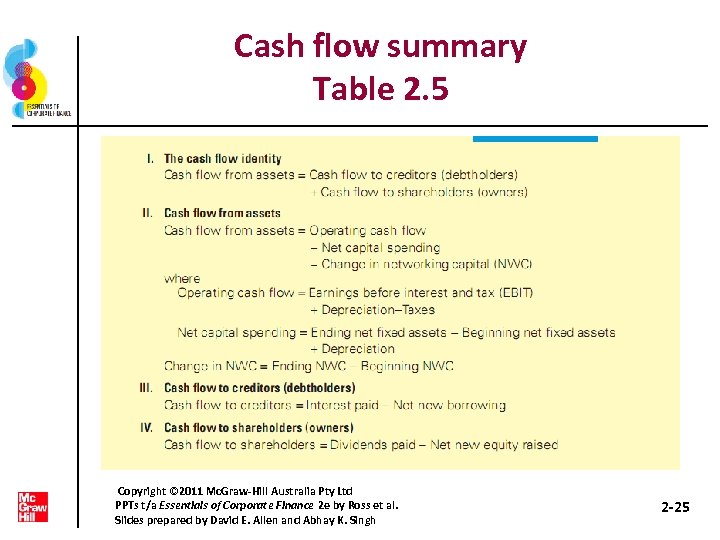 Cash flow summary Table 2. 5 Copyright © 2011 Mc. Graw-Hill Australia Pty Ltd PPTs t/a Essentials of Corporate Finance 2 e by Ross et al. Slides prepared by David E. Allen and Abhay K. Singh 2 -25
 Quick quiz • What is the difference between book value and market value? – Which should we use for decision-making purposes? • What is the difference between accounting income and cash flow? – Which do we need to use when making decisions? Copyright © 2011 Mc. Graw-Hill Australia Pty Ltd PPTs t/a Essentials of Corporate Finance 2 e by Ross et al. Slides prepared by David E. Allen and Abhay K. Singh 2 -26
 Quick quiz (cont. ) • What is the difference between average and marginal tax rates? – Which should we use when making financial decisions? • How do we determine a firm’s cash flows? – What are the equations and where do we find the information? Copyright © 2011 Mc. Graw-Hill Australia Pty Ltd PPTs t/a Essentials of Corporate Finance 2 e by Ross et al. Slides prepared by David E. Allen and Abhay K. Singh 2 -27
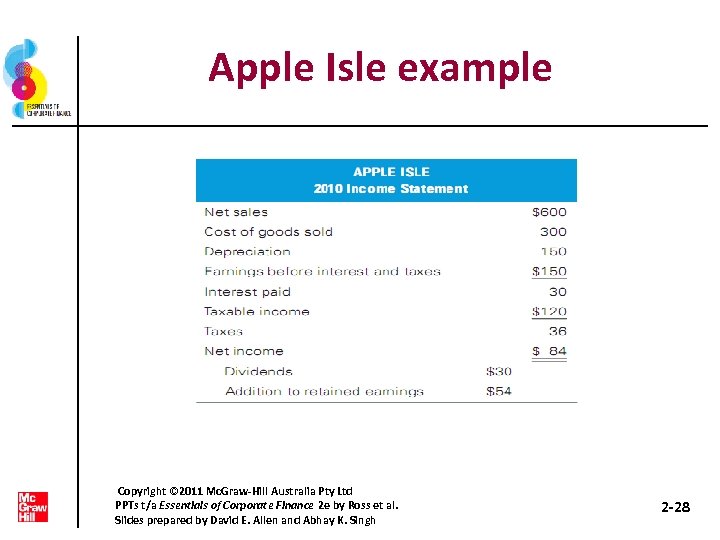 Apple Isle example Copyright © 2011 Mc. Graw-Hill Australia Pty Ltd PPTs t/a Essentials of Corporate Finance 2 e by Ross et al. Slides prepared by David E. Allen and Abhay K. Singh 2 -28
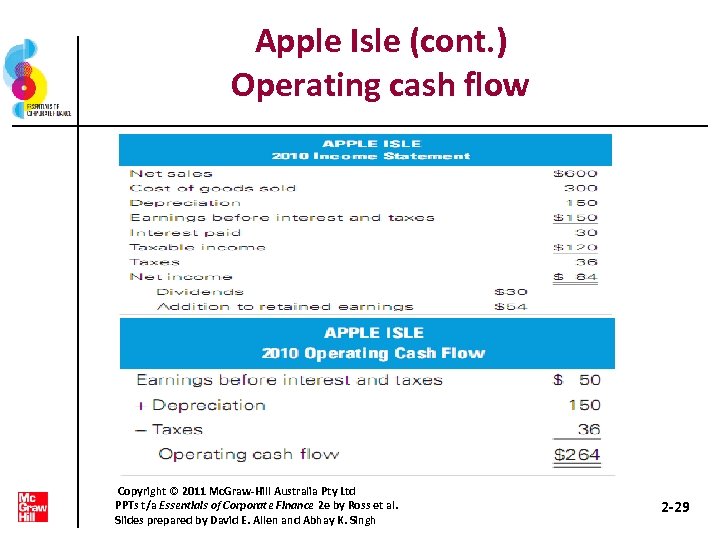 Apple Isle (cont. ) Operating cash flow Copyright © 2011 Mc. Graw-Hill Australia Pty Ltd PPTs t/a Essentials of Corporate Finance 2 e by Ross et al. Slides prepared by David E. Allen and Abhay K. Singh 2 -29
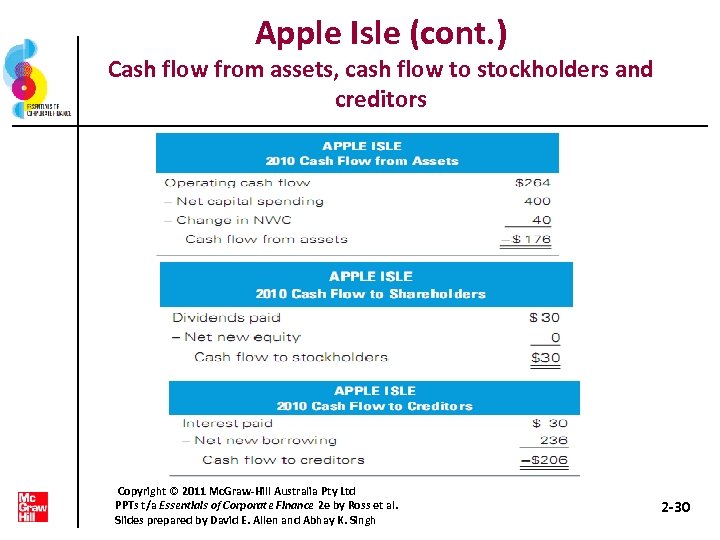 Apple Isle (cont. ) Cash flow from assets, cash flow to stockholders and creditors Copyright © 2011 Mc. Graw-Hill Australia Pty Ltd PPTs t/a Essentials of Corporate Finance 2 e by Ross et al. Slides prepared by David E. Allen and Abhay K. Singh 2 -30
 Chapter 2 END 2 -31