 Скачать презентацию Financial Statements Meeting with National Contact Points Brussels
1d45696b0500f6c90366e4cca026e1dc.ppt
- Количество слайдов: 33



Financial Statements Meeting with National Contact Points Brussels 8 March 2005
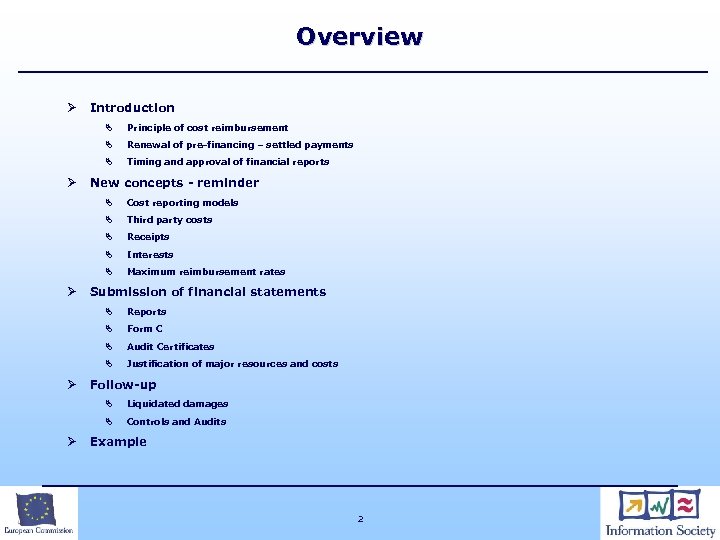
Overview Ø Introduction Ä Ä Renewal of pre-financing – settled payments Ä Ø Principle of cost reimbursement Timing and approval of financial reports New concepts - reminder Ä Ä Third party costs Ä Receipts Ä Interests Ä Ø Cost reporting models Maximum reimbursement rates Submission of financial statements Ä Ä Form C Ä Audit Certificates Ä Ø Reports Justification of major resources and costs Follow-up Ä Ä Ø Liquidated damages Controls and Audits Example 2
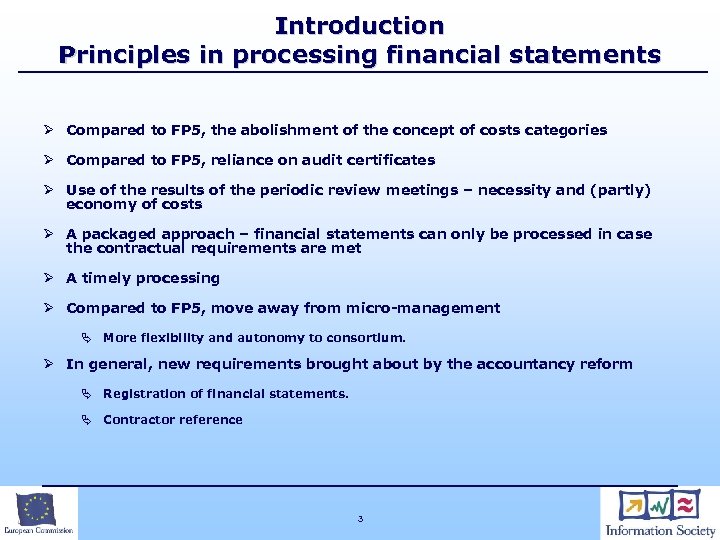
Introduction Principles in processing financial statements Ø Compared to FP 5, the abolishment of the concept of costs categories Ø Compared to FP 5, reliance on audit certificates Ø Use of the results of the periodic review meetings – necessity and (partly) economy of costs Ø A packaged approach – financial statements can only be processed in case the contractual requirements are met Ø A timely processing Ø Compared to FP 5, move away from micro-management Ä More flexibility and autonomy to consortium. Ø In general, new requirements brought about by the accountancy reform Ä Registration of financial statements. Ä Contractor reference 3
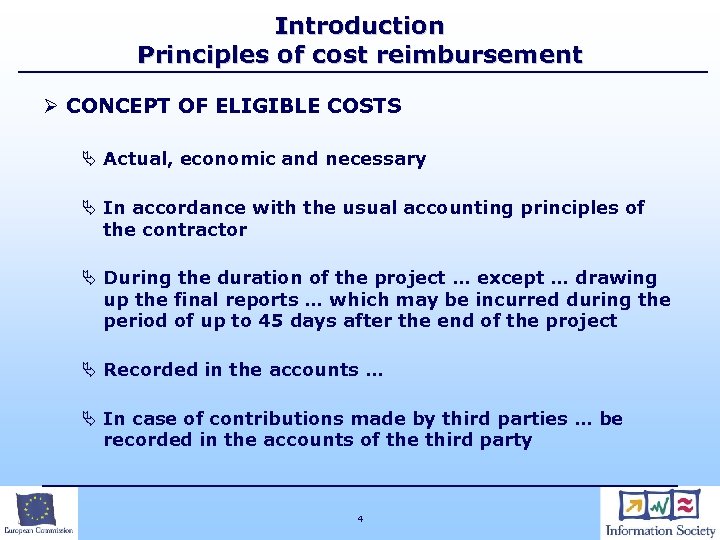
Introduction Principles of cost reimbursement Ø CONCEPT OF ELIGIBLE COSTS Ä Actual, economic and necessary Ä In accordance with the usual accounting principles of the contractor Ä During the duration of the project … except … drawing up the final reports … which may be incurred during the period of up to 45 days after the end of the project Ä Recorded in the accounts … Ä In case of contributions made by third parties … be recorded in the accounts of the third party 4
Introduction Principles of cost reimbursement Ø CONCEPT OF NON-ELIGIBLE COSTS. Ä Any identifiable indirect taxes, including VAT or duties; Ä Interest owed; Ä Provisions for possible future losses or charges; Ä Exchange losses; Ä Costs declared, incurred or reimbursed in respect of another Community project; Ä Costs related to the return on capital; Ä Debt and debt related charges; Ä Excessive or reckless expenditure; Ä Any cost which does not meet the conditions established in Article II. 19. 1 5
Introduction Principles of costs reimbursement Ø Reimbursement of eligible costs claimed by contractors Ø In accordance with the cost reporting models used by each contractor Ø Maximum reimbursement rates of eligible costs per type of activity Ø Approval of requested periodic reports Ø Subject – if required in the contract - to the submission of an audit certificate Ø Taking into account the receipts of the project Ø Limits of public funding established by international regulations and in particular by the Community framework for State aid for research and development for certain activities 6
Introduction Renewal of pre-financing – settled payments Ø Pre-financing is calculated as % of the estimated Community financial contribution corresponding to the first/subsequent reporting period and the 6 months of the subsequent reporting period as indicated in the table of estimated breakdown of costs Ø Pre-financing is normally renewed at each reporting period Ø In case audit certificates are submitted a payment is made which settles the amounts justified and accepted during the reporting period Ø In case no audit certificates are submitted the amount justified and accepted is taking into account in calculating the pre-financing 7
Processing of financial statements Renewal of pre-financing – settled payments Ø Case with audit certificate – See Article 8. 2 (b) of the contract Ä Within 45 days following approval by the Commission of the reports related to each reporting period: F A payment which settles the amounts justified and accepted during F the reporting period Pre-financing of x% of the estimated Community financial contribution corresponding to the subsequent period and the first six months … Ä Where the amount justified and accepted for the reporting period is less than the pre-financing already paid to the consortium, that part of the pre-financing is re-qualified as a payment and the Commission shall deduct the difference from the subsequent pre-financing. Ä Where the amount justified and accepted for the reporting period is more than the pre-financing already paid to the consortium, the pre-financing is re-qualified as a payment and the Commission shall add the difference as a complementary payment at the time of the payment of the subsequent prefinancing 8
Processing of financial statements Renewal of pre-financing – settled payments Ø Case of a reporting period without audit certificates Ä Similar wording in Art. 8. 2 (b) however no ‘settlement of payment’ and Ä Art. 8. 2 (d) F Where less than 70% of a pre-financing has been used at the end of a reporting period, and …, subsequent intermediate pre-financing may be paid be only; ; If an audit certificate is provided … ; On the basis of a complementary periodic management report … Ø In addition in all cases one can never pay more than foreseen in the contract 9
Introduction Timing and approval of financial reports Ø Art. II. 7 – Reports and Deliverables All reports and deliverables shall be submitted within 45 days following the end of the respective reporting periods Ø Art. II. 8 – Evaluation and approval of Reports and Deliverables The Commission undertakes to evaluate all other reports (i. e. periodic management reports) within 45 days of receipt. The absence of a response from the Commission within 45 days of receipt of these reports shall not imply approval by the Commission. The Commission may reject these reports even after the time limit for payment. 10
New concepts -reminder Cost reporting models Ø FC: actual direct and indirect costs Ä all instruments, however in case of Co-ordination Actions and Specific Support Actions flat rate for indirect costs (20% of direct costs minus subcontracting) reimbursed Ø FCF (variant of FC): actual direct costs + flat rate for indirect costs (20% of direct costs minus subcontracting) Ä all instruments Ø AC: actual additional non-recurring direct costs + flat rate for indirect costs (20% of direct costs minus subcontracting) Ä all instruments 11
New concepts Cost reporting models – reminder Ø SMEs, non-commercial or non-profit organisations established either under public or private law, international organisations: FC/FCF Ø Physical persons: AC mandatory Ø Private companies (other than above): FC Ø AC: only for those non-commercial or non-profit organisations established either under public or private law or international organisations that do not have an accounting system that allows the share of their direct and indirect costs relating to the project to be distinguished. 12
New concepts Cost reporting models - reminder Ø Direct costs for contractors using the Additional Cost model Ä direct costs of personnel shall be limited to the actual costs of the personnel assigned to the project where the contractor has concluded with the personnel F a temporary contract for working on Community RTD projects F a temporary contract for completing a doctorate F a contract which depends, in full or in part, upon external funding additional to the normal recurring funding of the contractor. In that case, the costs charged to this contract must exclude any costs borne by the normal recurring funding 13
New concepts Cost reporting models - reminder Ø Partners using the AC cost reporting model will have to identify all the resources employed in the project and provide a global estimate of all their costs - not only additional eligible costs Ø Partners using the AC cost reporting model - exclude any direct additional costs specifically covered by contributions from third parties Ø Partners using the AC cost reporting model may charge permanent personnel under Management Activities under certain conditions – however for these costs no indirect costs can be claimed 14
New concepts Third party costs - reminder Ø Resources made available by third parties on the basis of an agreement between the contractor and the third party existing prior to its contribution to the project can be an eligible costs for the contractor Ø The tasks and their execution by such third parties are clearly identified in the Annex I Ø Costs will have to be incurred in accordance with the usual accounting principles of such third parties and be recorded in the accounts of this third party - to be covered by audit certificates Ø Contractors shall ensure that third parties whose resources are made available to the project are informed on the use of their resources 15
New concepts Receipts - Reminder Ø Three kinds of receipts F Financial transfers or their equivalent to the contractor from third parties, contributions in kind from third parties or income generated by the project Ø Financial transfers or contributions in kind F These endowments are considered as receipts of the project if the third party has provided them specifically to be used in the project (unless a prior commitment exists that the third party resources are to be reimbursed or used for common interest) F If these endowments are at the discretion of the contractor they are not to be considered as receipts. Ø Income generated by the project F General rule: any income generated by the project itself, including the sale of assets bought for the project, are considered as income to the project (receipts) F Derogation: income generated by the use of the knowledge from the project is not considered to be a receipt 16
New concepts Interests - reminder Ø Article II. 24. 5 Ä The Community contribution shall be offset by any interest or equivalent benefits yielded by the prefinancing of the project, as referred to in Article II. 27 Ø Article II. 27 Ä In accordance with the provisions of the Financial Regulation, pre-financing granted to the coordinator on behalf of the consortium remains the property of the Community Ä The coordinator shall inform the Commission of the amount of any interest or equivalent benefits yielded by the pre-financing it has received from the Commission. … 17
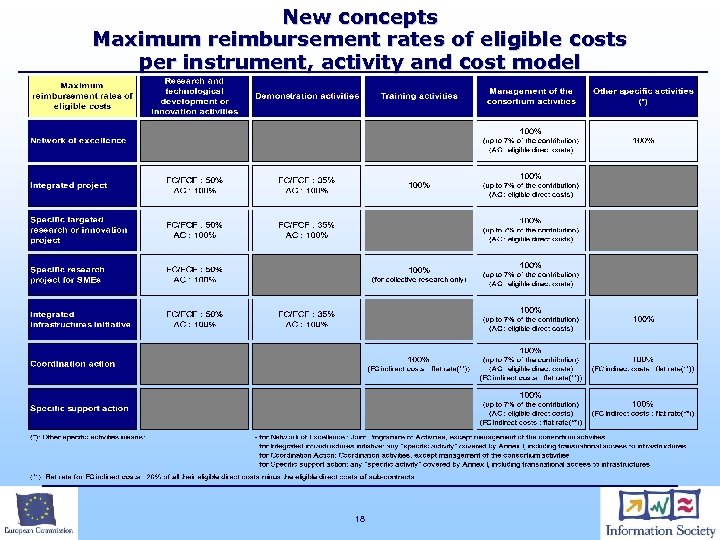
New concepts Maximum reimbursement rates of eligible costs per instrument, activity and cost model 18
Submission of financial statements reports Ø Article II. 7. 2(b) • A periodic management including i. A justification of the resources deployed by each contractor, linking them to activities implemented and justifying their necessity; ii. The Form C Financial statement set out in Annex VI, provided by each contractor for that period iii. A summary financial report consolidating the claimed costs of all the contractors in an aggregate form, based on the information provided in Form C. Ø Article II. 7. 2(c) • A report on the distribution between contractors made during that period of the Community financial contribution. 19
Submission of ‘financial’ reports Audit Certificates Ø Article II. 7. 3 Ä The consortium shall submit the audit certificates provided by each contractor … for each period for which the audit certificate is required. Ä Even though an audit certificate is not required for a specific period, an audit certificate must be provided by each contractor where the Community financial contribution requested by the contractor exceeds € 750, 000 for that period. Ø Article 7. 2 Ä Reports referred to in Article II. 7. 3. covering each period … OR Ä Reports referred to in Article II. 7. 3 shall be submitted … after the following periods: F P(x) covering reporting periods from P(1) to P(x) F P(last) covering reporting period from P(z+1) to the last reporting period of the project 20
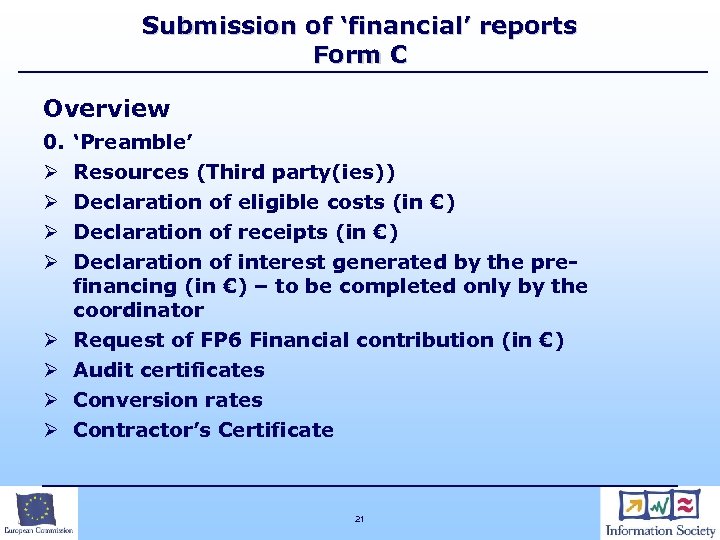
Submission of ‘financial’ reports Form C Overview 0. ‘Preamble’ Ø Ø Ø Ø Resources (Third party(ies)) Declaration of eligible costs (in €) Declaration of receipts (in €) Declaration of interest generated by the prefinancing (in €) – to be completed only by the coordinator Request of FP 6 Financial contribution (in €) Audit certificates Conversion rates Contractor’s Certificate 21
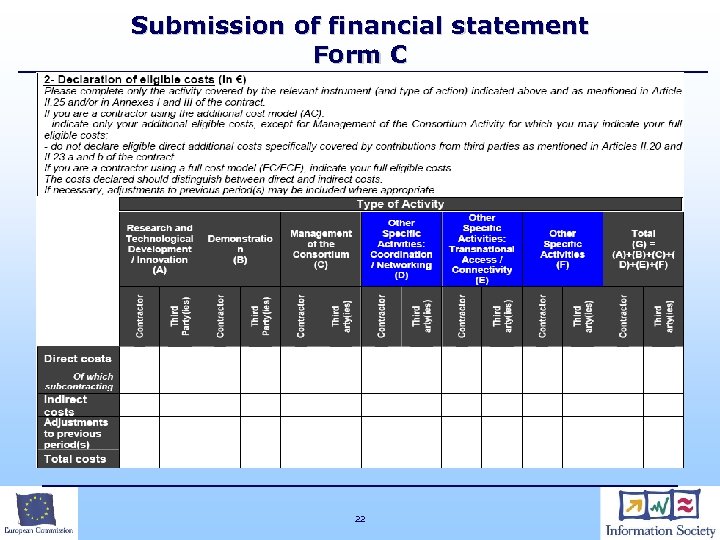
Submission of financial statement Form C 22
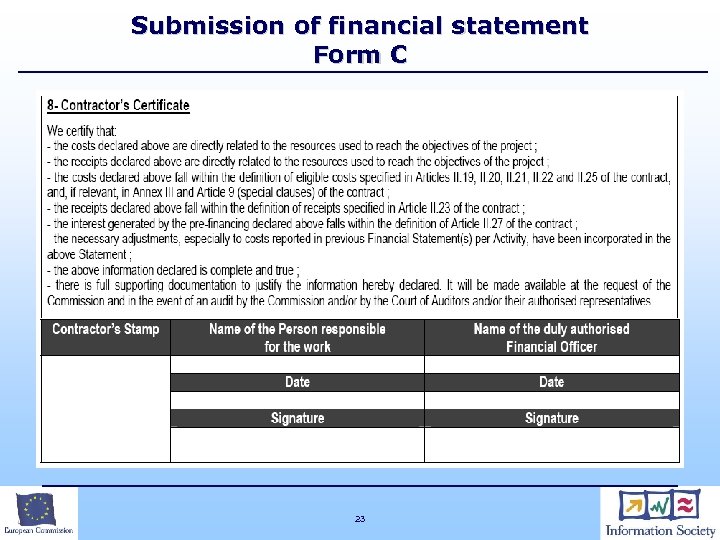
Submission of financial statement Form C 23
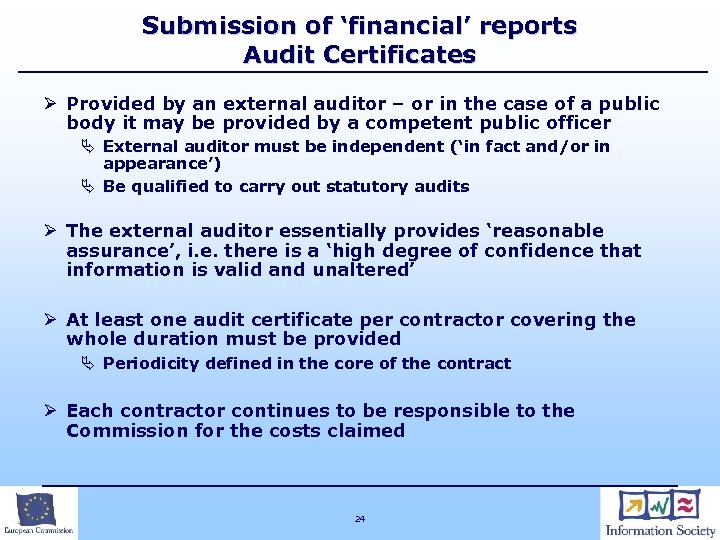
Submission of ‘financial’ reports Audit Certificates Ø Provided by an external auditor – or in the case of a public body it may be provided by a competent public officer Ä External auditor must be independent (‘in fact and/or in appearance’) Ä Be qualified to carry out statutory audits Ø The external auditor essentially provides ‘reasonable assurance’, i. e. there is a ‘high degree of confidence that information is valid and unaltered’ Ø At least one audit certificate per contractor covering the whole duration must be provided Ä Periodicity defined in the core of the contract Ø Each contractor continues to be responsible to the Commission for the costs claimed 24
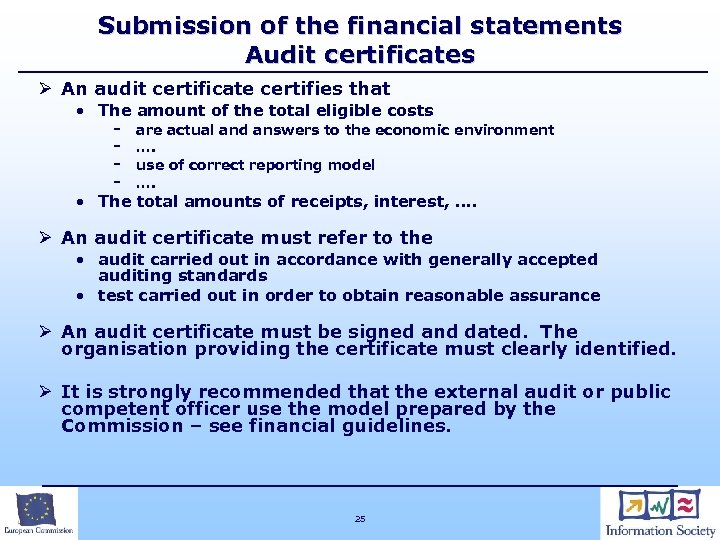
Submission of the financial statements Audit certificates Ø An audit certificate certifies that • The amount of the total eligible costs are actual and answers to the economic environment …. use of correct reporting model …. total amounts of receipts, interest, …. Ø An audit certificate must refer to the • audit carried out in accordance with generally accepted auditing standards • test carried out in order to obtain reasonable assurance Ø An audit certificate must be signed and dated. The organisation providing the certificate must clearly identified. Ø It is strongly recommended that the external audit or public competent officer use the model prepared by the Commission – see financial guidelines. 25
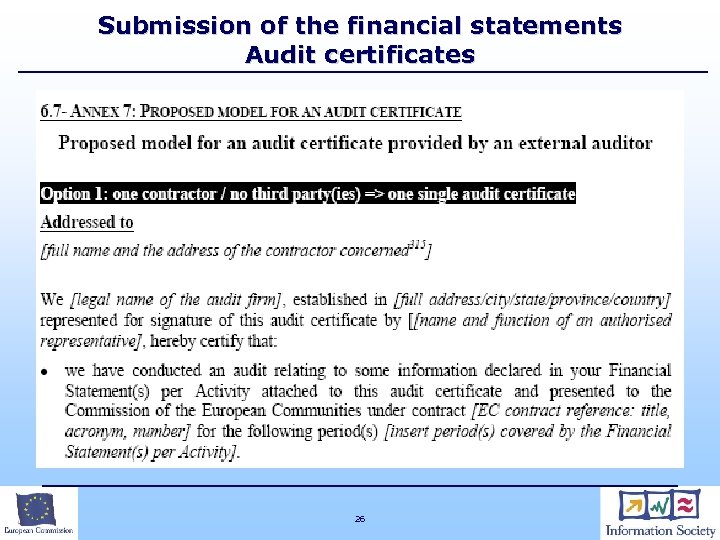
Submission of the financial statements Audit certificates 26
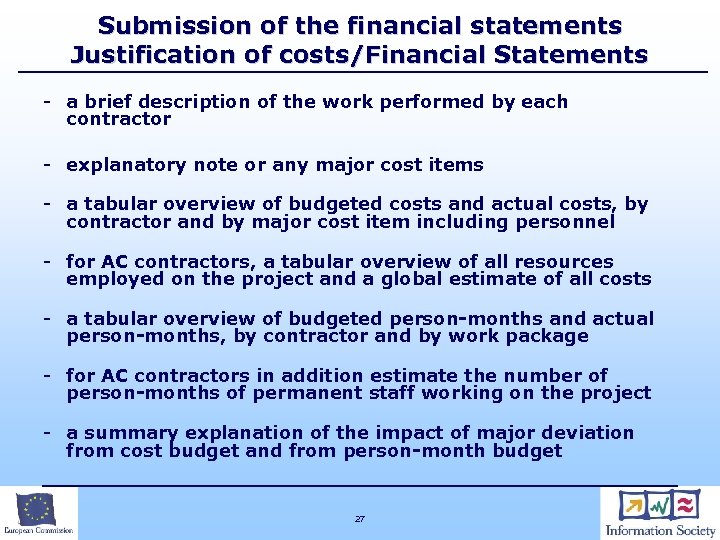
Submission of the financial statements Justification of costs/Financial Statements - a brief description of the work performed by each contractor - explanatory note or any major cost items - a tabular overview of budgeted costs and actual costs, by contractor and by major cost item including personnel - for AC contractors, a tabular overview of all resources employed on the project and a global estimate of all costs - a tabular overview of budgeted person-months and actual person-months, by contractor and by work package - for AC contractors in addition estimate the number of person-months of permanent staff working on the project - a summary explanation of the impact of major deviation from cost budget and from person-month budget 27
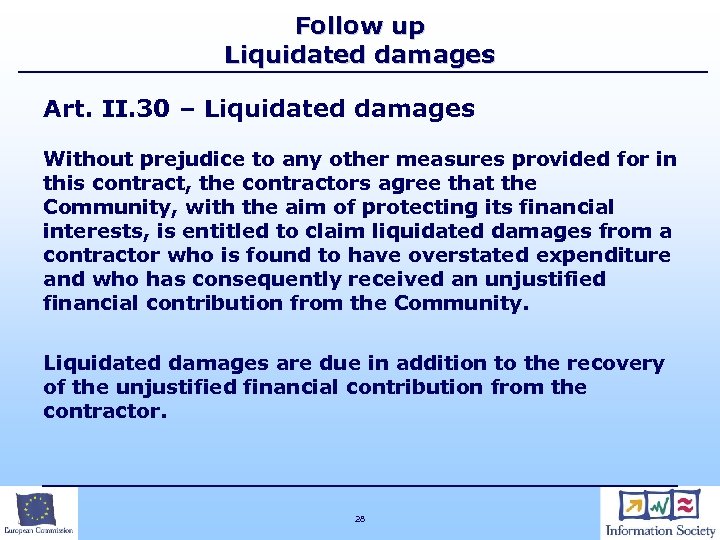
Follow up Liquidated damages Art. II. 30 – Liquidated damages Without prejudice to any other measures provided for in this contract, the contractors agree that the Community, with the aim of protecting its financial interests, is entitled to claim liquidated damages from a contractor who is found to have overstated expenditure and who has consequently received an unjustified financial contribution from the Community. Liquidated damages are due in addition to the recovery of the unjustified financial contribution from the contractor. 28
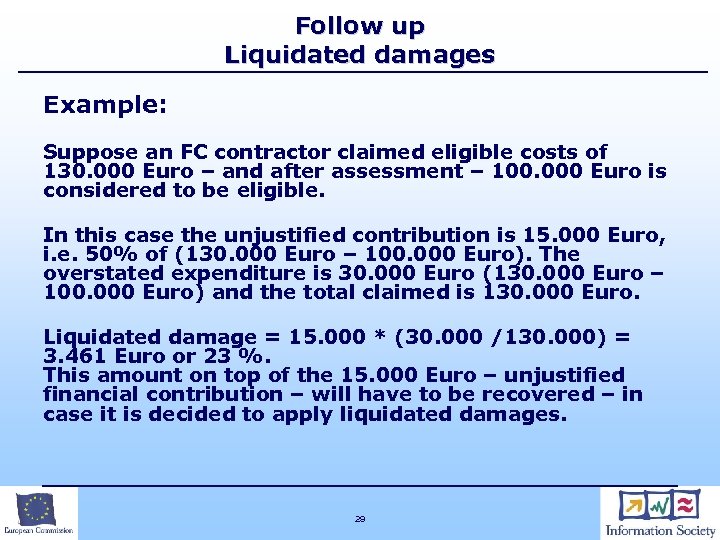
Follow up Liquidated damages Example: Suppose an FC contractor claimed eligible costs of 130. 000 Euro – and after assessment – 100. 000 Euro is considered to be eligible. In this case the unjustified contribution is 15. 000 Euro, i. e. 50% of (130. 000 Euro – 100. 000 Euro). The overstated expenditure is 30. 000 Euro (130. 000 Euro – 100. 000 Euro) and the total claimed is 130. 000 Euro. Liquidated damage = 15. 000 * (30. 000 /130. 000) = 3. 461 Euro or 23 %. This amount on top of the 15. 000 Euro – unjustified financial contribution – will have to be recovered – in case it is decided to apply liquidated damages. 29
Follow up Control and Audits Art. II. 29. 1 The Commission may, at any time during the contract and up to five years after the end of the project, arrange for audits to be carried out, either by outside scientific or technological reviewers or auditors, or by the Commission departments themselves including OLAF. Such audits may cover scientific, financial, technological and other aspects (such as accounting and management principles) relating to the proper execution of the project and the contract. Any such audit shall be carried out on a confidential basis. Any amounts due to the Commission as a result of the findings of any such audit may be the subject of a recovery. 30
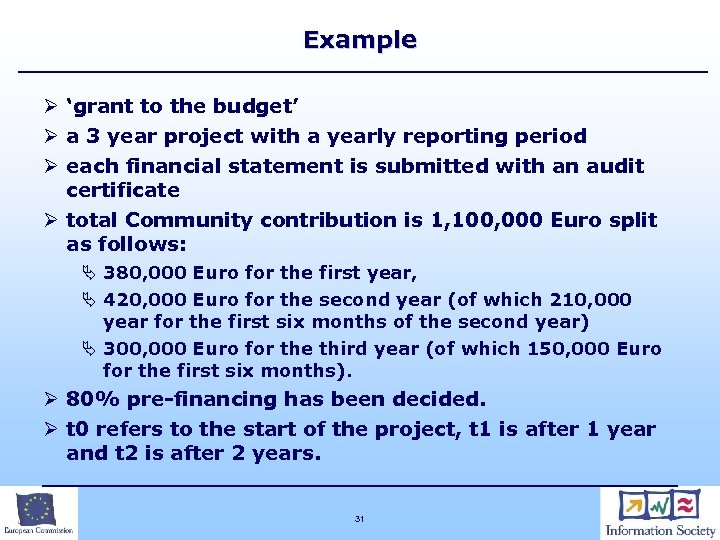
Example Ø ‘grant to the budget’ Ø a 3 year project with a yearly reporting period Ø each financial statement is submitted with an audit certificate Ø total Community contribution is 1, 100, 000 Euro split as follows: Ä 380, 000 Euro for the first year, Ä 420, 000 Euro for the second year (of which 210, 000 year for the first six months of the second year) Ä 300, 000 Euro for the third year (of which 150, 000 Euro for the first six months). Ø 80% pre-financing has been decided. Ø t 0 refers to the start of the project, t 1 is after 1 year and t 2 is after 2 years. 31
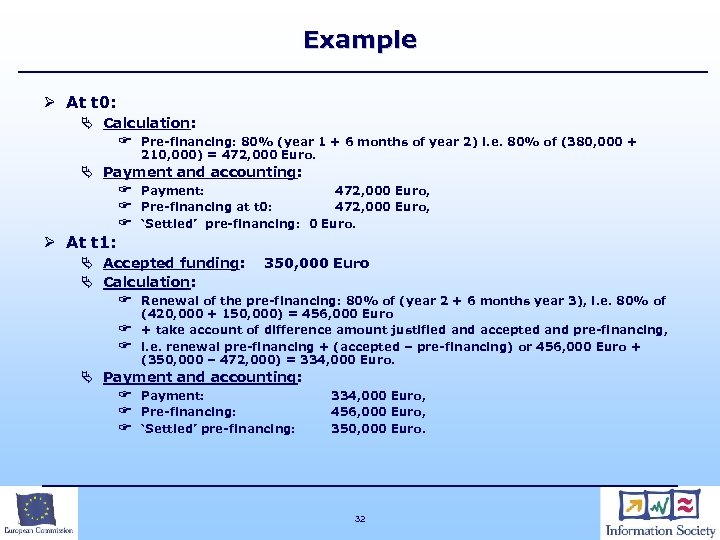
Example Ø At t 0: Ä Calculation: F Pre-financing: 80% (year 1 + 6 months of year 2) i. e. 80% of (380, 000 + 210, 000) = 472, 000 Euro. Ä Payment and accounting: F Payment: 472, 000 Euro, F Pre-financing at t 0: 472, 000 Euro, F ‘Settled’ pre-financing: 0 Euro. Ø At t 1: Ä Accepted funding: 350, 000 Euro Ä Calculation: F Renewal of the pre-financing: 80% of (year 2 + 6 months year 3), i. e. 80% of F F (420, 000 + 150, 000) = 456, 000 Euro + take account of difference amount justified and accepted and pre-financing, i. e. renewal pre-financing + (accepted – pre-financing) or 456, 000 Euro + (350, 000 – 472, 000) = 334, 000 Euro. Ä Payment and accounting: F Payment: F Pre-financing: F ‘Settled’ pre-financing: 334, 000 Euro, 456, 000 Euro, 350, 000 Euro. 32
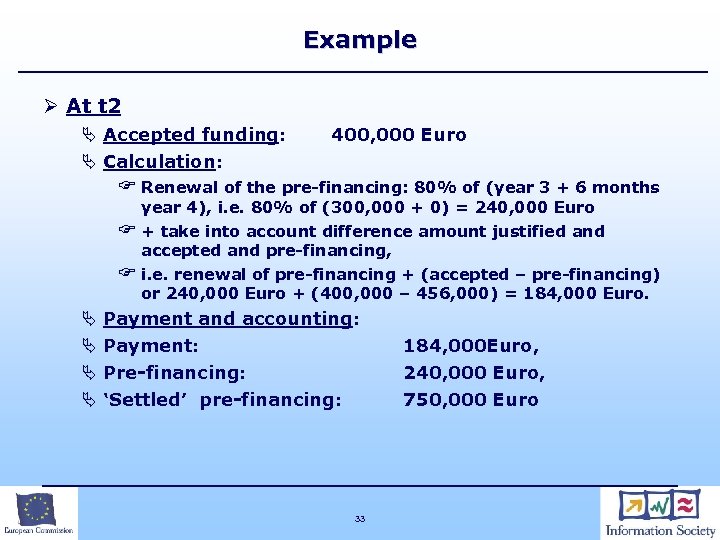
Example Ø At t 2 Ä Accepted funding: Ä Calculation: 400, 000 Euro F Renewal of the pre-financing: 80% of (year 3 + 6 months year 4), i. e. 80% of (300, 000 + 0) = 240, 000 Euro F + take into account difference amount justified and accepted and pre-financing, F i. e. renewal of pre-financing + (accepted – pre-financing) or 240, 000 Euro + (400, 000 – 456, 000) = 184, 000 Euro. Ä Payment and accounting: Ä Payment: Ä Pre-financing: Ä ‘Settled’ pre-financing: 33 184, 000 Euro, 240, 000 Euro, 750, 000 Euro
Скачать презентацию Financial Statements Meeting with National Contact Points Brussels
1d45696b0500f6c90366e4cca026e1dc.ppt