


 Скачать презентацию Financial Statement Analysis 1 Financial Statement Analysis
Fin_analysis-6.ppt
- Количество слайдов: 38
 Financial Statement Analysis 1
 Financial Statement Analysis: Lecture Outline l l l Review of Financial Statements Review of Ratios – Types of Ratios – Examples The Du. Pont Method Ratios and Growth Summary – Strengths – Weaknesses – Ratios and Forecasting 2
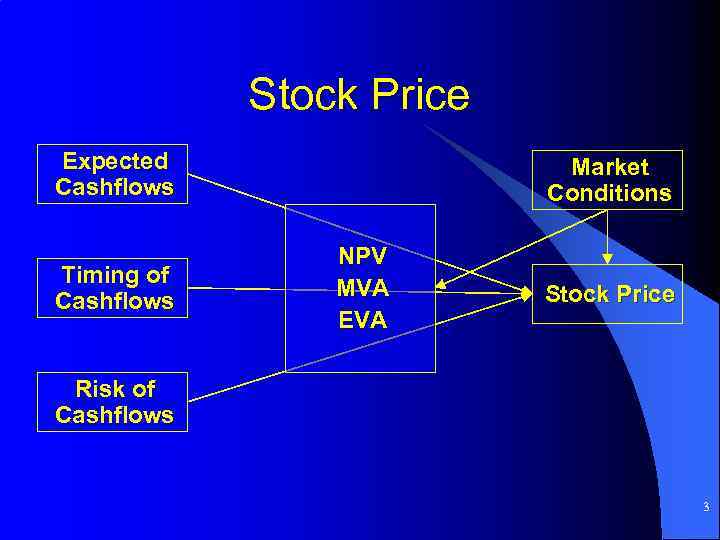 Stock Price Expected Cashflows Timing of Cashflows Market Conditions NPV MVA EVA Stock Price Risk of Cashflows 3
 Financial Analysis l l l Assessment of the firm’s past, present and future financial conditions Done to find firm’s financial strengths and weaknesses Primary Tools: – Financial Statements – Comparison of financial ratios to past, industry, sector and all firms 4
 Financial Statements Balance Sheet l Income Statement l Cashflow Statement l Statement of Retained Earnings l 5
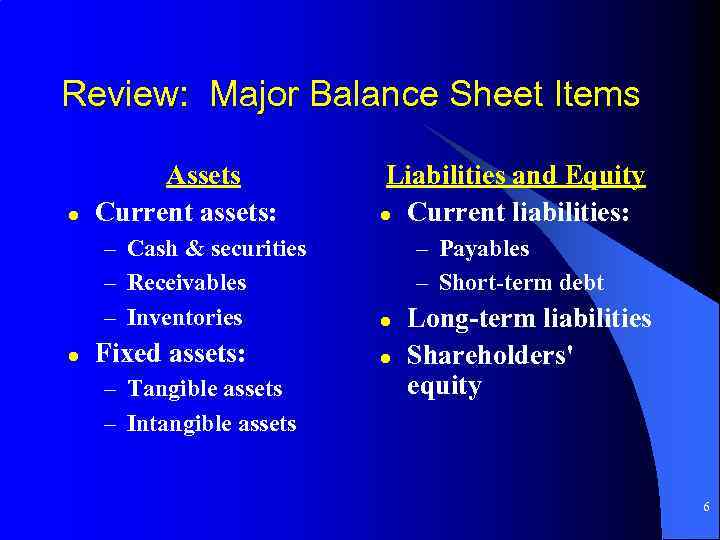 Review: Major Balance Sheet Items l Assets Current assets: – Cash & securities – Receivables – Inventories l Fixed assets: – Tangible assets – Intangible assets Liabilities and Equity l Current liabilities: – Payables – Short-term debt l l Long-term liabilities Shareholders' equity 6
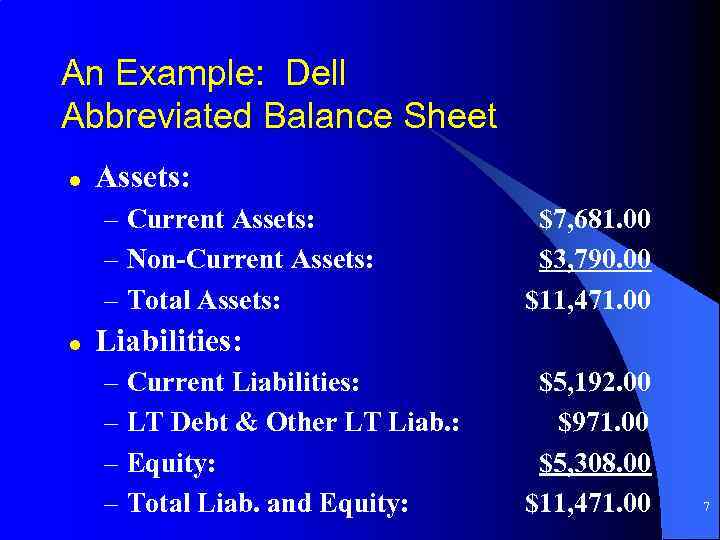 An Example: Dell Abbreviated Balance Sheet l Assets: – Current Assets: – Non-Current Assets: – Total Assets: l $7, 681. 00 $3, 790. 00 $11, 471. 00 Liabilities: – Current Liabilities: – LT Debt & Other LT Liab. : – Equity: – Total Liab. and Equity: $5, 192. 00 $971. 00 $5, 308. 00 $11, 471. 00 7
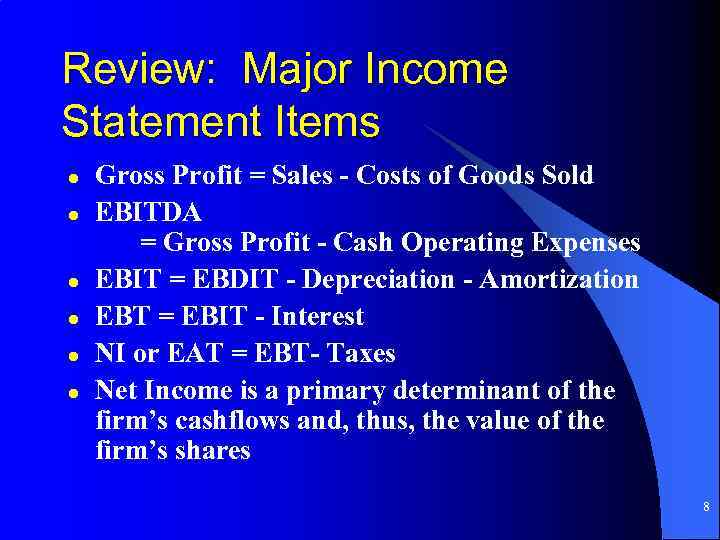 Review: Major Income Statement Items l l l Gross Profit = Sales - Costs of Goods Sold EBITDA = Gross Profit - Cash Operating Expenses EBIT = EBDIT - Depreciation - Amortization EBT = EBIT - Interest NI or EAT = EBT- Taxes Net Income is a primary determinant of the firm’s cashflows and, thus, the value of the firm’s shares 8
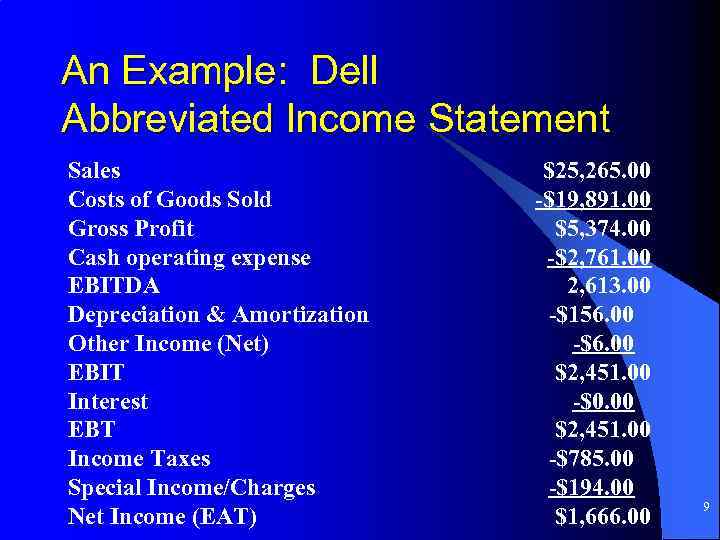 An Example: Dell Abbreviated Income Statement Sales Costs of Goods Sold Gross Profit Cash operating expense EBITDA Depreciation & Amortization Other Income (Net) EBIT Interest EBT Income Taxes Special Income/Charges Net Income (EAT) $25, 265. 00 -$19, 891. 00 $5, 374. 00 -$2, 761. 00 2, 613. 00 -$156. 00 -$6. 00 $2, 451. 00 -$0. 00 $2, 451. 00 -$785. 00 -$194. 00 $1, 666. 00 9
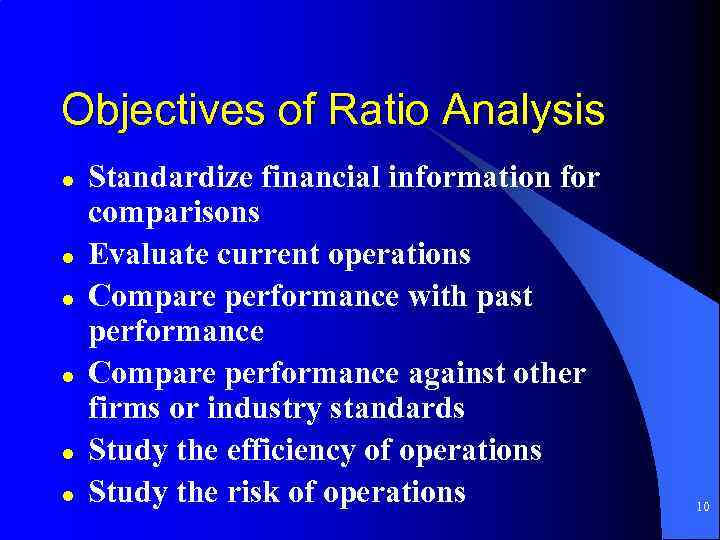 Objectives of Ratio Analysis l l l Standardize financial information for comparisons Evaluate current operations Compare performance with past performance Compare performance against other firms or industry standards Study the efficiency of operations Study the risk of operations 10
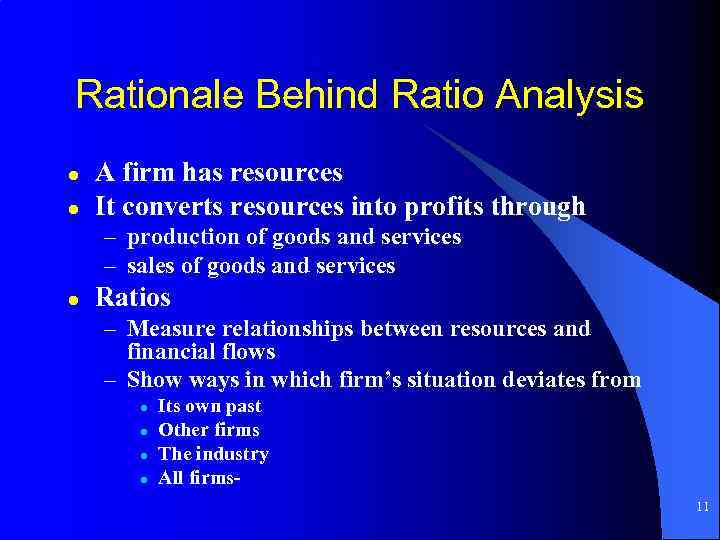 Rationale Behind Ratio Analysis l l A firm has resources It converts resources into profits through – production of goods and services – sales of goods and services l Ratios – Measure relationships between resources and financial flows – Show ways in which firm’s situation deviates from l l Its own past Other firms The industry All firms 11
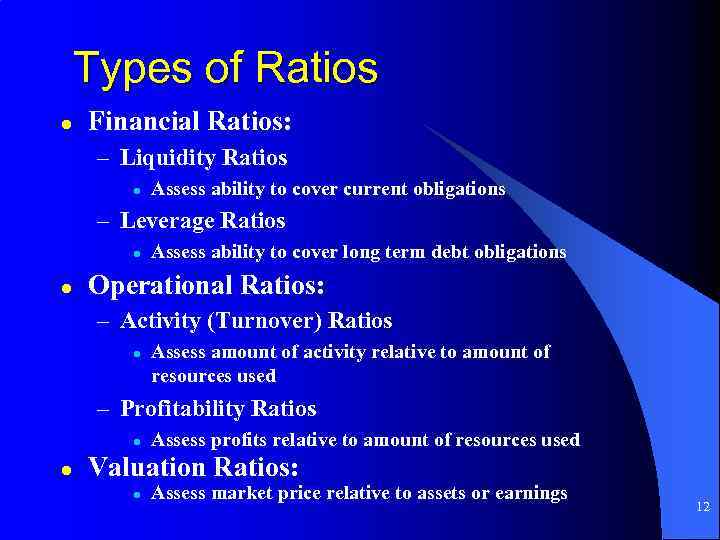 Types of Ratios l Financial Ratios: – Liquidity Ratios l Assess ability to cover current obligations – Leverage Ratios l l Assess ability to cover long term debt obligations Operational Ratios: – Activity (Turnover) Ratios l Assess amount of activity relative to amount of resources used – Profitability Ratios l l Assess profits relative to amount of resources used Valuation Ratios: l Assess market price relative to assets or earnings 12
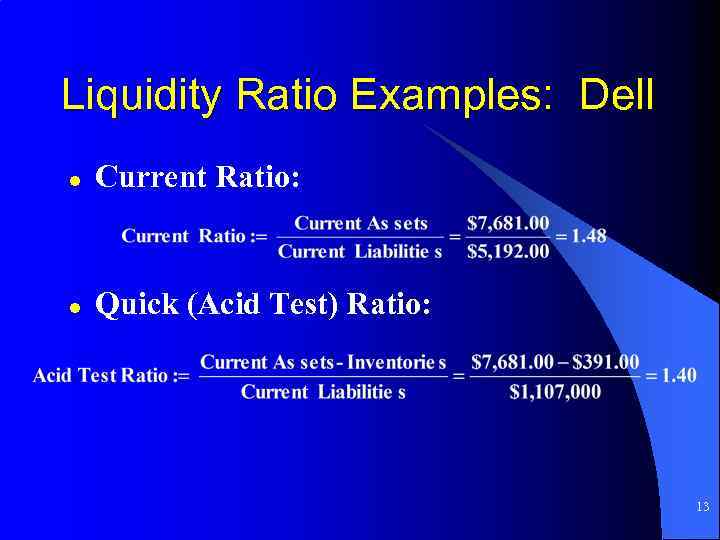 Liquidity Ratio Examples: Dell l Current Ratio: l Quick (Acid Test) Ratio: 13
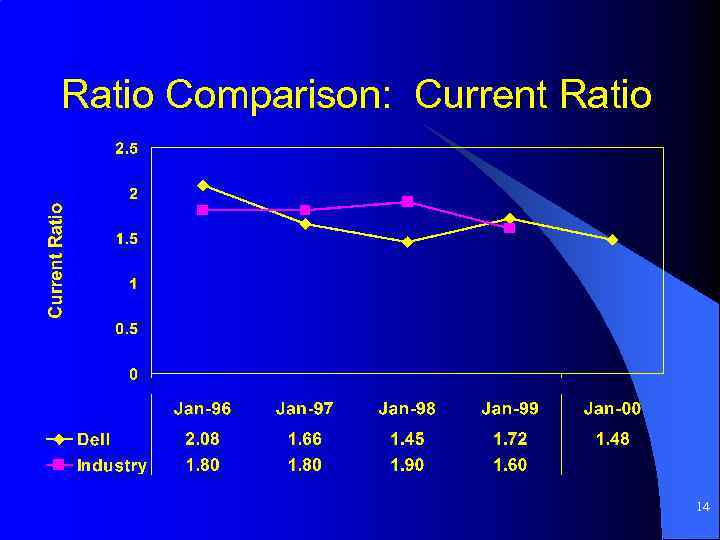 Ratio Comparison: Current Ratio 14
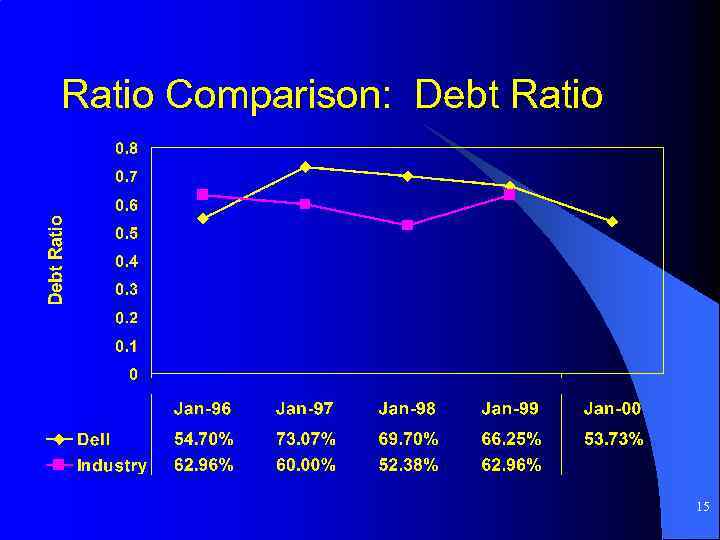 Ratio Comparison: Debt Ratio 15
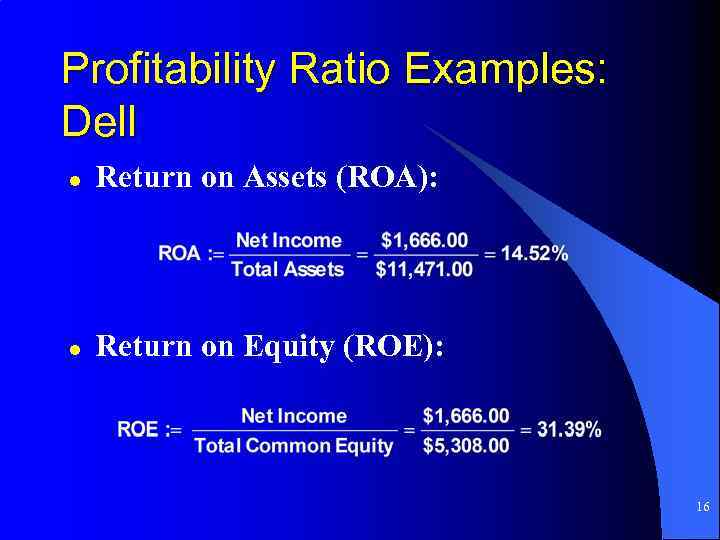 Profitability Ratio Examples: Dell l Return on Assets (ROA): l Return on Equity (ROE): 16
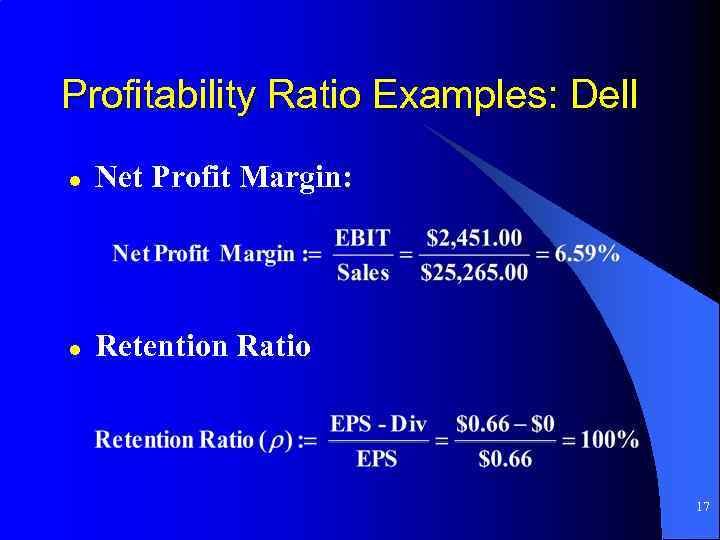 Profitability Ratio Examples: Dell l Net Profit Margin: l Retention Ratio 17
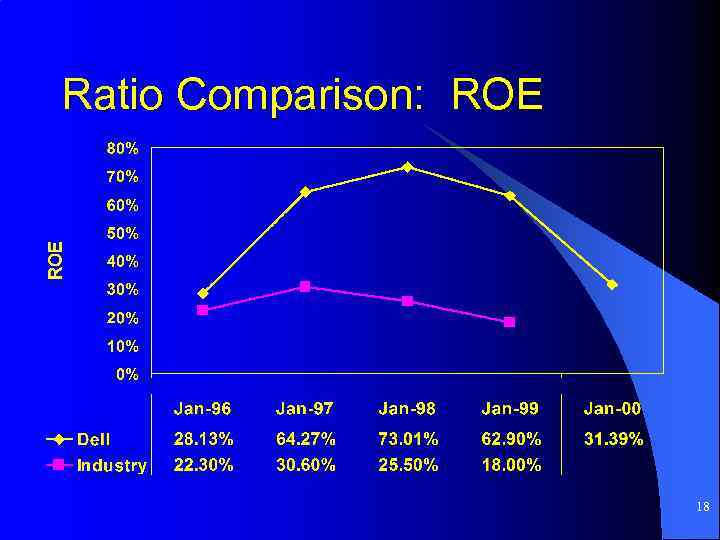 Ratio Comparison: ROE 18
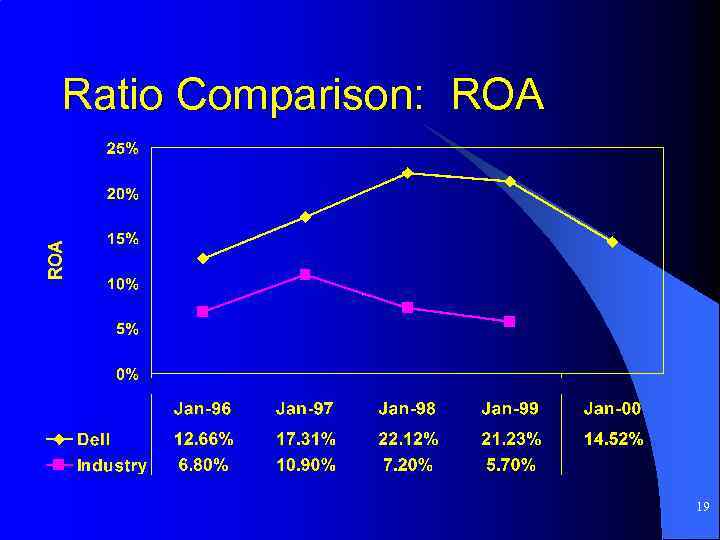 Ratio Comparison: ROA 19
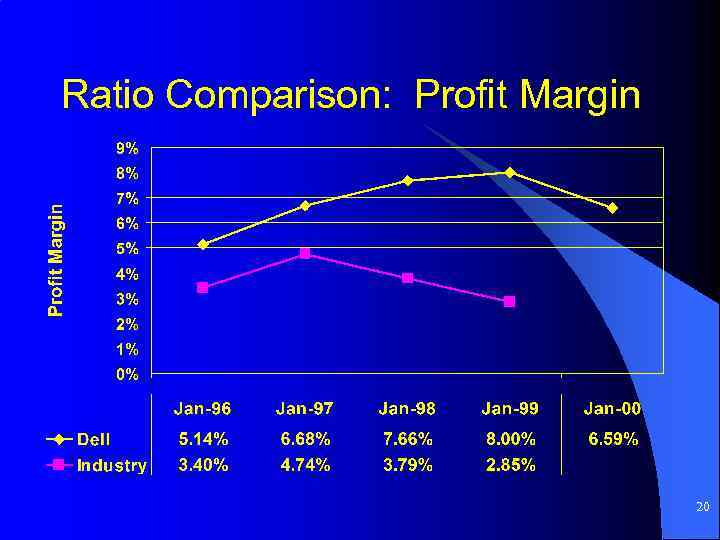 Ratio Comparison: Profit Margin 20
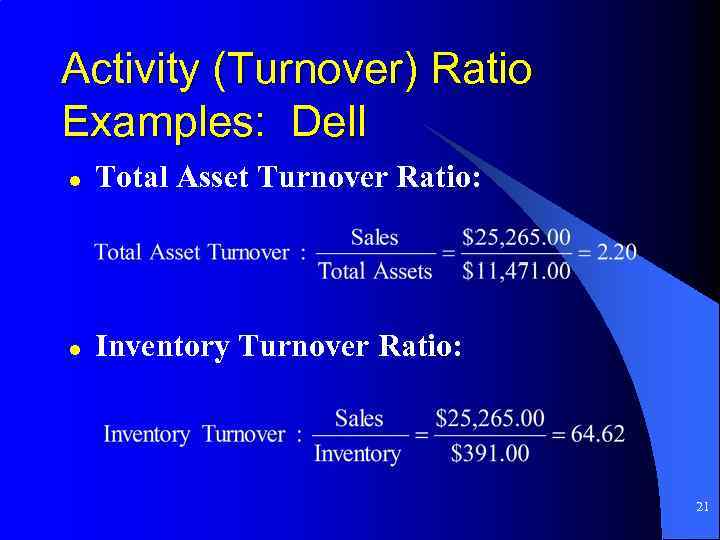 Activity (Turnover) Ratio Examples: Dell l Total Asset Turnover Ratio: l Inventory Turnover Ratio: 21
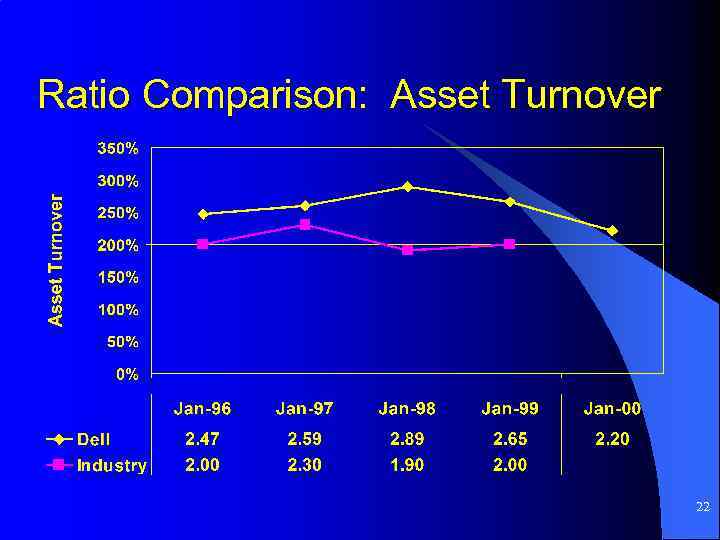 Ratio Comparison: Asset Turnover 22
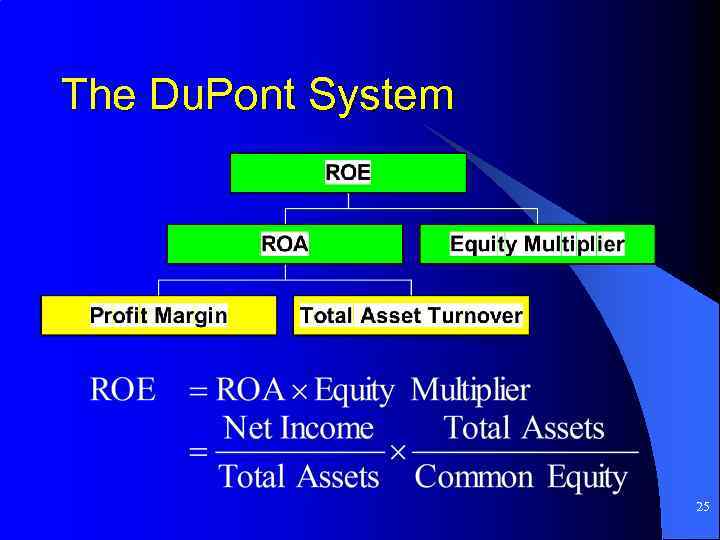
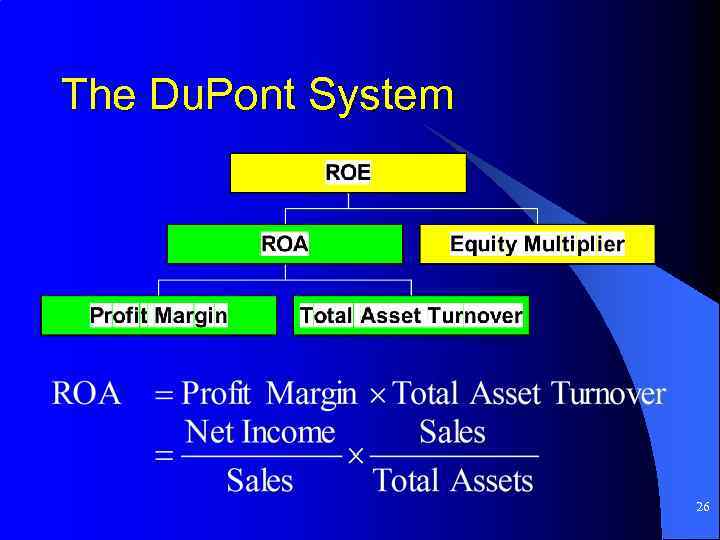
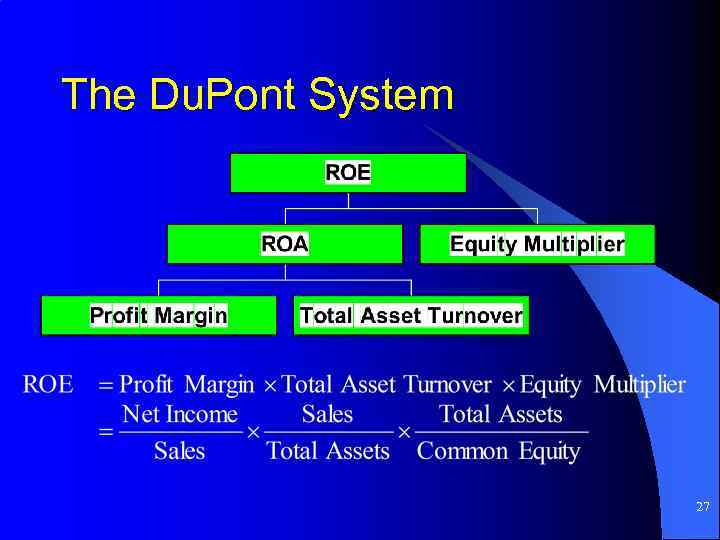
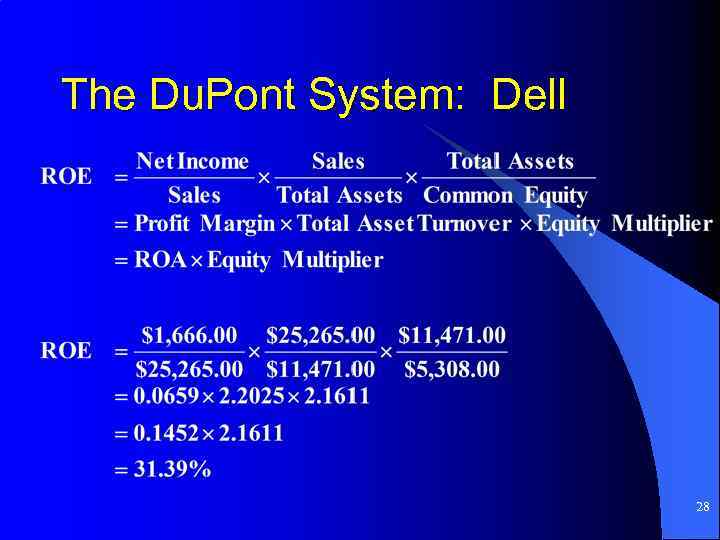
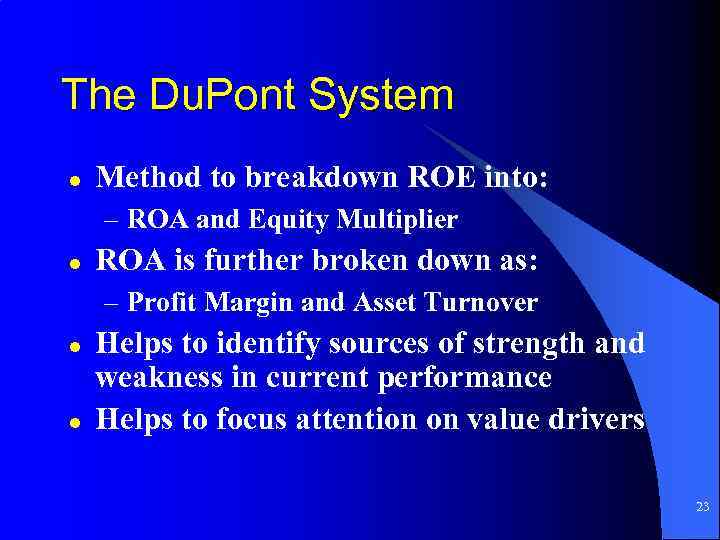 The Du. Pont System l Method to breakdown ROE into: – ROA and Equity Multiplier l ROA is further broken down as: – Profit Margin and Asset Turnover l l Helps to identify sources of strength and weakness in current performance Helps to focus attention on value drivers 23
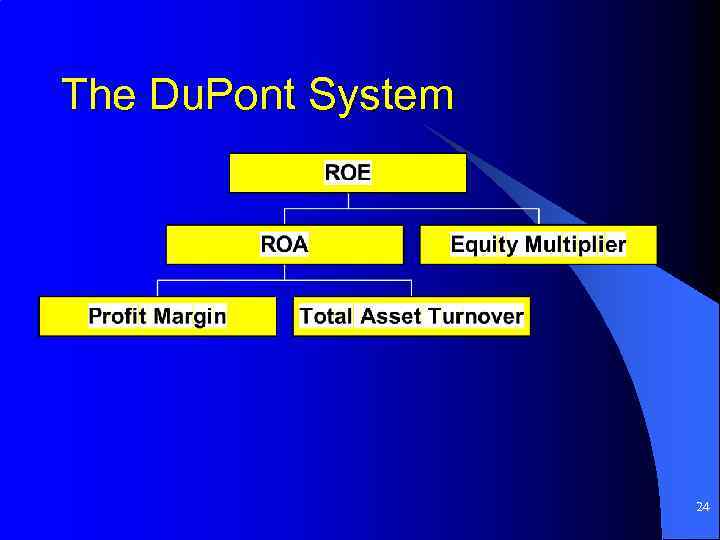 The Du. Pont System 24
 The Du. Pont System 25
 The Du. Pont System 26
 The Du. Pont System 27
 The Du. Pont System: Dell 28
 A Note on Sustainable Growth and Stock Returns l In the long run – Sustainable growth and long run capital gains (g) = ROE x r l Recall the relationship between stock returns (r), capital gains (g) and forward dividend yields (D 1/P 0): – r = g + D 1/P 0 = g + Do(1+g)/P 0 l Note: r & g must be quarterly if D is quarterly and annual if D is annual 29
 Example: Predicted Sustainable Growth for Dell l Based on the most recent numbers: – ROE = 31. 39% & r = 100% – g = 0. 3139 x 1 = 31. 39% – r = 0. 3139 + 0/P = 31. 39% l Based on 5 year averages: – ROE = 51. 94% & r = 100% – g = 0. 5194 x 1 = 51. 94% – r = 0. 3139 + 0/P = 51. 94% 30
 Ratios and Forecasting l Common stock valuation based on – Expected cashflows to stockholders – ROE and r are major determinants of cashflows to stockholders l Ratios influence expectations by: – Showing where firm is now – Providing context for current performance l Current information influences expectations by: – Showing developments that will alter future performance 31
 Summary of Financial Ratios help to: – Evaluate performance – Structure analysis – Show the connection between activities and performance l Benchmark with – Past for the company – Industry l Ratios adjust for size differences 32
 Limitations of Ratio Analysis l l l A firm’s industry category is often difficult to identify Published industry averages are only guidelines Accounting practices differ across firms Sometimes difficult to interpret deviations in ratios Industry ratios may not be desirable targets Seasonality affects ratios 33
 Limitations of Ratio Analysis l We have been talking as if management always wants to increase ROE or as if a high ROE is always better. – If company A has a higher ROE than company B is company A necessarily better? – If a company increases its ROE is it necessarily evidence of improved performance? l There are three critical problems with ROE. – Often called the timing problem, the value problem, and the risk problem.
 The Timing Problem l l l As a decision-maker in a business environment you are often encouraged to focus your attention on the past and particularly on one period in the past – correct? Sounds silly, but this is exactly what ROE does. Clearly last year’s ROE must be taken in context. – If not it is virtually meaningless. – If company ROE was lower last year than it was two years ago the company must be doing worse – correct?
 The Risk Problem l l l We talked a lot about how risk and return go together. ROE is a “return” like measure so where is the risk dimension? This problem alone makes ROE an inaccurate and possibly misleading indicator of financial performance. One has to realize that the risk dimension is missing and so be particularly wary of making comparisons across companies using ROE alone.
 The Value Problem l l ROE measures a “return” figure but it is based on two accounting figures. The numerator is net income and this is not free cash flow (the cash flow that the company could payout to its investors). Secondly, even if net income is close to free cash flow, ROE is measured relative to book value of equity not the market value of equity. It is the market value investors must pay to purchase a share of the firm’s equity and this is generally higher than the book value.
 How Might Ratios Help l Analysis of AAPL, IBM and MSFT, and comparisons to the S&P 500 companies can help to: – Assess the (absolute and relative) financial state of each company – Show each company’s strengths and weaknesses – Predict sustainable growth rate l Combined with current information, this can help to: – Assess likely future performance – Predict future valuation and earnings growth – Predict returns 38