 Скачать презентацию Financial Stability 1 2003 Charts Chapter 1 Chart
b736d53d71b303de612575baf341b850.ppt
- Количество слайдов: 70



Financial Stability 1/2003 Charts Chapter 1
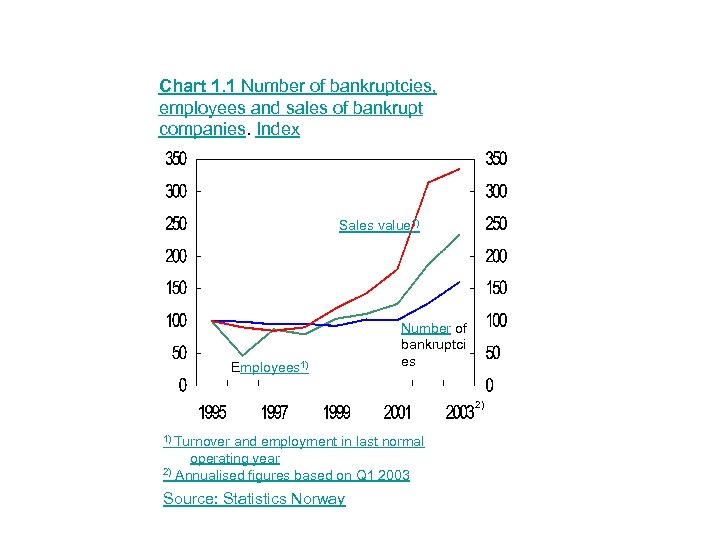
Chart 1. 1 Number of bankruptcies, employees and sales of bankrupt companies. Index Sales value 1) Employees 1) Number of bankruptci es 2) 1) Turnover and employment in last normal operating year 2) Annualised figures based on Q 1 2003 Source: Statistics Norway
Chart 1. 2 Banks' pre-tax operating profit/loss on ordinary activities as a percentage of ATA 1) 2) 1) Average total assets. Parent bank 2) Annualised figures for 2003 based on Q 1 Source: Norges Bank
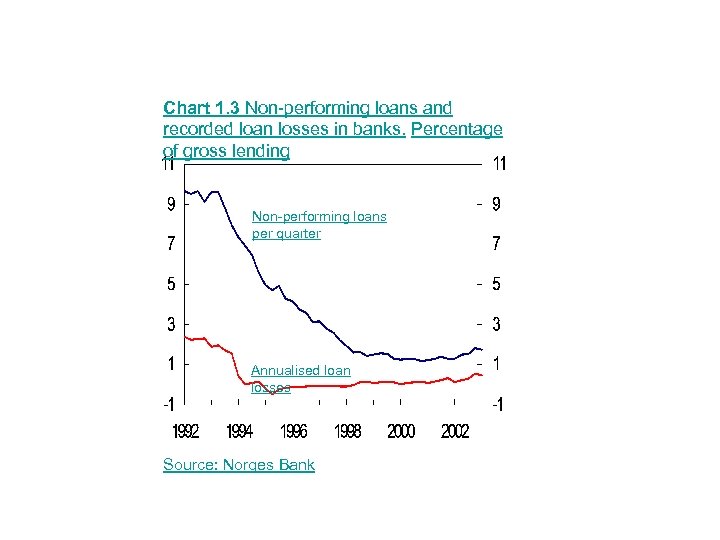
Chart 1. 3 Non-performing loans and recorded loan losses in banks. Percentage of gross lending Non-performing loans per quarter Annualised loan losses Source: Norges Bank
Chart 1. 4 Deposit-to-loan ratios in banks 1). Percentage of gross lending 3 largest 2) Other 4 th-8 th largest Excluding branches of foreign banks Den norske Bank (incl. Postbanken throughout the period), Nordea Bank Norge and Gjensidige NOR Sparebank 1) 2) Source: Norges Bank
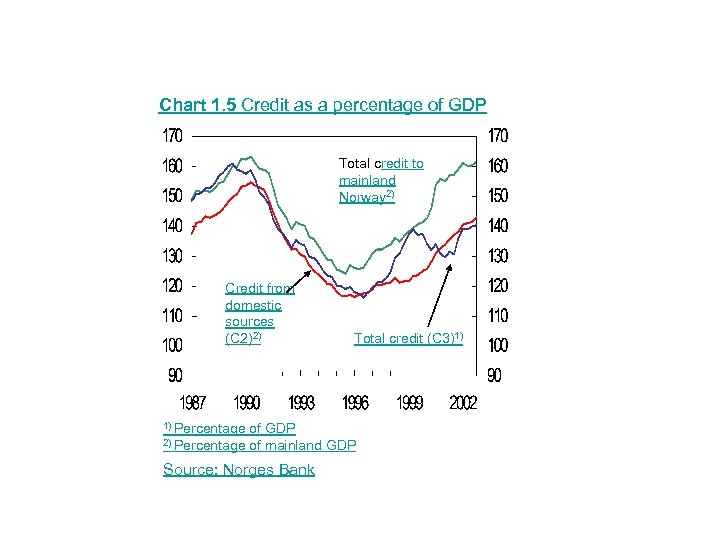
Chart 1. 5 Credit as a percentage of GDP Total credit to mainland Norway 2) Credit from domestic sources (C 2)2) 1) Percentage 2) Percentage Total credit (C 3)1) of GDP of mainland GDP Source: Norges Bank
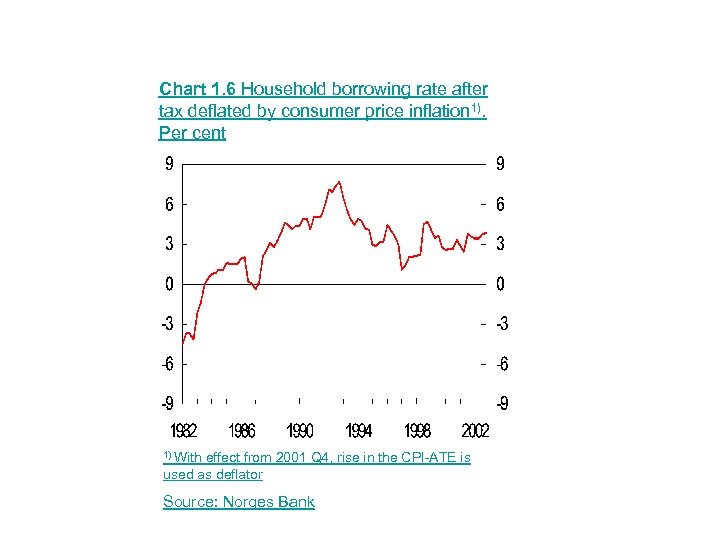
Chart 1. 6 Household borrowing rate after tax deflated by consumer price inflation 1). Per cent 1) With effect from 2001 Q 4, rise in the CPI-ATE is used as deflator Source: Norges Bank

Charts Chapter 2
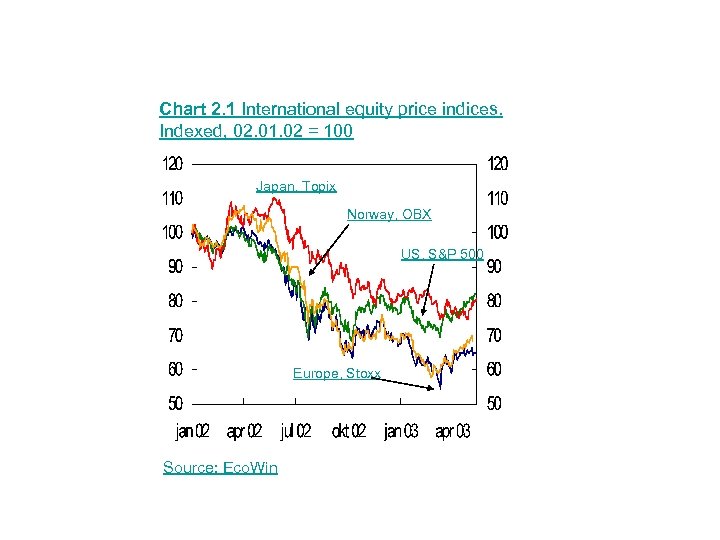
Chart 2. 1 International equity price indices. Indexed, 02. 01. 02 = 100 Japan, Topix Norway, OBX US, S&P 500 Europe, Stoxx Source: Eco. Win
Chart 2. 2 Relationship between price and future earnings 1) for companies in the S&P 500 index 1) Actual and estimated (from Q 4 2002) annual earnings one year ahead from the price date Sources: Standard and Poor’s and Norges Bank
Chart 2. 3 Effective yield on government bonds with 10 years to maturity US Euro countries Source: Datastream
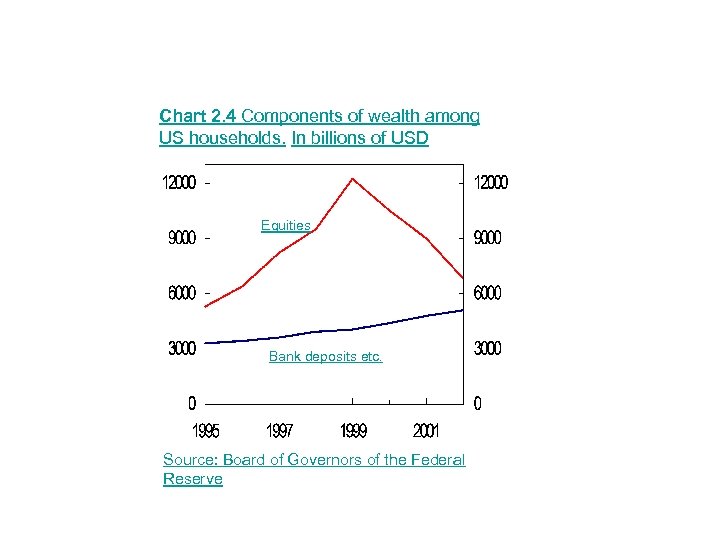
Chart 2. 4 Components of wealth among US households. In billions of USD Equities Bank deposits etc. Source: Board of Governors of the Federal Reserve
Chart 2. 5 Default rates for corporate bonds 1) and bank loans 2) in the US. Percentage outstanding Bonds Bank loans 1) The figure for 2003 is the average for January-April loans more than 30 days after due 2) Non-performing date Sources: Datastream and Federal Deposit
Chart 2. 6 Bank failures 1) in the US. Measured in terms of total assets (USD bn) and number of banks Total assets (right-hand scale) Number of banks (left-hand scale) Banks where insolvency proceedings have been initiated 1) Source: Federal Deposit Insurance Corporation
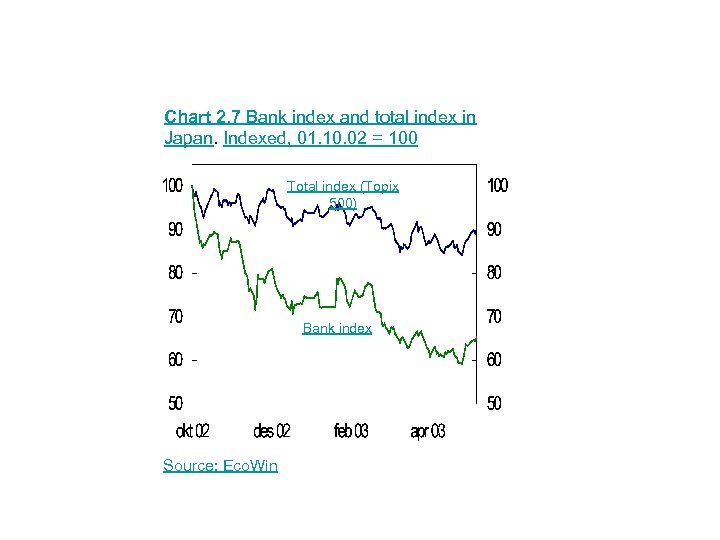
Chart 2. 7 Bank index and total index in Japan. Indexed, 01. 10. 02 = 100 Total index (Topix 500) Bank index Source: Eco. Win
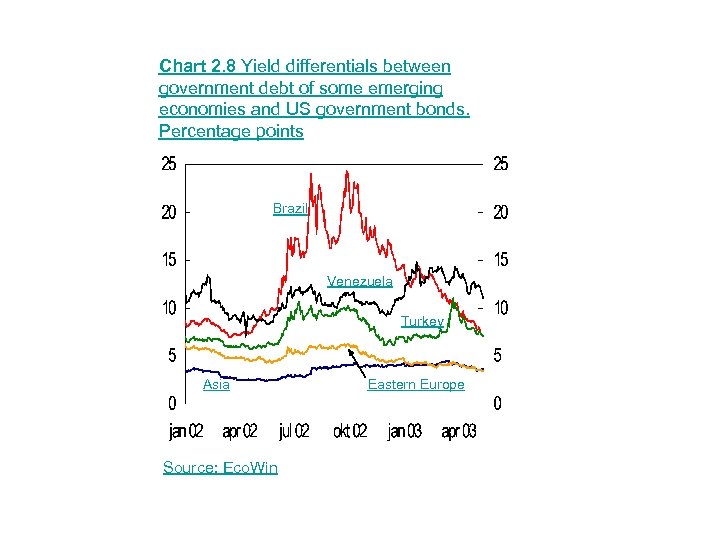
Chart 2. 8 Yield differentials between government debt of some emerging economies and US government bonds. Percentage points Brazil Venezuela Turkey Asia Source: Eco. Win Eastern Europe
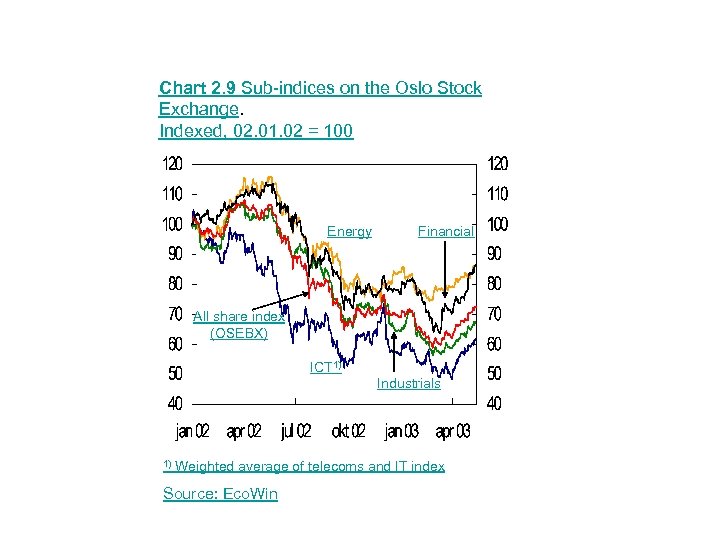
Chart 2. 9 Sub-indices on the Oslo Stock Exchange. Indexed, 02. 01. 02 = 100 Energy Financial All share index (OSEBX) ICT 1) Industrials 1) Weighted average of telecoms and IT index Source: Eco. Win
Charts. Box P/E ratio for the Norwegian stock market
Chart 1 Price earnings (P/E) ratio for companies listed on the Oslo Stock Exchange 1) 1) Total market value at year-end divided by total profit/loss on ordinary activities same year Sources: Dun & Bradstreet, Oslo Stock Exchange and Norges Bank
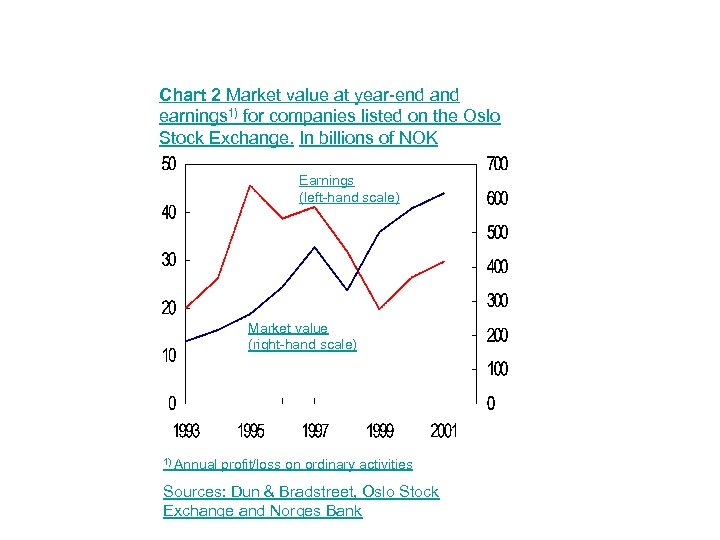
Chart 2 Market value at year-end and earnings 1) for companies listed on the Oslo Stock Exchange. In billions of NOK Earnings (left-hand scale) Market value (right-hand scale) 1) Annual profit/loss on ordinary activities Sources: Dun & Bradstreet, Oslo Stock Exchange and Norges Bank
Charts Chapter 3
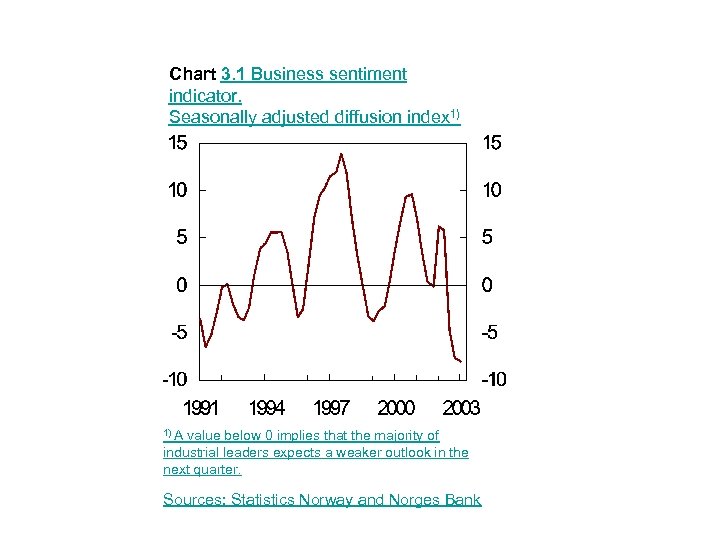
Chart 3. 1 Business sentiment indicator. Seasonally adjusted diffusion index 1) 1) A value below 0 implies that the majority of industrial leaders expects a weaker outlook in the next quarter. Sources: Statistics Norway and Norges Bank
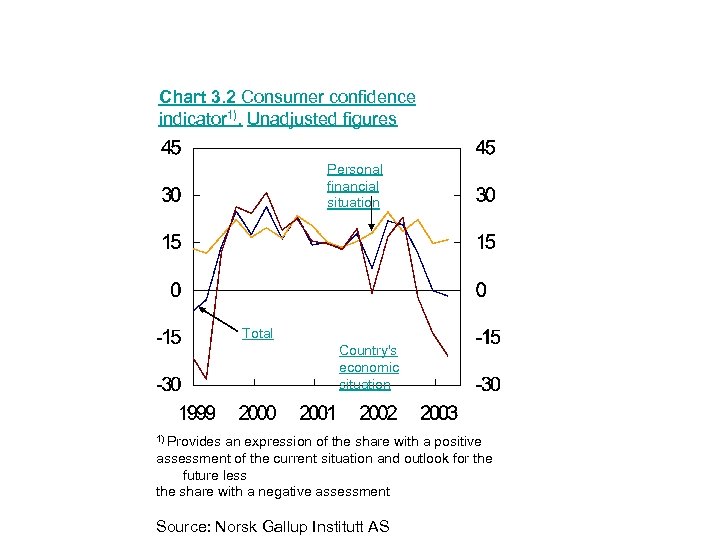
Chart 3. 2 Consumer confidence indicator 1). Unadjusted figures Personal financial situation Total Country's economic situation 1) Provides an expression of the share with a positive assessment of the current situation and outlook for the future less the share with a negative assessment Source: Norsk Gallup Institutt AS
Chart 3. 3 Rise in house prices and growth in credit to households. 12 -month growth. Per cent Credit growth Rise in house prices Sources: Norwegian Association of Real Estate Agents and Norges Bank
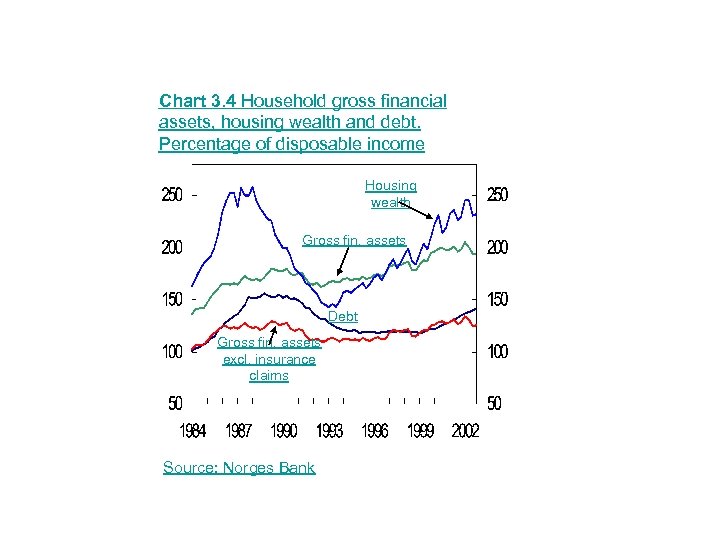
Chart 3. 4 Household gross financial assets, housing wealth and debt. Percentage of disposable income Housing wealth Gross fin. assets Debt Gross fin. assets excl. insurance claims Source: Norges Bank
Chart 3. 5 Households' total debt as a percentage of the value of housing wealth Source: Norges Bank
Chart 3. 6 Number of dwellings sold. In thousands House properties. Unrestricted sales. Including housing cooperative dwellings 1) Source: Statistics Norway and NBBL
Chart 3. 7 Household debt burden 1) and debt as a percentage of disposable income less expenses for necessities 2) Debt/disposable income less necessities Debt burden 1) Loan debt as a percentage of disposable income 2) Food, non-alcoholic beverages, clothing and footwear Source: Norges Bank
Chart 3. 8 Household debt burden 1) in selected countries. Annual figures Japan Norway UK US Sweden 1) Loan debt as a percentage of disposable income Sources: OECD, Sveriges Riksbank and Norges Bank
Chart 3. 9 Household interest burden 1) and the borrowing rate Interest burden Borrowing rate after tax Interest expenses after tax as a percentage of disposable income plus interest expenses 1) Source: Norges Bank
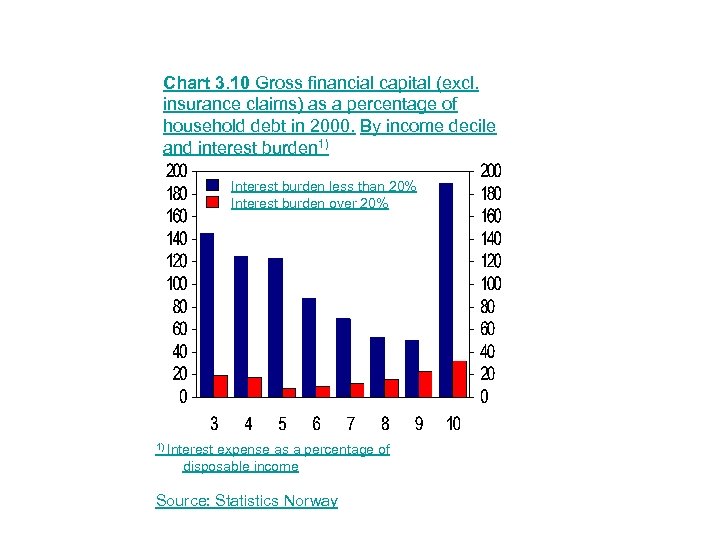
Chart 3. 10 Gross financial capital (excl. insurance claims) as a percentage of household debt in 2000. By income decile and interest burden 1) Interest burden less than 20% Interest burden over 20% 1) Interest expense as a percentage of disposable income Source: Statistics Norway
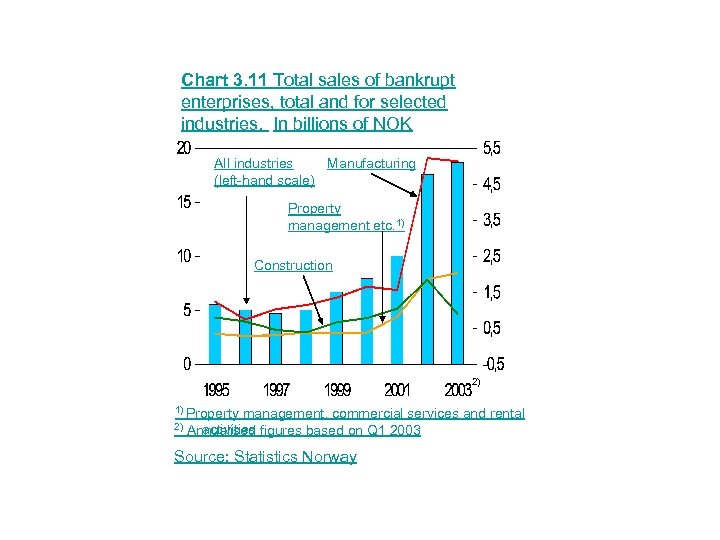
Chart 3. 11 Total sales of bankrupt enterprises, total and for selected industries. In billions of NOK All industries Manufacturing (left-hand scale) Property management etc. 1) Construction 2) 1) Property 2) management, commercial services and rental activities Annualised figures based on Q 1 2003 Source: Statistics Norway
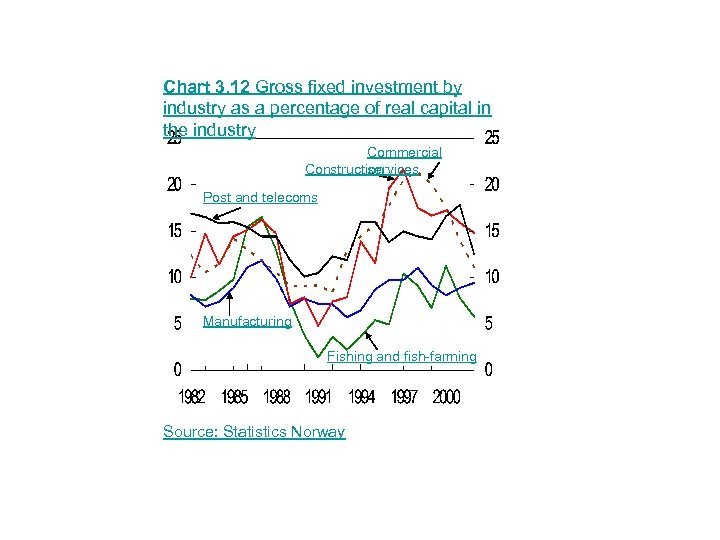
Chart 3. 12 Gross fixed investment by industry as a percentage of real capital in the industry Commercial services Construction Post and telecoms Manufacturing Fishing and fish-farming Source: Statistics Norway
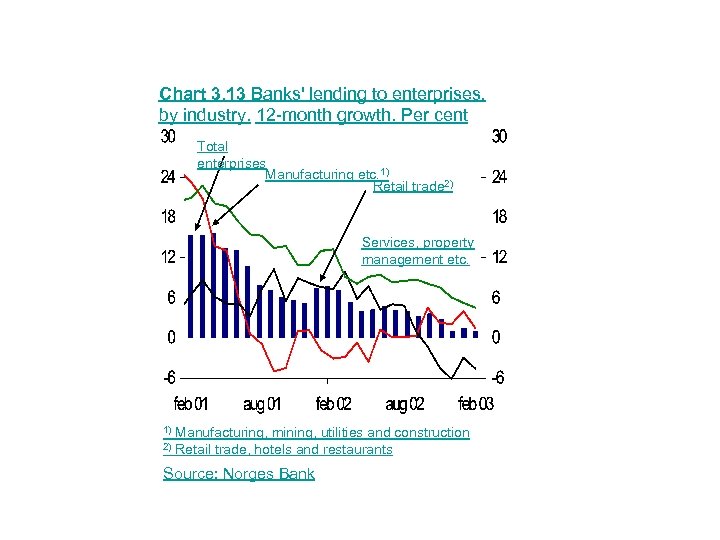
Chart 3. 13 Banks' lending to enterprises, by industry. 12 -month growth. Per cent Total enterprises Manufacturing etc. 1) Retail trade 2) Services, property management etc. 1) 2) Manufacturing, mining, utilities and construction Retail trade, hotels and restaurants Source: Norges Bank
Chart 3. 14 Probability of default for large unlisted enterprises 1). Per cent Median of 20% weakest Median of 50 % weakest Median enterprise Non-financial, unlisted enterprises with a turnover of more than NOK 70 million. Probability of default within one year 1) Source: Moody's KMV
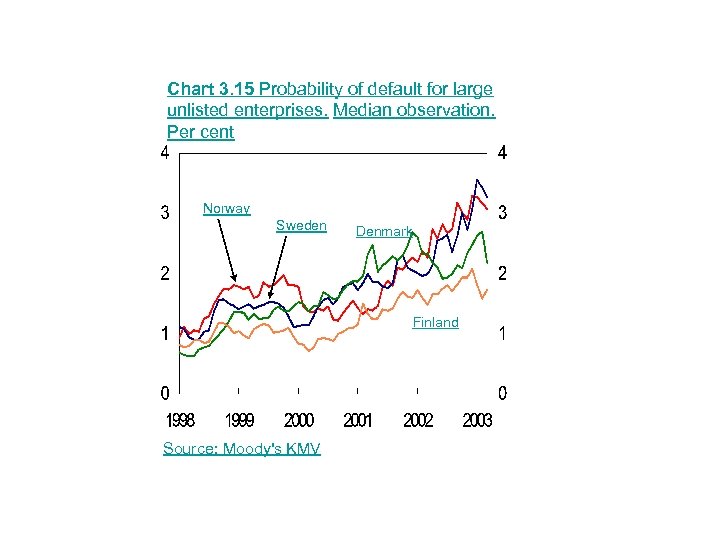
Chart 3. 15 Probability of default for large unlisted enterprises. Median observation. Per cent Norway Sweden Denmark Finland Source: Moody's KMV
Chart 3. 16 Banks' loans to property management. Per cent Annual change (left-hand scale) Property management as a share of total bank loans (right-hand scale) Source: Norges Bank
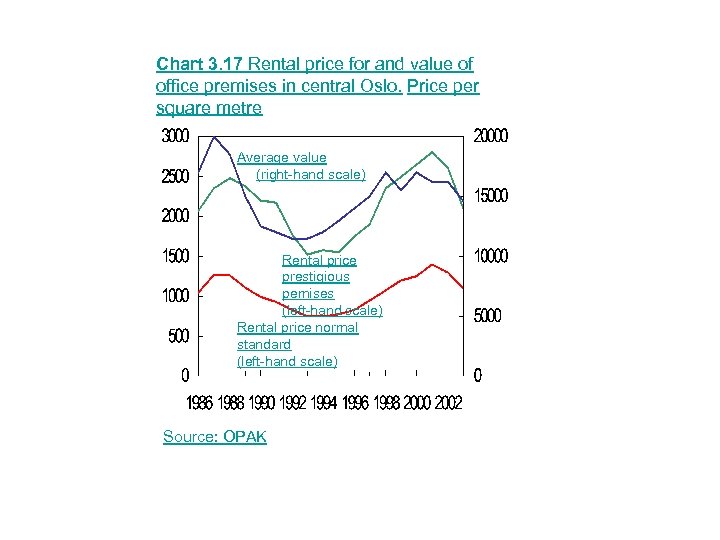
Chart 3. 17 Rental price for and value of office premises in central Oslo. Price per square metre Average value (right-hand scale) Rental price prestigious pemises (left-hand scale) Rental price normal standard (left-hand scale) Source: OPAK
Chart 3. 18 Vacant office premises in Oslo, Asker and Bærum. In thousands of square metres. As of February Source: Eiendomsspar
Chart 3. 19 Debt burden of non-financial enterprises excl. petroleum and shipping. Per cent of cash surplus 1) excl. interest expenses Debt burden based on net capital income Debt burden based on gross capital income Debt burden previous report 2) Cash surplus = Value added - labour costs + gross or net capital income 2) An audit of the figures has led to an increase in corporate sector capital income since the November 2002 Financial Stability report 1)
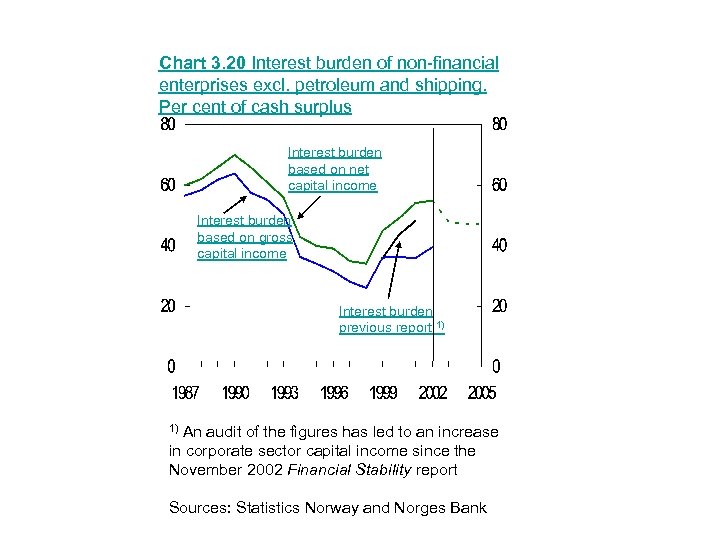
Chart 3. 20 Interest burden of non-financial enterprises excl. petroleum and shipping. Per cent of cash surplus Interest burden based on net capital income Interest burden based on gross capital income Interest burden previous report 1) An audit of the figures has led to an increase in corporate sector capital income since the November 2002 Financial Stability report 1) Sources: Statistics Norway and Norges Bank

Charts Chapter 3, Box 1 P/E ratios for dwellings
Chart 1 House prices deflated by the building cost index and the annual wage index. Index, 1987=100 Deflated by the building cost index Deflated by the annual wage index Source: Norges Bank
Chart 2 The P/E ratio for the housing market and households' real borrowing rate P/E Average Real borrowing rate Sources: Statistics Norway and Norges Bank
Charts Chapter 4
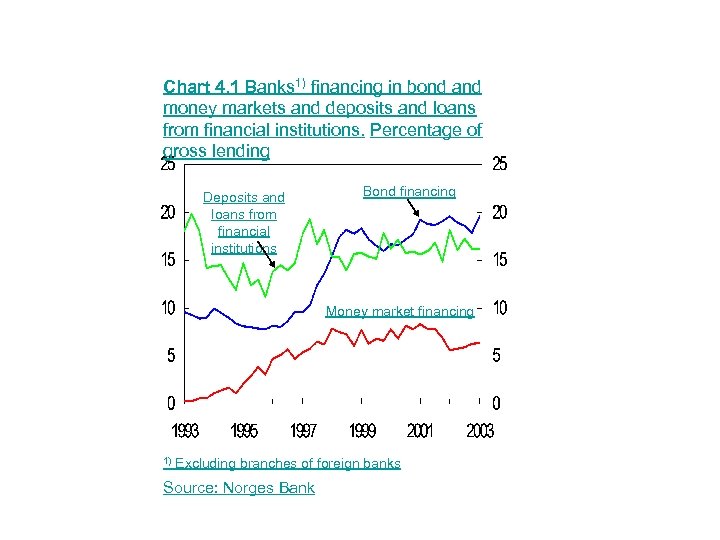
Chart 4. 1 Banks 1) financing in bond and money markets and deposits and loans from financial institutions. Percentage of gross lending Deposits and loans from financial institutions Bond financing Money market financing 1) Excluding branches of foreign banks Source: Norges Bank
Chart 4. 2 Residual maturity on banks 1) financing in money and capital markets 2). March 2003. Percentage of gross lending 3 largest 4 th-8 th largest Other Excluding branches of foreign banks Deposits and loans from credit institutions, bonds, notes and short-term paper 1) 2) Source: Norges Bank
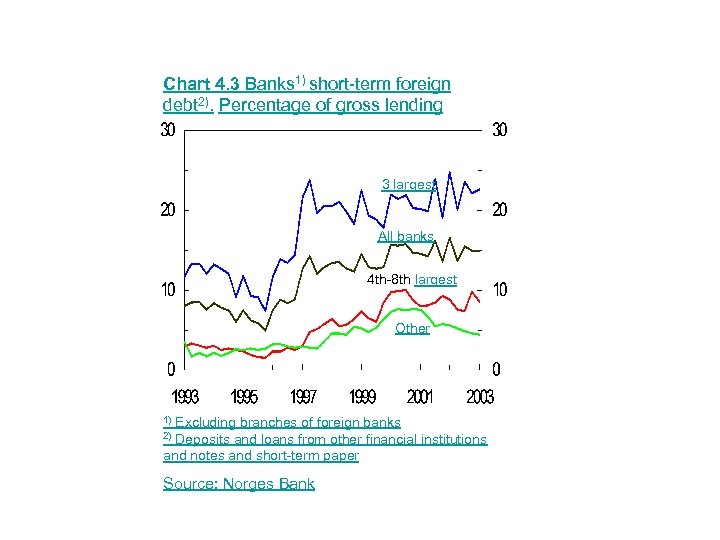
Chart 4. 3 Banks 1) short-term foreign debt 2). Percentage of gross lending 3 largest All banks 4 th-8 th largest Other Excluding branches of foreign banks Deposits and loans from other financial institutions and notes and short-term paper 1) 2) Source: Norges Bank
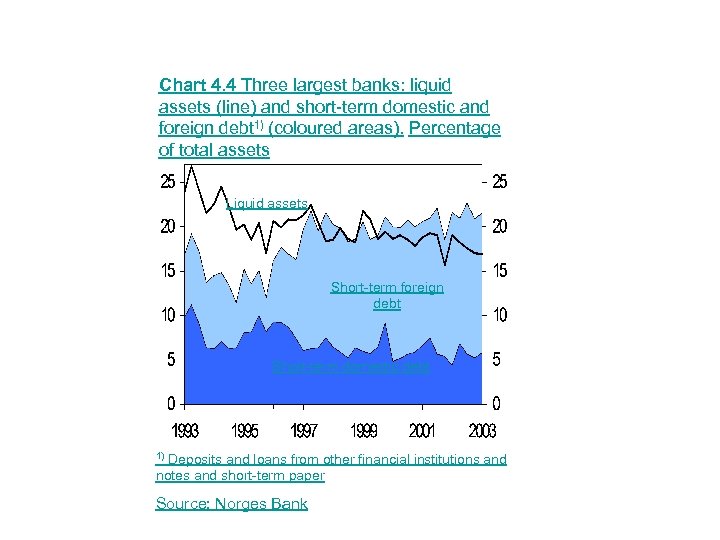
Chart 4. 4 Three largest banks: liquid assets (line) and short-term domestic and foreign debt 1) (coloured areas). Percentage of total assets Liquid assets Short-term foreign debt Short-term domestic debt Deposits and loans from other financial institutions and notes and short-term paper 1) Source: Norges Bank
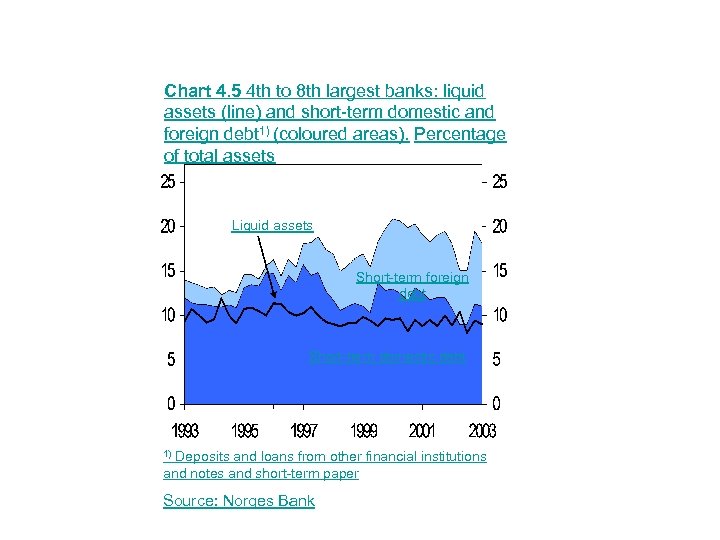
Chart 4. 5 4 th to 8 th largest banks: liquid assets (line) and short-term domestic and foreign debt 1) (coloured areas). Percentage of total assets Liquid assets Short-term foreign debt Short-term domestic debt Deposits and loans from other financial institutions and notes and short-term paper 1) Source: Norges Bank
Chart 4. 6 Other banks 1): liquid assets (line) and short-term domestic and foreign debt 2) (coloured areas). Percentage of total assets Short-term foreign debt Liquid assets Short-term domestic debt Excluding branches of foreign banks Deposits and loans from other financial institutions and notes and short-term paper 1) 2) Source: Norges Bank
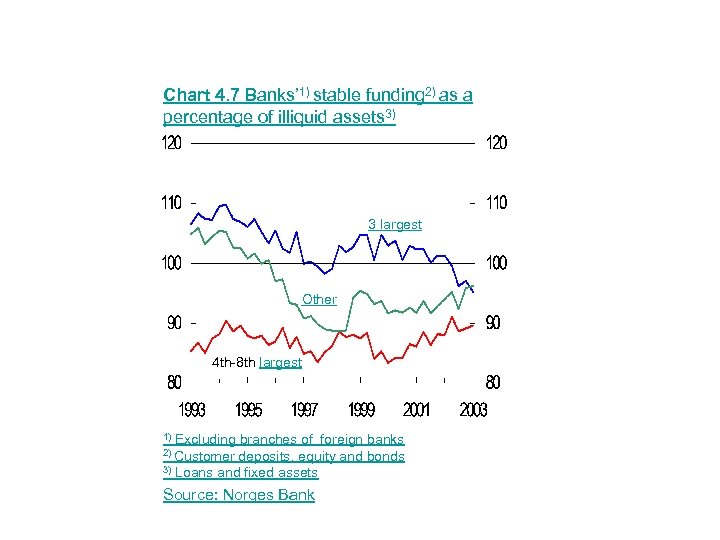
Chart 4. 7 Banks’ 1) stable funding 2) as a percentage of illiquid assets 3) 3 largest Other 4 th-8 th largest Excluding branches of foreign banks 2) Customer deposits, equity and bonds 3) Loans and fixed assets 1) Source: Norges Bank
Chart 4. 8 Number of banks by value of liquidity indicator Sept. 2002 Dec. 2002 March 2003 Source: Norges Bank

Charts Chapter 5
Chart 5. 1 Operational abnormalities in the payment system for ordinary payments. Number of errors and total errors weighted according to significance (consequence index). Bi-annual figures 1) 1) Figures for the first quarter multiplied by 2 Source: The Banks' Payment and Central Clearing House
Chart 5. 2 Operational abnormalities in the payment system for large-value payments. Number of errors and total errors weighted according to significance (consequence index). Bi-annual figures 1) 1) Figures for the first quarter multiplied by 2 Source: The Banks’ Payment and Central Clearing House

Charts Chapter 6
Chart 6. 1 Number of banks distributed by pre-tax profit. Percentage of average total assets Source: Norges Bank
Chart 6. 2 Loss on loans as a percentage of gross lending 1) distributed by bank groups Other 4 th - 8 th largest 3 largest Cumulative quarterly figures. Annualised 1) Source: Norges Bank
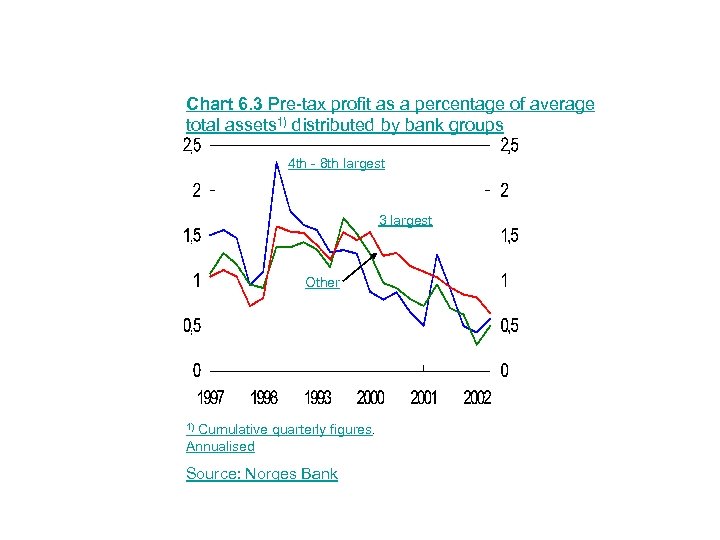
Chart 6. 3 Pre-tax profit as a percentage of average total assets 1) distributed by bank groups 4 th - 8 th largest 3 largest Other Cumulative quarterly figures. Annualised 1) Source: Norges Bank
Chart 6. 4 Number of banks distributed by core capital ratio Source: Norges Bank
Chart 6. 5 Gross non-performing loans by sector. All banks. In billions of NOK Other sectors Corporate sector Household sector Source: Norges Bank
Chart 6. 6 Percentage distribution of corporate loans. All banks Source: Norges Bank
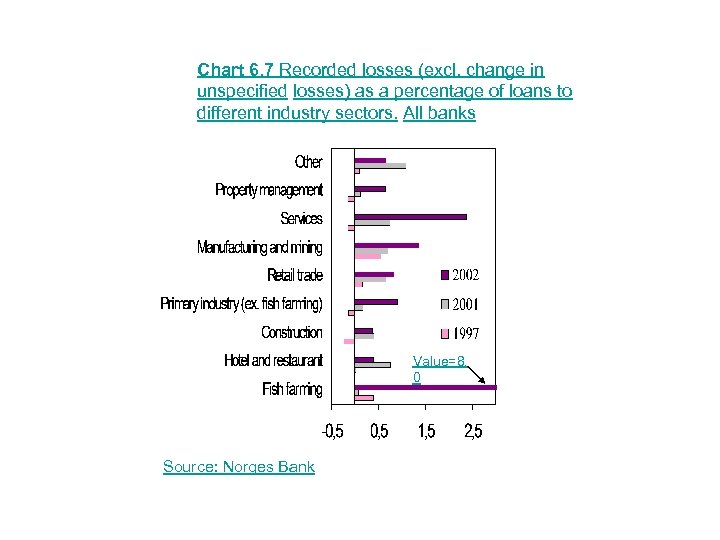
Chart 6. 7 Recorded losses (excl. change in unspecified losses) as a percentage of loans to different industry sectors. All banks Value=8. 0 Source: Norges Bank
Chart 6. 8 The 8 largest bank groups’ ability to withstand losses with a break-even result before losses and with the same profit/loss as in 2002 respectively. Losses over 3 years Same profit/loss as in 2002 Break-even result before losses Source: Norges Bank and banks' financial statements for 2002
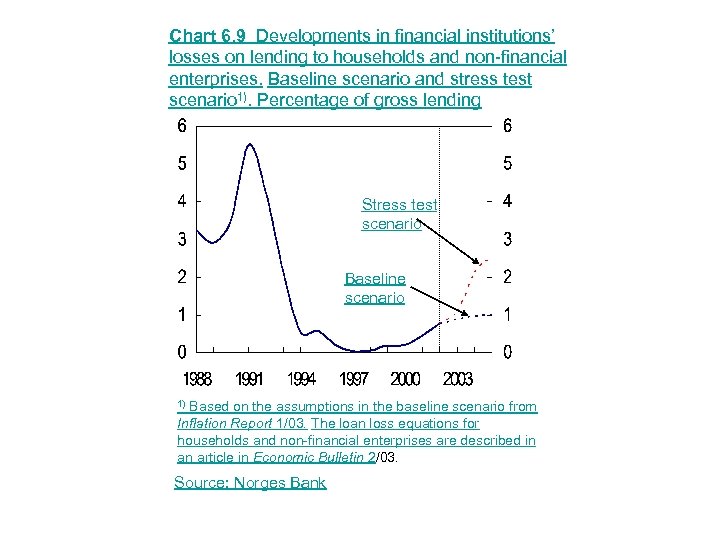
Chart 6. 9 Developments in financial institutions’ losses on lending to households and non-financial enterprises. Baseline scenario and stress test scenario 1). Percentage of gross lending Stress test scenario Baseline scenario Based on the assumptions in the baseline scenario from Inflation Report 1/03. The loan loss equations for households and non-financial enterprises are described in an article in Economic Bulletin 2/03. 1) Source: Norges Bank
Charts Chapter 6, Box 1
Chart 1 Probability of bankruptcy in banks' portfolio of loans to limited companies, distributed by different bank groups. Per cent Small banks 8 largest banks Medium-sized banks Source: Norges Bank
Charts Chapter 6, Box 2
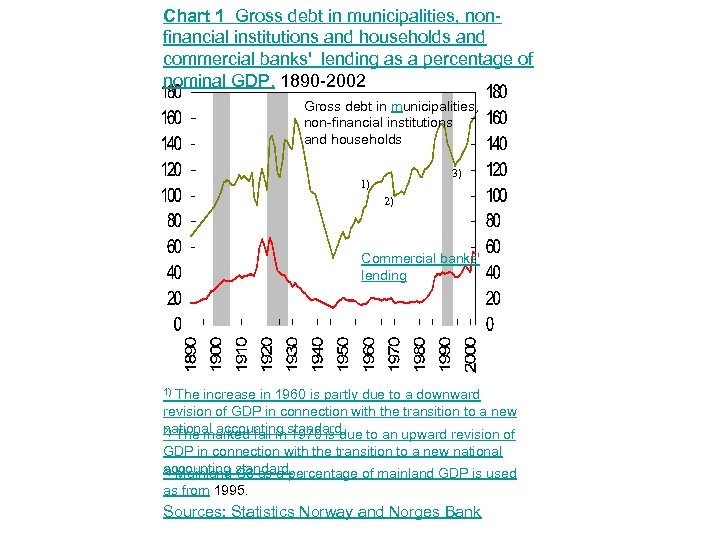
Chart 1 Gross debt in municipalities, nonfinancial institutions and households and commercial banks' lending as a percentage of nominal GDP. 1890 -2002 Gross debt in municipalities, non-financial institutions and households 3) 1) 2) Commercial banks' lending The increase in 1960 is partly due to a downward revision of GDP in connection with the transition to a new national accounting 1970 is due to an upward revision of 2) The marked fall in standard. 1) GDP in connection with the transition to a new national accounting C 3 as a percentage of mainland GDP is used 3) Mainland standard. as from 1995. Sources: Statistics Norway and Norges Bank
Скачать презентацию Financial Stability 1 2003 Charts Chapter 1 Chart
b736d53d71b303de612575baf341b850.ppt