 Скачать презентацию Financial Services A Swiss Perspective Christine Breining
36307d9d5c6822d3135295c63d1599c4.ppt
- Количество слайдов: 12



Financial Services: A Swiss Perspective Christine Breining & Thomas Cottier World Trade Institute, Berne Symposium on Assessment of Trade in Services 14 15. 3. 2002 WTO Geneva 15. 03. 2002 Worldtradeinstitute. ch 1
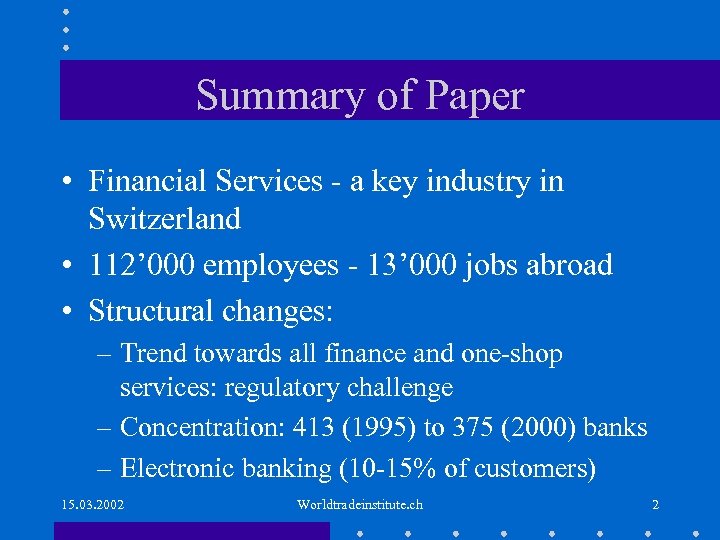
Summary of Paper • Financial Services - a key industry in Switzerland • 112’ 000 employees - 13’ 000 jobs abroad • Structural changes: – Trend towards all finance and one-shop services: regulatory challenge – Concentration: 413 (1995) to 375 (2000) banks – Electronic banking (10 -15% of customers) 15. 03. 2002 Worldtradeinstitute. ch 2
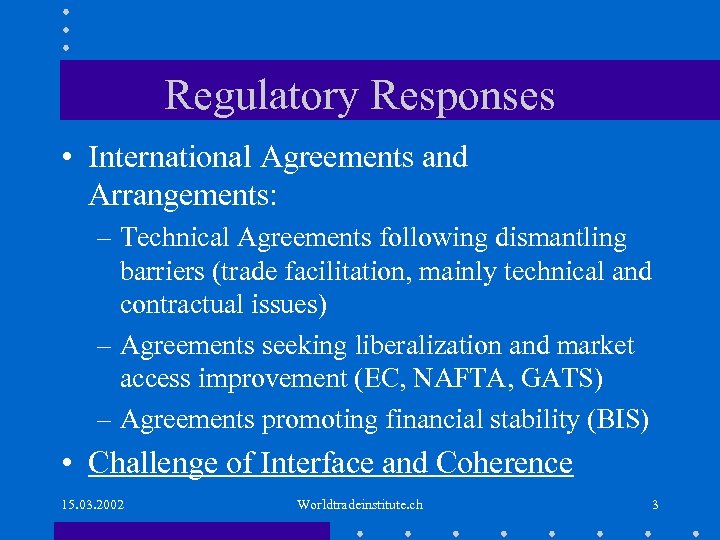
Regulatory Responses • International Agreements and Arrangements: – Technical Agreements following dismantling barriers (trade facilitation, mainly technical and contractual issues) – Agreements seeking liberalization and market access improvement (EC, NAFTA, GATS) – Agreements promoting financial stability (BIS) • Challenge of Interface and Coherence 15. 03. 2002 Worldtradeinstitute. ch 3
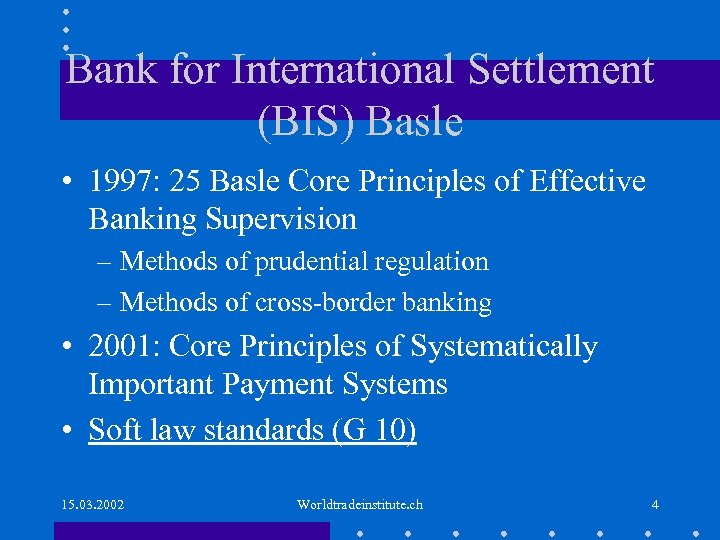
Bank for International Settlement (BIS) Basle • 1997: 25 Basle Core Principles of Effective Banking Supervision – Methods of prudential regulation – Methods of cross-border banking • 2001: Core Principles of Systematically Important Payment Systems • Soft law standards (G 10) 15. 03. 2002 Worldtradeinstitute. ch 4
Prudential Regulation • Prudential regulations of paramount importance and a necessary companion of trade liberalization • Where to place them ? – exclusively national law (home control) – exclusively international law (harmonization) – mixed regimes? 15. 03. 2002 Worldtradeinstitute. ch 5
Establishment or Cross Border? • Exclusive home control relates to the concept of establishment abroad (3 rd mode) • Progress in modes 1 and 2 are impeded by exclusive and thus highly varied home controls • Transparency alone will not do • The EC experience: mutual recognition 15. 03. 2002 Worldtradeinstitute. ch 6
Current WTO Rules • Art. VI: 4 GATS: authority to develop standards; Art. VI: 5 GATS: interim rules • Art. VII: Mutual Recognition and CMFN (and Annex FS para. 3) • Annex FS Art. 2: (carve out? ) Notwithstanding any other provision of this Agreement, a Member shall not be prevented from taking measures for prudential reasons. . Where such measures do not conform with the provisions of the Agreement, they shall not be used as a means of avoiding the Member’s commitment or obligations under the Agreement. 15. 03. 2002 Worldtradeinstitute. ch 7
Regulatory Options (1) • Status Quo (case by case) – home rules, variations, adjudication (DSU, including non-violation complaints), taking into account Basle instruments likely – protracted implementation modes 1 and 2 likely • Mutual Recognition (CMNF) – Discriminatory potential (in particular for LDCs) 15. 03. 2002 Worldtradeinstitute. ch 8
Regulatory Options (2) • TRIPs Approach – Incorporation of Standards – No treaty standards available – Inter-organizational tensions 15. 03. 2002 Worldtradeinstitute. ch 9
Regulatory Options (3) • SPS/TBT Approach – Reference to external standards – Possibility to apply stricter home standards (subject to consistent risk analysis and management) – Problem of broad legitimacy of standards – Plurilateral Approach or Opting-out option 15. 03. 2002 Worldtradeinstitute. ch 10
Regulatory Options (4) • Commitment to international Standards as part of negotiated individual concessions and thus part of schedules: – Recourse to Basle Rules and others (IMF? ) – Recourse to adopted WTO set of rules – Specifically negotiated rules and conditions (MFN) – Value of concession linked to quality of PS commitment 15. 03. 2002 Worldtradeinstitute. ch 11
Conclusions • Whatever regulatory option is chosen, negotiators should remember: – Prudential regulation and market access are of equal importance – Prudential regulation is a a key element of good governance and the rule of law – Good goverance and the rule of law depend on vertical and thus international checks and balances 15. 03. 2002 Worldtradeinstitute. ch 12
Скачать презентацию Financial Services A Swiss Perspective Christine Breining
36307d9d5c6822d3135295c63d1599c4.ppt