


 Скачать презентацию Financial Risk Management Zvi Wiener Following P Jorion
2eaea9be98cbafda21111f75fe70706b.ppt
- Количество слайдов: 26
 Financial Risk Management Zvi Wiener Following P. Jorion, Financial Risk Manager Handbook http: //pluto. huji. ac. il/~mswiener/zvi. html FRM 972 -2 -588 -3049
 Chapter 12 Identification of Risk Factors Following P. Jorion 2001 Financial Risk Manager Handbook http: //pluto. huji. ac. il/~mswiener/zvi. html FRM 972 -2 -588 -3049
 Absolute and Relative Risk • Absolute risk - measured in dollar terms • Relative risk - measured relative to benchmark index and is often called tracking error. Ch. 12, Handbook Zvi Wiener 3
 Directional Risk Directional risk involves exposures to the direction of movements in major market variables. beta for exposure to stock market duration for IR exposure delta for exposure of options to undelying Ch. 12, Handbook Zvi Wiener 4
 Non-directional Risk Non-linear exposures, volatility exposures, etc. residual risk in equity portfolios convexity in interest rates gamma - second order effects in options vega or volatility risk in options Ch. 12, Handbook Zvi Wiener 5
 Market versus Credit Risk Market risk is related to changes in prices, rates, etc. Credit risk is related to defaults. Many assets have both types - bonds, swaps, options. Ch. 12, Handbook Zvi Wiener 6
 Risk Interaction You buy 1 M GBP at 1. 5 $/GBP, settlement in two days. We will deliver $1. 5 M in exchange for 1 M GBP. Market risk Credit risk Settlement risk (Herstatt risk) Operational risk Ch. 12, Handbook Zvi Wiener 7
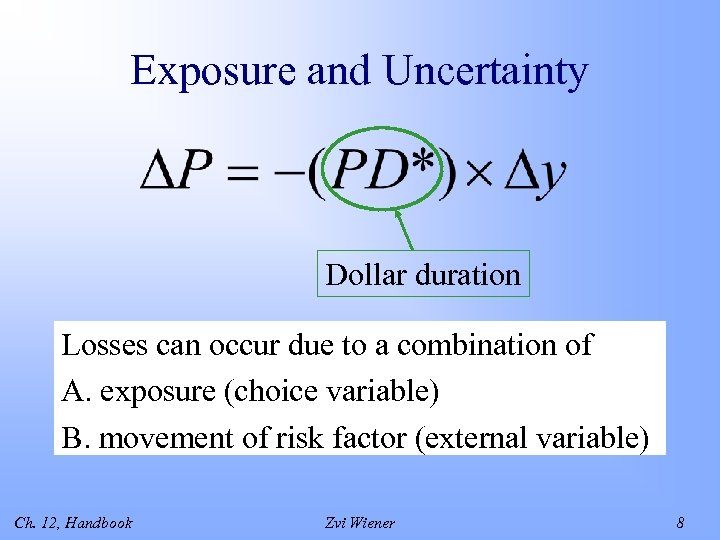 Exposure and Uncertainty Dollar duration Losses can occur due to a combination of A. exposure (choice variable) B. movement of risk factor (external variable) Ch. 12, Handbook Zvi Wiener 8
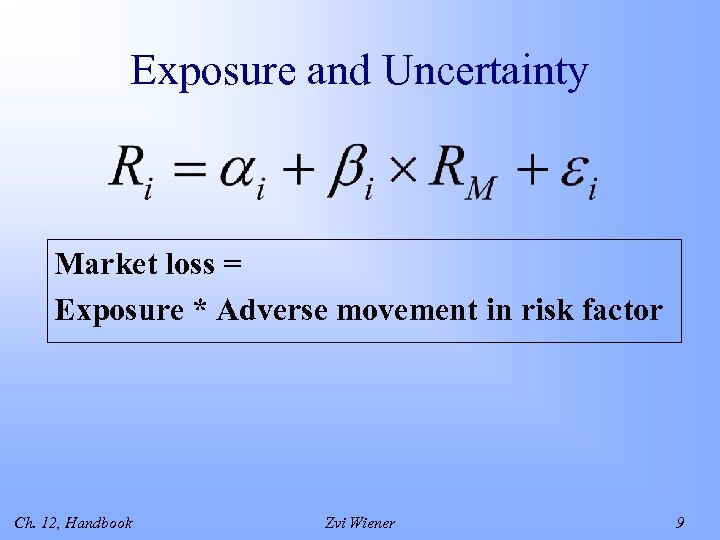 Exposure and Uncertainty Market loss = Exposure * Adverse movement in risk factor Ch. 12, Handbook Zvi Wiener 9
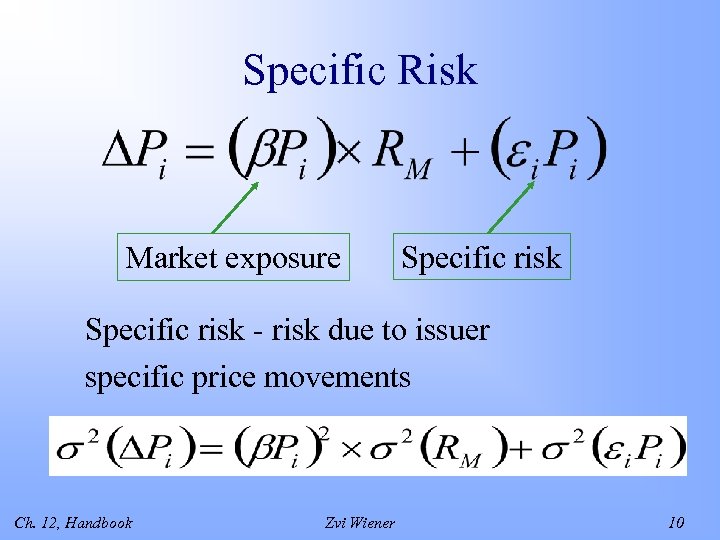 Specific Risk Market exposure Specific risk - risk due to issuer specific price movements Ch. 12, Handbook Zvi Wiener 10
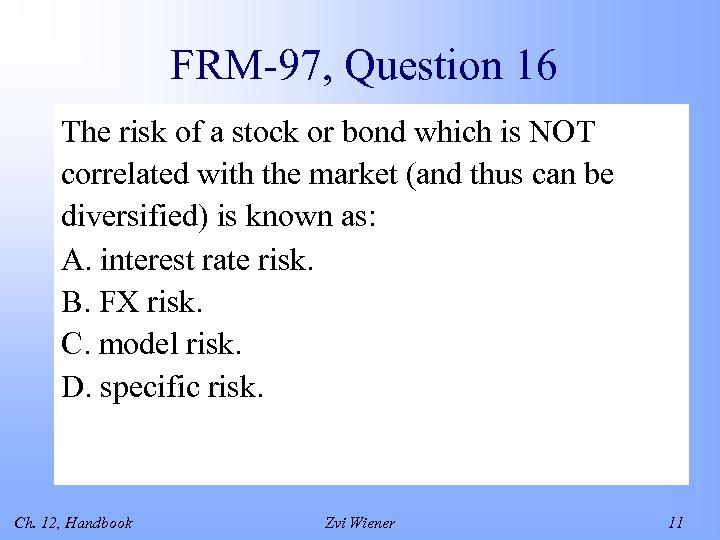 FRM-97, Question 16 The risk of a stock or bond which is NOT correlated with the market (and thus can be diversified) is known as: A. interest rate risk. B. FX risk. C. model risk. D. specific risk. Ch. 12, Handbook Zvi Wiener 11
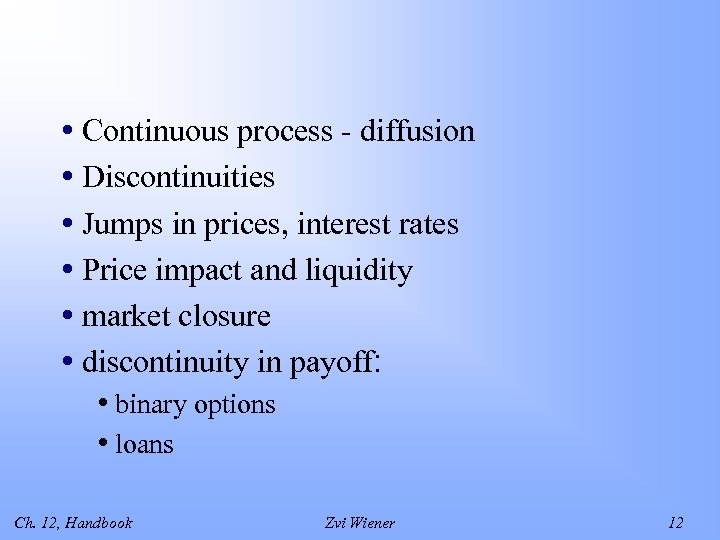 • Continuous process - diffusion • Discontinuities • Jumps in prices, interest rates • Price impact and liquidity • market closure • discontinuity in payoff: • binary options • loans Ch. 12, Handbook Zvi Wiener 12
 Emerging Markets Emerging stock market - definition by IFC (1981) International Finance Corporation. Stock markets located in developing countries (countries with GDP per capita less than $8, 625 in 1993). Ch. 12, Handbook Zvi Wiener 13
 Liquidity Risk Difficult to measure. Very unstable. Market depth can be used as an approximation. Liquidity risk consists of both asset liquidity and funding liquidity! Ch. 12, Handbook Zvi Wiener 14
 Funding Liquidity Risk of not meeting payment obligations. Cash flow risk! Liquidity needs can be met by • using cash • selling assets • borrowing Ch. 12, Handbook Zvi Wiener 15
 Highly liquid assets • tightness - difference between quoted mid market price and transaction price. • depth - volume of trade that does not affect prices. • resiliency - speed at which price fluctuations disappear. Ch. 12, Handbook Zvi Wiener 16
 Flight to quality Shift in demand from low grade towards high grade securities. Low grade market becomes illiquid with depressed prices. Spread between government and corporate issues increases. Ch. 12, Handbook Zvi Wiener 17
 On-the-run • recently issued • most active • very liquid • after a new issue appears they become offthe-run • liquidity premium can be compensated by repos/reverse repos Ch. 12, Handbook Zvi Wiener 18
 FRM-98, Question 7 Which of the following products has the least liquidity? A. US on-the-run Treasuries B. US off-the-run Treasuries C. Floating rate notes D. High grade corporate bonds Ch. 12, Handbook Zvi Wiener 19
 FRM-98, Question 7 Which of the following products has the least liquidity? A. US on-the-run Treasuries B. US off-the-run Treasuries C. Floating rate notes D. High grade corporate bonds Ch. 12, Handbook Zvi Wiener 20
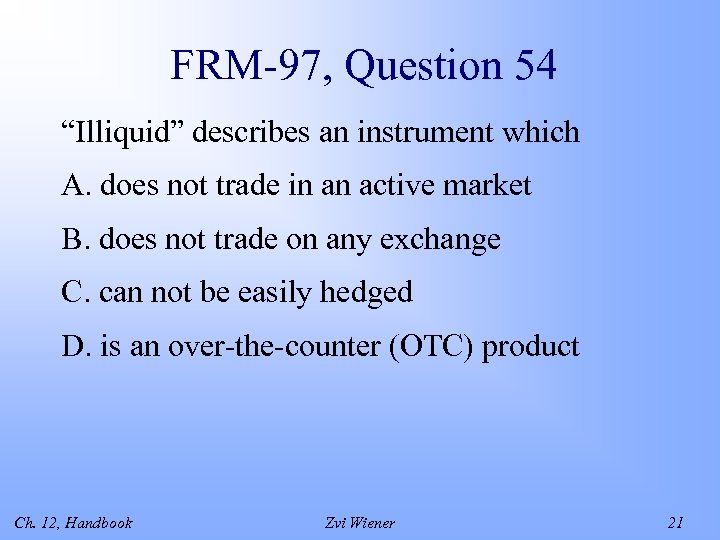 FRM-97, Question 54 “Illiquid” describes an instrument which A. does not trade in an active market B. does not trade on any exchange C. can not be easily hedged D. is an over-the-counter (OTC) product Ch. 12, Handbook Zvi Wiener 21
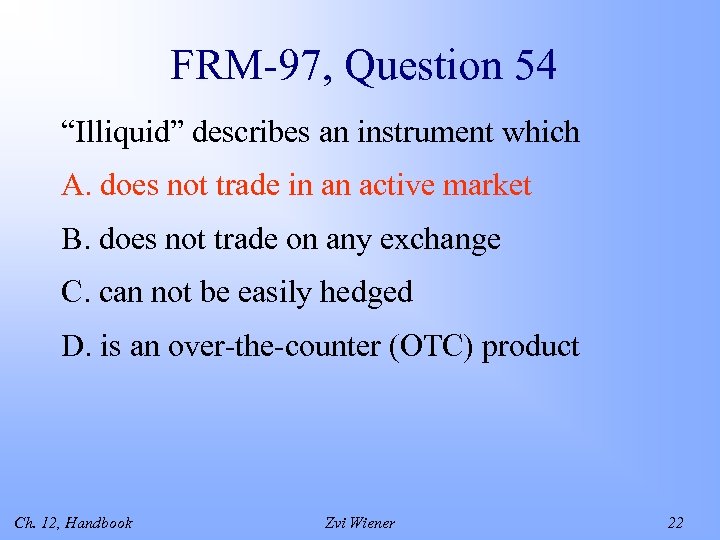 FRM-97, Question 54 “Illiquid” describes an instrument which A. does not trade in an active market B. does not trade on any exchange C. can not be easily hedged D. is an over-the-counter (OTC) product Ch. 12, Handbook Zvi Wiener 22
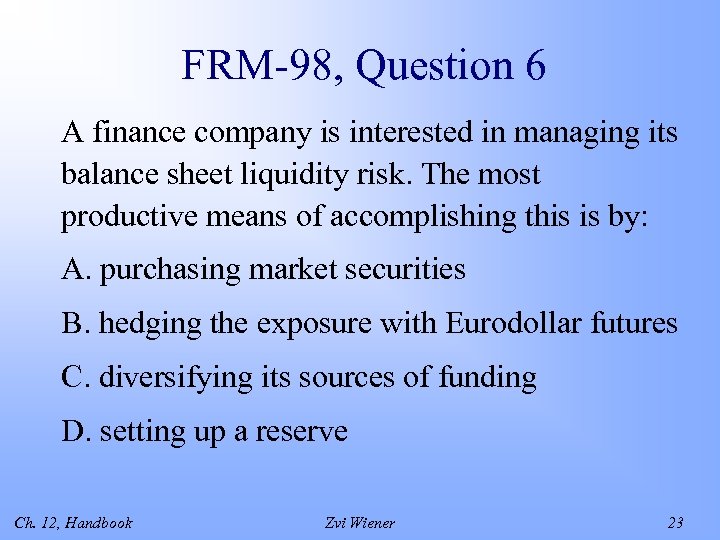 FRM-98, Question 6 A finance company is interested in managing its balance sheet liquidity risk. The most productive means of accomplishing this is by: A. purchasing market securities B. hedging the exposure with Eurodollar futures C. diversifying its sources of funding D. setting up a reserve Ch. 12, Handbook Zvi Wiener 23
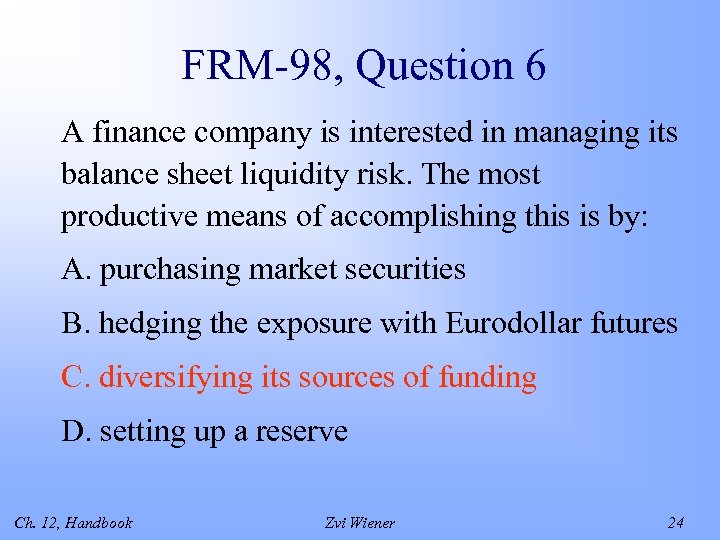 FRM-98, Question 6 A finance company is interested in managing its balance sheet liquidity risk. The most productive means of accomplishing this is by: A. purchasing market securities B. hedging the exposure with Eurodollar futures C. diversifying its sources of funding D. setting up a reserve Ch. 12, Handbook Zvi Wiener 24
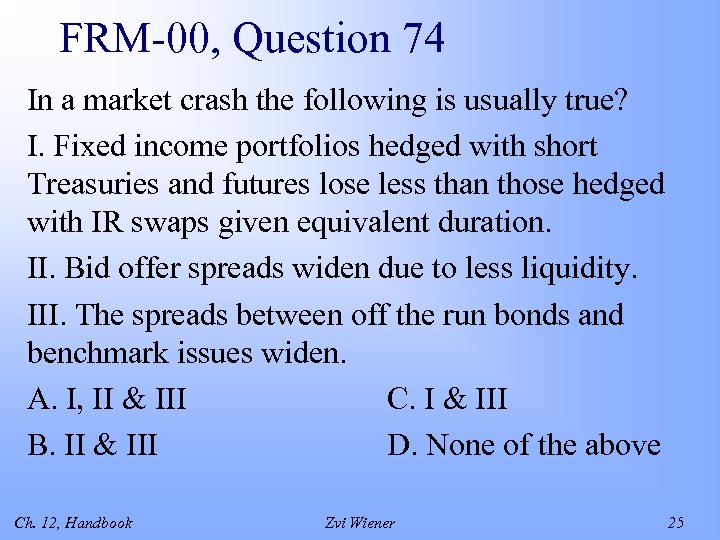 FRM-00, Question 74 In a market crash the following is usually true? I. Fixed income portfolios hedged with short Treasuries and futures lose less than those hedged with IR swaps given equivalent duration. II. Bid offer spreads widen due to less liquidity. III. The spreads between off the run bonds and benchmark issues widen. A. I, II & III C. I & III B. II & III D. None of the above Ch. 12, Handbook Zvi Wiener 25
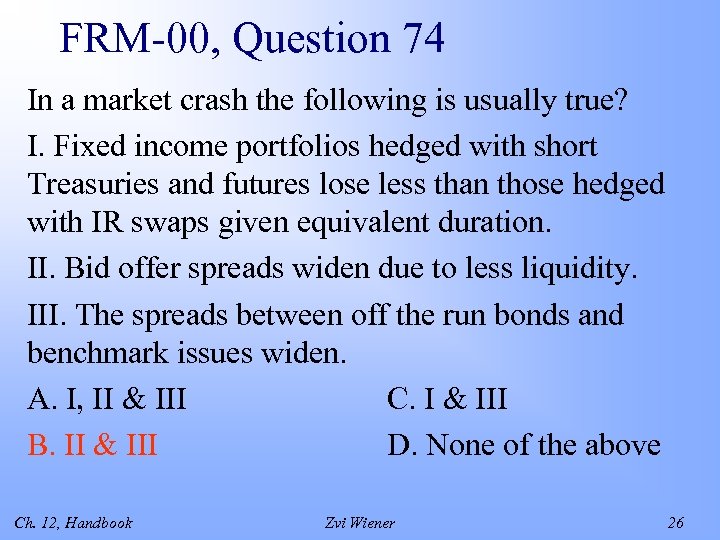 FRM-00, Question 74 In a market crash the following is usually true? I. Fixed income portfolios hedged with short Treasuries and futures lose less than those hedged with IR swaps given equivalent duration. II. Bid offer spreads widen due to less liquidity. III. The spreads between off the run bonds and benchmark issues widen. A. I, II & III C. I & III B. II & III D. None of the above Ch. 12, Handbook Zvi Wiener 26