 Скачать презентацию Financial Risk Management of Insurance Enterprises 1 Embedded
ac927acbf4859f6b9637b8ffd4bd1b63.ppt
- Количество слайдов: 25



Financial Risk Management of Insurance Enterprises 1. Embedded Options 2. Binomial Method
Embedded Options • Up to this point, we have considered cash flows which are fixed • Insurers’ liabilities are not fixed due to options given to the policyholder • Frequently, asset cash flows are not fixed either – Callable bonds or defaults on bonds can cause payments to differ • Embedded options are features which can alter the payments of an otherwise fixed cash flow – Embedded options may be part of assets or liabilities
Evaluating Option-Embedded Cash Flows • Cash flows with embedded options can be simplified by separating into two components – Fixed cash flow – Option cash flow • Evaluating the fixed cash flow and its sensitivity to interest is easy • To estimate the option’s cash flows, we need to consider a variety of possible future scenarios

Valuation Methods • Today and next lecture, we will discuss two popular approaches in developing future scenarios to predict option cash flows – Binomial method – Monte Carlo method or simulation
Binomial Method • As its name suggests, the binomial method models future periods with two distinct scenarios – Usually described by an “up” scenario and a “down” scenario • The tree “grows” by repeating this assumption at every point in time • This binomial process continues until maturity
Binomial Method (p. 2) • Typically, the binomial method is used for stock prices or interest rates – Stock prices go up or down – Interest rates go up or down • The volatility of the stock price or interest rate is based on the difference between an up movement and a down movement – Higher volatility requires a bigger difference between up and down movements
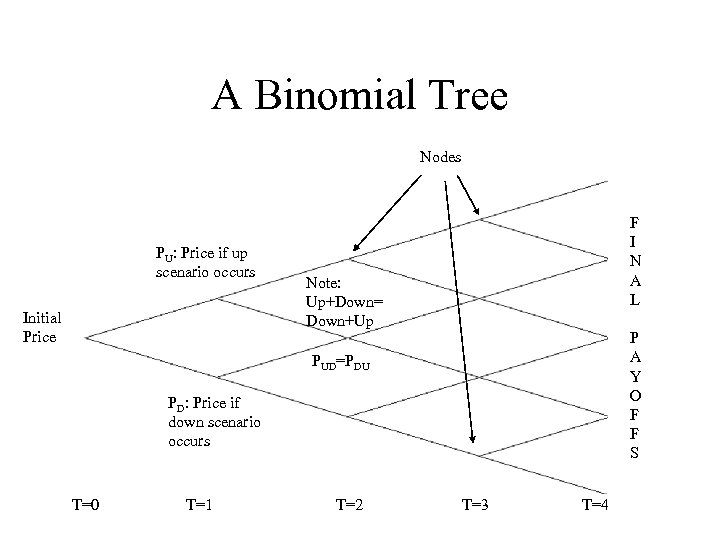
A Binomial Tree Nodes PU: Price if up scenario occurs Initial Price F I N A L Note: Up+Down= Down+Up P A Y O F F S PUD=PDU PD: Price if down scenario occurs T=0 T=1 T=2 T=3 T=4
Notes to Binomial Trees • A simple tree or lattice is recombining – An up-down movement has the same ending value as a down-up movement – In the example, PUD=PDU • For a t-period tree, there are t+1 final payoffs • By decreasing the time interval between nodes, the binomial method increases the number of possible future states of the world that occur in any finite period
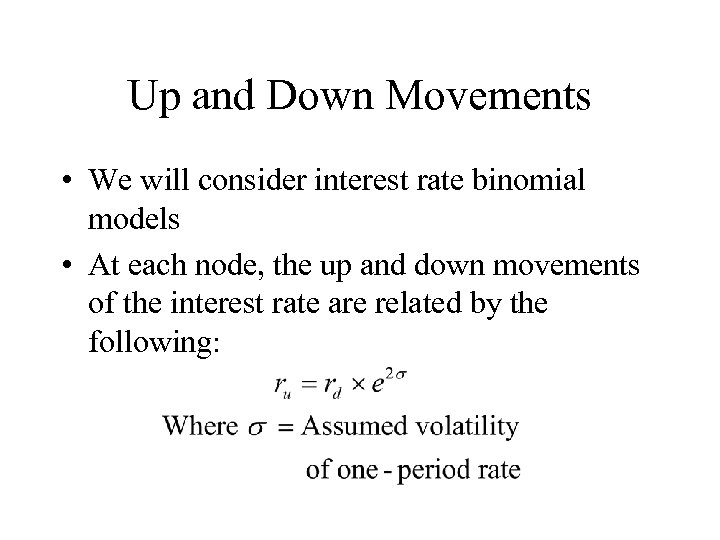
Up and Down Movements • We will consider interest rate binomial models • At each node, the up and down movements of the interest rate are related by the following:
Building the Tree - An Overview • Our objective is to value non-fixed cash flows • We must first “calibrate” our model – Valuing a non-callable bond with the binomial tree must replicate its market value • Similar to bootstrap method, we must build the tree one period at a time • At any node, the value of the bond depends on future cash flows and the one-period interest rate
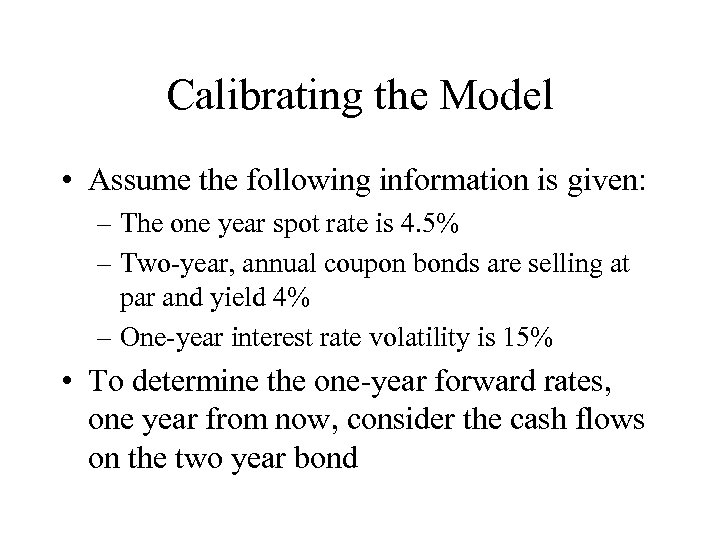
Calibrating the Model • Assume the following information is given: – The one year spot rate is 4. 5% – Two-year, annual coupon bonds are selling at par and yield 4% – One-year interest rate volatility is 15% • To determine the one-year forward rates, one year from now, consider the cash flows on the two year bond
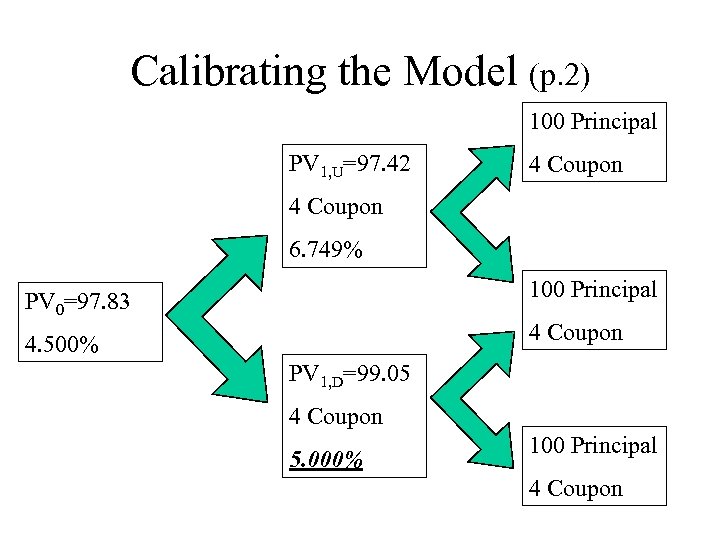
Calibrating the Model (p. 2) 100 Principal PV 1, U=97. 42 4 Coupon 6. 749% PV 0=97. 83 100 Principal 4. 500% 4 Coupon PV 1, D=99. 05 4 Coupon 5. 000% 100 Principal 4 Coupon
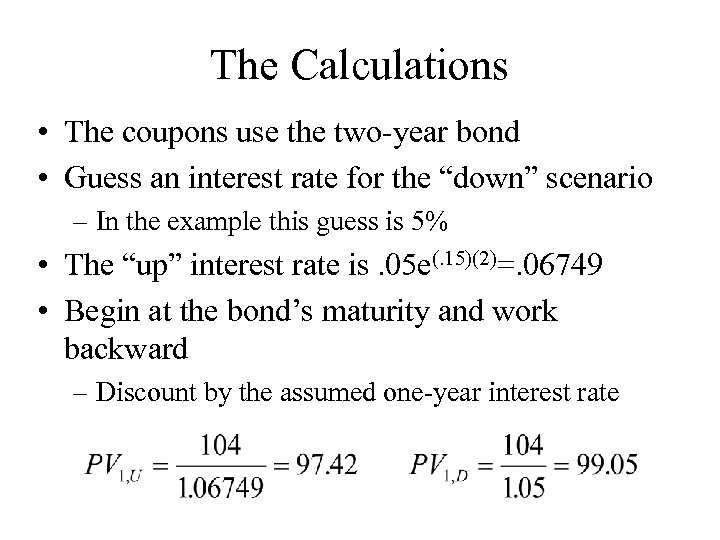
The Calculations • The coupons use the two-year bond • Guess an interest rate for the “down” scenario – In the example this guess is 5% • The “up” interest rate is. 05 e(. 15)(2)=. 06749 • Begin at the bond’s maturity and work backward – Discount by the assumed one-year interest rate
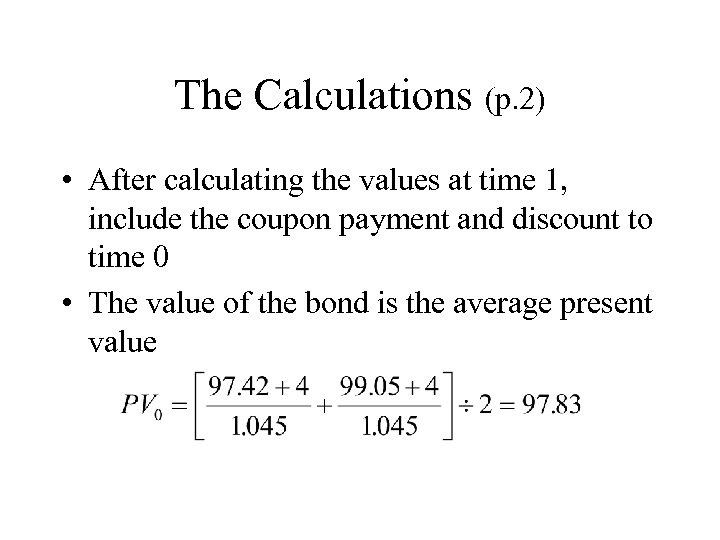
The Calculations (p. 2) • After calculating the values at time 1, include the coupon payment and discount to time 0 • The value of the bond is the average present value
Adjusting the Initial Guess • Our interest rate process does not reproduce the two-year bond market value • Since the PV is too low, the guess of 5% is too high • Use trial-and-error (or a Solver) to find the correct rate • In the example, the correct rate is 2. 97%
Binomial “Bootstrap” • Once the model is calibrated through two years, we can continue the process for three years – Keep the “calibrated” two year rates for the threeperiod tree • For each period, the unknown interest rate that we must determine is the one-year interest rate corresponding to all down movements • All other rates are related to this guess
The Completed Tree • Assume that we have found all of the nodes needed for valuing a cash flow – Interest rate binomial tree is completed through the last payment date • Bonds can be valued using the completed tree – For option-free bonds, results should be identical to valuation using spot rates or implied forward rates – Bonds with options may also be valued using the tree
The Option in Callable Bonds • Many bonds are callable • Option is owned by the issuer and gives the right to buy the bond at a fixed price at any time – However, there may be some period of call protection • Issuer will call an issue if the market yield is below the coupon – At this point, the bond will sell at a premium
Valuing Callable Bonds • Using the interest rate tree, the value of a callable bond can be determined • At nodes where the present value exceeds par, the issuer will call at par – Coupon will exceed interest rate. too – This may occur in the part of the tree where interest rates decline – Holder of bond only gets the call value at that node and the present value of future cash flows is irrelevant
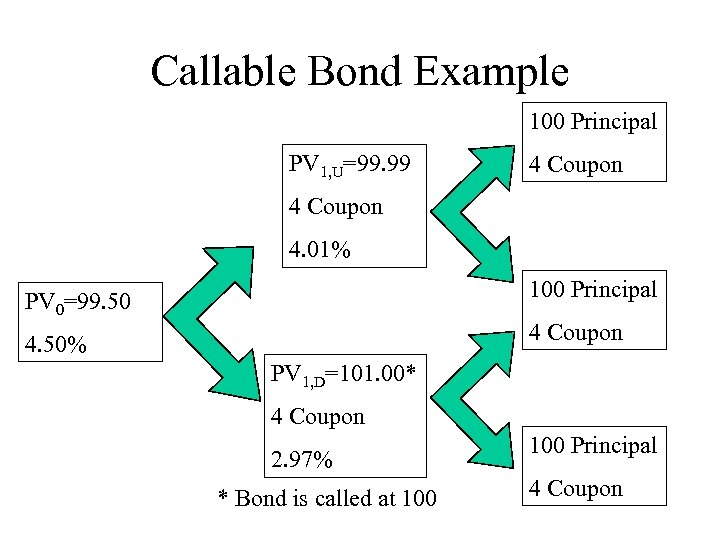
Callable Bond Example 100 Principal PV 1, U=99. 99 4 Coupon 4. 01% PV 0=99. 50 100 Principal 4. 50% 4 Coupon PV 1, D=101. 00* 4 Coupon 2. 97% * Bond is called at 100 Principal 4 Coupon
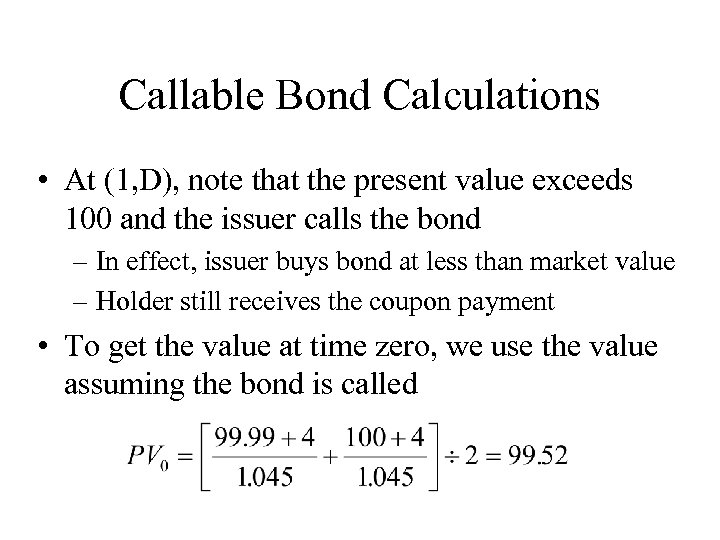
Callable Bond Calculations • At (1, D), note that the present value exceeds 100 and the issuer calls the bond – In effect, issuer buys bond at less than market value – Holder still receives the coupon payment • To get the value at time zero, we use the value assuming the bond is called
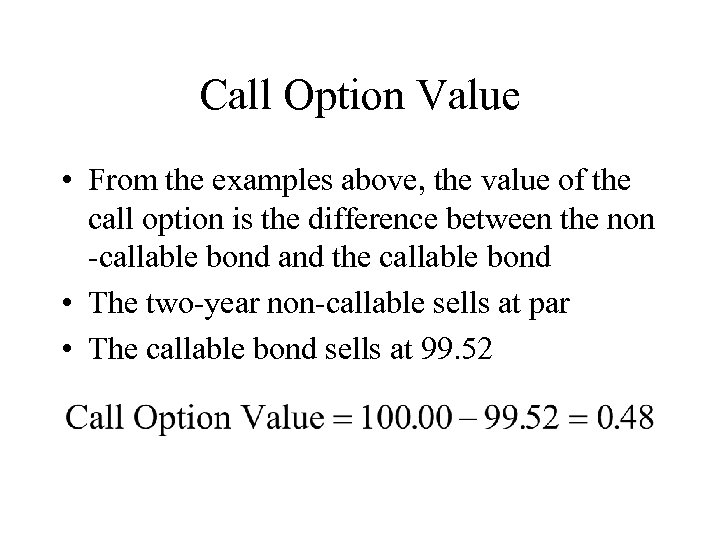
Call Option Value • From the examples above, the value of the call option is the difference between the non -callable bond and the callable bond • The two-year non-callable sells at par • The callable bond sells at 99. 52
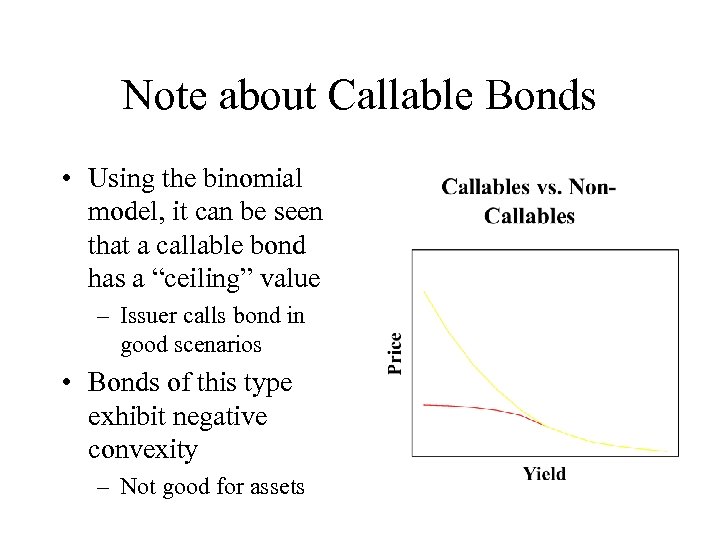
Note about Callable Bonds • Using the binomial model, it can be seen that a callable bond has a “ceiling” value – Issuer calls bond in good scenarios • Bonds of this type exhibit negative convexity – Not good for assets
Extensions • Embedded options come in all shapes and sizes • For nodes where the option is exercised, incorporate the effects on cash flows • Potential uses: – Putable bonds – Options on bonds
Next time. . . • Mortgage-Backed Securities • Embedded Option Valuation Method #2: Monte Carlo Simulation • How to use Monte Carlo Simulation for CMOs and Callable Bonds
Скачать презентацию Financial Risk Management of Insurance Enterprises 1 Embedded
ac927acbf4859f6b9637b8ffd4bd1b63.ppt