


 Скачать презентацию Financial Reporting Scott Furniss Sr VP CFO St Agnes
61c8d088b5bb44698ee34da1ad044807.ppt
- Количество слайдов: 69
 Financial Reporting Scott Furniss Sr. VP/CFO St. Agnes Health. Care, Inc. March 30, 2012
 Intro
Intro
 Today’s Discussion 4 4 4 4 Finance Departments and Activities Accounting Concepts Common Issues Basic Accounting Transactions Basic Financial Statements Example Financial Statements Financial Ratios and Analysis Case Study
 Finance Departments
 Typical Finance Department • • • General Accounting Accounts Payable Payroll Treasury Rates & Reimbursement Taxes Financial Analysis and Budget Financial Reporting All entities…. Hospital and Subsidiaries 4
 Typical Finance Department • • Daily Account posting Bi-weekly Payroll Monthly Close (J/E’s, Reconciliations, etc. ) Monthly Compliance Reports (HSCRC) Monthly/Quarterly Management-Board Reports Quarterly Disclosure Reports Plus… 5
 Typical Finance Department • • • Annual Budget Annual Cost Reports (CMS, HSCRC, others) Annual Tax Returns (IRS, PBGC, State) Annual Financial Statements and Audit All entities…. Hospital and Subsidiaries 6
 Accounting Concepts
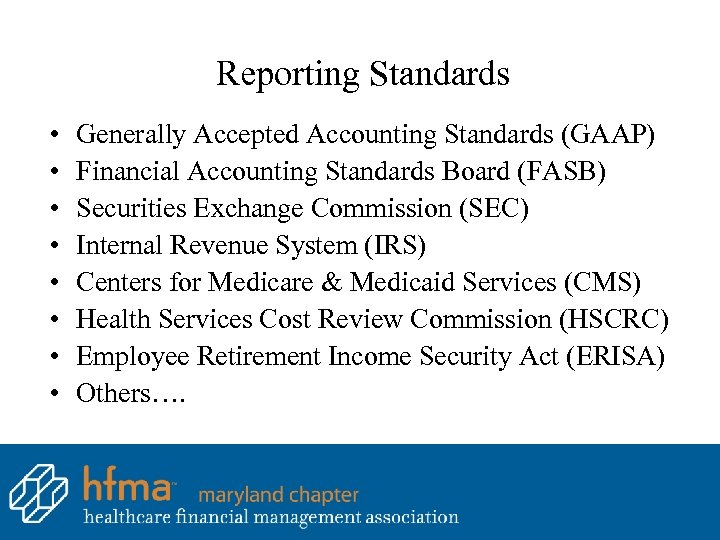 Reporting Standards • • Generally Accepted Accounting Standards (GAAP) Financial Accounting Standards Board (FASB) Securities Exchange Commission (SEC) Internal Revenue System (IRS) Centers for Medicare & Medicaid Services (CMS) Health Services Cost Review Commission (HSCRC) Employee Retirement Income Security Act (ERISA) Others….
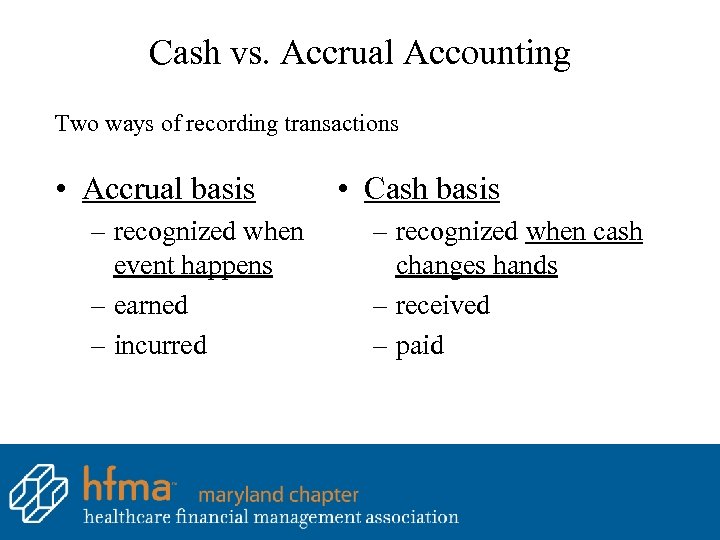 Cash vs. Accrual Accounting Two ways of recording transactions • Accrual basis – recognized when event happens – earned – incurred • Cash basis – recognized when cash changes hands – received – paid
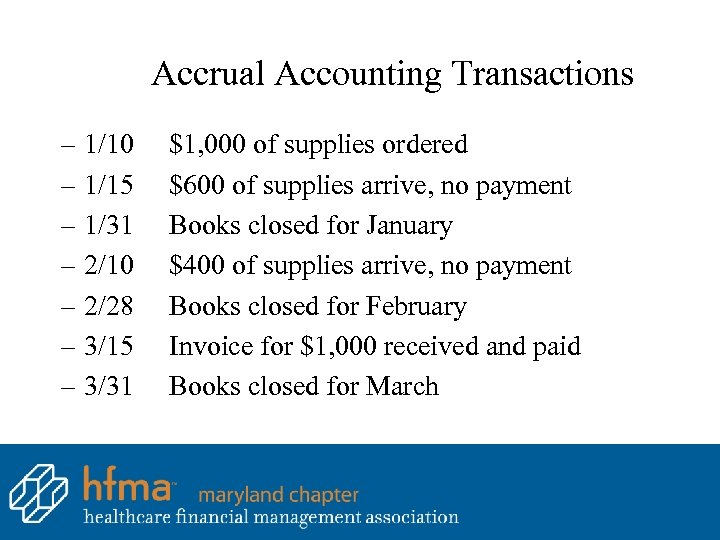 Accrual Accounting Transactions – 1/10 – 1/15 – 1/31 – 2/10 – 2/28 – 3/15 – 3/31 $1, 000 of supplies ordered $600 of supplies arrive, no payment Books closed for January $400 of supplies arrive, no payment Books closed for February Invoice for $1, 000 received and paid Books closed for March
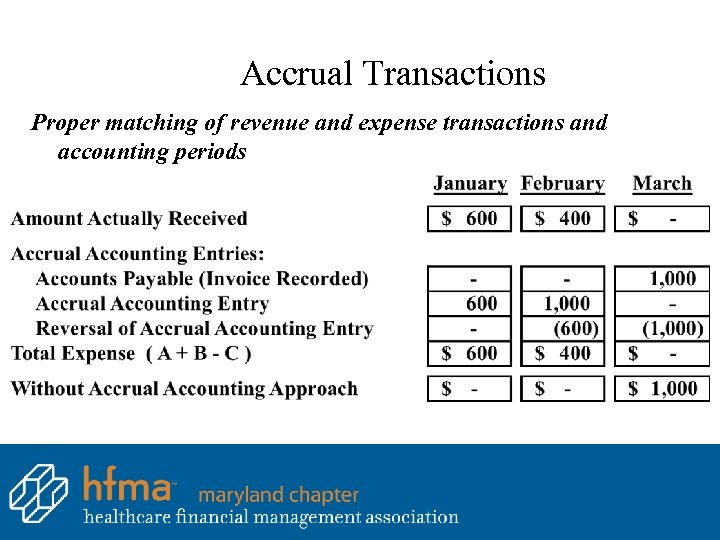 Accrual Transactions Proper matching of revenue and expense transactions and accounting periods
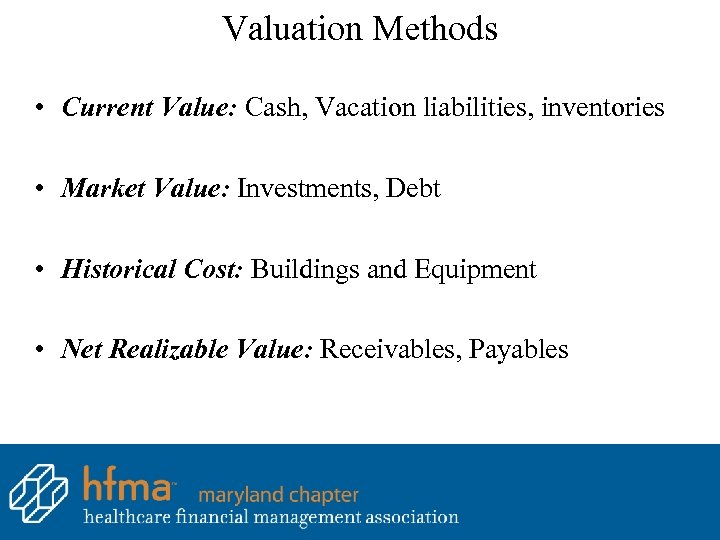 Valuation Methods • Current Value: Cash, Vacation liabilities, inventories • Market Value: Investments, Debt • Historical Cost: Buildings and Equipment • Net Realizable Value: Receivables, Payables
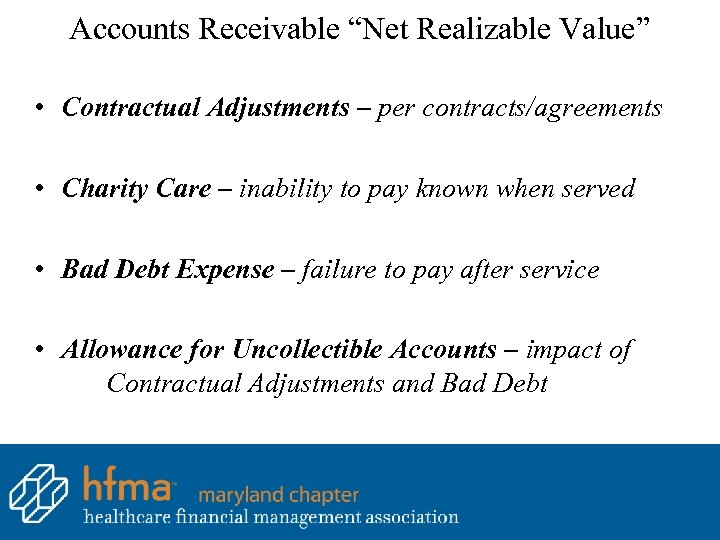 Accounts Receivable “Net Realizable Value” • Contractual Adjustments – per contracts/agreements • Charity Care – inability to pay known when served • Bad Debt Expense – failure to pay after service • Allowance for Uncollectible Accounts – impact of Contractual Adjustments and Bad Debt
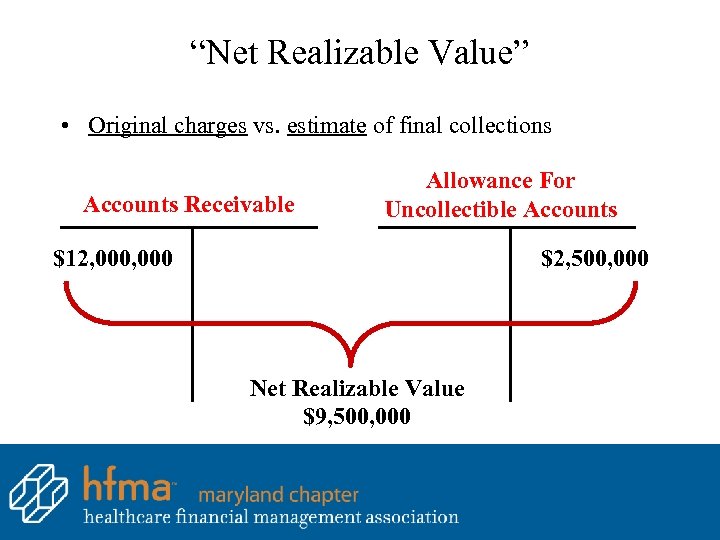 “Net Realizable Value” • Original charges vs. estimate of final collections Accounts Receivable Allowance For Uncollectible Accounts $12, 000 $2, 500, 000 Net Realizable Value $9, 500, 000
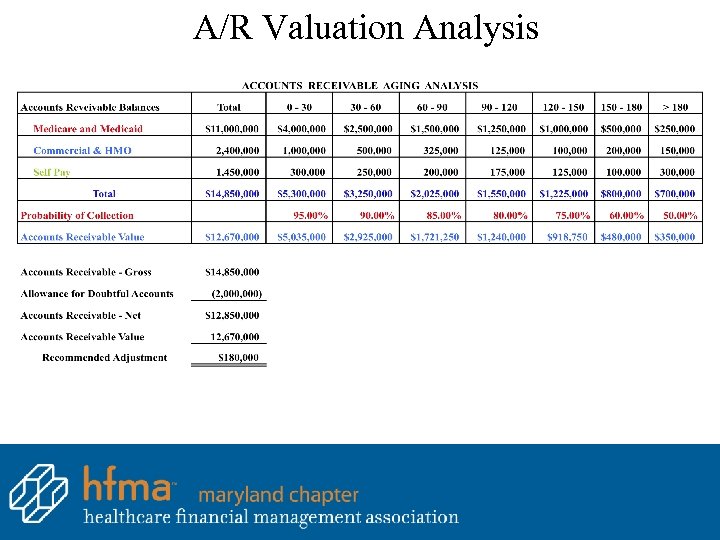 A/R Valuation Analysis
 Common Issues
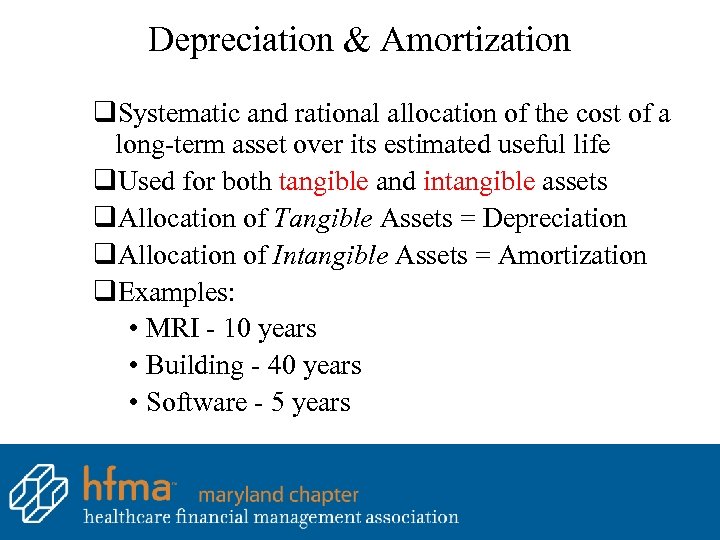 Depreciation & Amortization q. Systematic and rational allocation of the cost of a long-term asset over its estimated useful life q. Used for both tangible and intangible assets q. Allocation of Tangible Assets = Depreciation q. Allocation of Intangible Assets = Amortization q. Examples: • MRI - 10 years • Building - 40 years • Software - 5 years
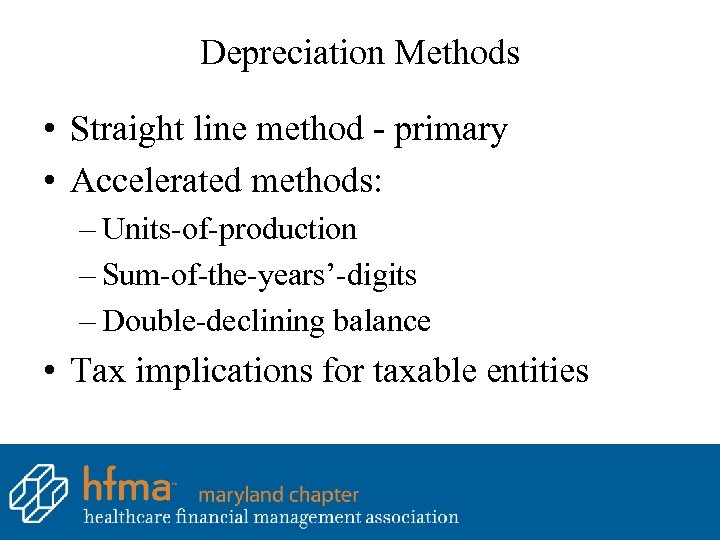 Depreciation Methods • Straight line method - primary • Accelerated methods: – Units-of-production – Sum-of-the-years’-digits – Double-declining balance • Tax implications for taxable entities
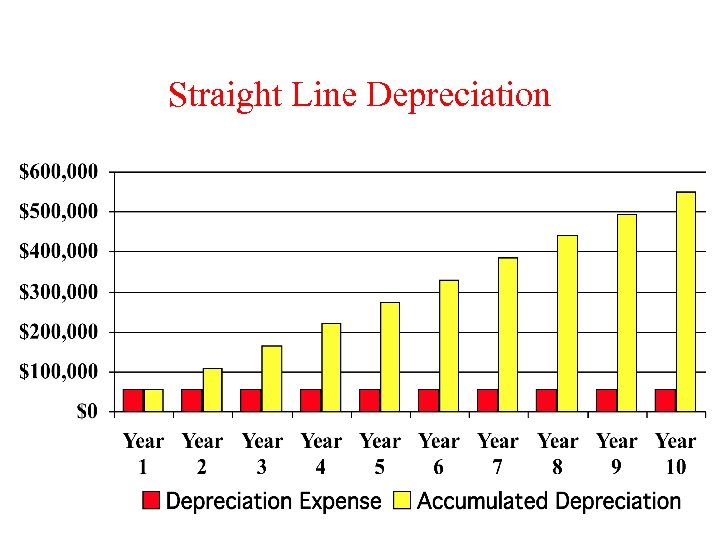 Straight Line Depreciation
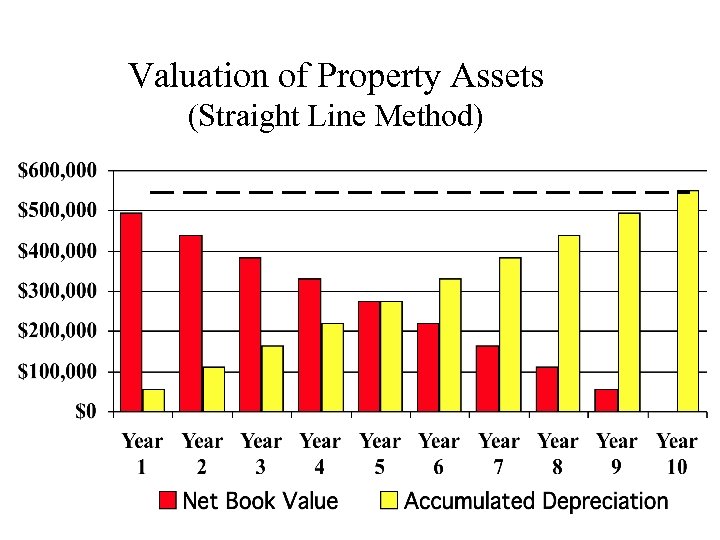 Valuation of Property Assets (Straight Line Method)
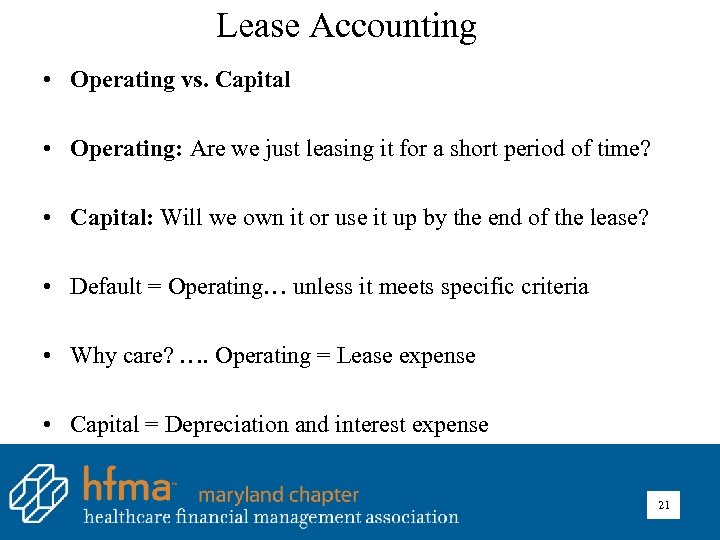 Lease Accounting • Operating vs. Capital • Operating: Are we just leasing it for a short period of time? • Capital: Will we own it or use it up by the end of the lease? • Default = Operating… unless it meets specific criteria • Why care? …. Operating = Lease expense • Capital = Depreciation and interest expense 21
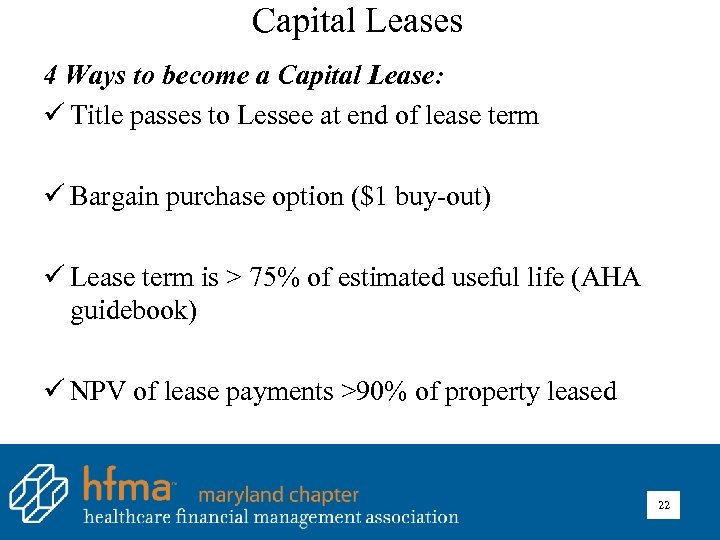 Capital Leases 4 Ways to become a Capital Lease: ü Title passes to Lessee at end of lease term ü Bargain purchase option ($1 buy-out) ü Lease term is > 75% of estimated useful life (AHA guidebook) ü NPV of lease payments >90% of property leased 22
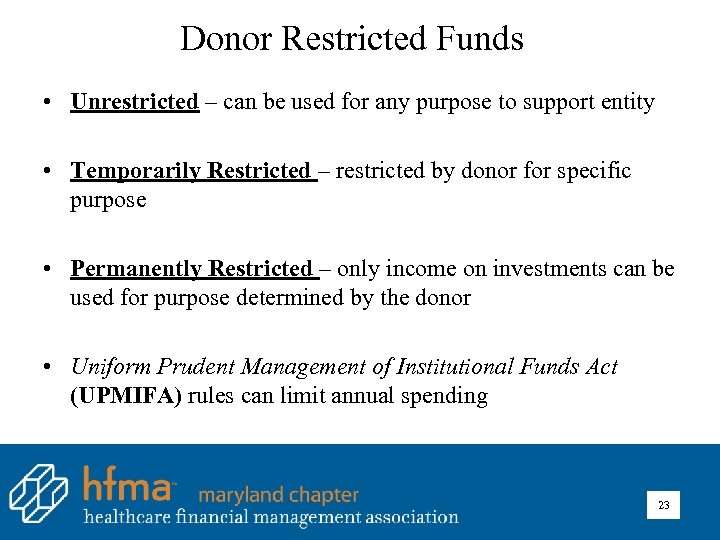 Donor Restricted Funds • Unrestricted – can be used for any purpose to support entity • Temporarily Restricted – restricted by donor for specific purpose • Permanently Restricted – only income on investments can be used for purpose determined by the donor • Uniform Prudent Management of Institutional Funds Act (UPMIFA) rules can limit annual spending 23
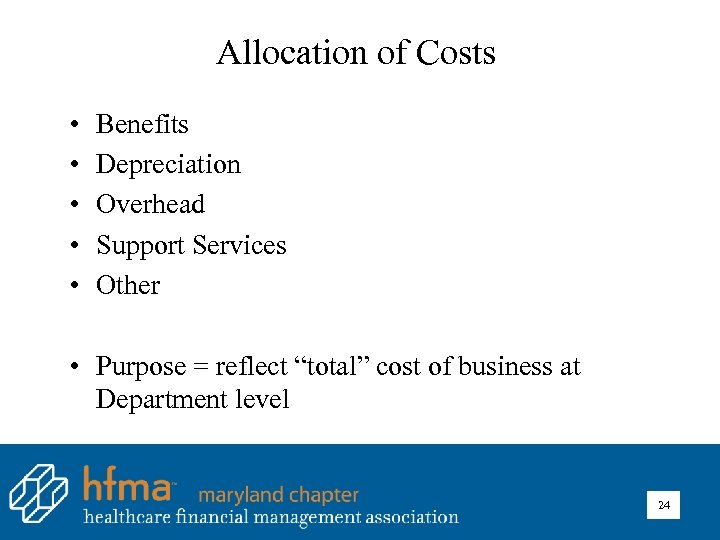 Allocation of Costs • • • Benefits Depreciation Overhead Support Services Other • Purpose = reflect “total” cost of business at Department level 24
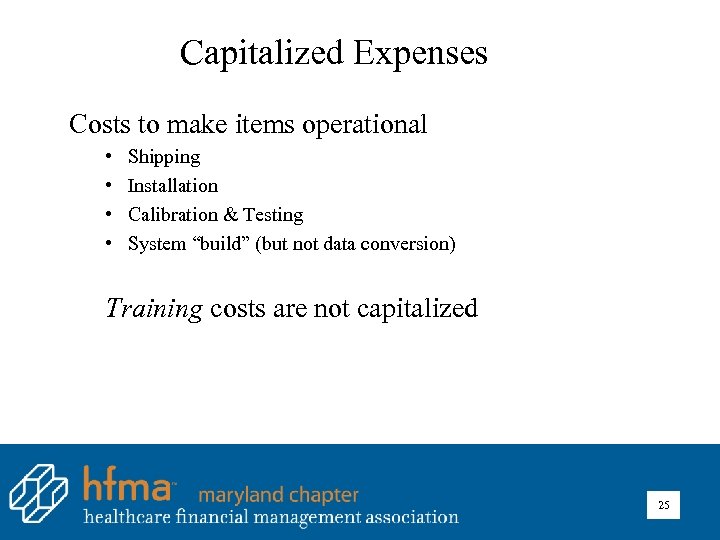 Capitalized Expenses Costs to make items operational • • Shipping Installation Calibration & Testing System “build” (but not data conversion) Training costs are not capitalized 25
 Basic Accounting Transactions
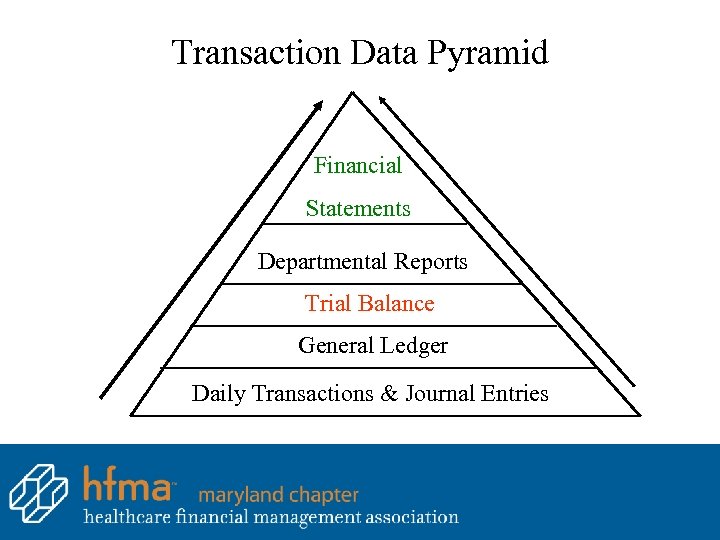 Transaction Data Pyramid Financial Statements Departmental Reports Trial Balance General Ledger Daily Transactions & Journal Entries
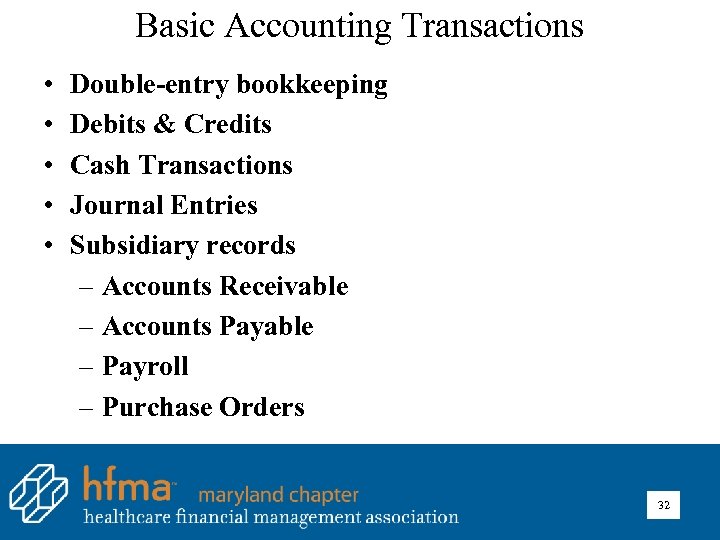
 Basic Accounting Transactions Transaction based activity: • Accounts Payable – invoices/payments • Purchasing Activity – supplies and services • Patient Charges • Payroll • Collections on receivables • Investment and Debt activity
 Basic Accounting Transactions Journal Entry Activity: • • Depreciation expense Bad Debt Expense Accrual adjustments Reconciliation adjustments This can be a manual activity, data “upload”, or an interface…
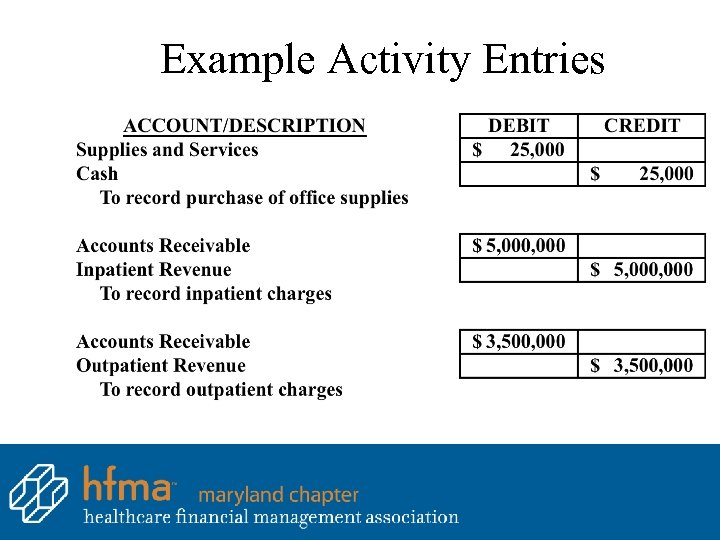 Example Activity Entries
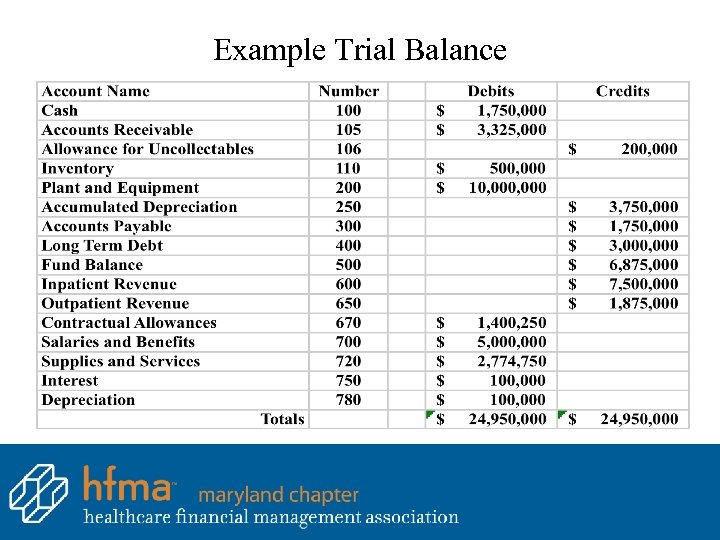
 Trial Balance • List of all account BALANCES • Total debits = total credits • Preliminary to preparation of financial statements
 Basic Accounting Transactions • • • Double-entry bookkeeping Debits & Credits Cash Transactions Journal Entries Subsidiary records – Accounts Receivable – Accounts Payable – Payroll – Purchase Orders 32
 Example Trial Balance
 Departmental Reports
 Basic Financial Statements
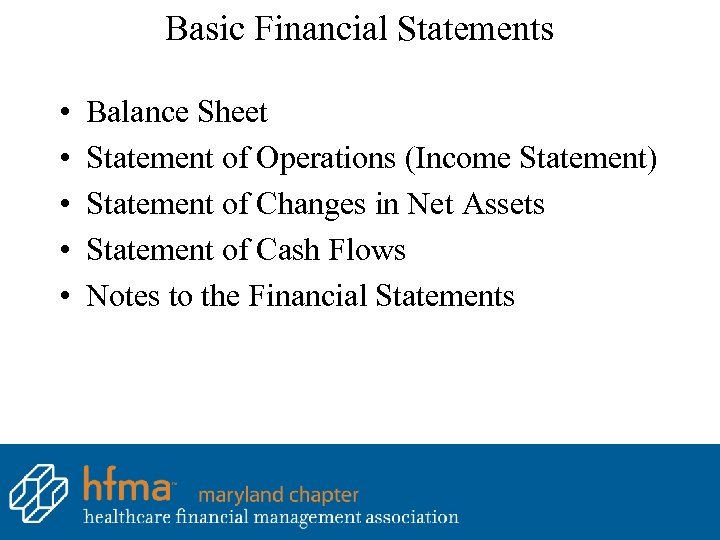 Basic Financial Statements • • • Balance Sheet Statement of Operations (Income Statement) Statement of Changes in Net Assets Statement of Cash Flows Notes to the Financial Statements
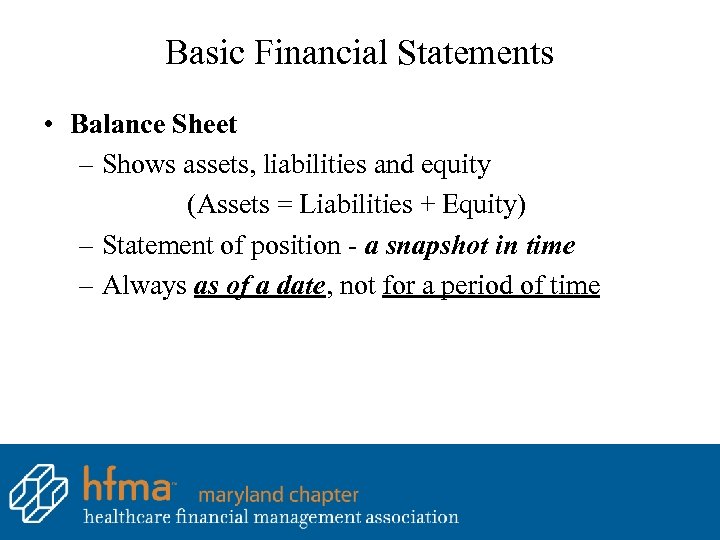 Basic Financial Statements • Balance Sheet – Shows assets, liabilities and equity (Assets = Liabilities + Equity) – Statement of position - a snapshot in time – Always as of a date, not for a period of time
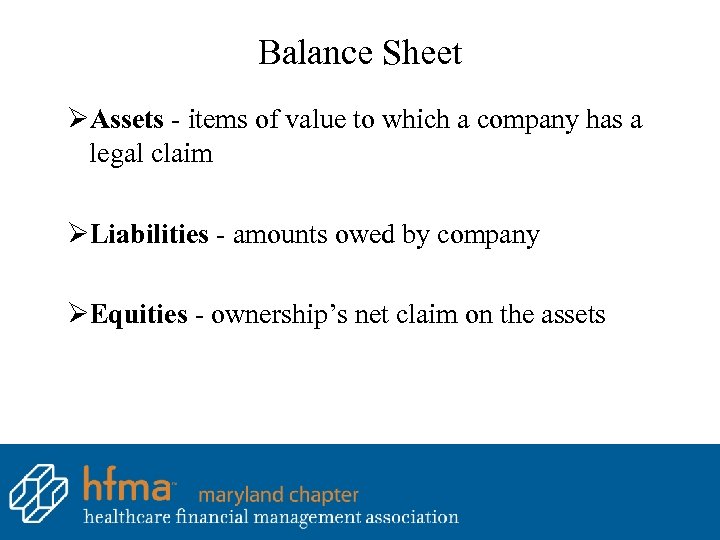 Balance Sheet ØAssets - items of value to which a company has a legal claim ØLiabilities - amounts owed by company ØEquities - ownership’s net claim on the assets
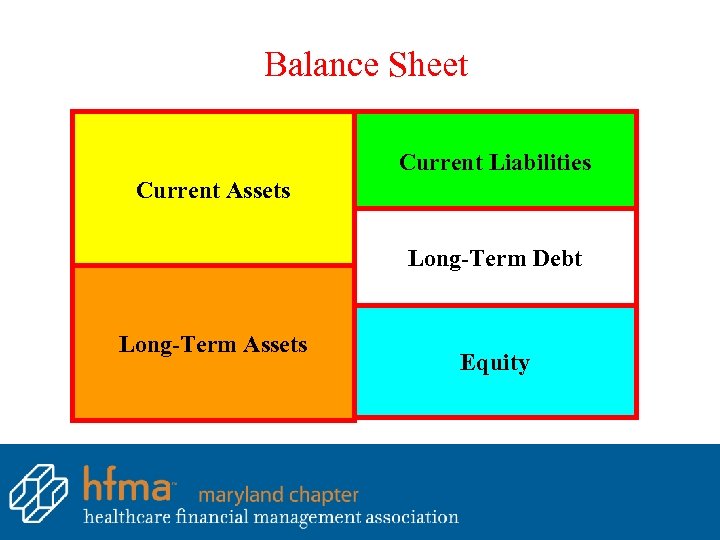 Balance Sheet Current Liabilities Current Assets Long-Term Debt Long-Term Assets Equity
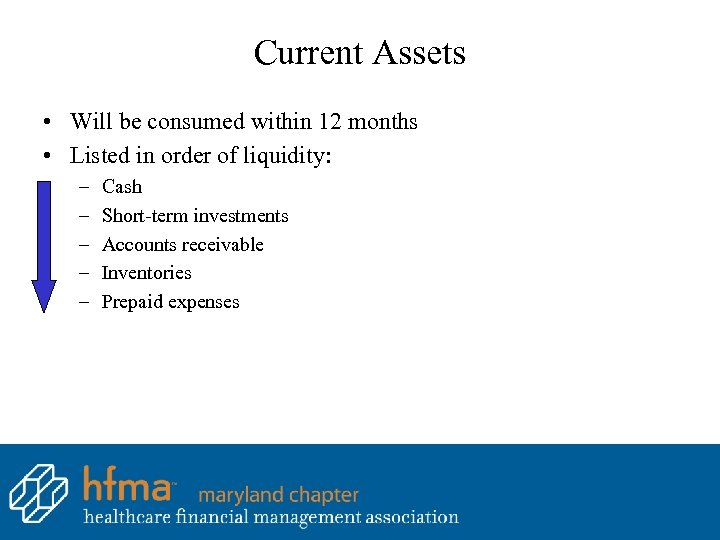 Current Assets • Will be consumed within 12 months • Listed in order of liquidity: – – – Cash Short-term investments Accounts receivable Inventories Prepaid expenses
 Current Assets • Cash – checks and money on deposit – credit card receipts • Short-term investments – marketable securities – certificates of deposit – other investment instruments
 Current Assets • Accounts receivable – funds owed to the company – government and insurance payors – individual patients – other • Inventories – Medical, surgical and office supplies – Fuel, food
 Current Assets • Prepaid expenses – prepaid insurance – prepaid rent and supplies – prepaid interest and property taxes
 Fixed (Long-Term) Assets • Useful life > 1 year • Long-term assets include: – Property, plant and equipment – Natural resources – Intangible assets
 Property, Plant & Equipment • Land improvements – parking lots, sidewalks, landscaping • Buildings • Fixed equipment – Boilers, HVAC • Major equipment – MRI, Linear Accelerators
 Intangible Assets • Items of value which lack physical characteristics – Goodwill – Patents/Trademarks – Franchises/Licenses – Customer lists – Computer software
 Current Liabilities • Payable within 12 months – trade accounts payable (invoiced) – salaries, wages, payroll taxes payable, accrued vacation – accrued liabilities (known, but not yet invoiced) – advances from third-party payers – interest payable
 Long-Term Liabilities • Repaid over a period > 1 year – bonds and notes payable – bank loans – pension liability
 Equity • Net assets of the company • Owners’ claims on the company assets – stock – contributed (or paid in) capital – accumulated profits/losses • Restricted and Unrestricted
 Unique to Not-For-Profits • • • Assets limited as to use Contributions receivable Advances from 3 rd party payors Third party settlements Restricted net assets No Tax expense/liability
 Unique to Health Care ASSETS: • Assets Limited as to Use – Proceeds from tax-exempt bond issues • Construction Fund • Debt Service Reserve Fund – Board Designated – Donor Restricted • Contributions
 Unique to Health Care LIABILITIES AND NET ASSETS: • Advances from third-party payors • Temporarily and permanently restricted Net Assets
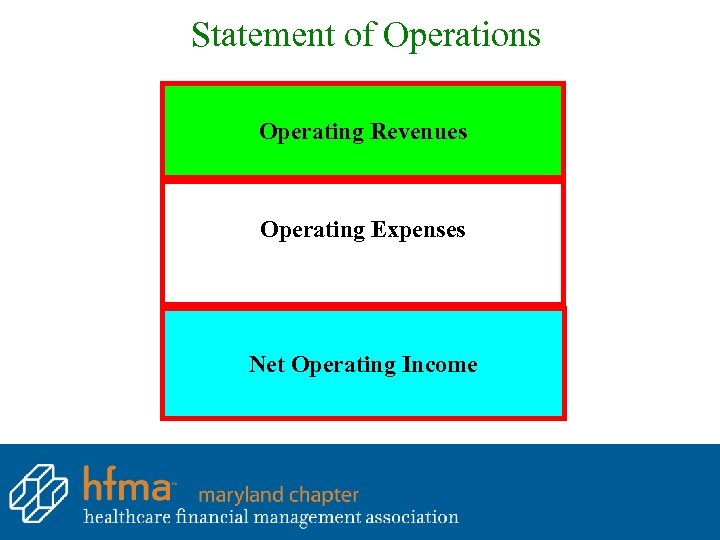 Statement of Operations Operating Revenues Operating Expenses Net Operating Income
 Basic Financial Statements STATEMENT OF OPERATIONS: • Revenues and Gains • Expenses • Other Income and Expenses
 Unique to Health Care NFP’s OTHER REVENUES: • Separate from Patient Revenue… • Contributions • Net Assets Released from Restrictions • Rental Income • Parking/Cafeteria Sales • Grants
 Basic Financial Statements STATEMENT OF CHANGES IN NET ASSETS: • Operating income • Grants • Contributions • Net assets released from restrictions • For operations • For property and equipment
 Basic Financial Statements STATEMENT OF CASH FLOWS: • Operating activity • Investing activity • Financing activity • Unrestricted and Restricted
 Notes to Financial Statements u u Significant Accounting Policies Major Assets and Liabilities Detail Commitments and Contingencies Other Information
 Notes to Financial Statements SIGNIFICANT ACCOUNTING POLICIES: • Organizational structure • Charity Care • Revenue Methodology • Asset Valuations
 Notes to Financial Statements ASSET AND LIABILITIES DETAIL: • Investments – Cost vs. . Current Value • Property and Equipment • Debt and Assets Held by Trustee
 Notes to Financial Statements COMMITMENTS AND CONTINGENCIES: • Pension and Post-Retirement Benefits • Malpractice • Outstanding Litigation • Credit Risk/Payor Mix
 Notes to Financial Statements OTHER INFORMATION: • Related Party Transactions • Credit Risk/Payor Mix • Functional Expenses – Healthcare services – General and administrative
 Financial Ratios and Analysis
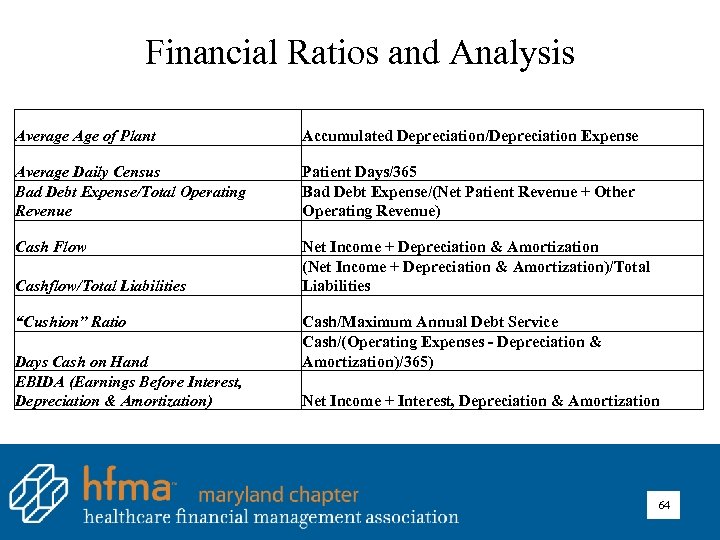 Financial Ratios and Analysis Average Age of Plant Accumulated Depreciation/Depreciation Expense Average Daily Census Bad Debt Expense/Total Operating Revenue Patient Days/365 Bad Debt Expense/(Net Patient Revenue + Other Operating Revenue) Cash Flow Net Income + Depreciation & Amortization (Net Income + Depreciation & Amortization)/Total Liabilities Cashflow/Total Liabilities “Cushion” Ratio Days Cash on Hand EBIDA (Earnings Before Interest, Depreciation & Amortization) Cash/Maximum Annual Debt Service Cash/(Operating Expenses - Depreciation & Amortization)/365) Net Income + Interest, Depreciation & Amortization 64
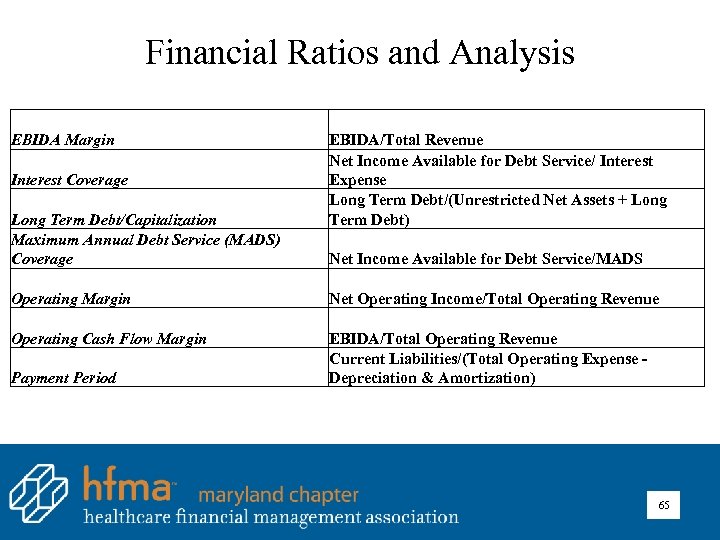 Financial Ratios and Analysis EBIDA Margin Interest Coverage Long Term Debt/Capitalization Maximum Annual Debt Service (MADS) Coverage EBIDA/Total Revenue Net Income Available for Debt Service/ Interest Expense Long Term Debt/(Unrestricted Net Assets + Long Term Debt) Net Income Available for Debt Service/MADS Operating Margin Net Operating Income/Total Operating Revenue Operating Cash Flow Margin EBIDA/Total Operating Revenue Current Liabilities/(Total Operating Expense - Depreciation & Amortization) Payment Period 65
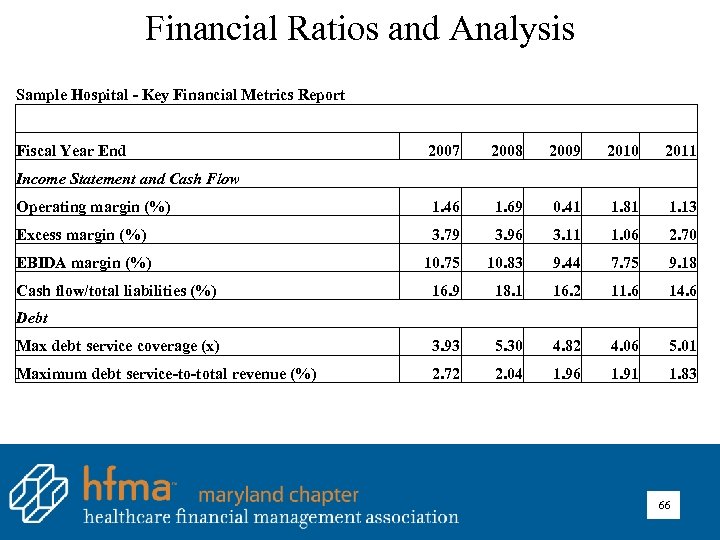 Financial Ratios and Analysis Sample Hospital - Key Financial Metrics Report Fiscal Year End 2007 2008 2009 2010 2011 Operating margin (%) 1. 46 1. 69 0. 41 1. 81 1. 13 Excess margin (%) 3. 79 3. 96 3. 11 1. 06 2. 70 EBIDA margin (%) 10. 75 10. 83 9. 44 7. 75 9. 18 16. 9 18. 1 16. 2 11. 6 14. 6 Max debt service coverage (x) 3. 93 5. 30 4. 82 4. 06 5. 01 Maximum debt service-to-total revenue (%) 2. 72 2. 04 1. 96 1. 91 1. 83 Income Statement and Cash Flow Cash flow/total liabilities (%) Debt 66
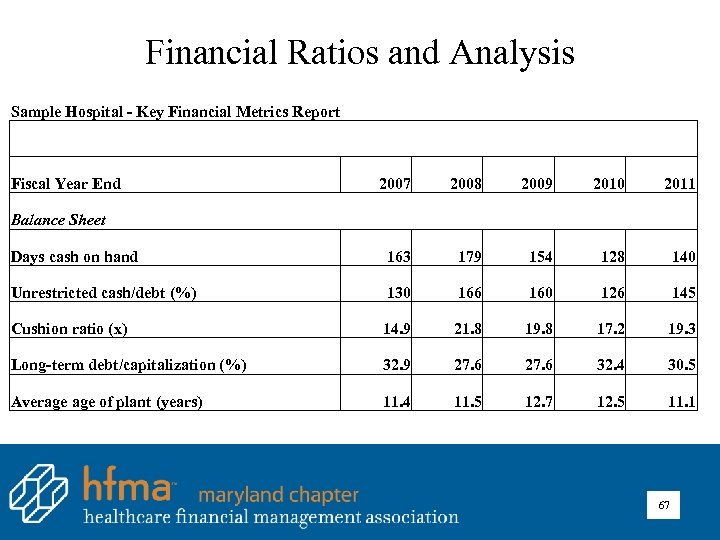 Financial Ratios and Analysis Sample Hospital - Key Financial Metrics Report Fiscal Year End 2007 2008 2009 2010 2011 Days cash on hand 163 179 154 128 140 Unrestricted cash/debt (%) 130 166 160 126 145 Cushion ratio (x) 14. 9 21. 8 19. 8 17. 2 19. 3 Long-term debt/capitalization (%) 32. 9 27. 6 32. 4 30. 5 Average of plant (years) 11. 4 11. 5 12. 7 12. 5 11. 1 Balance Sheet 67
 Questions?