 Скачать презентацию Financial performance and Accountability the Role of Auditing
9393e2d620a5614ca4edf320fa1f8926.ppt
- Количество слайдов: 42



Financial performance and Accountability: the Role of Auditing Jan van Schalkwyk Office of the Auditor General South Africa CABRI/WBI Budget Management and Public Financial Accountability Training Workshop 18 -20 June 2007 2
Our stakeholders say… “The … Auditor-General has an awesome responsibility as one of the protectors and promoters of people’s aspirations, hopes and expectations that government performance will bring a better quality of life and overcome the burden of poverty. You have been invested with the mantle of leadership to champion this purpose. ” Joan Fubbs Senior Management Workshop, 2005
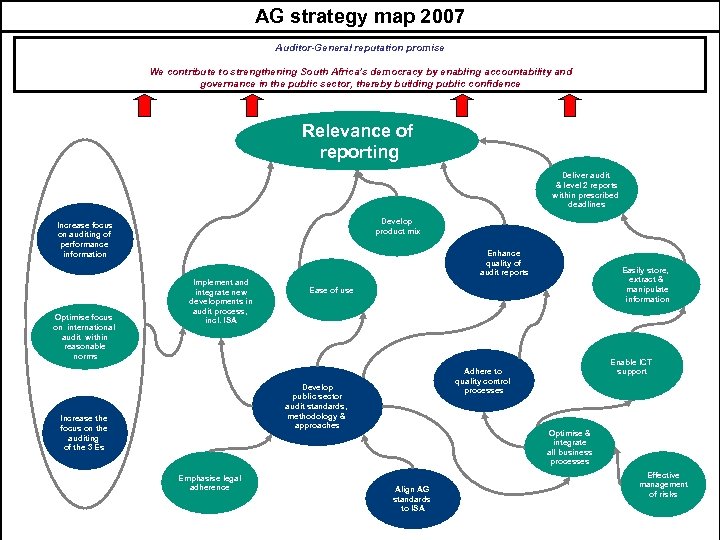
AG strategy map 2007 Auditor-General reputation promise We contribute to strengthening South Africa’s democracy by enabling accountability and governance in the public sector, thereby building public confidence Relevance of reporting Deliver audit & level 2 reports within prescribed deadlines Develop product mix Increase focus on auditing of performance information Optimise focus on international audit within reasonable norms Enhance quality of audit reports Implement and integrate new developments in audit process, incl. ISA Ease of use Emphasise legal adherence Enable ICT support Adhere to quality control processes Develop public sector audit standards, methodology & approaches Increase the focus on the auditing of the 3 Es Easily store, extract & manipulate information Optimise & integrate all business processes Align AG standards to ISA Effective management of risks
AGSA Reputation promise We contribute to strengthening South Africa’s democracy by enabling accountability and governance in the public sector, thereby building public confidence.
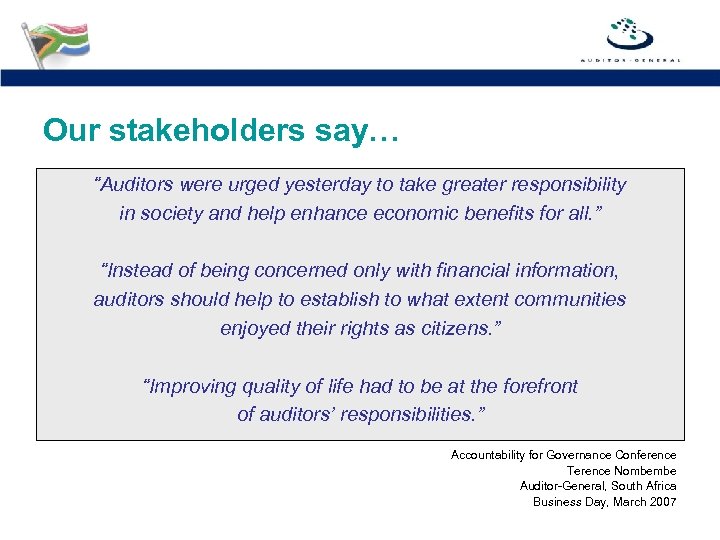
Our stakeholders say… “Auditors were urged yesterday to take greater responsibility in society and help enhance economic benefits for all. ” “Instead of being concerned only with financial information, auditors should help to establish to what extent communities enjoyed their rights as citizens. ” “Improving quality of life had to be at the forefront of auditors’ responsibilities. ” Accountability for Governance Conference Terence Nombembe Auditor-General, South Africa Business Day, March 2007
The challenge A common vision for good governance that is characterised by clean external audit opinions. Terence Nombembe Auditor-General, South-Africa Accountability for Governance Conference, 2007
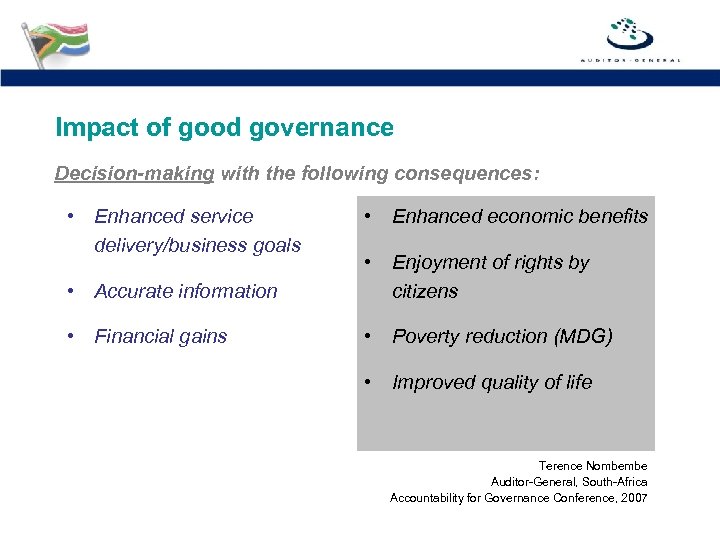
Impact of good governance Decision-making with the following consequences: • Enhanced service delivery/business goals • Enhanced economic benefits • Accurate information • Enjoyment of rights by citizens • Financial gains • Poverty reduction (MDG) • Improved quality of life Terence Nombembe Auditor-General, South-Africa Accountability for Governance Conference, 2007
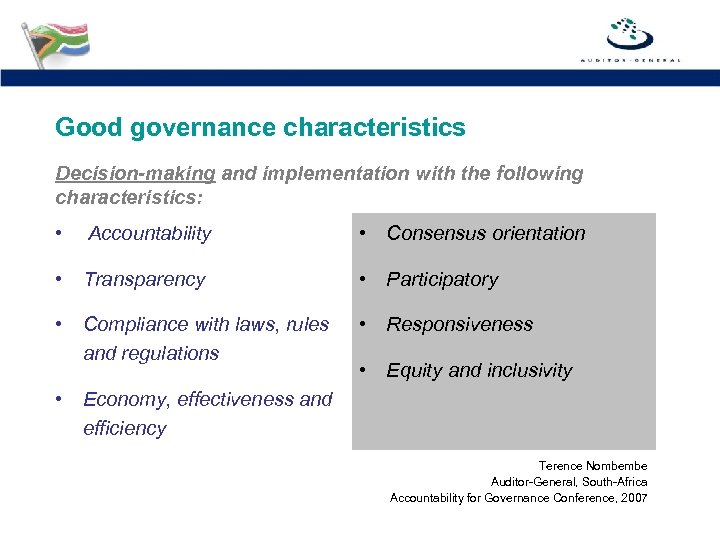
Good governance characteristics Decision-making and implementation with the following characteristics: • Accountability • Consensus orientation • Transparency • Participatory • Compliance with laws, rules and regulations • Responsiveness • Equity and inclusivity • Economy, effectiveness and efficiency Terence Nombembe Auditor-General, South-Africa Accountability for Governance Conference, 2007
Roll-out of governance principles by the governance champion • Creation of strategic management framework • Readiness evaluation • Guidance and capacity building • Effective monitoring of management discipline Terence Nombembe Auditor-General, South-Africa Accountability for Governance Conference, 2007
Key questions Does the mandate of the AG speak to the challenges of good governance?
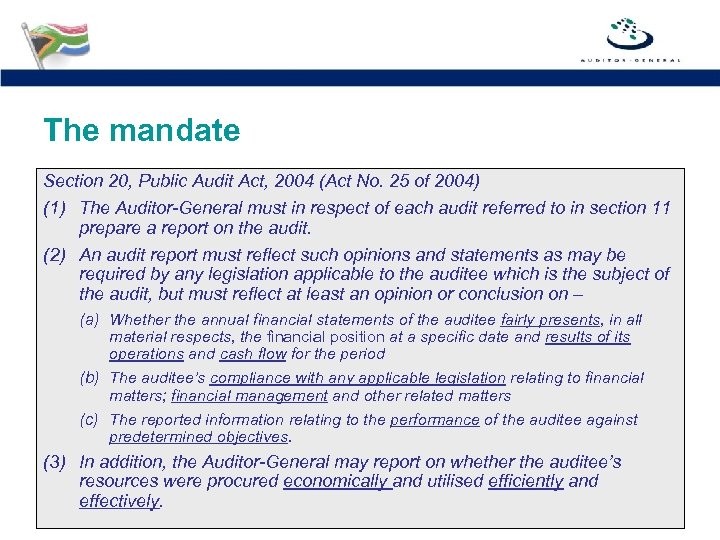
The mandate Section 20, Public Audit Act, 2004 (Act No. 25 of 2004) (1) The Auditor-General must in respect of each audit referred to in section 11 prepare a report on the audit. (2) An audit report must reflect such opinions and statements as may be required by any legislation applicable to the auditee which is the subject of the audit, but must reflect at least an opinion or conclusion on – (a) Whether the annual financial statements of the auditee fairly presents, in all material respects, the financial position at a specific date and results of its operations and cash flow for the period (b) The auditee’s compliance with any applicable legislation relating to financial matters; financial management and other related matters (c) The reported information relating to the performance of the auditee against predetermined objectives. (3) In addition, the Auditor-General may report on whether the auditee’s resources were procured economically and utilised efficiently and effectively.
Our stakeholders say… “As the severity of high-profile corporate accounting failures has increased steadily over the last decade, there has been a corresponding increase in the development of new legislation, standards, codes and guidelines to assist organisations in improving their corporate governance. While these standards and guidelines originated from a variety of sources, they share a core principle: that good governance, by its nature, demands effective systems of internal control. ” Information paper on “Internal Controls – a review of current developments” International Federation of Accountants (IFAC) August 2006
Key questions • Does the mandate of the AG speak to the challenges of good governance? • Are we likely to see a separate audit opinion on internal control in a couple of years’ time?
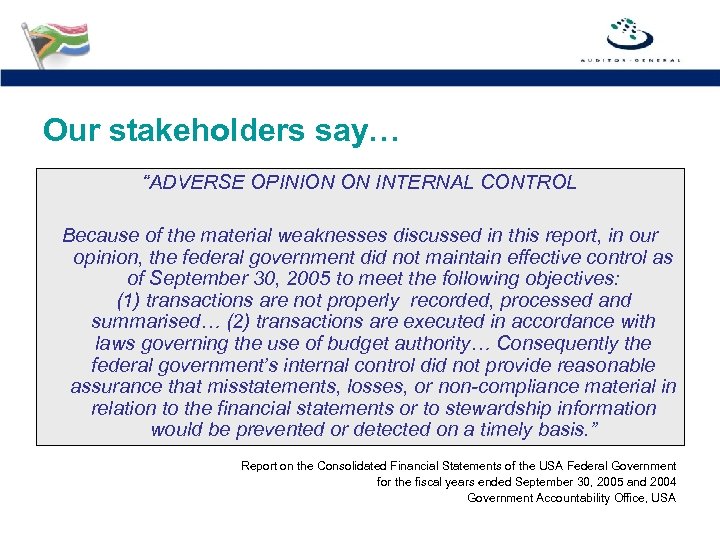
Our stakeholders say… “ADVERSE OPINION ON INTERNAL CONTROL Because of the material weaknesses discussed in this report, in our opinion, the federal government did not maintain effective control as of September 30, 2005 to meet the following objectives: (1) transactions are not properly recorded, processed and summarised… (2) transactions are executed in accordance with laws governing the use of budget authority… Consequently the federal government’s internal control did not provide reasonable assurance that misstatements, losses, or non-compliance material in relation to the financial statements or to stewardship information would be prevented or detected on a timely basis. ” Report on the Consolidated Financial Statements of the USA Federal Government for the fiscal years ended September 30, 2005 and 2004 Government Accountability Office, USA
Key questions • • Does the mandate of the AG speak to the challenges of good governance? Are we likely to see a separate audit opinion on internal control in a couple of years’ time? • Is root cause reporting the way to go?
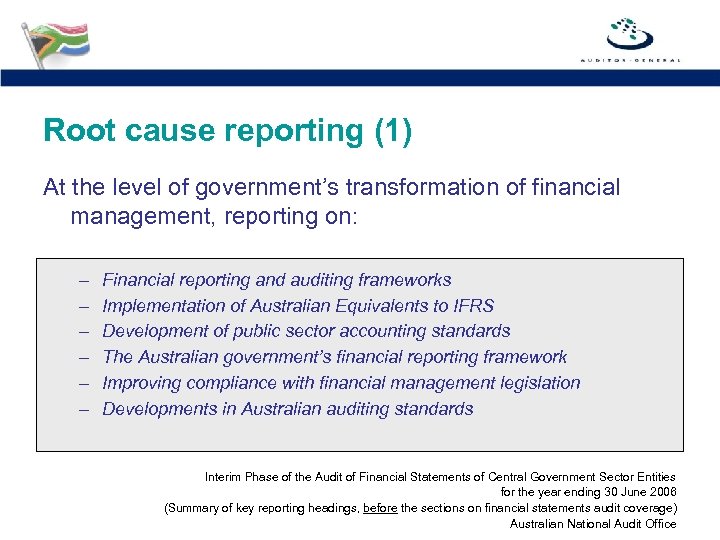
Root cause reporting (1) At the level of government’s transformation of financial management, reporting on: – – – Financial reporting and auditing frameworks Implementation of Australian Equivalents to IFRS Development of public sector accounting standards The Australian government’s financial reporting framework Improving compliance with financial management legislation Developments in Australian auditing standards Interim Phase of the Audit of Financial Statements of Central Government Sector Entities for the year ending 30 June 2006 (Summary of key reporting headings, before the sections on financial statements audit coverage) Australian National Audit Office
Root cause reporting (2) At the level of entity audit reports: “Reflect … broad categories of audit findings: Observations relating to the various components of the entities’ internal control (including the control environment, risk management processes, control activities and monitoring of controls)…” Interim Phase of the Audit of Financial Statements of Central Government Sector Entities for the year ending 30 June 2006 Australian National Audit Office
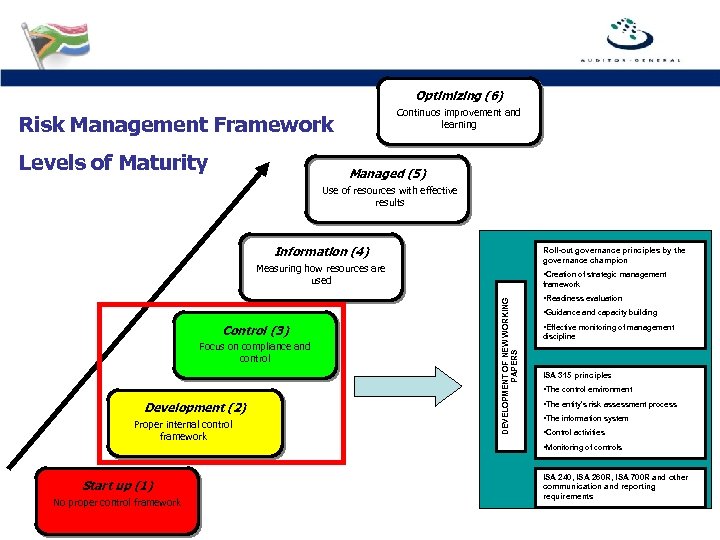
Optimizing (6) Continuos improvement and learning Risk Management Framework Levels of Maturity Managed (5) Use of resources with effective results Information (4) Roll-out governance principles by the governance champion Measuring how resources are used Focus on compliance and control Development (2) Proper internal control framework DEVELOPMENT OF NEW WORKING PAPERS Control (3) • Creation of strategic management • Readiness evaluation • Guidance and capacity building • Effective monitoring of management discipline ISA 315 principles • The control environment • The entity’s risk assessment process • The information system • Control activities • Monitoring of controls Start up (1) No proper control framework ISA 240, ISA 260 R, ISA 700 R and other communication and reporting requirements
Key questions • • • Does the mandate of the AG speak to the challenges of good governance? Are we likely to see a separate audit opinion on internal control in a couple of years time? Is root cause reporting the way to go? • Does this have any implications on the way in which the governance champion, and other role-players in the accountability process, need to function?
Our stakeholders say… “To do my job well, I need to know specifically what my office needs to do in response to the Auditor-General’s reports – whether it is to render support to an entity, issues guidance, etc. The audit reports need to reflect well considered root causes and be very direct about pertinent issues. ” Freeman Nomvalo Accountant-General, South Africa
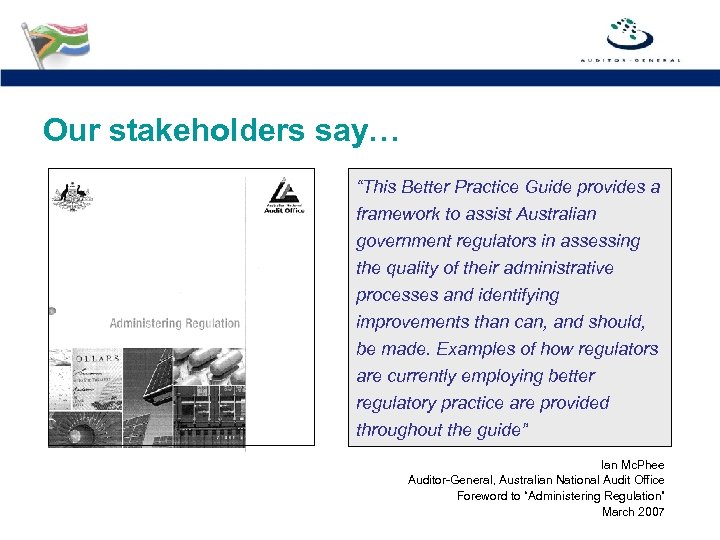
Our stakeholders say… “This Better Practice Guide provides a framework to assist Australian government regulators in assessing the quality of their administrative processes and identifying improvements than can, and should, be made. Examples of how regulators are currently employing better regulatory practice are provided throughout the guide” Ian Mc. Phee Auditor-General, Australian National Audit Office Foreword to “Administering Regulation” March 2007
Key questions • • Does the mandate of the AG speak to the challenges of good governance? Are we likely to see a separate audit opinion on internal control in a couple of years time? Is root cause reporting the way to go? Does this have any implications for the way in which the governance champion, and other role-players in the accountability process, need to function? • How does one show impact of auditing?
Our stakeholders say… “We hold government to account on behalf of citizens as consumers, by publishing reports that look at the experience of people using public services. Our work to improve financial management on behalf of the taxpayer saves £ 8 for every £ 1 spent running the Office. We recommend ways in which the delivery of public services could be improved for the benefit of the people using them. ” “Helping the nation spend wisely” Annual Report 2005 National Audit Office
Key questions • • • Does the mandate of the AG speak to the challenges of good governance? Are we likely to see a separate audit opinion on internal control in a couple of years time? Is root cause reporting the way to go? Does this have any implications for the way in which the governance champion, and other role-players in the accountability process, need to function? How does one show impact of auditing? • Has the profession, and specifically the standard-setters, taken note of these requirements?
The views of standard-setting bodies • Beyond COSO, Co. Co, Turnbull, COBIT, Sarbanes. Oxley… • Renewed emphasis on importance of internal control • Internal control defined in the context of good governance • On the work-programmes of IFAC, INTOSAI, IAASB, SAIs and the Auditor-General, South-Africa
Key questions • • • Does the mandate of the AG speak to the challenges of good governance? Are we likely to see a separate audit opinion on internal control in a couple of years time? Is root cause reporting the way to go? Does this have any implications for the way in which the governance champion, and other role-players in the accountability process, need to function? How does one show impact of auditing? Has the profession, and specifically the standard-setters, taken note of these requirements? • Has the AG work-programme taken note of this?
Our stakeholders say… “After our road-show to workshop the AG’s reputation promise, there has been a clear response from all audit business units that we need to understand our role as a SAI differently: Our objective is not only to audit and report, but to use that to enable accountability and good governance in the public sector, thereby strengthening the country’s democracy and building public confidence. The core elements of audits (standards and principles) will remain, but we will have to think and work differently. ” Adri van der Merwe Business Executive: Reputation and Stakeholder Management Auditor-General, South Africa
Current developments • Focused and timeous general report – Rework of key documentation • • Engagement letter Documentation and communication of audit findings Management report Audit report – Refinement of consistency processes – Database development • • Audit procedure review and integration Audit directives New / improved governance structures Emphasis on integration
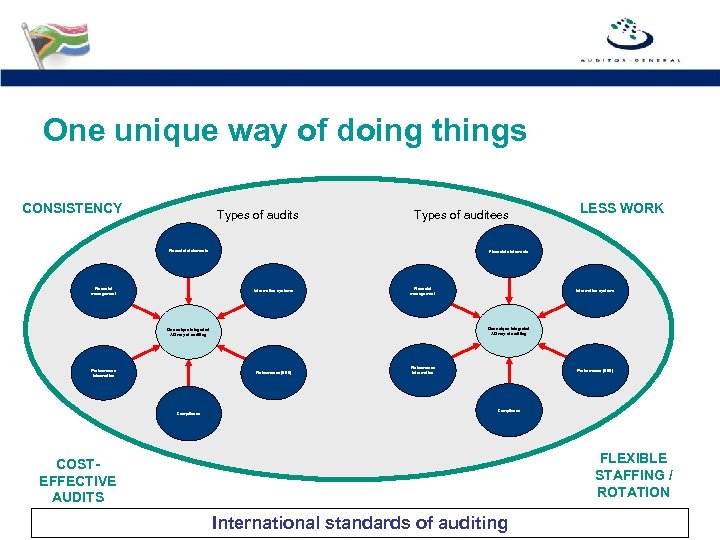
One unique way of doing things CONSISTENCY Types of audits Types of auditees Financial statements Financial management Financial statements Information systems Financial management Performance (EEE) Compliance Information systems One unique integrated AG way of auditing Performance information LESS WORK Performance information Performance (EEE) Compliance FLEXIBLE STAFFING / ROTATION COSTEFFECTIVE AUDITS International standards of auditing
Key questions • • Does the mandate of the AG speak to the challenges of good governance? Are we likely to see a separate audit opinion on internal control in a couple of years time? Is root cause reporting the way to go? Does this have any implications for the way in which the governance champion, and other role-players in the accountability process, need to function? How does one show impact of auditing? Has the profession, and specifically the standard-setters, taken note of these requirements? Has the AG work-program taken note of this? • Where does developments such as AOPI and the increased emphasis on performance auditing fit in?
Our stakeholders say… “The audit found that the development of a comprehensive, relevant and informative regime of performance indicators, as well as having cost-effective systems and processes to capture, monitor and report complete, accurate and relevant agency performance, continues to be challenging for many agencies. In particular, the audit identified that many performance indicators did not enable an assessment to be made on whether desired results were achieved, as the indicators did not incorporate targets, benchmarks or other details of the extent of achievement expected. ” Audit Report No 23 of 2006 -07 Australian National Audit Office
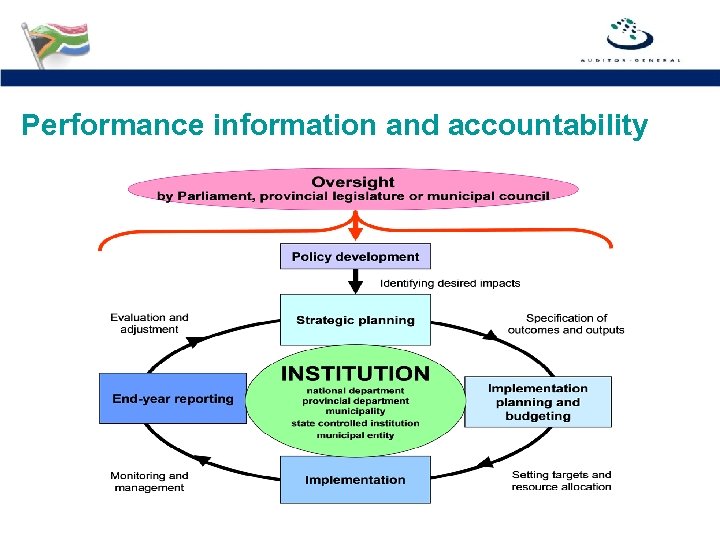
Performance information and accountability
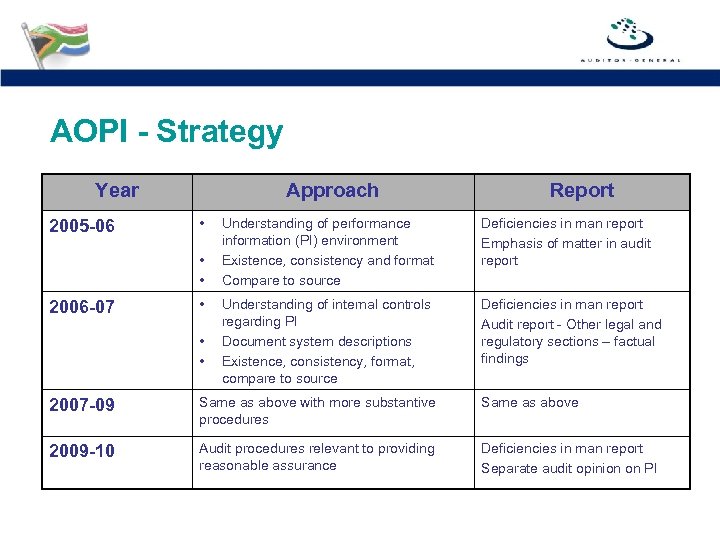
AOPI - Strategy Year 2005 -06 Approach • • • 2006 -07 • • • Report Understanding of performance information (PI) environment Existence, consistency and format Compare to source Deficiencies in man report Emphasis of matter in audit report Understanding of internal controls regarding PI Document system descriptions Existence, consistency, format, compare to source Deficiencies in man report Audit report - Other legal and regulatory sections – factual findings 2007 -09 Same as above with more substantive procedures Same as above 2009 -10 Audit procedures relevant to providing reasonable assurance Deficiencies in man report Separate audit opinion on PI
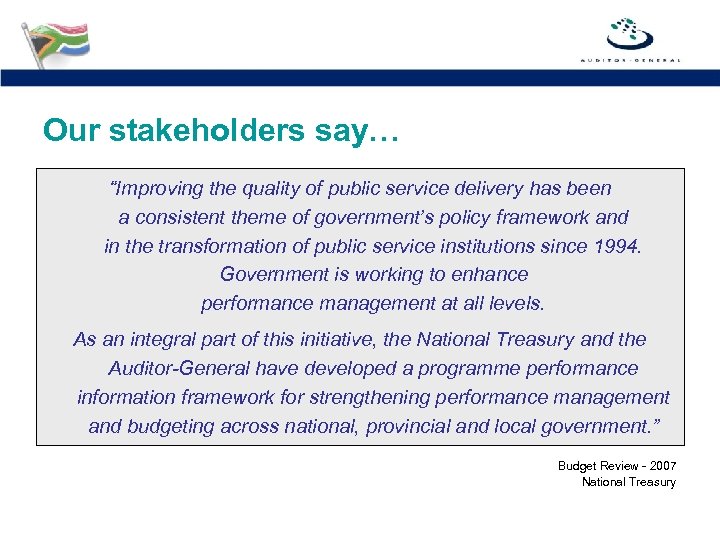
Our stakeholders say… “Improving the quality of public service delivery has been a consistent theme of government’s policy framework and in the transformation of public service institutions since 1994. Government is working to enhance performance management at all levels. As an integral part of this initiative, the National Treasury and the Auditor-General have developed a programme performance information framework for strengthening performance management and budgeting across national, provincial and local government. ” Budget Review - 2007 National Treasury
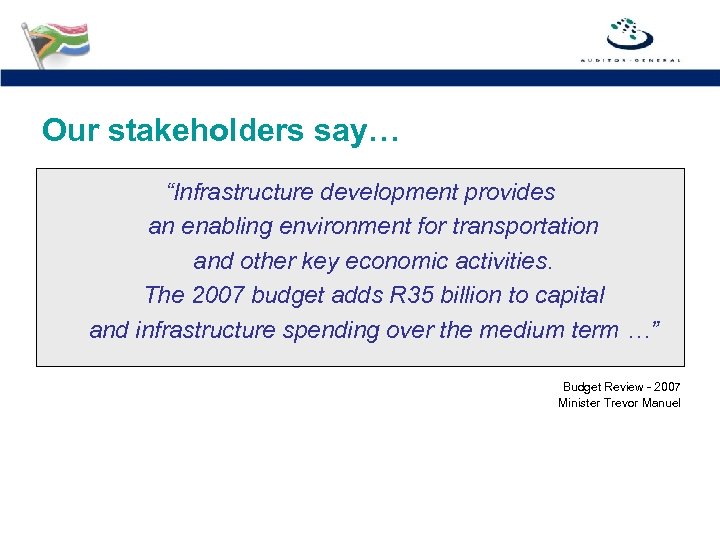
Our stakeholders say… “Infrastructure development provides an enabling environment for transportation and other key economic activities. The 2007 budget adds R 35 billion to capital and infrastructure spending over the medium term …” Budget Review - 2007 Minister Trevor Manuel
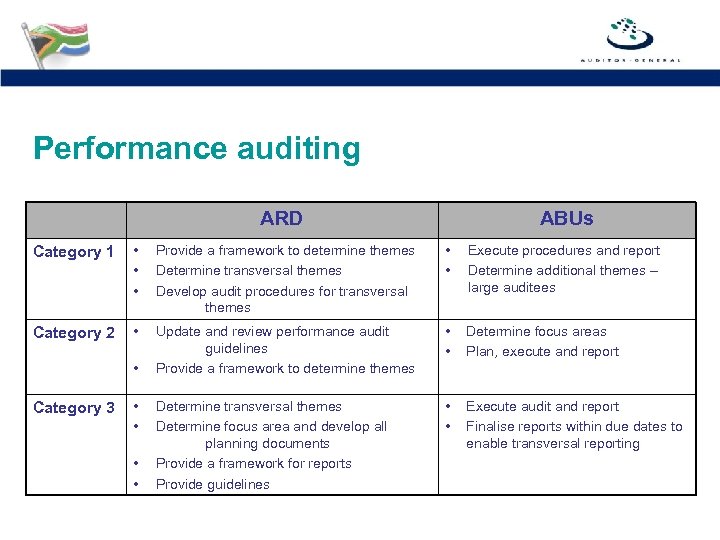
Performance auditing ARD ABUs Category 1 • • • Provide a framework to determine themes Determine transversal themes Develop audit procedures for transversal themes • • Execute procedures and report Determine additional themes – large auditees Category 2 • Update and review performance audit guidelines Provide a framework to determine themes • • Determine focus areas Plan, execute and report Determine transversal themes Determine focus area and develop all planning documents Provide a framework for reports Provide guidelines • • Execute audit and report Finalise reports within due dates to enable transversal reporting • Category 3 • •
Key questions • • Does the mandate of the AG speak to the challenges of good governance? Are we likely to see a separate audit opinion on internal control in a couple of years time? Is root cause reporting the way to go? Does this have any implications for the way in which the governance champion, and other role-players in the accountability process, need to function? How does one show impact of auditing? Has the profession, and specifically the standard-setters, taken note of these requirements? Has the AG work-program taken note of this? Where does developments such as AOPI and the increased emphasis on performance auditing fit in? • If we say that we will only be successful when our stakeholder say so, what key “technical evaluation milestones” are we working towards?
Stakeholder feedback • SCo. AG • Quality Assurance committee • Technical Committee • Product champions • International peer reviews • Ask Africa
Our stakeholders say… “In our opinion the US government accountability office’s quality assurance system was suitably designed and operating effectively, … , to provide the GAO with reasonable assurance of conforming with the US government auditing standards in conducting its performance audit practice. ” GAO peer review report, April 2005
Our stakeholders say… The audit report is the only visual evidence of the audit freely available to the public. This makes “audit reporting” of crucial relevance to the triangle of auditee, auditor and user (the public). In the public sector, through the audit report, the AG discharges his responsibilities by reporting. Indicating that an audit has been conducted, stating the scope and “terms of reference” as well as the findings add credibility to the financial reporting process and ultimately public accountability in general. Taking into account the broad field of users of the AG’s reports, the audit report has to be understandable (user-friendly), be issued timely and display professionalism. Dieter Gloeck Professor in Auditing, University of Pretoria Executive President, SAIGA
Current developments Refinement of QC processes – Tier 2 developments – adding a proactive element and measuring it • Pre-issuance - same process as for IRBA review, with scoring of high and low risk areas • Consistency review – process to mature, only give credit for full participation in year 1, full scoring to follow Prepare for IRBA firm level review – ISQC 1 requirements – Dry run in 2008 – IRBA review in 2009
Our stakeholders say… “The barometer of a relevant report is its usage value. In other words, if our audit reports can be optimally used by all our various external stakeholders, then only can we consider those audit reports to be relevant. This means that our reports should contain the appropriate quantity and quality of information; be technically correct; but also be practically useful. It also means that our audit reports should be articulated in a manner that considers all our diverse stakeholders and the variety of purposes for which they would use these reports. ” Pramesh Bhana Corporate Executive Chairperson, Technical Committee Auditor-General, South-Africa
Скачать презентацию Financial performance and Accountability the Role of Auditing
9393e2d620a5614ca4edf320fa1f8926.ppt