


 Скачать презентацию Financial Markets with Stochastic Volatilities Anatoliy Swishchuk Mathematical
432ca4a8520acd18ad8d36df6876655f.ppt
- Количество слайдов: 53
 Financial Markets with Stochastic Volatilities Anatoliy Swishchuk Mathematical and Computational Finance Lab Department of Mathematics & Statistics University of Calgary, AB, Canada Seminar Talk Mathematical and Computational Finance Lab Department of Mathematics and Statistics, University of Calgary, Alberta October 28 , 2004
 Outline • Introduction • Research: -Random Evolutions (REs); -Applications of REs; -Biomathematics; -Financial and Insurance Mathematics; -Stochastic Models with Delay and Applications to Finance; -Stochastic Models in Economics; --Financial Mathematics: Option Pricing, Stability, Control, Swaps --Swing Options --Future Work
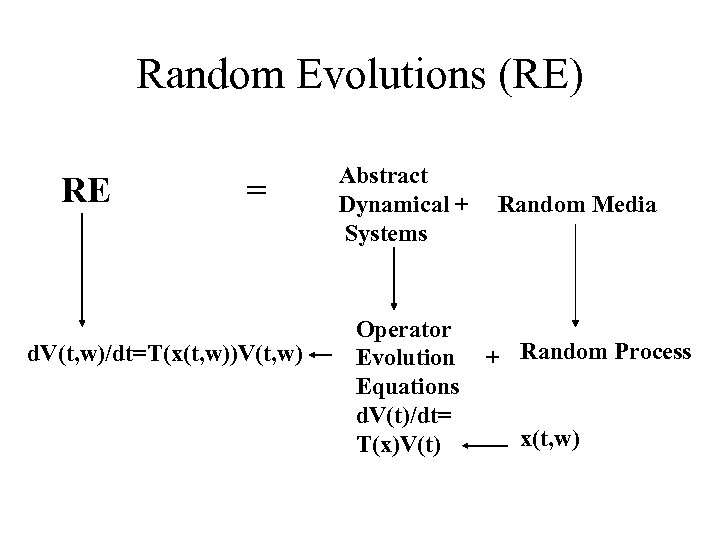 Random Evolutions (RE) RE = d. V(t, w)/dt=T(x(t, w))V(t, w) Abstract Dynamical + Systems Operator Evolution Equations d. V(t)/dt= T(x)V(t) Random Media + Random Process x(t, w)
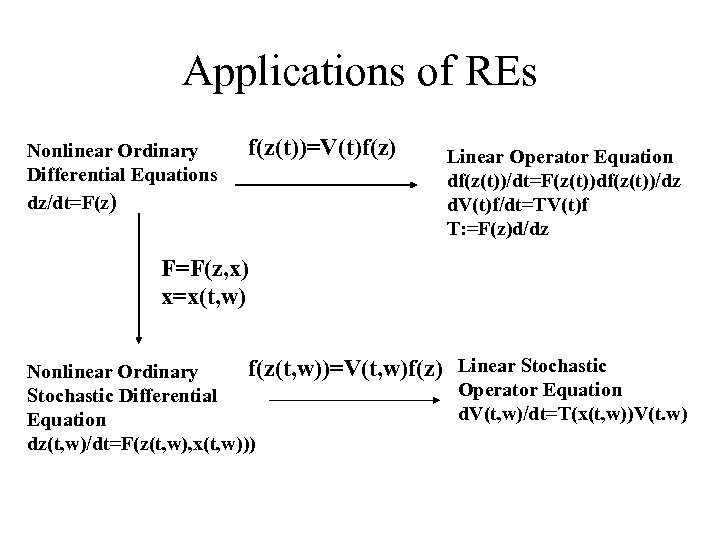 Applications of REs Nonlinear Ordinary Differential Equations dz/dt=F(z) f(z(t))=V(t)f(z) Linear Operator Equation df(z(t))/dt=F(z(t))df(z(t))/dz d. V(t)f/dt=TV(t)f T: =F(z)d/dz F=F(z, x) x=x(t, w) f(z(t, w))=V(t, w)f(z) Linear Stochastic Nonlinear Ordinary Operator Equation Stochastic Differential d. V(t, w)/dt=T(x(t, w))V(t. w) Equation dz(t, w)/dt=F(z(t, w), x(t, w)))
 Another Names for Random Evolutions • Hidden Markov (or other) Models • Regime-Switching Models
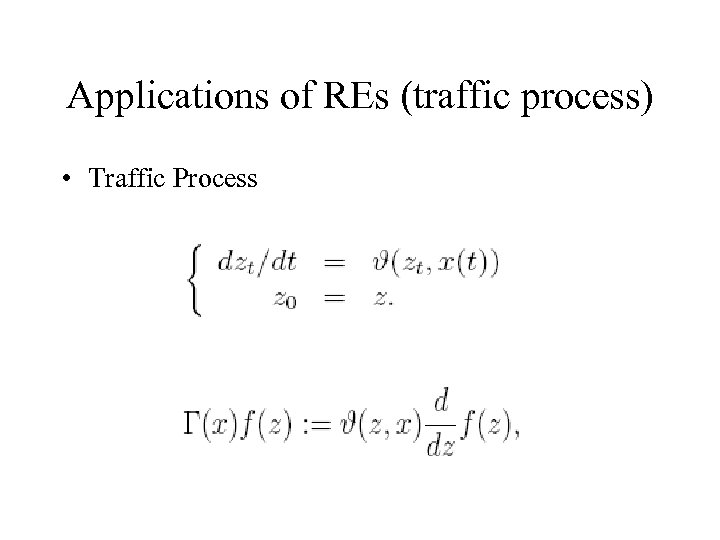 Applications of REs (traffic process) • Traffic Process
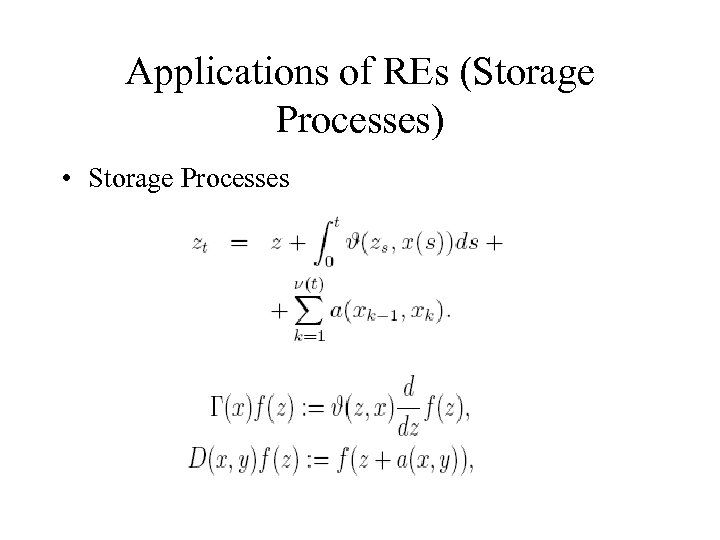 Applications of REs (Storage Processes) • Storage Processes
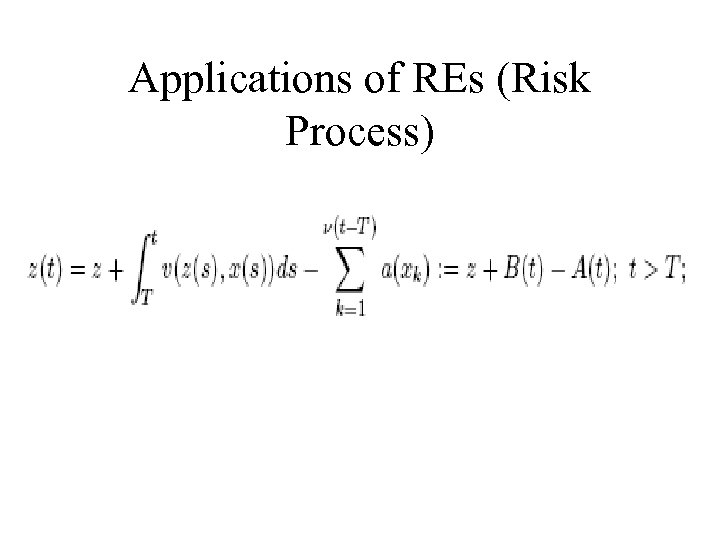 Applications of REs (Risk Process)
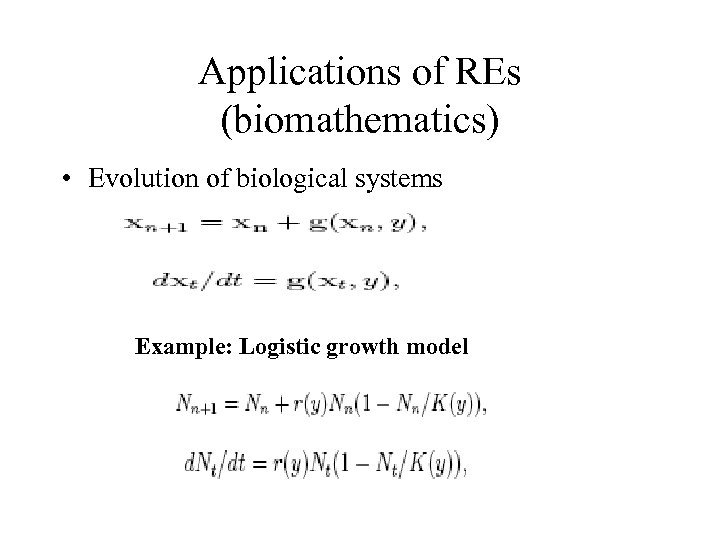 Applications of REs (biomathematics) • Evolution of biological systems Example: Logistic growth model
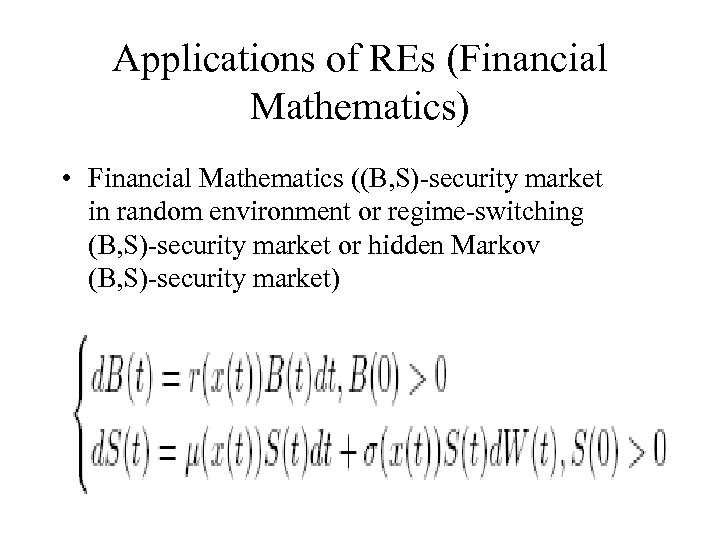 Applications of REs (Financial Mathematics) • Financial Mathematics ((B, S)-security market in random environment or regime-switching (B, S)-security market or hidden Markov (B, S)-security market)
 Application of REs (Financial Mathematics) • Pricing Electricity Calls (R. Elliott, G. Sick and M. Stein, September 28, 2000, working paper) • The spot price S (t) of electricity S (t)=f (t) g (t) exp (X (t)) , where f (t) is an annual periodic factor, g (t) is a daily periodic factor, X (t) is a scalar diffusion factor, Z (t) is a Markov chain.
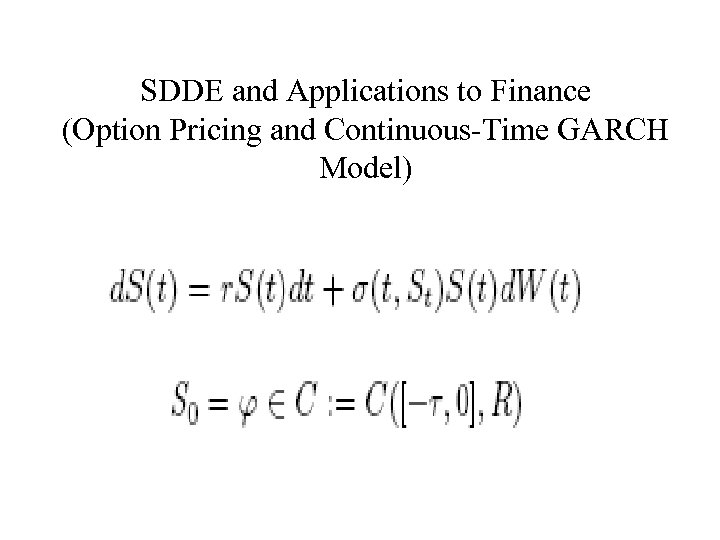 SDDE and Applications to Finance (Option Pricing and Continuous-Time GARCH Model)
 Introduction to Swaps • • • Bachelier (1900)-used Brownian motion to model stock price Samuelson (1965)-geometric Brownian motion Black-Scholes (1973)-first option pricing formula Merton (1973)-option pricing formula for jump model Cox, Ingersoll & Ross (1985), Hull & White (1987) stochastic volatility models • Heston (1993)-model of stock price with stochastic volatility • Brockhaus & Long (2000)-formulae for variance and volatility swaps with stochastic volatility • He & Wang (RBC Financial Group) (2002)-variance, volatility, covariance, correlation swaps for deterministic volatility
 Swaps Security-a piece of paper representing a promise Basic Securities • Stock • Bonds (bank accounts) Derivative Securities • Option • Forward contract • Swaps-agreements between two counterparts to exchange cash flows in the future to a prearrange formula
 Variance and Volatility Swaps Forward contract-an agreement to buy or sell something at a future date for a set price (forward price) Variance is a measure of the uncertainty of a stock price. Volatility (standard deviation) is the square root of the variance (the amount of “noise”, risk or variability in stock price) Variance=(Volatility)^2 • Volatility swaps are forward contracts on future realized stock volatility • Variance swaps are forward contract on future realized stock variance
 Types of Volatilities Deterministic Volatility= Deterministic Function of Time Stochastic Volatility= Deterministic Function of Time+Risk (“Noise”)
 Deterministic Volatility • Realized (Observed) Variance and Volatility • Payoff for Variance and Volatility Swaps • Example
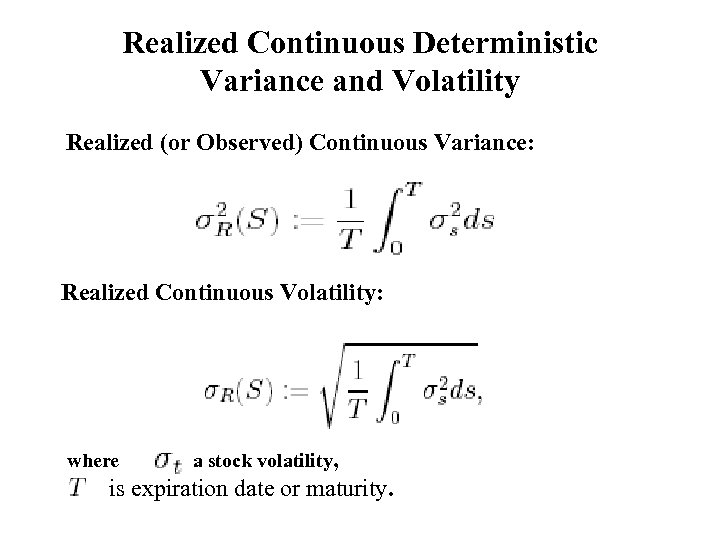 Realized Continuous Deterministic Variance and Volatility Realized (or Observed) Continuous Variance: Realized Continuous Volatility: where is a stock volatility, is expiration date or maturity.
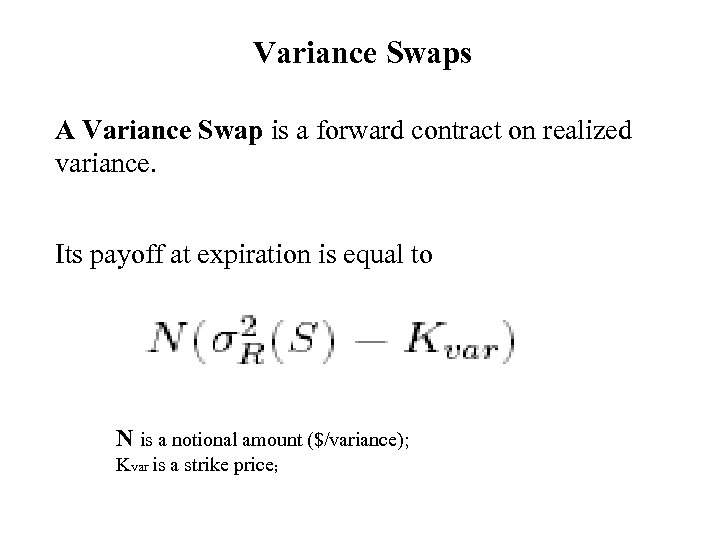 Variance Swaps A Variance Swap is a forward contract on realized variance. Its payoff at expiration is equal to N is a notional amount ($/variance); Kvar is a strike price;
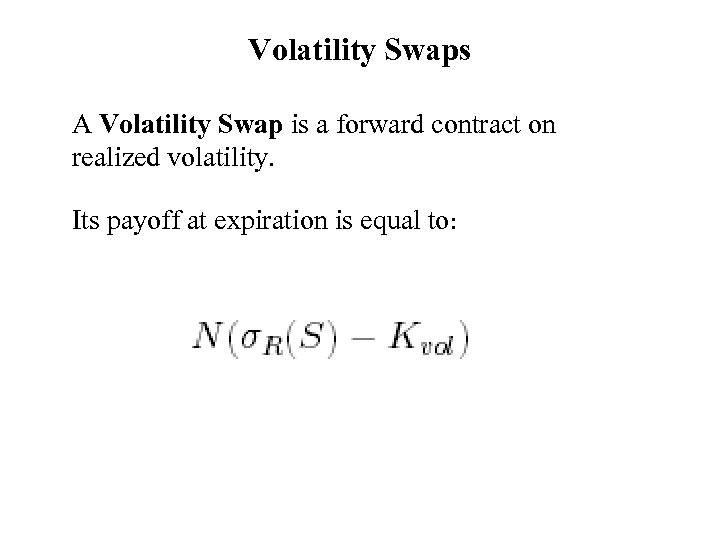 Volatility Swaps A Volatility Swap is a forward contract on realized volatility. Its payoff at expiration is equal to:
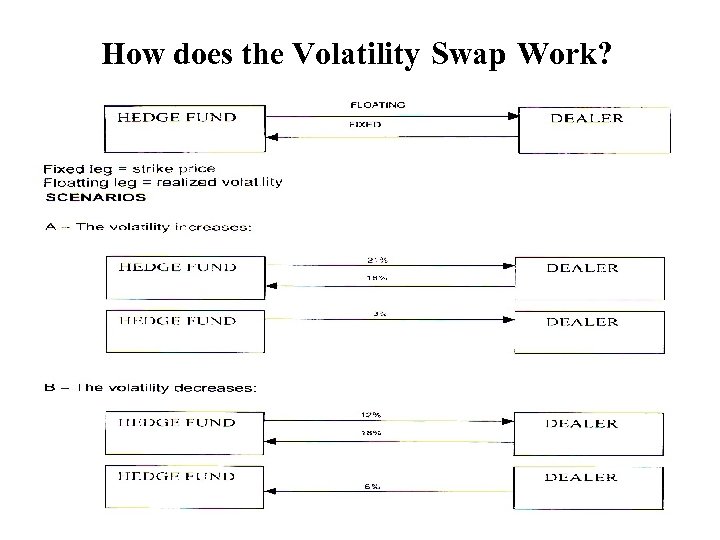 How does the Volatility Swap Work?
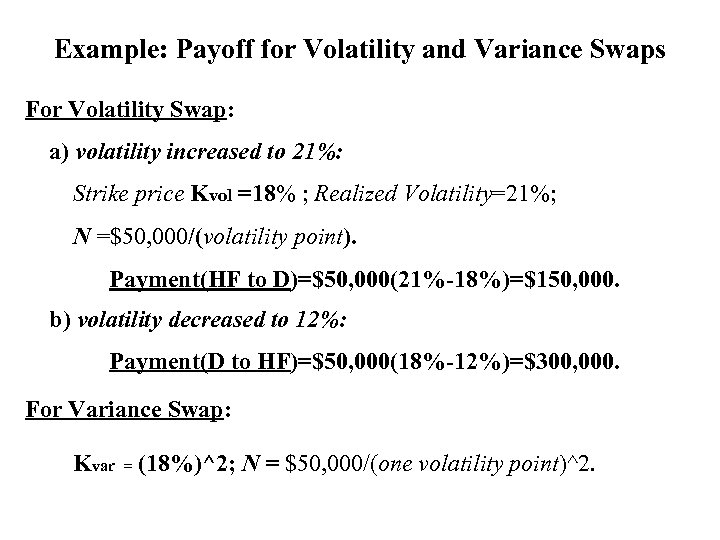 Example: Payoff for Volatility and Variance Swaps For Volatility Swap: a) volatility increased to 21%: Strike price Kvol =18% ; Realized Volatility=21%; N =$50, 000/(volatility point). Payment(HF to D)=$50, 000(21%-18%)=$150, 000. b) volatility decreased to 12%: Payment(D to HF)=$50, 000(18%-12%)=$300, 000. For Variance Swap: Kvar = (18%)^2; N = $50, 000/(one volatility point)^2.
 Models of Stock Price • Bachelier Model (1900)-first model • Samuelson Model (1965)- Geometric Brownian Motion-the most popular
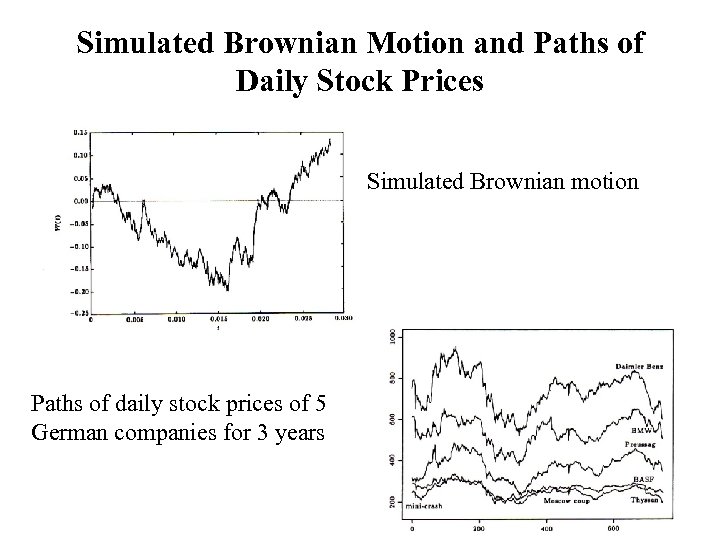 Simulated Brownian Motion and Paths of Daily Stock Prices Simulated Brownian motion Paths of daily stock prices of 5 German companies for 3 years
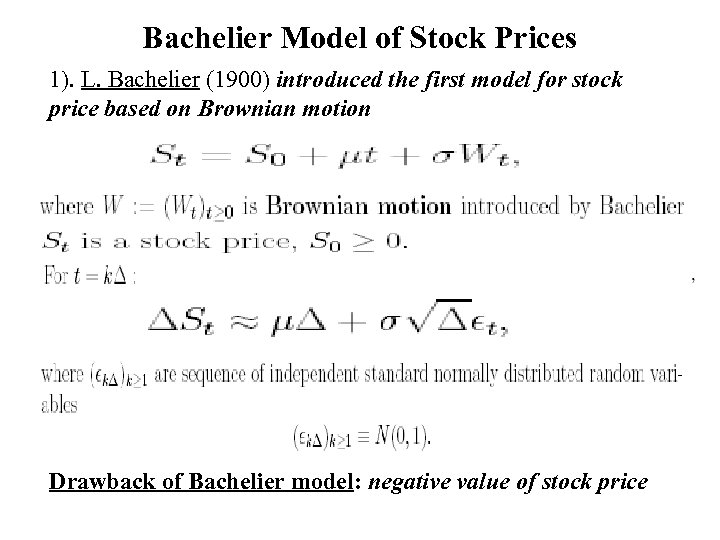 Bachelier Model of Stock Prices 1). L. Bachelier (1900) introduced the first model for stock price based on Brownian motion Drawback of Bachelier model: negative value of stock price
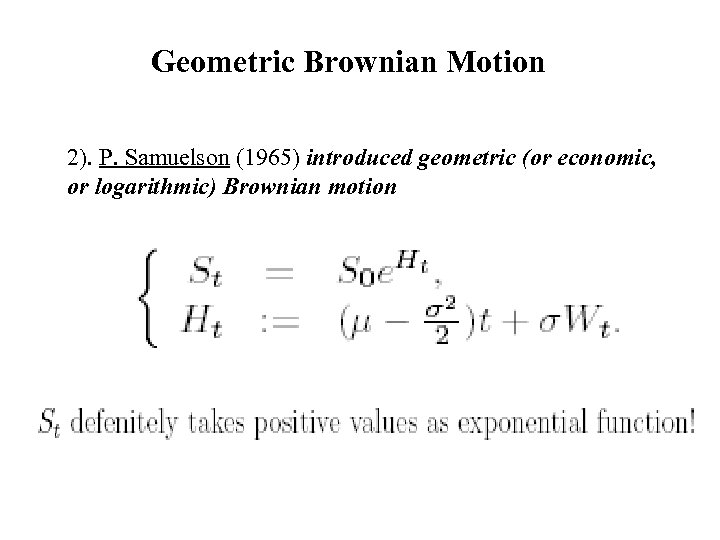 Geometric Brownian Motion 2). P. Samuelson (1965) introduced geometric (or economic, or logarithmic) Brownian motion
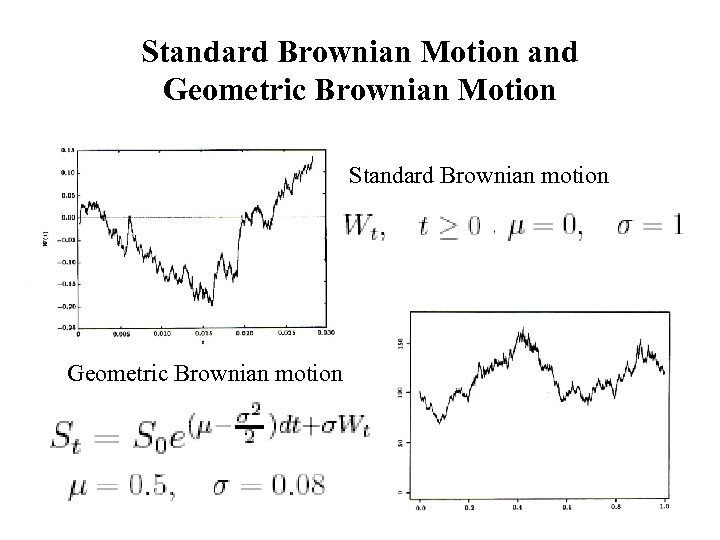 Standard Brownian Motion and Geometric Brownian Motion Standard Brownian motion Geometric Brownian motion
 Stochastic Volatility Models • Cox-Ingersol-Ross (CIR) Model for Stochastic Volatility • Heston Model for Stock Price with Stochastic Volatility as CIR Model • Key Result: Explicit Solution of CIR Equation! We Use New Approach-Change of Time-to Solve CIR Equation • Valuing of Variance and Volatility Swaps for Stochastic Volatility
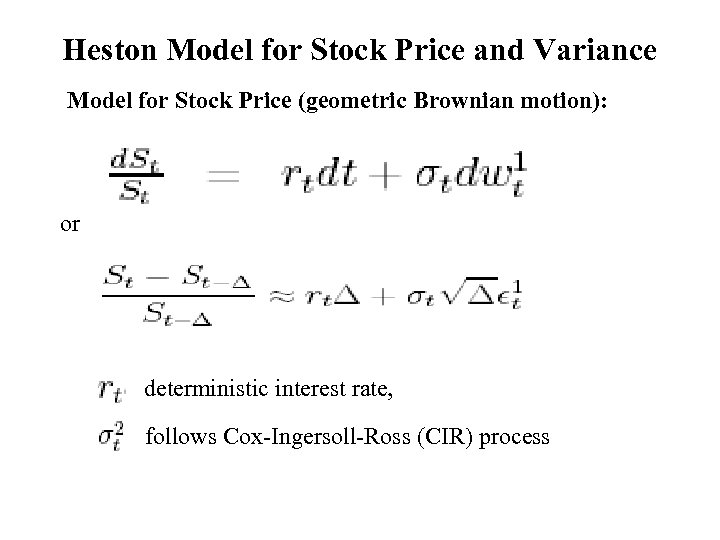 Heston Model for Stock Price and Variance Model for Stock Price (geometric Brownian motion): or deterministic interest rate, follows Cox-Ingersoll-Ross (CIR) process
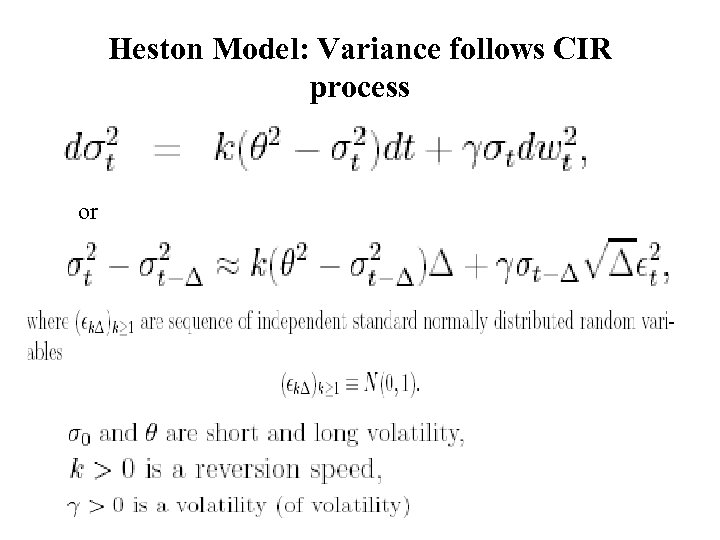 Heston Model: Variance follows CIR process or
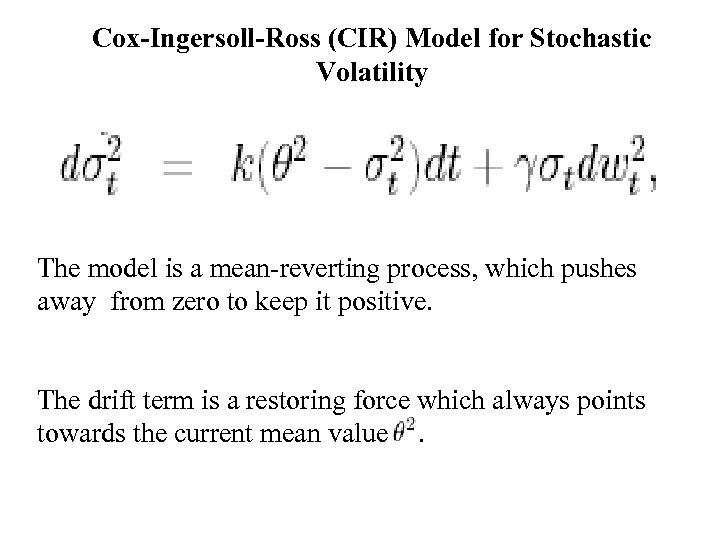 Cox-Ingersoll-Ross (CIR) Model for Stochastic Volatility The model is a mean-reverting process, which pushes away from zero to keep it positive. The drift term is a restoring force which always points towards the current mean value.
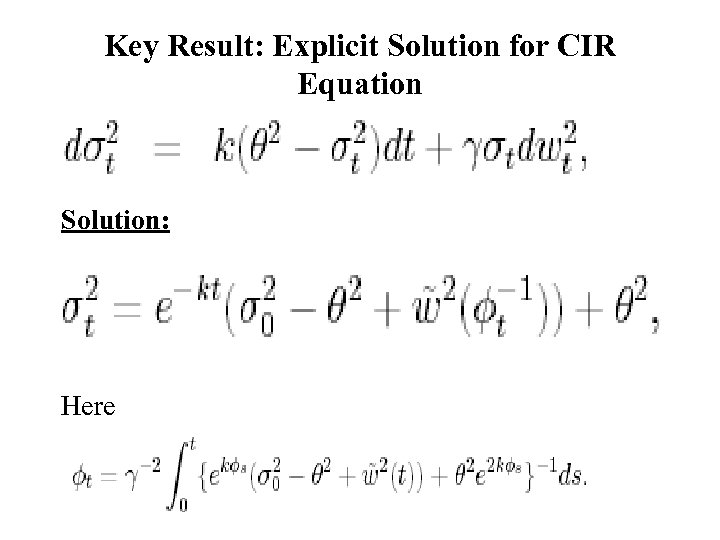 Key Result: Explicit Solution for CIR Equation Solution: Here
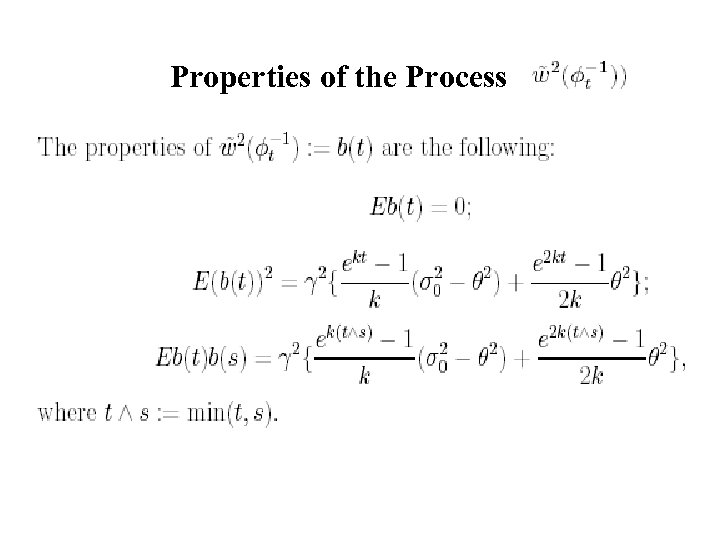 Properties of the Process
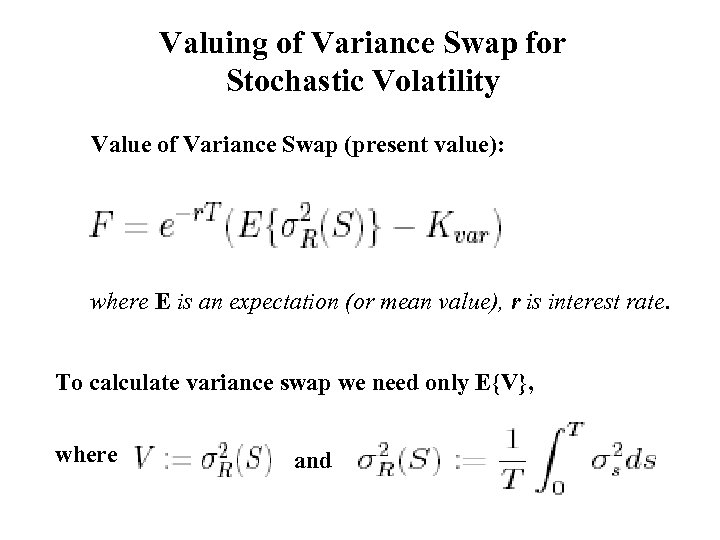 Valuing of Variance Swap for Stochastic Volatility Value of Variance Swap (present value): where E is an expectation (or mean value), r is interest rate. To calculate variance swap we need only E{V}, where and
![Calculation E[V]](https://present5.com/presentation/432ca4a8520acd18ad8d36df6876655f/image-35.jpg "Calculation E[V]") Calculation E[V]
Calculation E[V]
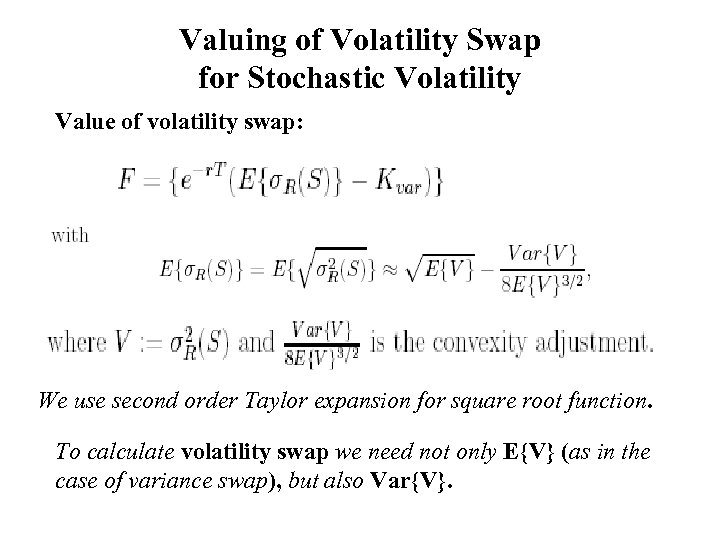 Valuing of Volatility Swap for Stochastic Volatility Value of volatility swap: We use second order Taylor expansion for square root function. To calculate volatility swap we need not only E{V} (as in the case of variance swap), but also Var{V}.
![Calculation of Var[V] Variance of V is equal to: We need EV^2, because we](https://present5.com/presentation/432ca4a8520acd18ad8d36df6876655f/image-37.jpg "Calculation of Var[V] Variance of V is equal to: We need EV^2, because we") Calculation of Var[V] Variance of V is equal to: We need EV^2, because we have (EV)^2:
Calculation of Var[V] Variance of V is equal to: We need EV^2, because we have (EV)^2:
![Calculation of Var[V] (continuation) After calculations: Finally we obtain:](https://present5.com/presentation/432ca4a8520acd18ad8d36df6876655f/image-38.jpg "Calculation of Var[V] (continuation) After calculations: Finally we obtain:") Calculation of Var[V] (continuation) After calculations: Finally we obtain:
Calculation of Var[V] (continuation) After calculations: Finally we obtain:
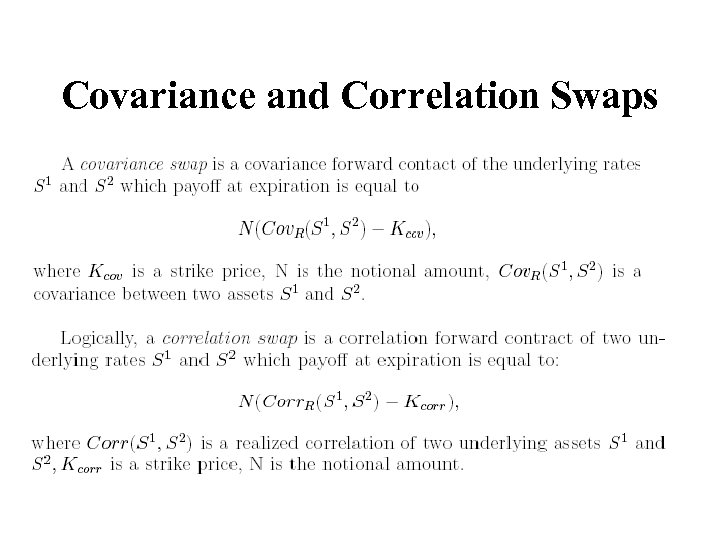 Covariance and Correlation Swaps
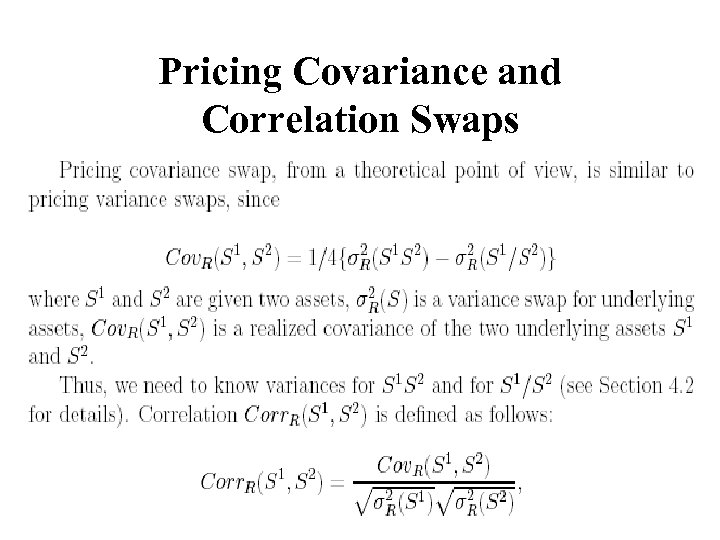 Pricing Covariance and Correlation Swaps
 Numerical Example: S&P 60 Canada Index
 Numerical Example: S&P 60 Canada Index • We apply the obtained analytical solutions to price a swap on the volatility of the S&P 60 Canada Index for five years (January 1997 February 2002) • These data were kindly presented to author by Raymond Theoret (University of Quebec, Montreal, Quebec, Canada) and Pierre Rostan (Bank of Montreal, Quebec, Canada)
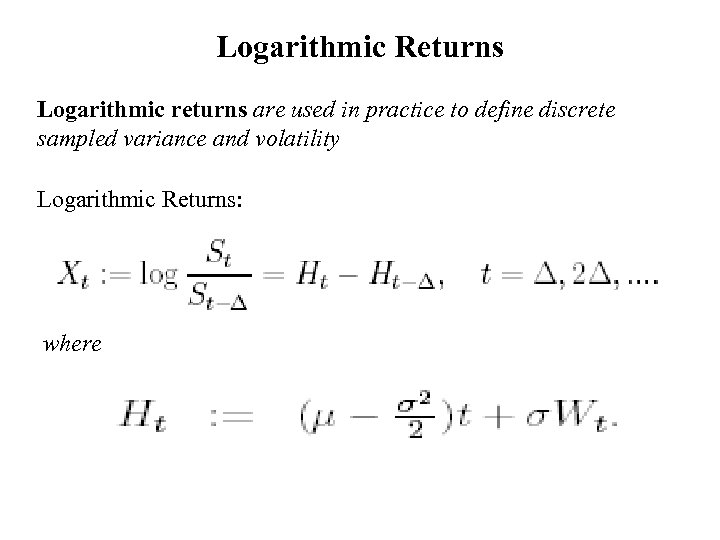 Logarithmic Returns Logarithmic returns are used in practice to define discrete sampled variance and volatility Logarithmic Returns: where
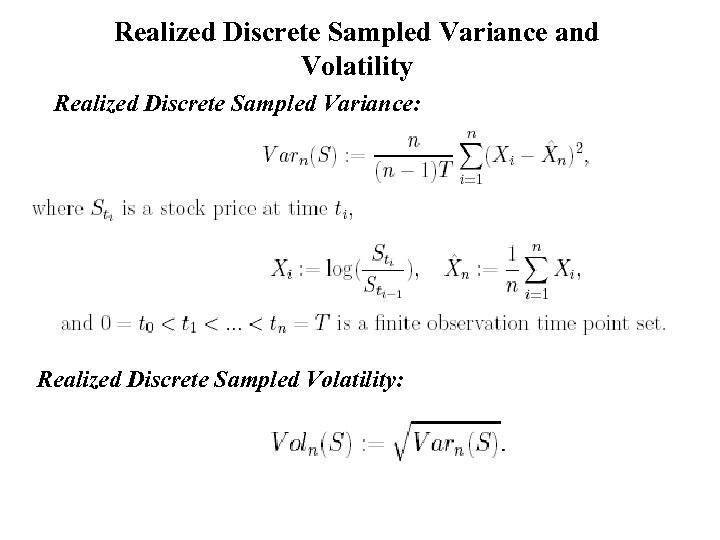 Realized Discrete Sampled Variance and Volatility Realized Discrete Sampled Variance: Realized Discrete Sampled Volatility:
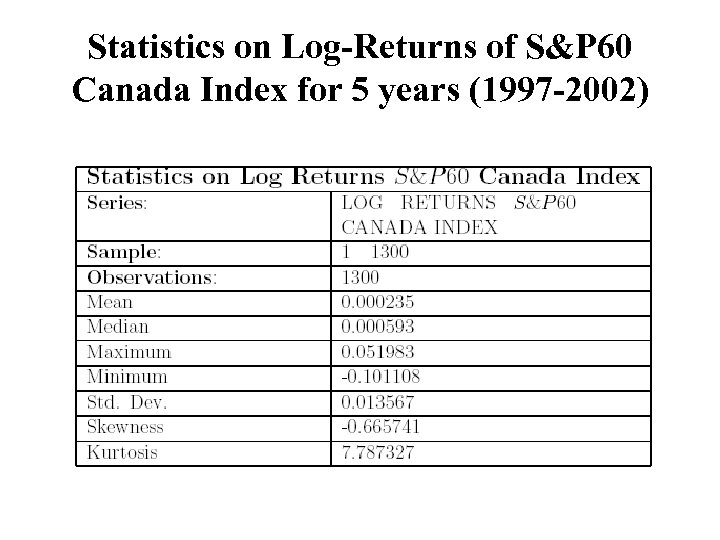 Statistics on Log-Returns of S&P 60 Canada Index for 5 years (1997 -2002)
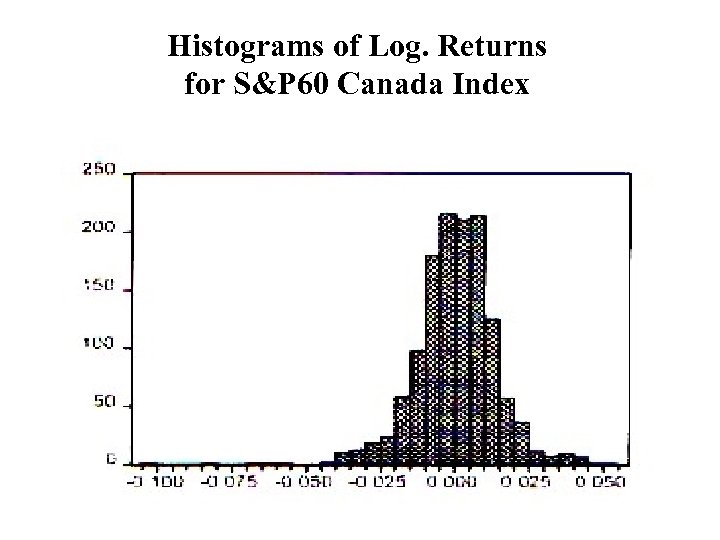 Histograms of Log. Returns for S&P 60 Canada Index
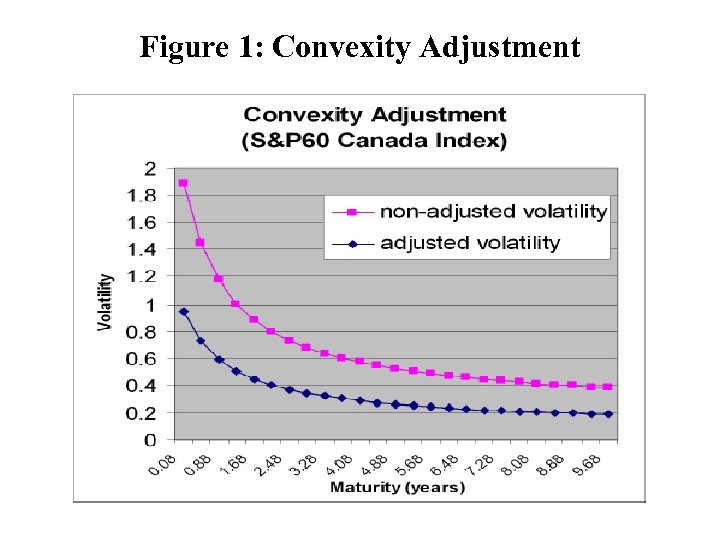 Figure 1: Convexity Adjustment
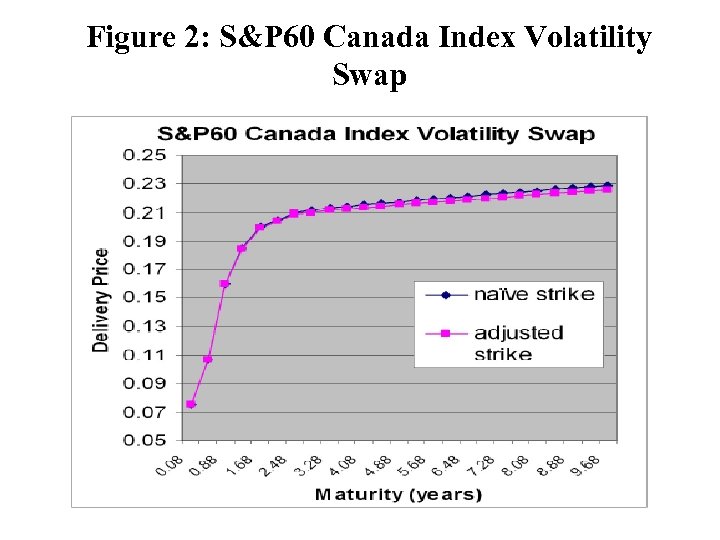 Figure 2: S&P 60 Canada Index Volatility Swap
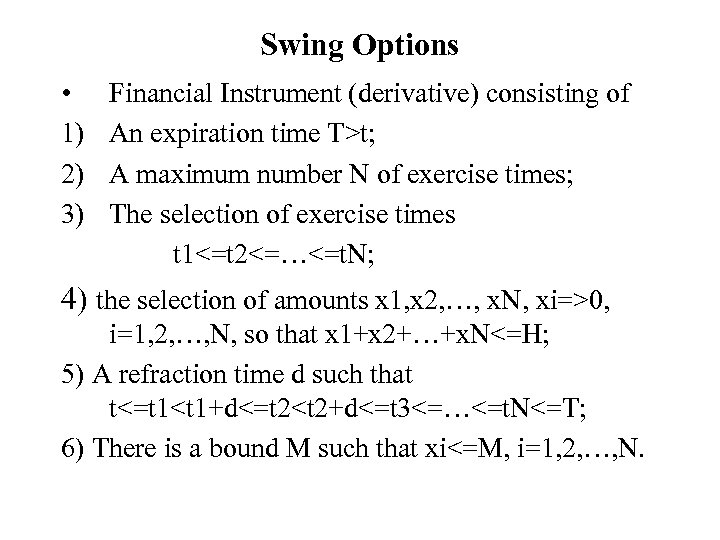 Swing Options • 1) 2) 3) Financial Instrument (derivative) consisting of An expiration time T>t; A maximum number N of exercise times; The selection of exercise times t 1<=t 2<=…<=t. N; 4) the selection of amounts x 1, x 2, …, x. N, xi=>0, i=1, 2, …, N, so that x 1+x 2+…+x. N<=H; 5) A refraction time d such that t<=t 1
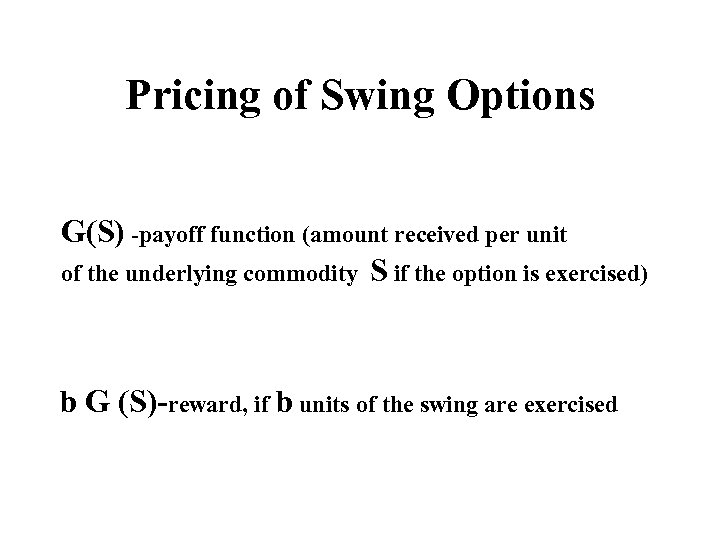 Pricing of Swing Options G(S) -payoff function (amount received per unit of the underlying commodity S if the option is exercised) b G (S)-reward, if b units of the swing are exercised
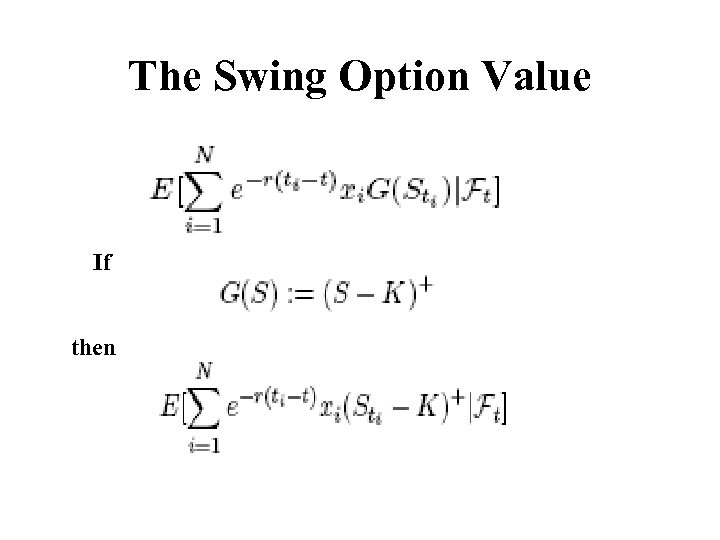 The Swing Option Value If then
 Future Work in Financial Mathematics • • Swaps with Jumps Swaps with Regime-Switching Components Swing Options with Jumps Swing Options with Regime-Switching Components
 Thank you for your attention !