


 Скачать презентацию FINANCIAL MARKETS Introduction to Finance Lecture 5
Financial markets.pptx
- Количество слайдов: 42
 FINANCIAL MARKETS Introduction to Finance Lecture 5
 CONTENTS What is it Financial market? Functions of Financial Markets Structure of Financial Markets Ø Ø Ø Debt & Equity markets Primary & Secondary markets Exchanges & Over-the-Counter markets Public Offering & Private Placement Money & Capital Markets The Foreign Exchange Market
 FINANCIAL MARKETS Are forums that facilitate the flows of funds among investors, firms & governments.
 FUNCTIONS OF FINANCIAL MARKETS: Borrowing and Lending Price Determination Information Aggregation and Coordination Risk Sharing Liquidity Efficiency
 STRUCTURE OF FINANCIAL MARKETS Debt & Equity markets Primary & Secondary markets Exchanges & Over-the-Counter markets Public Offering & Private Placement Money & Capital Markets
 DEBT &EQUITY MARKETS The Eguity Market facilitates the sale of equity by firms to investors or between investors. The Debt Markets enable firms to obtain debt financing from institutional and individual investors or to transfer ownership of debt securities between investors.
 DEBT MARKETS The most common method to obtain funds in a financial markets is to issue a debt instrument, such as a bond or a mortgage,
 DEBT INSTRUMENT: Bond or mortgage which is a contractual agreement by the borrower to pay the holder of the instrument fixed dollar amounts at regular intervals (interest and principal payments) until a specified date (the maturity date), when a final payment is made. The maturity of a debt instrument is the number of years (term) until that instrument`s expiration date. Short term: less than 1 year Intermediate term: between 1 & 10 years Long-term: more than 10 years
 EQUITY MARKETS The second method of raising funds is by issuing equities Such as common stock
 EQUITY INSTRUMENT Claims to share in the net income (income after expenses and taxes) and the assets of a business Makes periodic payments (dividends) Long-term securities (no maturity date) Holders benefit directly from any increases in the corporation`s profitability or asset value Holders are residual claimants; that is, the corporation must pay all its debt holders before it pays its equity holders.
 PRIMARY VS. SECONDARY MARKETS Primary market – a financial market in which securities are initially issued; Secondary market - a financial market in which securities that are already owned (those that are not new issues) are traded.
 PRIMARY MARKET The only market in which issuer is directly involved in the transaction. Are not well known to the public because the selling of securities to initial buyers often takes place behind closed doors. Initial Public Offering (IPO): a firm`s first offering of stock to the public. Any offering of stock by the firm after that point is referred to as Secondary offering.
 PRIMARY MARKET An important financial institution that assists in the initial sale of securities in the primary market is the investment bank. Advice: Advising on whether they should issue bonds or stocks, and, for bond issues, on the particular types of payment schedules these securities should offer. Underwriting: guarantees a price for a corporation's securities and then sells them to the public. Sales Assistance: Assisting in the sale of these securities to the public.
 SECONDARY MARKET The New York and American stock exchanges and NASDAQ, in which previously issued stocks are traded, are the best-known examples of secondary markets. Bond markets Foreign exchange markets Derivatives Securities Market
 SECONDARY MARKET Brokers are agents of investors who match buyers and sellers of securities. Does not take a position in the assets he or she trades The profit: determined by the commissions Example of brokers: real estate and stock brokers
 SECONDARY MARKET Dealers link buyers and sellers by buying and selling securities at stated prices. Can and do “take positions” in the assets he or she trades that permit the dealer to sell out of inventory rather than always having to locate sellers to match every offer to buy. Examples of dealers: car dealers, dealers in U. S. government bonds, and NASDAQ stock dealers.
 SECONDARY MARKET Make profit by: buy low- sell high “asked price”- price at which a dealer offers to sell an asset “bid price”- price at which a dealer offers to buy an asset “asked price” minus the “bid price” is called bid-ask spread
 EXCHANGES AND OVER-THE- OUNTER C MARKETS Secondary markets can be organized in two ways: 1. Exchanges 2. Over-the-counter
 EXCHANGES AND OVER-THE- OUNTER C MARKETS Exchanges, where buyers and sellers of securities (or their agents and brokers) meet in one central location to conduct trades. The New York Stock Exchange The American Stock Exchange The Chicago Board of Trade for Commodities
 PUBLIC OFFERING VS. PRIVATE PLACEMENT Public offering: the nonexclusive sale of securities to the general public. Private Placement: the sale of new securities directly to investors, rather than to the general public.
 MONEY MARKETS VS. CAPITAL MARKETS Another way of distinguishing between markets is on the basis of the maturity of the securities traded in each market.
 MONEY MARKETS Is financial markets in which only short-term debt instruments (with maturities of 1 year or less) are traded. The securities that are traded in money markets are called money market securities.
 KEY MONEY MARKET SECURITIES Treasure Bills Commercial Paper Negotiable Certificates Foreign Money Market Securities
 TREASURE BILL Is short-term debt securities issued by the government (treasure).
 NEGOTIABLE CERTIFICATES OF DEPOSITS (NCD) short –term debt security issued by financial institutions to obtain short-term funds.
 FOREIGN MONEY MARKET SECURITIES Firms and investors can borrow or invest funds for short-term periods: They may attempt to borrow short-term funds in other currencies by issuing short-term securities denominated in foreign currency.
 COMMERCIAL PAPER Is a short-term debt security issued by firms with a high credit standing.
 CAPITAL MARKETS Is financial markets that facilitate the flow of long-term funds ( with maturities of more than 1 year) Securities which are traded in capital markets: stocks & bonds
 KEY CAPITAL MARKET SECURITIES 1. 2. 3. 4. 1. 2. 3. Bonds: Treasure Municipal Corporate International Stocks: Common Preferred International
 BONDS Treasure Bonds: bonds issued by government to obtain long term (10 -30 years) funds. 2. Municipal Bonds: bonds issued by municipalities to support their expenditures. General obligation bonds: municipal bonds backed by the municipality`s ability to tax. Revenue bonds: municipal bonds that will be repaid with the funds generated from the project financed with the proceeds of the bond issue. 1.
 BONDS 3. Corporate Bonds: a debt instrument indicating that a corporation has borrowed a certain amount of money and promises to repay it in the future under clearly defined terms. 4. International Bonds: Firms commonly issue bonds in the Eurobond market, which serves issuers and investors in bonds denominated in a variety of currencies.
 STOCKS Common Stock: collectively, units of ownership interest or equity, in a corporation. Preferred Stock: a special form of ownership having a fixed periodic dividend that must be paid prior to payment of any common stock dividends. International Stock
 INTERNATIONAL CAPITAL MARKETS Foreign Bond: a bond issued by a foreign corporation or government that is denominated in the investor`s home currency & sold in the investor`s home market.
 DERIVATIVE SECURITIES MARKET Derivative securities are financial contracts whose values are derived from the values of underlying financial assets (such as securities).
 THE FOREIGN EXCHANGE MARKET Allows for the purchase and sale of currencies to facilitate international purchases of products, services, and securities.
 THE FOREIGN EXCHANGE MARKET Spot market Forward market
 SPOT MARKET FORFOREIGN EXCHANGE Spot market: a market that facilitates foreign exchange transactions that involve the immediate exchange of currencies. Spot Exchange Rate (spot rate): the prevailing rate at which one currency can be immediately exchanged for another currency.
 FORWARD MARKET FORFOREIGN EXCHANGE Forward market: a market that facilitates foreign exchange transactions that involve the future exchange of currencies. Forward rate: the rate at which one currency can be exchanged for another currency on a specific future date.
 FINANCIAL MARKETS Facilitate the transfer of funds between the investors who wish to invest & firms that need to obtain funds. Can accommodate the needs of firms that temporarily have excess funds & wish to invest those funds. Can accommodate the needs of investors who wish to liquidate their investments in order to spend the process or invest them in alternative investments.
 INTERNET TOOLS Education www. investorguide. com www. fool. com www. smartmoney. com Calculators www. financenter. com
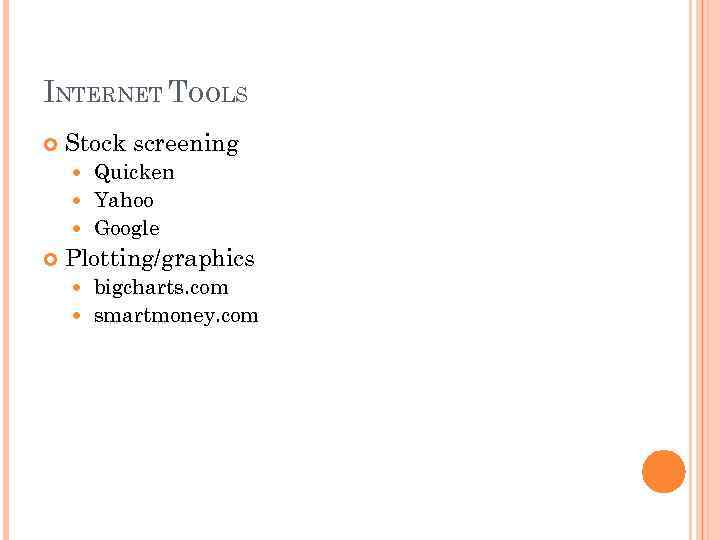 INTERNET TOOLS Stock screening Quicken Yahoo Google Plotting/graphics bigcharts. com smartmoney. com
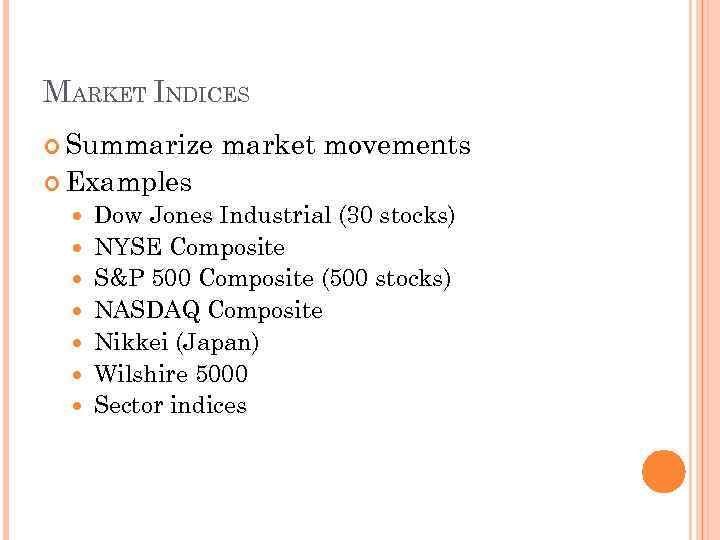 MARKET INDICES Summarize market movements Examples Dow Jones Industrial (30 stocks) NYSE Composite S&P 500 Composite (500 stocks) NASDAQ Composite Nikkei (Japan) Wilshire 5000 Sector indices