


 Скачать презентацию Financial Markets and Institutions FIN 712 I
7626c7a5be71b91dc2cfaaab6c86279c.ppt
- Количество слайдов: 65
 Financial Markets and Institutions FIN 712
 I. General Introduction
 Course Objectives • Dynamic picture of markets (interest rates) • Structural evolution of markets – Financial innovation (and regulatory response) – Why market has its current structure
 Managerial implications 1. Level and structure of interest rates • Impact on financing decisions? 2. Structure of financial sector: Why so many financial instruments ? • Which one is best suited?
 Some sources of data • Wall St. Journal: “Markets Data Center” http: //online. wsj. com • St. Louis Fed (data repository of system) http: //research. stlouisfed. org/fred 2/ • Federal Reserve: Board of Governors http: //www. federalreserve. gov/
 TANSTAFL
 The Answers 1. Gains from Trade • Consumer/producer surplus • “Win – Win” 2. Transaction cost minimization
 The Answers 1. Gains from Trade • • Differences lead to gains from trade Instruments exist to realize gains from trade 2. Transaction cost • Transactions are structured to minimize cost
 GFT & Transactions Costs • Tell us directly why instruments and intermediaries exist. • Are also central to understanding the behavior of interest rates – Because understanding supply and demand for an instrument requires us to understand how it creates GFT
 Introduction: How markets change Junk Bonds: An Example of Financial Innovation
 Key ideas related to finanial innovation: • Benefits of markets (and financial innovations) economic concept of Gains-from-Trade • Hazards – unintended results of financial innovation and how they are handled. – Market responses – design changes implemented by market participants (further innovations) – Regulatory responses – continuing interaction of regulators and participants • Continuing cycle of innovation and reaction
 One innovation: The case of ‘junk’ bonds • “Junk” bonds – These are below investment grade: rated BB or lower, also called “high yield” bonds. – Traditionally existed only when originally investment grade bonds were downgraded – “fallen angels”.
 The innovation • Beginning about 1980, Michael Milken began encouraging corporate borrowers to sell bonds rated below investment grade at issue. – Clients who could not qualify for an investment grade rating, – Or issues deliberately structured to have a lower rating.
 The sell side: bond issuers Junk bonds were particularly attractive to: • Issuers not well known to the market – e. g. new technologies of the time – “disintermediation” of the 1970 s had reduced banks’ willingness to fund less well-know borrowers. • Later became a popular means to finance corporate takeovers – creating leveraged buyouts.
 Building the buy side of the market: the sales pitch • Milken asserted aggressively that the default probability for these bonds was much lower than what was allowed for by their higher yield. – He argued the ratings agencies were irrationally conservative in their evaluation of risk. • Initially, the data seemed to support him.
 Building the buy side (2): providing liquidity • Milken assured buyers that Drexel Burnham Lambert would always make a market – be willing to buy or sell – bonds they placed. • Promised liquidity increased the value of the bonds to purchasers.
 Building the buy side (3): Result: Market concentration • As a result, both the primary market (initial issue) and secondary market (trading after issue) were concentrated in Drexel. • Milken had an unassailable informational advantage about who held what, who was willing to buy what. • Reinforced the his advantage in placing newly issued bonds and controlling the market.
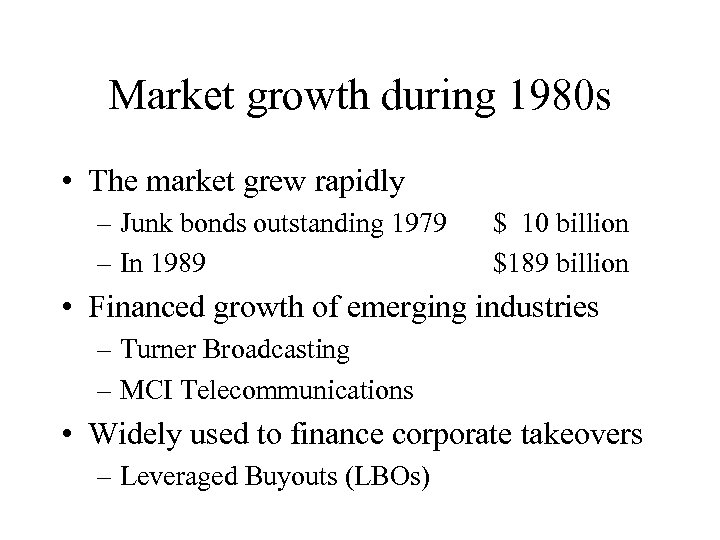 Market growth during 1980 s • The market grew rapidly – Junk bonds outstanding 1979 – In 1989 $ 10 billion $189 billion • Financed growth of emerging industries – Turner Broadcasting – MCI Telecommunications • Widely used to finance corporate takeovers – Leveraged Buyouts (LBOs)
 Late 1980 s • Default experience began to deteriorate • Michael Milken was investigated – for insider trading related to some of the junk bond financed LBOs. – for market manipulation of junk-bond prices.
 End of the decade • The junk bond market collapsed as Michael Milken’s legal problems mounted: – Indicted 1989 – In a plea bargain, pled guilty to securities violations – Fined, spent almost 2 years in jail, barred from the securities industry for life. • Junk bond issuance in 1990 – virtually zero
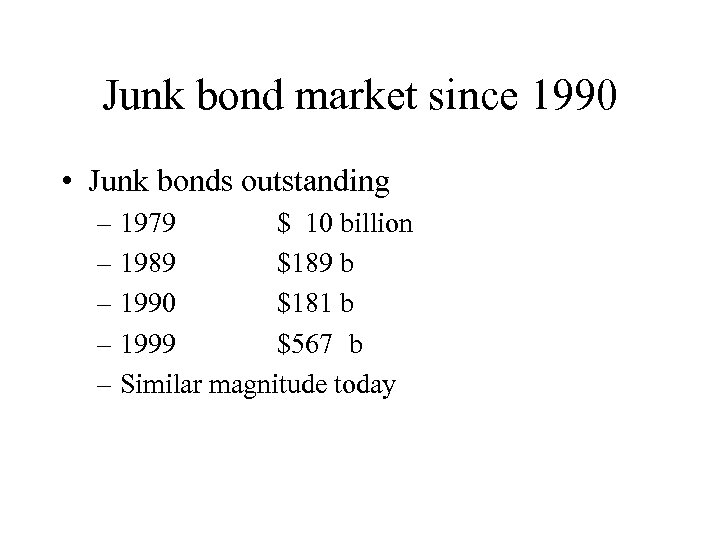 Junk bond market since 1990 • Junk bonds outstanding – 1979 $ 10 billion – 1989 $189 b – 1990 $181 b – 1999 $567 b – Similar magnitude today
 Junk Bonds: Further Question • Why has the market continued to grow since 1990? – Benefit to borrowers? – Benefit to investors?
 Case Summary. Innovation Key Issues for Any Financial Application to Junk Bonds • Benefits derived from markets – Purpose or reason markets exist – Drivers of financial innovation • Potential problems with market functioning – Ethical or “moral hazard” issues – Other issues
 Case Summary (continued) • Consequences of these problems, including financial crises • Appropriate responses – Market driven responses – Regulatory responses
 II. Loanable Funds Theory (The Fisher Model )
 The Fisher Model • We begin with the simplest possible case: the market for generic loans • Questions addressed: – What determines the overall level of interest rates in the economy? – What is the source of GFT in this market? Why is the economy better off when there are capital markets?
 Example: history of interest rates http: //research. stlouisfed. org/fred 2/series/GS 1 ? cid=47
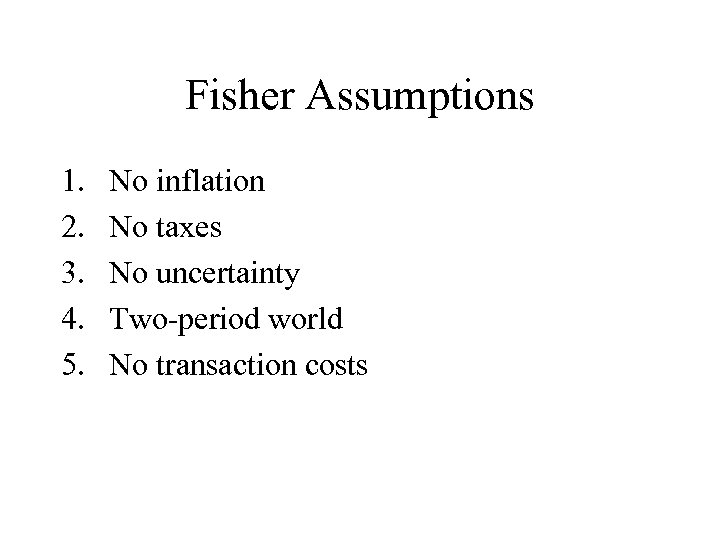 Fisher Assumptions 1. 2. 3. 4. 5. No inflation No taxes No uncertainty Two-period world No transaction costs
 This list of assumptions is also an outline for the first part of the course: • Relaxing each one in turn lets us examine another dimension of the structure of interest rates. • It also reveals an additional source of gains from trade.
 Fisher Model Outline of Topics • • Demand for loans (business) Differences and Gains from Trade (GFT) Supply of loans (households) Summary and lessons
 Simple numerical example: Business demand for loans • How business demand for loans is determined (PV maximizing borrowing) • Key lesson: What information governs this decision – What shifts the demand curves/interest rate – What are sources of GFT
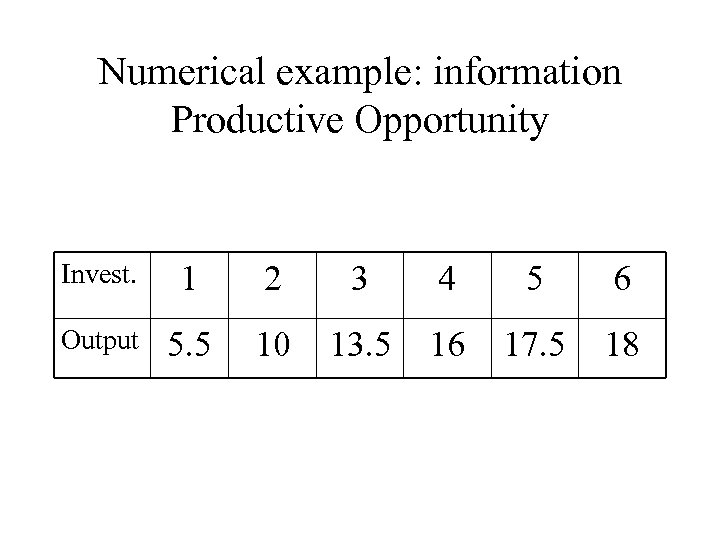 Numerical example: information Productive Opportunity Invest. 1 2 3 4 5 6 Output 5. 5 10 13. 5 16 17. 5 18
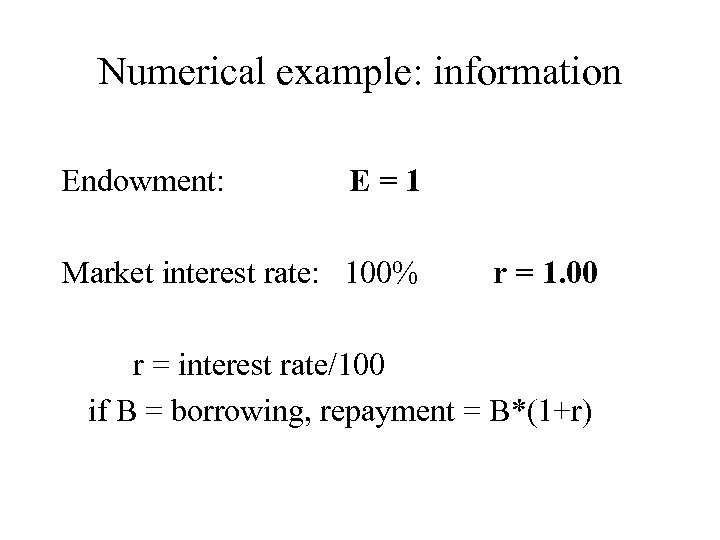 Numerical example: information Endowment: E=1 Market interest rate: 100% r = 1. 00 r = interest rate/100 if B = borrowing, repayment = B*(1+r)
 Numerical Example • What level of borrowing maximizes profit (value of firm)?
 Lessons from the numerical example 1. Optimal decision rule: MP(B) = 1 + r Decision rule determines: 2. Choice of how much to borrow 3. Quantifiable gain from being able to trade on the market (borrow or lend).
 From decision rule to demand curve 1. MP(B) = 1 + r 2. Diminishing returns How does borrowing respond to changes in r? Why?
 Definition: demand curve • Demand curve shows desired quantity of borrowing as a function of the interest rate. • Or, the other way around: Demand curve shows the interest rate at which a given quantity of borrowing is optimal. • Either way, demand curve relates interest rate and amount of borrowing
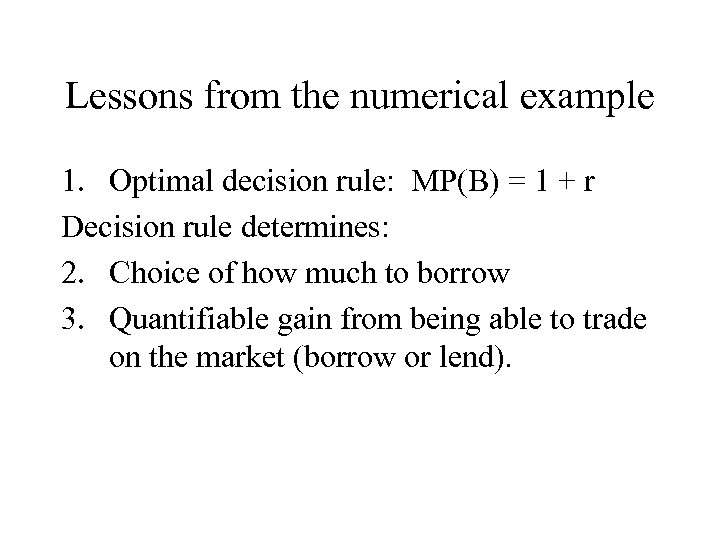
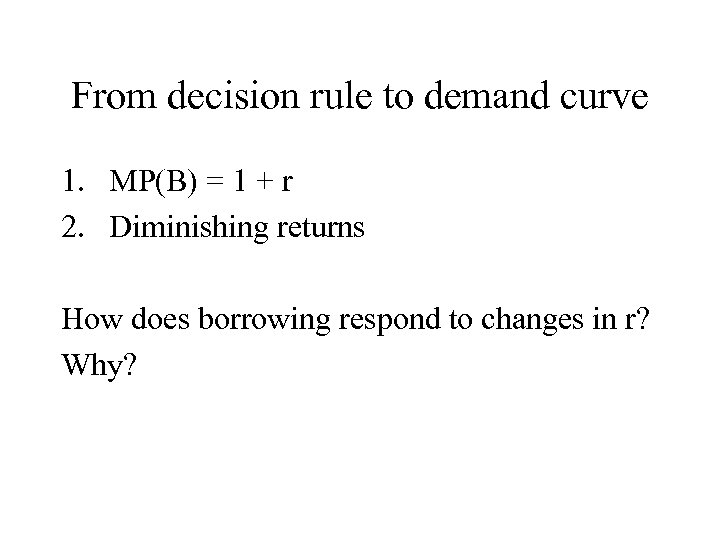
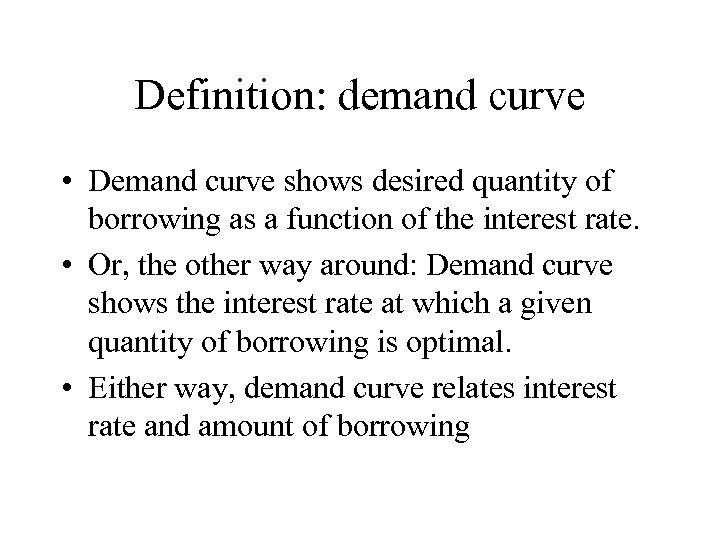
 Lessons from numerical example (2) 4. Optimal decision rule generates the firm’s demand curve for loans • Note that this can become a supply curve when interest rates are high enough. 5. Demand curve affected (only) by factors influencing firm’s borrowing decision • • Production opportunity endowment
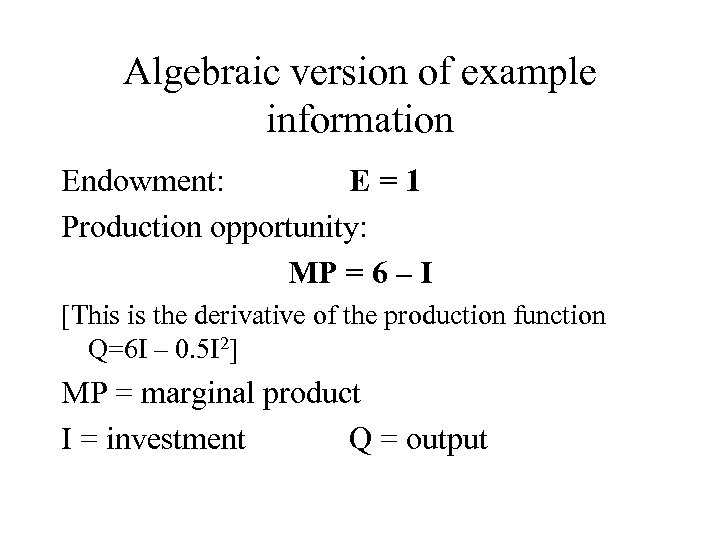 Algebraic version of example information Endowment: E=1 Production opportunity: MP = 6 – I [This is the derivative of the production function Q=6 I – 0. 5 I 2] MP = marginal product I = investment Q = output
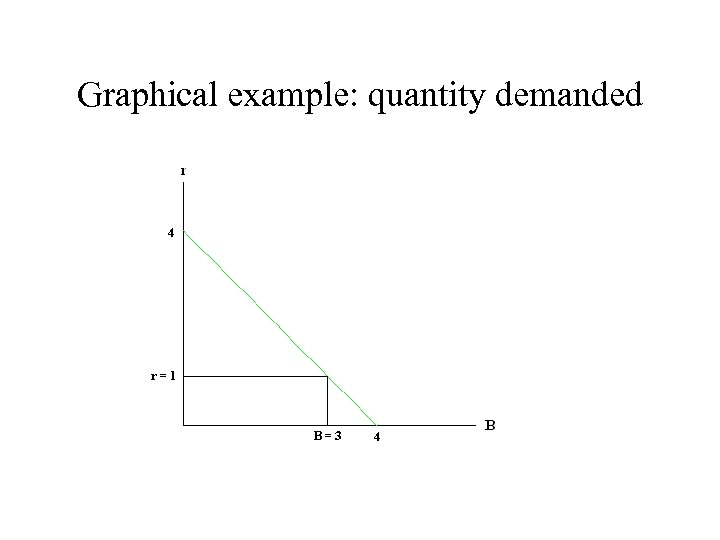
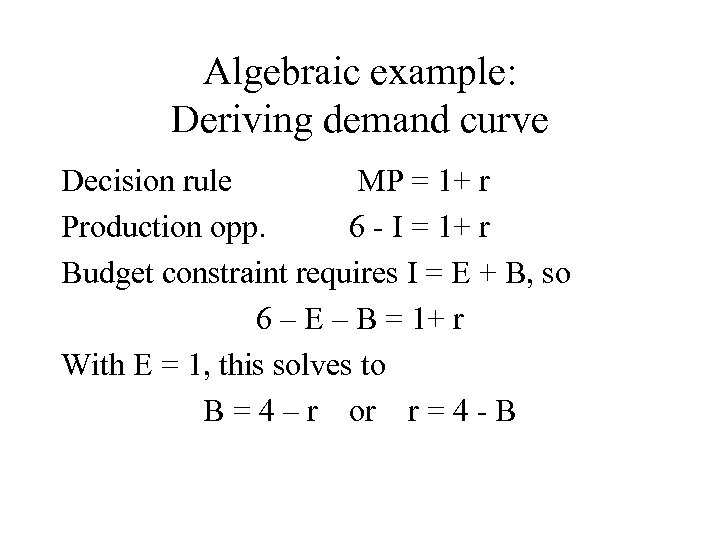 Algebraic example: Deriving demand curve Decision rule MP = 1+ r Production opp. 6 - I = 1+ r Budget constraint requires I = E + B, so 6 – E – B = 1+ r With E = 1, this solves to B = 4 – r or r = 4 - B
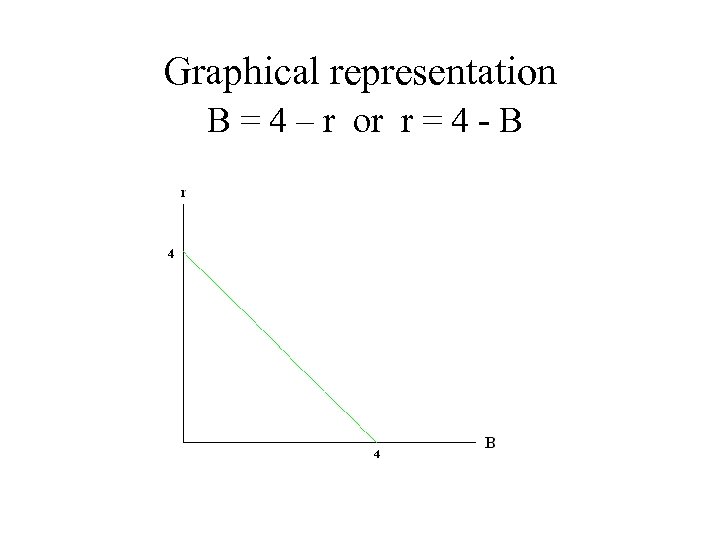 Graphical representation B = 4 – r or r = 4 - B
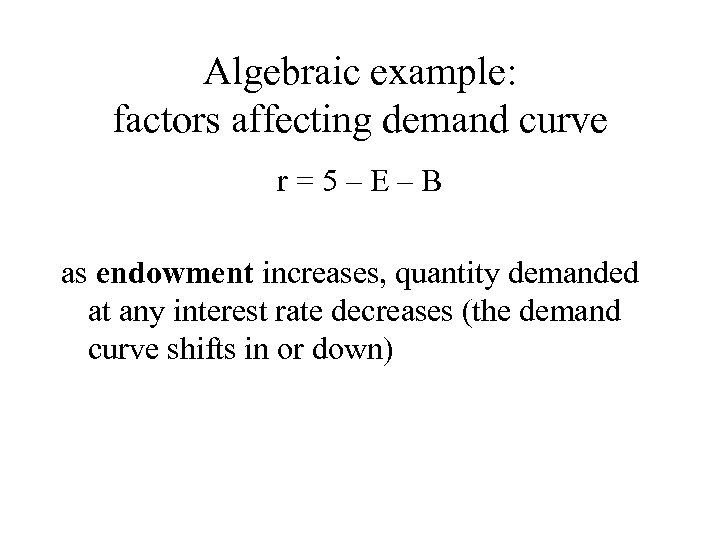 Algebraic example: factors affecting demand curve r=5–E–B as endowment increases, quantity demanded at any interest rate decreases (the demand curve shifts in or down)
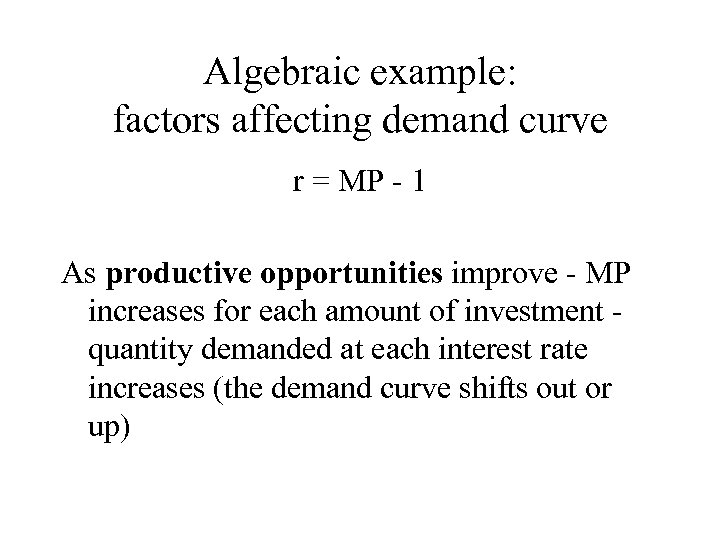 Algebraic example: factors affecting demand curve r = MP - 1 As productive opportunities improve - MP increases for each amount of investment quantity demanded at each interest rate increases (the demand curve shifts out or up)
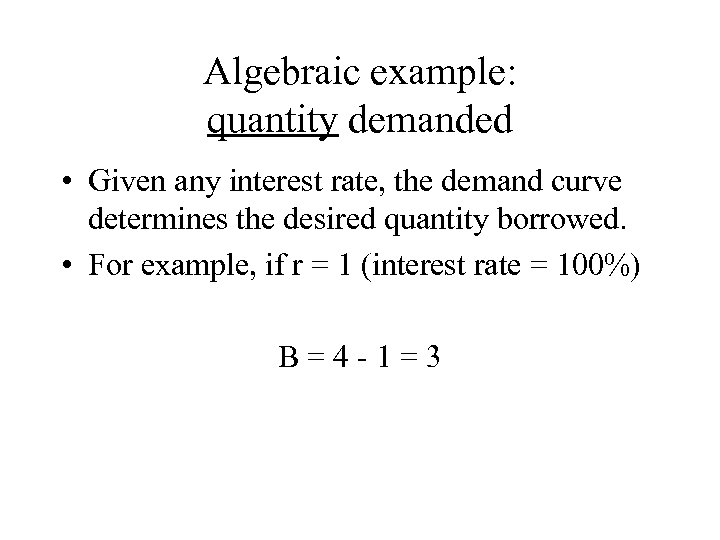 Algebraic example: quantity demanded • Given any interest rate, the demand curve determines the desired quantity borrowed. • For example, if r = 1 (interest rate = 100%) B=4 -1=3
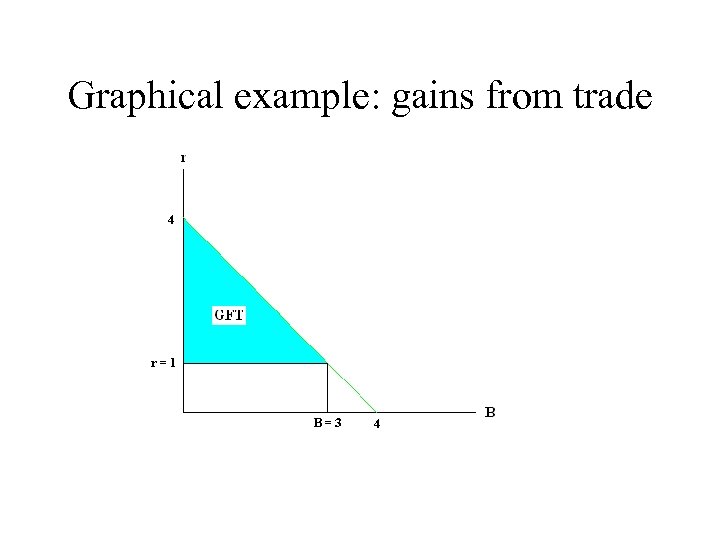
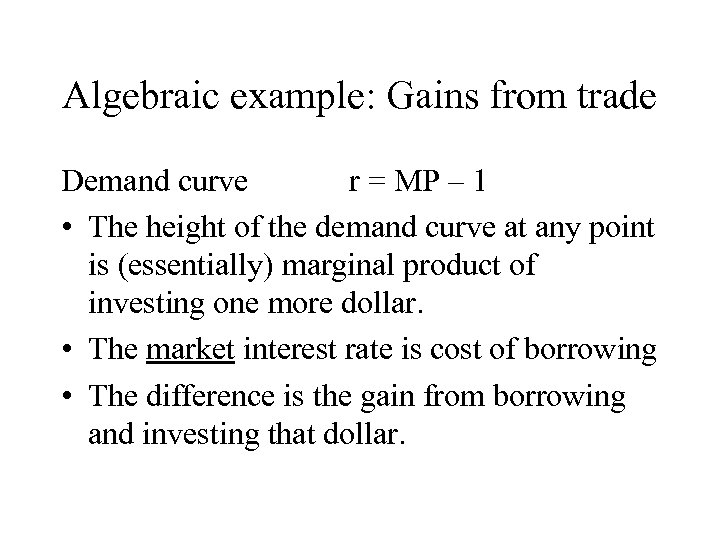 Algebraic example: Gains from trade Demand curve r = MP – 1 • The height of the demand curve at any point is (essentially) marginal product of investing one more dollar. • The market interest rate is cost of borrowing • The difference is the gain from borrowing and investing that dollar.
 Graphical example: quantity demanded
 Graphical example: gains from trade
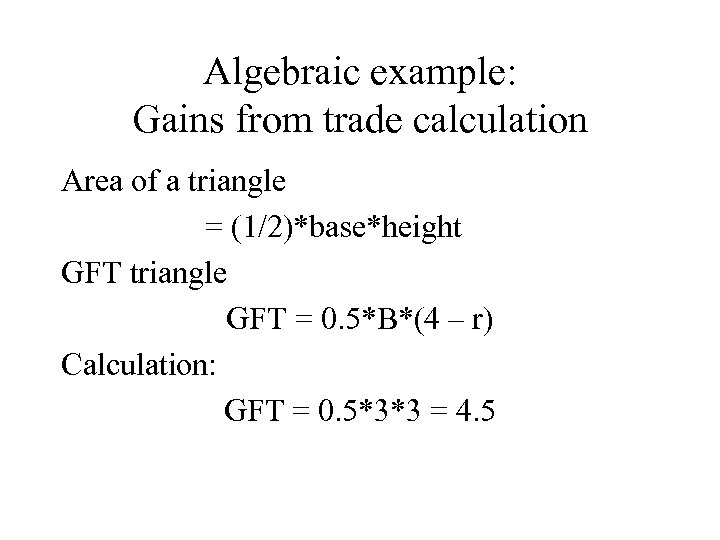 Algebraic example: Gains from trade calculation Area of a triangle = (1/2)*base*height GFT triangle GFT = 0. 5*B*(4 – r) Calculation: GFT = 0. 5*3*3 = 4. 5
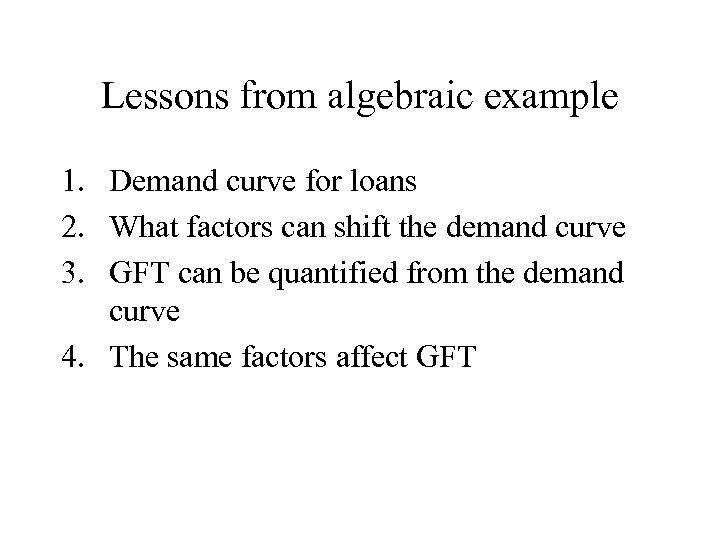 Lessons from algebraic example 1. Demand curve for loans 2. What factors can shift the demand curve 3. GFT can be quantified from the demand curve 4. The same factors affect GFT
 Supply Curve of Loans • Depends on household behavior
 Deriving Supply of Loans • Household behavior is analogous to that of firms • But depends on – Taste for current versus future consumption – Endowments
 Market interest rate • Aggregate (add horizontally) individual demand curves to derive market demand • Aggregate individual supply curves to derive market supply • The market interest rate equates quantity demanded and quantity supplied (intersection of the curves).
 Lessons about the level of interest rates • Interest rates can be changed by any factor that shifts the supply or demand for loans. – Note: a change in interest rates (price) does not shift a supply or demand curve. – Any information (other than the interest rate) used to decide quantity demanded can shift a supply or demand curve
 Example: Differences and GFT
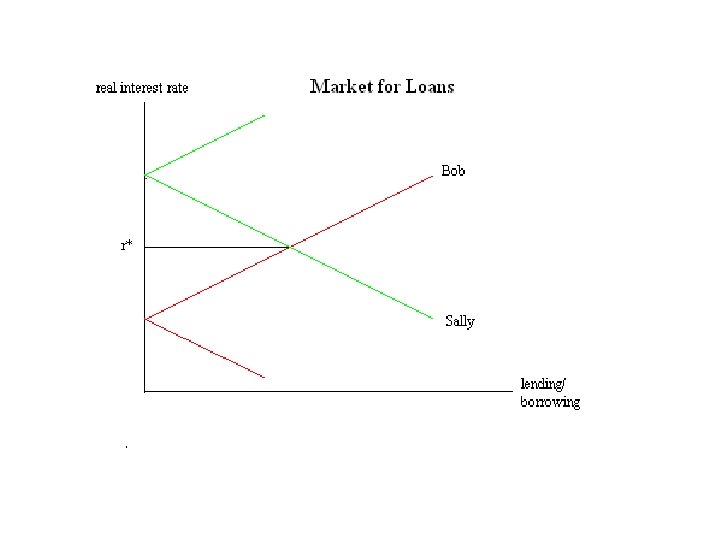
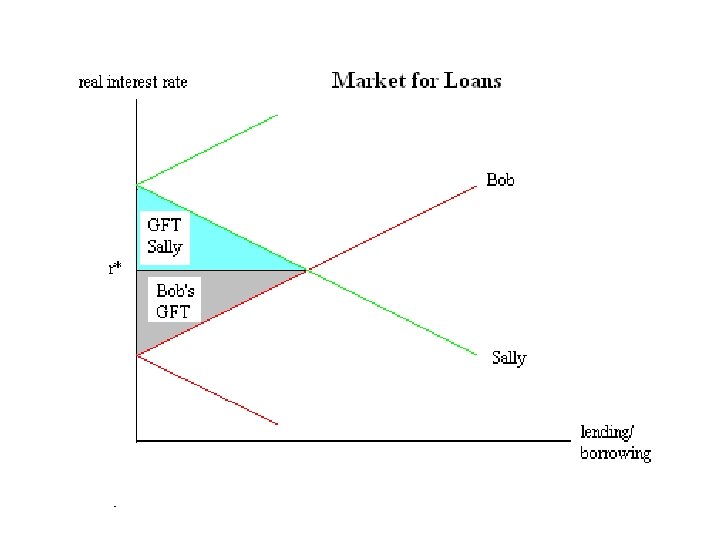
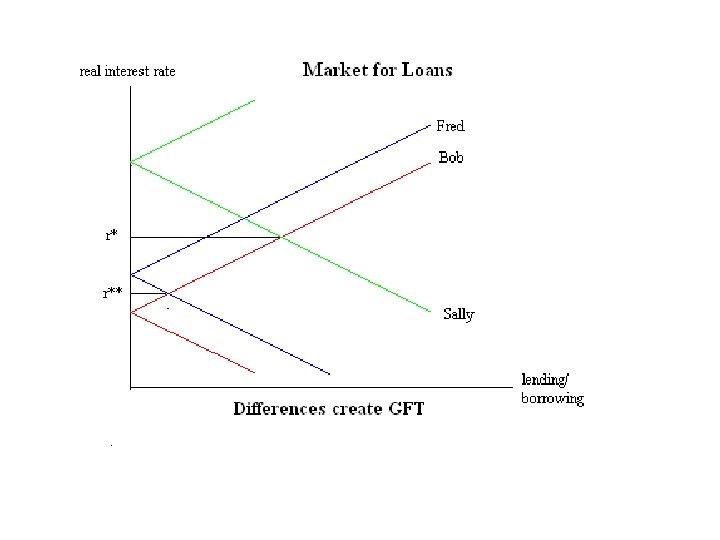
 Lessons about GFT • • • GFT = benefit from creating a market GFT are reflected in demand supply curves GFT result from differences
 Summary of Fisher Model Factors that can change interest rates/create gains from trade in the Fisher Model 1. Productive opportunities 2. Taste (current v. future consumption) 3. endowments
 III. Applying the Fisher Model
 Applying the Fisher Model A useful stylization • Firms demand loans • Households supply them
 Applying the Fisher Model: Underlying thought process 1. What could change r? [a shift of the supply or demand curve] 2. What could shift a curve? [productive opportunities, taste, endowments] 3. What event(s) described in the article could change any of these?
 Applying the Fisher Model Telling the story/How I grade 1. Relevant event in article 2. Which factor in the model is affected and why. 3. Which curve shifts? Which way? Why? 4. Resulting change in equilibrium.
 Discussion question: example
 Key points of this class 1. Differences = GFT = financial instruments 2. In the Fisher model, the factors that can produce GFT and/or change interest rates: • • • Production opportunities Taste (current v future consumption) Endowments 3. Steps to use Fisher Model to explain changes in interest rates