 Скачать презентацию Financial Markets and Institutions BA 441 Monday
ff0f6d56c35d8200c951653c586316f5.ppt
- Количество слайдов: 10



Financial Markets and Institutions – BA 441 Monday -- Wednesday Bexell 103 8: 00 a. m. to 9: 50 a. m.
Chapter 2 – Financial Intermediation n Definition of Financial Intermediation n Transforming financial assets into more widely preferred type of asset/liability n n Example: Car Loan Example: Swap (Bond swap from fixed to floating rate) n Performed by Financial Institutions n Many of these intermediation functions are completed with large institutions n Completed in Financial Markets
Chapter 2 – Financial Intermediation n A closer look at Financial Institutions n Types n n n Banks – Commercial, Investment, Savings and Loans, Credit Unions, etc. Investment Companies Insurance Companies Others – Pension Funds, Foundations, etc. Functions n n Transforming, Exchanging, and Designing Financial Assets Advising and Managing Financial Assets
Chapter 2 – Financial Intermediation n Direct Investing with Intermediaries n Commercial Bank n n Direct Deposit – CD – Promised Payment at the end of the Investment Period Dollars are loaned to a borrower (to buy a car) with a different payment schedule n Indirect Investing with Intermediaries n Mutual Fund Company (Investment Company) n n Buy mutual fund shares at NAV (no load) Company uses funds to buy stocks and bonds
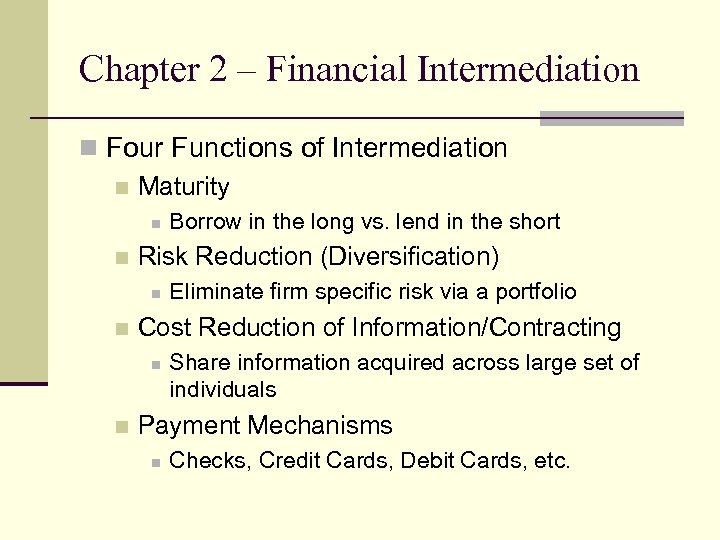
Chapter 2 – Financial Intermediation n Four Functions of Intermediation n Maturity n n Risk Reduction (Diversification) n n Eliminate firm specific risk via a portfolio Cost Reduction of Information/Contracting n n Borrow in the long vs. lend in the short Share information acquired across large set of individuals Payment Mechanisms n Checks, Credit Cards, Debit Cards, etc.
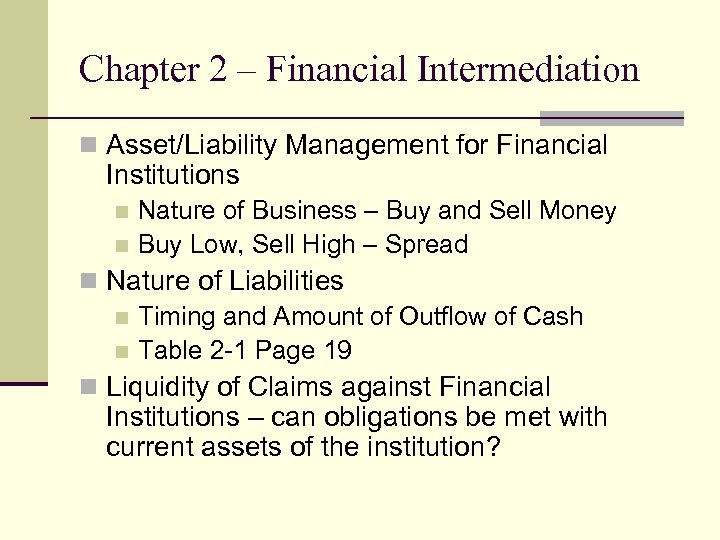
Chapter 2 – Financial Intermediation n Asset/Liability Management for Financial Institutions Nature of Business – Buy and Sell Money n Buy Low, Sell High – Spread n n Nature of Liabilities n Timing and Amount of Outflow of Cash n Table 2 -1 Page 19 n Liquidity of Claims against Financial Institutions – can obligations be met with current assets of the institution?
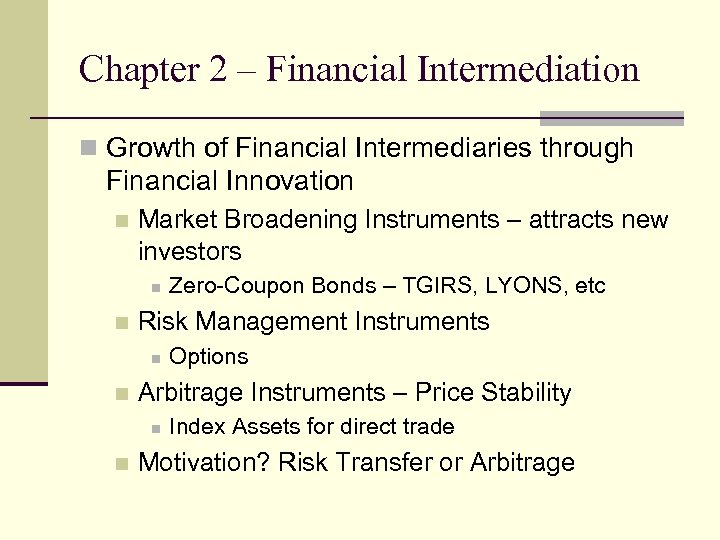
Chapter 2 – Financial Intermediation n Growth of Financial Intermediaries through Financial Innovation n Market Broadening Instruments – attracts new investors n n Risk Management Instruments n n Options Arbitrage Instruments – Price Stability n n Zero-Coupon Bonds – TGIRS, LYONS, etc Index Assets for direct trade Motivation? Risk Transfer or Arbitrage
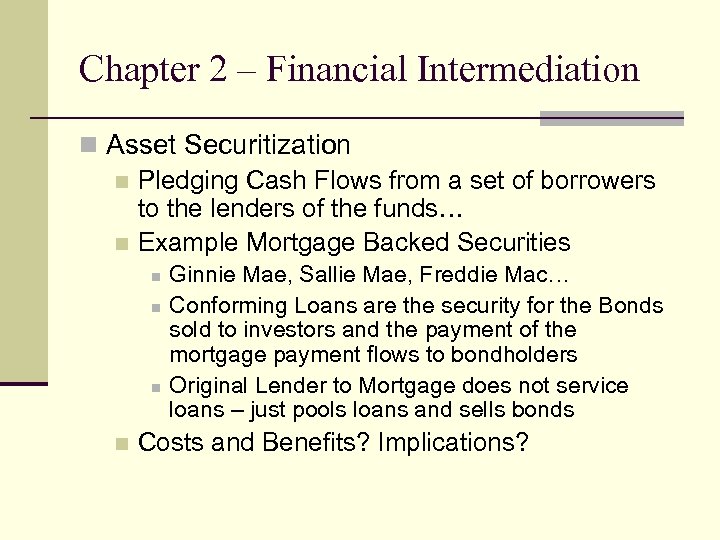
Chapter 2 – Financial Intermediation n Asset Securitization n Pledging Cash Flows from a set of borrowers to the lenders of the funds… n Example Mortgage Backed Securities n n Ginnie Mae, Sallie Mae, Freddie Mac… Conforming Loans are the security for the Bonds sold to investors and the payment of the mortgage payment flows to bondholders Original Lender to Mortgage does not service loans – just pools loans and sells bonds Costs and Benefits? Implications?
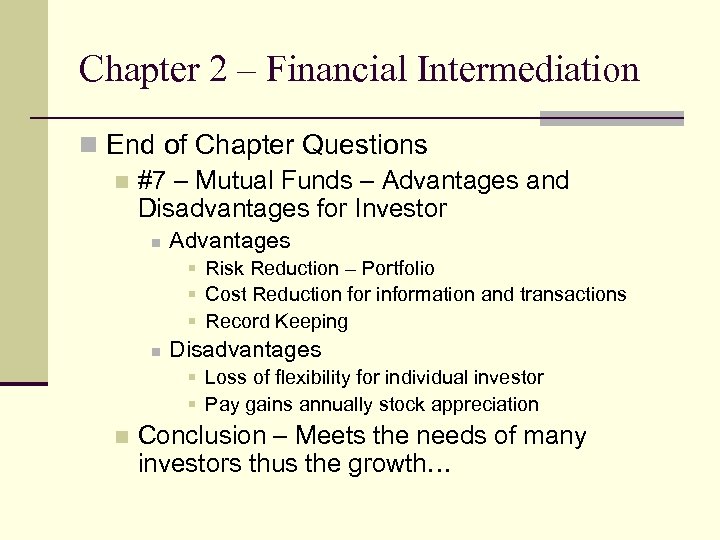
Chapter 2 – Financial Intermediation n End of Chapter Questions n #7 – Mutual Funds – Advantages and Disadvantages for Investor n Advantages § Risk Reduction – Portfolio § Cost Reduction for information and transactions § Record Keeping n Disadvantages § Loss of flexibility for individual investor § Pay gains annually stock appreciation n Conclusion – Meets the needs of many investors thus the growth…
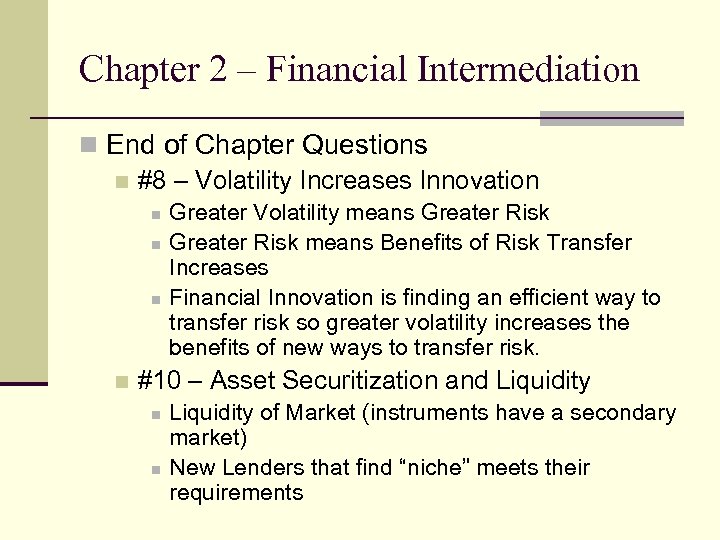
Chapter 2 – Financial Intermediation n End of Chapter Questions n #8 – Volatility Increases Innovation n n Greater Volatility means Greater Risk means Benefits of Risk Transfer Increases Financial Innovation is finding an efficient way to transfer risk so greater volatility increases the benefits of new ways to transfer risk. #10 – Asset Securitization and Liquidity n n Liquidity of Market (instruments have a secondary market) New Lenders that find “niche” meets their requirements
Скачать презентацию Financial Markets and Institutions BA 441 Monday
ff0f6d56c35d8200c951653c586316f5.ppt