 Скачать презентацию Financial Management By Dr Imamuddin Khoso Ph D
38bd13dd482da3b23a58005103f1535f.ppt
- Количество слайдов: 33



Financial Management By: Dr Imamuddin Khoso (Ph. D, Japan), (Post Doctorate, Canada) Director IBA, University of Sindh Jamshoro 1
Financial Management Text Book: Financial Management 13 th Edition By: Van Horne and Wachowicz l Suggested Readings: Financial Management International edition By: Timothy J. Gallagher and Joseph D. Andrew l Financial Management By I. M. Pandey 2
Chapter #1. Introduction to Financial Management Lecture outlines l l l 3 Finance Defined Financial Management Defined Functions of Financial Management Goal of the Firm Agency Problem Corporate Social Responsibility
Finance defined l l 4 The body of facts, principles, and theories relating to the raising and using of money by individuals, businesses, and governments. It is the art of creating and managing money.
Finance Defined (continued) According to Merriam Webster’s Collegiate Dictionary, 10 th Edition: l “. . . finance is: (1) money or other liquid resources of a government, business, group, or individual; l (2) the system that includes the circulation of money, the granting of credit, the making of investments, and the provision of banking facilities; l (3) the science or study of the management of funds; l (4) the obtaining of funds or capital. ” 5
Finance Defined (continued) Porsche A name that frequently brings to mind an image of the world’s best sports car. Its chairman says, “A company's goal is to make money, if it does not make money, it has no reason to exist”. 6
Why Learn Finance? l l l 7 To manage your personal resources To deal with world of business (financial decisions of firms) To expand your mind
Nobel laureates in Finance l 8 Harry Markowitz is the father of modern portfolio theory, the scientific study of how to trade of risk and reward and choosing among risky investments. l William Sharpe showed that a very specific structure must exist on risky assets through (Capital Asset Pricing Model). l Modigliani-Miller (M&M) showed that how financing policies (capital structure) affect the total value of a firm. l Robert C. Merton discovered a mathematical formula for the pricing of options and derivative securities.
Financial Management Defined l l 9 Financial Management is concerned with the acquisition, financing, and management of assets with the goal of maximizing the value of the firm. Financial Manager is responsible to carry out those decisions.
Functions of Financial Management Investment Decisions l l l What is the optimal firm size? What specific assets should be acquired? What assets (if any) should be reduced or eliminated? Objective: Best mix of assets 10
Functions of Financial Management (continued) Financing Decisions Determine how the assets (LHS of balance sheet) will be financed (RHS of balance sheet) l l l What is the best type of financing? What is the best dividend policy (e. g. , dividendpayout ratio)? How will the funds be physically acquired? Objective: Best mix of financing 11
Functions of Financial Management (continued) l l l Asset Management Decisions How do we manage existing assets efficiently? Financial Manager has varying degrees of operating responsibility over assets. Greater emphasis on current asset management than fixed asset management. Objective: Maximize the value of the firm 12

Work of Management Planning Directing and Motivating Controlling
Challenges to Financial Manager l l 14 Heightened corporate competition, globalization, technological change, volatility in interest rates and inflation, fluctuating exchange rates, tax law changes, and ethical concerns over certain financial dealings must be dealt with almost daily. Agency problem If you become a Financial Manager, your ability to adapt to change, raise funds, invest in assets, and mange wisely will affect the success of your firm and, ultimately, the overall economy as well. It is indeed a time of both challenge and opportunity.
The Goal of the Firm l Profit Maximization u Maximizing a firm’s earnings after taxes. l Problems l Could increase current profits while harming firm (e. g. , defer maintenance, issue common stock to buy T-bills, etc. ). Ignores changes in the risk level of the firm. l 15
The Goal of the Firm (continued) l Earnings per Share Maximization u Maximizing earnings after taxes divided by shares outstanding. l Problems l Does not specify timing or duration of expected returns. Ignores changes in the risk level of the firm. Calls for a zero payout dividend policy. l 16 l
The Goal of the Firm (continued) l Share Holder Wealth Maximization l Takes account of: – – – l 17 current and future profits and EPS, the timing, duration, and risk of profits dividend policy and all other relevant factors Thus, Share Price serves as a barometer for business performance.
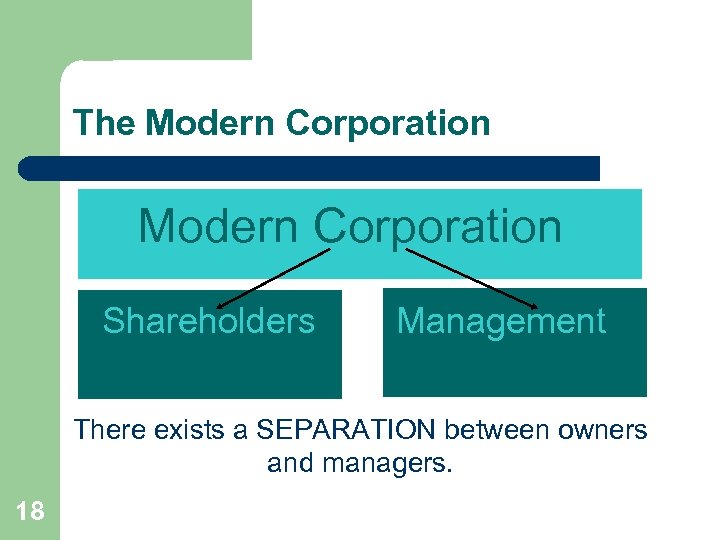
The Modern Corporation Shareholders Management There exists a SEPARATION between owners and managers. 18
Role of Management acts as an agent for the owners (shareholders) of the firm. l 19 An agent is an individual authorized by another person, called the principal, to act in the latter’s behalf.
Agency Theory u. Jensen and Meckling developed a theory of the firm based on agency theory l 20 Agency Theory: It relates to the behavior of principals and their agents.
Agency Theory (continued) u. Principals must provide incentives so that management acts in the principals’ best interests and then monitor results. l 21 Incentives include stock options, bonuses, etc
Corporate Social Responsibility (CSR) l l 22 Wealth maximization does not preclude the firm from being socially responsible. Assume we view the firm as producing both private and social goods. CSR such as protecting the consumer, paying fair wages to employees, maintaining fair hiring practices, safe working conditions, supporting education, and becoming involved in such environmental issues as clean air and water. Sustainability: Meeting the needs of the present without compromising the ability of future generations to meet their needs.

Corporate Social Responsibility (CSR) l l 23 Wealth maximization does not preclude the firm from being socially responsible. Assume we view the firm as producing both private and social goods.

24

25

26

27

28
Forms of Business Organization l Three major forms: – – – 29 Sole proprietorship Partnership Corporation

Sole Proprietorship l Advantages – – 30 Easiest to start Least regulated Single owner keeps all the profits Taxed once as personal income l Disadvantages – – Limited to life of owner Equity capital limited to owner’s personal wealth Unlimited liability Difficult to sell ownership interest
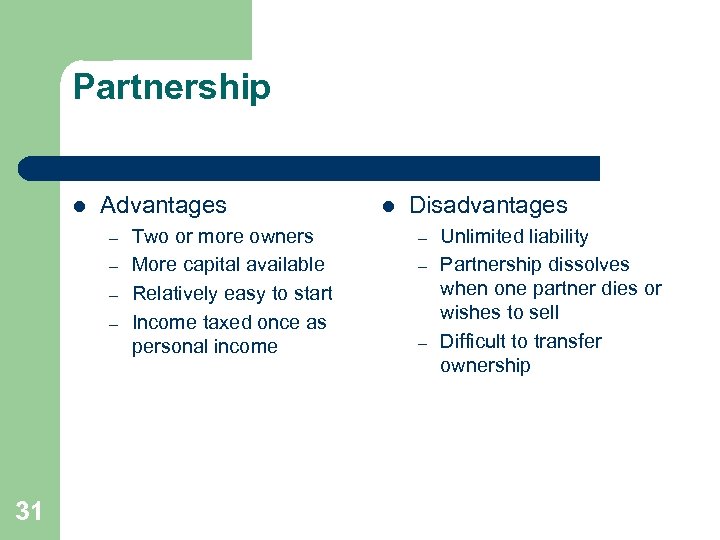
Partnership l Advantages – – 31 Two or more owners More capital available Relatively easy to start Income taxed once as personal income l Disadvantages – – – Unlimited liability Partnership dissolves when one partner dies or wishes to sell Difficult to transfer ownership
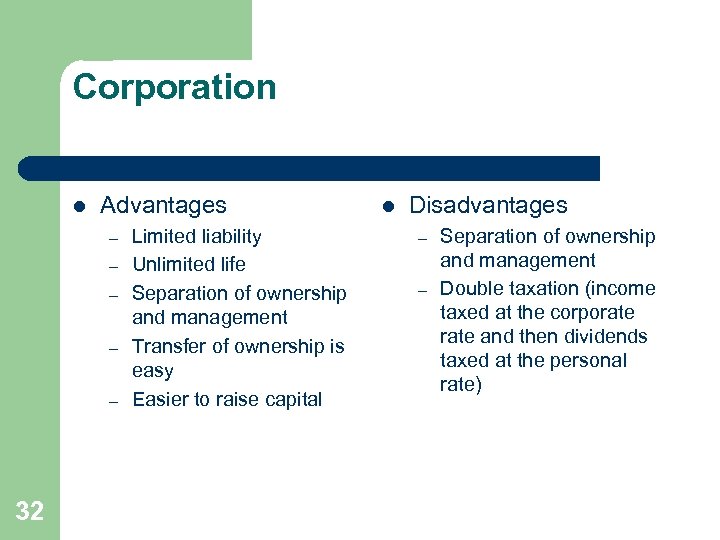
Corporation l Advantages – – – 32 Limited liability Unlimited life Separation of ownership and management Transfer of ownership is easy Easier to raise capital l Disadvantages – – Separation of ownership and management Double taxation (income taxed at the corporate and then dividends taxed at the personal rate)

Thank You 33
Скачать презентацию Financial Management By Dr Imamuddin Khoso Ph D
38bd13dd482da3b23a58005103f1535f.ppt